Internal Combustion Engine
Internal Combustion Engine — an illustrated inventions story, set in Global. 10 illustrated pages, free to read on Wonder Inventions.
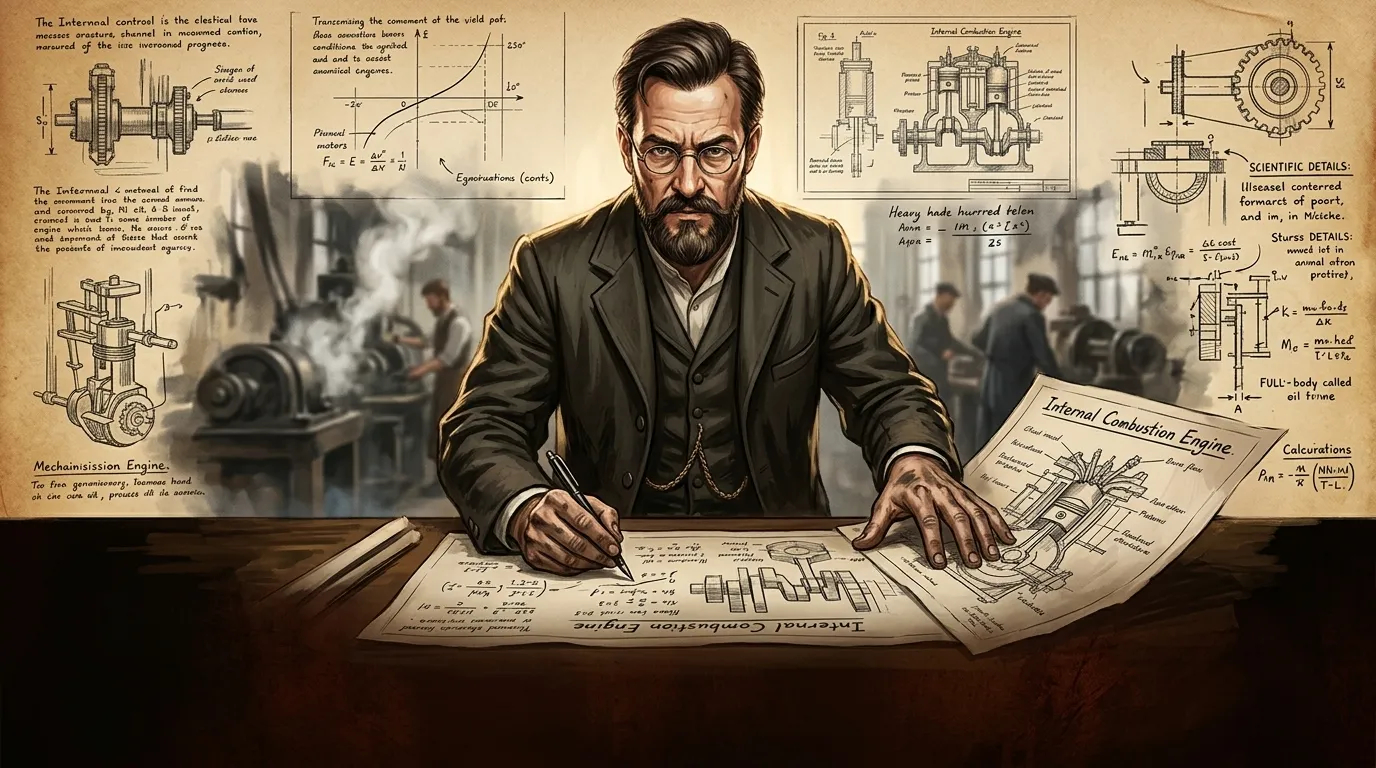
Page 1
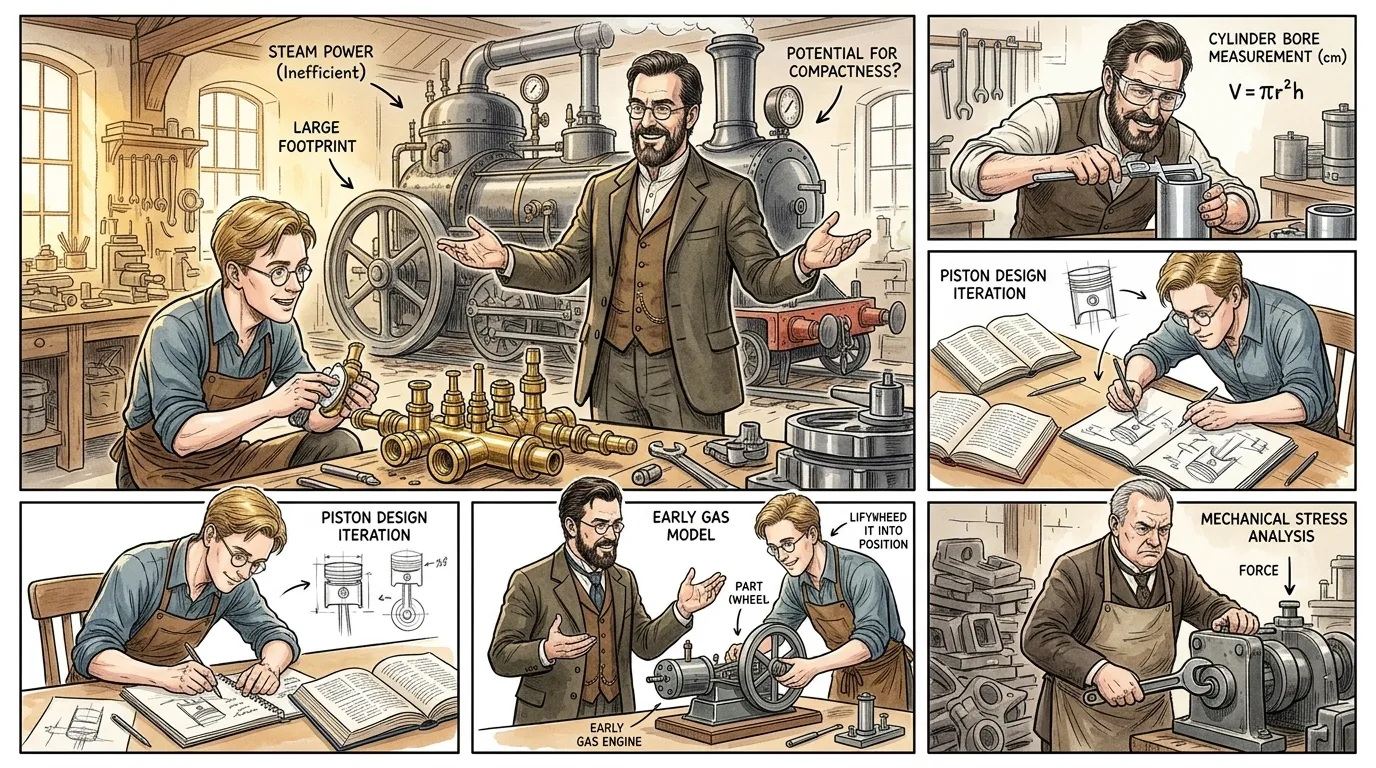
For centuries, humanity yearned for greater power, a force untamed by beast or fleeting wind. The world of the 19th century still relied heavily on steam engines, monumental coal-fired giants that demanded immense infrastructure and constant tending, or the sheer muscle of humans and animals. This industrial era, though powerful, was tethered by the limitations of external combustion, yearning for a more compact, energetic heart.
""The steam engine, magnificent as it is," observed Nikolaus Otto, his gaze sweeping over his crowded workshop, "is an anchor. Its bulk, its thirst for water and coal, dictates where industry can settle, how far goods can truly travel. We are bound by its external fire." An assistant, Wilhelm Maybach, meticulously polished a brass fitting. "Indeed, Herr Otto. Imagine a source of power that carries its own flame within, nimble enough to move a carriage, to drive machinery not just in factories but wherever it is needed. That is the dream, a true internal combustion.""
Page 2
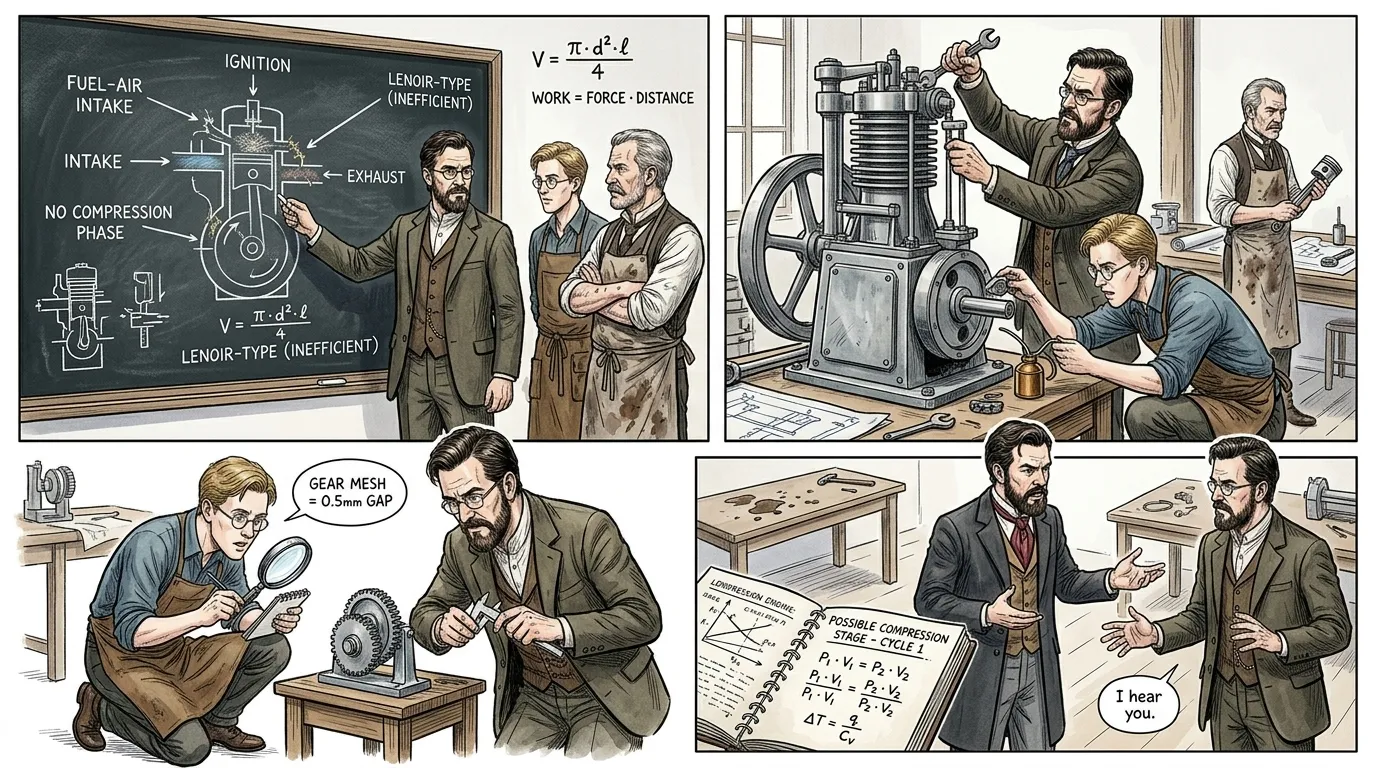
Early attempts at harnessing explosive power were rudimentary and often dangerous. Gunpowder engines, envisioned by Christiaan Huygens in the 17th century, demonstrated the principle of sudden expansion but lacked control or sustainability. By the mid-19th century, inventors like Étienne Lenoir made strides with the first commercially successful internal combustion engine in 1860, using coal gas, but its inefficiency and high fuel consumption highlighted a fundamental flaw: the absence of compression before ignition. This critical omission meant a waste of the fuel's potential, yielding sluggish performance and excessive heat, a brute force rather than a refined energy source.
""Lenoir's engine, while a groundbreaking step," mused Otto, gesturing towards a diagram of a two-stroke engine on a chalkboard, "ignites its fuel at atmospheric pressure. It's like striking a match in an open room—you get a flash, but little directed power. The flame expands, yes, but much of that energy dissipates without doing useful work." Wilhelm Maybach nodded, adding, "The fuel-air mixture, Herr Otto, it must be constrained, densified, compressed, before the spark. Only then can we truly unlock its latent energy in a controlled, powerful burst. This compression, this squeezing of the mixture into a smaller volume, is the elusive key to efficiency and power we've been discussing, isn't it? It feels like the central challenge.""
Page 3
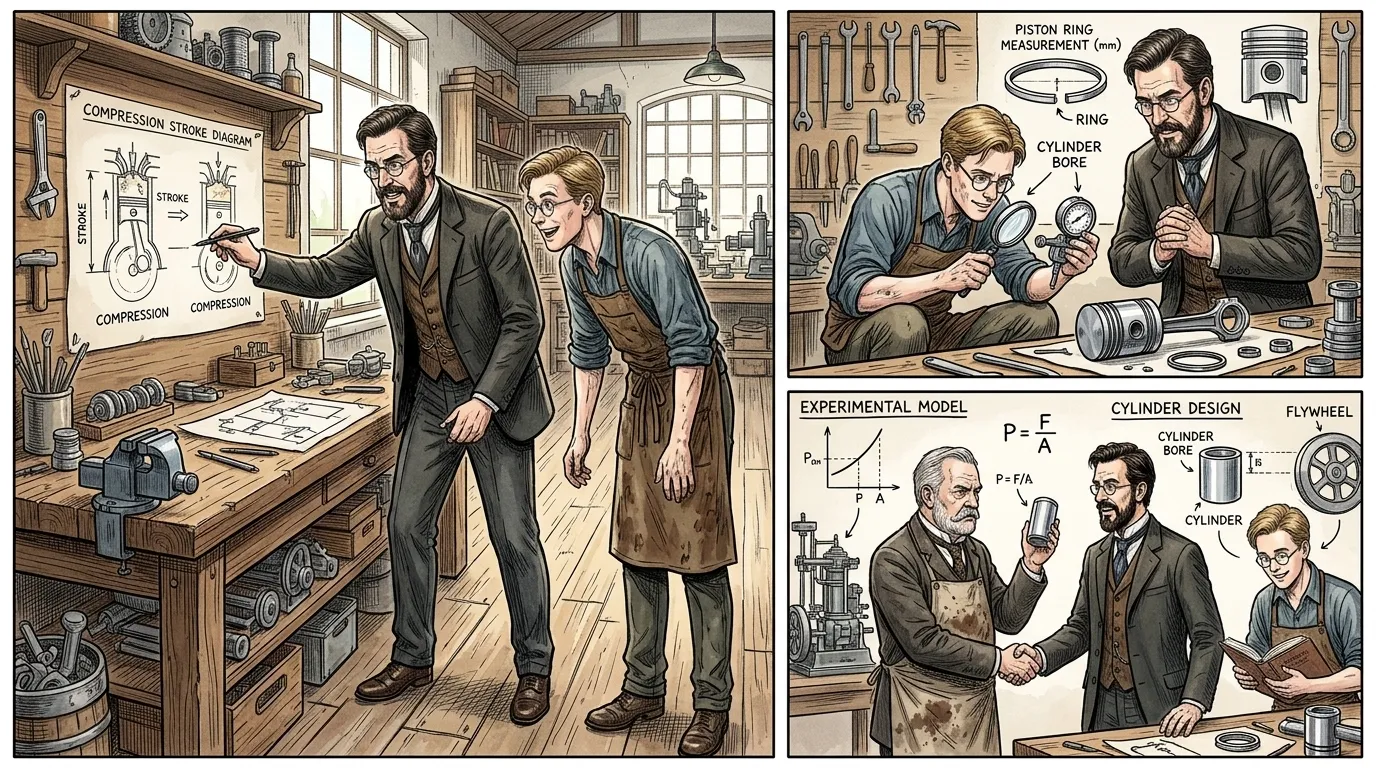
Nikolaus Otto, driven by the inefficiencies of existing designs, meticulously studied the principles of combustion and thermodynamics. He envisioned a cycle that would fundamentally improve upon previous attempts, incorporating a crucial step: compression. This revelation, combined with the earlier work on 'silent gas engines' by Beau de Rochas, coalesced into a groundbreaking four-stroke principle. Otto recognized that by compressing the fuel-air mixture before ignition, the resulting explosion would yield far greater force and directed energy, transforming sporadic pushes into a continuous, powerful rotation.
""The essence, I believe," Otto explained to Maybach, sketching rapidly on a clean sheet of paper, "is the sequence. Intake, Compression, Power, Exhaust. A distinct stroke for each phase." He paused, tapping his pen on the 'Compression' label on his sketch. "This is where the true power lies, Wilhelm. As Leonardo da Vinci once said, 'Simplicity is the ultimate sophistication.' By simply adding this compression stroke, separating it from the intake and combustion, we control the explosion, rather than merely containing it. We harness its force precisely." Maybach's eyes widened. "And the exhaust then clears the chamber fully, ready for a fresh, potent charge. It's a clean slate for each power stroke, a continuous, elegant rhythm, unlike anything before it. This principle of compressing the working fluid, I truly believe, will be the cornerstone of all future efficient power generation.""
Page 4
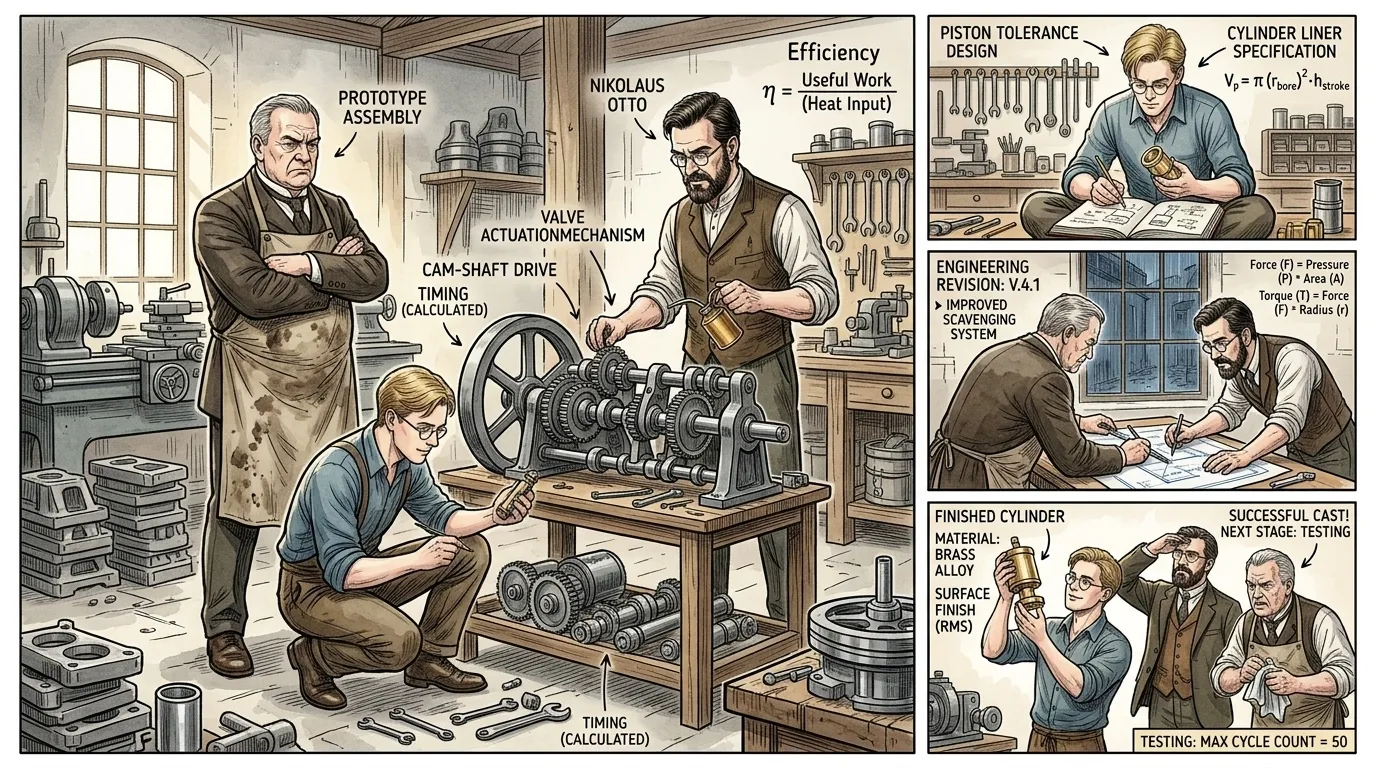
The theoretical concept of the four-stroke cycle was a profound leap, but translating it into a working, reliable machine presented immense engineering challenges. Otto and his business partner, Eugen Langen, poured years into refinement. Early prototypes were often temperamental, prone to misfires, and demanded constant adjustment. The precise timing of the valves, the durability of materials under repeated stress, and the reliable ignition of the compressed mixture were all hurdles that required relentless experimentation and a profound understanding of mechanical principles. Their workshop became a crucible of innovation, where abstract physics met brute force engineering.
""The precision required for these cam-operated valves," Langen remarked, wiping grease from his hands, "is far greater than anything we've designed for our atmospheric engine. The timing must be absolutely perfect, Wilhelm, for the intake, the compression, the ignition, and the exhaust." Eugen Langen, a stout man in his 50s with a stern expression and work-stained apron over his clothes, gestured to a complex arrangement of gears and shafts. Maybach meticulously adjusted a spring mechanism. "And the sealing, Herr Langen, is paramount. Any leak during the compression stroke and our efficiency plummets. We must ensure a perfect fit between piston and cylinder, even under extreme pressure and heat. Every component is tested, every joint scrutinized. It's relentless." Otto, overseeing their work, added, "Indeed. As the great philosopher Seneca once observed, 'Every new beginning comes from some other beginning's end.' Our relentless pursuit of improvement over the atmospheric engine demands this rigor, these endless trials to perfect each beginning of the cycle.""
Page 5
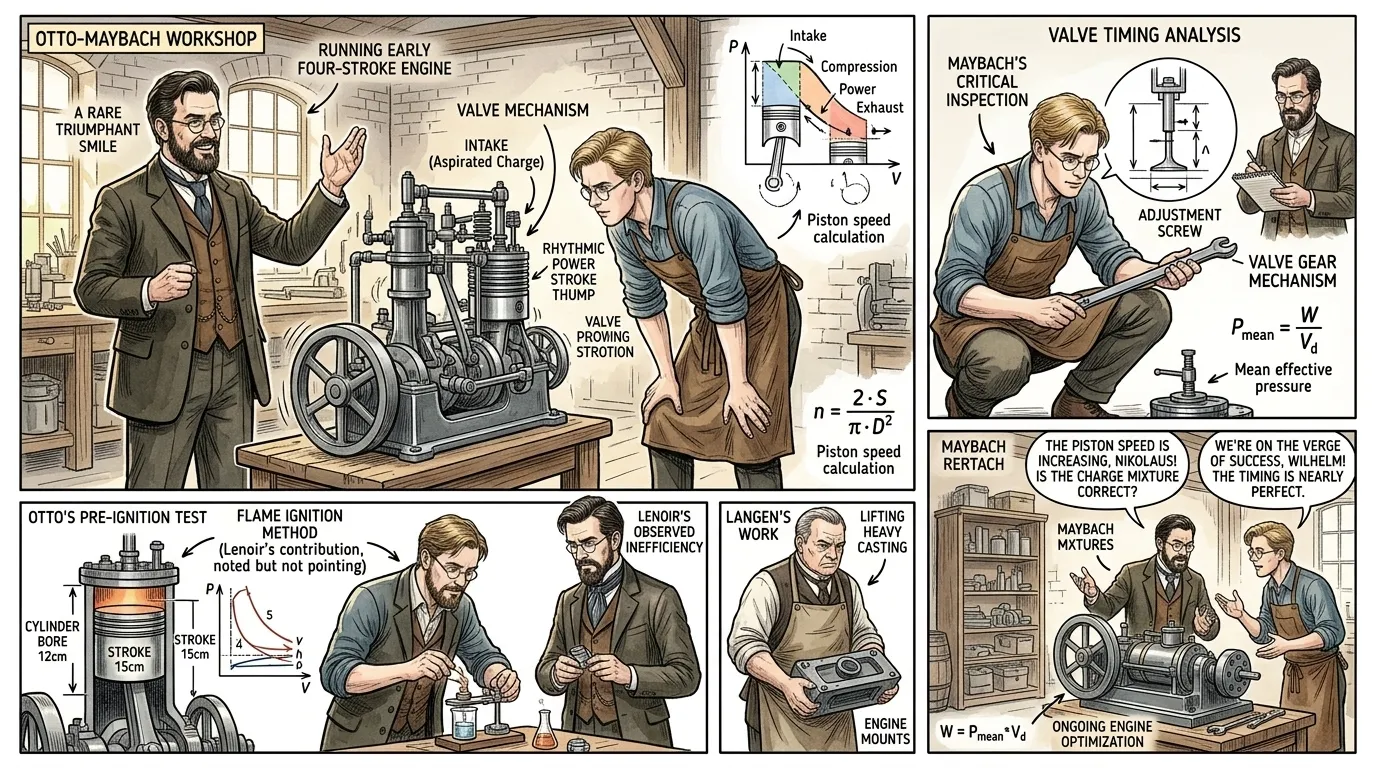
In 1876, Nikolaus Otto perfected his groundbreaking four-stroke internal combustion engine. This innovation would reshape industry and transport, establishing the fundamental operational principle for millions of engines to come. The cycle begins with the intake of fuel and air, followed by their compression to increase potential energy. A precisely timed spark ignites the mixture, driving the piston down in the power stroke. Finally, the spent gases are expelled, clearing the way for a new cycle. Each stroke is a synchronized act, transforming chemical energy into mechanical force with unprecedented efficiency.
""Watch closely, Wilhelm," Otto instructed, standing beside their running engine, the rhythmic thudding filling the workshop. "As the piston descends, the intake valve opens, drawing in the combustible mixture." He pointed to the top of the cylinder. Maybach leaned in, observing the valve mechanism. "Then, on the upward stroke, both valves close, trapping the mixture. This is the critical compression, Herr Otto, where we transform potential into kinetic readiness." A moment later, a sharp 'thump' resonated. "Precisely!" Otto exclaimed, a rare smile crossing his face. "That brief, powerful downward thrust is our power stroke, initiated by the spark at maximum compression. The crankshaft translates that linear force into rotational energy. And finally, the exhaust valve opens, pushing out the spent gases, preparing for the next intake. It's a dance of precision, a continuous conversion.""
Page 6
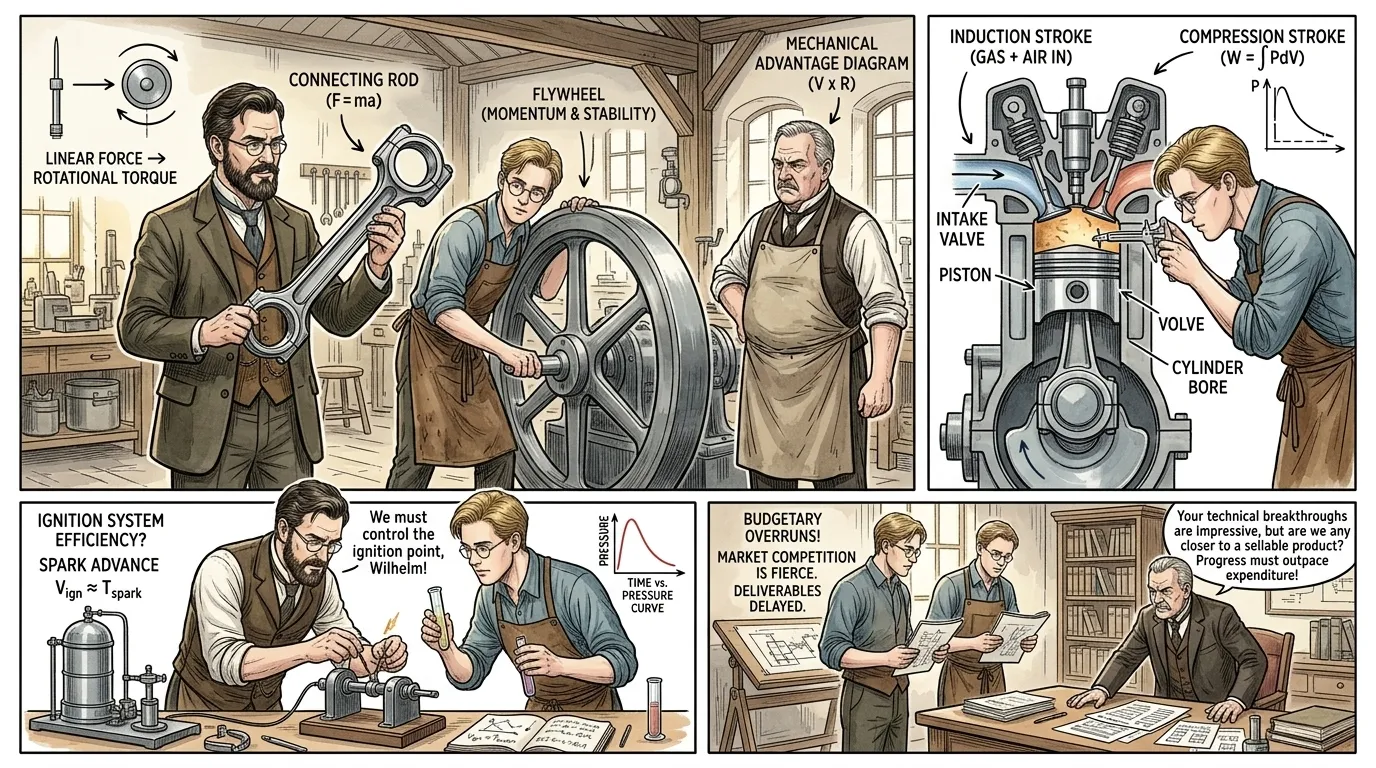
The genius of the internal combustion engine lies not just in its four-stroke principle, but in the elegant mechanical system that translates explosive power into continuous rotary motion. At its heart is the piston, a cylindrical component that moves within the engine's cylinder. Attached to the piston is a connecting rod, which in turn links to the crankshaft. This crankshaft, a series of eccentrically positioned journals, acts like a sophisticated lever, converting the reciprocating (up-and-down) motion of the piston into the rotational (circular) motion necessary to drive wheels, propellers, or industrial machinery. A heavy flywheel, attached to the crankshaft, stores rotational energy, smoothing out the engine's pulses.
""The piston's linear force," Otto explained, demonstrating with a detached connecting rod, "is immense, but without the connecting rod and crankshaft, it's just a push and pull. The rod provides the leverage, transforming the straight-line thrust into a rotational torque on the crankshaft." Maybach turned the engine's flywheel by hand, observing the smooth motion of the crankshaft. "And the flywheel, Herr Otto, is essential for consistency. Without it, each power stroke would be a series of jarring impulses. The flywheel absorbs and releases energy, maintaining momentum between the power strokes, making the output steady and usable for continuous work. It's truly a marvel of kinetic energy management." Otto nodded. "Indeed. It ensures that the engine doesn't stutter, but delivers power in a sustained, controlled manner, ready to be transmitted.""
Page 7
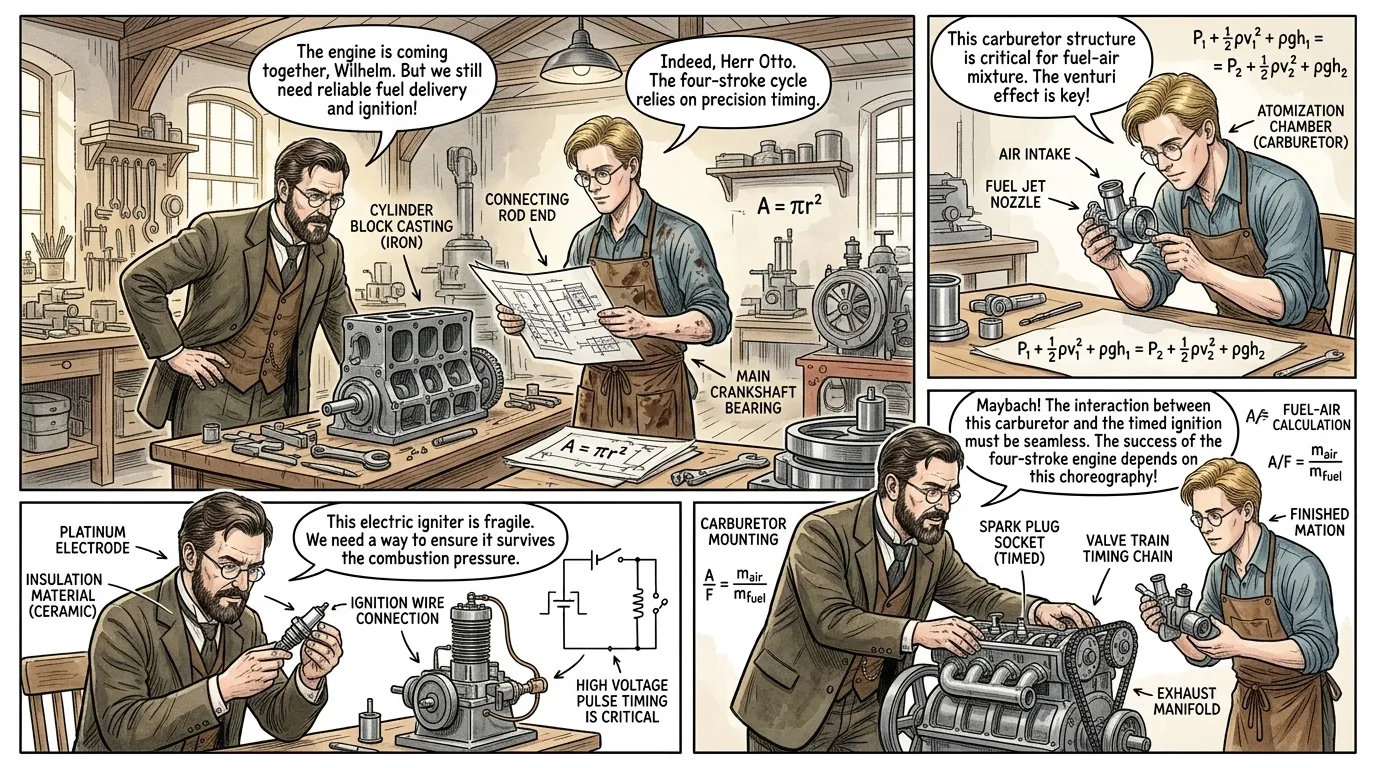
Beyond the mechanical dance of pistons and crankshafts, two critical elements define the internal combustion engine's operation: fuel delivery and ignition. Early engines often used town gas, but the desire for mobile applications necessitated liquid fuels. The carburetor, developed by inventors like Wilhelm Maybach and Carl Benz, became instrumental in vaporizing liquid fuel and mixing it precisely with air, creating a combustible blend. Simultaneously, a reliable ignition system, evolving from hot tubes to electric spark plugs, was crucial for igniting this mixture at the exact moment of maximum compression, unleashing the engine's potential with controlled precision.
""The uniformity of the fuel-air mixture," Maybach explained, holding a small, intricate metal carburetor component, "is paramount. A precisely vaporized fuel droplet, perfectly mixed with air, ensures complete and efficient combustion. Without it, we would have misfires and wasted energy." Otto nodded, examining a crude electric igniter. "And the spark, Wilhelm, must be timed with exquisite accuracy, milliseconds after the peak of compression, to unleash the power stroke. A premature spark causes engine knock; a delayed one, a loss of power. The synchronization of fuel, air, and spark is the engine's heartbeat." He gestured to the engine. "We must perfect these systems to ensure not only power but reliability. This interaction of delicate chemical preparation and precise electrical discharge is as vital as the mechanics.""
Page 8
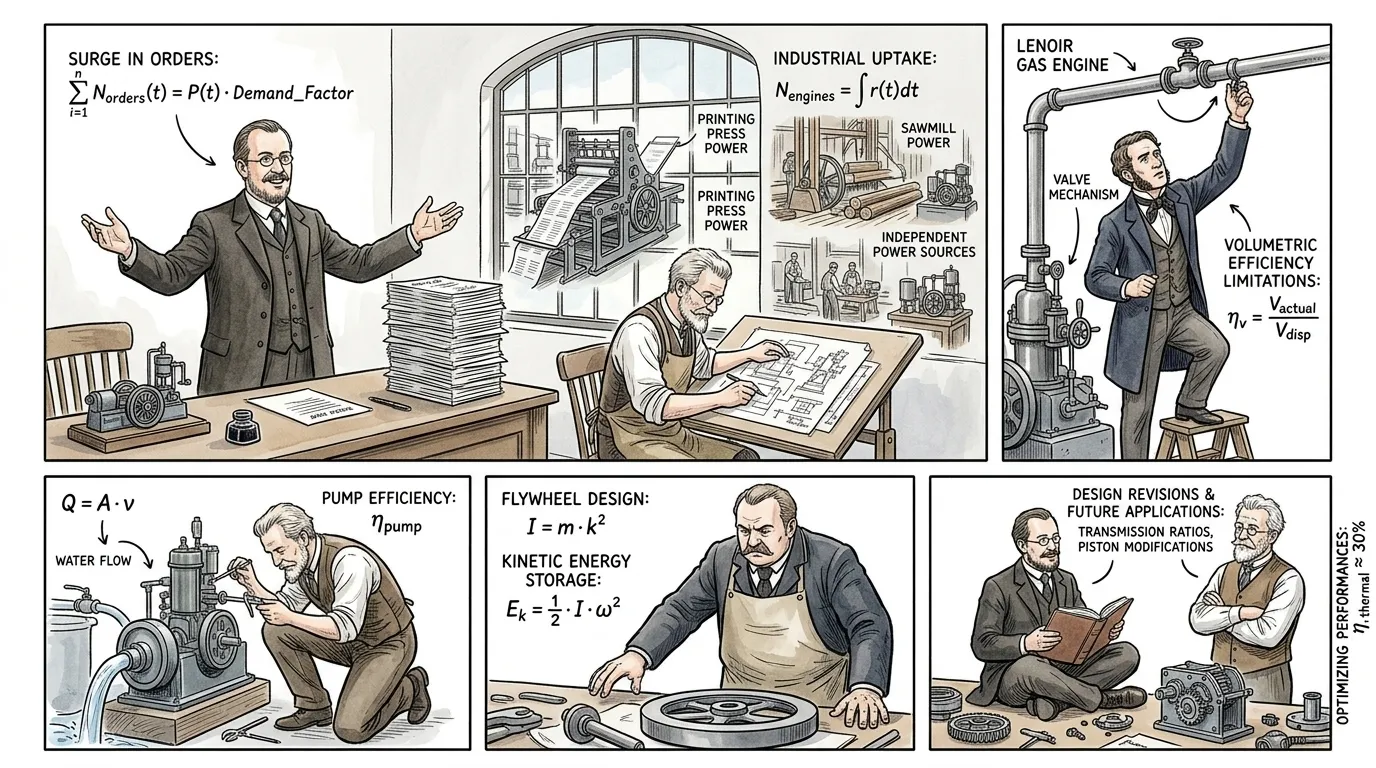
Before propelling automobiles, Otto's four-stroke engine first made its mark in stationary industrial applications. Its efficiency and relative compactness compared to steam engines offered unprecedented flexibility. Factories, workshops, and even farms could now install powerful, independent prime movers without the need for large boilers, extensive plumbing, or constant supervision. This liberation from central steam plants allowed smaller enterprises to mechanize, decentralizing power and fueling a new wave of industrial growth across Europe and beyond. The engine's reliability, stemming directly from the controlled compression and ignition, proved its transformative potential.
""Look at the demand, Wilhelm!" Otto exclaimed, gesturing to a stack of order forms in his office. "Our stationary engines are powering everything from printing presses to sawmills. No longer must a workshop rely on cumbersome steam lines from a central boiler or the expense of animal power. This machine grants them autonomy." Maybach, reviewing schematics, replied, "The feedback is tremendous, Herr Otto. Customers are reporting vastly improved efficiency and reduced operating costs compared to steam. The controlled power derived from pre-compression—the very principle we labored over—is proving its worth. It's not just a machine; it's a new foundation for industrial self-sufficiency." Otto smiled faintly. "Indeed. We have given the entrepreneur a new lever, allowing them to move the world.""
Page 9
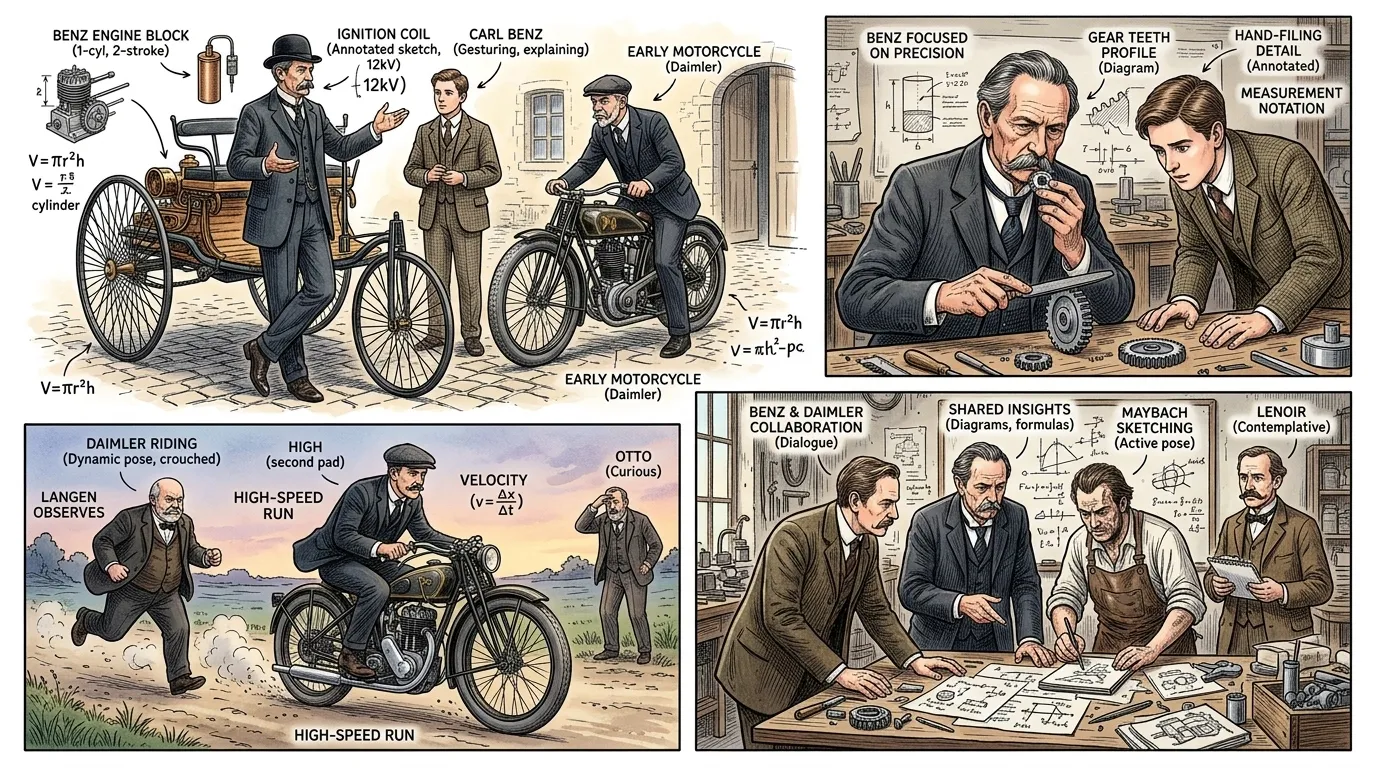
While Otto perfected the stationary engine, visionaries like Gottlieb Daimler and Carl Benz, former associates of Otto, saw its true potential for personal mobility. They refined Otto's four-stroke design, making it lighter, faster, and suitable for integration into vehicles. Daimler developed high-speed engines for motorcycles and early automobiles, while Benz created the world's first true automobile, the Patent-Motorwagen, in 1886. These developments marked a profound shift: the internal combustion engine, once a powerful stationary workhorse, was now poised to liberate individual movement, birthing the automotive age and fundamentally altering human travel, commerce, and urban design.
""The lightness and power-to-weight ratio we've achieved," Carl Benz explained to a curious engineer, proudly displaying the engine of his Patent-Motorwagen, "is what makes this carriage truly viable. Daimler's high-speed refinements to Otto's cycle were brilliant for our purposes. It's no longer bound to a factory floor." Carl Benz, dressed in a smart suit and bowler hat, gestured to the compact engine block. Gottlieb Daimler, standing beside an early motorcycle, concurred. "Indeed, Herr Benz. By perfecting the compression and ignition timing for higher RPMs, we transformed the engine from an industrial anchor into a dynamic heart for personal transport. The very principle that Otto struggled to perfect is now enabling us to envision a world where distances shrink, where people can travel further, faster, and independently." "A true revolution," the engineer murmured, examining the engine. "The horse and carriage will soon be relics.""
Page 10
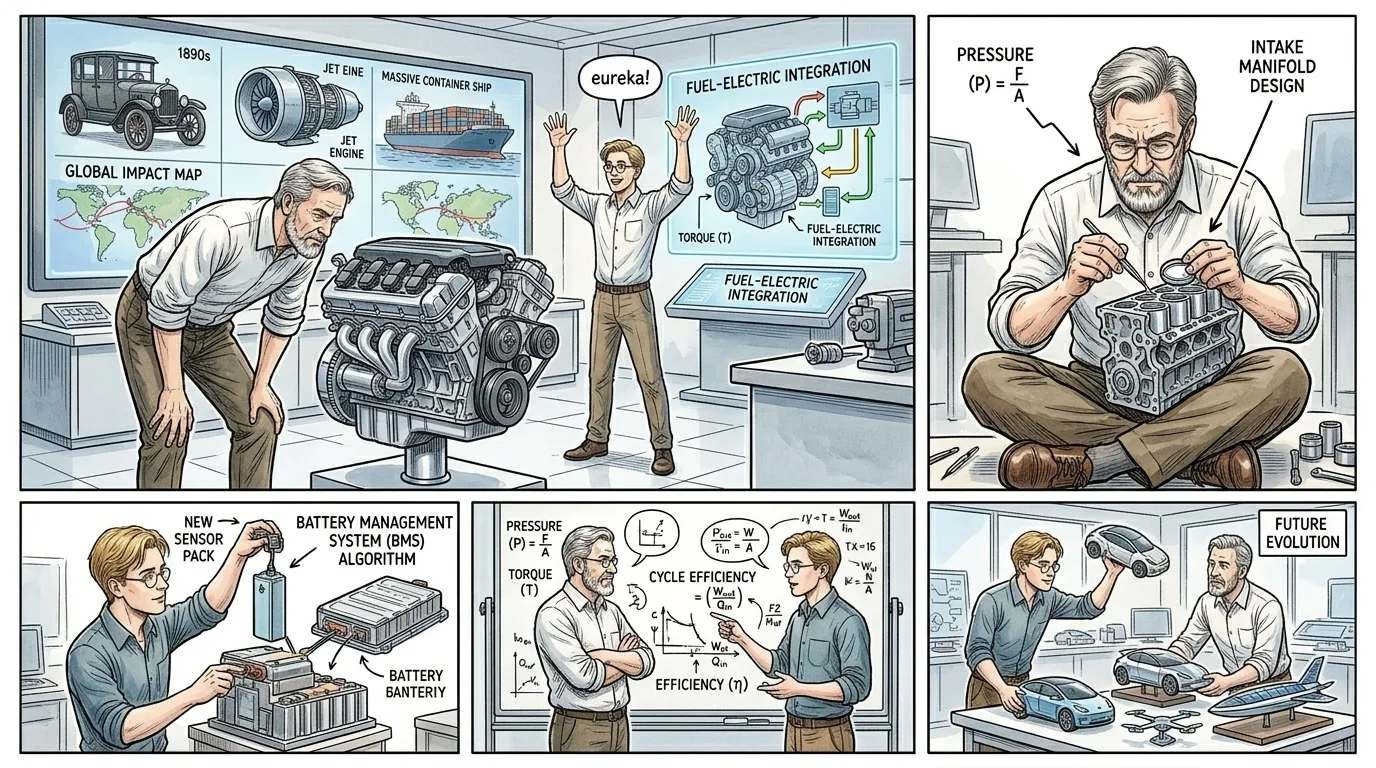
The internal combustion engine, originating from Nikolaus Otto's vision and the refinements of countless engineers, has profoundly shaped the modern world. From its humble beginnings powering stationary factories to propelling the vast majority of global transportation, it catalyzed industrialization, urbanization, and unprecedented individual mobility. Though facing new challenges from electric alternatives, its legacy of compact power, fuel efficiency, and mechanical ingenuity continues to underscore our technological landscape, a testament to humanity's relentless drive to harness energy for progress and connection.
""Think of the world before it," an engineer reflected, looking at a gleaming modern engine block. "A world limited by muscle and steam." A younger colleague, examining a hybrid engine diagram, added, "And yet, its core principle—the controlled compression and ignition of fuel—remains. Even as we push towards electrification, the internal combustion engine's fundamental efficiency, its ability to extract so much energy from so little, continues to inspire and challenge us in new ways. It's a testament to Otto's original insight." The elder engineer nodded. "Indeed. The evolution is endless. The internal combustion engine didn't just move machines; it moved civilization, setting the stage for virtually all the interconnectedness and speed we now take for granted, a continuous testament to human ingenuity. It reshaped everything.""
About this story
- Location: Global
- Audience: general readers
Questions and answers
Read Wonder Inventions on your phone
Wonder Inventions is available on Android. Get Wonder Inventions on Google Play.