Internet
Internet — an illustrated inventions story, set in Global. 10 illustrated pages, free to read on Wonder Inventions.
Page 1
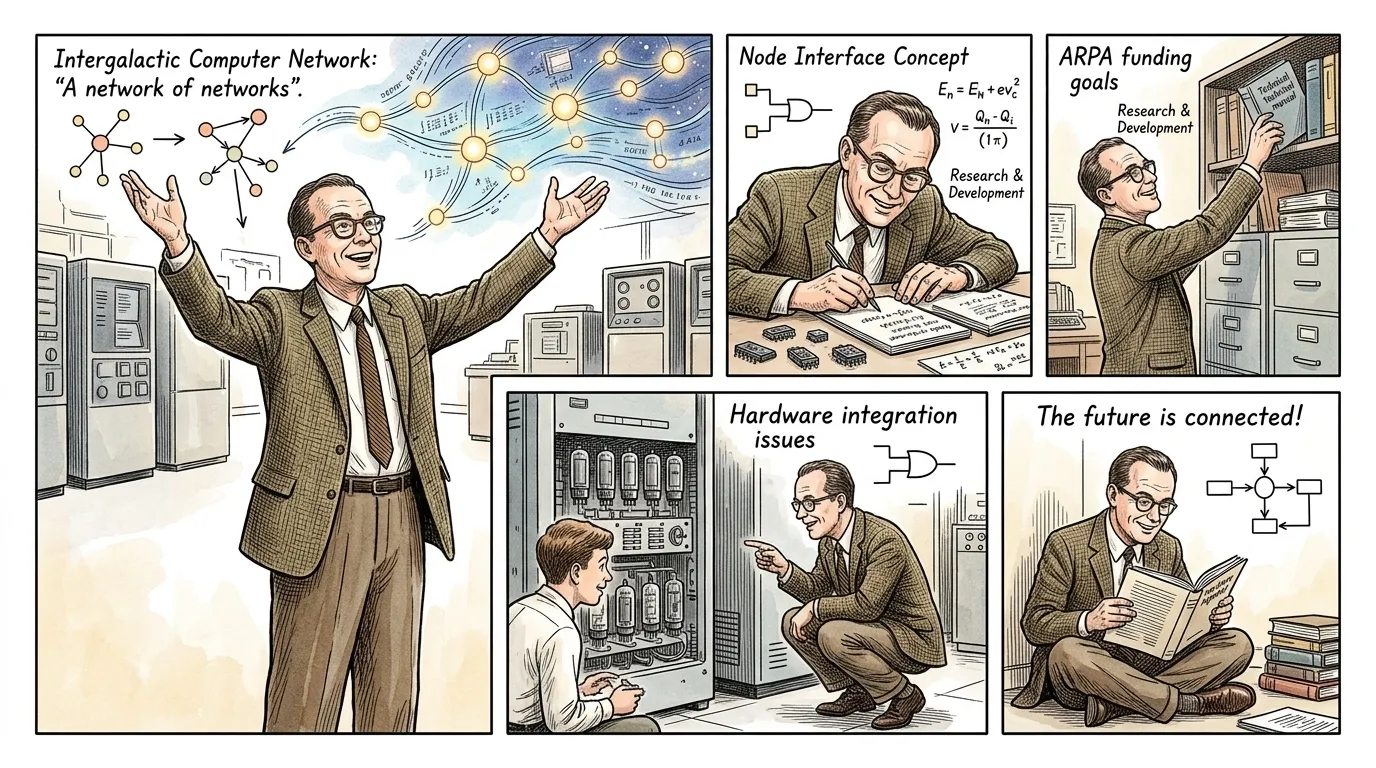
Before the digital age, communication and data sharing were constrained by physical limitations. Universities, research institutions, and government agencies operated in isolation, their computational resources and invaluable data locked within local systems. The urgent need for a robust, resilient network to link these disparate nodes became a paramount challenge, particularly amidst the geopolitical tensions of the Cold War era.
"Dr. J.C.R. Licklider, a visionary computer scientist at MIT and later ARPA, often articulated this frustration. 'We envisioned a world where minds could connect instantly, regardless of distance,' he stated, 'a true "Intergalactic Computer Network" where information flowed freely.' His foresight, articulated in the early 1960s, underscored a profound limitation: the absence of a unified, distributed network capable of surviving unforeseen disruptions."
Page 2
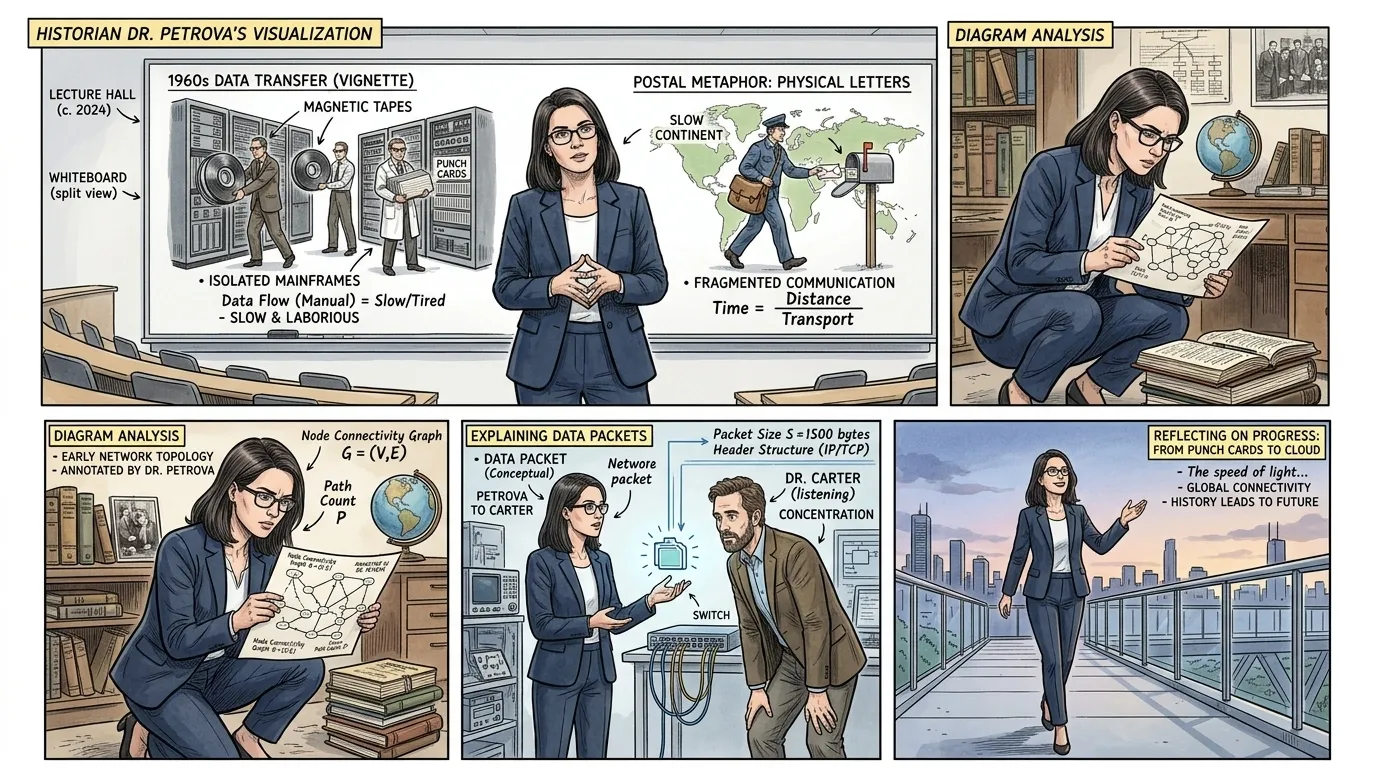
In the mid-20th century, computing power was immense but fragmented. Data resided on individual mainframes, accessible only to local terminals, necessitating laborious manual transfers via magnetic tapes or punch cards for external sharing. This isolation hindered collaborative research and efficient resource utilization, creating significant bottlenecks in scientific and military endeavors alike. Furthermore, these centralized systems presented a critical vulnerability, as a single point of failure could disable an entire network.
"'Consider the era's infrastructure,' explains Dr. Elena Petrova, a contemporary network historian. 'If a research team in California needed data from a machine in Massachusetts, the process was akin to mailing physical letters across the continent. There was no instant digital highway. This highlighted a critical flaw: 'What we needed,' she observes, 'was not just speed, but resilience — a system that could withstand damage and still function, much like a robust biological organism.' The reliance on single, powerful central computers created an Achilles' heel for any large-scale communication ambition."
Page 3
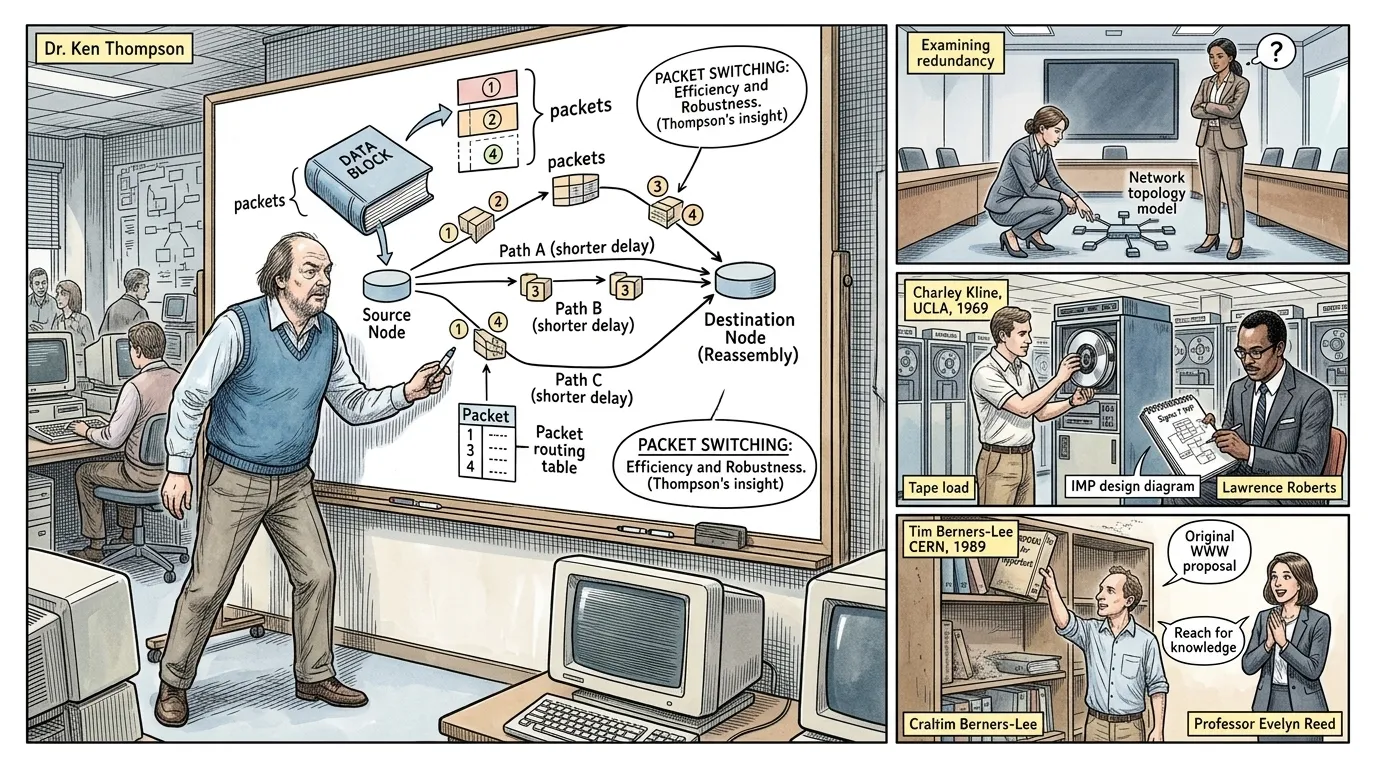
The limitations of circuit-switched networks, where a dedicated communication path must be established and maintained for the entire duration of a transmission, became glaringly obvious. This method was inefficient for bursty, intermittent computer data, tying up bandwidth unnecessarily. A revolutionary concept was needed: a way to break data into smaller, independent units that could travel diverse paths.
"As computer scientist Dr. Ken Thompson explains, 'Early thinkers realized that rather than maintaining a continuous, dedicated line, we could dissect the message. Imagine sending a book not as one enormous manuscript, but as individual pages, each with an address, that could travel independently and be reassembled at the destination.' He gestures to a complex whiteboard drawing, adding, 'This idea of breaking data into discrete 'packets' was brilliantly explored by figures like Paul Baran and Donald Davies. As Baran himself put it when considering a robust network for military communications, 'A network that can survive attack by its very nature must be decentralized.' This theoretical groundwork, often overlooked, was the crucial 'setup' for the Internet's eventual resilience and efficiency."
Page 4
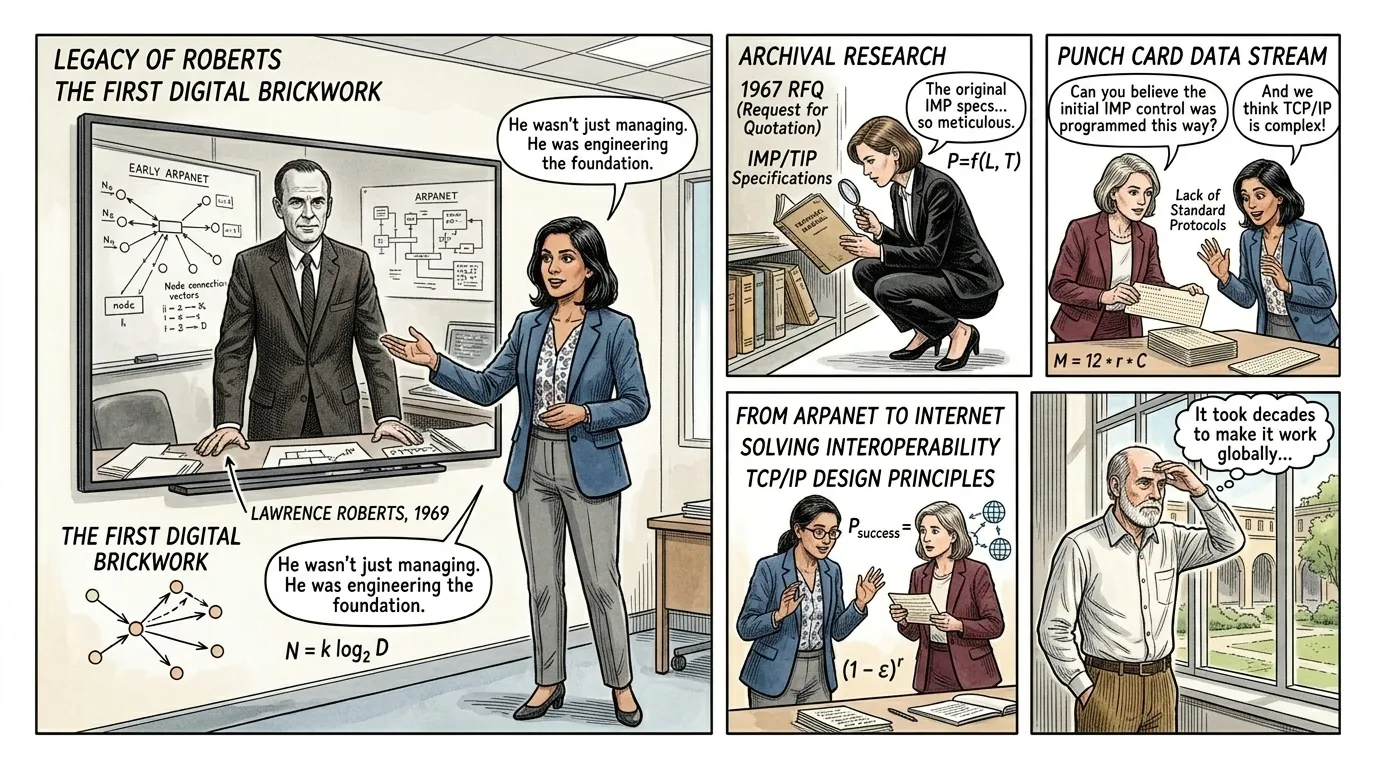
The Advanced Research Projects Agency (ARPA) launched the ARPANET project in 1966, driven by a vision to enable resource sharing among remote computers. This initiative gathered leading computer scientists and engineers to translate the theoretical concepts of packet switching into a tangible, operational network. The primary goal was to connect university and research centers, fostering collaboration and maximizing the utility of expensive computing resources. The challenge was immense: no such distributed network had ever been built.
"'Lawrence Roberts, the program manager, faced an unprecedented engineering feat,' recounts network architect, Dr. Anya Sharma. 'He worked tirelessly, pushing the boundaries of what was technologically possible.' She indicates a vintage photograph of a stern-faced Roberts in an office environment. 'Roberts orchestrated the critical decisions, from selecting the Interface Message Processors, or IMPs, to defining the initial protocols. He effectively laid the first digital brickwork for what would become a global highway.' This concentrated effort marked the true beginning of the Internet's physical manifestation."
Page 5
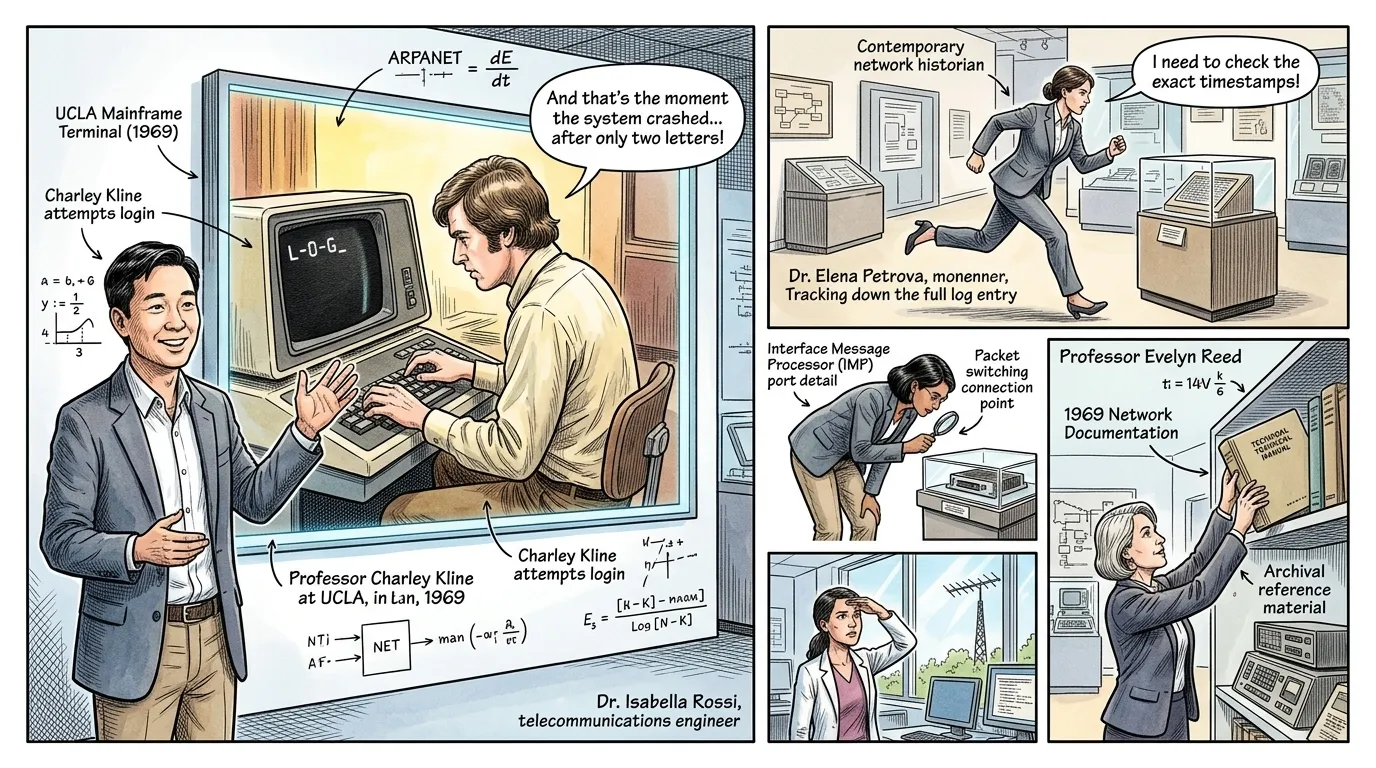
The inaugural ARPANET connection took place on October 29, 1969, between the University of California, Los Angeles (UCLA) and the Stanford Research Institute (SRI). This event, though fraught with technical glitches, marked a pivotal moment in the history of communication. Researchers attempted to transmit the word 'LOGIN' from UCLA to SRI, proving the fundamental viability of packet-switched communication over long distances. It was a modest beginning for a revolution.
"Professor Charley Kline at UCLA, tasked with sending the first message, famously recounted the moment. Dr. Marcus Chen, a computer science historian, gestures towards an archival photograph of Kline. 'He typed 'L', then 'O', and then 'G' before the system crashed.' Dr. Chen pauses, a slight smile on his face. 'It was imperfect, yet profoundly successful. They had demonstrated that information could travel from one computer to another, across a network, in a distributed fashion. As the French chemist Louis Pasteur once noted, 'Chance favors only the prepared mind.' Kline and his team were prepared, and their 'LOGIN' attempt, even with its initial failure, was the first spark in a chain reaction of innovation.' This single connection, imperfect as it was, validated the entire packet-switching paradigm."
Page 6
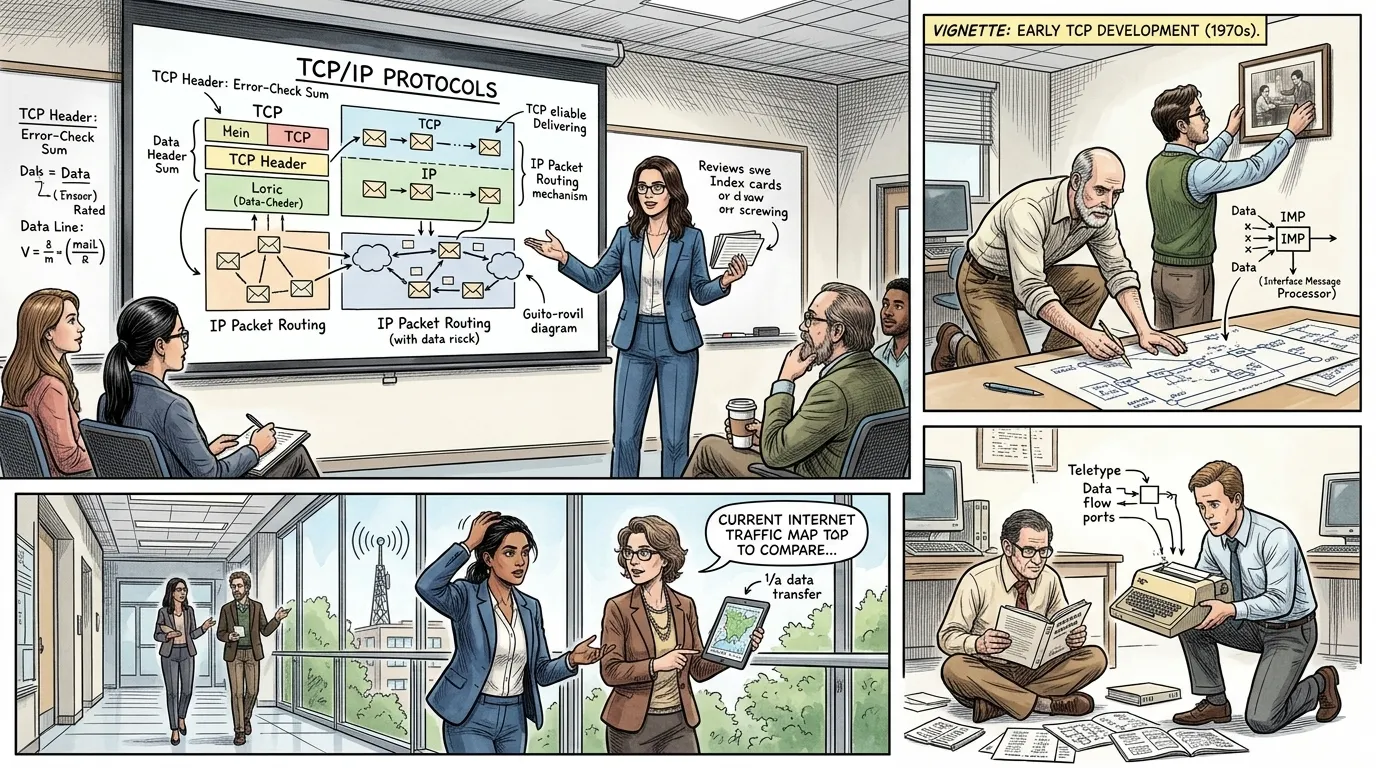
As ARPANET expanded, it became clear that different networks, each with its own internal rules, needed a common language to communicate. This challenge led to the development of the Transmission Control Protocol/Internet Protocol (TCP/IP) by Vinton Cerf and Robert Kahn in the 1970s. TCP/IP provided the essential framework for 'internetworking,' allowing diverse networks to seamlessly exchange data, effectively creating a 'network of networks.' Without it, the modern Internet would be impossible.
"'The brilliance of TCP/IP was its layered approach,' explains Dr. Isabella Rossi, a telecommunications engineer. She gestures towards a detailed diagram. 'TCP ensures reliable, ordered packet delivery, handling error checking and retransmission. IP, on the other hand, is the addressing and routing mechanism, guiding packets across various networks to their correct destination.' She elaborates, 'It's like sending mail: TCP makes sure your letter arrives intact and in order, while IP makes sure it gets to the right mailbox in the right city. Robert Kahn once emphasized the necessity, saying, 'The goal was to allow different networks to interconnect transparently, giving users the illusion of a single, unified network.' This abstraction was key to scalability.'"
Page 7
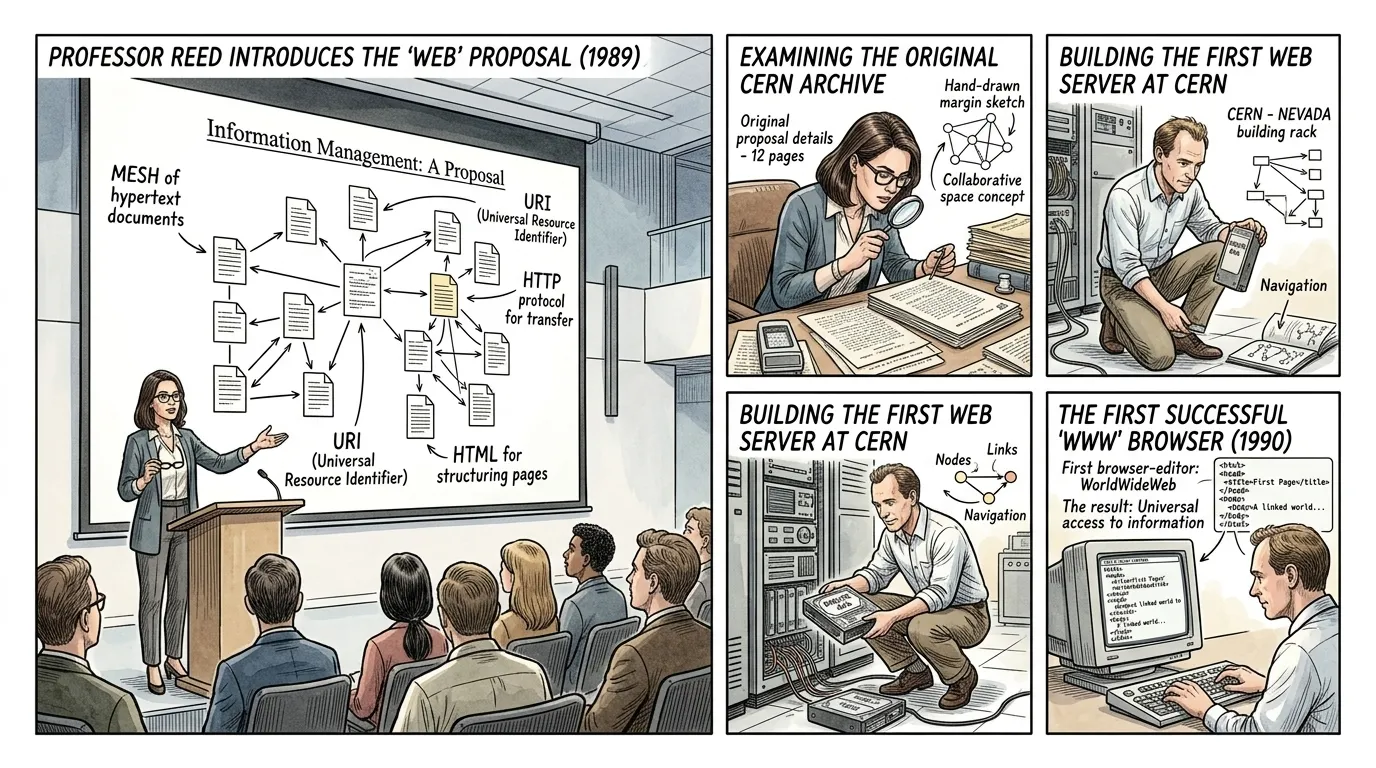
While TCP/IP provided the underlying infrastructure, the Internet remained largely a tool for academics and specialists. The breakthrough that truly democratized access and usability arrived in 1989 with the invention of the World Wide Web by Tim Berners-Lee at CERN. He conceived of a system that would link information globally through hypertext, making it navigable and accessible to anyone with a browser.
"Professor Evelyn Reed, a historian of digital media, emphasizes the transformative nature of Berners-Lee's contribution. 'He didn't invent the Internet, but he made it intuitive and universally understandable. Imagine a vast library where every book, every article, every image is instantly cross-referenced and accessible with a click.' She points to a projection of Berners-Lee's original proposal. 'Berners-Lee proposed three fundamental technologies: HTML for structuring web pages, URI (or URL) for unique addresses, and HTTP for transferring data. As he himself famously stated, 'The original idea of the Web was that it should be a collaborative space where you could interact with other people.' This vision of shared knowledge and interaction was the ultimate 'payoff' from decades of foundational networking research.'"
Page 8
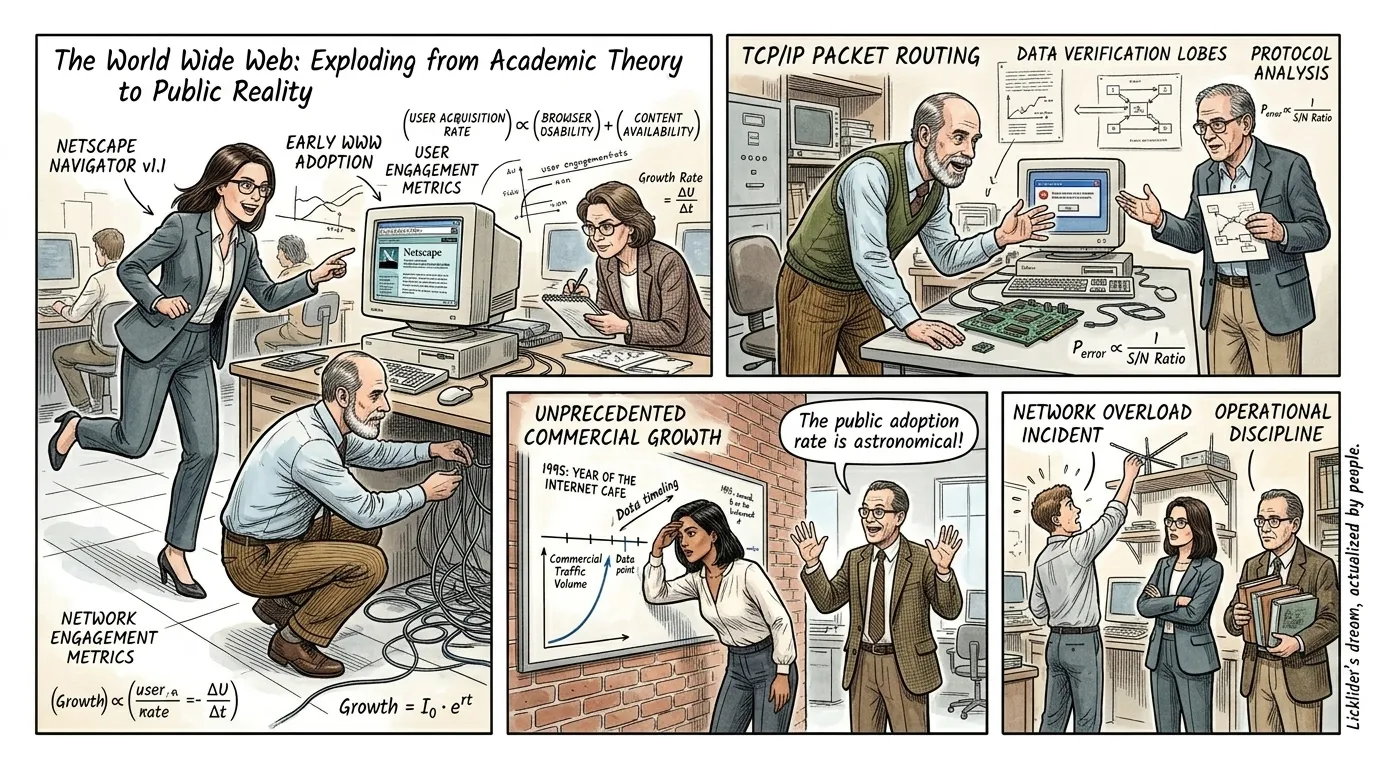
The introduction of the World Wide Web, coupled with the lifting of commercial restrictions on the Internet in the early 1990s, catalyzed an explosion of public and commercial adoption. Early web browsers like Mosaic and Netscape Navigator made the vast resources of the Internet navigable for ordinary users, transforming it from a scientific curiosity into an indispensable public utility. This rapid expansion validated decades of foundational work.
"Dr. Ben Carter, a technology analyst, observes this crucial transition. 'The period from 1993 to 1995 was exponential. Suddenly, businesses could create online storefronts, individuals could publish personal pages, and information that was once exclusive became widely accessible.' He gestures to historical images of early internet cafes. 'The very concept of 'online presence' was born. The underlying architecture of packet switching, which we discussed earlier, became absolutely critical here. Its decentralized, robust nature allowed the network to scale exponentially without collapsing under demand.' He adds, 'As computer scientist Gordon Bell wisely noted, 'The Internet is a triumph of engineering and a testament to the power of open standards.' Its ability to grow was embedded in its design.'"
Page 9
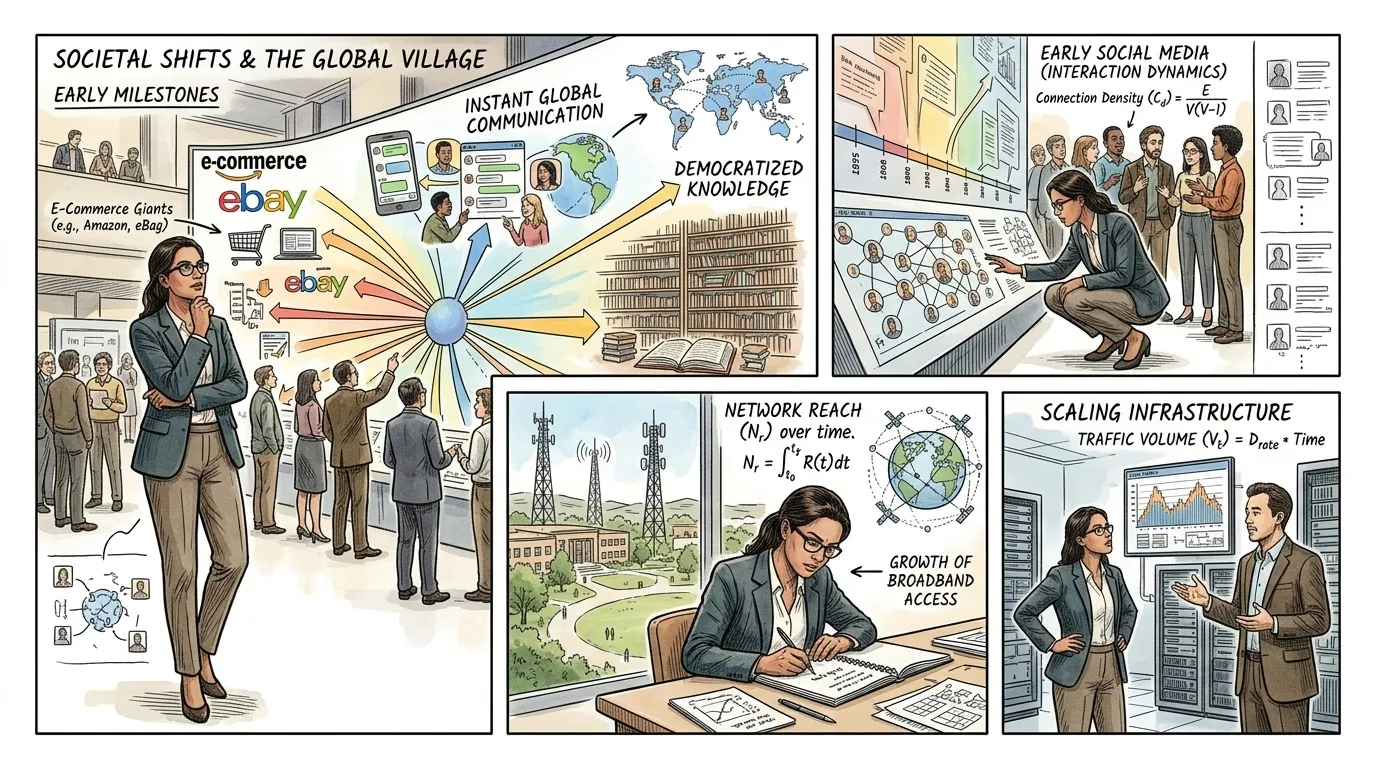
The Internet's widespread adoption profoundly reshaped every facet of modern life. Commerce moved online, giving rise to e-commerce giants and a global marketplace. Communication became instantaneous and ubiquitous, connecting people across continents through email, instant messaging, and later, social media. Access to information exploded, democratizing knowledge and altering educational paradigms. This unprecedented connectivity brought forth new industries, new forms of expression, and fundamentally changed human interaction.
"Professor Anya Sharma returns to reflect on the societal shifts. 'The Internet became the great equalizer, empowering individuals and small businesses to reach global audiences. It shattered traditional gatekeepers of information and commerce.' She gestures to a timeline display of internet milestones. 'The shift was monumental; it allowed for truly decentralized communication, realizing the ultimate potential of the packet-switching architecture devised decades prior.' Dr. Sharma adds, 'This global, interconnected web of information and interaction, as the philosopher Marshall McLuhan once predicted in a different context, truly transformed the world into a 'global village'.' The ability to instantly share and access information irrevocably changed our world, fulfilling a prophecy of interconnectedness."
Page 10
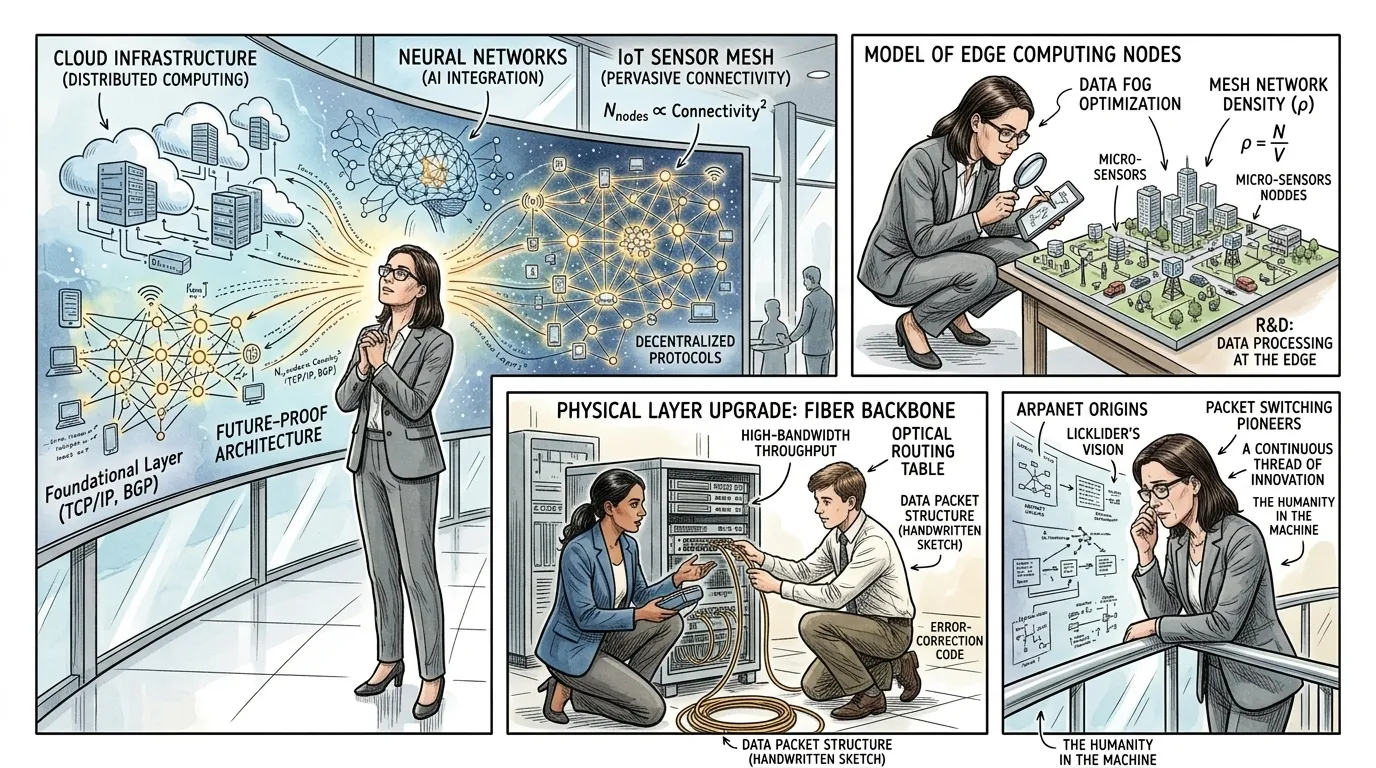
Today, the Internet is an indispensable global utility, constantly evolving with new technologies and applications. From cloud computing and artificial intelligence to the Internet of Things, its foundational architecture continues to support innovations unimaginable to its early pioneers. It stands as a testament to collaborative ingenuity, demonstrating how a theoretical concept, nurtured by dedicated researchers and engineers, can fundamentally transform human civilization.
"Dr. Elena Petrova provides a final reflection. 'The Internet's legacy is its inherent adaptability. It was designed to be robust and decentralized, allowing for continuous growth and reinvention. From those first hesitant 'LOGIN' attempts, we've built a global nervous system.' She pauses, looking out at a of interconnected digital imagery. 'We must remember the core principles: open standards, distributed architecture, and a commitment to free information flow. The future of this incredible invention depends on upholding those tenets.' Its journey from a specialized research tool to a ubiquitous global platform continues, defining the very fabric of modern existence."
About this story
- Location: Global
- Audience: kids (ages 6–12)
Questions and answers
Read Wonder Inventions on your phone
Wonder Inventions is available on Android. Get Wonder Inventions on Google Play.