Inhaler
Inhaler — an illustrated inventions story, set in Global. 10 illustrated pages, free to read on Wonder Inventions.

Page 1
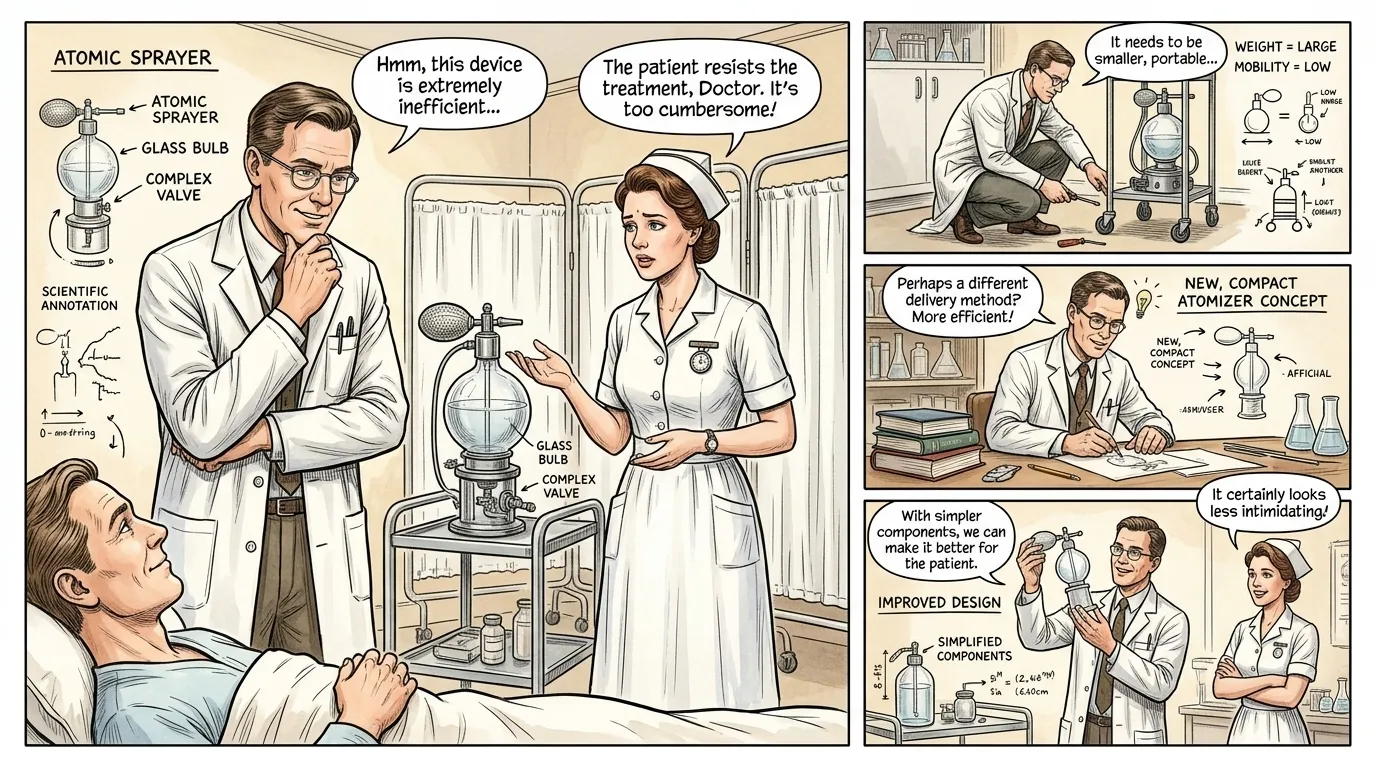
Before the mid-20th century, severe respiratory distress, especially from asthma, was a terrifying ordeal. Treatments were often cumbersome, inconsistent, and offered only temporary, unpredictable relief. Medical practitioners faced profound limitations in administering effective medication directly to the airways.
""Dr. Barach, the patient is struggling again. The epinephrine helps, but the methods of delivery are so inefficient," a nurse lamented, her voice tinged with urgency. Dr. Alfred L. Barach, observing the laborious breathing of his patient, sighed deeply. "Indeed, Nurse. As the ancient physician Hippocrates once observed, 'Wherever the art of medicine is loved, there is also a love of humanity.' Yet, we struggle to bring consistent relief to our patients with respiratory distress, often relying on bulky atomizers that are far from ideal." He gestured to a large, glass device on a nearby cart."
Page 2
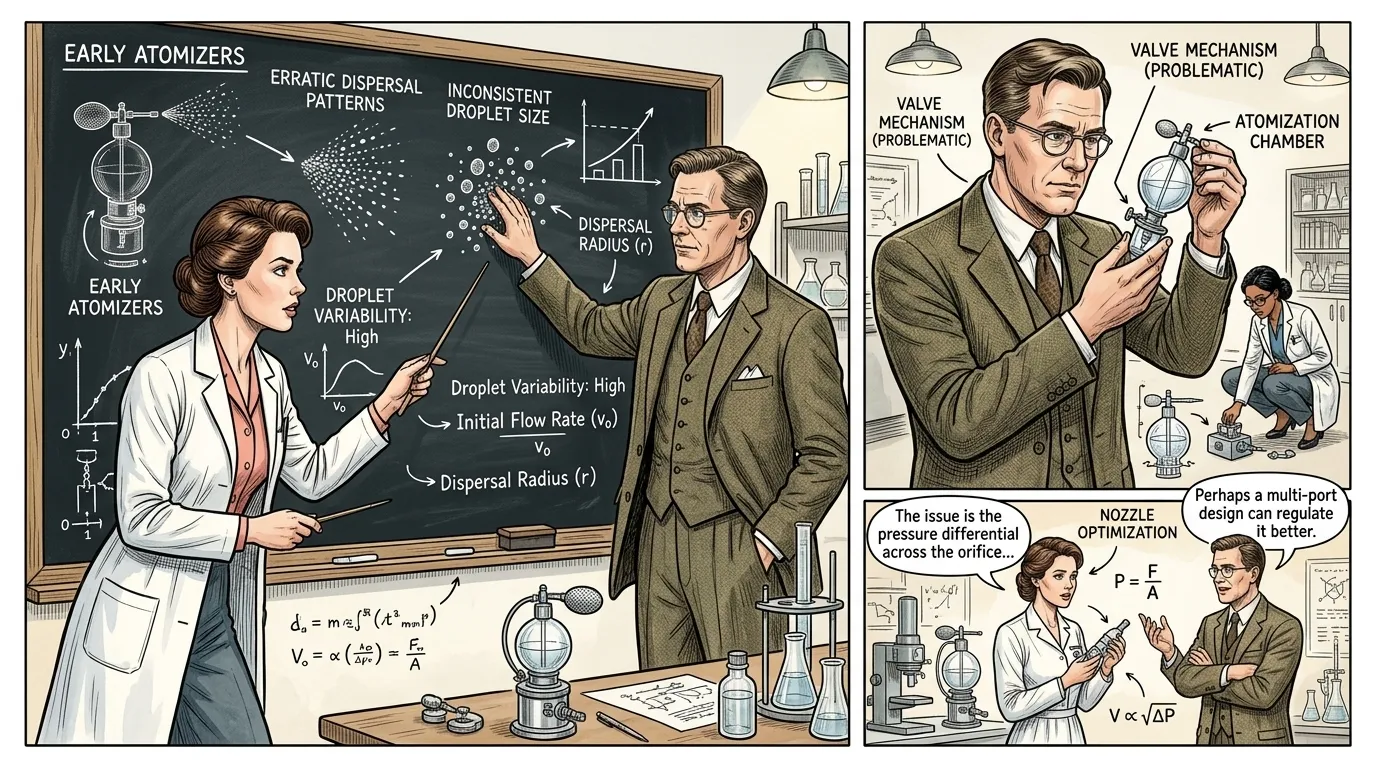
Early attempts at pulmonary drug delivery included burning stramonium leaves and the use of large, hand-pumped atomizers. These methods, while innovative for their time, suffered from critical flaws: inconsistent particle size, inefficient drug dispersion, and a complete lack of precise dosage control.
""Professor Davies, our current atomizers are simply not precise enough," remarked Dr. Evelyn Reed, pointing to a complex diagram on a laboratory blackboard. Professor Alistair Davies, a seasoned chemist with spectacles perched on his nose, nodded in agreement. "You're quite right, Dr. Reed. As Isaac Newton famously stated, 'If I have seen further than others, it is by standing upon the shoulders of giants.' We honor those early attempts, like the stramonium 'cigarettes,' but we must reach higher for true pharmaceutical precision. Look at this diagram; the particle size varies wildly, making targeted delivery almost impossible." He tapped a section of the diagram depicting erratic droplet dispersal."
Page 3
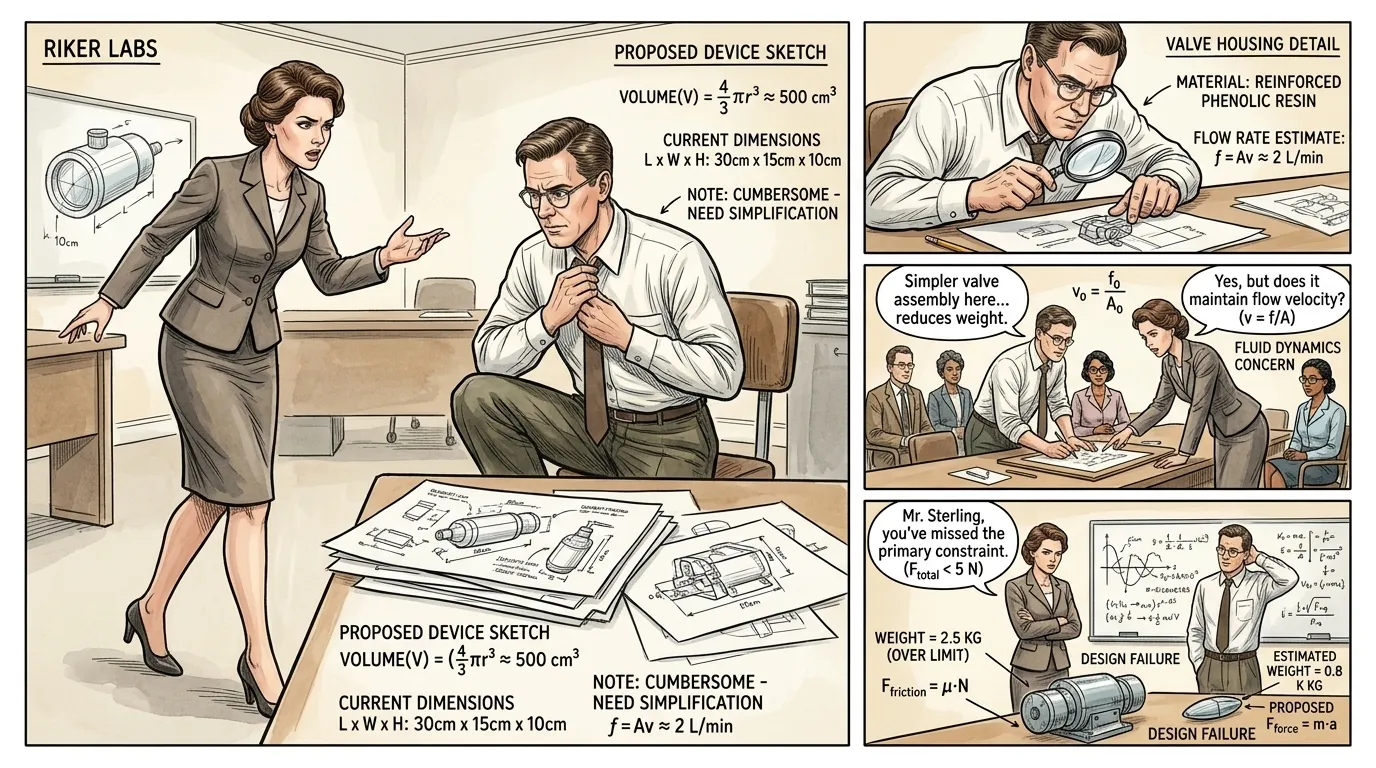
The medical community understood the need for a revolution: a portable device that could deliver a consistent, exact dose of medication directly to the lungs, avoiding systemic side effects and offering immediate relief. This was not merely a convenience, but a critical unmet medical necessity.
""Mr. Sterling, the demand from physicians is overwhelming," stated Dr. Lena Petrova, a pharmaceutical executive, her voice firm. "We need a breakthrough, not just another incremental improvement. The market, and more importantly, the patients, are crying out for a truly effective, portable solution." Mr. Arthur Sterling, a Riker Labs researcher, adjusted his tie. "Dr. Petrova, we understand the urgency. As Leonardo da Vinci wrote, 'Simplicity is the ultimate sophistication.' Our current methods are anything but simple or sophisticated for the patient; they are cumbersome and often ineffective. Our challenge is to combine simplicity of use with unprecedented precision." He gestured to some preliminary sketches of proposed devices, illustrating their bulkiness."
Page 4
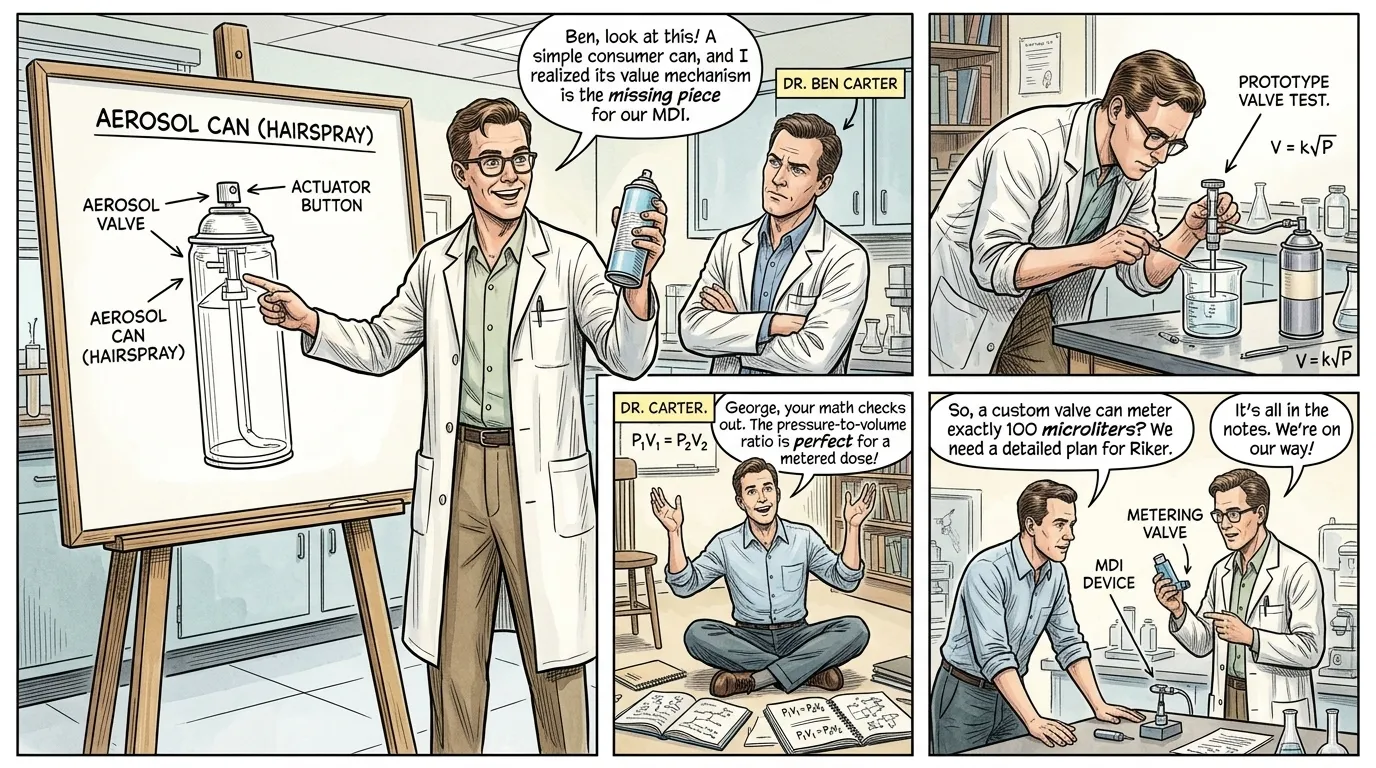
The quest for such a device led to Riker Laboratories in the mid-1950s, where chemist George Maison was tasked with solving this intractable problem. His inspiration came from an unlikely source: the burgeoning consumer market for aerosol hairsprays and insecticides.
""George, you propose we adapt insecticide technology for medicine?" scoffed Dr. Ben Carter, another Riker chemist, eyeing a can of hairspray Maison held. George Maison, undeterred, held up a pressurized can. "Not the contents, Ben, but the delivery mechanism! Marie Curie once reminded us that 'Nothing in life is to be feared, it is only to be understood.' We must understand how to control these aerosols for healing, not just for cleaning or styling. Imagine, a precise, portable mist for patients, simply by pressing a button." He pointed to an initial schematic illustrating a basic aerosol valve, clearly differentiating it from the can's contents."
Page 5
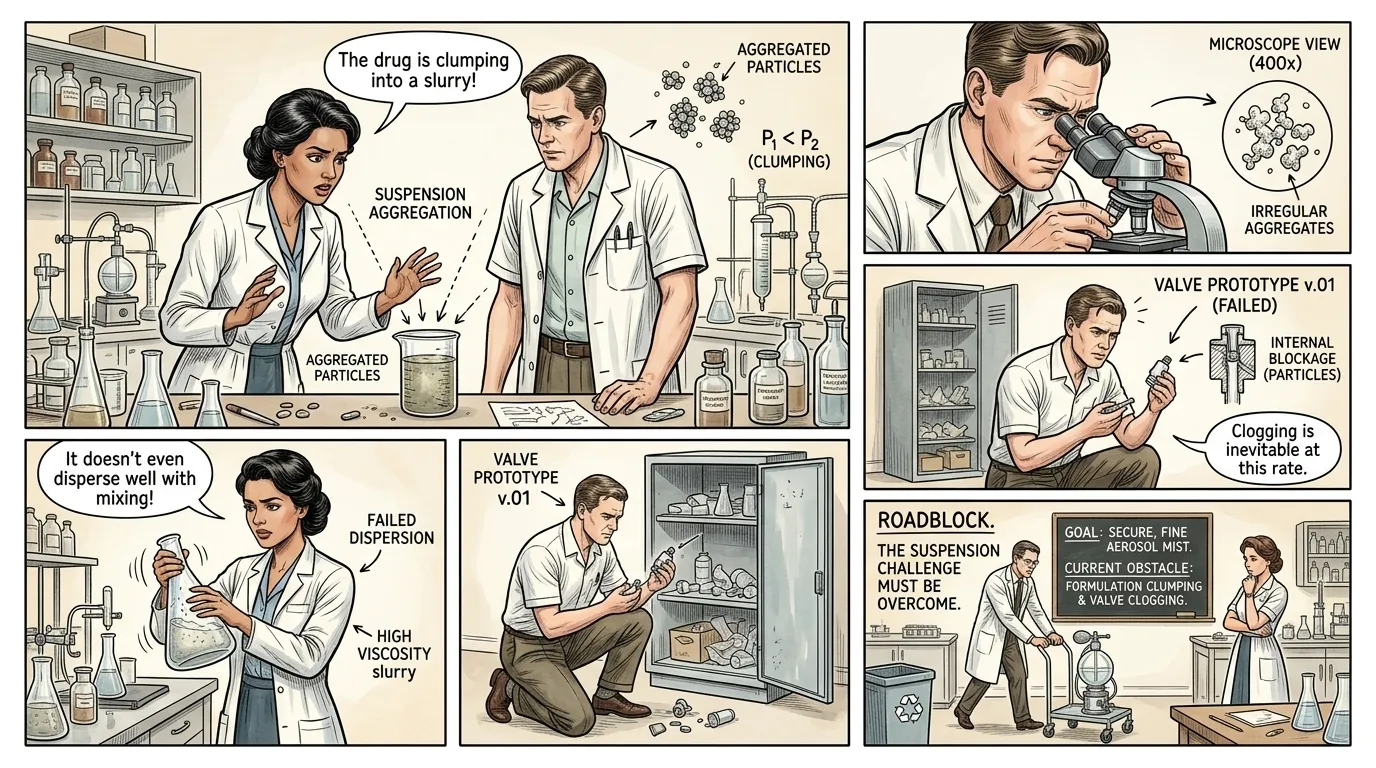
The path was fraught with technical hurdles. The delicate medication needed to remain stable when suspended in a propellant and then be released in a precise, consistent cloud of micron-sized particles. This required innovative chemical formulation and an entirely new valve design.
""The drug particles clump, George. And they settle out of suspension far too quickly. We can't guarantee a consistent dose with this approach," explained Dr. Anya Sharma, Riker's lead formulation chemist, gesturing at a beaker. George Maison frowned, examining a microscopic slide. "You're right, Anya. As the philosopher Seneca observed, 'Every new beginning comes from some other beginning's end.' Our traditional methods of mixing and delivery are ending here. We need a completely new chemical approach to keep these particles uniformly suspended and stable within the propellant itself." He pushed a failed prototype of a simple aerosol valve across the workbench."
Page 6
The pivotal moment came with the invention of the metered valve. This ingenious mechanism, a small chamber designed to hold an exact volume of drug-propellant mixture, ensured that each activation delivered a precise, repeatable dose. This was the critical breakthrough that transformed a general aerosol into a medical device.
"George Maison, holding a gleaming, newly manufactured metered valve, exclaimed, "Eureka! As Archimedes might have cried, this small mechanism, this precise volumetric chamber, changes everything for patient dosage!" Dr. Anya Sharma, her face alight with excitement, clapped her hands. "Indeed, George! With this, we can guarantee consistency. The propellant pressure, combined with this valve, forces a measured amount through a tiny orifice, creating the fine mist we need. No more guesswork!" A junior engineer nodded enthusiastically, ready to assemble the next prototype."
Page 7
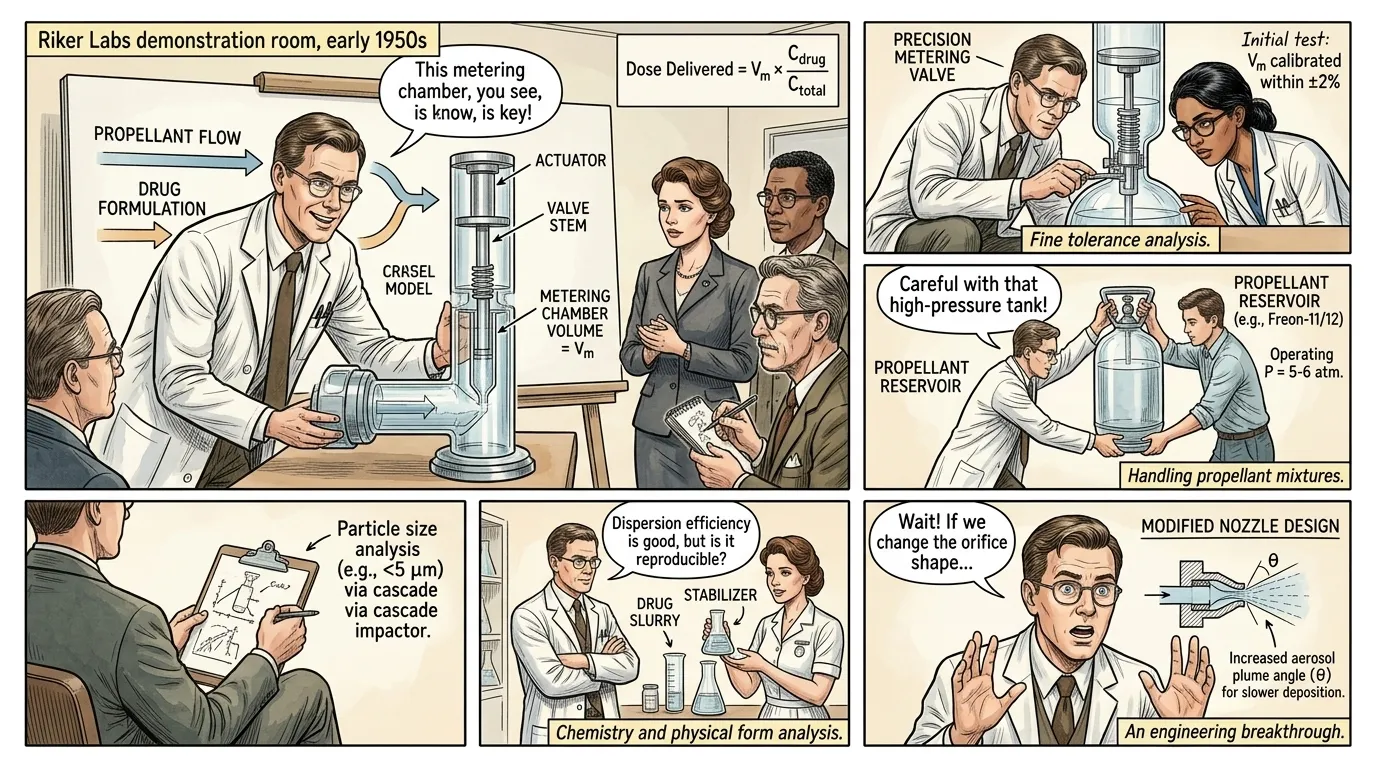
The metered-dose inhaler operates on a deceptively simple principle. A liquefied propellant holds the medication in suspension. Upon actuation, a precisely measured dose is released from the metering chamber, rapidly depressurizes, and atomizes into an ultrafine aerosol cloud, ready for inhalation.
""Observe this transparent model," an engineer explained to a group of Riker executives. "When the patient presses down, the stem descends, opening the metering chamber. This chamber, the heart of the device, contains a precise volume of the drug and propellant mixture." He pointed to the diagram. "As Galileo Galilei once stated, 'Measure what is measurable, and make measurable what is not so.' This valve precisely measures an imperceptible quantity, making it profoundly effective. When the stem returns, that measured dose is forced out, rapidly expanding and turning into a fine, breathable mist, ready to be inhaled directly into the lungs.""
Page 8
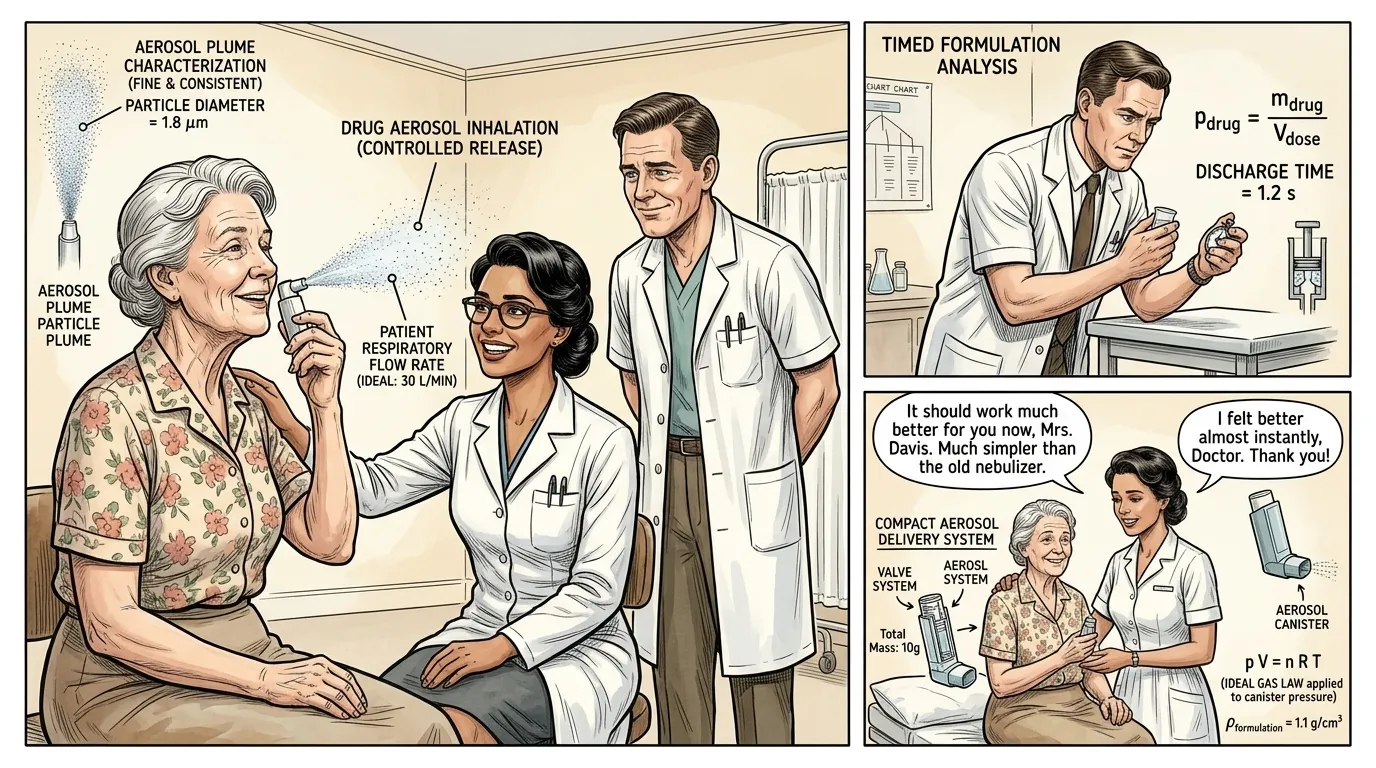
In 1956, Riker Laboratories introduced the Medihaler-Epi and Medihaler-Iso, the world's first metered-dose inhalers. The immediate impact on patients suffering from asthma and other respiratory conditions was revolutionary. No longer bound by bulky equipment, individuals could manage their symptoms with unprecedented independence.
""This is truly life-changing, George," Dr. Anya Sharma stated, watching a patient take a controlled breath from the newly released Medihaler. George Maison, observing the patient's immediate relief, nodded. "Indeed, Anya. Ralph Waldo Emerson penned, 'To be yourself in a world that is constantly trying to make you something else is the greatest accomplishment.' This invention allows patients to reclaim their breath, to be themselves, free from the constant fear of an attack." The patient, an elderly woman, coughed less and smiled, visibly breathing easier. The mist was visibly fine and consistent, a testament to the breakthrough."
Page 9
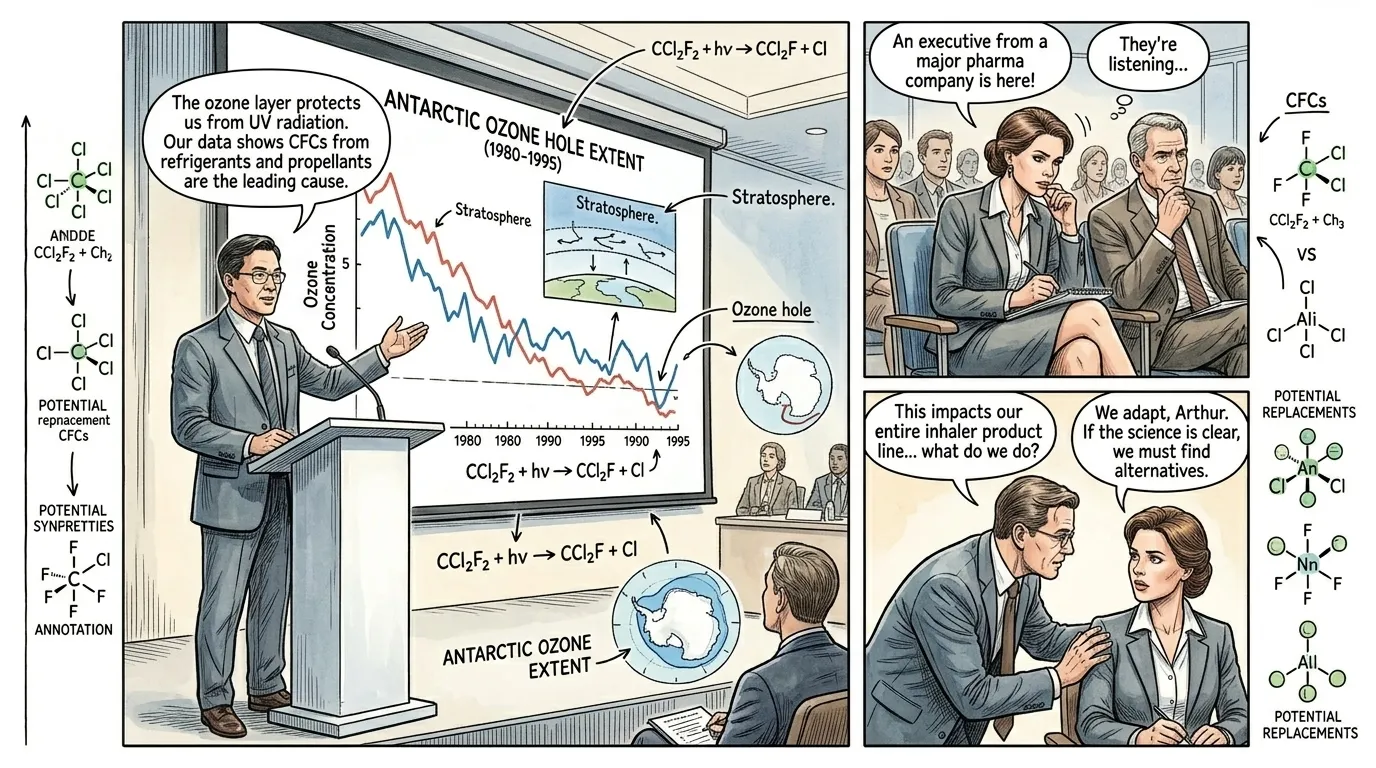
The metered-dose inhaler quickly became a global standard, profoundly improving public health outcomes. However, by the late 20th century, the propellants that made MDIs possible—chlorofluorocarbons (CFCs)—were found to deplete the ozone layer, posing a new ethical and scientific challenge.
""Our data on CFCs is irrefutable; their environmental impact is severe," stated Dr. Kenji Tanaka, an environmental scientist, during a medical conference in the 1990s. He presented graphs showing ozone depletion. "As Albert Einstein wisely noted, 'We cannot solve our problems with the same thinking we used when we created them.' Our understanding of environmental impact necessitates new propellants, even for life-saving devices." A pharmaceutical representative confirmed, "The transition to hydrofluoroalkanes, or HFCs, is underway, ensuring both patient care and environmental stewardship.""
Page 10

The inhaler fundamentally transformed the lives of millions, converting a life-threatening condition into a manageable chronic illness. It empowered individuals, reduced emergency hospitalizations, and fostered a generation of patients who could live active, fulfilling lives, a testament to the power of precision engineering in medicine.
"Dr. Sofia Rodriguez, a pulmonologist in a modern clinic, reflected, "The impact is immeasurable. Helen Keller once said, 'Optimism is the faith that leads to achievement. Nothing can be done without hope and confidence.' The inhaler instilled that hope and confidence for millions, shifting the narrative from despair to empowerment for those with respiratory conditions. It's a marvel of medical engineering." She gestured to a series of images on a digital display, showcasing the profound transformation in patients' lives."
About this story
- Location: Global
- Audience: general readers
Questions and answers
Read Wonder Inventions on your phone
Wonder Inventions is available on Android. Get Wonder Inventions on Google Play.