Papyrus Scroll
Papyrus Scroll — an illustrated inventions story, set in Global. 10 illustrated pages, free to read on Wonder Inventions.
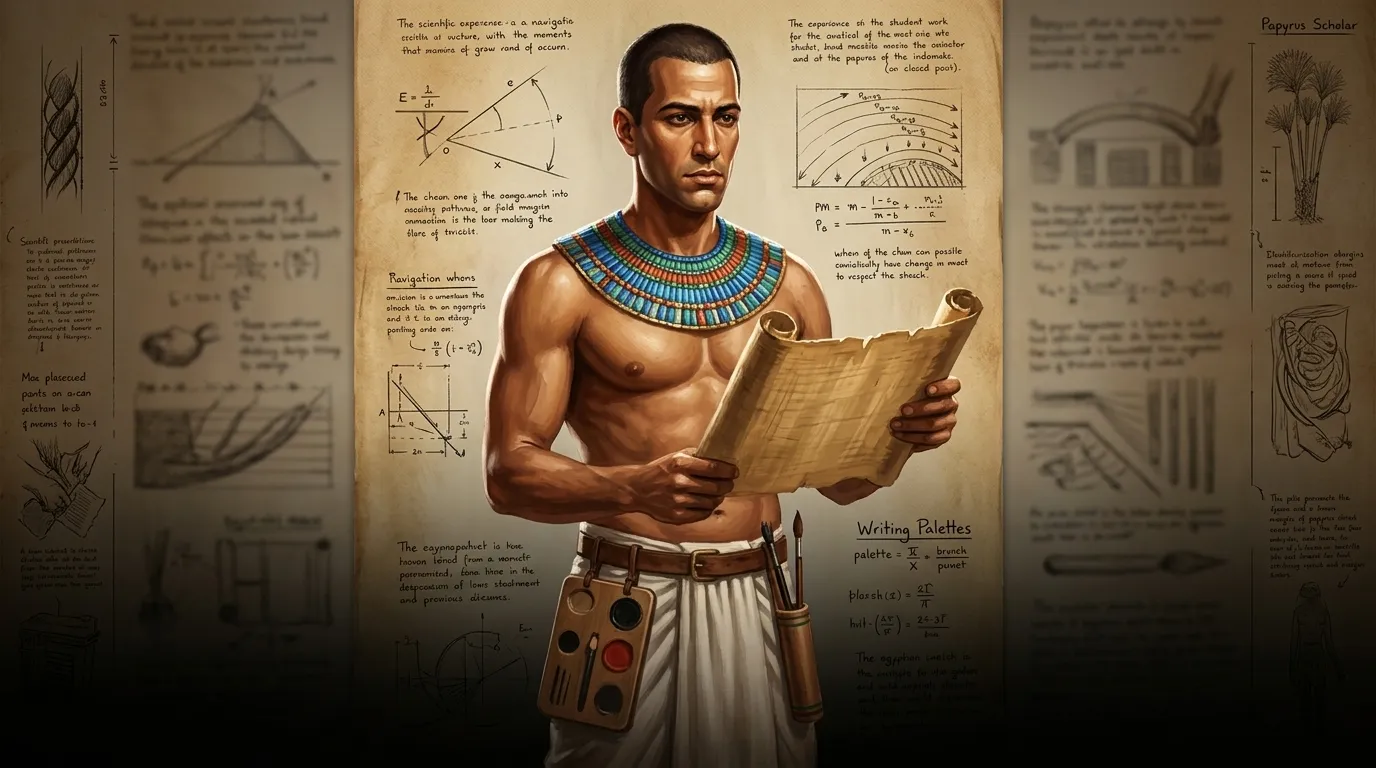
Page 1
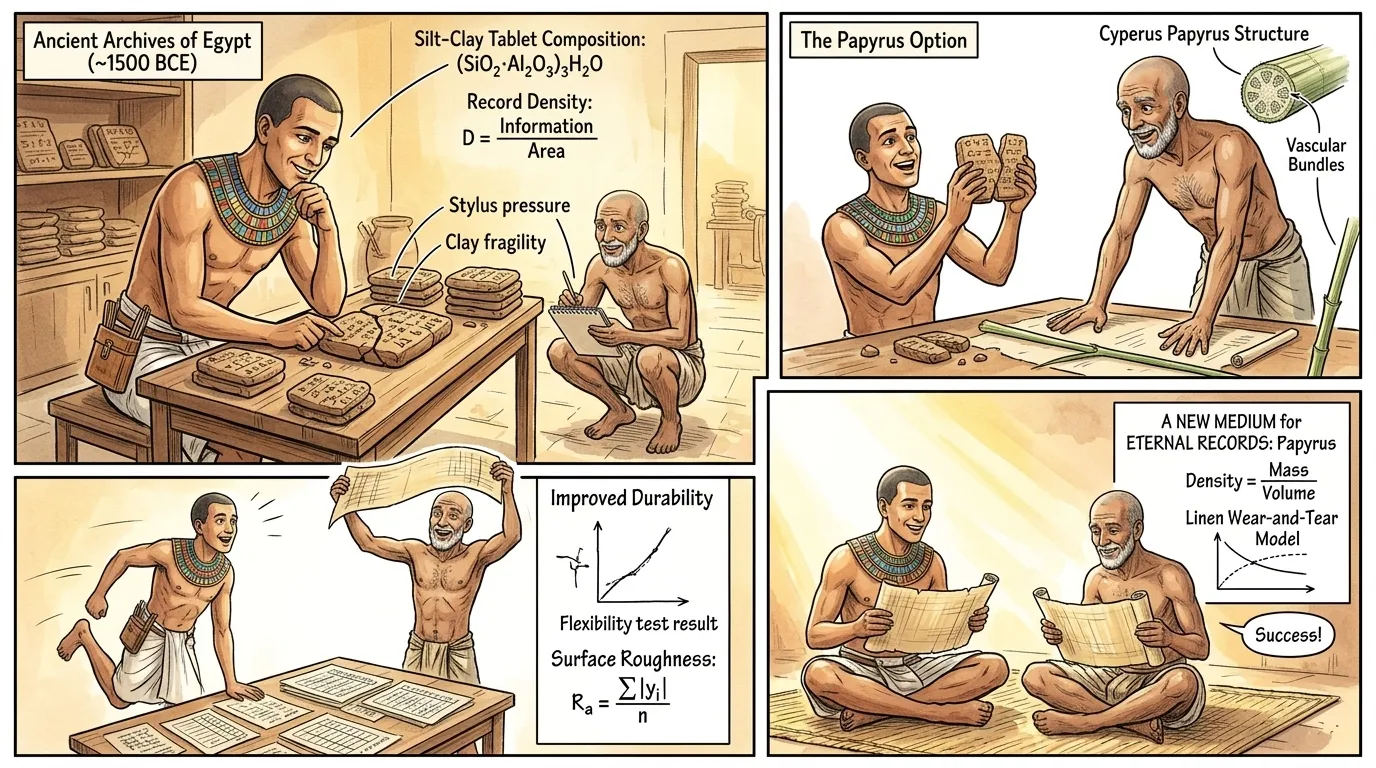
For millennia, the transmission of complex information was cumbersome, hindered by the very materials used to record it. Ancient civilizations, striving for administrative efficiency and cultural dissemination, faced a fundamental challenge: how to create a durable, lightweight, and readily available medium for writing.
""This clay is heavy, and cracks too easily!" exclaimed a frustrated Egyptian official, examining a damaged tablet. "How are we to record our decrees, pass down our laws, or share our knowledge across the vast lands of Egypt with such fragile, cumbersome burdens?""
Page 2
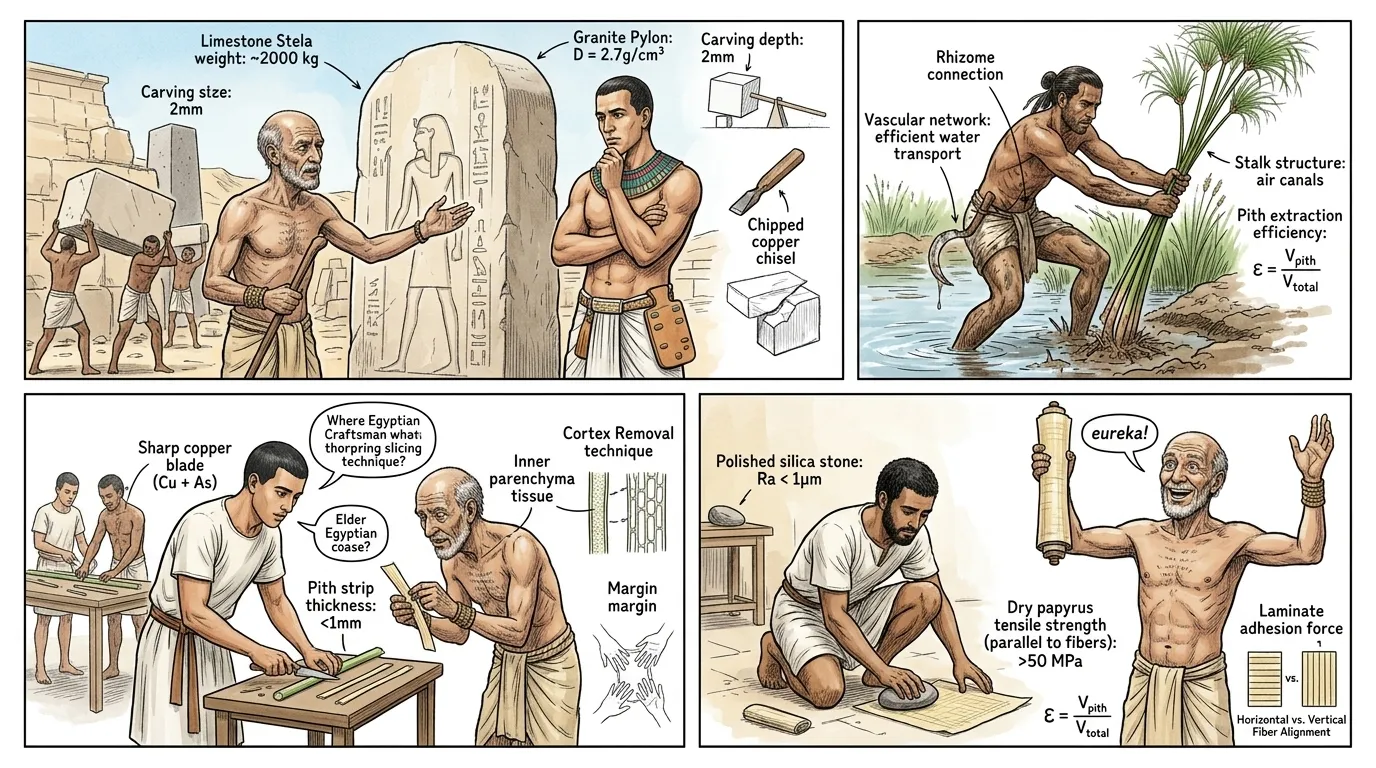
Before the widespread adoption of papyrus, the recording of information was an arduous undertaking. Early methods, like carving into stone or impressing cuneiform onto wet clay tablets, offered permanence but at the cost of portability and scalability. These materials were heavy, fragile, or required immense effort to produce and transport, severely limiting the reach and volume of recorded knowledge.
""Imagine carrying an entire library carved into stone!" remarked an elder Egyptian craftsman, his face etched with experience. "The resources, the manpower... it's a bottleneck for progress. We need a material that flows like the Nile itself, easily carried by any messenger.""
Page 3
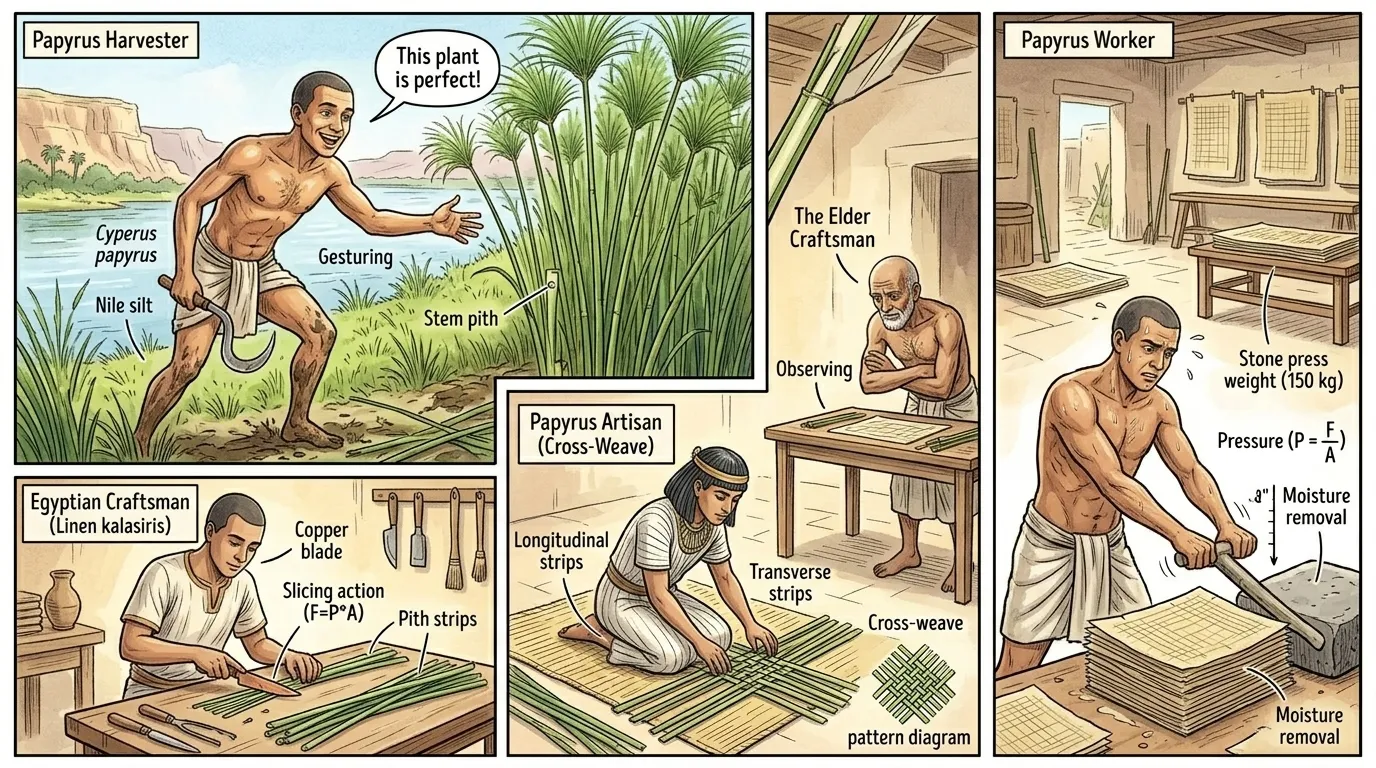
The solution lay in plain sight, abundant along the banks of the Nile: the Cyperus papyrus plant. Its tall, triangular stalks, seemingly unremarkable, held a fibrous core that the ancient Egyptians learned to transform into a revolutionary writing surface. The challenge was to harness this natural structure into a stable, enduring sheet, a task requiring deep understanding of botany and careful craftsmanship. The inherent strength of the plant's layered fibers would prove crucial.
""Behold, the gift of the Nile!" proclaimed an experienced papyrus harvester, his voice raspy, gesturing towards a dense thicket of tall papyrus reeds. "Its green skin protects an inner core, fibrous and strong. Our task is to coax that strength into a sheet. We must cut these stalks precisely, revealing the inner pith.""
Page 4
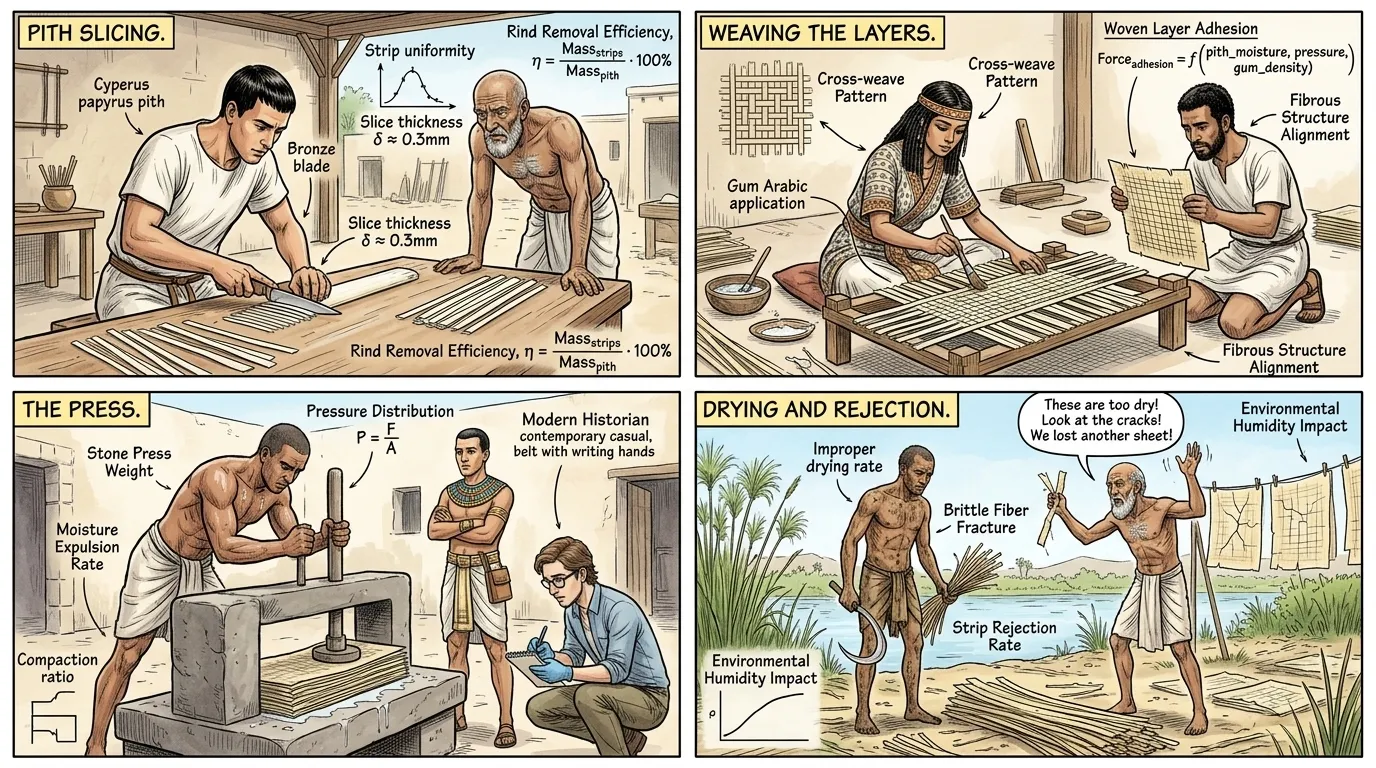
The first critical step involved carefully preparing the harvested papyrus stalks. The outer rind was peeled away, revealing the soft, white pith within. This pith was then meticulously sliced lengthwise into thin, uniform strips, known as 'schida'. Consistency in thickness was paramount; irregular strips would lead to an uneven and structurally weak final sheet. This process required patience and a skilled hand, honed over generations.
""Each slice must be uniform, thin as a breath," instructed a stoic papyrus craftsman, demonstrating the technique with a sharp blade. "Too thick, and the sheet will be inflexible; too thin, and it lacks strength. This isn't merely cutting, it is an art of precision, ensuring the integrity of the future scroll.""
Page 5
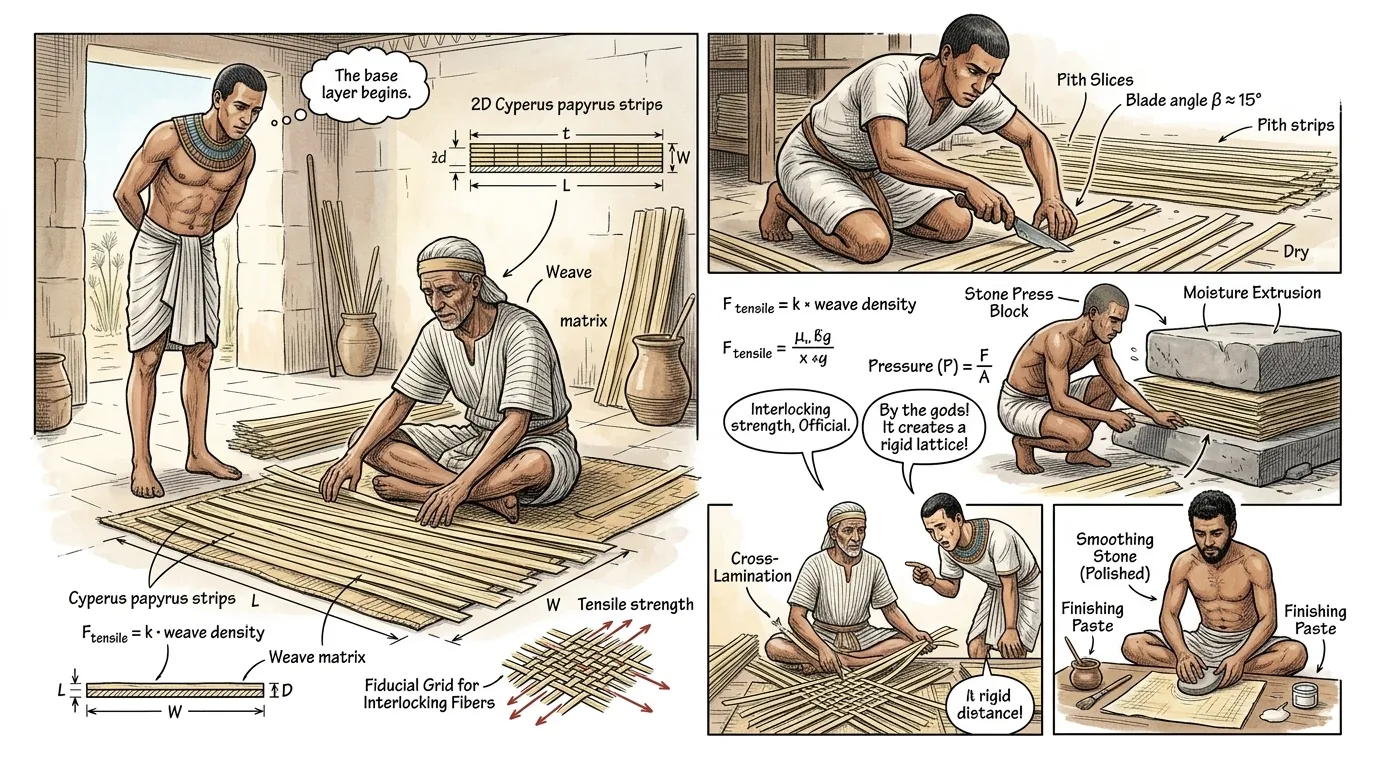
The true innovation arrived with the assembly of these strips. The 'schida' were laid out side-by-side on a flat surface, slightly overlapping, forming a horizontal layer. Then, a second layer of strips was placed directly on top of the first, this time running perpendicularly. This ingenious cross-layering, or 'cross-weave', was the structural breakthrough, providing immense tensile strength and preventing tearing, much like woven fabric. This technique, though seemingly simple, was the foundation of papyrus's durability.
""Observe the method!" announced an elder Egyptian artisan, his hands deftly arranging the papyrus strips. "One layer horizontal, then the next vertical. It is the secret to its enduring strength, locking the fibers against each other. Without this cross-grain, it would simply crumble.""
Page 6
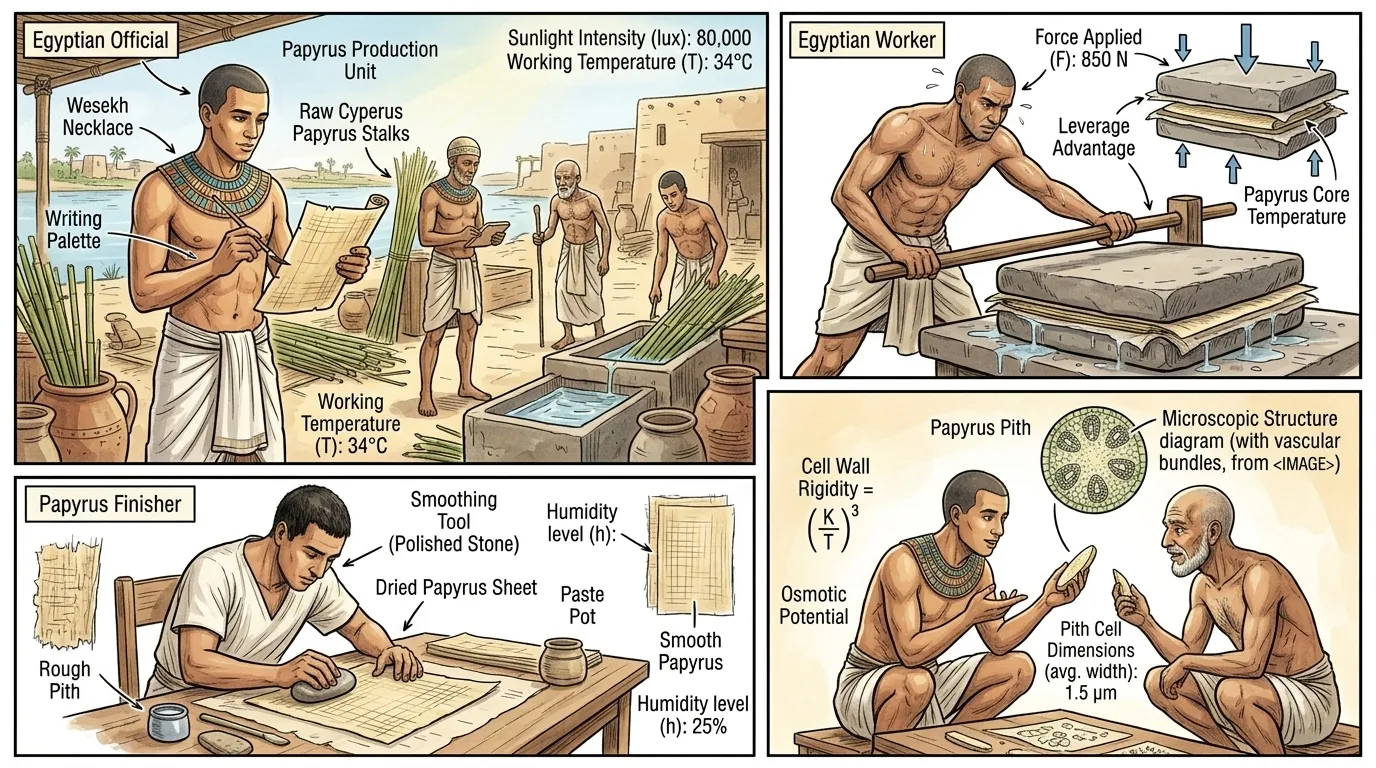
Once the two layers of 'schida' were meticulously arranged, the nascent papyrus sheet was subjected to immense pressure. Placed between two pieces of cloth or felt, it was pressed, often under a heavy flat stone or a wooden press. Crucially, the natural sap released from the plant fibers under pressure acted as a powerful adhesive, bonding the cross-laid strips into a single, cohesive sheet without the need for external glue. This inherent self-adhesion was a marvel of natural chemistry and craftsmanship.
""The river's lifeblood binds it!" declared a sturdy Egyptian worker, his muscles straining as he adjusted a heavy stone press. "No need for resins or glues. The plant itself provides the bond. The moisture must be squeezed out, leaving behind a unified sheet, stronger than its parts.""
Page 7
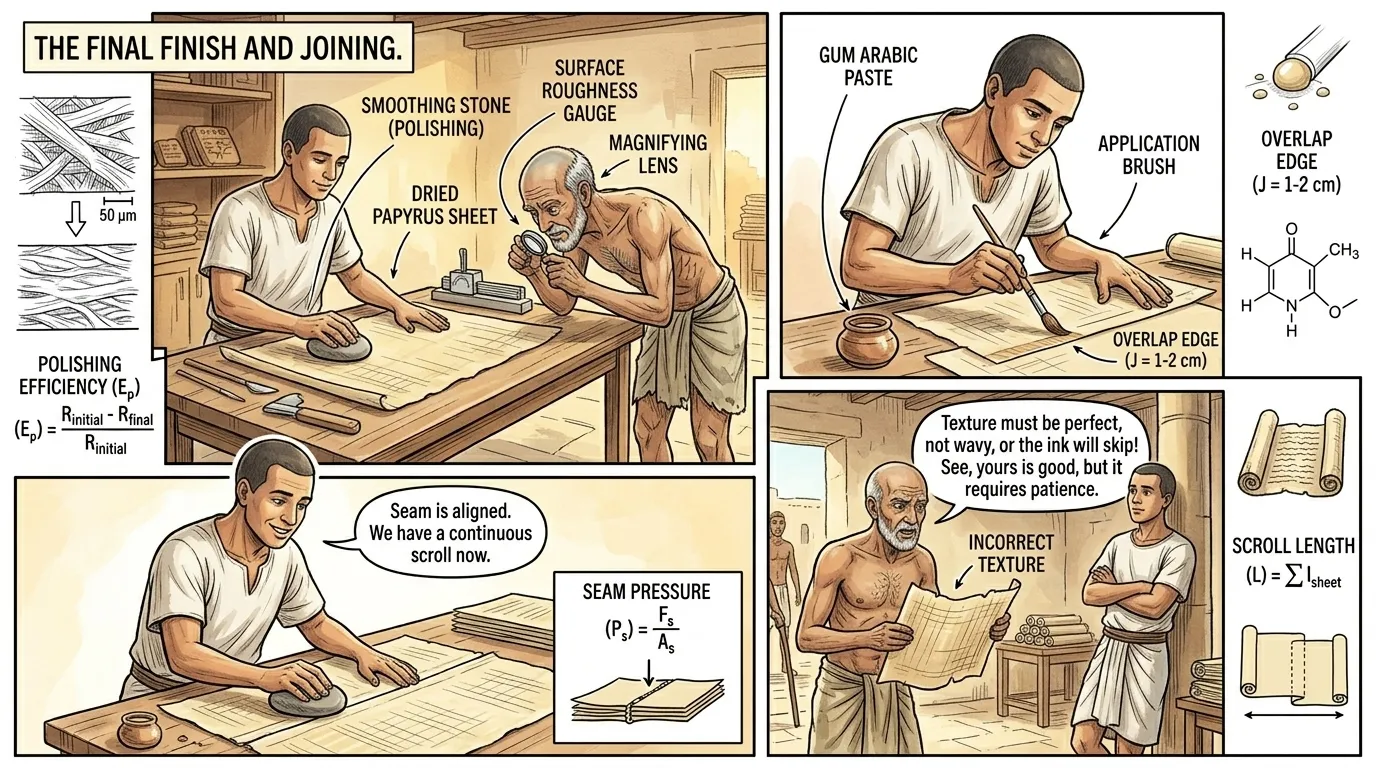
After pressing, the damp sheets were laid out in the sun to dry thoroughly. Once dry, their surface was carefully smoothed and polished, often with a rounded stone or shell, to create an ideal surface for writing. These individual sheets, typically around 20 by 30 centimeters, were then joined together side-by-side, using a paste made from flour and water, to create long continuous rolls. This 'kollesis' process allowed for texts of considerable length to be compiled into a single, manageable scroll.
""Smooth as polished ivory, yet strong as reed," murmured a meticulous craftsman, running his hand over a dried papyrus sheet. "Now, we join them, one to the next, to create a scroll long enough for histories, for epics. A single sheet is a sentence; a scroll is a story.""
Page 8
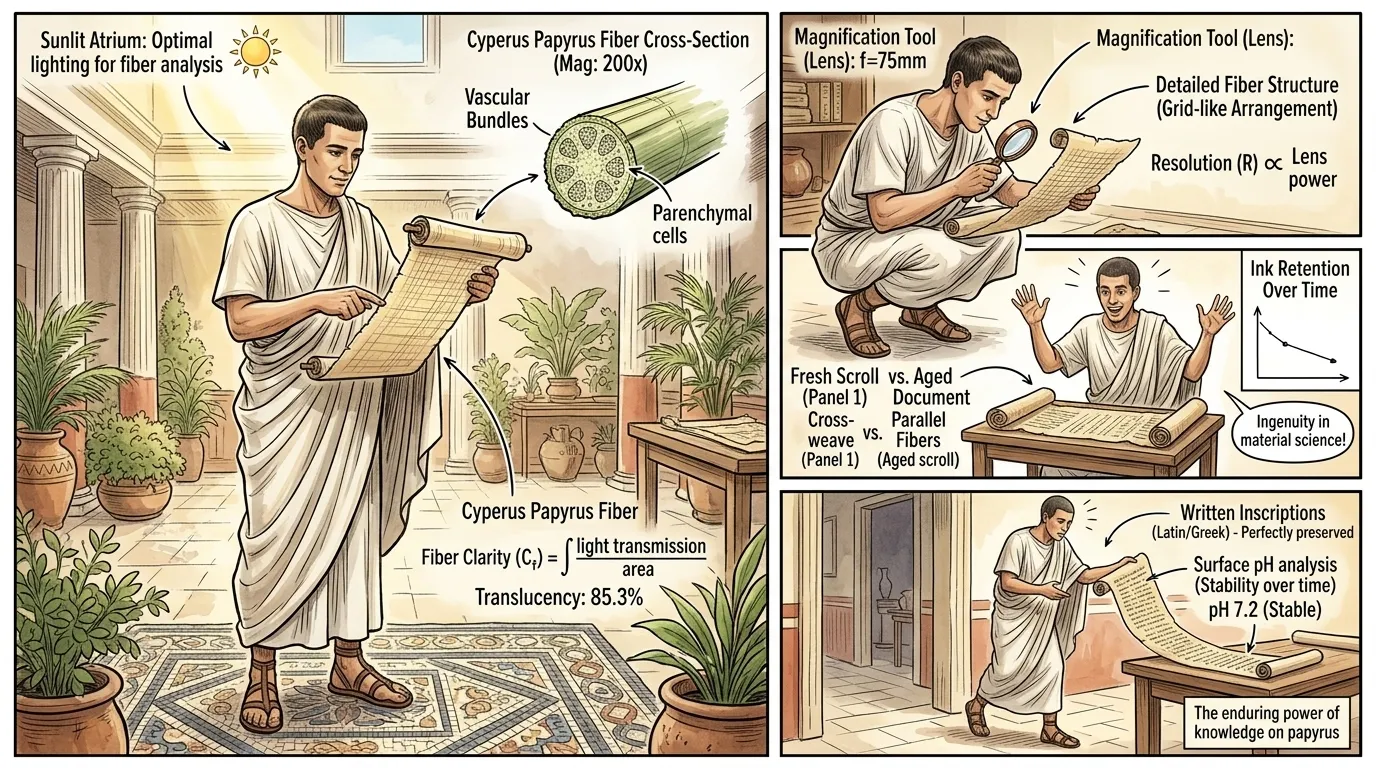
The finished papyrus scroll represented an unparalleled leap in information technology. Lightweight, portable, and durable, it dramatically reduced the physical barriers to widespread literacy and administrative record-keeping. The ingenious cross-layering, combined with the plant's natural bonding agents, resulted in a medium capable of preserving texts for centuries, fundamentally transforming the dissemination and endurance of knowledge throughout the ancient world. It enabled complex narratives, philosophical treatises, and intricate laws to travel far beyond their point of origin.
""This is more than just paper," mused a Roman scholar, his fingers gently tracing the delicate fibers of a freshly prepared scroll in a sunlit atrium. "As the philosopher Seneca wisely observed, 'To be everywhere is to be nowhere.' With papyrus, knowledge can now travel, be distributed, and be preserved, giving thoughts a true home and permanence, rather than being confined to cumbersome stone or fleeting memory. The ancient Egyptians truly understood how to give words wings, through this marvel of layered fibers.""
Page 9
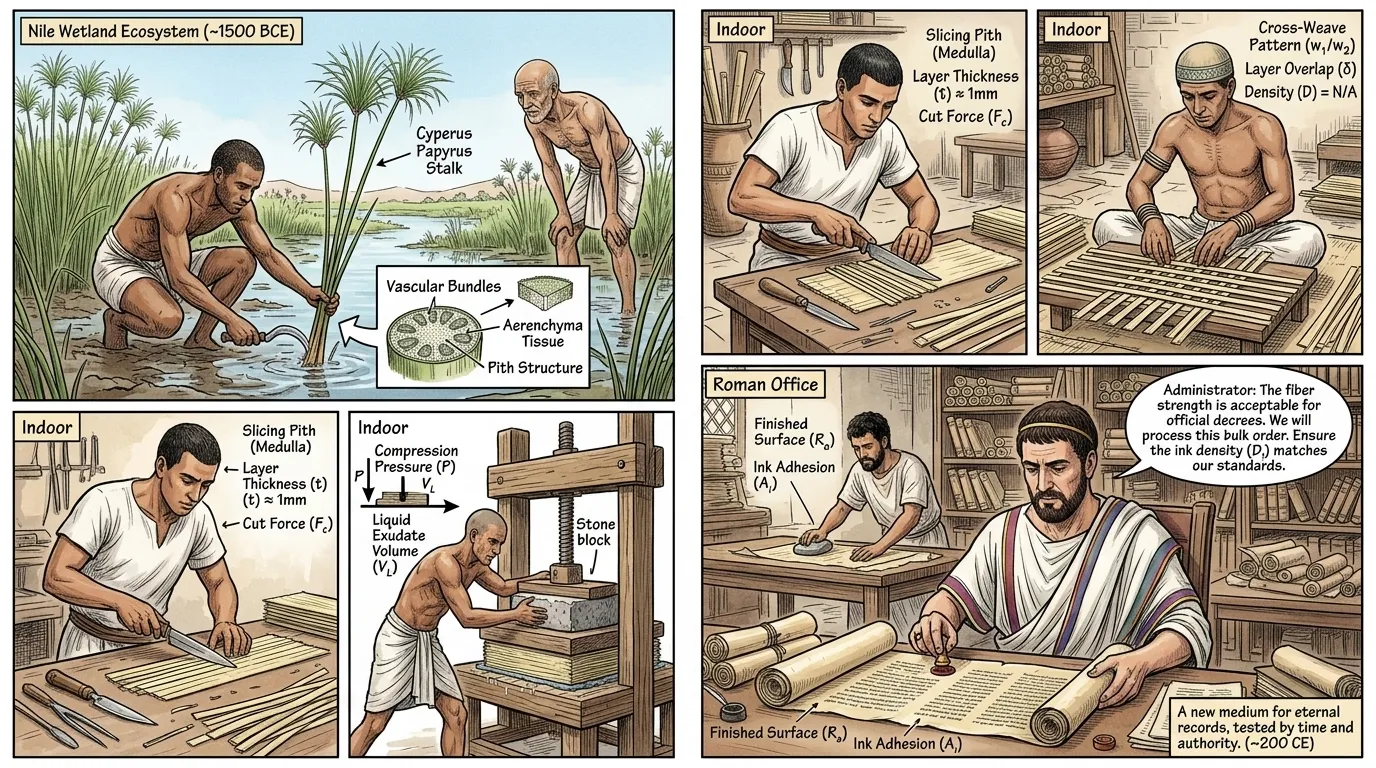
From its Egyptian origins, papyrus quickly became the dominant writing material across the Mediterranean. The libraries of Alexandria and Pergamum swelled with papyrus rolls, preserving vast collections of literature, science, and philosophy. Roman administrators relied on papyrus for imperial decrees, legal codes, and detailed census records, enabling the governance of a sprawling empire. Its lightweight nature facilitated trade and communication, binding disparate regions through shared information and written culture.
""The logistical backbone of Rome itself relies on papyrus," stated a severe Roman administrator, meticulously reviewing a stack of scrolls in his office. "Our legions, our laws, our very census – all recorded, all transportable. Imagine trying to manage an empire this vast with only clay tablets; it would be utterly impossible!""
Page 10
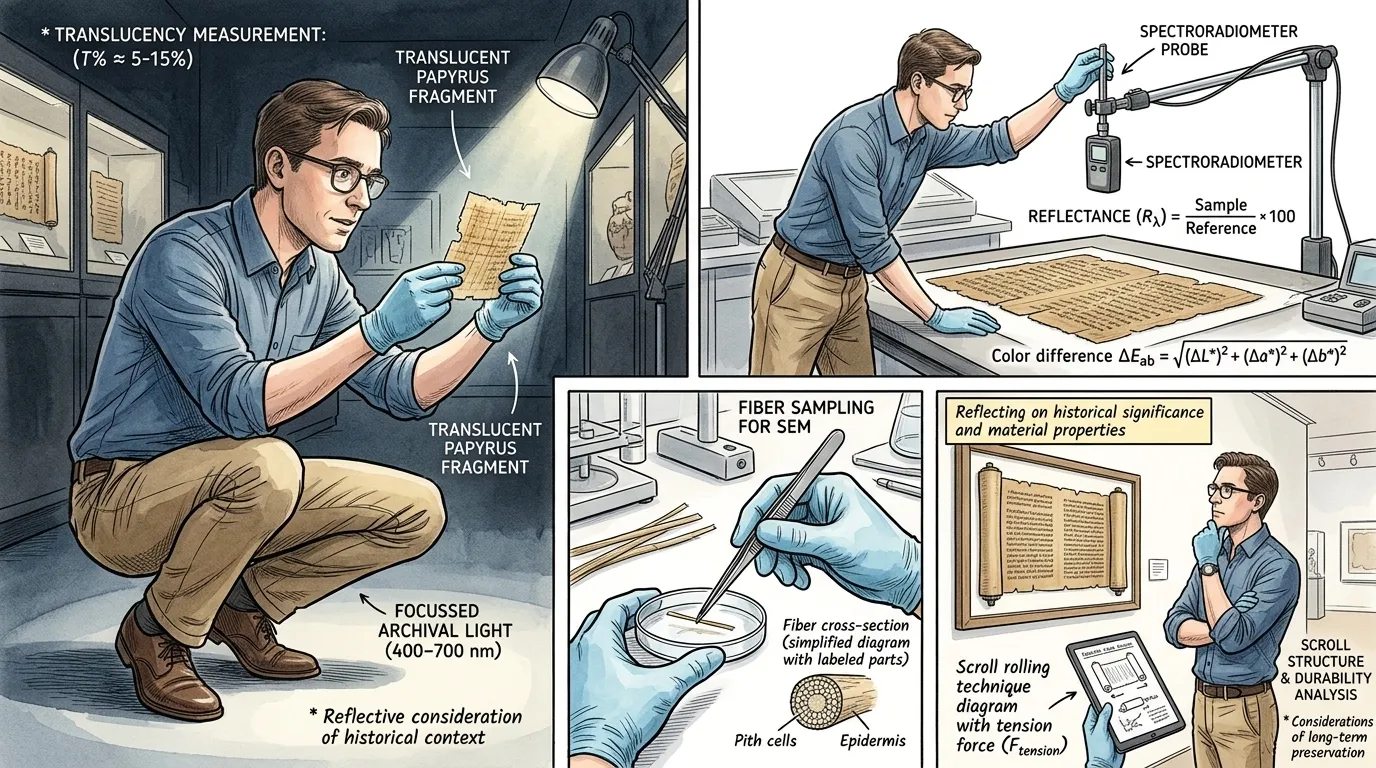
Papyrus remained the primary writing material for over three millennia, profoundly shaping the course of human history by enabling the efficient creation, storage, and dissemination of information. It facilitated the rise of complex states, organized religions, and scholarly traditions, laying the groundwork for subsequent advancements in media. Though eventually superseded by parchment and then paper, the papyrus scroll stands as a testament to the ingenuity of ancient cultures, a fundamental step in humanity's quest to conquer the challenges of communication and preserve knowledge across generations.
""Without papyrus, the very foundations of our knowledge, our laws, and our stories would have been lost to time," reflected a modern historian, examining a fragile fragment of an ancient papyrus. "It was the first truly portable information technology, crucial for everything from sacred texts to scientific theories. The silent reeds of the Nile speak volumes still.""
About this story
- Location: Global
- Audience: general readers
Read Wonder Inventions on your phone
Wonder Inventions is available on Android. Get Wonder Inventions on Google Play.