Photocopier
Photocopier — an illustrated inventions story, set in Global. 10 illustrated pages, free to read on Wonder Inventions.
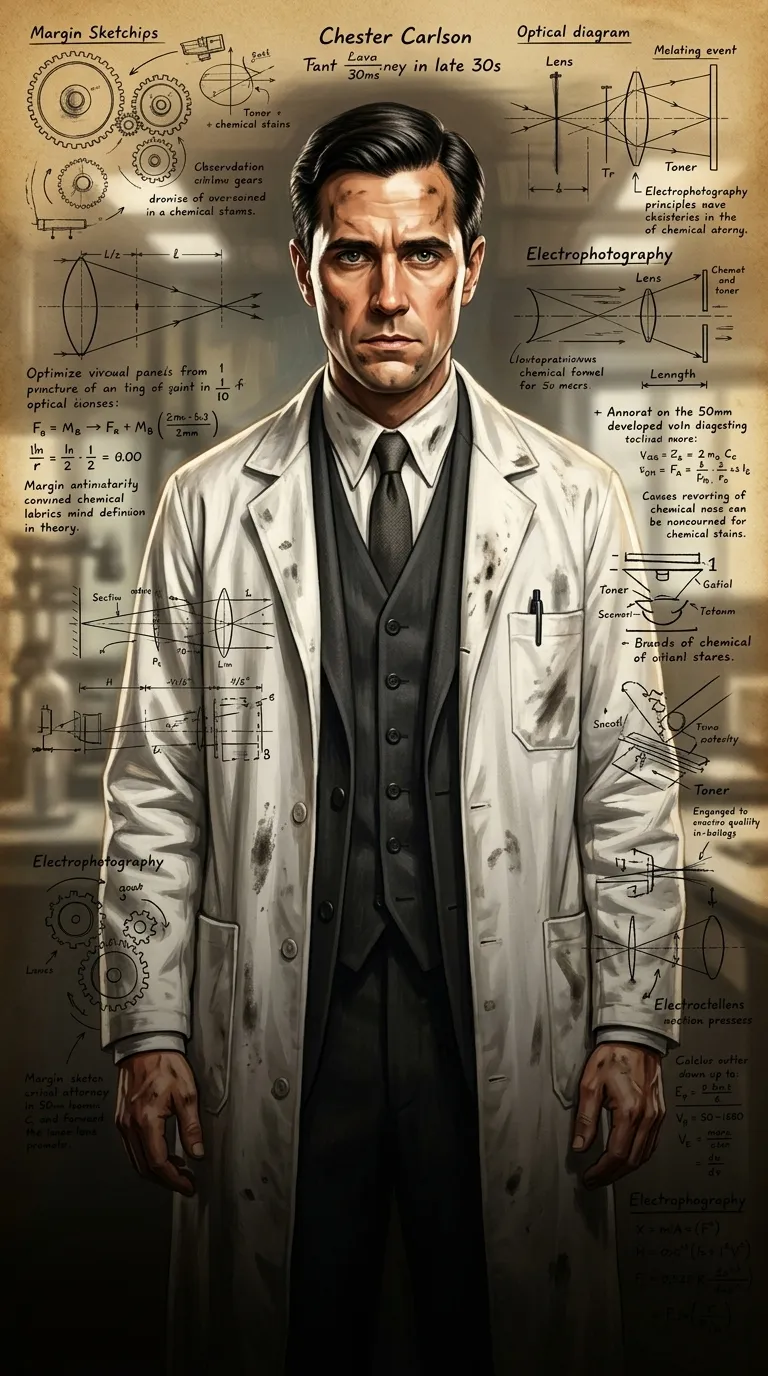
Page 1
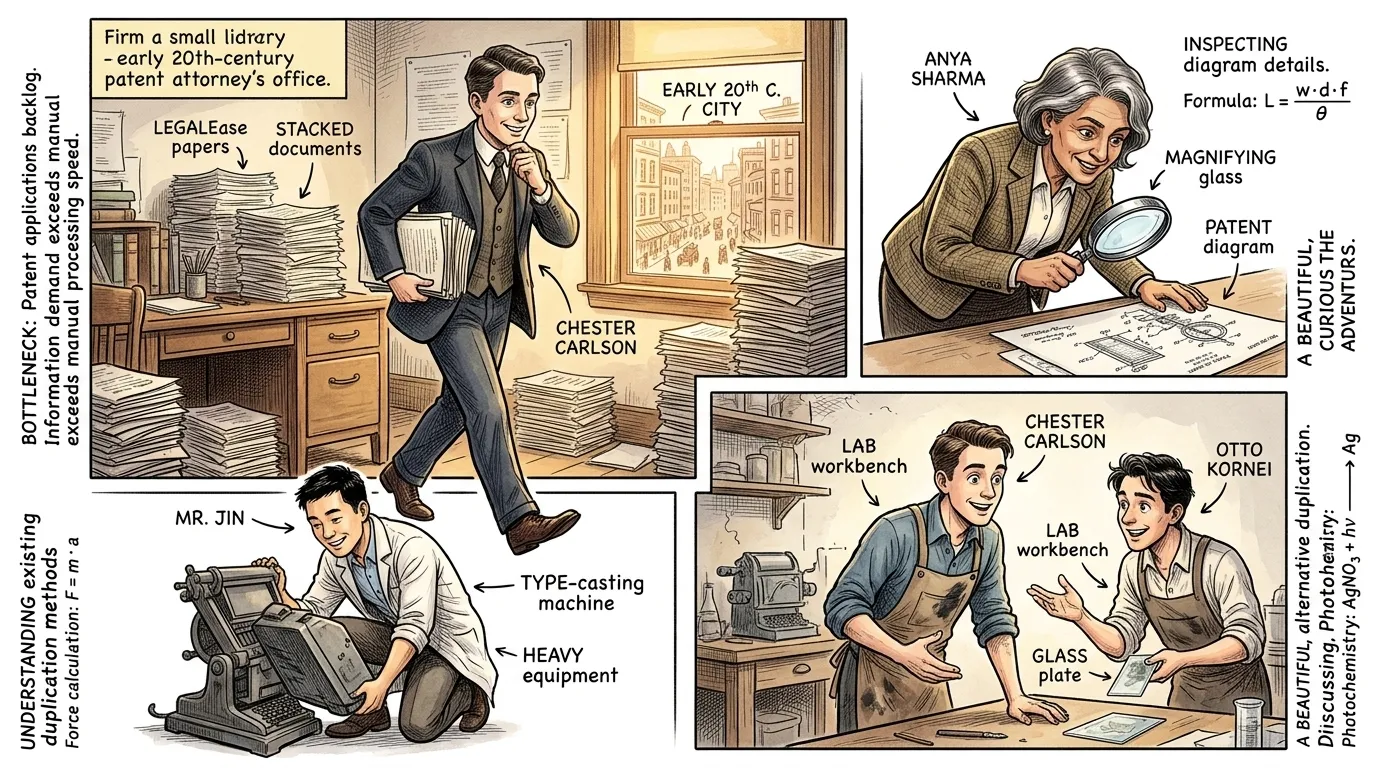
In the early 20th century, the relentless demand for document duplication created an overwhelming bottleneck. Manual transcription and messy, slow photographic processes hampered the flow of information, stifling efficiency in offices and research institutions worldwide. It was a problem ripe for disruption, a challenge that required a radical rethinking of how text and images could be replicated.
"Chester Carlson, a patent attorney burdened by endless copying, often lamented to his colleagues, 'Every day, I see countless hours wasted on manual reproduction. The sheer volume of documents needed is astounding, yet our methods are stuck in the past.' He paced his small office, surrounded by stacks of papers. 'There must be a cleaner, faster way to bring information to the masses.'"
Page 2
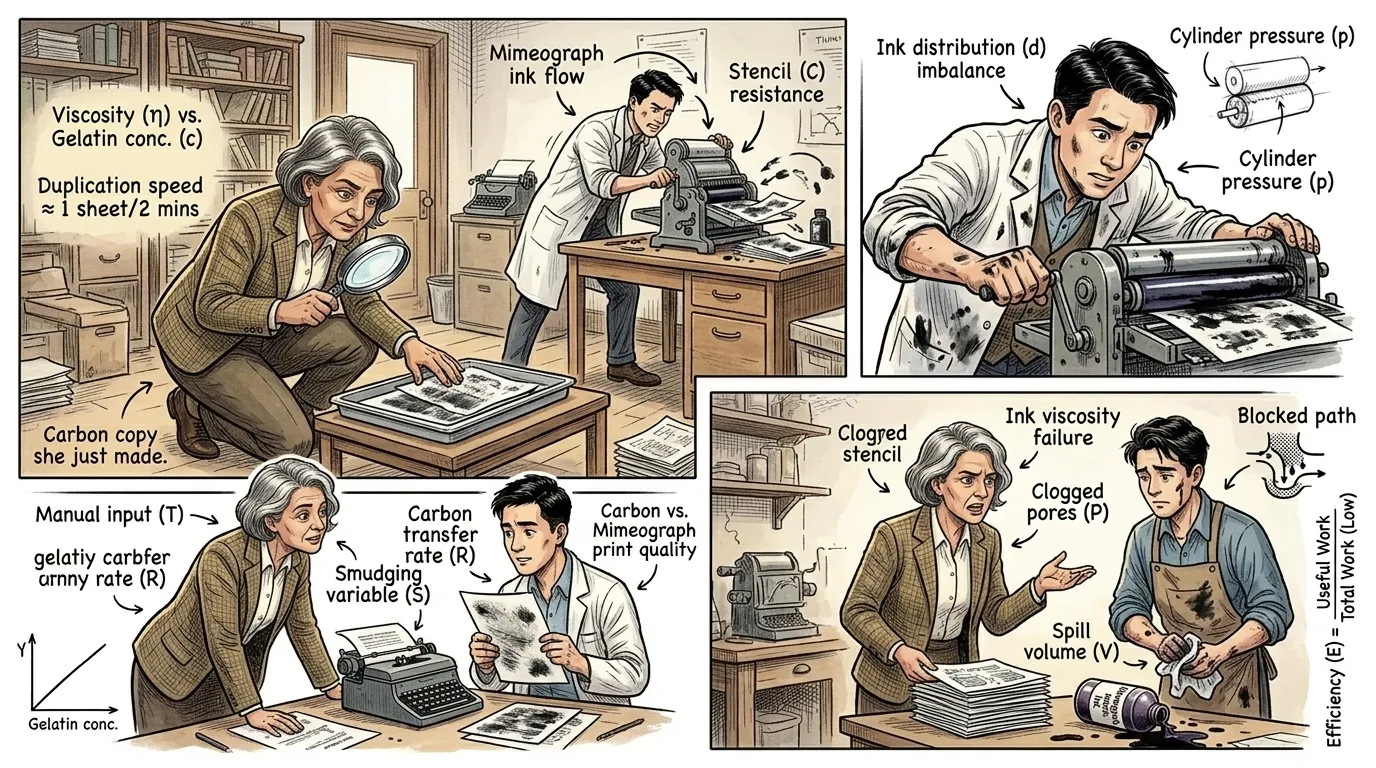
Before the advent of xerography, offices hummed with the rhythmic clatter of typewriters and the faint smell of chemical developers. Copying a document was a laborious, multi-step process, often involving carbon paper, gelatin duplicators, or cumbersome photographic methods. Each method had severe limitations: smudges, poor quality, limited runs, or prohibitive costs and time.
"A distinguished archival researcher, Dr. Anya Sharma, in her 50s with neat graying hair and a tweed jacket, observes a vintage office setup. She explains to a younger technician, 'The scale of document reproduction required in the early 20th century was simply overwhelming for existing technologies. Carbon paper offered limited copies, often faint and messy. The mimeograph was better for quantity but produced lower quality results and required stencils.' The technician, Mr. Jin, in his 30s with short dark hair and a crisp lab coat, nods, 'And photographic processes were too slow and costly for everyday office use. We needed a breakthrough in the very physics of image transfer.' Dr. Sharma adds, 'Indeed, Mr. Jin. The potential of photoconductivity, where certain materials change electrical resistance when exposed to light, was a recognized scientific curiosity, but its application to dry imaging remained an elusive dream.'"
Page 3
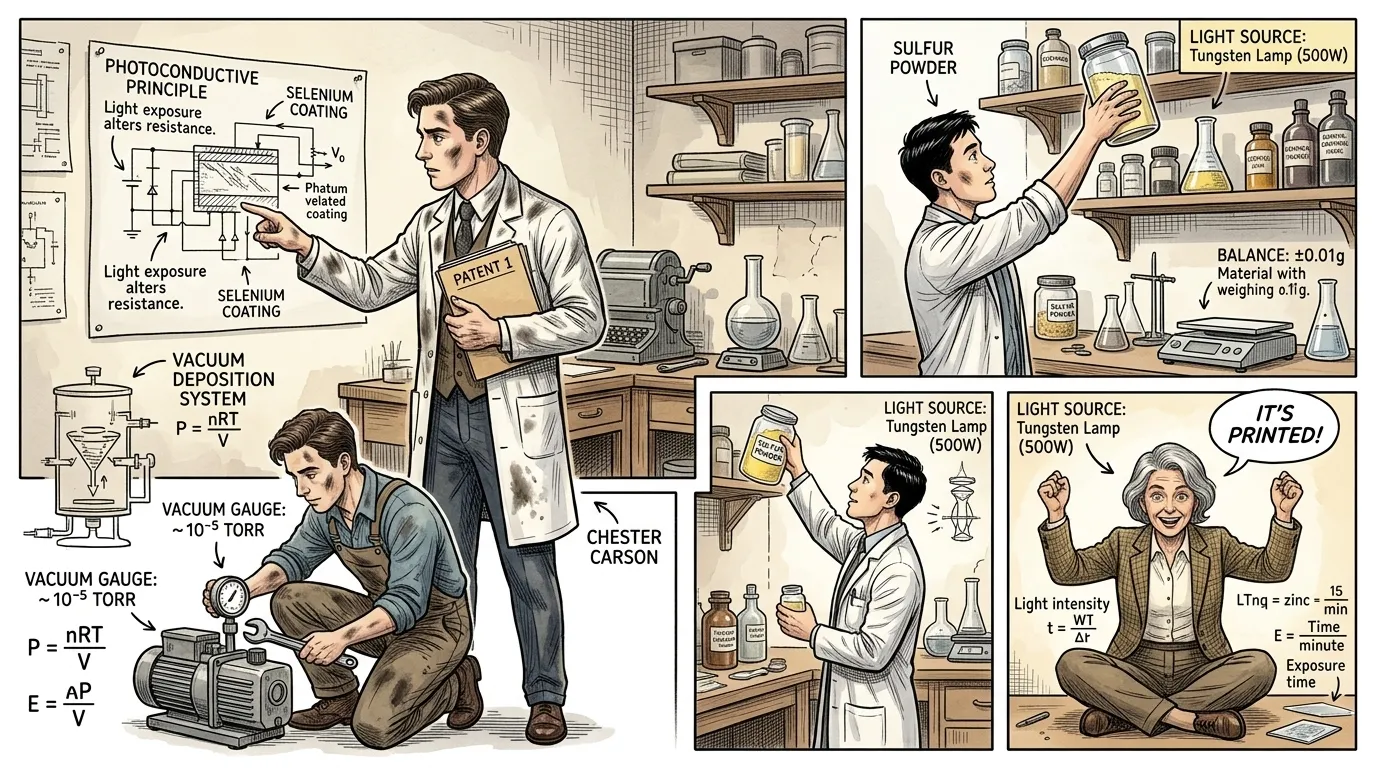
Chester Carlson's daily grind as a patent attorney fueled his obsession. The endless copying of legal documents, often by hand or through inefficient means, highlighted a glaring inefficiency in the modern office. He sought a method that was clean, dry, and immediate, envisioning a future where information could be duplicated almost effortlessly, without the need for inks or wet chemicals.
"Carlson, in his lab, mused aloud to himself, clutching a thick patent file, 'Each new patent, each legal brief, demands copies. It's a fundamental necessity, yet we're still wrestling with antiquated methods.' He then addressed an imaginary assistant, 'As Ralph Waldo Emerson said, 'Shallow men believe in luck. Strong men believe in cause and effect.' I believe in a cause: light and static electricity. And I intend to master its effect for printing.' He pointed to a schematic. 'The principle of photoconductivity – the way certain materials conduct electricity when light hits them – that's our key. If we can control that charge, we can control the image. But the challenge is immense: how to make that image tangible, dry, and permanent.'"
Page 4
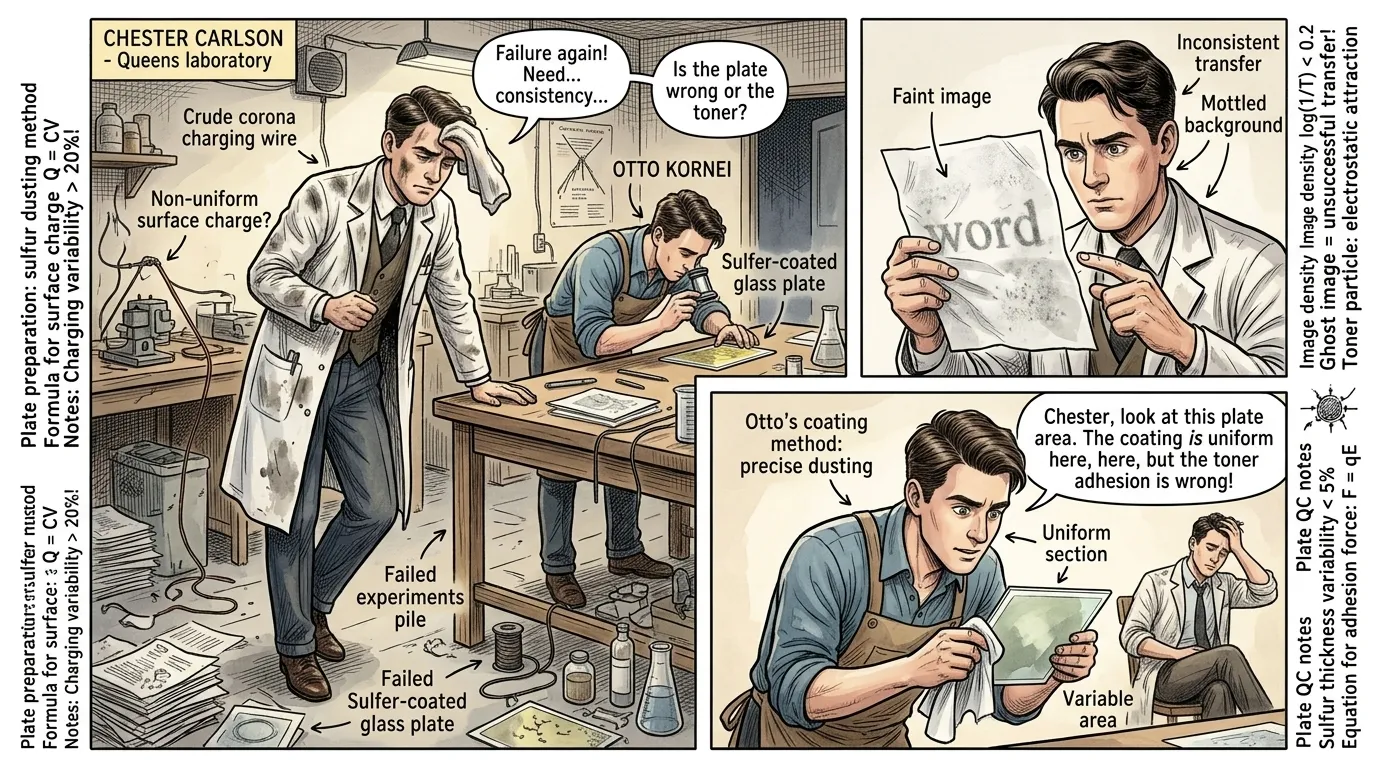
Carlson's journey was not one of immediate triumph. His early experiments were a testament to persistence in the face of repeated failure. Working with rudimentary equipment in his small Queens laboratory, he explored various photoconductive materials like sulfur, attempting to harness their elusive properties to form an image. The process was messy, unreliable, and often yielded nothing more than smudges or faint, unreadable traces.
"Carlson, wiping a smudge from his brow, muttered to his assistant, Otto Kornei, 'This sulfur layer is incredibly delicate. The charges dissipate too quickly, or the powder spreads unevenly.' Kornei, a meticulous man in his late 20s with dark hair, replied, 'Indeed, Mr. Carlson. The static adhesion is inconsistent. We apply the charge, expose it, but the toner particles simply aren't binding with enough precision.' Carlson picked up a failed test sheet, 'Look at this! Another ghost of an image. The principle is sound, but its practical application is proving far more stubborn than anticipated. We need better control over the charge, the light, and the toner itself.'"
Page 5
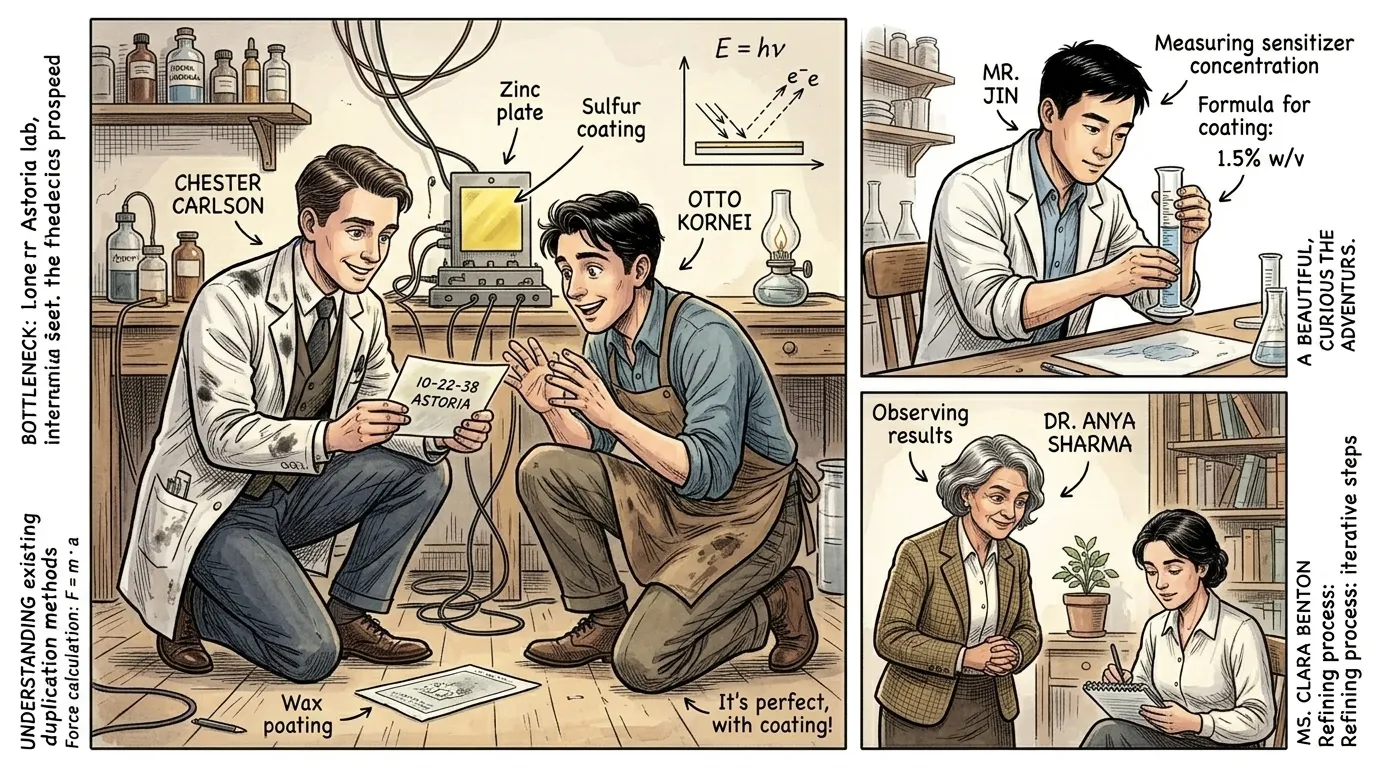
After years of tireless experimentation, a pivotal breakthrough finally arrived. On October 22, 1938, in his Astoria lab, Carlson, with the help of Otto Kornei, successfully produced the first clear xerographic image. Using a zinc plate coated with sulfur, a glass slide with '10-22-38 ASTORIA' inscribed on it, and a simple lamp, they captured an electrostatic image and transferred it using lycopodium powder and wax paper. It was a crude process, but the results were undeniable: a dry, stable copy.
"Carlson, his eyes wide with a mixture of exhaustion and exhilaration, exclaimed to Kornei, holding up a wax paper sheet, 'Otto, look! It's legible! '10-22-38 ASTORIA'. The charge held, the powder adhered, and the transfer worked!' Kornei, equally amazed, leaned closer. 'The selenium coating, even on this crude setup, maintained the electrostatic charge perfectly. And the lycopodium powder... it clung to the charged areas just as you theorized, Mr. Carlson!' Carlson smiled, 'This isn't just a copy, Otto. This is the future of information. The dry process, the clarity... it changes everything for document reproduction!'"
Page 6
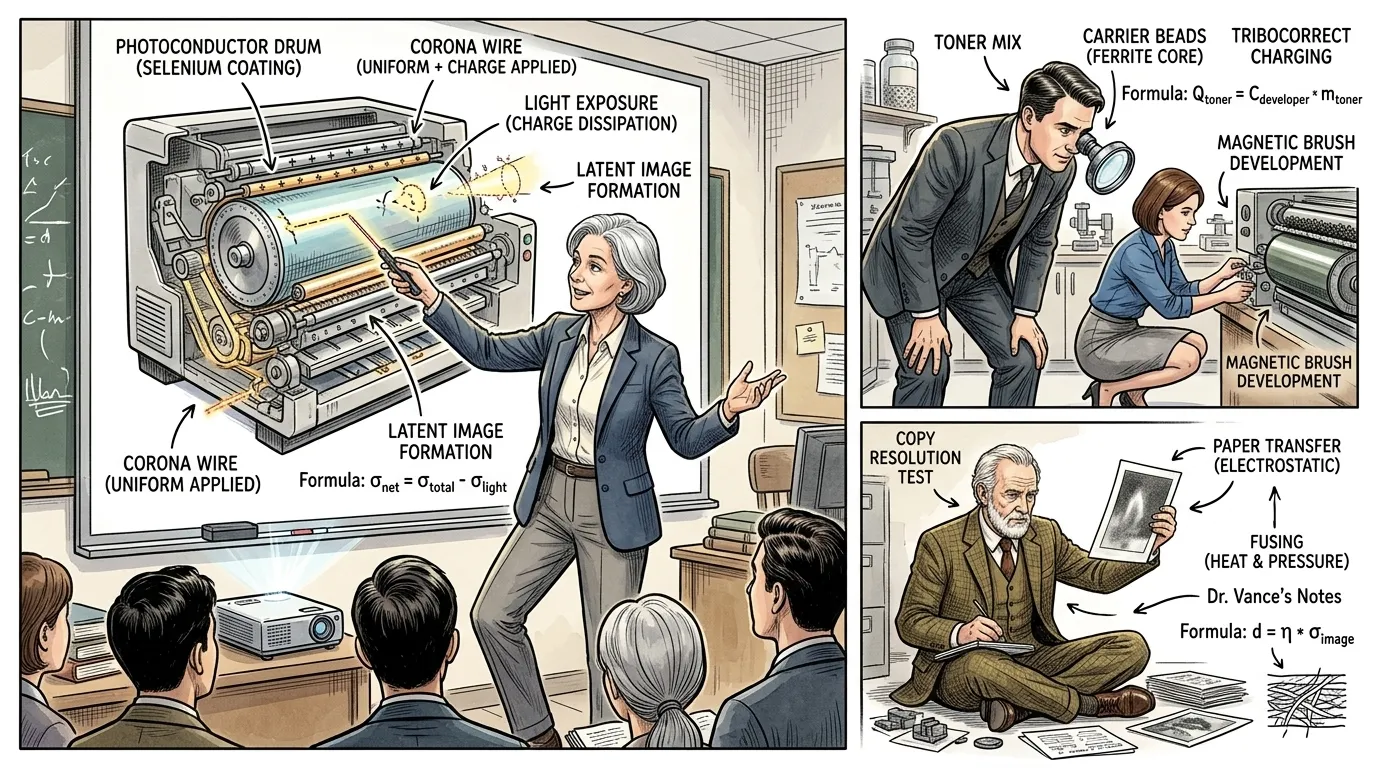
The core of Carlson's invention, later termed xerography (from Greek 'xeros' meaning dry, and 'graphos' meaning writing), lies in a revolutionary dry electrostatic process. It begins with a photoreceptor, typically a drum coated with a photoconductive material like selenium. This drum is crucial, acting as the canvas for the invisible image before it is transferred to paper.
"An experienced engineering lecturer, Dr. Eleanor Vance, in her 60s with neatly styled silver hair, wearing a tailored blazer, points to a detailed cutaway diagram. 'The process initiates with a corona wire applying a uniform electrostatic charge, typically positive, across the entire surface of the photoreceptor drum.' She traces a line on the diagram. 'This drum is the heart of the machine. Next, the original document is illuminated, and its image is projected onto the charged drum. Crucially, the photoconductive material on the drum loses its charge when exposed to light.' She highlights a section. 'This means areas corresponding to the white parts of the original document become discharged, while the dark text or images retain their positive charge, forming an invisible 'latent image' on the drum.'"
Page 7
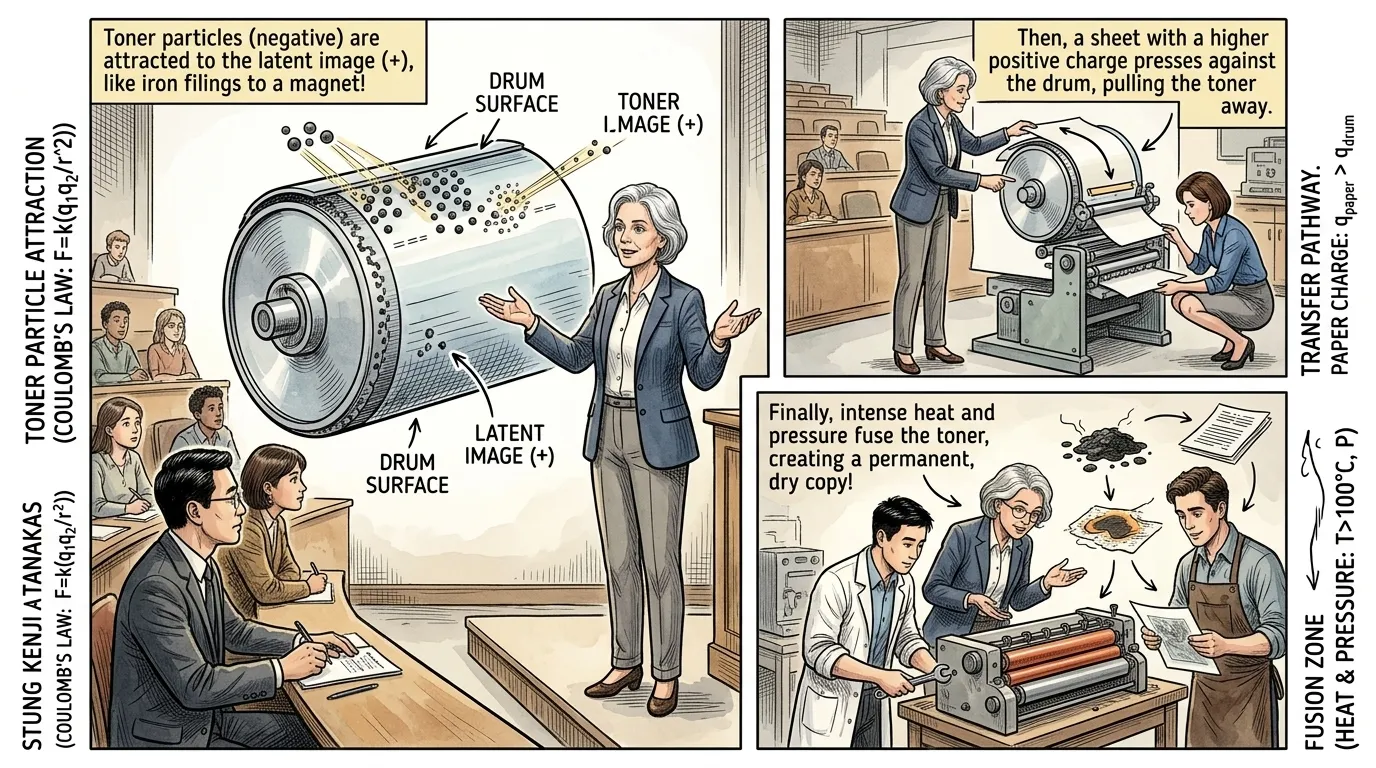
Once the latent electrostatic image is formed on the photoreceptor drum, the next critical step is to make this invisible image visible and permanent. This involves the application of toner and a precise transfer and fusing process, transforming the ephemeral electrostatic charges into a durable, physical copy on paper.
"Dr. Vance continues, indicating the diagram's next stage, 'The drum then rotates past a developer unit. Here, finely ground toner particles, typically negatively charged, are attracted to the positively charged areas of the latent image on the drum.' She gestures as if watching the particles move. 'Because opposite charges attract, the toner selectively adheres to the text and image areas, effectively making the invisible image visible as a fine powder.' She then moves to the paper path. 'A sheet of paper, given a stronger positive charge, then presses against the drum, drawing the toner particles from the drum onto the paper. Finally, the paper passes through a fuser assembly where heat and pressure permanently bond the toner to the paper fibers, creating a durable, dry copy. The drum is then cleaned, ready for the next cycle.'"
Page 8
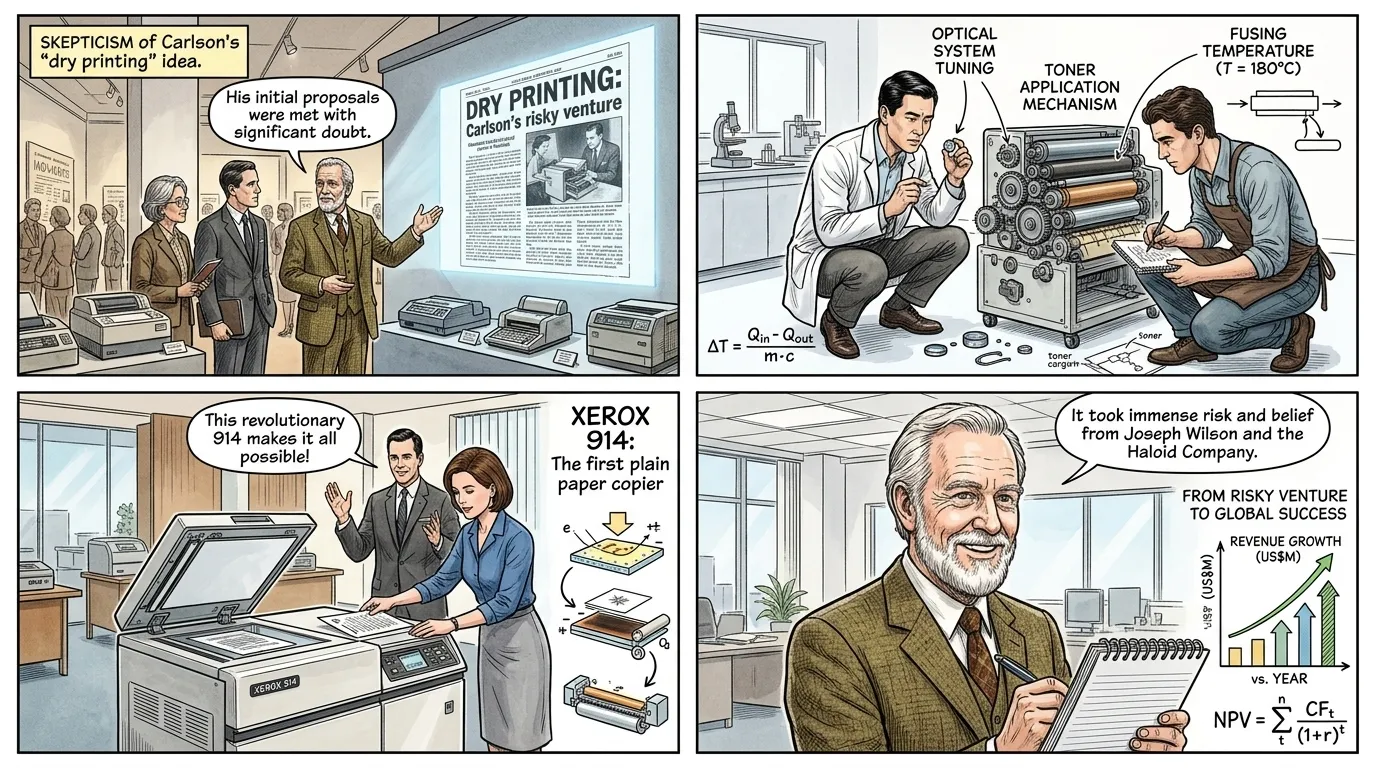
Despite Carlson's breakthrough, his invention languished for years. Major corporations, skeptical of a 'dry printing' method, rejected his patents. It wasn't until 1944 that the Battelle Memorial Institute, a non-profit research organization, saw the potential. They invested in further development, eventually partnering with a small photographic paper company called Haloid, which would later be renamed Xerox Corporation.
"A distinguished business historian, Dr. Julian Thorne, in his 70s with a neatly trimmed beard and a tweed suit, stands before a display of early Xerox machines. 'Carlson faced immense skepticism. Imagine trying to convince companies to abandon established printing methods for an untested electrostatic process.' He then turns to a projected image of a vintage newspaper ad. 'The Haloid Company, under President Joseph C. Wilson, eventually took the risk. As Benjamin Franklin wisely stated, 'Without continual growth and progress, such words as improvement, achievement, and success have no meaning.' They saw the meaning in Carlson's invention.' He gestures to a photograph of the Xerox 914. 'The introduction of the Xerox 914 in 1959 was truly revolutionary, the world's first successful automatic, push-button office copier. It proved that electrophotography could be reliable, fast, and commercially viable.'"
Page 9
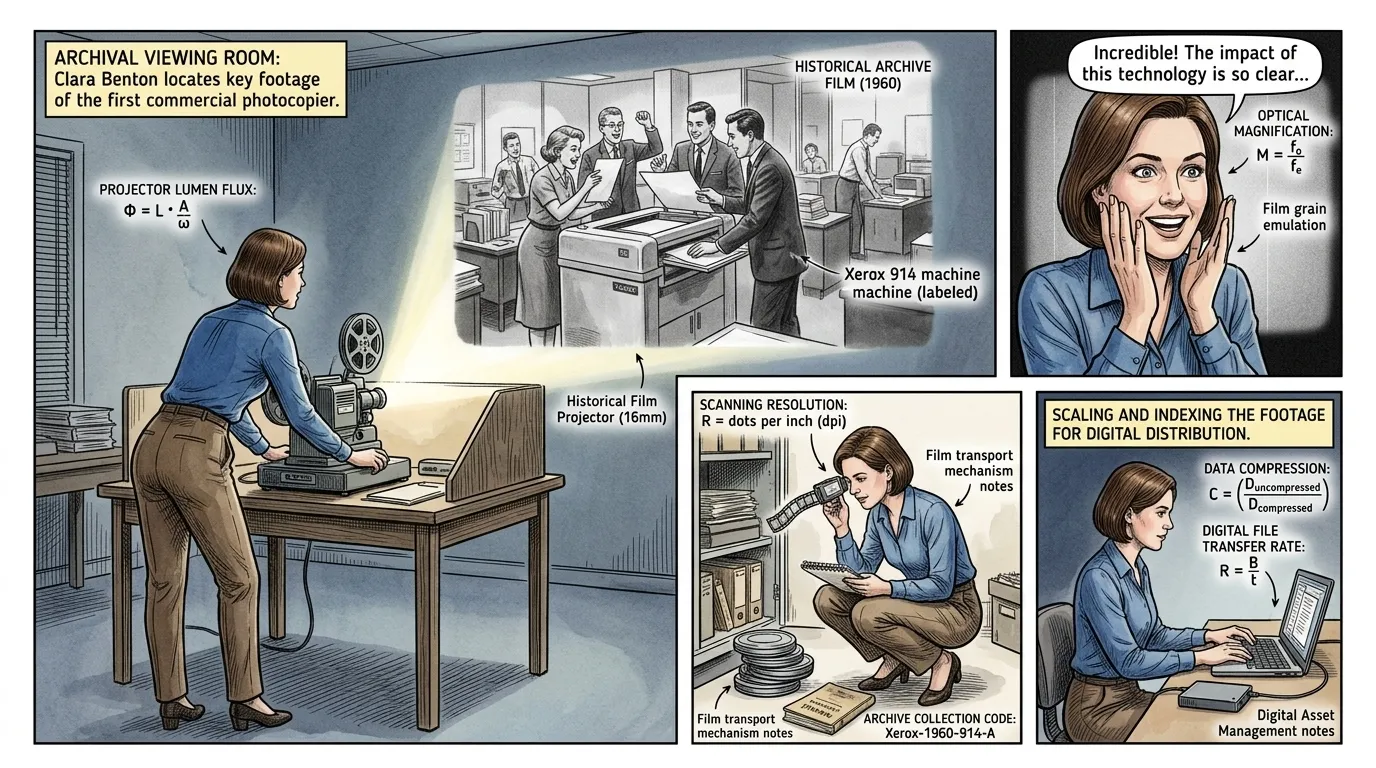
The Xerox 914 was an immediate sensation. Its ease of use and ability to produce high-quality, dry copies at speed transformed offices globally. Suddenly, businesses, educational institutions, and government agencies could duplicate documents with unprecedented efficiency, fostering an explosion of information sharing and collaboration that reshaped workflows and accelerated progress across countless fields.
"An archival researcher, Ms. Clara Benton, in her 40s with a practical bob haircut and a smart blouse, views historical footage projected onto a wall. 'The 914 didn't just copy; it liberated information. Think back to our discussions on photoconductivity on page two—who would have imagined that fundamental electrical property would become the engine of this global information revolution?' She gestures toward the screen. 'Office workers, once bogged down with manual tasks, were suddenly empowered. Teams could share data instantly, fostering an unprecedented level of collaboration. Scientists could disseminate research faster, and students gained easier access to learning materials.' She smiles, 'The photocopier democratized information, plain and simple.'"
Page 10
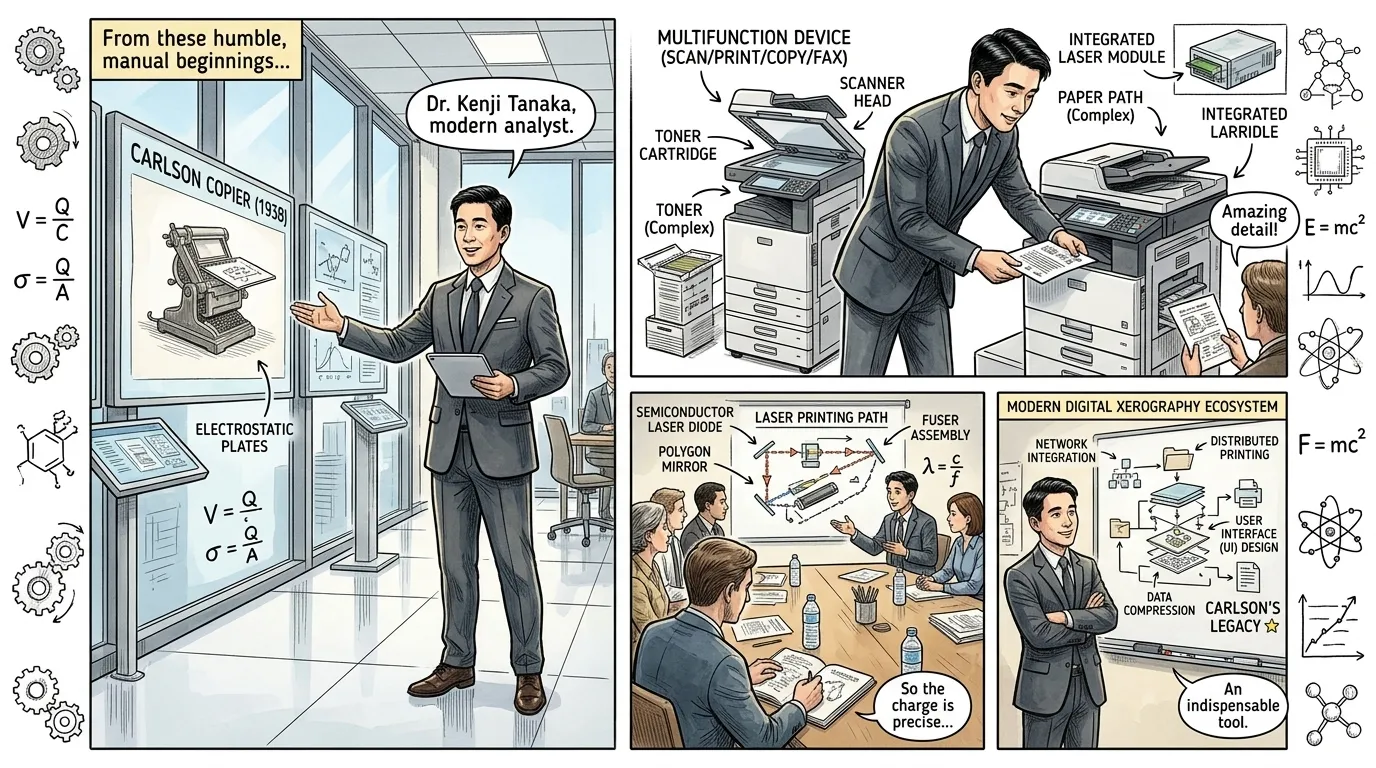
The photocopier's legacy extends far beyond its original form. Its core principles of xerography laid the groundwork for laser printing and eventually integrated into multifunction devices that scan, print, copy, and fax. While the digital age brought new methods of information sharing, the fundamental need for physical document reproduction, refined and enhanced by Carlson's vision, continues to be a cornerstone of modern communication.
"A contemporary technology analyst, Dr. Kenji Tanaka, in his 50s with short, styled black hair and a modern business suit, reflects, 'From Carlson's cramped lab to the ubiquitous machines in every office, the photocopier's principles underpin how we interact with physical information. Its evolution into multifunction devices has only broadened its reach, making it an indispensable tool for both individuals and corporations.' He gestures towards a series of panels. 'Even in a world dominated by screens, the ability to produce a tangible copy—a contract, a report, a cherished photograph—remains vital. The photocopier's impact on education, commerce, and daily life is immeasurable, a testament to one man's relentless pursuit of a dry, efficient copy.'"
About this story
- Location: Global
- Audience: general readers
Read Wonder Inventions on your phone
Wonder Inventions is available on Android. Get Wonder Inventions on Google Play.