Power Grid
Power Grid — an illustrated inventions story, set in Global. 10 illustrated pages, free to read on Wonder Inventions.
Page 1
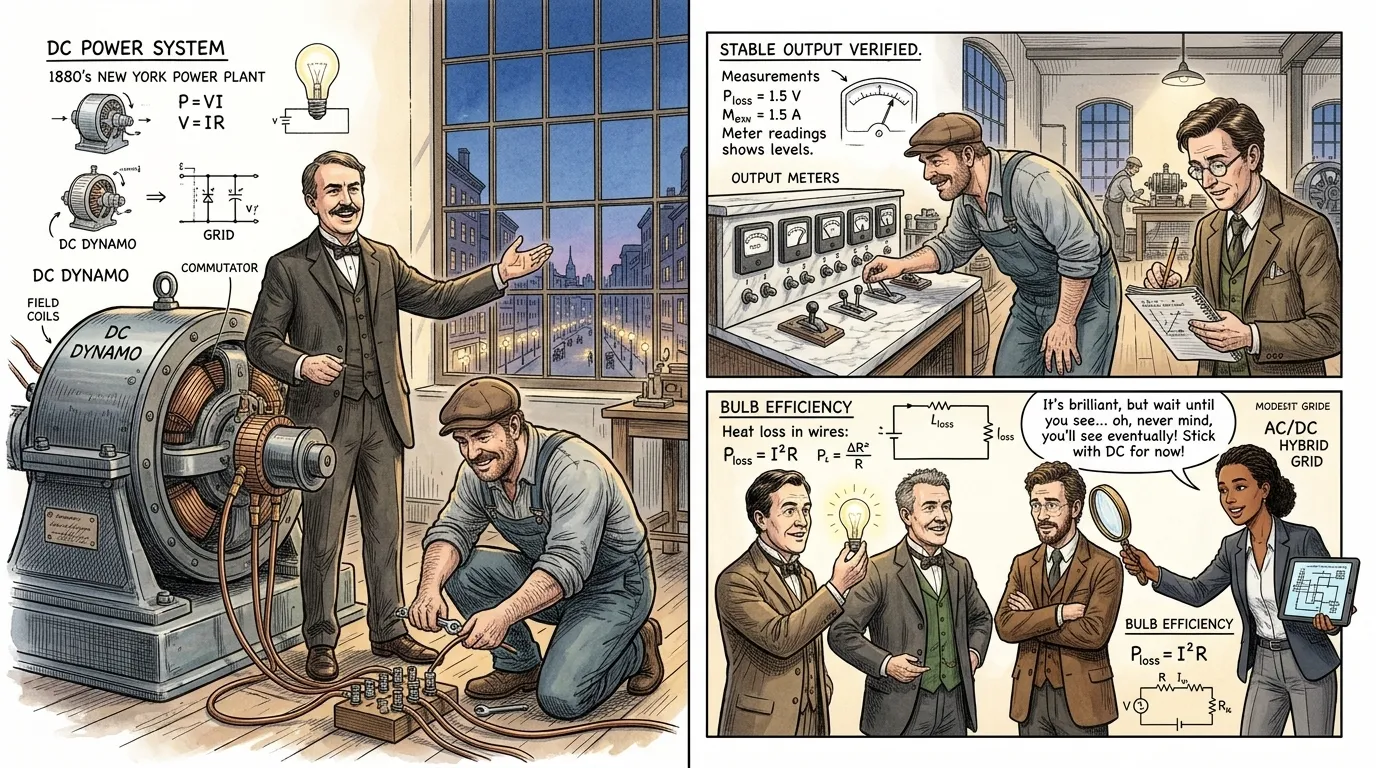
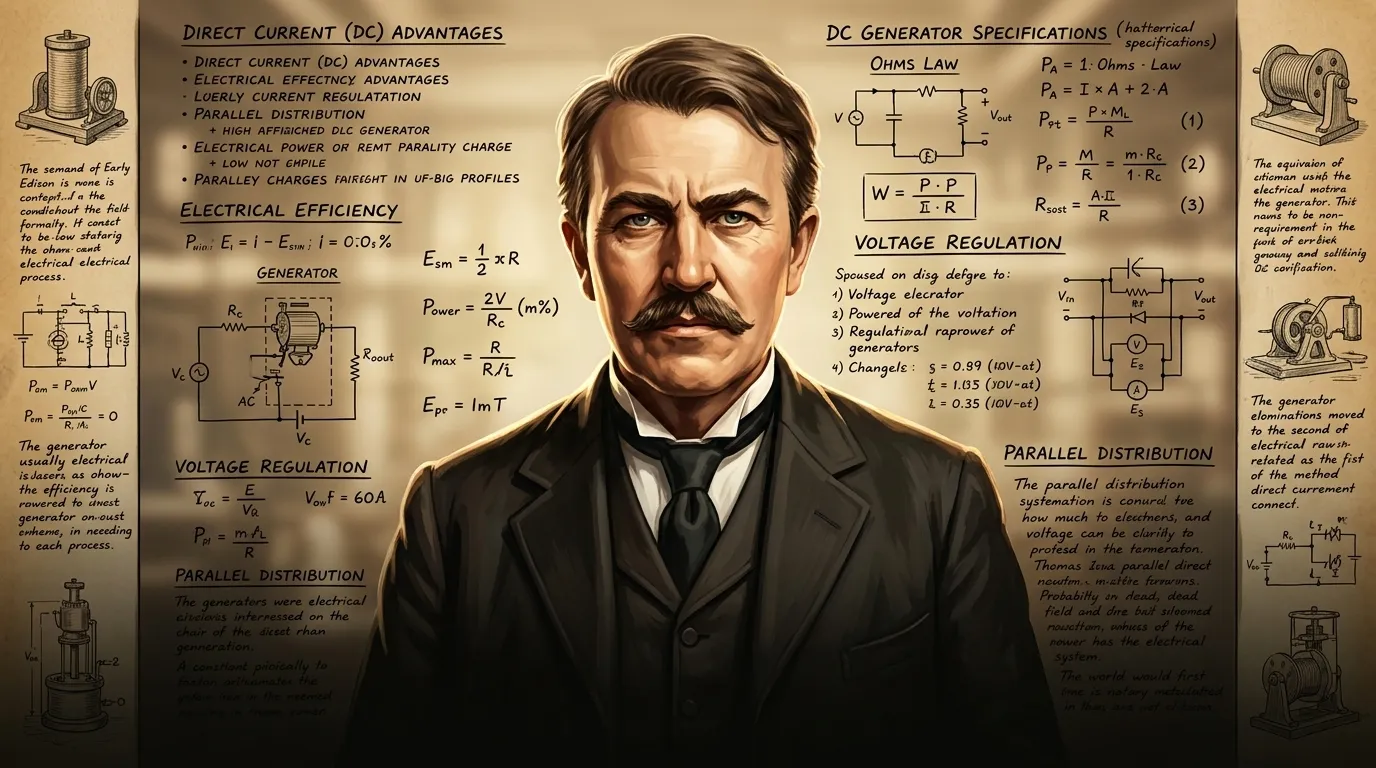
In the late 19th century, urban centers flickered to life, but only in isolated pockets. The promise of electric light was revolutionary, yet its reach was agonizingly limited. Early systems faced immense challenges in distributing power beyond a few city blocks.
"'This dynamo illuminates Pearl Street,' Thomas Edison declared, gesturing to the humming machinery. 'It serves our immediate needs, providing light to a few hundred eager subscribers in New York City. The challenge remains: how do we bring this brilliance to every corner?'"
Page 2
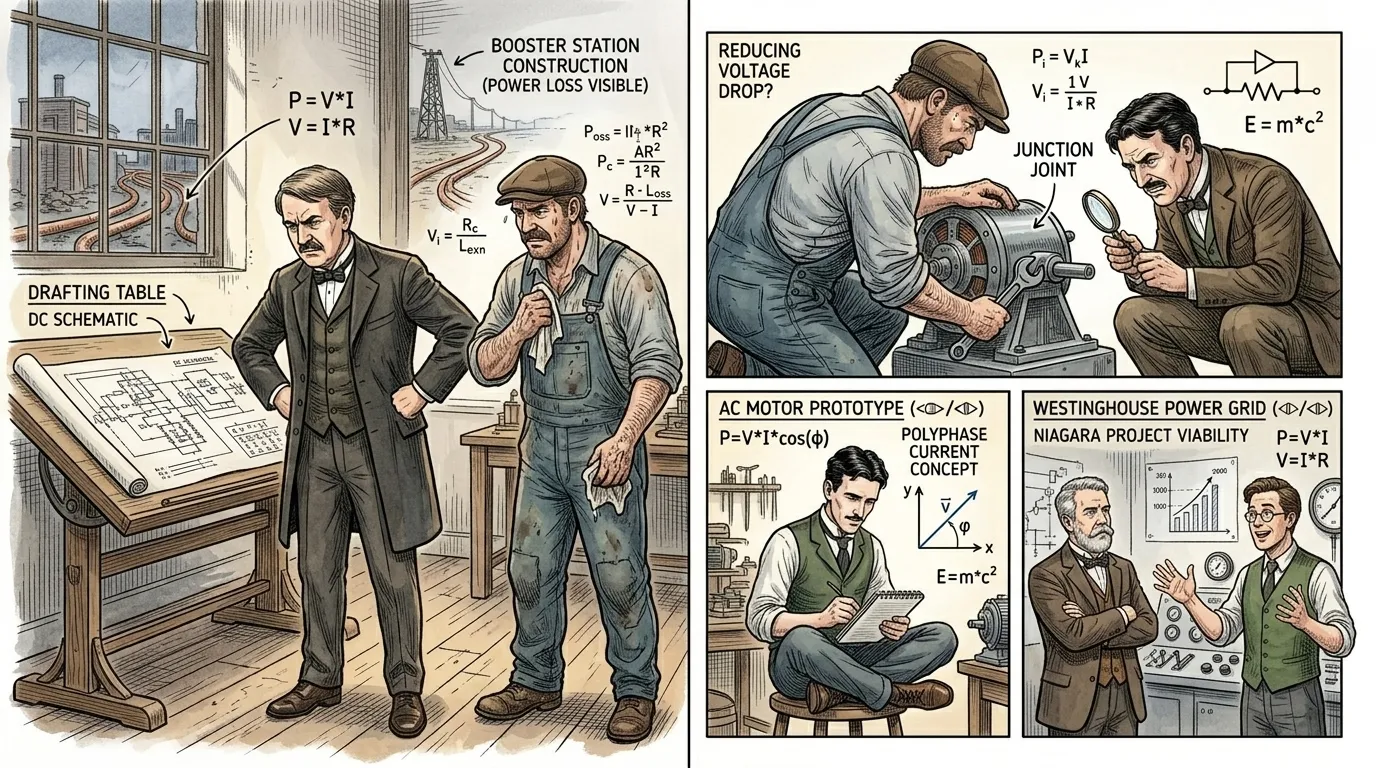
Direct current, or DC, was Edison's chosen method, efficient for short distances but plagued by fundamental limitations over sprawling urban landscapes. Voltage drop was an inherent hurdle, requiring power stations every few miles, making widespread distribution impractical and costly.
"A foreman, a burly man with a thick mustache and sweat on his brow, wipes his hands on his worn work overalls. 'Another booster station, Mr. Edison? The copper lines bleed power too quickly. We lose so much current trying to reach even a few blocks further!' Edison, hands on hips, frowns at a schematic. 'Indeed, the resistance is formidable. Every meter of wire means more loss, more expense. It seems nature dictates our reach.'"
Page 3
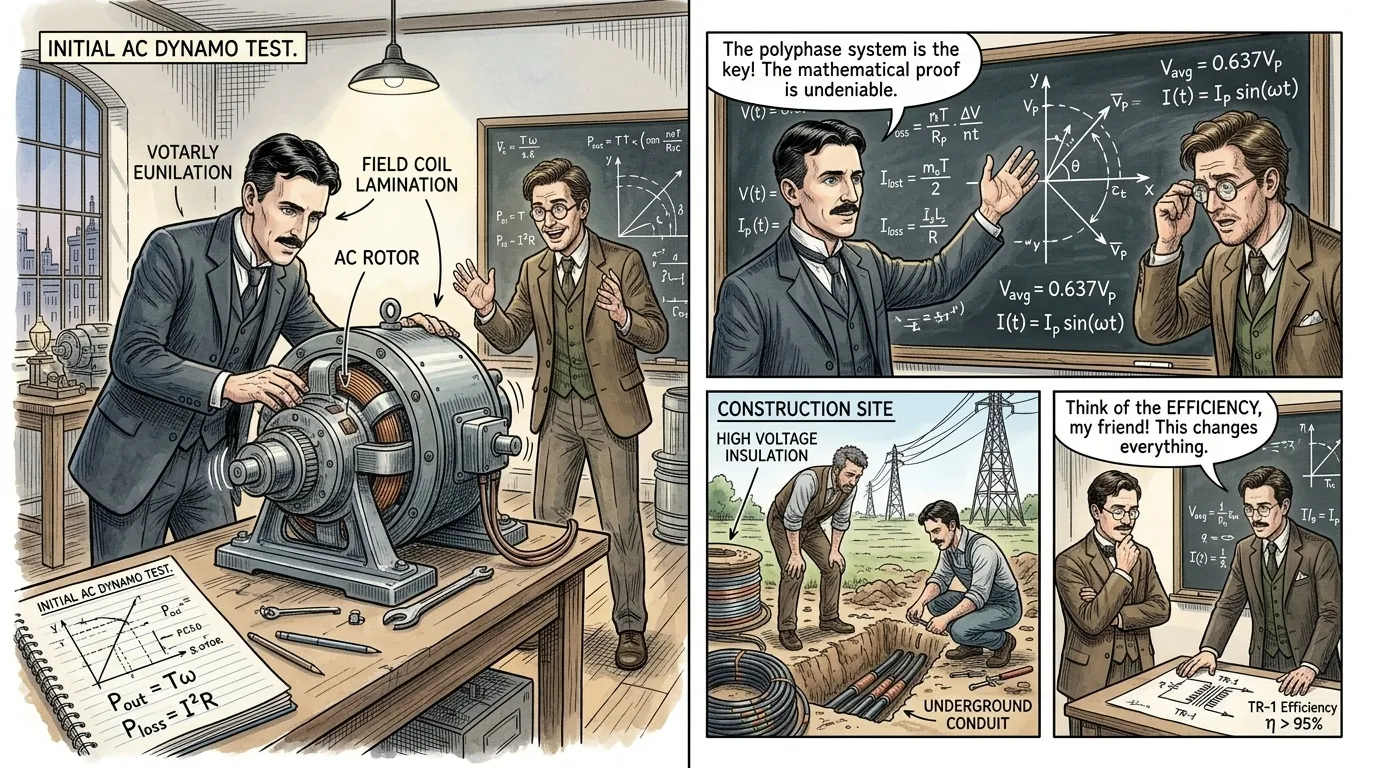
The limitations of direct current spurred many brilliant minds to seek alternatives. The scientific community grappled with the idea of a more flexible form of electricity, one that could be transformed and transmitted with greater efficiency over vast distances, a concept that seemed almost magical at the time.
"Nikola Tesla, a slim man with sharp features, intense blue eyes, and a neat dark mustache, stands before a blackboard covered in complex mathematical equations and circuit diagrams. He gestures emphatically. 'The alternating current holds the key! It flows, reverses, and can be stepped up and down with elegant simplicity, unlike the static burden of DC. We need a system that harnesses this wave, not fights it.' A fellow engineer, a man with a tired but intrigued expression, adjusted his spectacles. 'But the physics, Mr. Tesla... the motor, the generation... it feels like chasing a phantom force.'"
Page 4
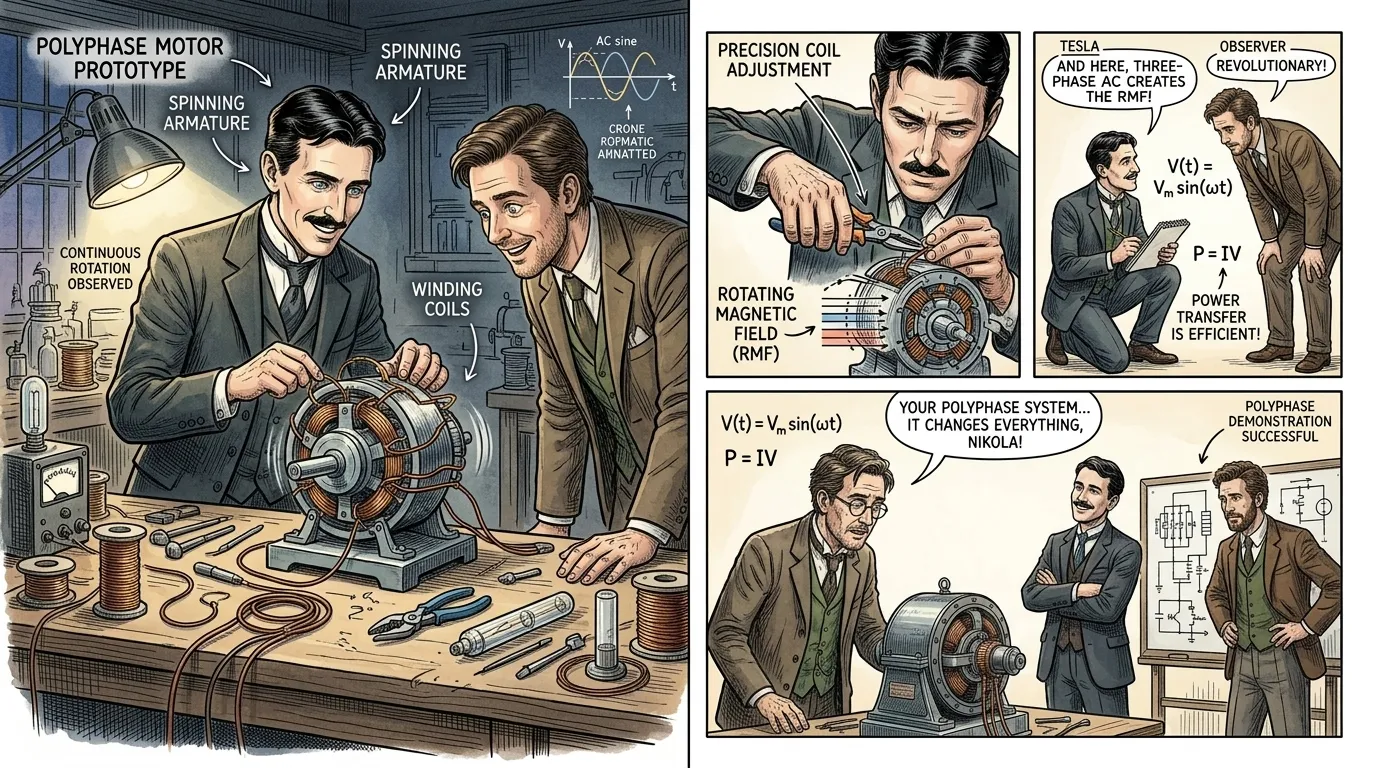
Nikola Tesla, after emigrating to America and a brief, tumultuous stint with Edison, conceived a radical solution. He envisioned a system where electric currents would alternate direction in a synchronized sequence—a polyphase alternating current. This elegant concept would allow for the creation of self-starting motors.
"Tesla, his eyes gleaming with excitement, carefully manipulates a small, intricately wired prototype on his workbench. 'See here, the rotating magnetic field! Two or more alternating currents, slightly out of phase, create a continuous, smooth rotation. No brushes, no commutator! This means efficiency, reliability!' An impressed observer, a man of similar age with a curious expression, leans closer. 'A self-starting motor? Mr. Tesla, this changes everything for industrial applications! Imagine factories powered without constant adjustments.'"
Page 5
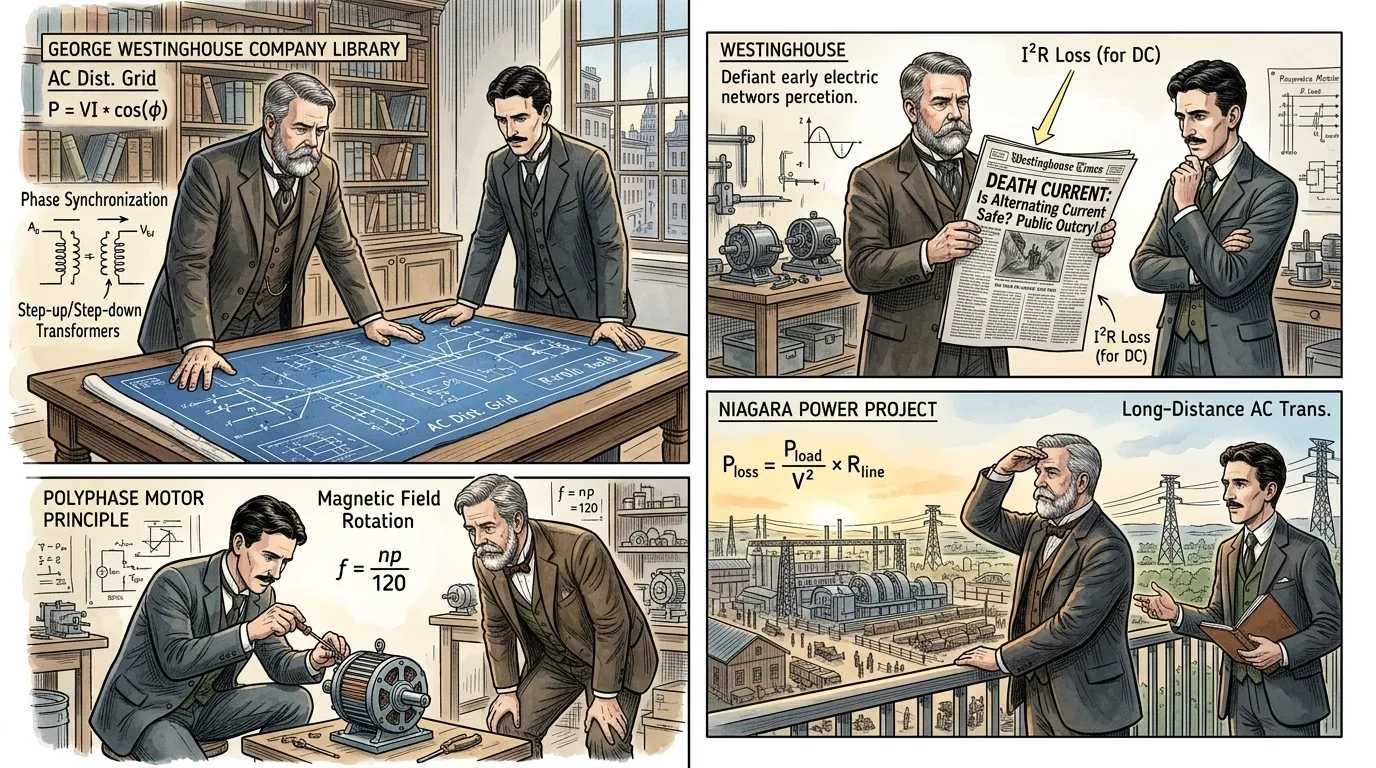
While Tesla patented his polyphase AC system, the established order remained largely invested in DC. Thomas Edison, a staunch advocate for his direct current, launched a public relations campaign against AC, highlighting its perceived dangers, marking the beginning of the infamous 'War of the Currents.'
"George Westinghouse, a distinguished man with a well-groomed beard and formal business attire, reviews technical drawings with Tesla. 'Your system, Mr. Tesla, it is undeniably superior for transmission. The ability to transform voltage up for long distances, then down for safe consumption, is its genius!' Westinghouse then turns to a newspaper headline depicting AC as dangerous. 'Edison's fearmongering will not deter us. We must demonstrate its safety and efficiency on a grand scale.'"
Page 6
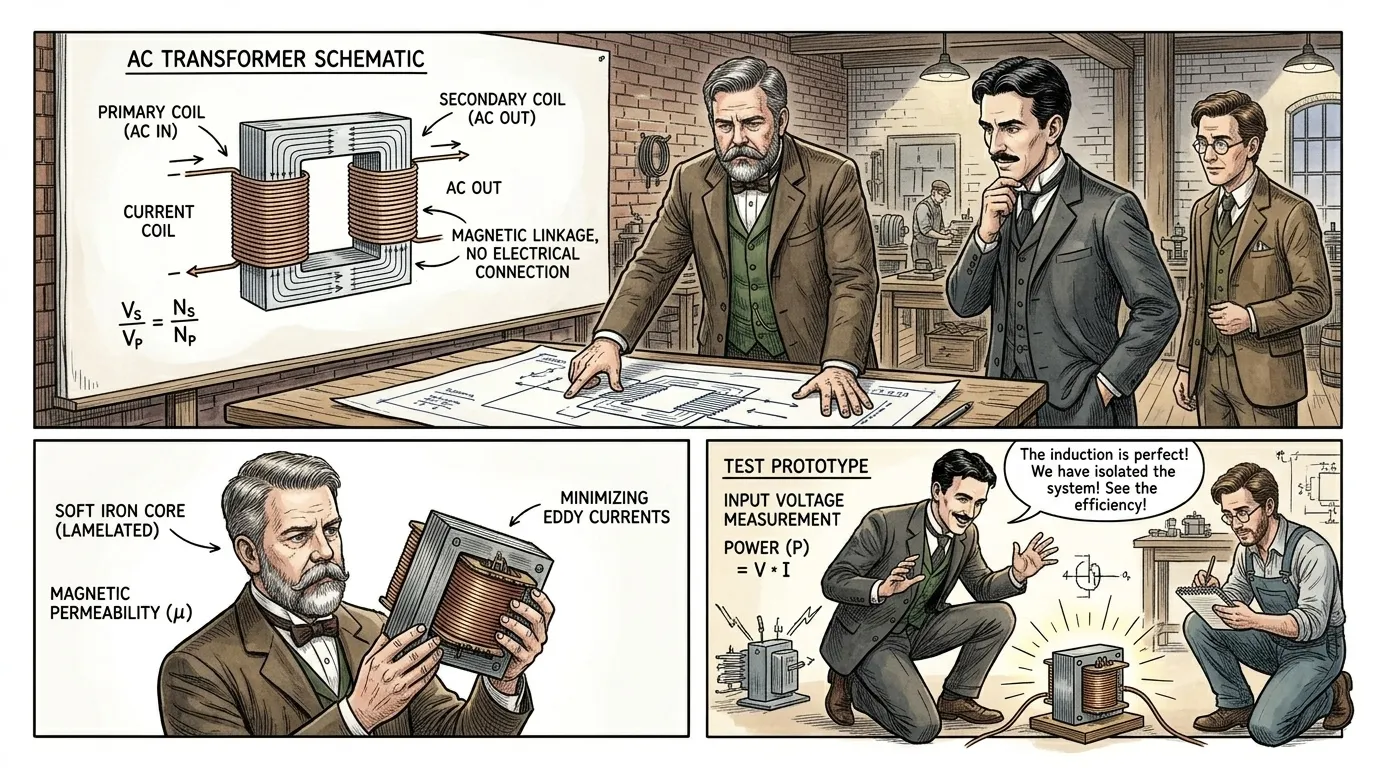
The true genius of alternating current lay in the transformer, a device allowing voltage to be stepped up or down with remarkable ease. This simple yet profound mechanism made long-distance, efficient power transmission economically viable, something impossible with DC.
"'Observe the transformer,' Westinghouse explains, pointing to a diagram. 'Two coils, magnetically linked, but not electrically connected. An alternating current in the primary coil induces a current in the secondary. Vary the coil turns, and we 'transform' the voltage—up for efficiency in transmission, down for safety in homes.' Tesla nods. 'Indeed. The electromagnetic induction is the dance. The voltage adjusts itself to the need, unlike DC's stubbornness.'"
Page 7
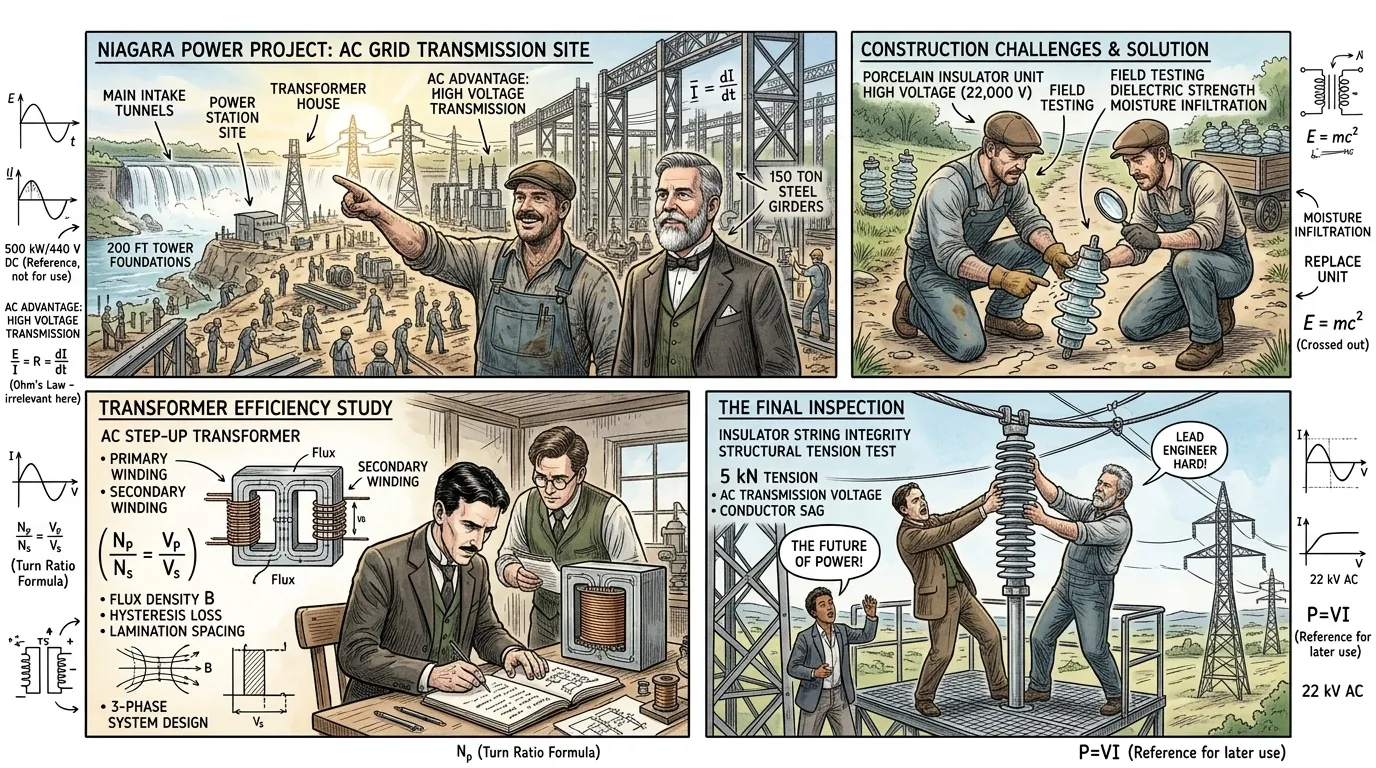
With the transformer and polyphase motors, the components for a truly interconnected power grid were in place. Westinghouse, backed by Tesla's patents, began constructing the first major AC power systems, setting the stage for a revolution in energy distribution.
"A lead engineer, a robust man with oil smudges on his face, surveys a vast construction site filled with steel girders and nascent electrical infrastructure. 'The transmission towers rise, Mr. Westinghouse! Kilometers of wire, carrying power from a single distant source! We are connecting cities, industries, truly building a network.' Westinghouse, looking out over the site, smiles. 'As Ralph Waldo Emerson once wrote, 'Build a better mousetrap, and the world will beat a path to your door.' We are building a better pathway for progress itself. This grid will power a new era.'"
Page 8
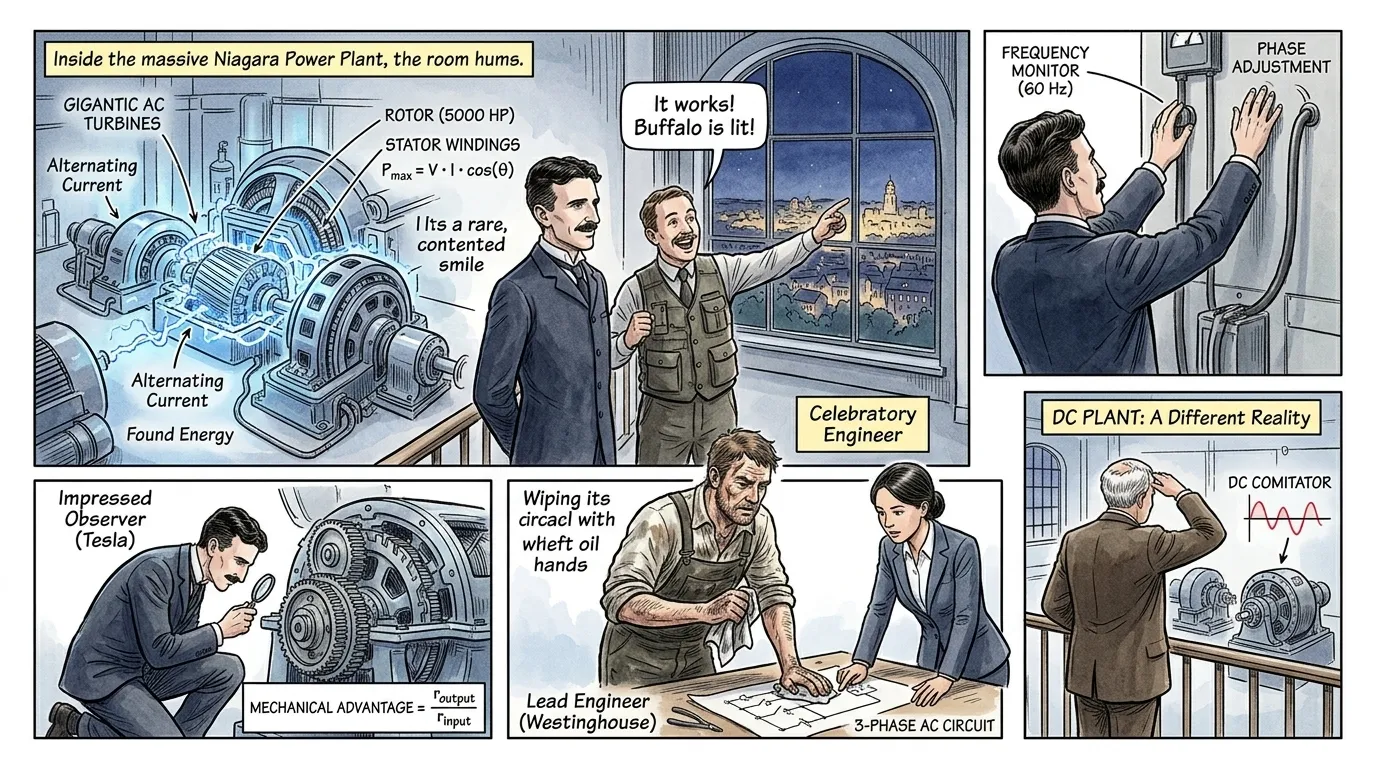
The crowning achievement of the early AC power grid was the harnessing of Niagara Falls. This monumental project, completed in 1896, saw Tesla's AC generators, manufactured by Westinghouse, deliver electrical power over 20 miles to Buffalo, New York, proving AC's long-distance capabilities beyond all doubt.
"'Buffalo now shines with our power!' a celebratory engineer exclaims, gazing at a distant, softly glowing cityscape. 'From the very force of Niagara, we illuminate homes and drive factories kilometers away!' Tesla, observing the humming turbines in the Niagara power plant, allows a rare, contented smile. 'A triumph of nature's raw power channeled by the unseen dance of alternating current. The waterfall now sings a song of progress.'"
Page 9
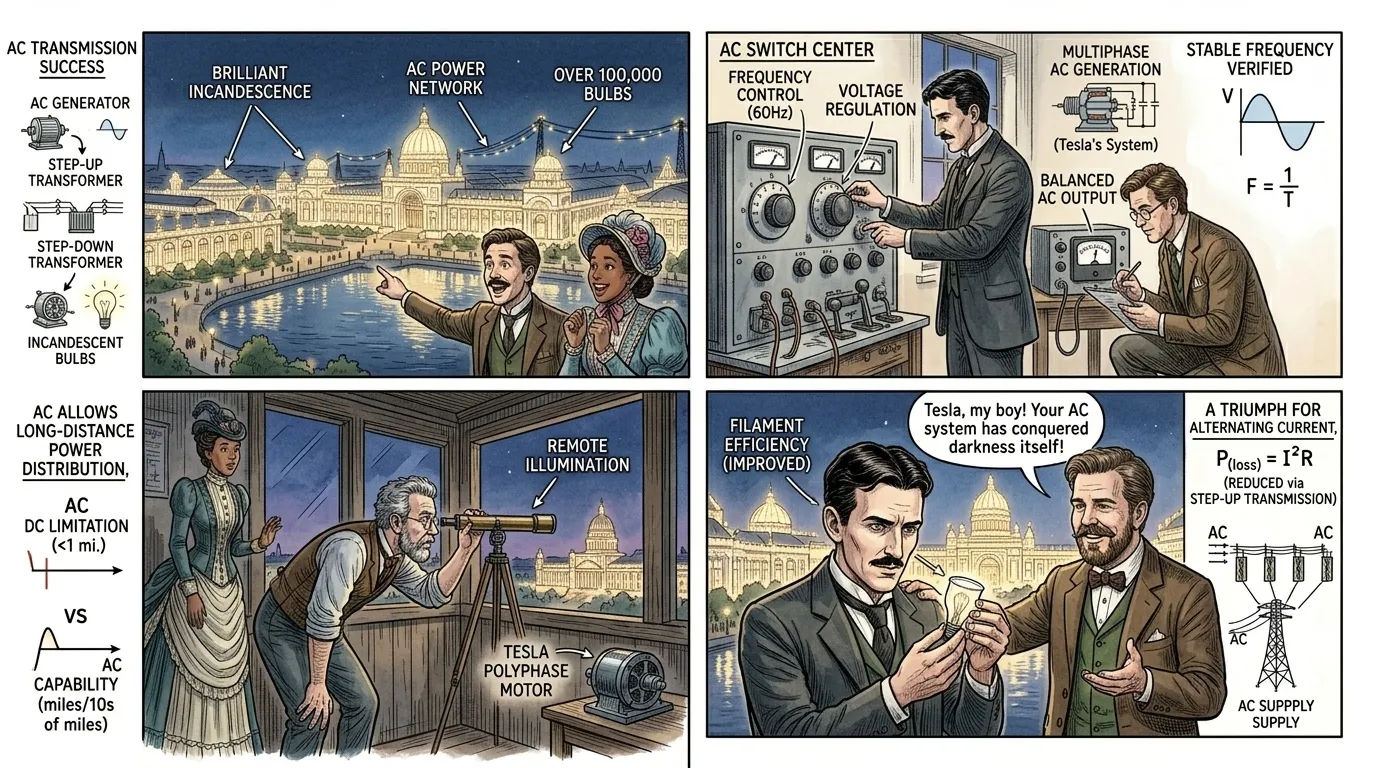
The 1893 World's Columbian Exposition in Chicago served as AC's spectacular debut on the global stage. Westinghouse, underbidding Edison's DC system, used Tesla's generators to illuminate the entire fairground, a dazzling spectacle that convinced the world of AC's superiority.
"A visitor, eyes wide with awe, points to the thousands of incandescent bulbs illuminating the grand fairgrounds. 'Look at it all! Every pavilion, every pathway, glowing with a steady, brilliant light! And from one central source?' Another visitor, dressed in fashionable late 19th-century attire, nods. 'Truly, it feels like we are witnessing the very future. This alternating current is nothing short of miraculous, making such grandeur possible.'"
Page 10
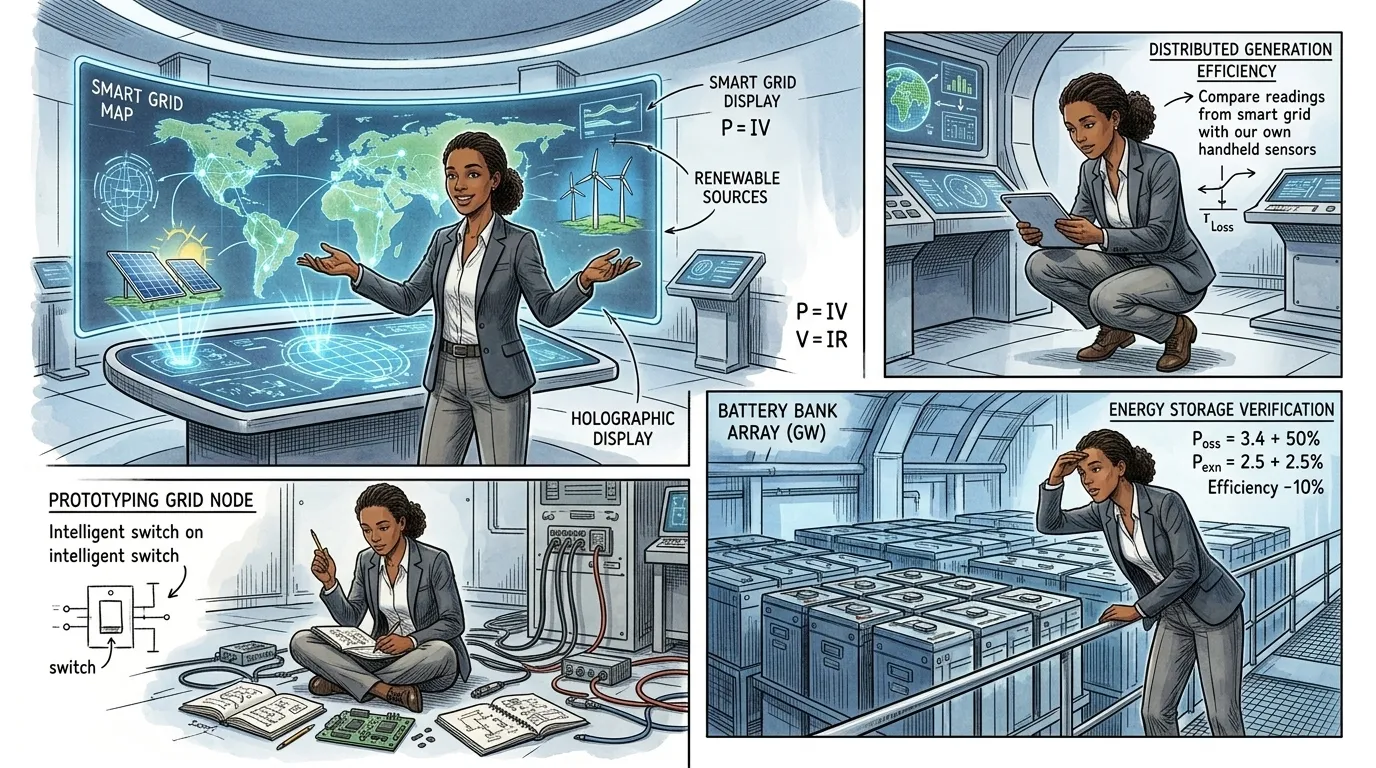
The foundational principles established by Tesla and Westinghouse reshaped civilization. The power grid, constantly evolving, has become the invisible backbone of modern society, delivering energy to homes, industries, and digital infrastructure across continents.
"An electrical engineer, a modern woman with a professional demeanor, stands before a control panel monitoring a vast contemporary smart grid map. 'From Niagara's first flicker to this global network, the power grid's evolution is continuous. Smart technologies now optimize flow, integrate renewables, and anticipate demand. The dream of universal access, first envisioned in those early AC battles, drives innovation still.' She gestures to a holographic display of clean energy sources integrating into the grid. 'The future of power is interconnected, sustainable, and always advancing.'"
About this story
- Location: Global
- Audience: general readers
Read Wonder Inventions on your phone
Wonder Inventions is available on Android. Get Wonder Inventions on Google Play.