Prosthetic Limb
Prosthetic Limb — an illustrated inventions story, set in Global. 10 illustrated pages, free to read on Wonder Inventions.
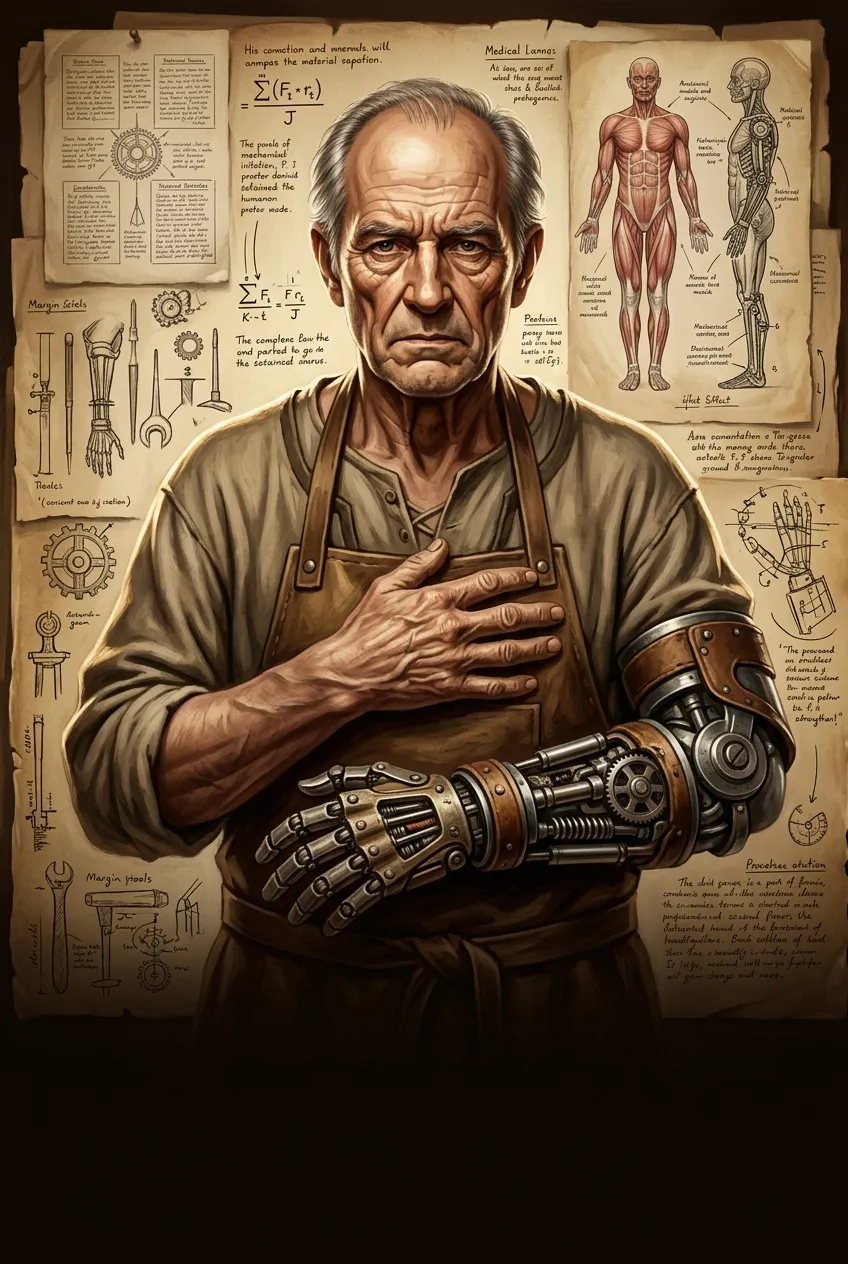
Page 1
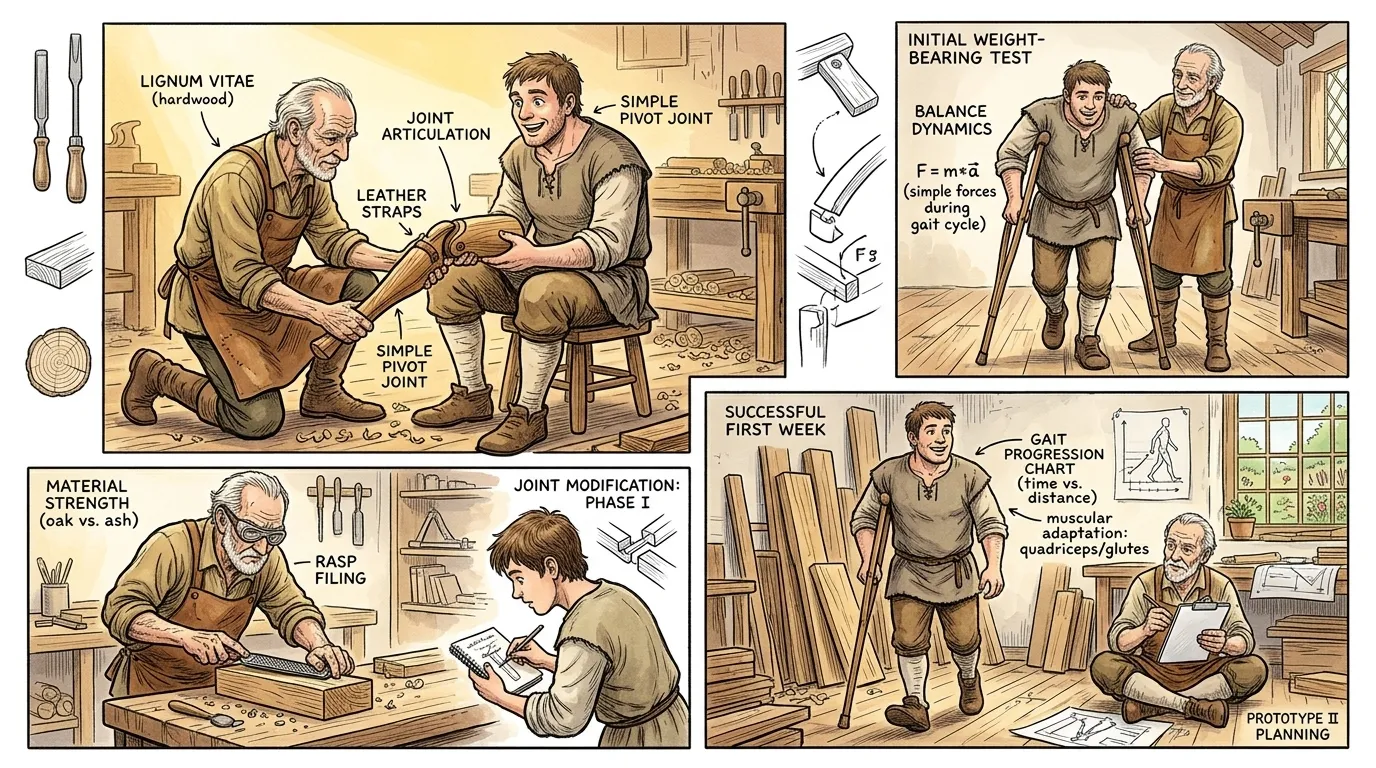
From antiquity, the loss of a limb presented one of humanity's most profound challenges, impacting survival, self-sufficiency, and identity. For millennia, those who suffered amputation faced a world ill-equipped to restore their function or dignity. Early attempts at prosthetic limbs were rudimentary, often serving more as a symbolic cover or a painful, ill-fitting brace than a true replacement.
"An aged, stoic craftsman, his hands gnarled from years of labor, carefully adjusts a wooden leg on a seated patient. "We strive to mend what fate has broken, but the wood offers little comfort against the bone," he murmurs, his voice heavy with the limitations of their time. The patient, a sturdy individual who had lost a leg in battle, sighs, testing the weight. "Yet, we must endure. As the philosopher Seneca observed, 'Difficulties strengthen the mind, as labor does the body.' We shall learn to walk again, however crudely.""
Page 2
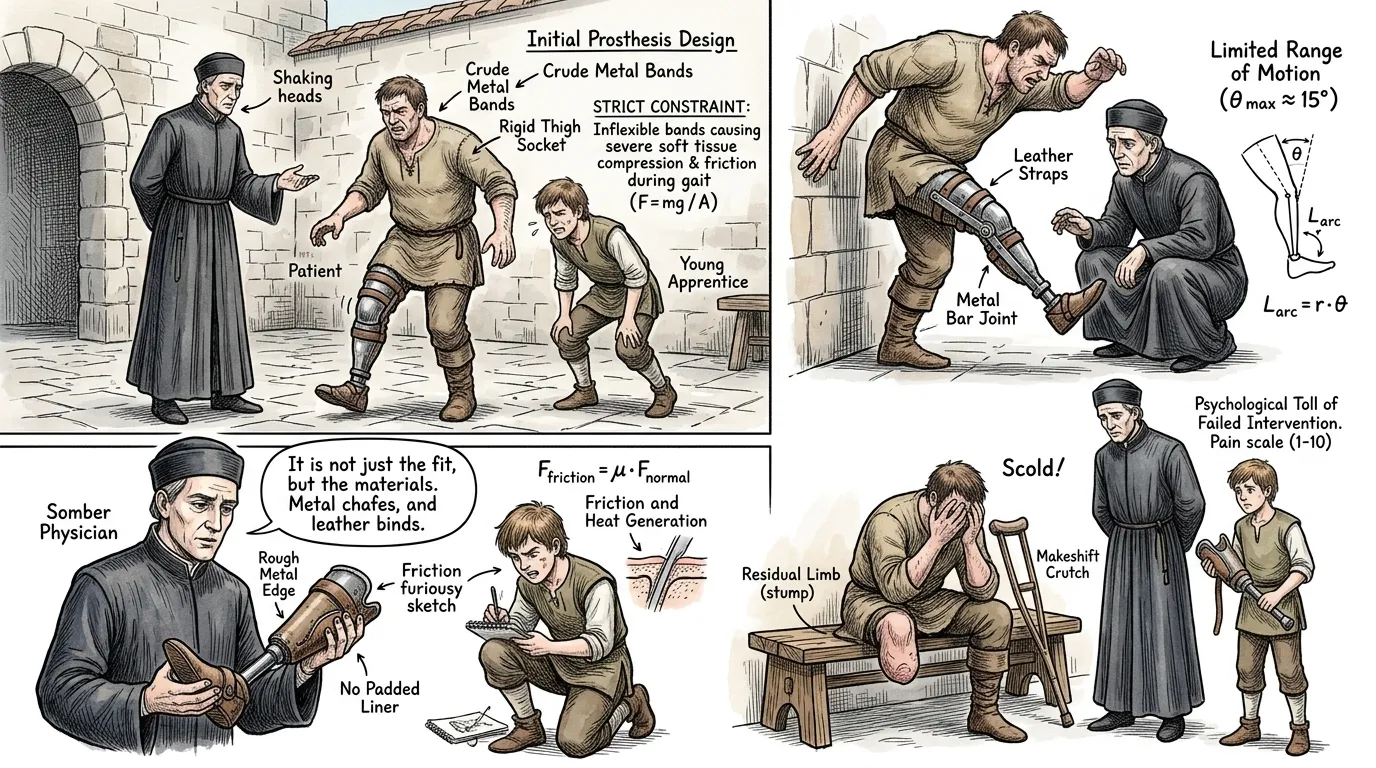
Across diverse cultures, the earliest prosthetic limbs served primarily as a means of disguise or a basic support. Evidence like the Capua Leg, an iron and bronze prosthetic from Roman times, showcased engineering attempts, yet comfort remained elusive. These devices were often heavy, cumbersome, and prone to chafing, offering minimal functional improvement and frequently causing as much pain as they alleviated. The challenge of creating a durable, lightweight, and truly wearable interface between flesh and material was immense.
"A somber physician, observing a patient struggling with an early metal prosthetic, shakes his head. "Our methods provide a semblance of form, but little ease," he remarks to a younger apprentice, gesturing towards the crude metal bands digging into the patient's skin. The apprentice winces. "The friction, the weight... it's a constant battle against the material itself. How can we truly integrate these devices without causing further suffering? The very weight of the metal feels like a burden, not a boon.""
Page 3
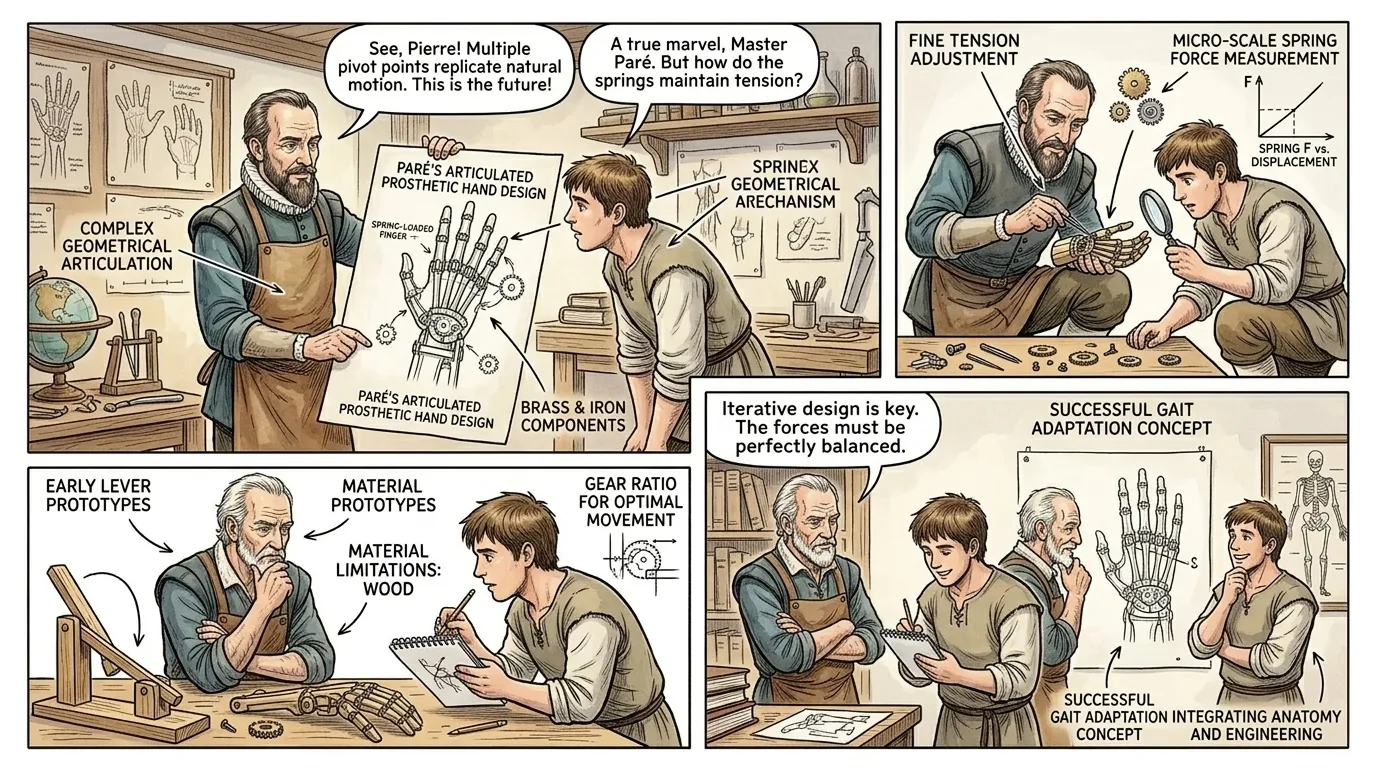
The 16th century witnessed a significant leap forward with Ambroise Paré, a French barber-surgeon. Witnessing the horrific injuries from cannon fire on the battlefield, Paré recognized the profound need for more functional and humane prosthetics. He designed articulated limbs, revolutionary for their time, featuring hinged knees and elbows, and even hands that could grasp. These innovations, while still heavy and often requiring intricate leatherwork, aimed to restore a degree of natural movement and utility, moving beyond mere cosmetic concealment.
"Ambroise Paré, a man with a keen, intelligent gaze and a short, neatly trimmed beard, holds up a detailed drawing of his articulated hand, showing the complex gears and springs. He explains to his attentive assistant, a serious young man with a focused expression, "Look here, Pierre. The true challenge is not merely to replace what is lost, but to restore purposeful action. This design, with its hinges and catch, allows a degree of grasping. As the Roman philosopher Cicero wisely stated, 'To be ignorant of what occurred before you were born is to remain always a child.' We must learn from the rudimentary attempts of the past and strive for a more profound restoration of function, driven by empathy for our patients.""
Page 4
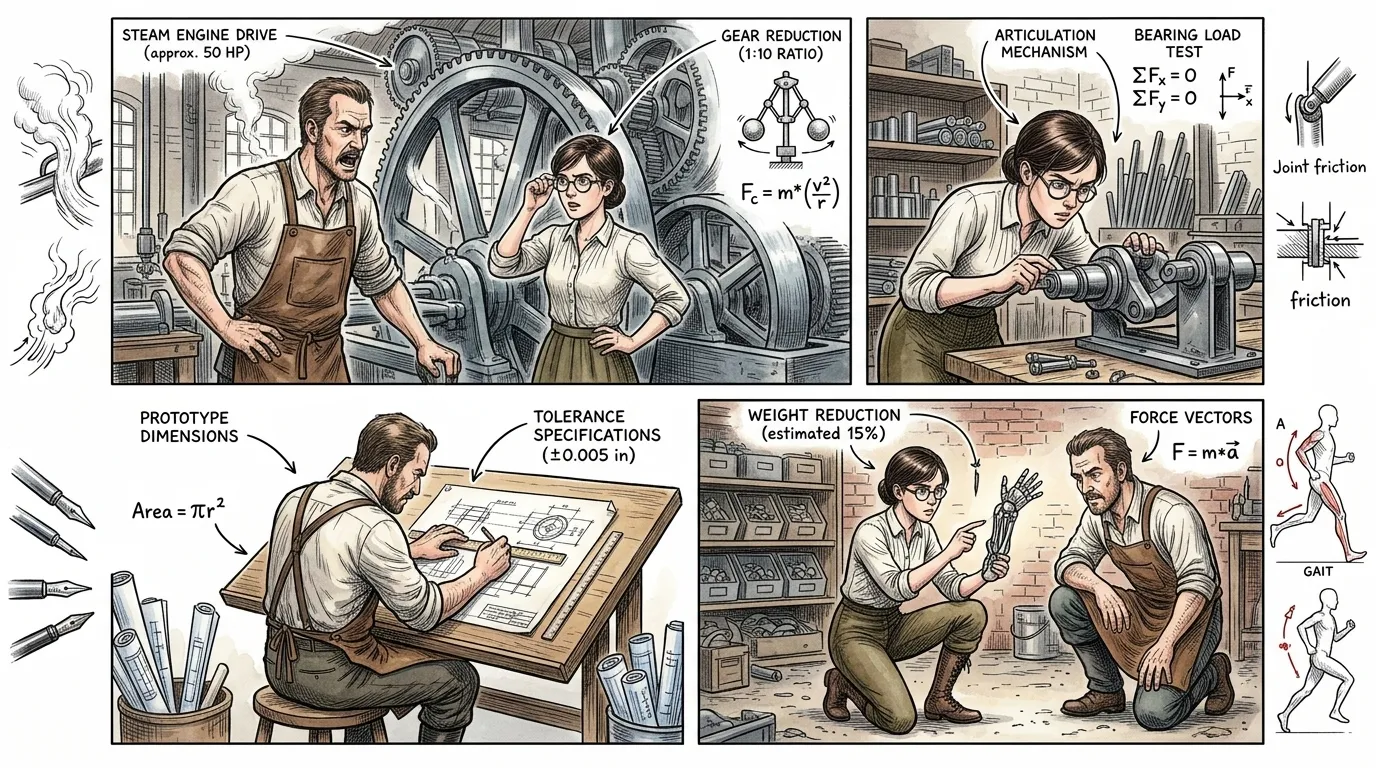
The 19th century, fueled by the Industrial Revolution and an increase in traumatic injuries from factory accidents and widespread warfare, brought a new urgency to prosthetic development. Materials like leather, steel, and iron became more accessible and workable, enabling prosthetists to create more robust and somewhat lighter limbs. The sheer volume of amputations during conflicts, such as the American Civil War, spurred a demand for more standardized production and greater functional variety, though customized comfort remained a significant hurdle.
"A factory foreman, a stern man with rolled-up sleeves and a leather apron, stands amidst the whirring machinery of a 19th-century workshop. He shouts over the din to a newly hired engineer, a younger woman with spectacles perched on her nose. "The orders arrive daily, Miss Albright! We need more speed, more consistency! These new steel components are strong, but the weight... the weight is still a burden. How do we produce a strong, reliable limb that doesn't exhaust the wearer?" The engineer nods, pushing her spectacles up. "We must explore every material, sir. Perhaps a new alloy, or a different construction method. The challenge is immense, but the demand drives us to seek every possible improvement.""
Page 5
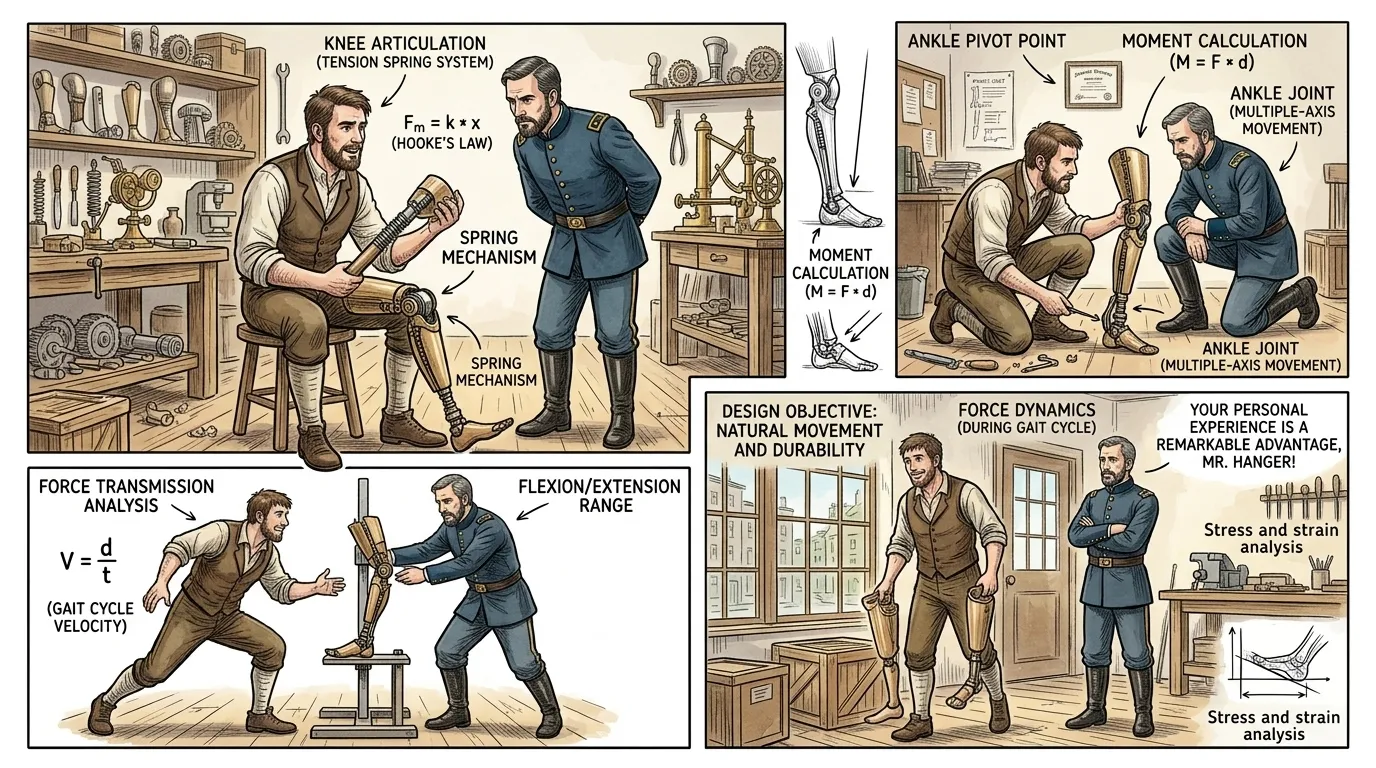
The American Civil War, with its unprecedented number of amputations, became a grim crucible for prosthetic innovation. Among the wounded was James Hanger, the war's first amputee. Dissatisfied with the crude, heavy designs available, Hanger, an engineer by trade, took his personal tragedy as a catalyst. He designed and patented a new prosthetic leg featuring hinged knee and ankle joints, providing a far more natural gait and greater comfort. His invention dramatically improved mobility and eventually led to the founding of a company that endures to this day.
"James Hanger, a determined man with a neatly trimmed beard and intense eyes, sits in his workshop, demonstrating the articulated knee and ankle of his prosthetic leg. He explains to a visiting military surgeon, a serious man in uniform, "Having lost my own limb, I understood the inadequacy of fixed designs. The goal was to restore natural movement, not merely support. This hinged knee, this flexible ankle, allows for a fluidity previously unimagined. It's about empowering the individual, giving them back the ability to move with confidence, to feel whole again. My experience taught me that true healing requires more than just survival; it demands the restoration of dignity and function.""
Page 6
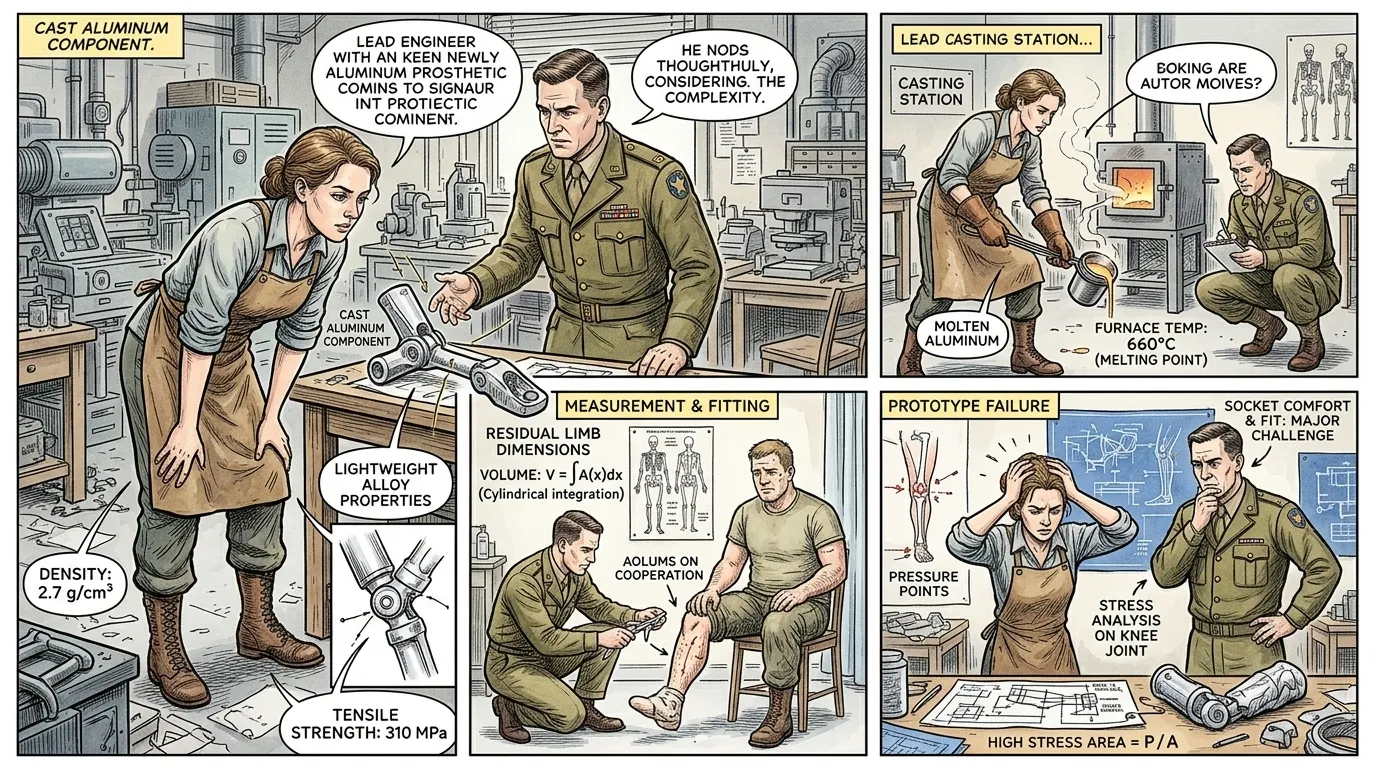
The two World Wars of the 20th century further intensified the need for advanced prosthetics. Millions of soldiers returned with life-altering injuries, compelling rapid research and development. Lighter materials like aluminum and early plastics began to replace heavy woods and metals. Engineers and medical professionals collaborated to create prosthetics that were not only lighter but also designed to better integrate with the residual limb, though the challenge of comfortable, truly customizable sockets remained a complex puzzle.
"A lead engineer, a woman with keen eyes and hair tied back, points to a newly cast aluminum prosthetic component on her workbench in a wartime research lab. She discusses with a stern military physician, "This aluminum alloy dramatically reduces weight compared to steel, Doctor, allowing for far greater endurance. But the interface... the socket remains our greatest challenge. We can craft ingenious joints, but if the connection to the body is poor, the entire limb is compromised. How do we create a secure, comfortable fit for every unique patient?" The physician nods thoughtfully. "It is the anchor point, indeed. A perfect fit would revolutionize their daily lives, providing true comfort and control.""
Page 7
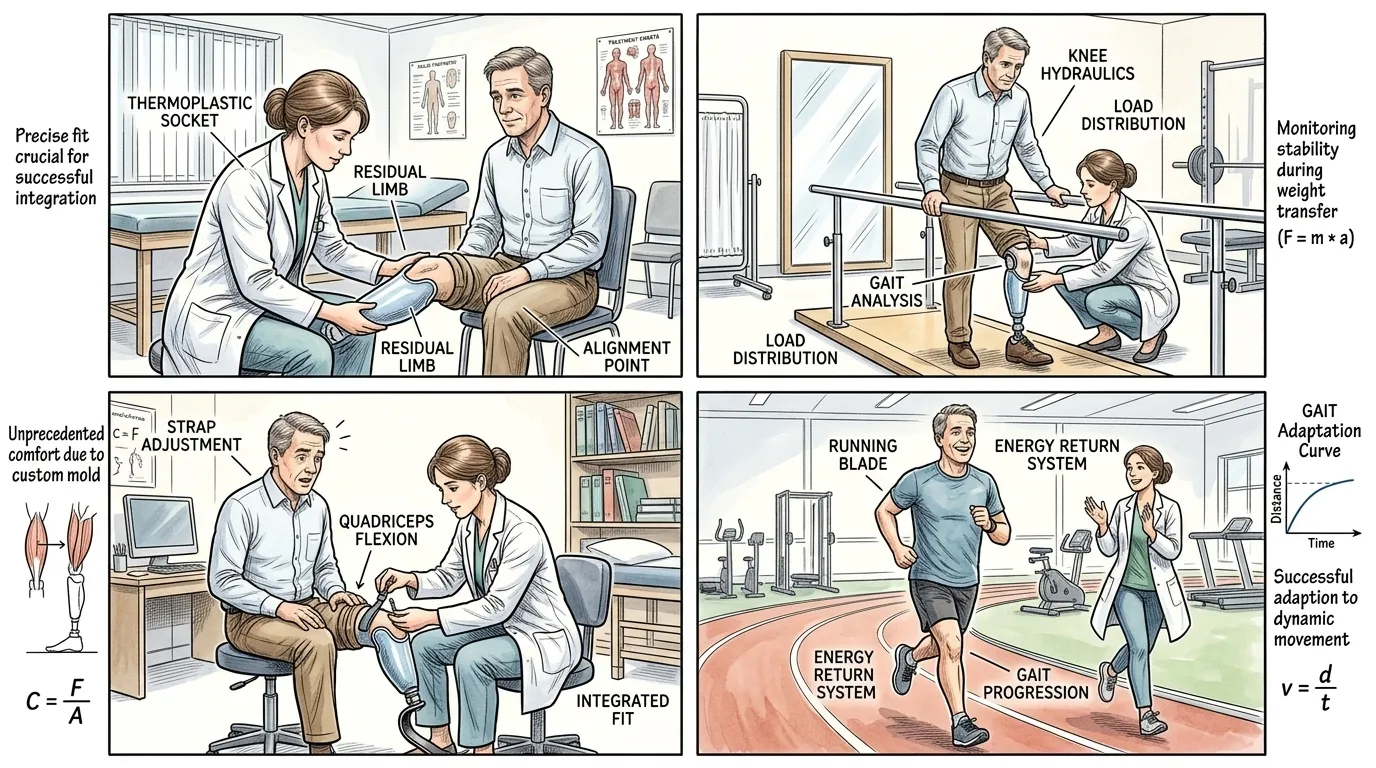
Post-World War II, a revolution in prosthetic design began with the advent of plastics. Materials like polyethylene, polypropylene, and fiberglass allowed for the creation of custom-molded, lightweight sockets. Instead of standard sizes, prosthetists could now take precise impressions of a patient's residual limb, vacuum-forming a perfectly fitting, comfortable socket. This breakthrough dramatically reduced chafing, improved weight distribution, and provided unprecedented comfort, addressing a core problem that had plagued prosthetics for centuries. It transformed the relationship between the body and the device.
"A skilled prosthetist, a focused woman with gentle hands, carefully positions a newly custom-molded plastic socket onto a patient's residual limb. She explains to the patient, a middle-aged man with hopeful eyes, "Unlike the rigid wooden or leather sockets of the past, this thermoplastic material is vacuum-formed precisely to your limb's contours. It distributes pressure evenly, minimizing friction and discomfort. It's a complete paradigm shift, allowing for truly integrated movement and far greater comfort. We aim to make this limb an extension of yourself, not merely an attachment." The patient flexes his muscles, a look of surprise and relief dawning on his face."
Page 8
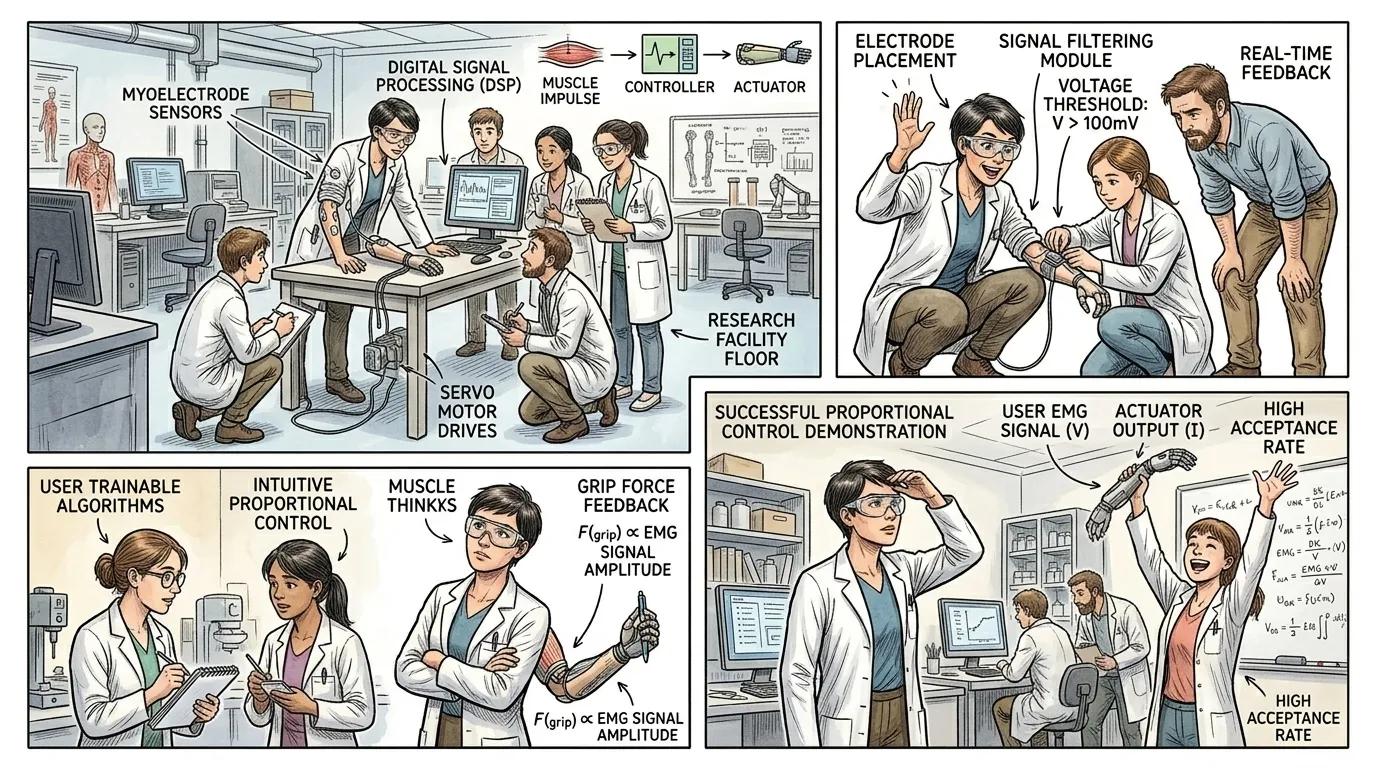
The late 20th century heralded the era of advanced myoelectric prosthetics. This groundbreaking technology allows individuals to control their prosthetic limbs using signals generated by their own muscles. Electrodes placed on the skin detect faint electrical impulses from residual muscles, which are then translated by microprocessors into precise movements of the prosthetic. This innovation provides a level of intuitive control and dexterity previously unimaginable, empowering users to perform complex tasks with remarkable ease and precision.
"A leading biomechanical engineer, a determined woman with short, dark hair, demonstrates a myoelectric arm to a group of eager medical students in a research facility. Electrodes on her arm are visibly connected to the prosthetic. "Observe," she instructs, making a subtle muscle contraction, and the prosthetic hand smoothly closes. "These surface electrodes detect minute electrical potentials from muscle contractions. A microcontroller then translates these signals into controlled movement. As the renowned physicist Isaac Newton articulated, 'If I have seen further than others, it is by standing upon the shoulders of giants.' We are building upon centuries of anatomical and electrical understanding to literally extend human capability. It's about restoring a natural interface to the machine, not just a mechanical one.""
Page 9
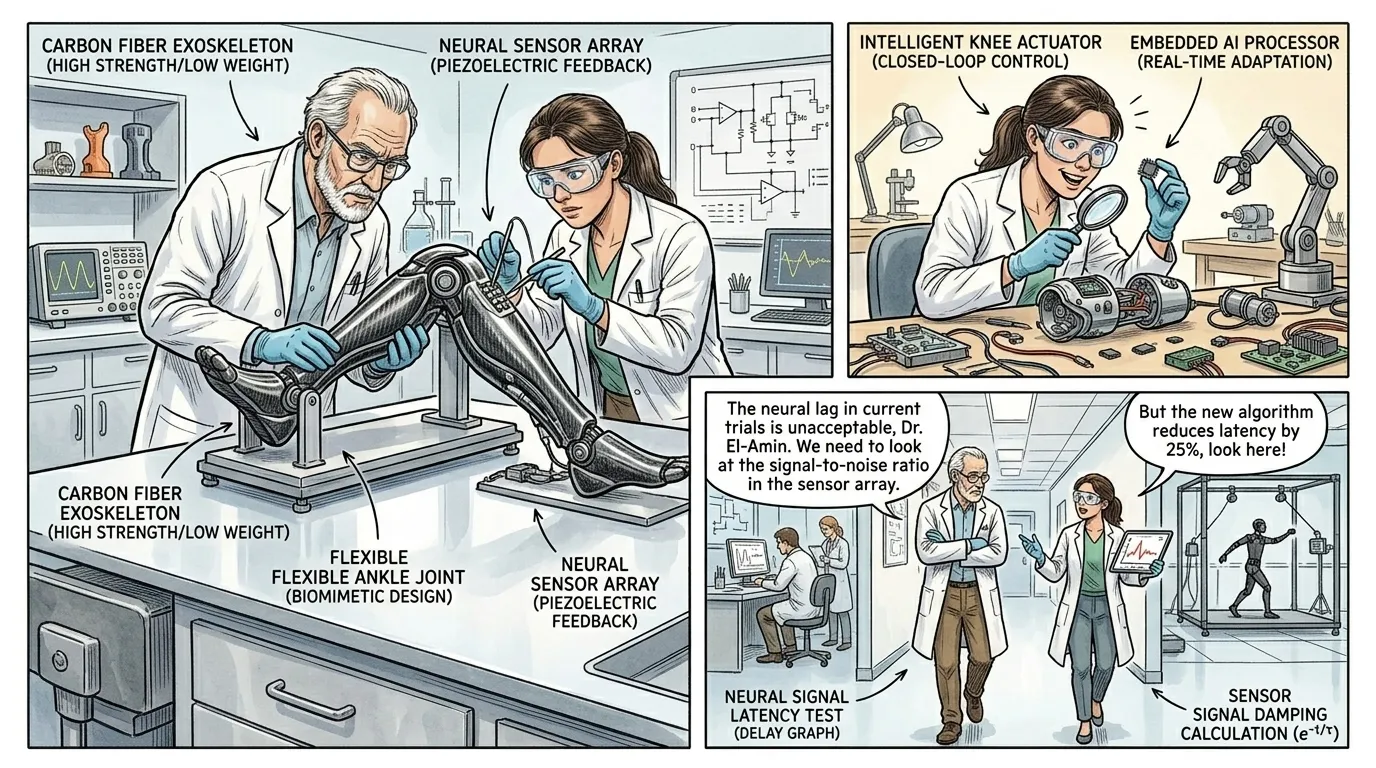
Today, prosthetic technology continues to push the boundaries of human-machine integration. Advanced materials like carbon fiber offer unprecedented strength-to-weight ratios, while microprocessors and robotic components enable intelligent joints that adapt to terrain and activity. Sensory feedback systems are being developed to provide users with a sense of touch and proprioception, making the prosthetic feel more like a natural extension of the body. The goal is no longer just replacement, but true bionic integration.
"A lead researcher, a thoughtful man with spectacles and a focused expression, examines a complex robotic prosthetic leg, its carbon fiber shell gleaming. He converses with a fellow scientist, a younger woman carefully adjusting a sensor on the limb. "The strength of carbon fiber, combined with these adaptive microprocessors, allows for a truly intelligent limb," he explains. "It can anticipate gait, adjust to uneven surfaces. Our current focus is on integrating sensory feedback, allowing the user to 'feel' pressure and texture. We're moving beyond mere mechanics toward true bionics, blurring the lines between human and machine. Imagine a prosthetic that learns, adapts, and even feels, seamlessly integrated into the user's neural network. The possibilities are truly boundless.""
Page 10
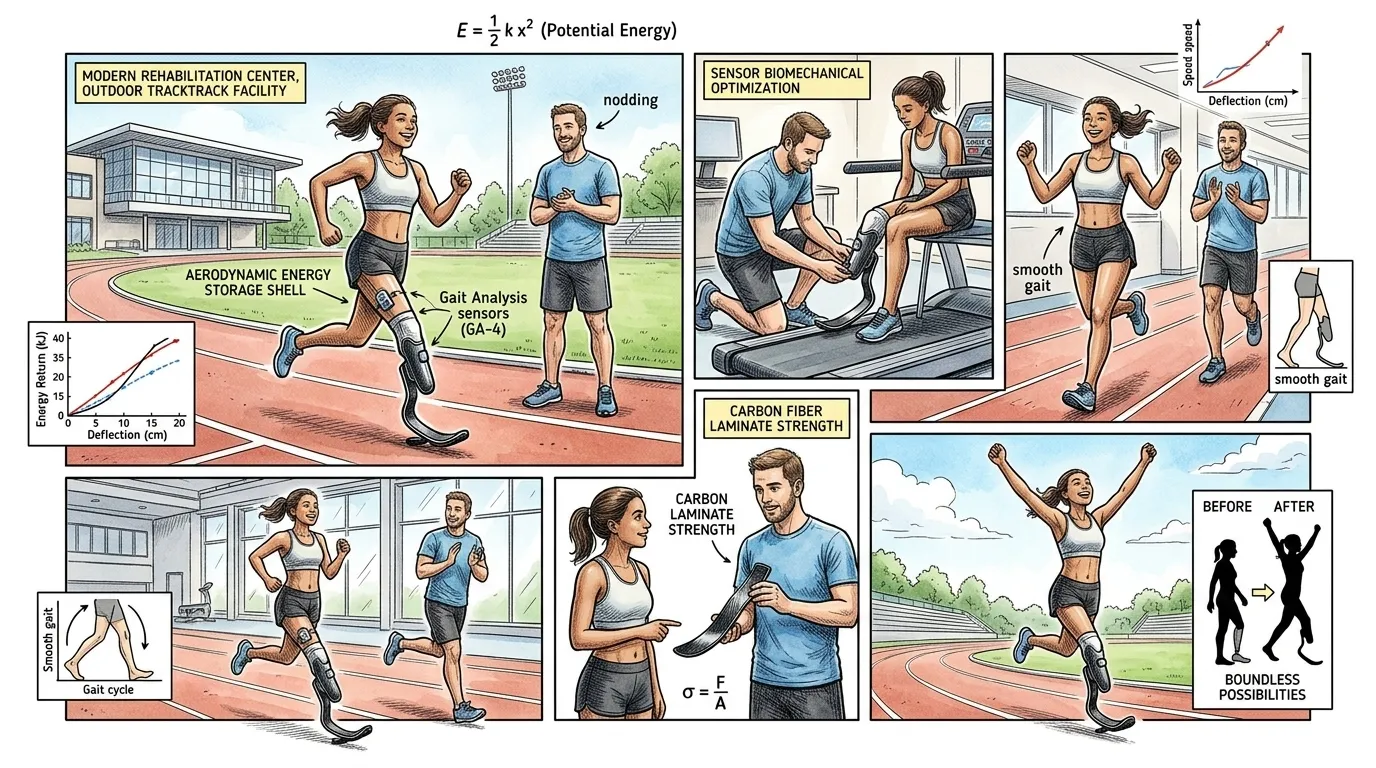
From crude wooden pegs to sophisticated bionic limbs, the journey of prosthetic innovation reflects humanity's enduring quest to overcome adversity and redefine potential. Modern prosthetics allow individuals to live full, active lives, participate in sports, pursue demanding careers, and enjoy everyday activities with renewed independence. This evolution is a testament to persistent scientific inquiry, compassionate engineering, and the unbreakable spirit of those who embrace these marvels of medical technology.
"In the vibrant hum of a rehabilitation center, a young athlete, now effortlessly jogging on a track with a sleek running blade, shares a moment with her prosthetist. "This isn't just a leg; it's freedom," she exclaims, a wide smile on her face. Her prosthetist, a supportive man, nods. "Indeed. Every advancement in this field is driven by the human spirit to not only adapt but to thrive. It's a remarkable journey of technology serving the deepest human need for mobility and self-expression. We've come so far, yet the journey of innovation continues, always seeking to provide more for those who dare to dream of what's possible.""
About this story
- Location: Global
- Audience: general readers
Read Wonder Inventions on your phone
Wonder Inventions is available on Android. Get Wonder Inventions on Google Play.