Radio
Radio — an illustrated inventions story, set in Global. 10 illustrated pages, free to read on Wonder Inventions.
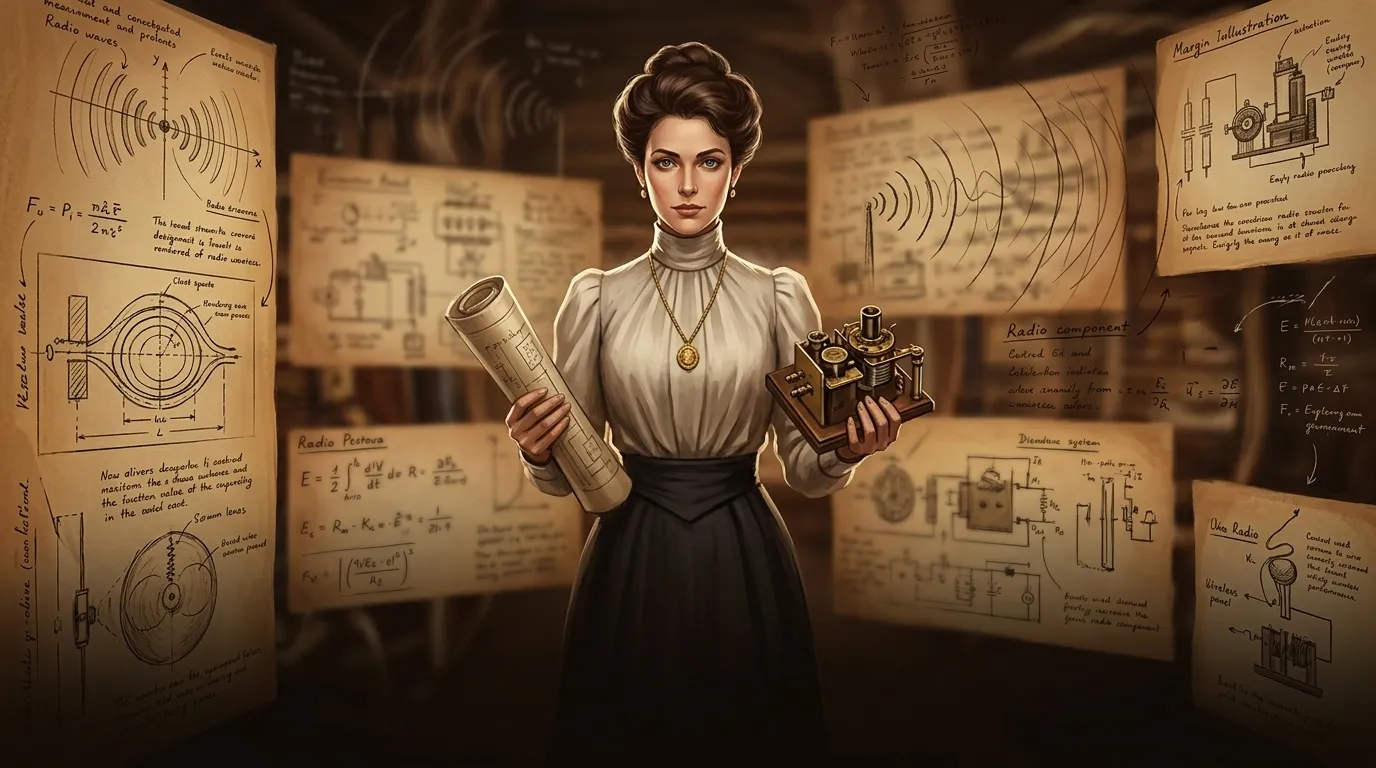
Page 1
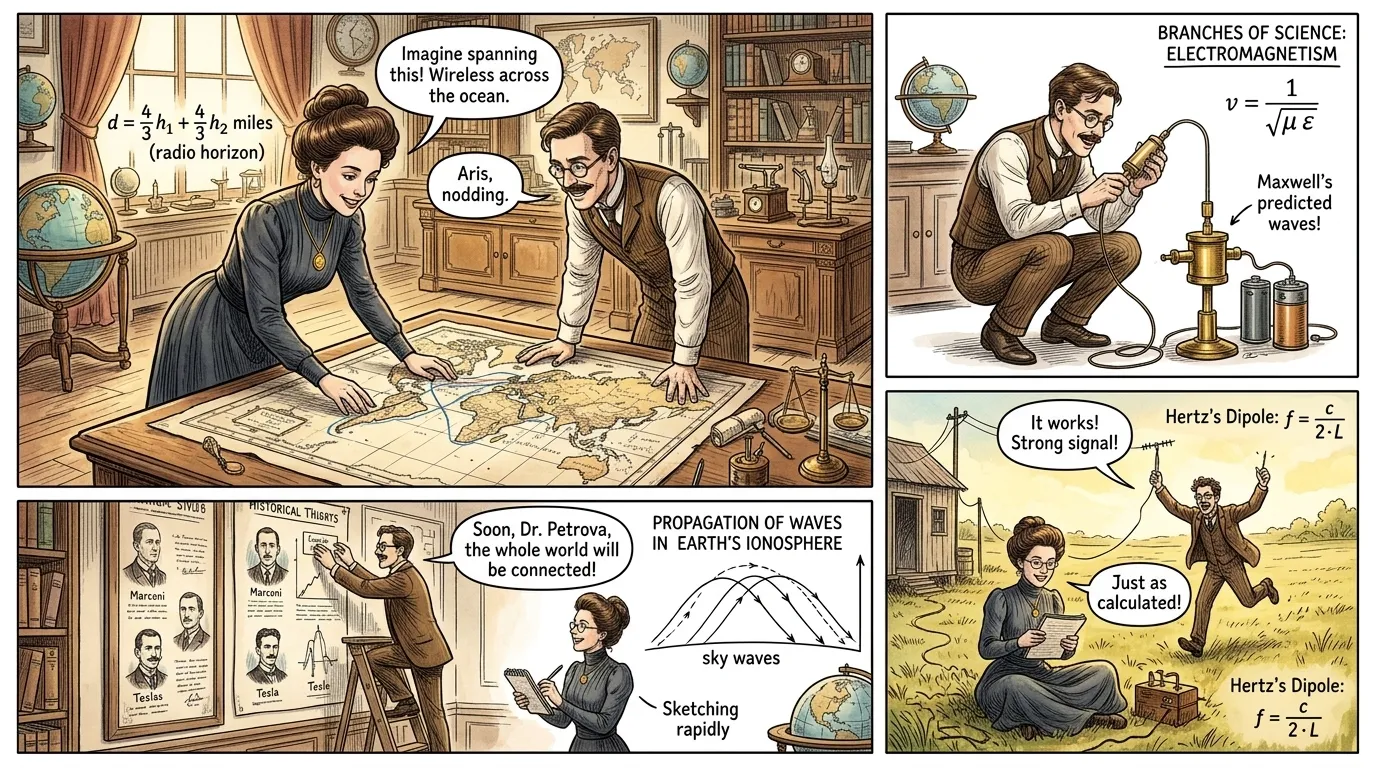
At the turn of the 20th century, the vastness of oceans and unspanned wilderness made instant, reliable communication across long distances a profound challenge. Wired telegraphy, though revolutionary, was tethered by physical cables that storm and sea could easily sever, leaving ships at sea, remote outposts, and distant continents isolated. The urgent need for a method to transmit information through the air itself, free from physical connection, pressed upon the minds of pioneering scientists. As Dr. Lena Petrova examined a detailed map, she remarked to her colleague, 'Dr. Thorne, the isolation is truly astonishing, isn't it? As Charles Dickens once wrote, 'It was the best of times, it was the worst of times' – a time of immense progress, yet immense communicative isolation.' Dr. Aris Thorne, adjusting his spectacles, nodded, acknowledging the significant hurdle of the era.
"'Dr. Thorne, the isolation is truly astonishing, isn't it? As Charles Dickens once wrote, 'It was the best of times, it was the worst of times' – a time of immense progress, yet immense communicative isolation,' Dr. Lena Petrova remarked, her finger tracing a shipping route across a detailed map. Dr. Aris Thorne, adjusting his spectacles, concurred, 'Indeed, Dr. Petrova; the telegraph laid the groundwork, but its physical constraints highlight the urgent need for a true breakthrough in wireless communication across these distances.'"
Page 2
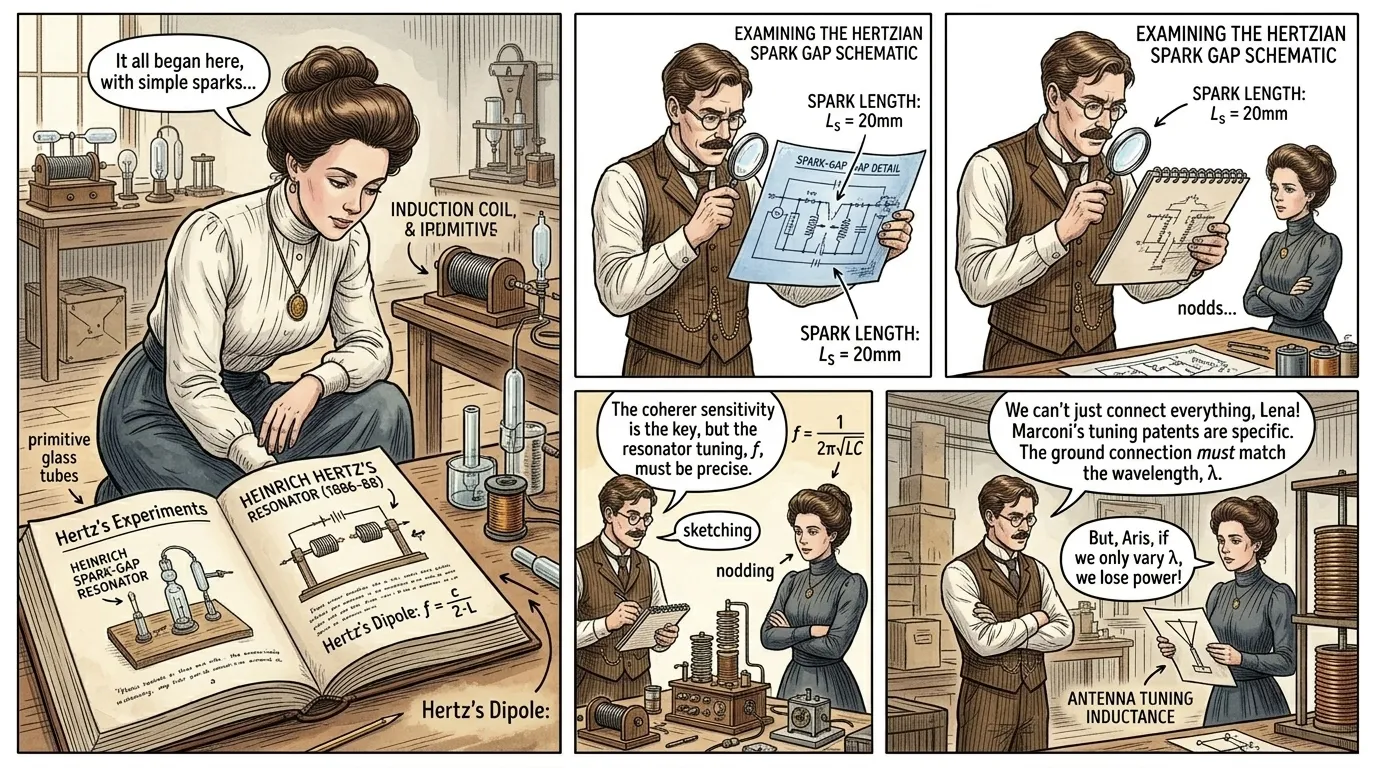
Before practical wireless communication could emerge, the very nature of invisible waves capable of carrying information had to be understood. James Clerk Maxwell's theoretical work in the 1860s had predicted the existence of electromagnetic waves, propagating at the speed of light, an astounding concept that unified electricity, magnetism, and light itself. Decades later, Heinrich Hertz, a German physicist, dedicated himself to experimentally proving Maxwell's audacious theory. 'Imagine, Dr. Thorne,' Dr. Petrova mused, looking at a diagram, 'a theoretical prediction so profound, waiting for someone to build the apparatus that could finally make these unseen waves manifest.' She gestured towards an old textbook opened to an illustration of Hertz's resonator.
"'Imagine, Dr. Thorne,' Dr. Petrova mused, looking at a diagram of a spark gap. 'A theoretical prediction so profound, waiting for someone to build the apparatus that could finally make these unseen waves manifest, unifying light and electricity.' Dr. Thorne, examining a schematic of Hertz's experiments, replied, 'Indeed, Dr. Petrova. Heinrich Hertz's genius was not just in confirming Maxwell's electromagnetic waves but demonstrating their generation and detection, a foundational step toward any practical wireless system.'"
Page 3
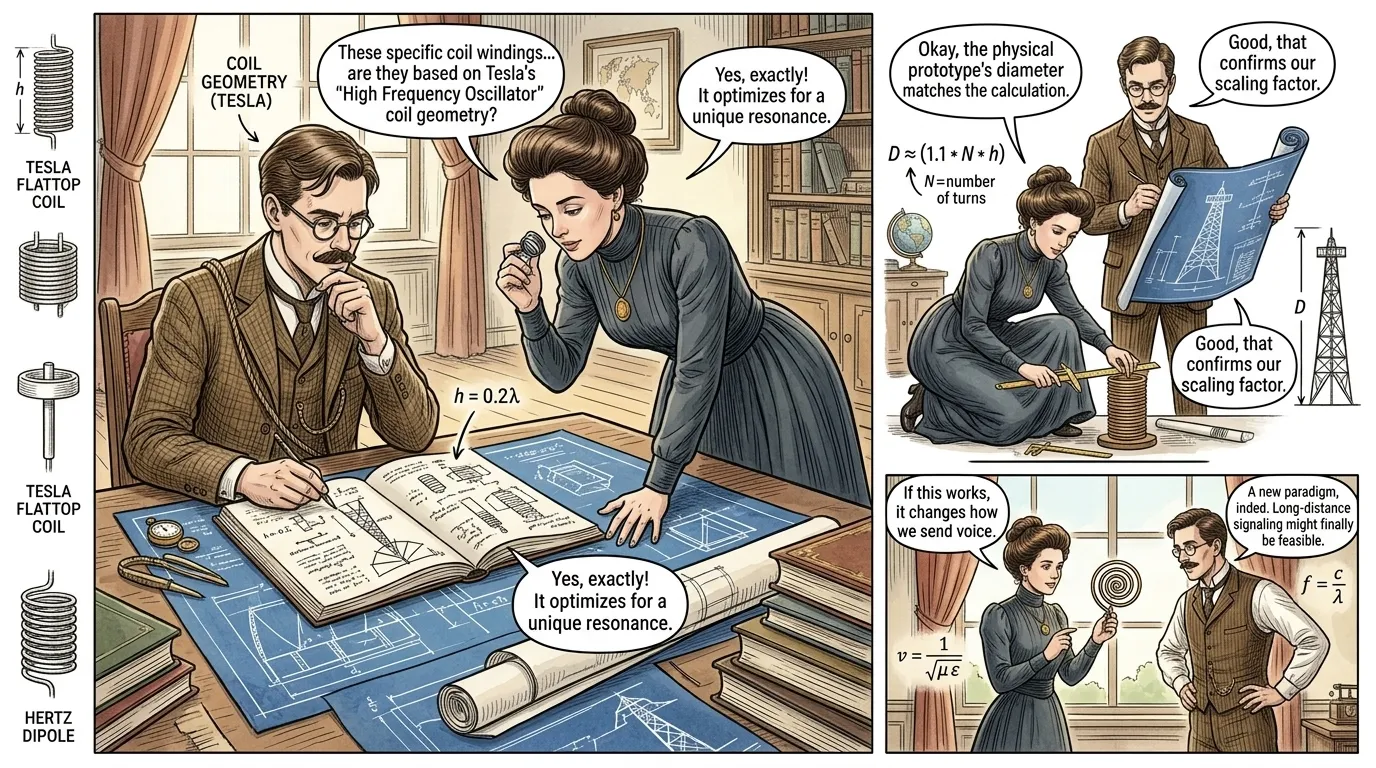
Hertz's experiments, while groundbreaking, demonstrated electromagnetic waves only over short distances—a few meters at most—and were perceived more as scientific curiosities than practical communication tools. Many brilliant minds across Europe and America recognized the potential, including Nikola Tesla, who conceptualized and patented systems for wireless power and communication. However, it was the relentless pursuit of practical long-distance signaling that began to converge these scientific principles into tangible devices. 'The true challenge wasn't just to prove the waves existed, but to harness them with enough power and sensitivity to span miles, not just rooms,' Dr. Thorne observed, sketching an antenna design in his notebook.
"'The true challenge wasn't just to prove the waves existed, but to harness them with enough power and sensitivity to span miles, not just rooms,' Dr. Thorne observed, sketching an antenna design in his notebook. Dr. Petrova leaned closer, pointing to his drawing. 'And for that, Dr. Thorne, the antenna became critical. Remember what we discussed about Tesla's patents from the 1890s? His elevated conducting terminal, specifically his 'four-tuned circuit' system, was conceptually advanced for radiating and receiving electromagnetic energy, setting a high bar for later practical applications.'"
Page 4
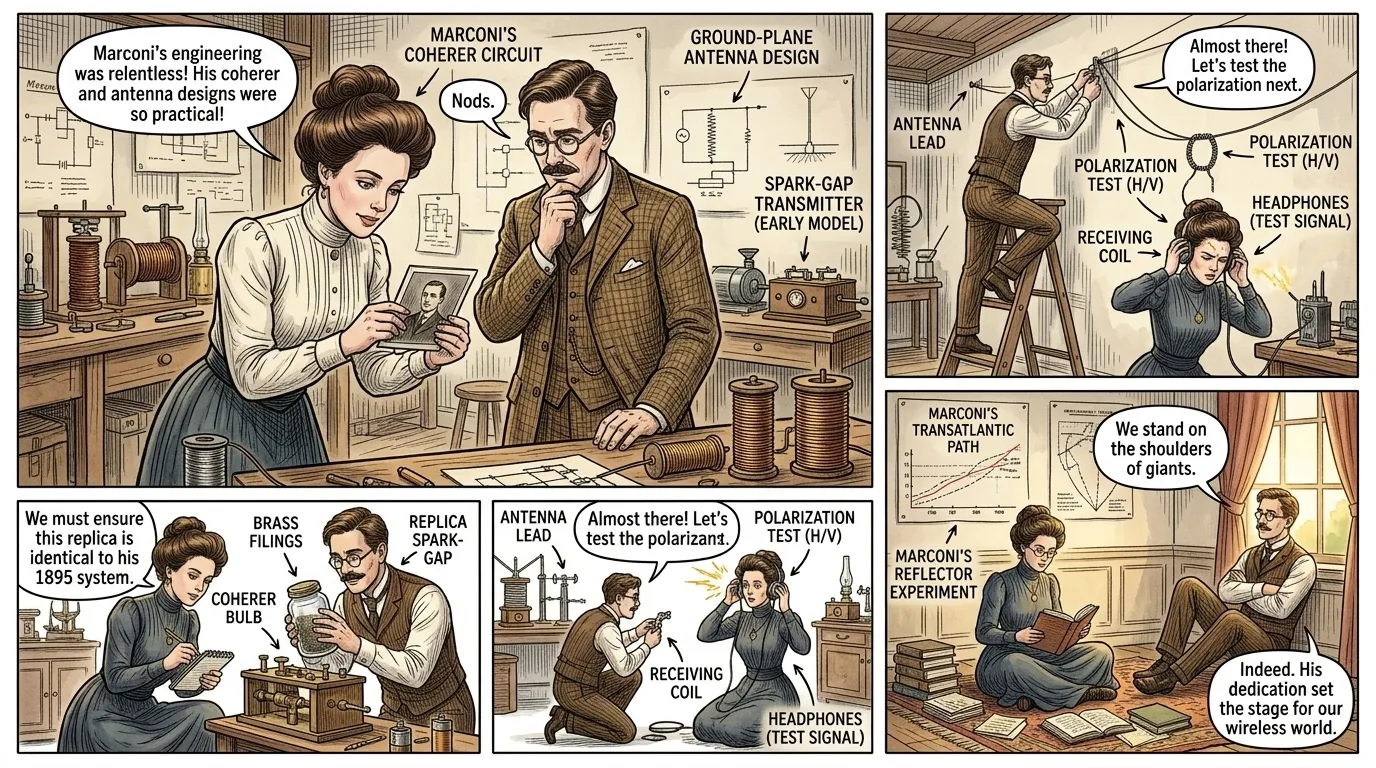
While many scientists explored the theory of electromagnetic waves, Guglielmo Marconi, a young Italian inventor, possessed a singular focus: to make wireless telegraphy a practical reality. Beginning in his family's attic in Pontecchio in 1894, he methodically improved every component of Hertz's rudimentary apparatus. He grasped that success lay in increasing power, improving antenna design, and developing a more sensitive receiver. 'Marconi's genius wasn't just in inventing; it was in relentless engineering and scaling,' Dr. Petrova commented, looking at a framed photograph of Marconi's early equipment. 'His commitment to making it work over distance defined his contribution.'
"'Marconi's genius wasn't just in inventing; it was in relentless engineering and scaling,' Dr. Petrova commented, looking at a framed photograph of Marconi's early equipment. 'His commitment to making it work over distance defined his contribution.' Dr. Thorne nodded, 'Indeed. He was not merely demonstrating physics; he was building a communication system. From his attic, extending the range from meters to kilometers, was a monumental leap, focusing on the coherer and his improved ground-plane antenna.'"
Page 5
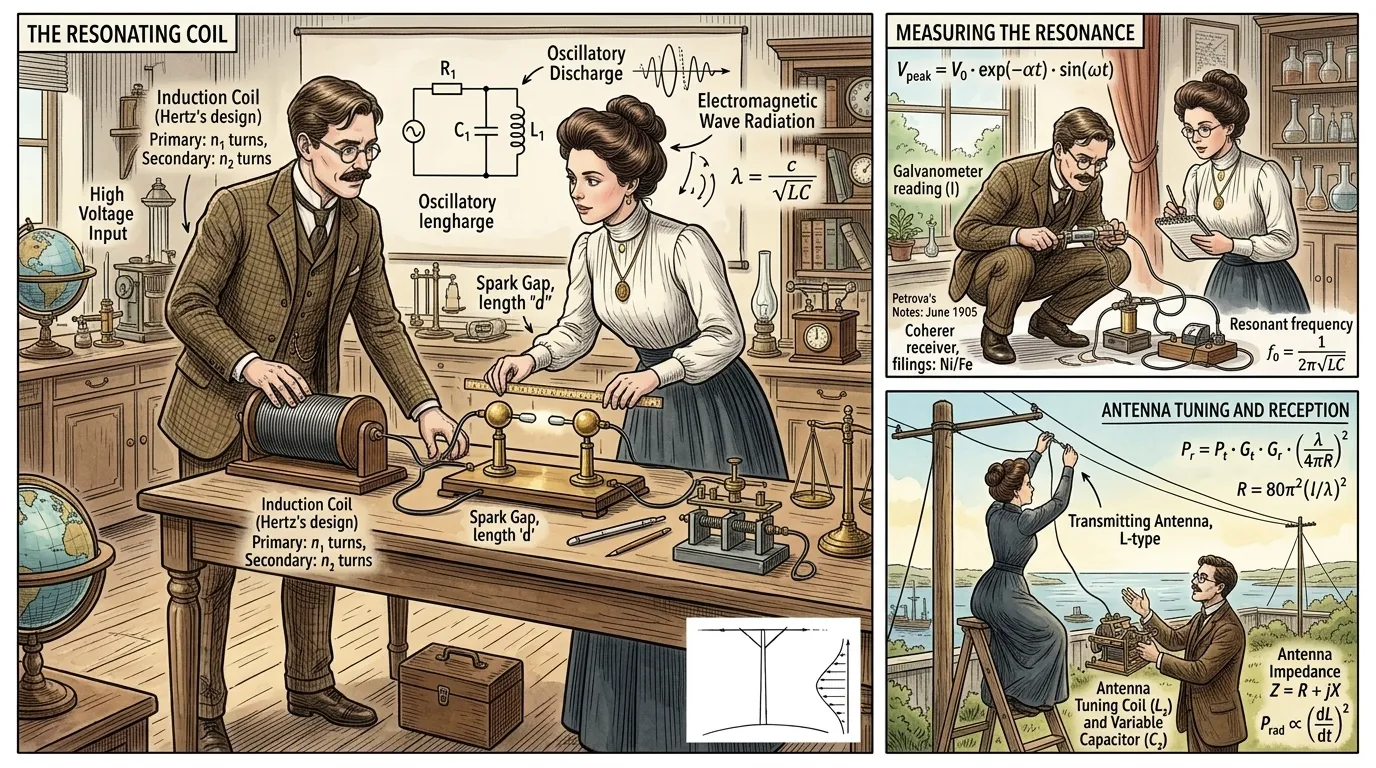
Marconi's system relied initially on the spark-gap transmitter, a relatively simple yet effective method for generating radio waves. When a high voltage was applied across a gap between two electrodes, it created a visible spark. This spark rapidly ionized the air, allowing a sudden burst of current to oscillate back and forth in a connected antenna circuit. This oscillation generated electromagnetic waves that radiated outwards. 'The spark was crude, but powerful,' Dr. Thorne explained, pointing to a diagram. 'Each spark created a 'damped wave'—a burst of energy that quickly faded, but it was enough to carry a signal.'
"'The spark was crude, but powerful,' Dr. Thorne explained, pointing to a cross-sectional diagram of a spark-gap transmitter. 'Each spark created a 'damped wave'—a burst of energy that quickly faded, but it was enough to carry a signal.' Dr. Petrova added, 'Exactly. The coil boosts voltage, the spark gap creates the oscillation, and the antenna radiates those oscillations into space as electromagnetic waves. The length and height of the antenna, a concept refined by early pioneers, were crucial for effective transmission range.'"
Page 6
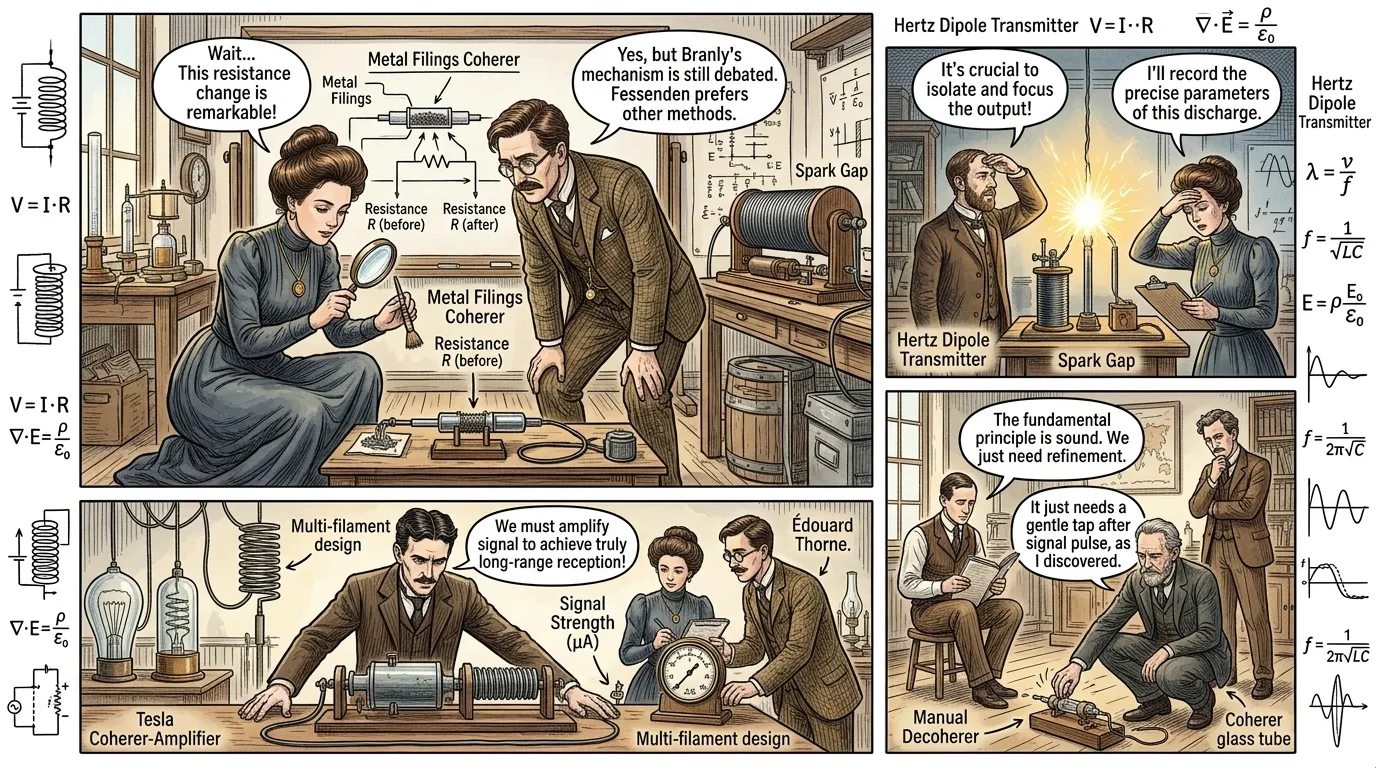
Detecting these faint, invisible radio waves was the next major challenge. Marconi adapted and refined the 'coherer,' an invention attributed to Édouard Branly and refined by others. This ingenious device consisted of a glass tube filled with metal filings. Normally, the filings offered high resistance to an electrical current. However, when struck by a radio wave, the filings would momentarily 'cohere' or clump together, dramatically reducing their resistance and allowing a current to flow. 'It was a remarkably simple yet effective 'on-off' switch,' Dr. Petrova demonstrated, tapping a replica coherer. 'Each wave packet made the filings cohere, and a mechanical 'decoherer' then tapped them apart, ready for the next signal.'
"'It was a remarkably simple yet effective 'on-off' switch,' Dr. Petrova demonstrated, tapping a replica coherer. 'Each wave packet made the filings cohere, and a mechanical 'decoherer' then tapped them apart, ready for the next signal, allowing the Morse code dot or dash to be registered.' Dr. Thorne added, 'Indeed. This ability of the coherer to change its resistance upon receiving an electromagnetic wave was paramount. Without such a sensitive detector, the transmitted waves would have remained undetectable noise, showcasing the receiver's critical role, especially with refined antenna systems.'"
Page 7
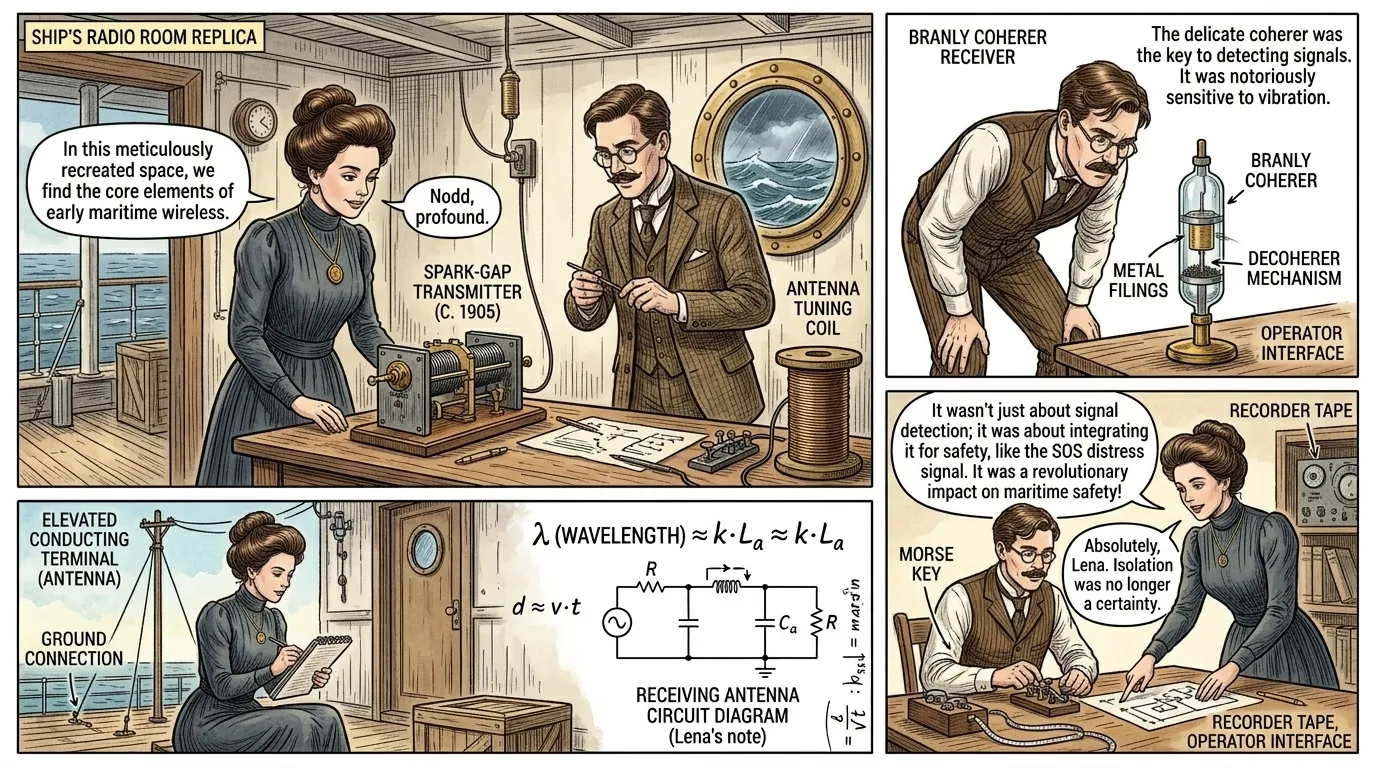
With the spark-gap transmitter and coherer receiver, Marconi's system became the first commercially viable method for long-distance wireless communication. It found immediate and critical application in maritime communication, allowing ships to send distress signals or receive weather reports, drastically improving safety at sea. Morse code, already the standard for telegraphy, was seamlessly adapted, with short and long bursts of radio waves representing dots and dashes. 'The ability to send an 'SOS' from a ship caught in a storm was revolutionary,' Dr. Thorne emphasized, observing a replica ship's radio room. 'It transformed maritime safety overnight, making previously isolated voyages far less perilous.'
"'The ability to send an 'SOS' from a ship caught in a storm was revolutionary,' Dr. Thorne emphasized, observing a replica ship's radio room. 'It transformed maritime safety overnight, making previously isolated voyages far less perilous.' Dr. Petrova nodded. 'And it was all thanks to the combination of a robust transmitter and a sensitive receiver, often using an improved antenna like the elevated conducting terminal we discussed, enabling communication that was once impossible, even in adverse weather conditions.'"
Page 8
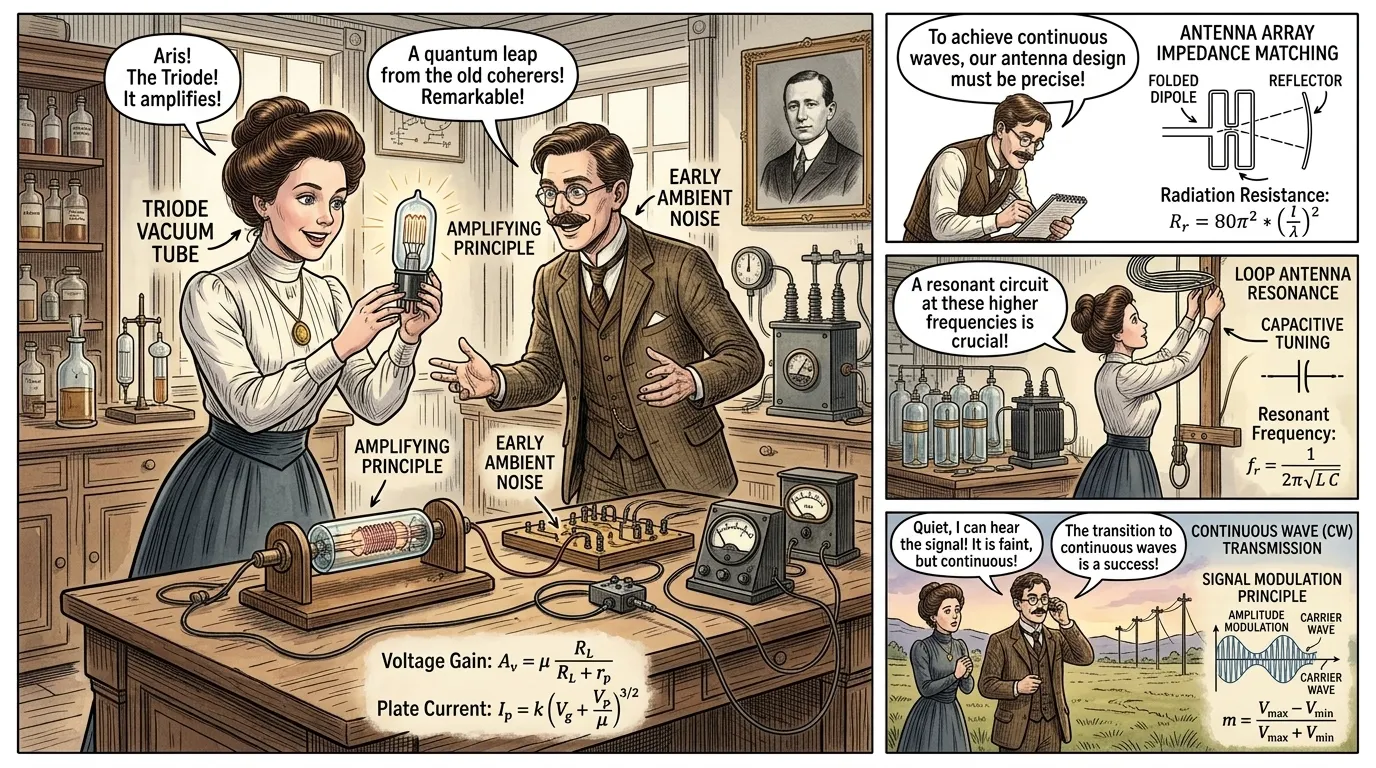
Despite its initial success, the spark-gap system had limitations: it produced 'noisy,' damped waves that caused interference and could only transmit simple on-off signals like Morse code. The next major leap came with the development of continuous wave (CW) transmitters, allowing for clearer, more efficient transmission. The invention of the vacuum tube by Lee de Forest (triode) and others further revolutionized radio by allowing for amplification of weak signals and the generation of stable, continuous waves. 'The coherer was a start, but the vacuum tube truly unlocked the potential for voice and music,' Dr. Petrova exclaimed, holding a replica triode. 'And the evolution of the antenna design, like the large, directional arrays, drastically improved signal capture and range, fulfilling the promise of distant communication.'
"'The coherer was a start, but the vacuum tube truly unlocked the potential for voice and music,' Dr. Petrova exclaimed, holding a replica triode. 'And the evolution of the antenna design, like the large, directional arrays, drastically improved signal capture and range, fulfilling the promise of distant communication.' Dr. Thorne added, 'Precisely, Dr. Petrova. With continuous waves, modulation became possible, allowing us to superimpose complex audio signals onto the carrier wave. The ability to amplify these signals, thanks to the triode, brought us closer to true broadcasting, a far cry from the spark's limitations. The refined antenna designs became the critical bridge, just as we discussed earlier regarding Tesla's foundational work.'"
Page 9
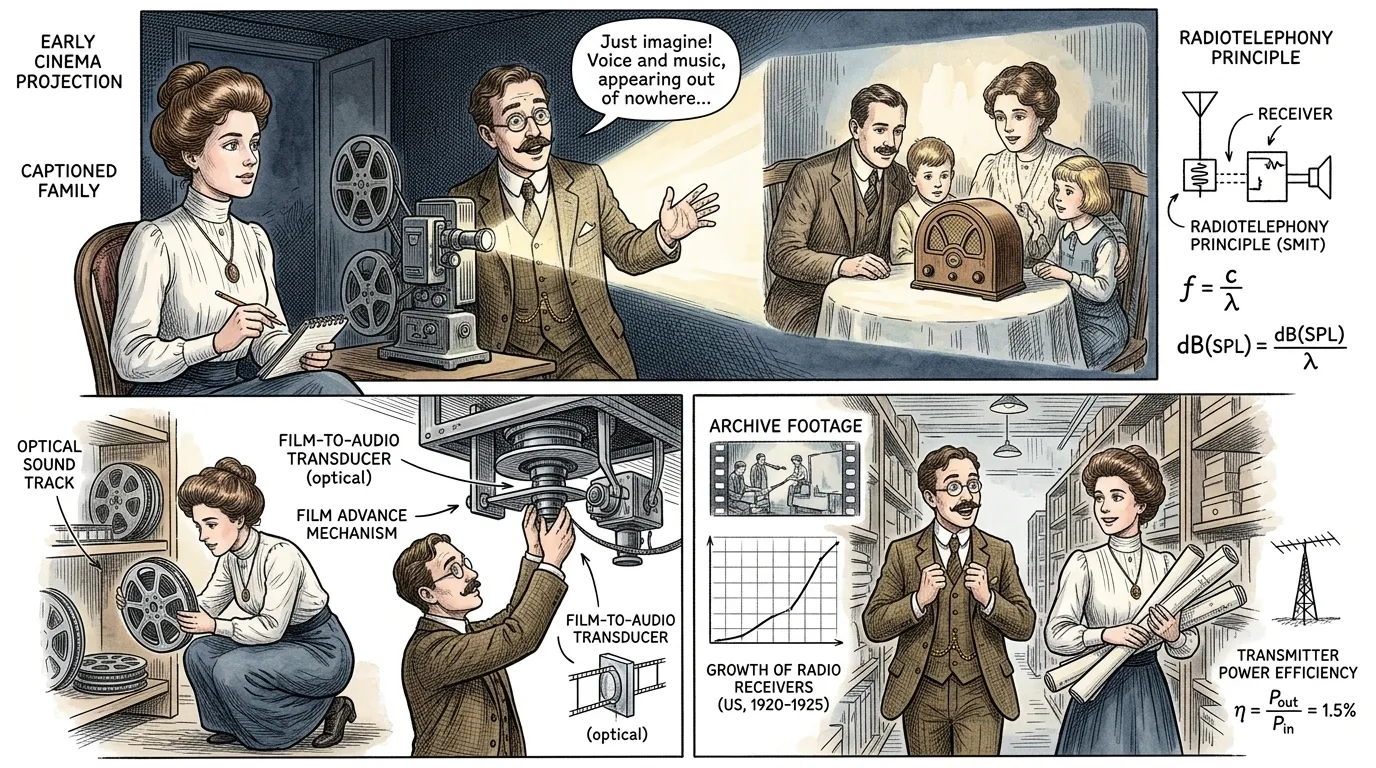
With continuous wave transmission and vacuum tube technology, the crude 'dot and dash' world of wireless telegraphy gave way to the vibrant era of 'wireless telephony,' enabling the transmission of human voice and music. Early radio pioneers like Reginald Fessenden and Lee de Forest conducted experimental broadcasts, hinting at a future where news, entertainment, and information could reach homes wirelessly. The public was captivated. 'Imagine the sheer wonder,' Dr. Thorne remarked, watching an archival film clip of an early radio listener, 'of hearing a voice, or an orchestra, materialize from thin air inside your living room!' This was no longer just communication; it was an entirely new form of mass media.
"'Imagine the sheer wonder,' Dr. Thorne remarked, watching an archival film clip of an early radio listener, 'of hearing a voice, or an orchestra, materialize from thin air inside your living room! This was no longer just communication; it was an entirely new form of mass media.' Dr. Petrova added, 'Indeed, Dr. Thorne. The ability to modulate the continuous carrier wave with complex audio signals, amplified by the vacuum tube, democratized information and entertainment. It transformed isolated homes into connected audiences, shaping society in profound ways, all built upon those initial wireless principles.'"
Page 10
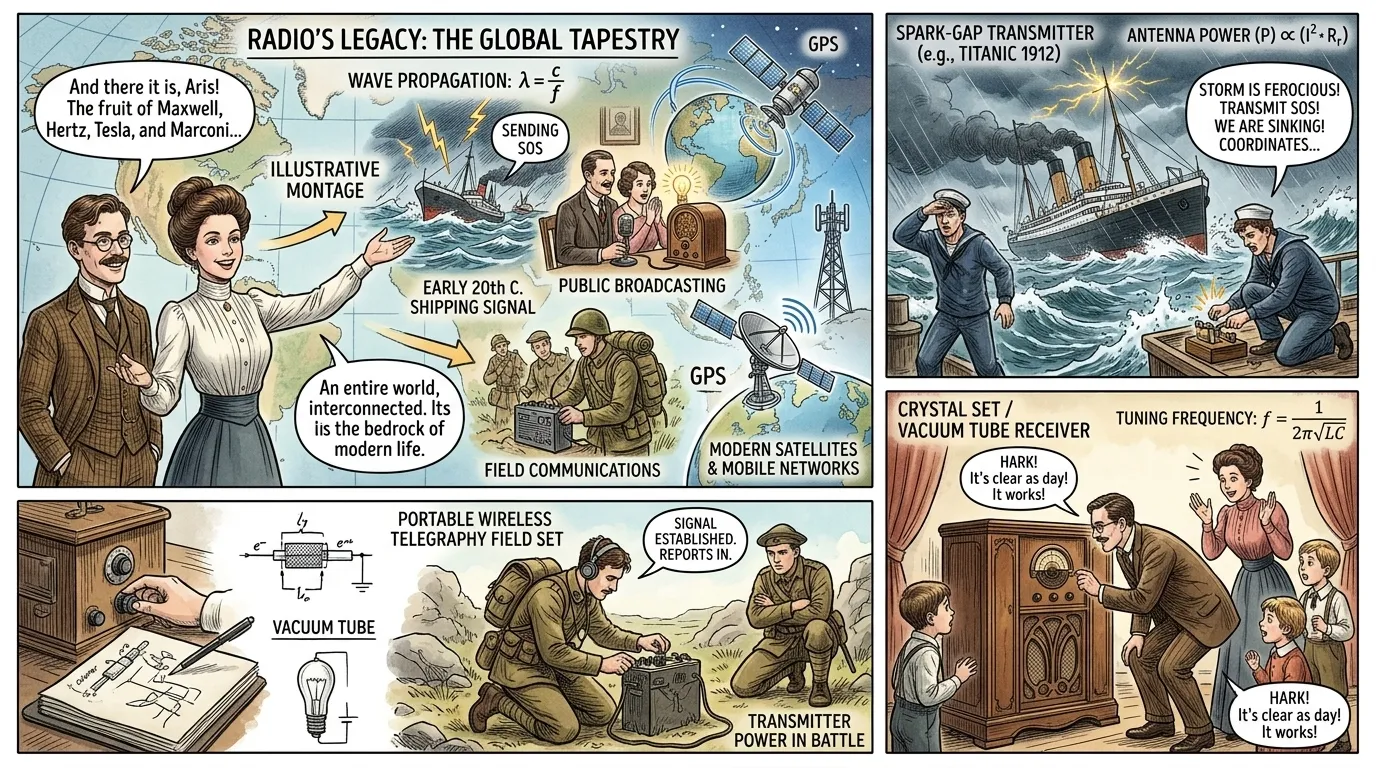
From its humble beginnings as a spark-gap curiosity to a global broadcasting phenomenon, radio profoundly reshaped the 20th century and continues to adapt in the 21st. It provided critical communication during world wars, delivered vital news during natural disasters, and brought cultural experiences—music, drama, speeches—into millions of homes. Radio waves paved the way for television, cellular networks, GPS, and countless other wireless technologies that define our modern existence. 'It's a testament to human ingenuity,' Dr. Petrova concluded, gesturing towards a montage of radio's diverse applications, 'how the desire to communicate across distance ignited a revolution that still echoes today.'
"'It's a testament to human ingenuity,' Dr. Petrova concluded, gesturing towards a montage of radio's diverse applications. 'How the desire to communicate across distance ignited a revolution that still echoes today, shaping everything from global news to emergency response.' Dr. Thorne reflected, 'Indeed, Dr. Petrova. Radio's core principles—generating, transmitting, and receiving electromagnetic waves—underpin almost every wireless technology we take for granted. Its evolution, from simple dots and dashes to complex digital signals, stands as a monumental achievement in human connection, forever changing how we perceive and interact with the world around us.'"
About this story
- Location: Global
- Audience: general readers
Read Wonder Inventions on your phone
Wonder Inventions is available on Android. Get Wonder Inventions on Google Play.