Railway
Railway — an illustrated inventions story, set in Global. 10 illustrated pages, free to read on Wonder Inventions.
Page 1
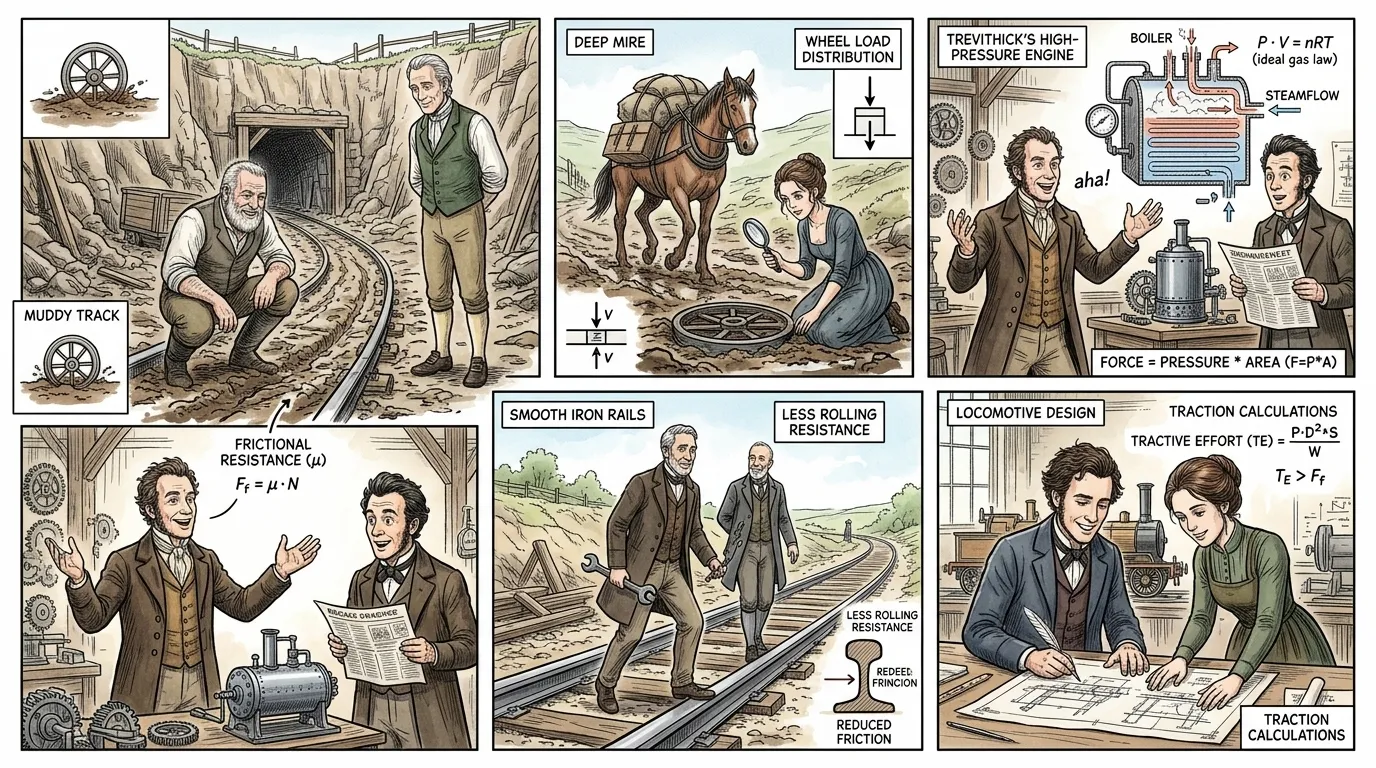
For millennia, the movement of bulk goods was a monumental undertaking, constrained by the limits of animal power and rudimentary roadways. The Industrial Revolution, with its insatiable demand for raw materials and efficient distribution, exposed the crippling inadequacies of existing transport networks. It necessitated a revolutionary solution, a system capable of moving immense weight over vast distances with unprecedented speed.
Page 2
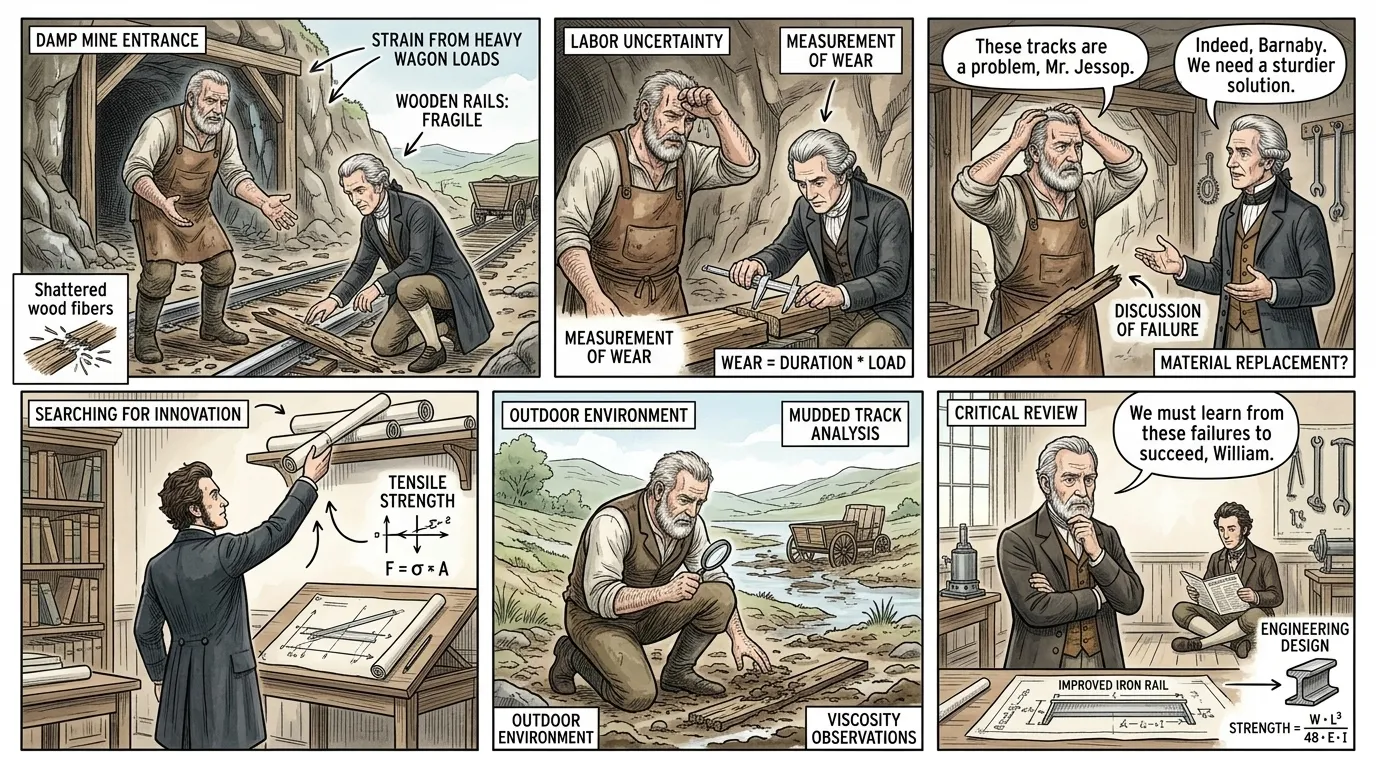
Before the advent of robust rail systems, attempts to ease transit involved 'wagonways' – wooden tracks laid for horse-drawn carts. These offered marginal improvement over dirt roads, reducing friction but prone to rapid wear and decay. The sheer weight of industrial materials quickly splintered the timber, leading to frequent repairs and limiting both speed and payload. The fundamental challenge lay in finding a durable, low-friction surface that could withstand colossal loads.
"A grizzled mine foreman, Barnaby, wiping sweat from his brow, gestured to a splintered wooden rail. 'These tracks are tearing themselves apart, Mr. Jessop,' he grumbled to William Jessop, a distinguished engineer in his 50s, meticulously examining the damaged section. 'We spend more time repairing than hauling coal. It's like trying to move mountains on matchsticks!' Jessop knelt, touching the shattered wood. 'Indeed, Barnaby. The timber simply lacks the tensile strength. We need something unyielding, something that can shoulder the weight of the new steam engines. The future of industry, as Benjamin Franklin once observed, 'depends on two things: the energy of the people and the good sense of their government to keep their hands out of their pockets and let them alone.' But here, Barnaby, it depends on a surface that won't simply disintegrate.'"
Page 3
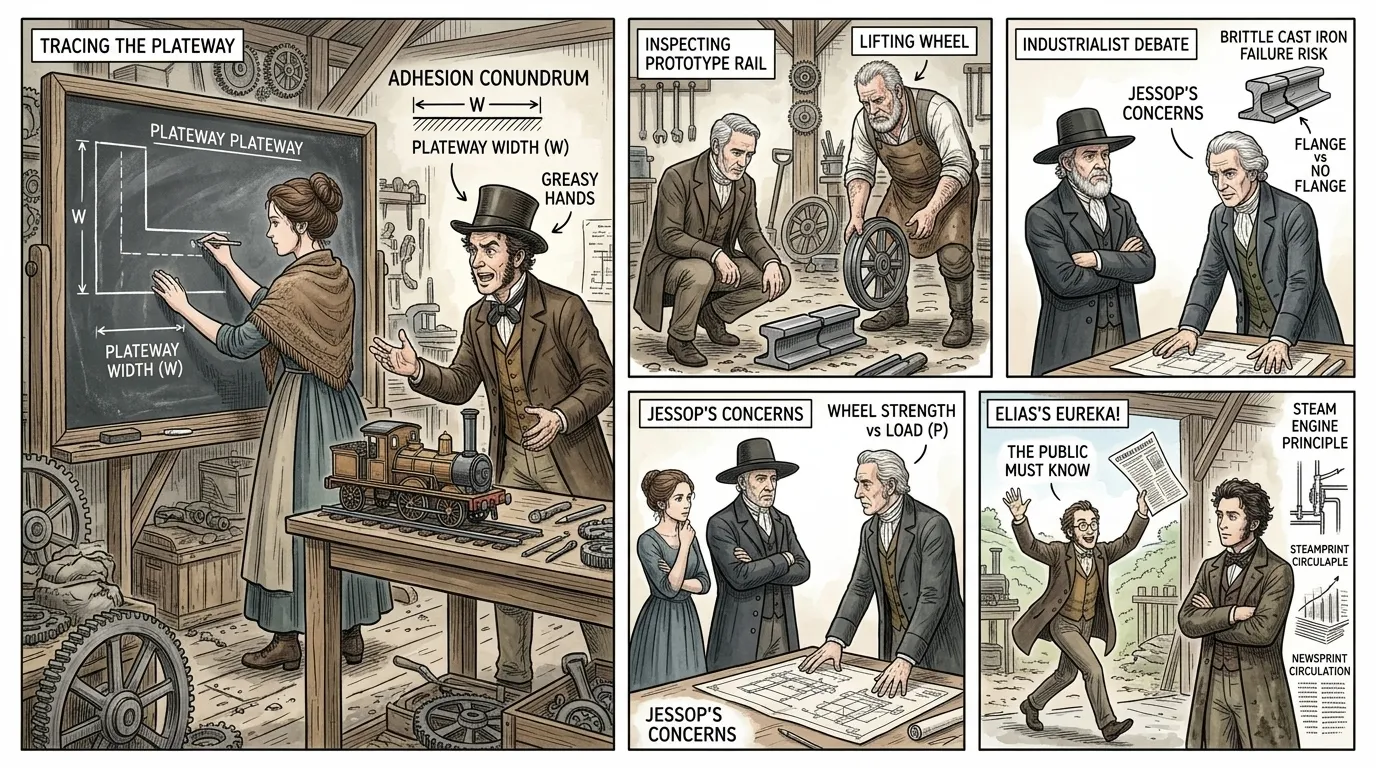
William Jessop's innovation in the late 18th century was the introduction of L-shaped cast-iron 'plateways' or 'flangeways.' These rails, with an integrated vertical flange to guide the wheels, represented a significant leap in durability over wood. However, cast iron, while strong in compression, proved brittle under the dynamic stresses of early steam locomotives and heavy loads, often cracking. A critical debate also raged: could a smooth metal wheel grip a smooth metal rail, or would specialized gears or chains be needed for traction?
"Inside a dusty workshop, a young engineer, Isabella, traced a diagram of an L-shaped rail on a chalkboard. 'Mr. Trevithick, these cast-iron plateways are an improvement, certainly,' she remarked to Richard Trevithick, now looking more animated, gesturing towards a model locomotive. 'But the brittle nature of cast iron leads to catastrophic failures under dynamic loads. And the core question remains: will a smooth iron wheel truly adhere to a smooth iron rail?' Trevithick stroked his chin. 'Ah, the adhesion conundrum. Many are convinced it's impossible, that only cogwheels or chains will suffice. But my experiments with the 'Puffing Devil' and 'Coalbrookdale' engines suggest otherwise. The sheer weight of the locomotive provides enough friction. We merely need to prove it unequivocally, and build rails that don't fracture under its might.'"
Page 4
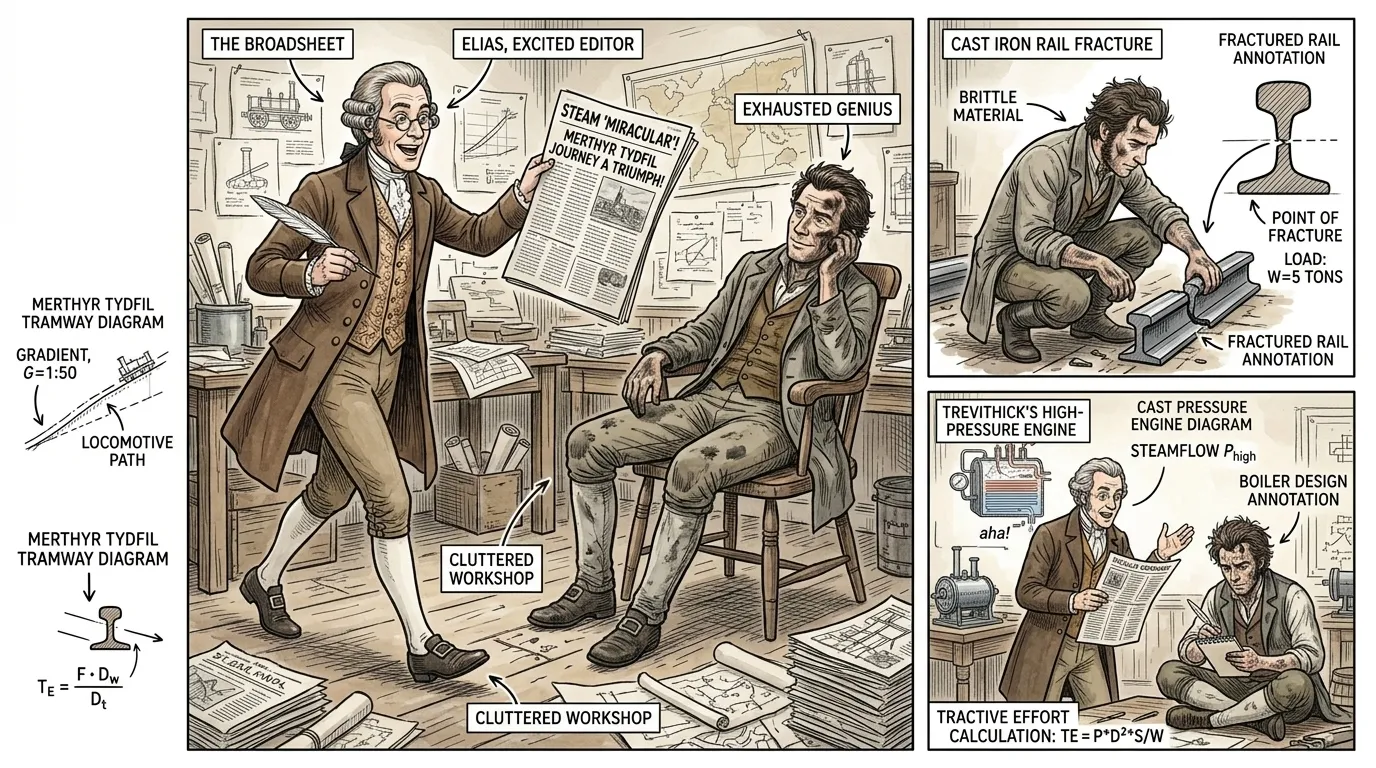
Richard Trevithick, a Cornish engineer, was a visionary. Building on his innovations in high-pressure steam engines, he constructed the world's first full-scale working railway steam locomotive. In 1804, his unnamed engine successfully hauled ten tons of iron and 70 passengers along 9.75 miles of tramway in Merthyr Tydfil, Wales. This monumental feat proved the viability of steam traction and the smooth wheel on smooth rail concept, albeit on rails ill-equipped for its weight, leading to frequent breakages.
"A newspaper editor, Elias, paced excitedly in Trevithick's small office, waving a freshly printed broadsheet. 'Mr. Trevithick, your locomotive's performance at Pen-y-darren is nothing short of miraculous! Ten tons of iron and seventy souls, moved by steam!' Trevithick, looking exhausted but triumphant, leaned back. 'Indeed, Elias. It validates my belief in high-pressure steam and the power of adhesion. But the cast-iron rails... they cannot endure the strain. They fractured constantly.' Elias nodded grimly. 'A powerful engine demands a robust track. This is merely the first step, then. The world needs a system, not just a magnificent machine.'"
Page 5
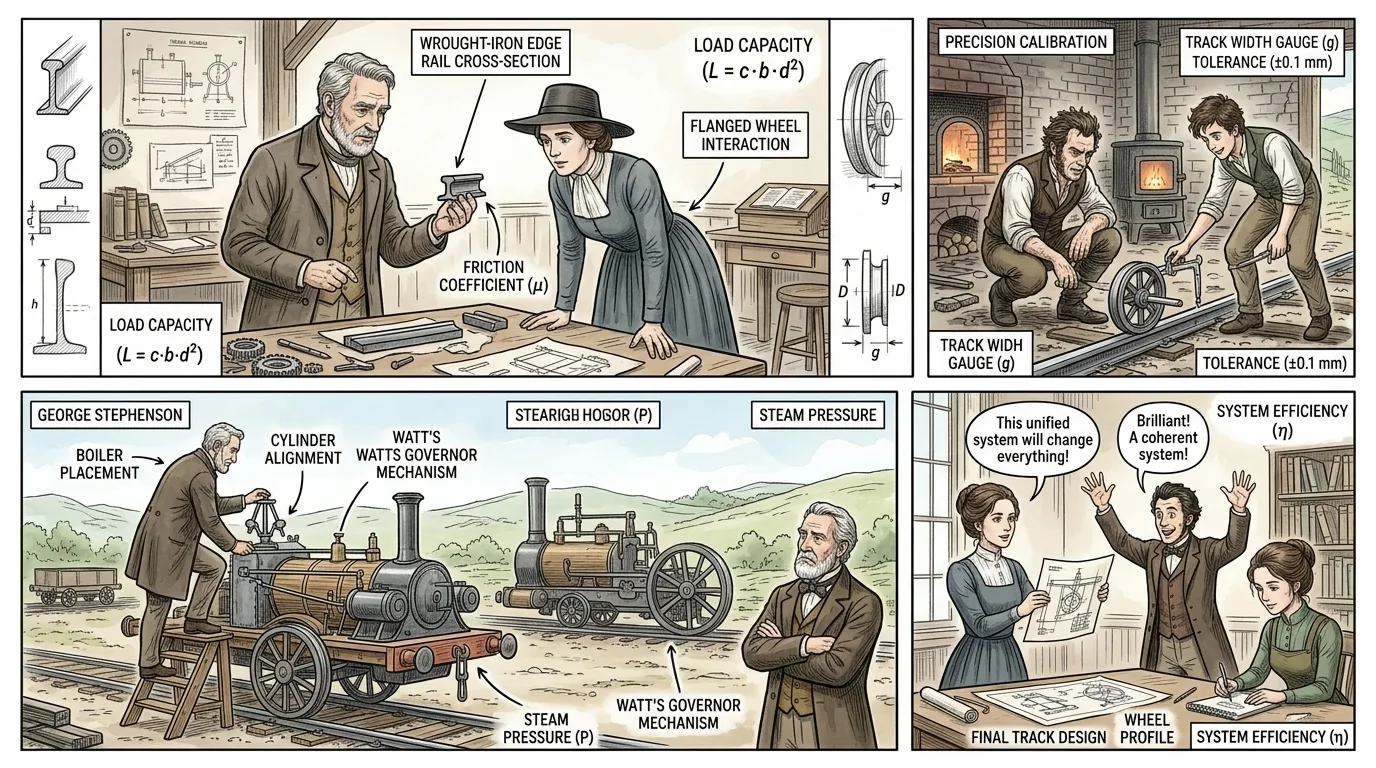
The limitations of Trevithick's early trials underscored the need for a cohesive system: a powerful locomotive married to a durable track. George Stephenson, a self-taught engineer from Northumberland, became the architect of this system. He meticulously studied adhesion, concluding that the friction between a smooth wheel and a smooth wrought-iron rail was indeed sufficient for traction, especially with improved engine design. His focus shifted from the flanged 'plateway' to the 'edge rail', where the wheel itself possessed the guiding flange, significantly improving track strength and durability.
"In a dimly lit workshop, George Stephenson, a thoughtful man in his 50s with a serious demeanor and plain work clothes, pointed to a detailed drawing of a wrought-iron 'edge rail' on his workbench. 'The key is not merely a stronger rail, but the entire interaction, Mr. Pease,' Stephenson explained to Edward Pease, a prominent Quaker industrialist, carefully examining the diagram. 'The wheel, not the rail, must provide the flange. This 'edge rail' design, forged from wrought iron, offers superior strength and resilience. And my locomotive, 'Blücher,' proved conclusively that adhesion on a smooth rail is more than adequate. We do not need cogs or chains. The friction itself is our servant.' Pease nodded, impressed. 'A coherent system, then. A track and an engine designed in unison.'"
Page 6
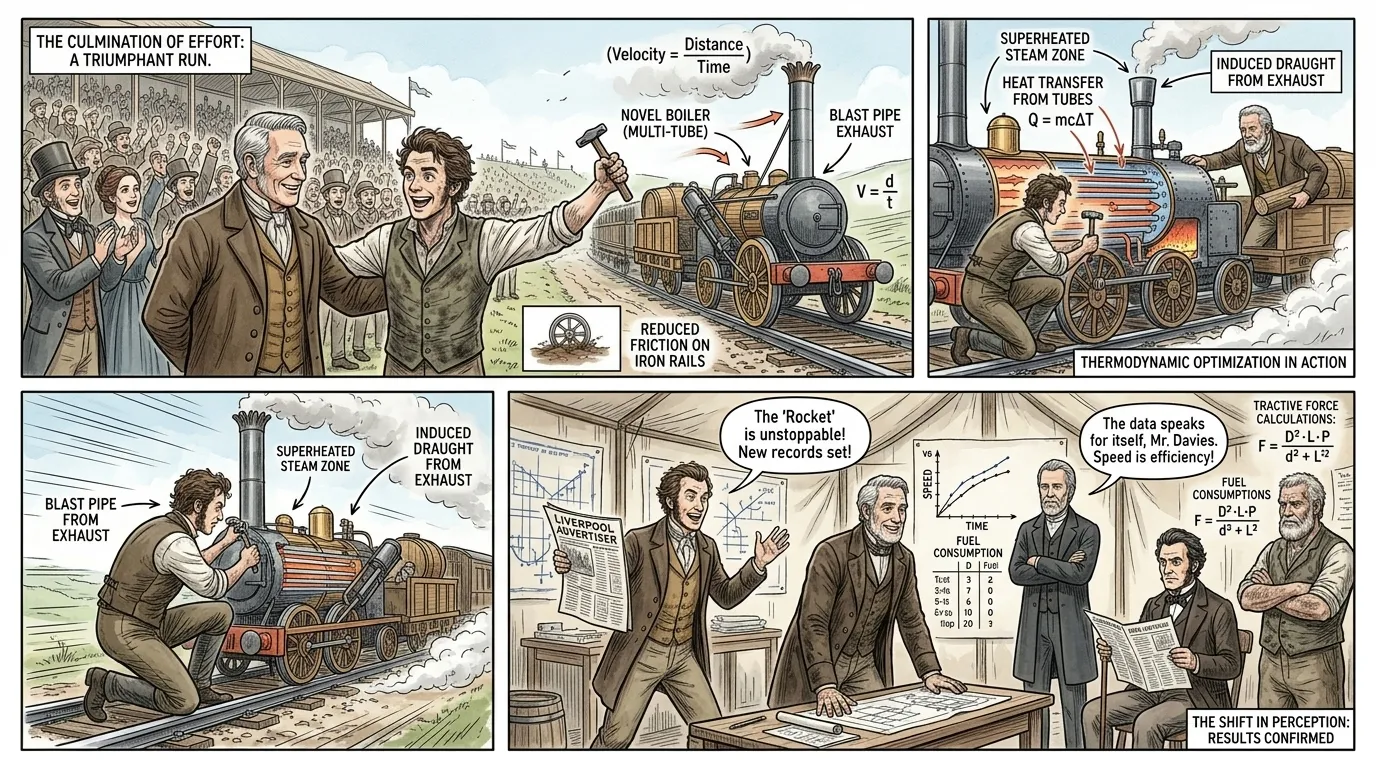
The year 1829 marked a pivotal moment in railway history: the Rainhill Trials. Organized by the Liverpool & Manchester Railway, this competition sought the best locomotive for their new line. George Stephenson's 'Rocket,' a marvel of engineering, demonstrated unparalleled speed, reliability, and efficiency. Its multi-tube boiler, connecting exhaust steam to the chimney for increased draft, significantly improved heat transfer and steam generation, a crucial breakthrough that propelled the locomotive into a new era of performance.
"Amidst the roar of the 'Rocket's' engine, George Stephenson, beaming, turned to his son Robert, a brilliant engineer in his 20s, also dressed in practical attire. 'Robert, listen to her! The multi-tube boiler, the blast pipe – they sing a song of efficiency and power!' Robert, exhilarated, shouted over the din. 'Father, the draft is magnificent! It's pulling the carriages with such ease. We have proven it beyond doubt: a faster, more powerful machine is possible! As Leonardo da Vinci so wisely articulated centuries ago, 'Simplicity is the ultimate sophistication.' The Rocket embodies that, through ingenious, yet elegant, engineering principles.' Spectators cheered as the locomotive thundered past."
Page 7
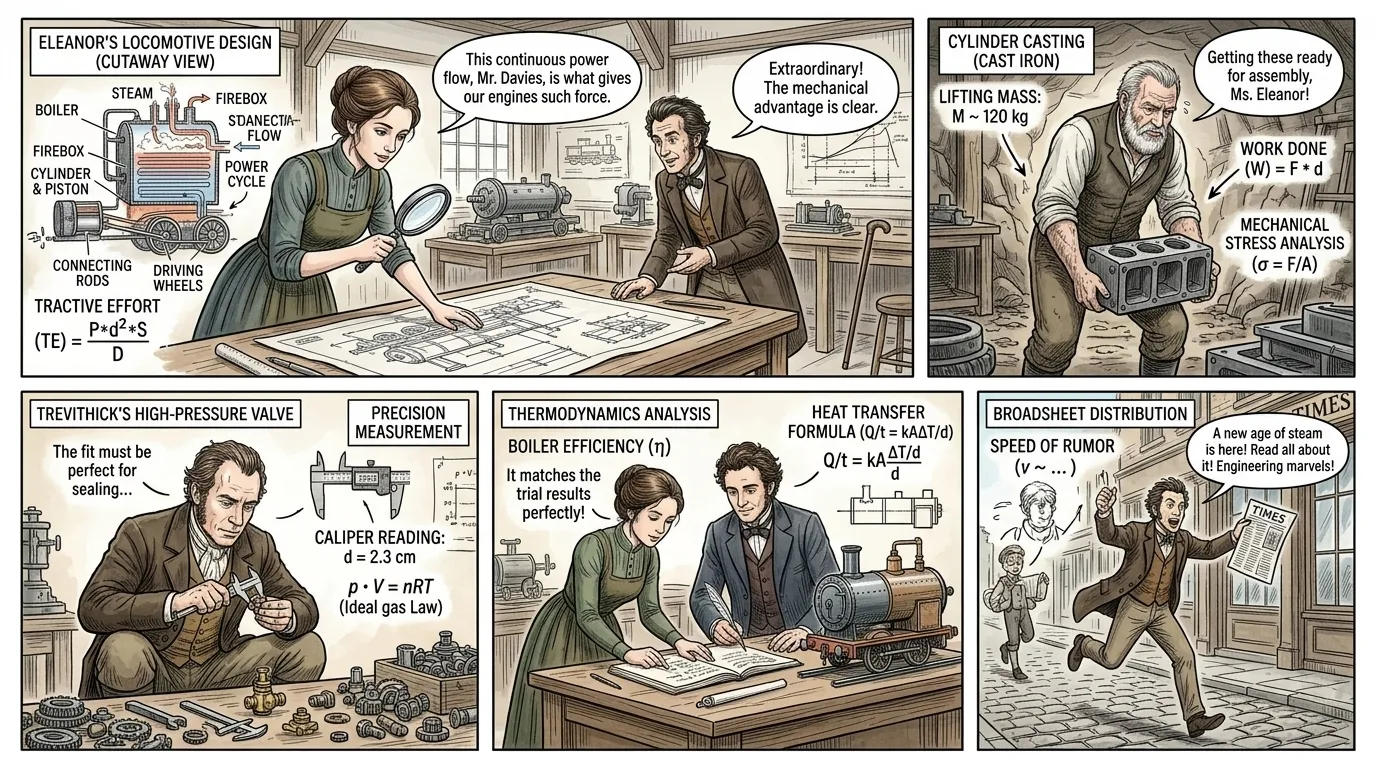
The steam locomotive functions as a mobile power plant. Coal is burned in the firebox, heating water in the boiler to create high-pressure steam. This steam is then directed into cylinders, pushing pistons back and forth. These reciprocating movements are transferred via connecting rods to the driving wheels, converting linear motion into rotational motion. Exhaust steam, channeled up the chimney, creates a powerful draft, drawing air through the firebox and intensifying the combustion, forming a continuous cycle of power generation and propulsion.
"Inside a cutaway diagram of a working locomotive, a chief engineer, Eleanor, explained the mechanics to a visiting industrialist, Mr. Davies. 'Observe, Mr. Davies, the raw power from combustion,' Eleanor, a composed woman in her 40s with her hair neatly pinned, pointed to the firebox. 'The heat transforms water into high-pressure steam, forcing the pistons within the cylinders to move. This simple linear motion, through the connecting rods, spins our massive driving wheels.' Mr. Davies leaned closer. 'And the exhaust? It contributes to the engine's very breath?' Eleanor nodded. 'Precisely. The steam, expelled upwards, creates a vacuum, drawing fresh air into the firebox, intensifying the fire, and perpetuating the cycle. Every component works in concert, a symphony of force.'"
Page 8
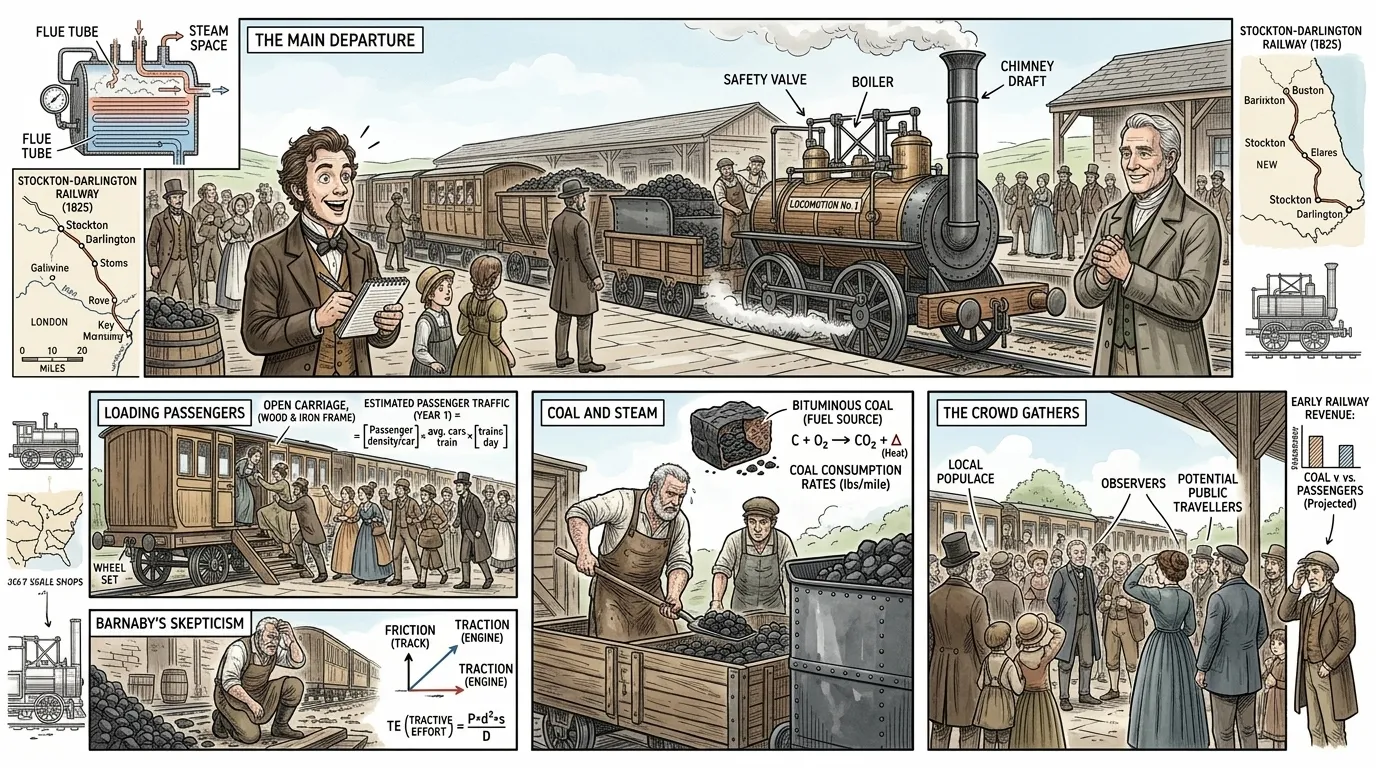
With Stephenson's innovations, the railway rapidly moved from experimental curiosities to vital infrastructure. The Stockton & Darlington Railway, opened in 1825, was the world's first public railway to use steam locomotives, marking the true dawn of the railway era. Initially designed for coal transport, it soon carried passengers, demonstrating the immense versatility and public appeal of this new mode of travel. Its success inspired a global network of railway construction, forever altering the landscape of transport and trade.
"Standing on the bustling platform of the Stockton & Darlington Railway, a young journalist, Thomas, marveled at the steam locomotive 'Locomotion No. 1' as it prepared to depart. 'Mr. Stephenson, this is beyond anything imagined!' he exclaimed to George Stephenson, who supervised the loading. 'Not only coal, but people! The possibilities for trade, for travel—it is limitless!' Stephenson, a rare smile on his face, surveyed the scene. 'Indeed, Thomas. This railway is a lifeline for industry, but it also unites communities. It is a testament to what disciplined engineering can achieve. The iron horse will carry us into an age of unparalleled connection, shrinking distances and expanding horizons for all.'"
Page 9
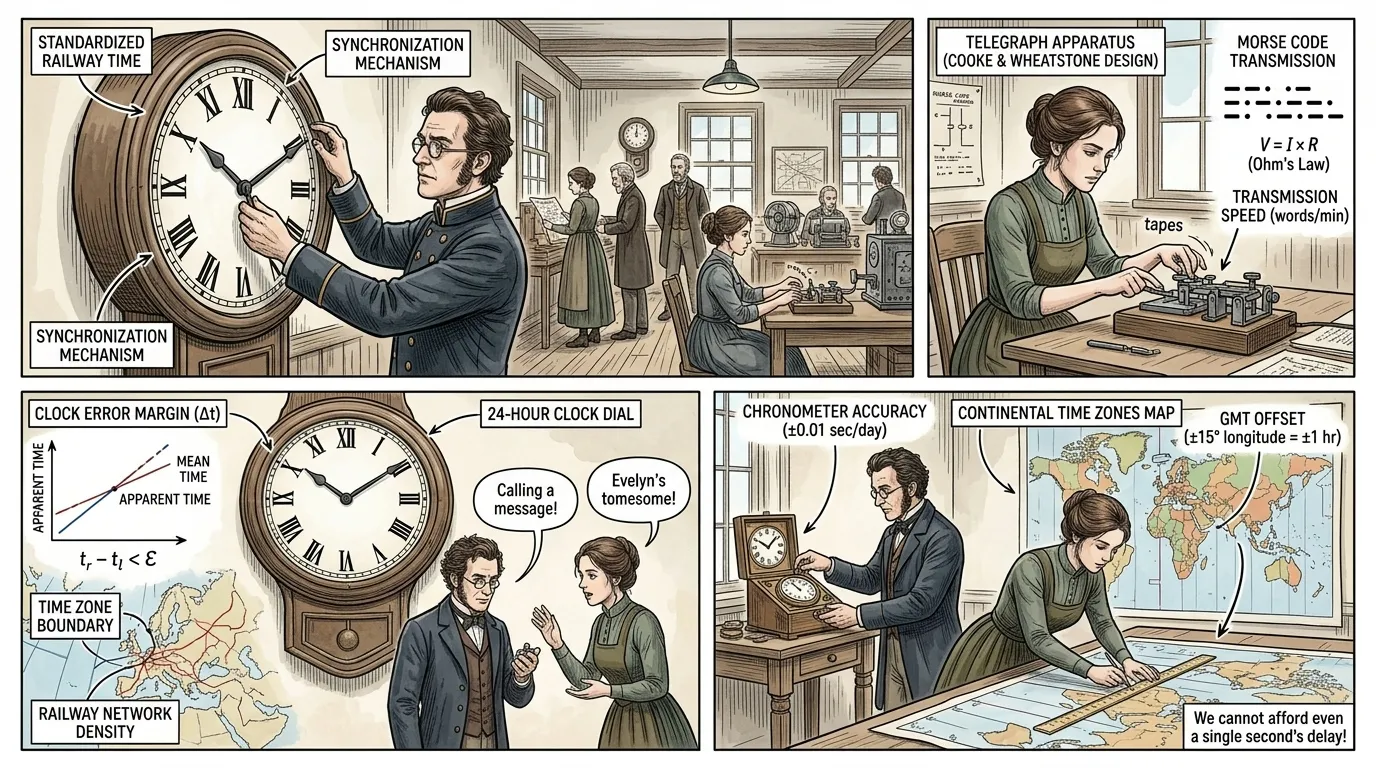
The railway's success ignited a construction boom across continents. From the vast plains of America to the intricate networks of Europe, railways became the arteries of burgeoning industrial nations. The immense scale and coordinated operation of these networks necessitated standardization, most notably in track gauge. Furthermore, the need for precise scheduling across time zones led to the adoption of standardized 'railway time,' a precursor to universal time zones, fundamentally altering human perception of time and distance.
"Inside a bustling railway operations room, a station manager, Arthur, checked a large clock. 'The London express is due in ten minutes, on standard railway time,' he announced, adjusting his spectacles. 'Imagine, fifty years ago, every town had its own local time! Now, thanks to the railways, we run on a unified schedule.' A telegraph operator, Evelyn, rapidly tapped out a message. 'The American transcontinental line has linked East and West, Arthur. Distances once measured in months are now traversed in days. Truly, the railway has not only reshaped the land but our very understanding of the world's scale.' Arthur nodded. 'It's as Charles Dickens once penned, 'It was the best of times, it was the worst of times.' For transportation, it is undeniably the best of times.'"
Page 10
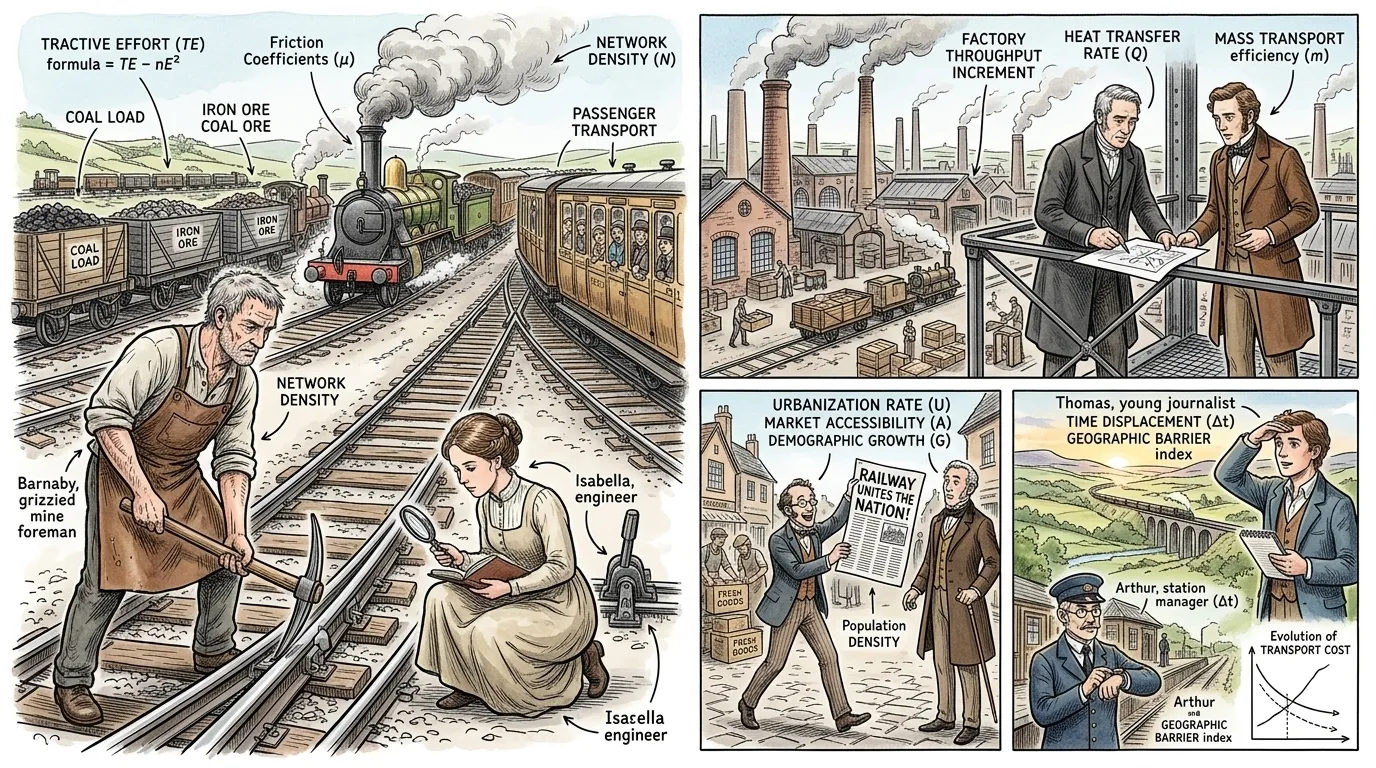
The railway transformed societies on an unprecedented scale. It fueled industrial growth by efficiently transporting raw materials and finished goods, connected distant towns into national markets, and facilitated mass migration and tourism. It reshaped landscapes, spurred civil engineering innovations, and even altered the fabric of daily life through standardized time. From the humble wagonway to high-speed bullet trains, the railway remains a cornerstone of global infrastructure, a testament to humanity's relentless pursuit of connection and progress.
About this story
- Location: Global
- Audience: general readers
Read Wonder Inventions on your phone
Wonder Inventions is available on Android. Get Wonder Inventions on Google Play.