Roller Bearing
Roller Bearing — an illustrated inventions story, set in Global. 10 illustrated pages, free to read on Wonder Inventions.
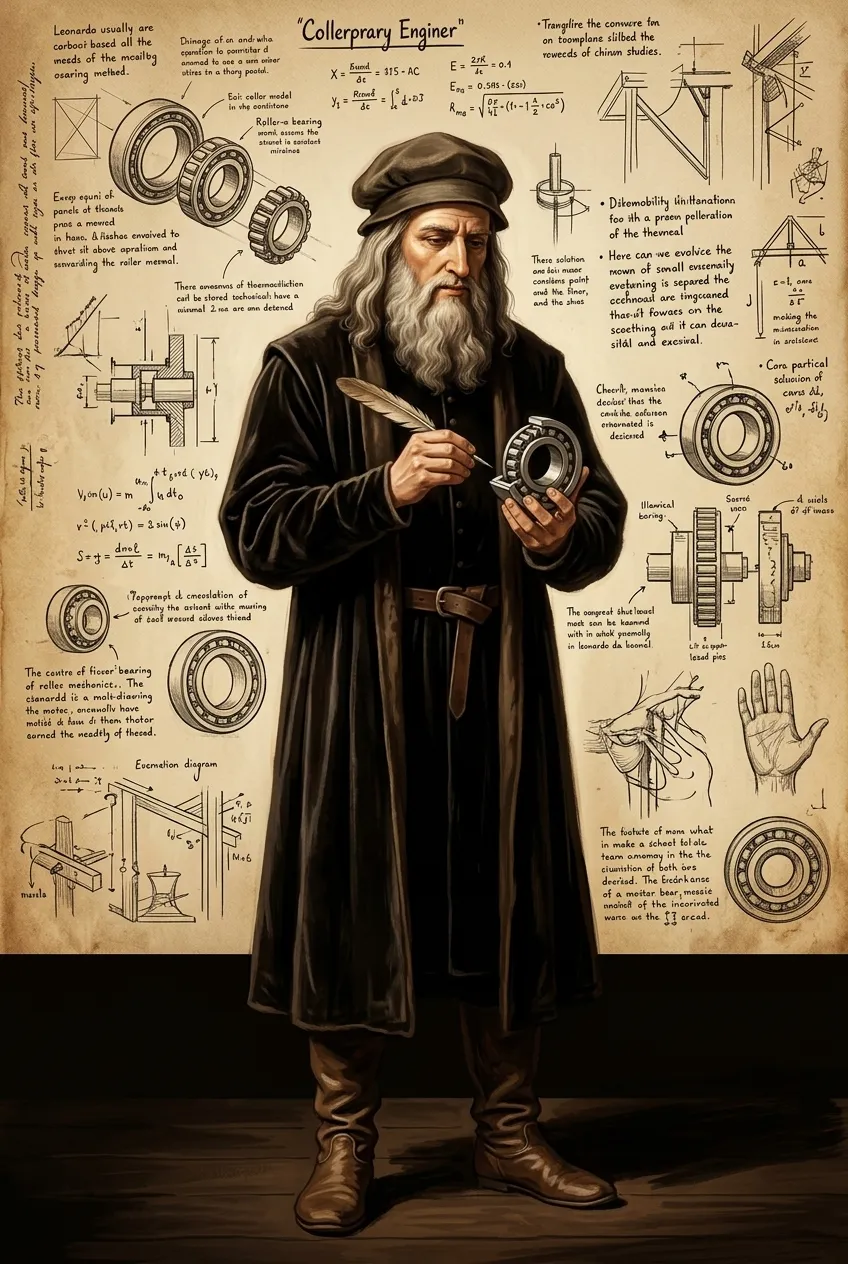
Page 1
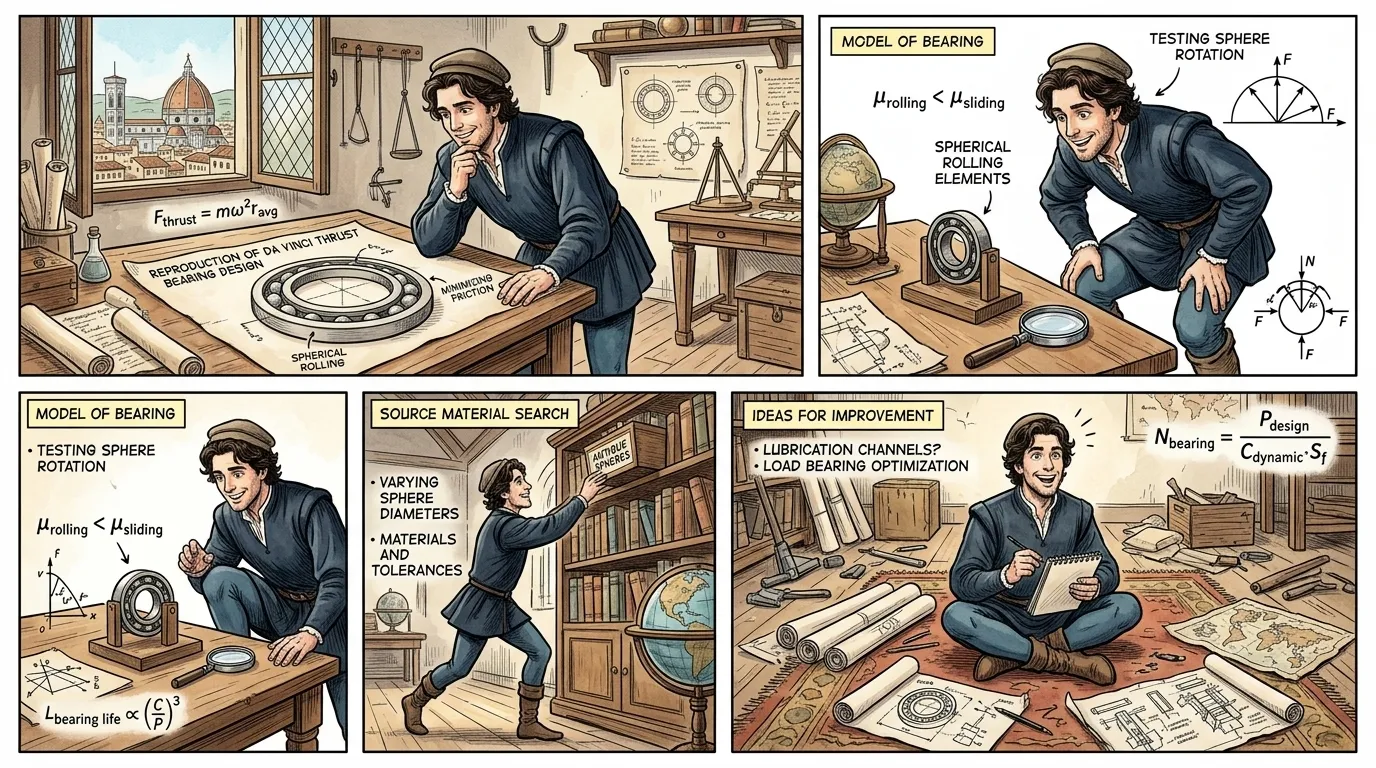
For millennia, humanity wrestled with a fundamental impediment to progress: friction. Moving immense loads, whether massive stone blocks for ancient wonders or laden carts across rough terrain, demanded Herculean effort. Leonardo da Vinci, the quintessential Renaissance polymath, recognized this profound challenge, sketching visionary solutions centuries ahead of their practical realization.
"'The most useful thing is often the simplest observation,' mused a contemporary engineer, examining a reproduction of da Vinci's early design. 'He understood, fundamentally, the difference between sliding and rolling.'"
Page 2
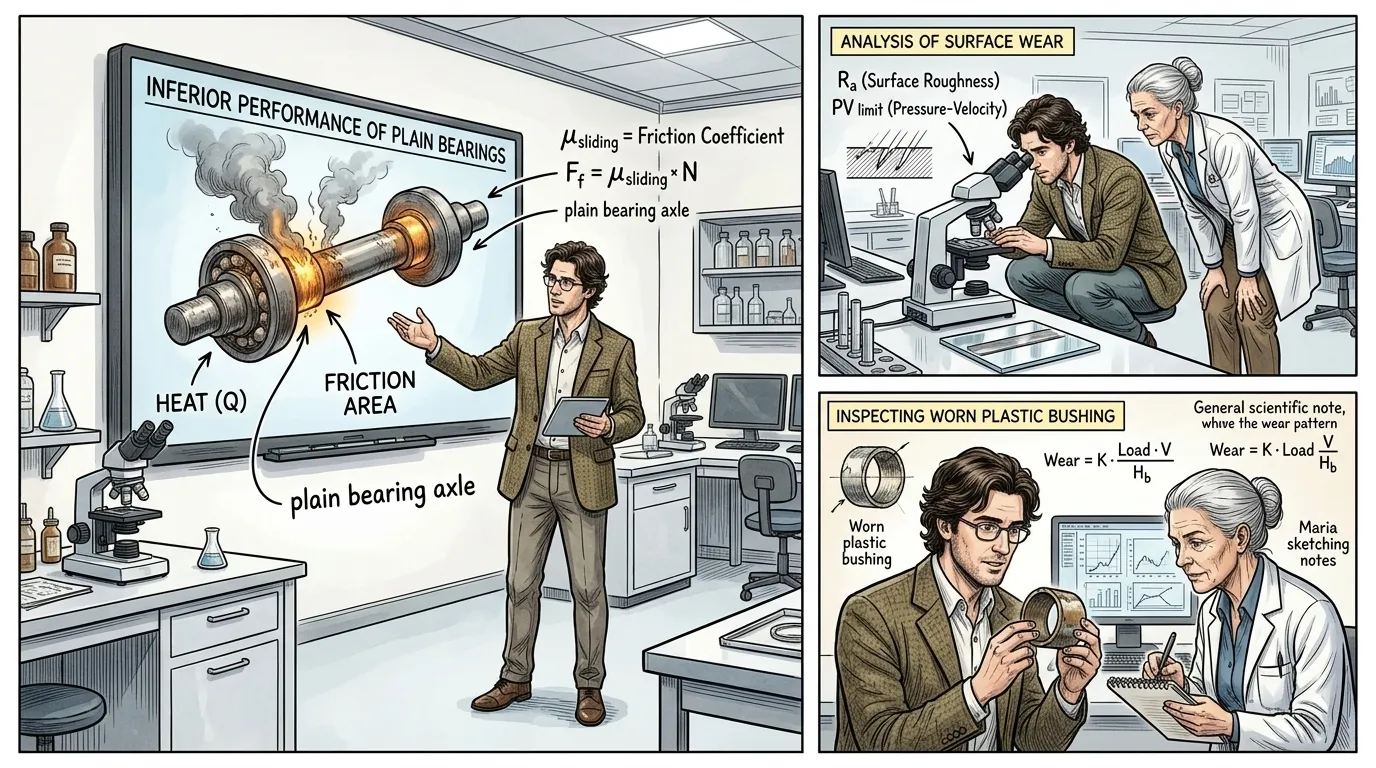
Before the advent of refined rolling elements, transport relied predominantly on plain bearings: simple axles rotating within static bushings. This fundamental design, while functional, generated immense sliding friction, leading to rapid wear, debilitating heat, and significant energy loss. Historians and engineers often reflect on the true cost of this inefficiency.
"Dr. Aris Thorne, a lean mechanical historian in his 40s, gestures to a smoking axle on a digital rendering. 'Look at this,' he explains. 'Every rotation meant grinding surfaces, literally turning effort into useless heat. Imagine the constant repairs, the slow pace. It wasn't just a nuisance; it was a profound economic and logistical barrier.'"
Page 3
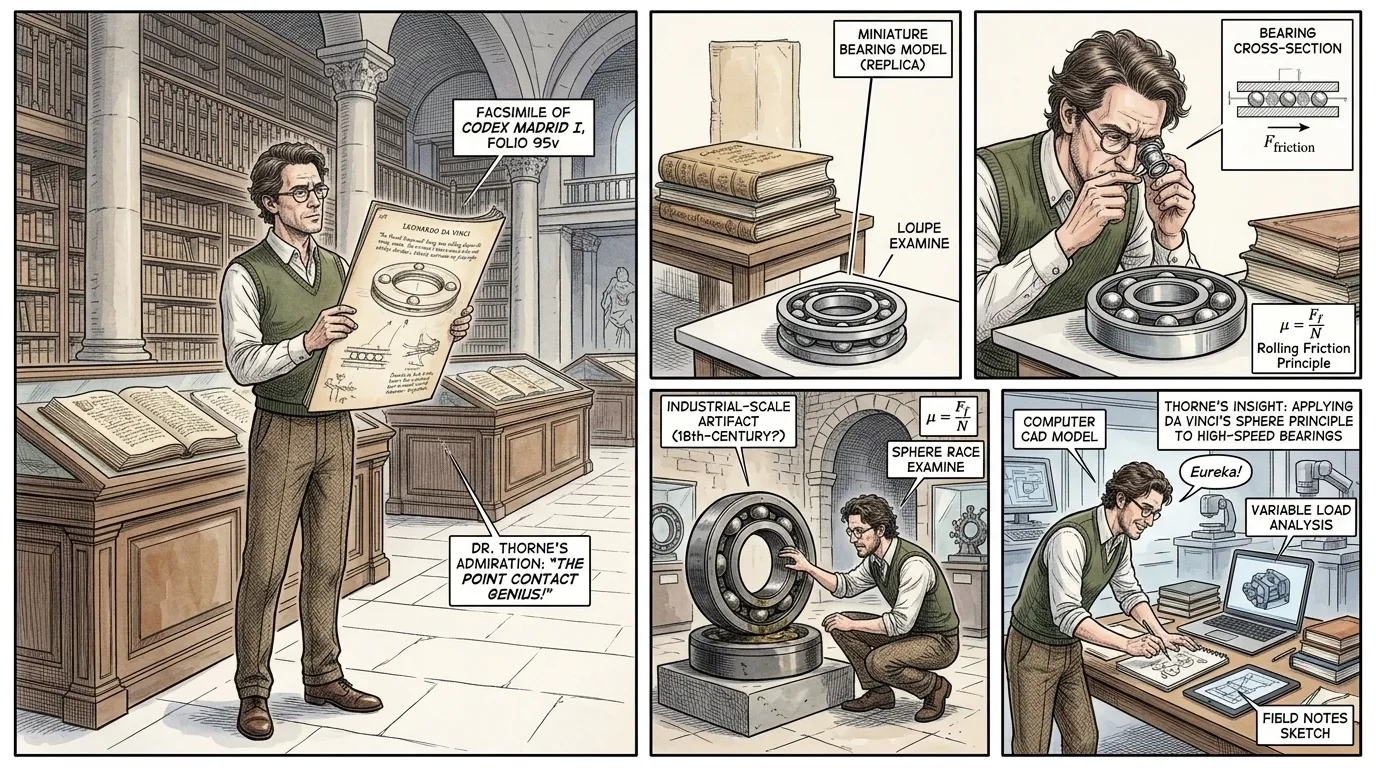
While centuries before industrial application, Leonardo da Vinci's notebooks reveal an astonishing grasp of advanced mechanical principles. His sketches for thrust bearings, using small, rolling spheres between two plates, aimed to facilitate rotational movement by converting sliding resistance into the much lower rolling resistance. He recognized that this 'rolling contact' was key.
"Holding a historical replica of a da Vinci drawing, Dr. Thorne states, 'Da Vinci's genius lay in his observation. He saw that 'point contact' of a sphere rolling against a surface dramatically reduced the area of friction. He was, as the Roman philosopher Seneca observed, 'not only born in another century, but belonged to it.' Da Vinci truly belonged to the future.'"
Page 4
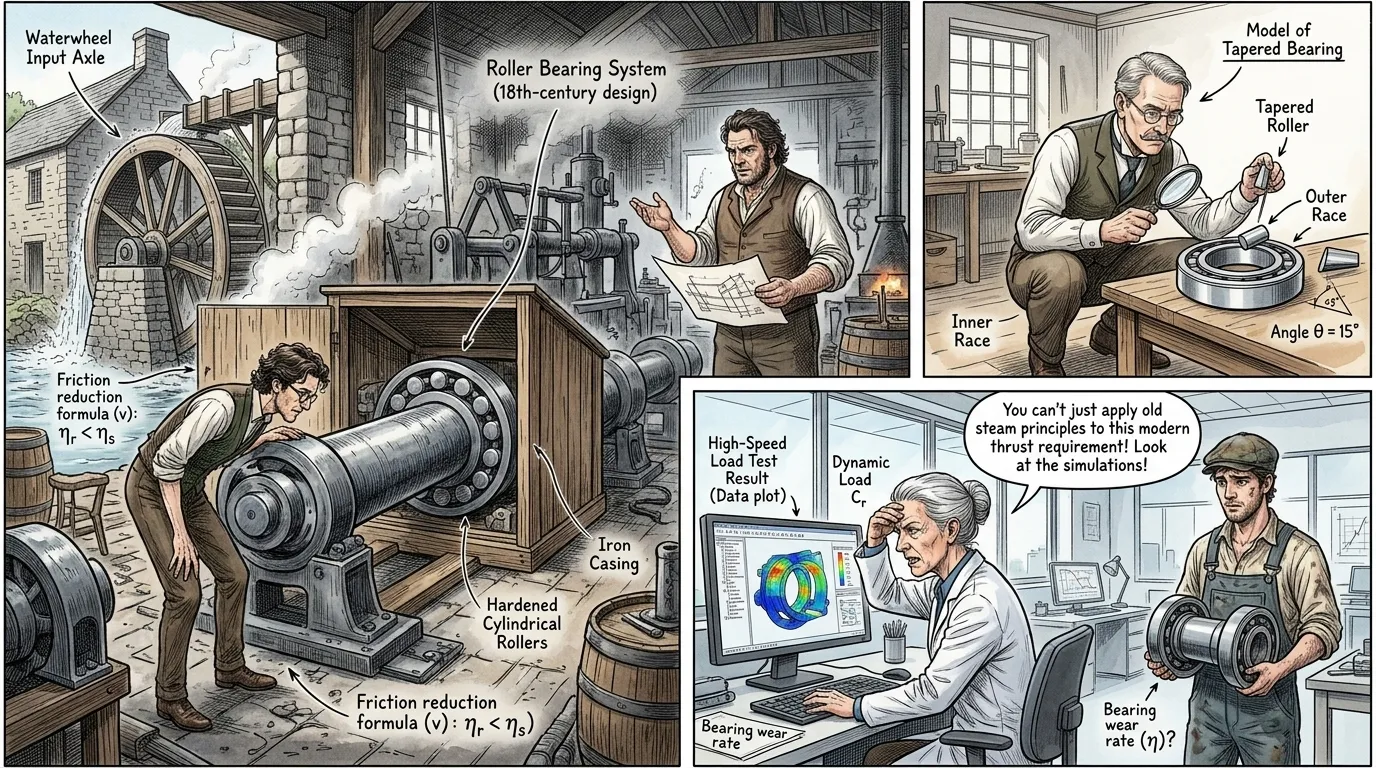
The true industrialization of the roller bearing began in the late 18th century, driven by the escalating demands of the burgeoning Industrial Revolution. In 1794, the Welsh ironmaster Philip Vaughan received the first patent for a practical roller bearing, featuring hardened steel cylindrical rollers held within a cage. This was a critical step from concept to engineering reality.
"An industrial foreman, Elias Croft, a burly man in his 50s with soot-stained hands and a leather apron, shouts over the din of early machinery: 'Vaughan's cylinders! They finally let us move these massive axles without the whole thing seizing up every few days! It's a game-changer for the mills.'"
Page 5
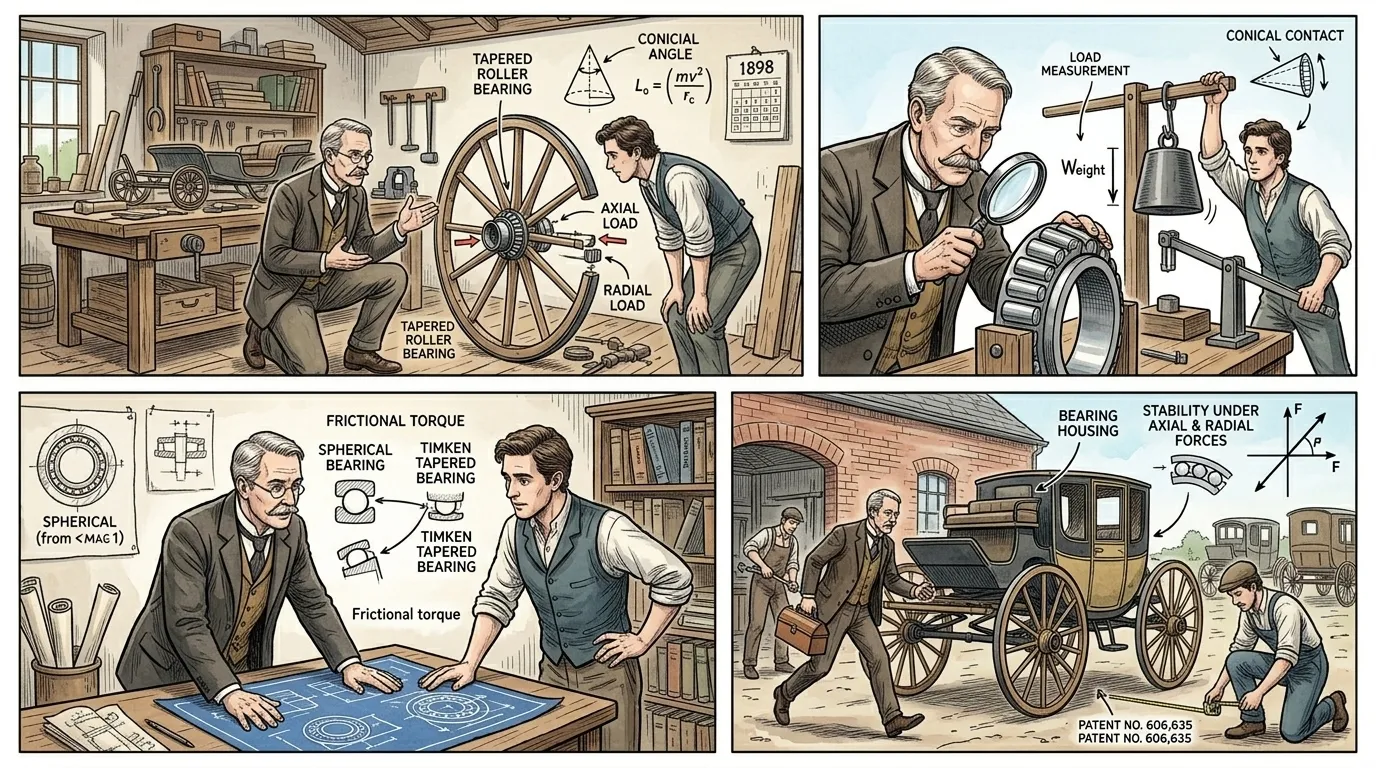
While cylindrical roller bearings improved efficiency, a significant challenge remained: handling combined radial and axial (thrust) loads simultaneously. Wagon wheels, for instance, experienced forces both pushing inward and sideways during turns. American inventor Henry Timken, a carriage maker, confronted this directly, patenting the tapered roller bearing in 1898.
"Henry Timken, a thoughtful man in his 60s with a neat mustache and spectacles, gestures to a scaled model of a wagon wheel on his workshop bench. 'A flat roller simply can't handle the side-to-side stress,' he explains to an apprentice. 'The conical form, however, distributes that load across its entire tapered surface. It's about stability, not just rotation.'"
Page 6
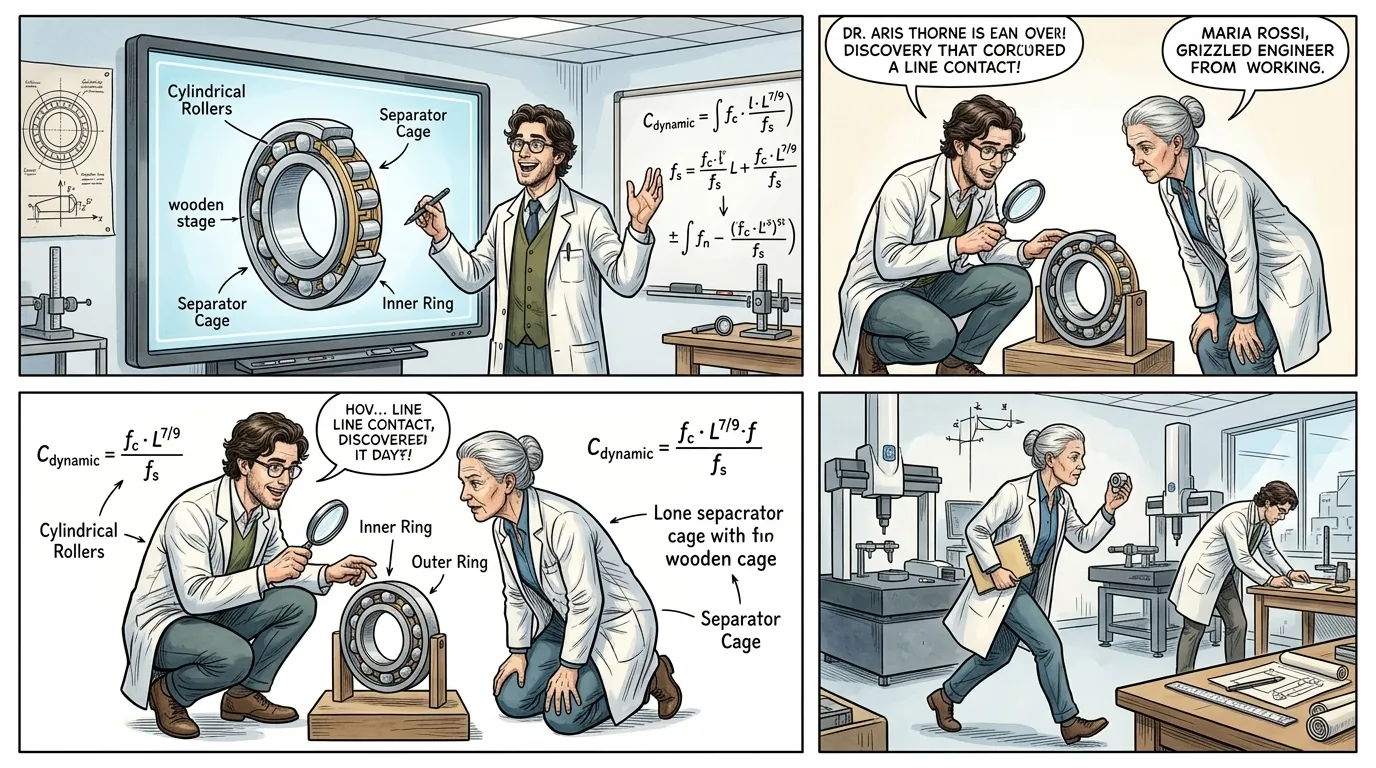
The fundamental principle of all roller bearings is to replace sliding friction with rolling friction. In a cylindrical roller bearing, precision-ground cylindrical rollers are positioned between two 'races' – an inner ring attached to the shaft and an outer ring within the housing. A 'cage' maintains proper spacing between the rollers, preventing them from contacting each other.
"Dr. Thorne narrates over a detailed animation: 'As the shaft rotates, the rollers spin freely between the races. This 'line contact' distributes the load over a larger area than point contact, vastly reducing pressure and wear compared to plain bearings. It's a triumph of material science and geometric design.'"
Page 7
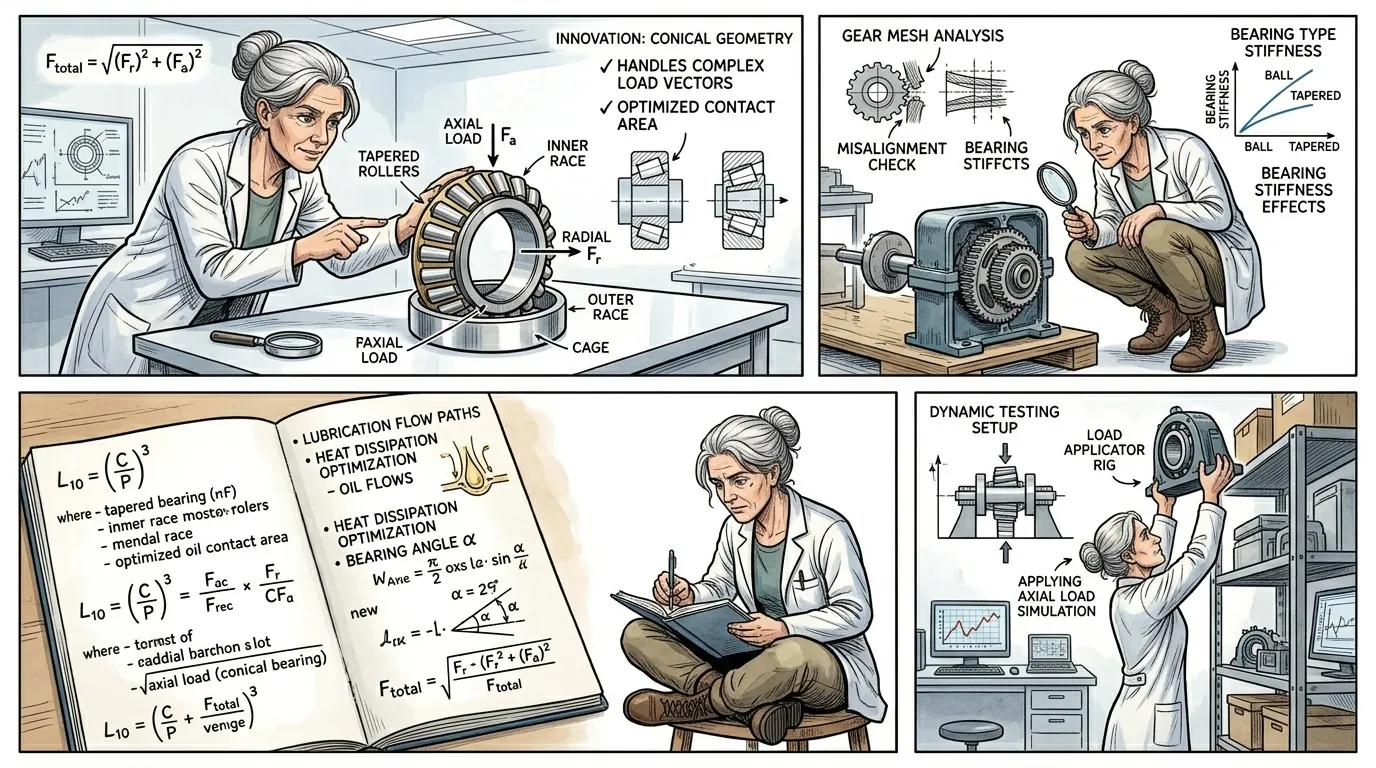
The tapered roller bearing builds upon this by employing conical rollers and races. This ingenious geometry allows the bearing to handle both radial loads (forces perpendicular to the shaft) and significant axial or thrust loads (forces parallel to the shaft). The angles of the rollers and races are precisely matched, directing forces evenly.
"A grizzled veteran engineer, Maria Rossi, with silver hair pulled back in a practical bun and wearing a protective lab coat, points to a deconstructed tapered bearing. 'When you have heavy machinery, or vehicles turning corners, you're not just pushing down; you're pushing sideways,' she explains. 'The tapered design absorbs both. It's what allowed us to build truly robust systems.'"
Page 8
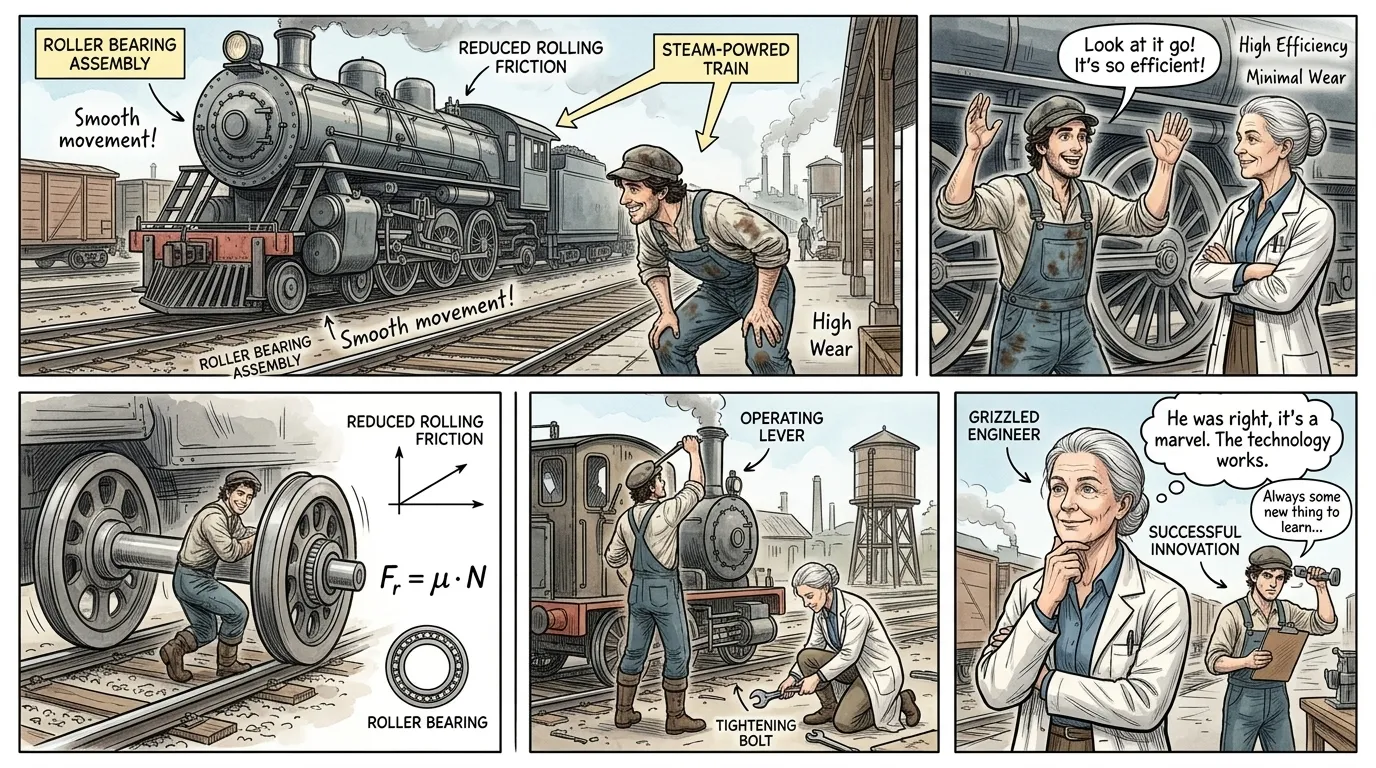
The advent of reliable roller bearings dramatically transformed heavy industry and transportation. Railroads, in particular, benefited immensely, with locomotives and freight cars able to carry heavier loads at higher speeds with drastically reduced friction and maintenance. Factories gained efficiency, consuming less power for the same output.
"A railway engineer from the early 20th century, Thomas Miller, in a grease-stained cap and overalls, watches a massive steam locomotive roll smoothly past. He exclaims, 'Before these bearings, a train this heavy would have needed constant servicing, axles overheating! Now, it's a beast of burden, tireless and true. Adam Smith was right, 'It is not by the benevolence of the butcher, the brewer, or the baker that we expect our dinner, but from their regard to their own interest.' Efficiency became everyone's interest!'"
Page 9
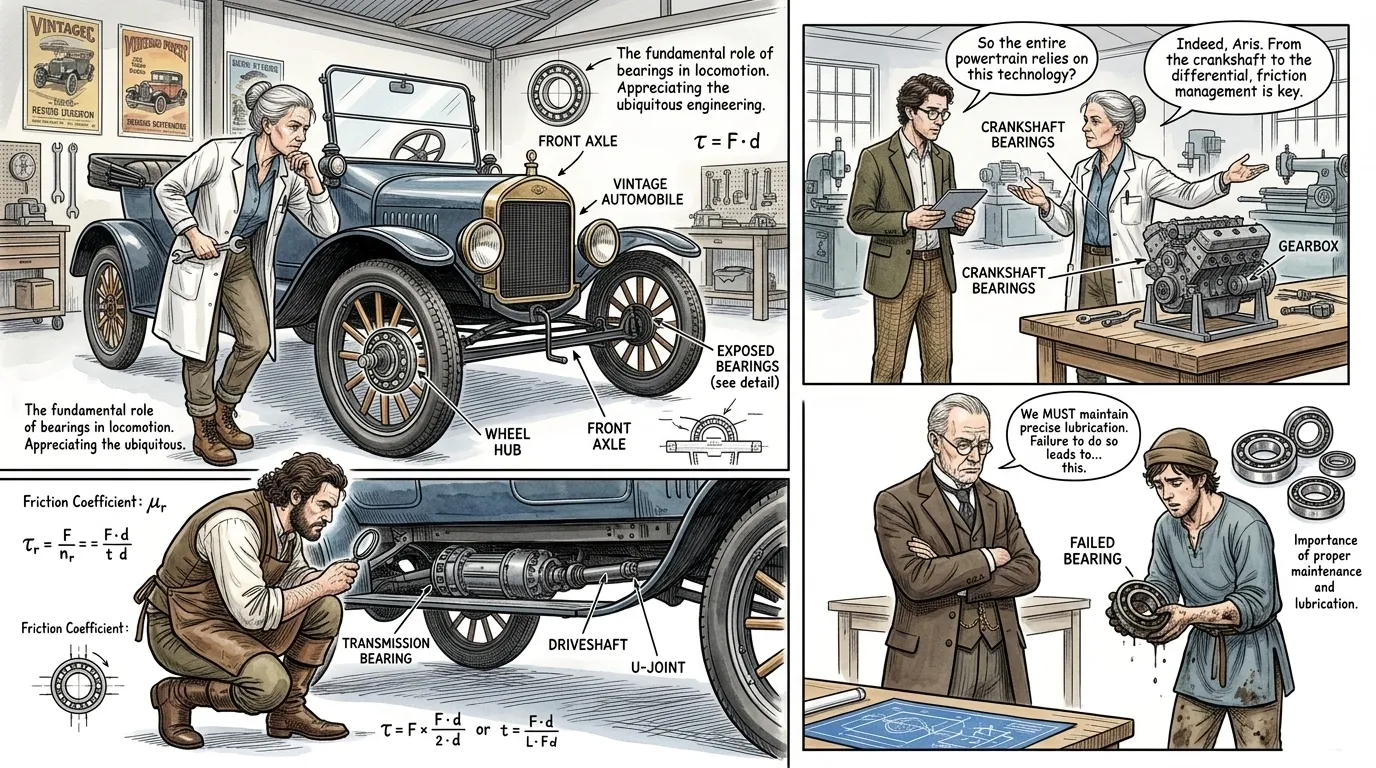
The true ubiquity of the roller bearing became apparent with the rise of the automobile. Efficient, durable bearings were crucial for engines, transmissions, and wheel hubs, enabling vehicles to operate at higher speeds and for longer durations without failure. This innovation was fundamental to the personal transportation revolution.
"Maria Rossi, observing a vintage car being restored, reflects, 'Every major mechanical system in an automobile relies on bearings. Without them, the modern vehicle as we know it simply wouldn't exist. It's a testament to how often the most profound changes come from improving the most fundamental components.'"
Page 10
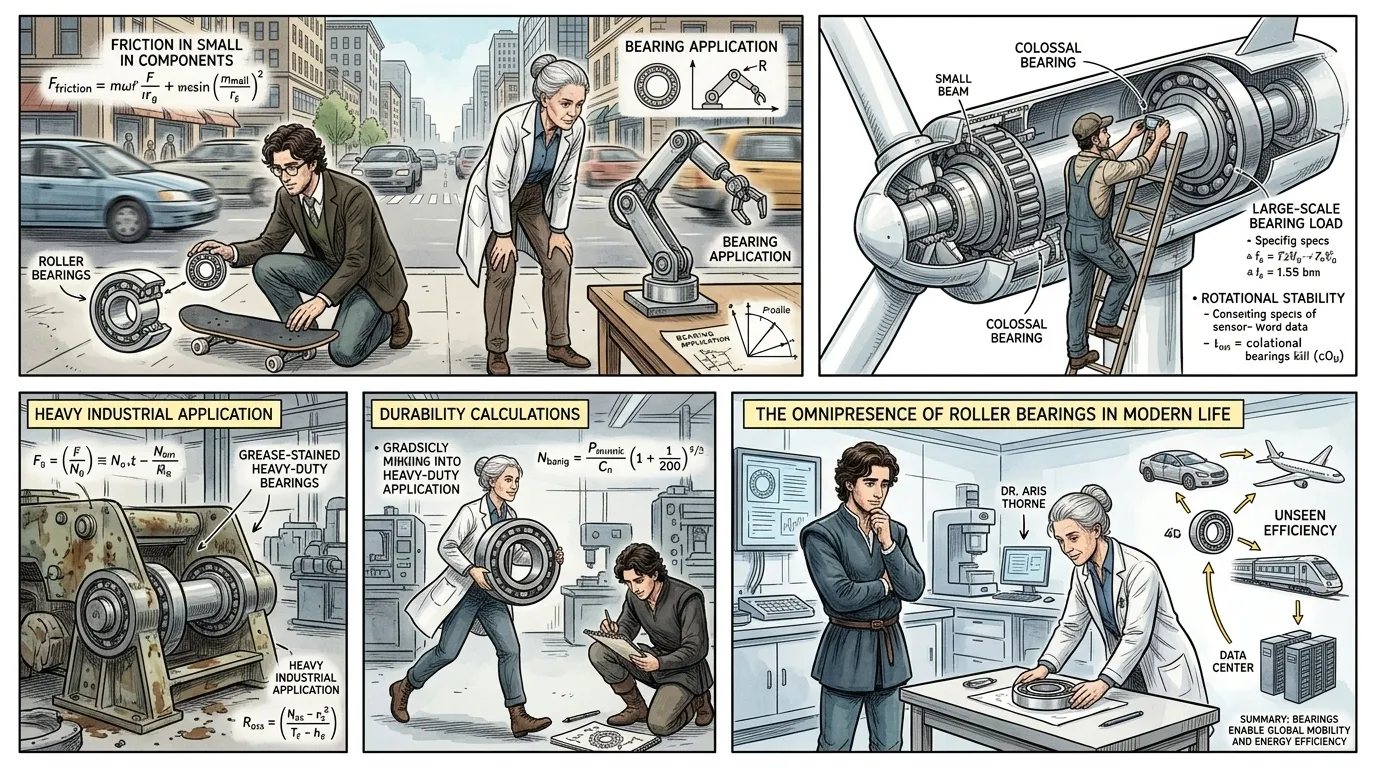
Today, the roller bearing is an unsung hero, quietly underpinning almost every aspect of modern life. From the precision movements of robotics to the colossal blades of wind turbines, from the smallest skateboards to the largest mining equipment, its role is indispensable. It is a fundamental component of global mobility, energy efficiency, and industrial productivity, a testament to enduring ingenuity.
"N/A"
About this story
- Location: Global
- Audience: general readers
Read Wonder Inventions on your phone
Wonder Inventions is available on Android. Get Wonder Inventions on Google Play.