Search Algorithm
Search Algorithm — an illustrated inventions story, set in Global. 10 illustrated pages, free to read on Wonder Inventions.

Page 1
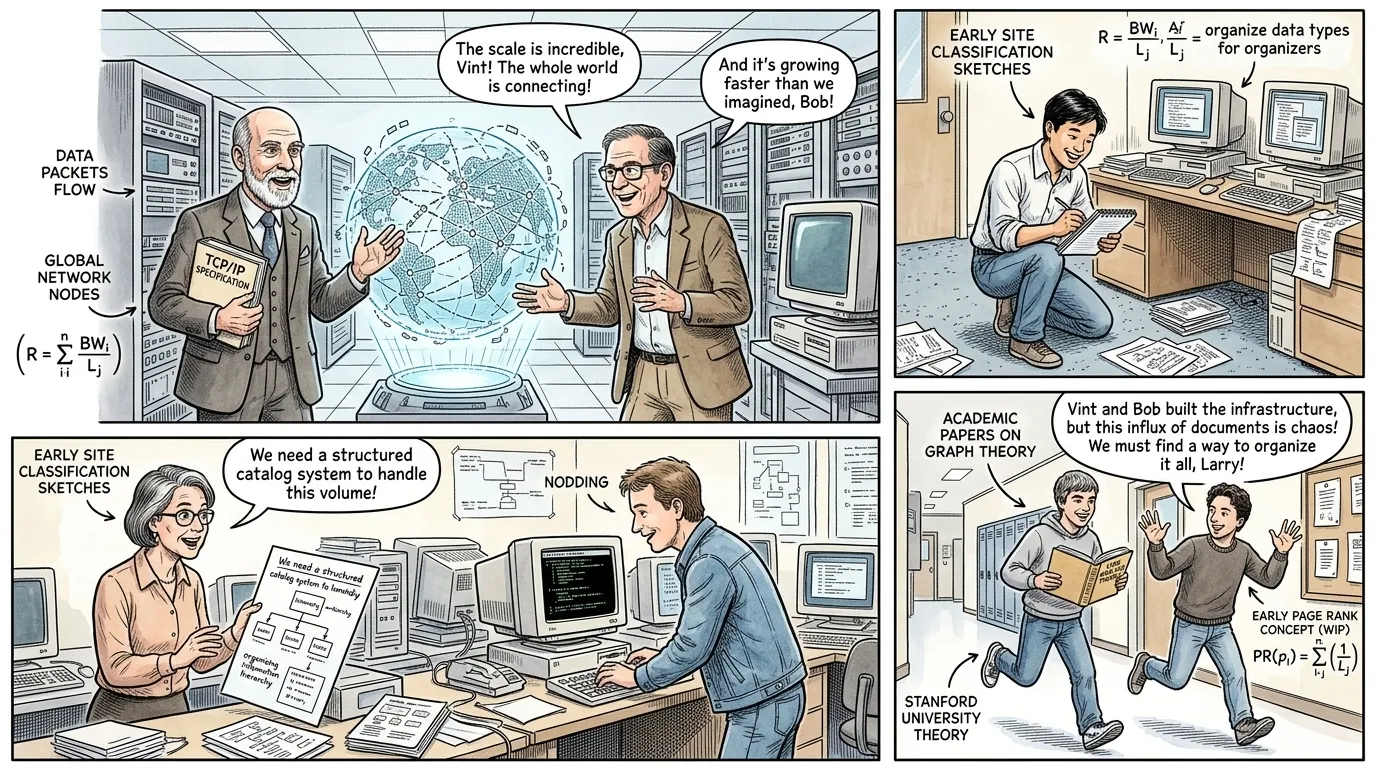
The dawn of the World Wide Web promised an unprecedented era of information access. Yet, as the number of interconnected documents exploded from a few thousand to millions by the mid-1990s, a new, critical problem emerged: how to find anything relevant amidst the digital deluge. Early internet pioneers, including the architects of the TCP/IP protocol, Vinton Cerf and Robert Kahn, understood that connecting computers was only the first step; making their vast contents discoverable was the true frontier. Without a robust system to organize and retrieve this rapidly growing data, the internet risked becoming an unusable, chaotic library.
Page 2
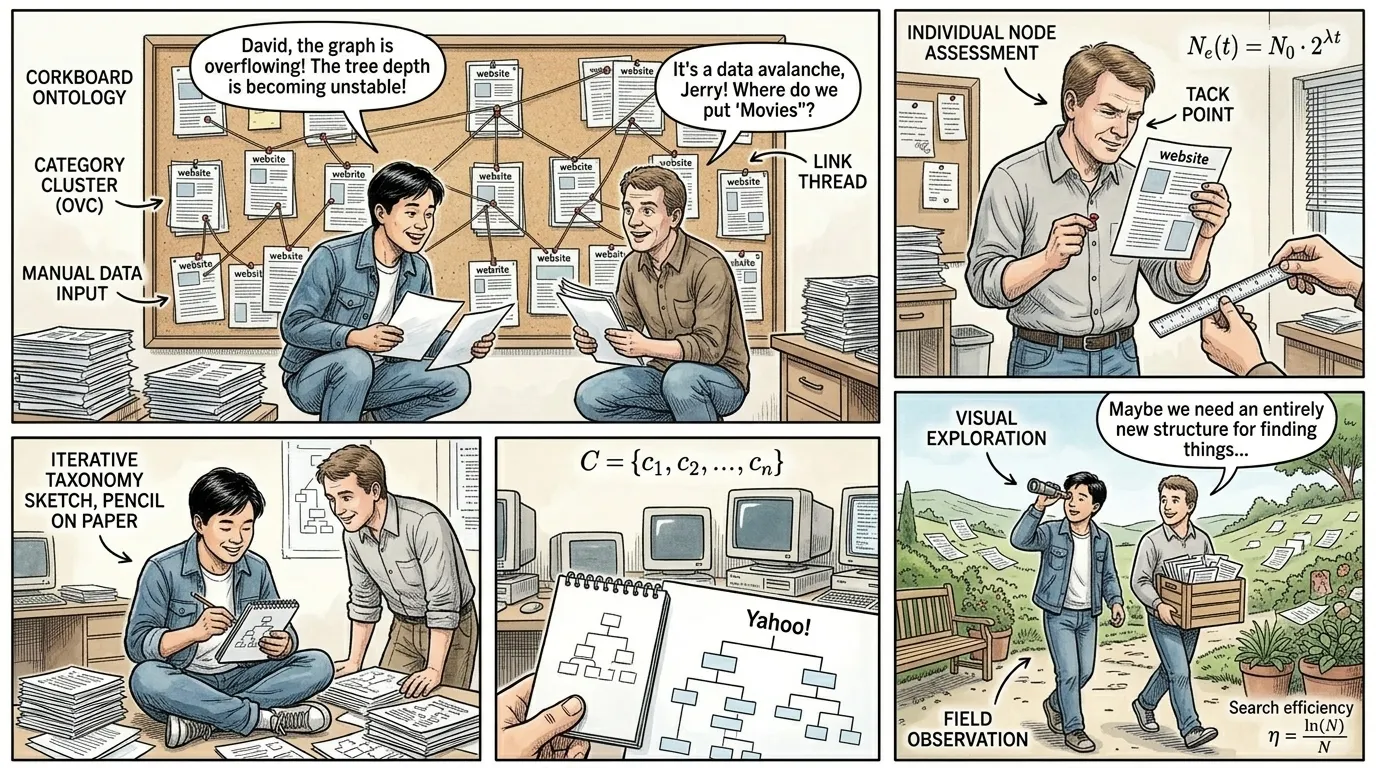
Before sophisticated search algorithms, the primary method for finding information online was through curated directories. Services like Yahoo!, founded by Jerry Yang and David Filo in 1994, relied on human editors to categorize websites into hierarchical structures. Users would drill down through categories like 'Arts Movies Genres' to locate desired content. While a valiant effort, this manual approach struggled to scale with the exponential growth of the web. New websites appeared faster than they could be indexed, and the subjective nature of human curation often led to incomplete or biased results. The digital universe was expanding too quickly for human hands to map.
Page 3
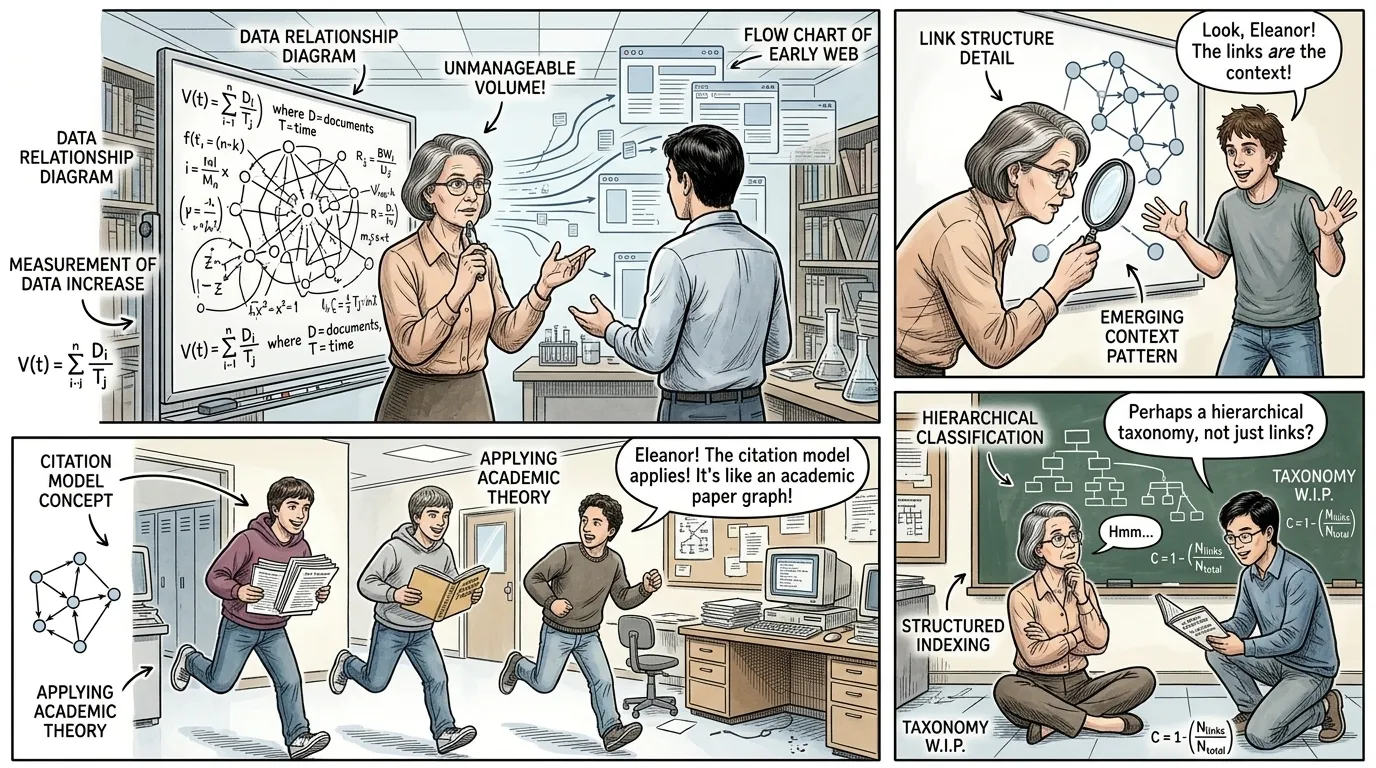
The fundamental challenge was clear: automate the process of information retrieval to match user queries with highly relevant documents. Early attempts beyond simple keyword matching grappled with the ambiguity of language and the sheer volume of data. Merely counting keywords could be easily manipulated, leading to irrelevant 'spam' results. Researchers knew that a truly effective search needed to understand not just what words were on a page, but the page's intrinsic value and its relationship to other information. This quest demanded a paradigm shift, moving beyond content analysis to structural understanding.
"Dr. Eleanor Vance, a researcher with short, grey-streaked brown hair, wearing a sensible blouse and glasses, stood before a whiteboard covered in mathematical equations. She turned to a colleague, her expression pensive. "As Vannevar Bush articulated back in 1945, 'The inherited difficulties of the present system of indexing are great.' He was referring to scientific papers, but it perfectly describes our digital dilemma now. We are being buried in a plethora of undigested data. The web's growth outpaces our current methods for making sense of it.""
Page 4
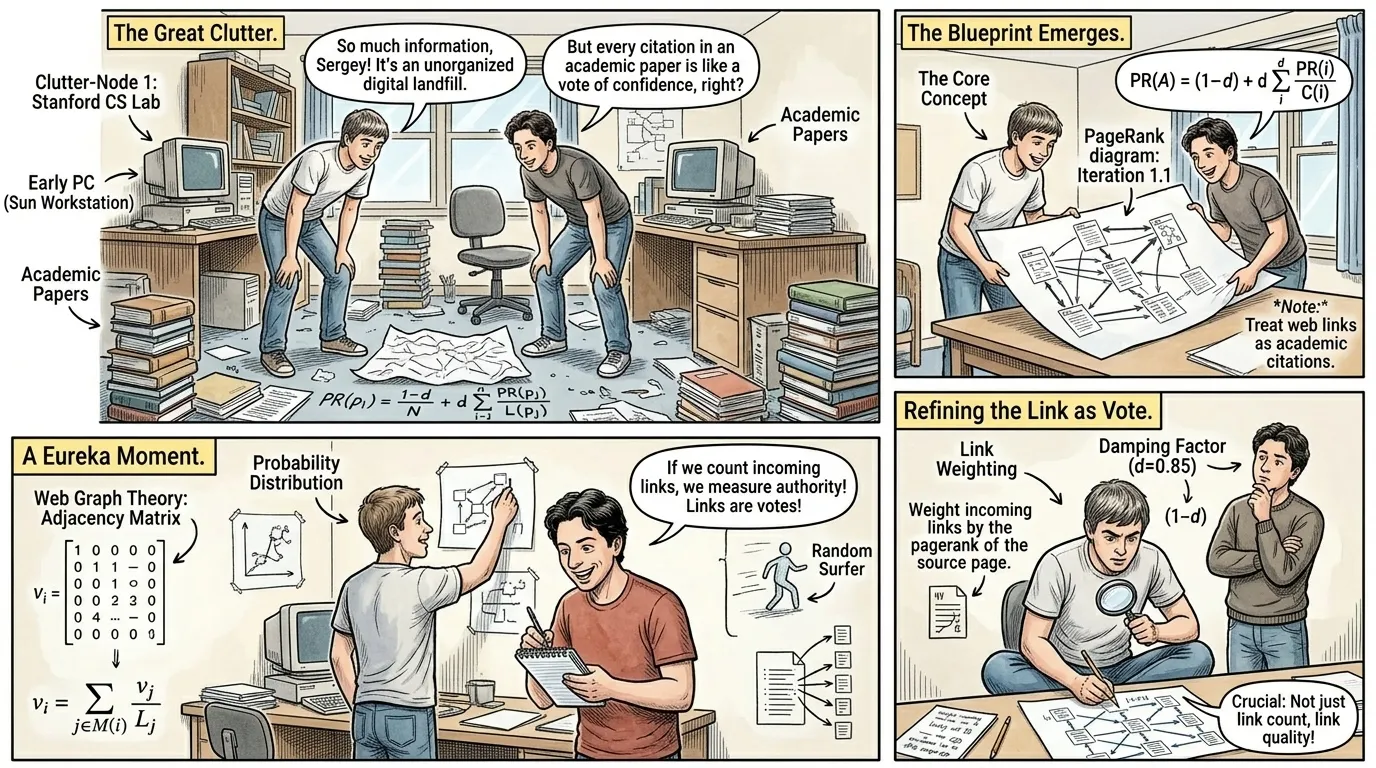
At Stanford University in the mid-1990s, two Ph.D. students, Larry Page and Sergey Brin, began to tackle this problem from a novel perspective. Instead of focusing solely on the content within web pages, they considered the structure of the web itself. Their inspiration came from academic citation practices: a paper cited by many other important papers is likely itself important. They theorized that the same principle could apply to web pages, where links from one page to another could be interpreted as 'votes' of importance. This 'citation analysis' approach would become the bedrock of their revolutionary search engine.
Page 5
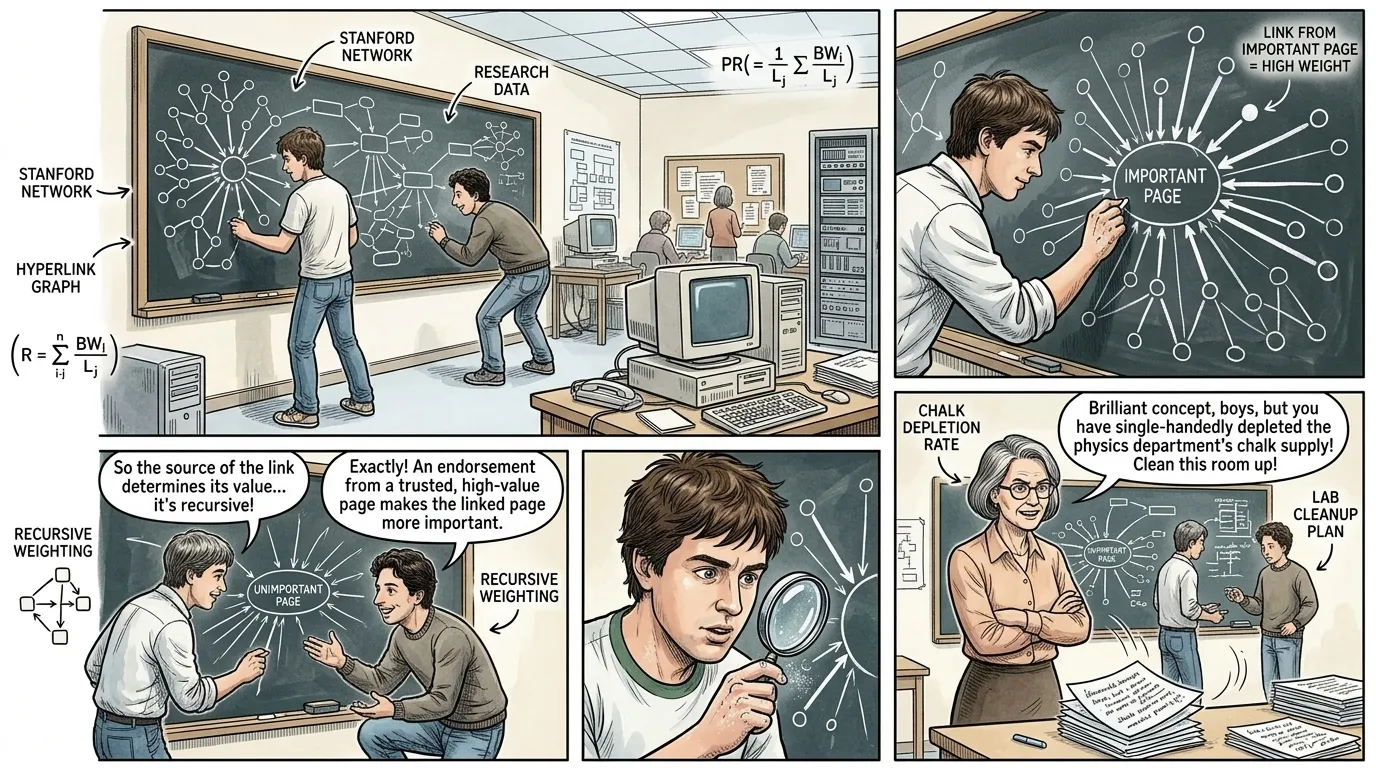
Page and Brin's research project was initially dubbed 'Backrub' because it analyzed the 'back links' pointing to a given web page. Their early experiments confirmed that simple link counts were too easily manipulated. A page could accrue many low-quality links and still appear important. The true breakthrough came from weighting these links: a link from an important page should count more than a link from an unimportant one. This recursive thinking – the importance of a page being derived from the importance of pages linking to it – formed the core concept of what would later be called PageRank, a system that fundamentally understood the web's implicit hierarchy.
Page 6
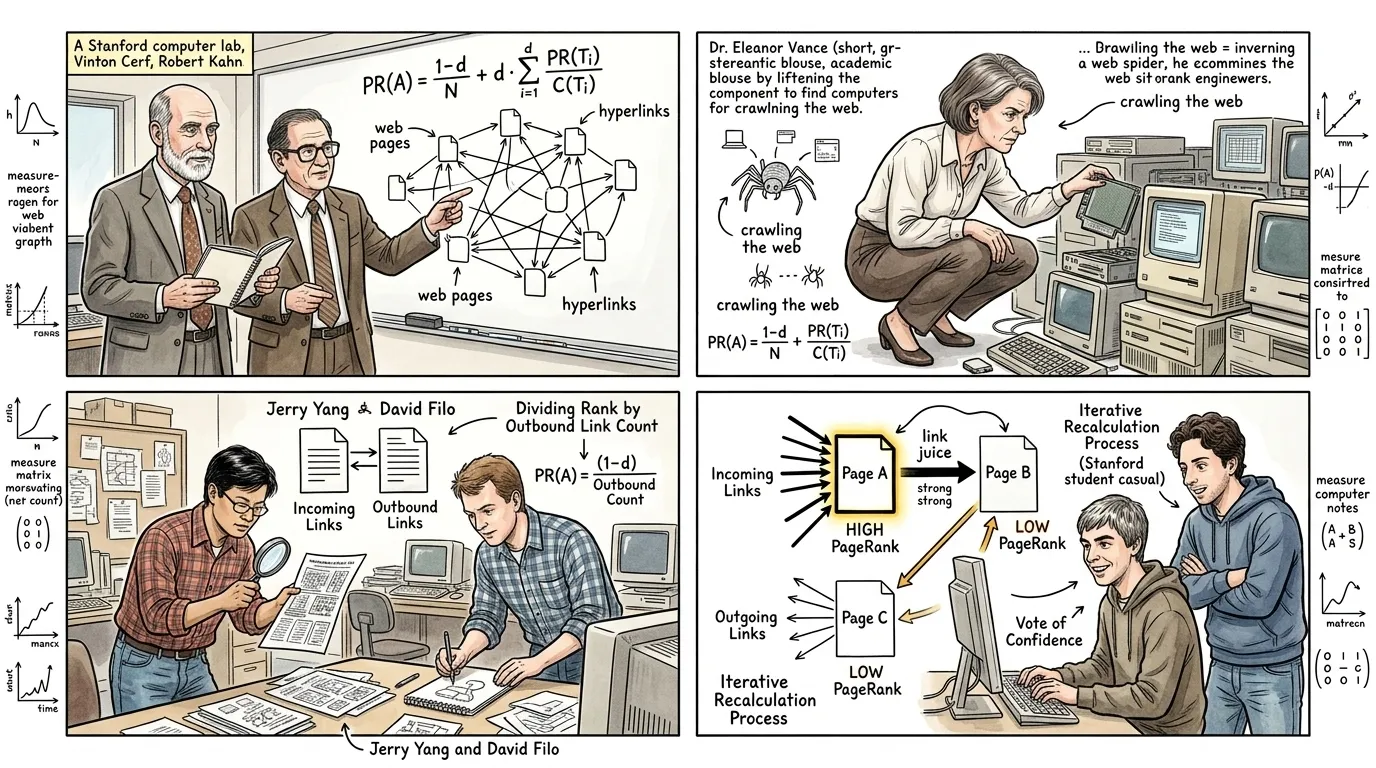
The PageRank algorithm, named after Larry Page, assigns a numerical 'importance' score to every web page. It operates on the premise that a link from page A to page B is a vote of confidence. Crucially, the weight of that vote depends on page A's own PageRank. Pages with higher PageRank distribute more 'link juice' to the pages they link to. Furthermore, PageRank accounts for the number of outbound links on a page: if page A links to many pages, its 'vote' is divided among them, lessening the impact of each individual link. This iterative process, continuously recalculating scores based on the latest network topology, provided a remarkably effective measure of a page's authority.
Page 7
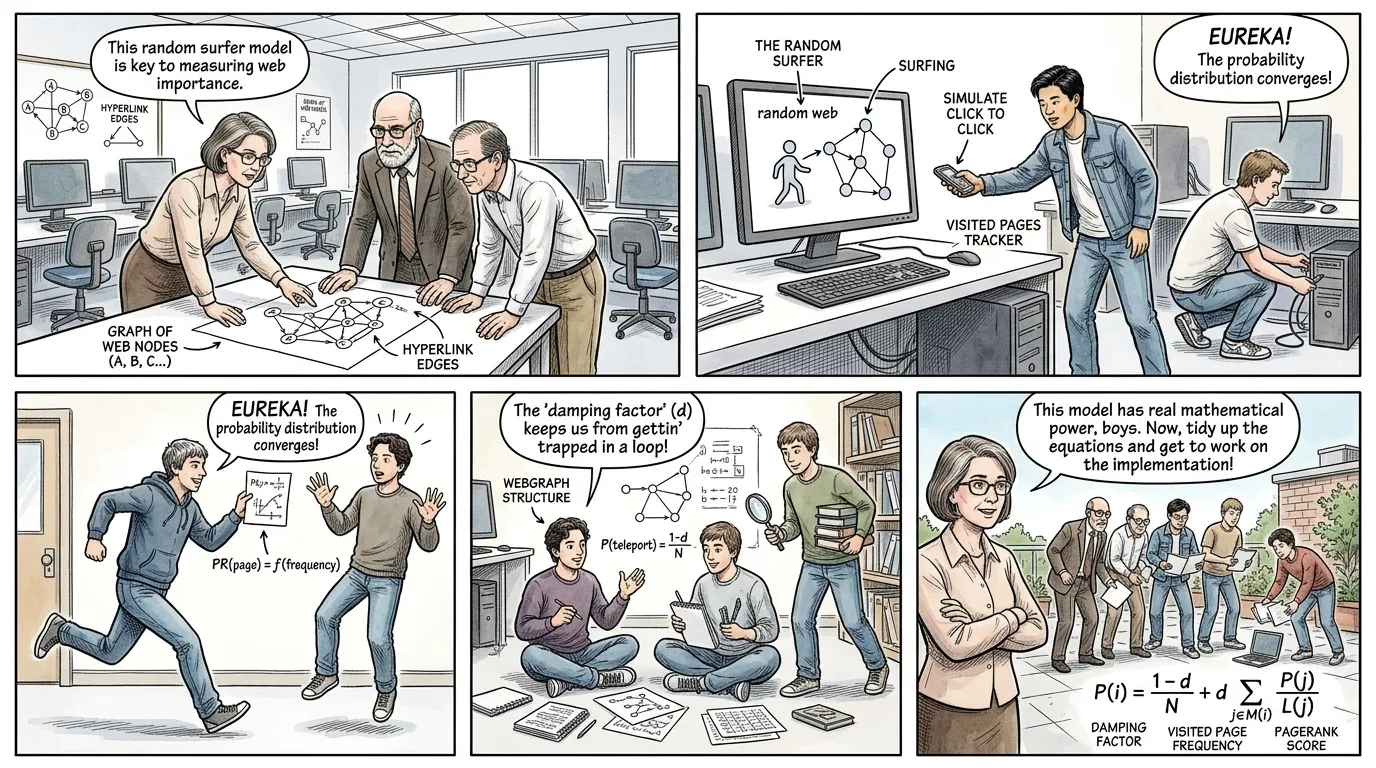
To calculate PageRank, the algorithm employs a conceptual 'random surfer' model. Imagine a user randomly clicking on links on web pages. The probability of the surfer landing on a particular page after many clicks is its PageRank score. The algorithm also incorporates a 'damping factor' – a small probability that the surfer, instead of clicking a link, will 'teleport' to a random new page. This prevents dead ends and ensures all pages, even those without inbound links, have some chance of being discovered, albeit with a very low PageRank. This sophisticated mathematical model transformed a subjective problem into a quantifiable one, offering a stable and scalable solution for web page ranking.
Page 8
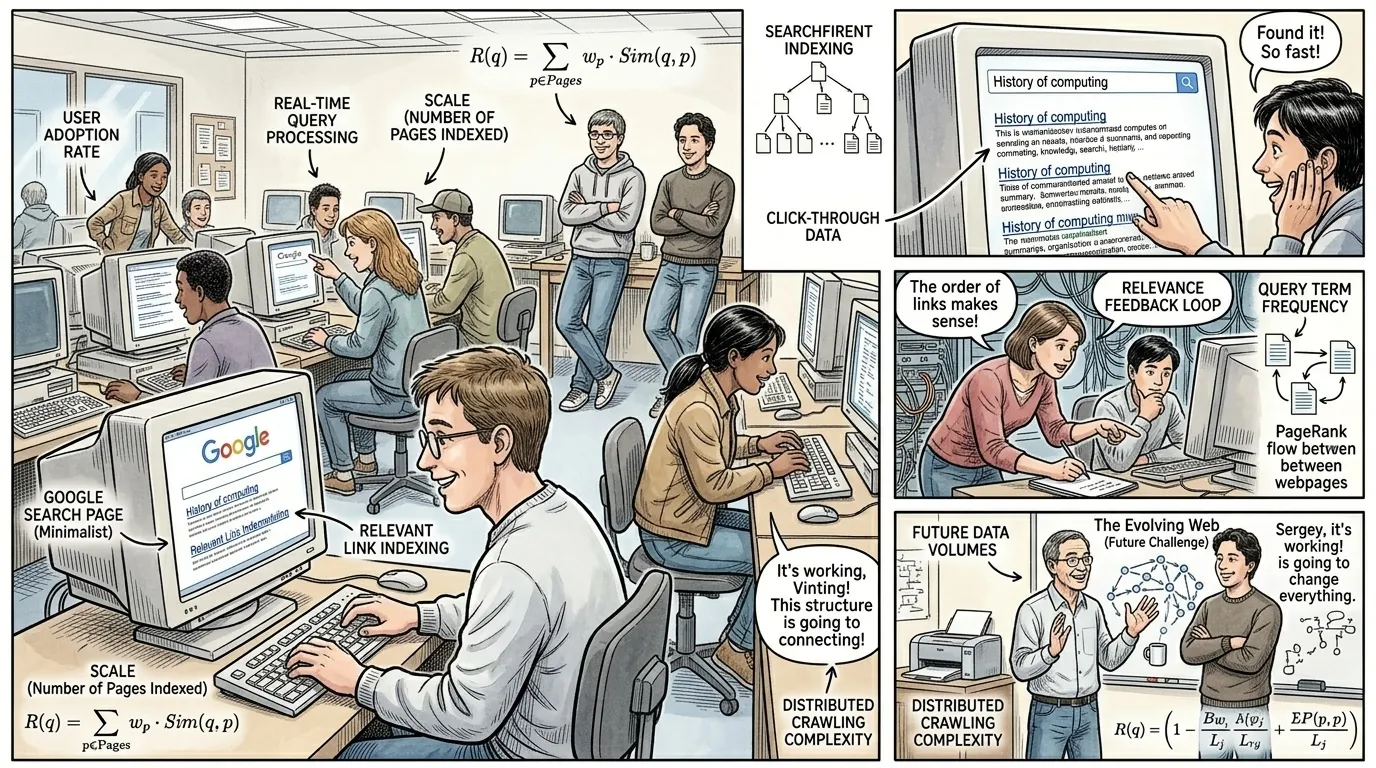
With the PageRank algorithm at its core, Google officially launched in 1998. Its initial search results were remarkably superior to competitors, providing highly relevant and authoritative links with unprecedented speed. Users quickly gravitated towards Google, recognizing its ability to cut through the noise of the growing internet. This rapid adoption solidified Google's position as the leading search engine. However, the internet continued to evolve, and with it, the complexities of search. As the web became more dynamic and user behavior diversified, Google's algorithms had to constantly adapt and integrate new signals beyond PageRank to maintain its relevance and combat increasingly sophisticated attempts at manipulation.
Page 9
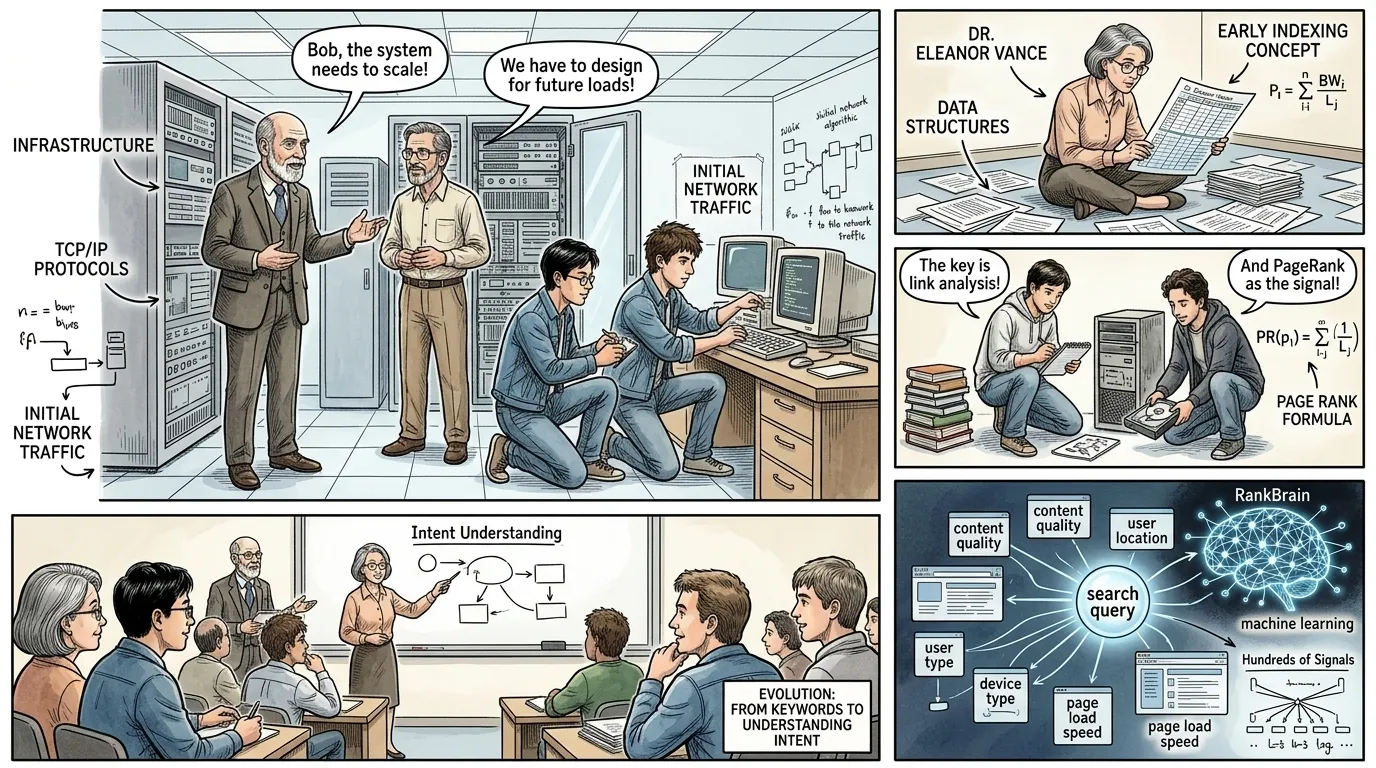
While PageRank remained a foundational element, modern search algorithms are vastly more complex, incorporating hundreds of signals. These include content quality, keyword usage, user location, search history, device type, page load speed, and increasingly, sophisticated machine learning and artificial intelligence models. Google's Hummingbird update (2013) marked a shift towards semantic search, understanding the meaning and context of queries rather than just keywords. RankBrain (2015), an AI-powered component, helps interpret ambiguous queries and delivers more relevant results, continuously learning from user interactions. Today's search algorithm is not a single formula, but a dynamic, multi-layered system designed to understand intent and deliver personalized, precise information.
Page 10
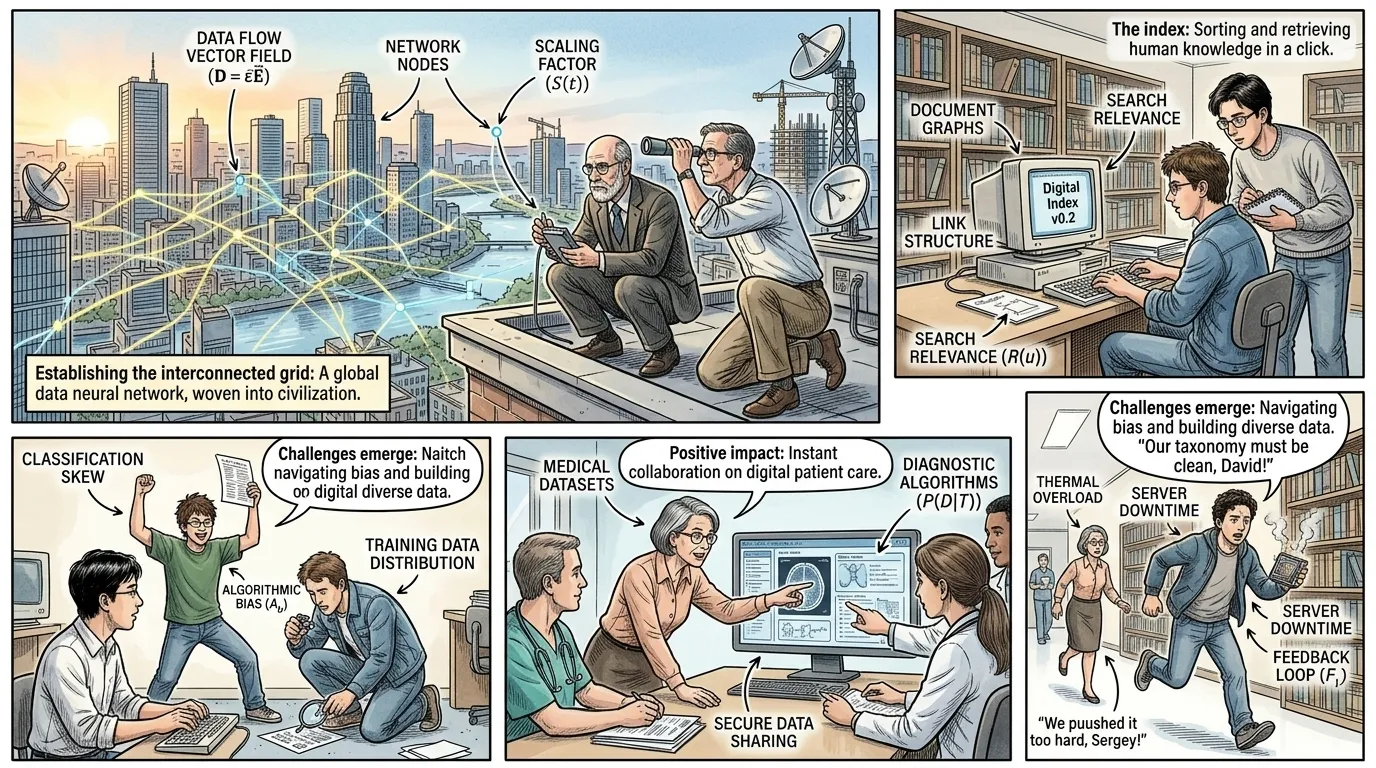
The search algorithm has profoundly reshaped human civilization, becoming an invisible infrastructure for daily life. It democratized access to information, empowering individuals with knowledge previously confined to libraries and institutions. From economic growth fueled by e-commerce and targeted advertising to the instant dissemination of news and academic research, its influence is pervasive. Yet, this power also brings challenges: the potential for filter bubbles, the spread of misinformation, and the ethical considerations of algorithmic bias. The search algorithm, a testament to human ingenuity in organizing chaos, continues to evolve, shaping our understanding of the world and our place within its vast, ever-expanding digital landscape.
About this story
- Location: Global
- Audience: general readers
Read Wonder Inventions on your phone
Wonder Inventions is available on Android. Get Wonder Inventions on Google Play.