Search Engine
Search Engine — an illustrated inventions story, set in Global. 10 illustrated pages, free to read on Wonder Inventions.
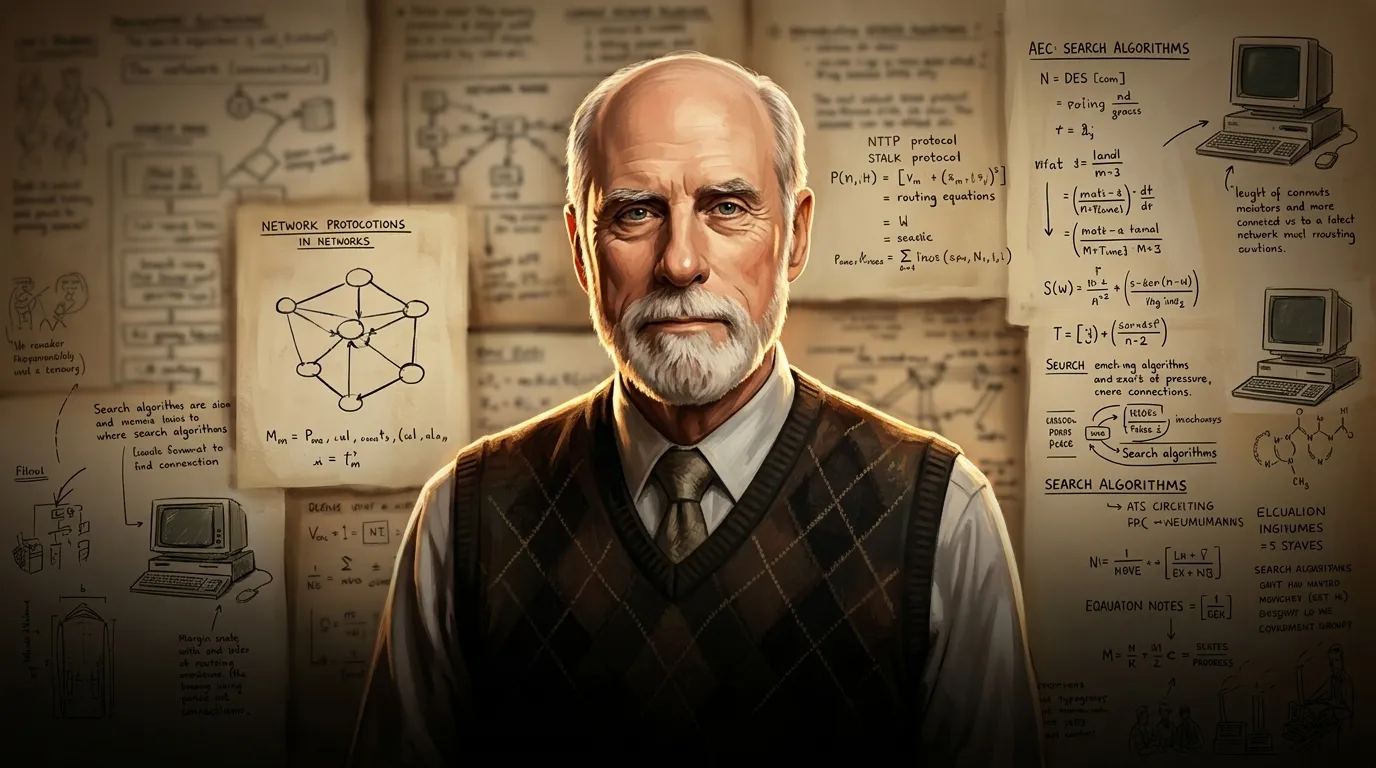
Page 1
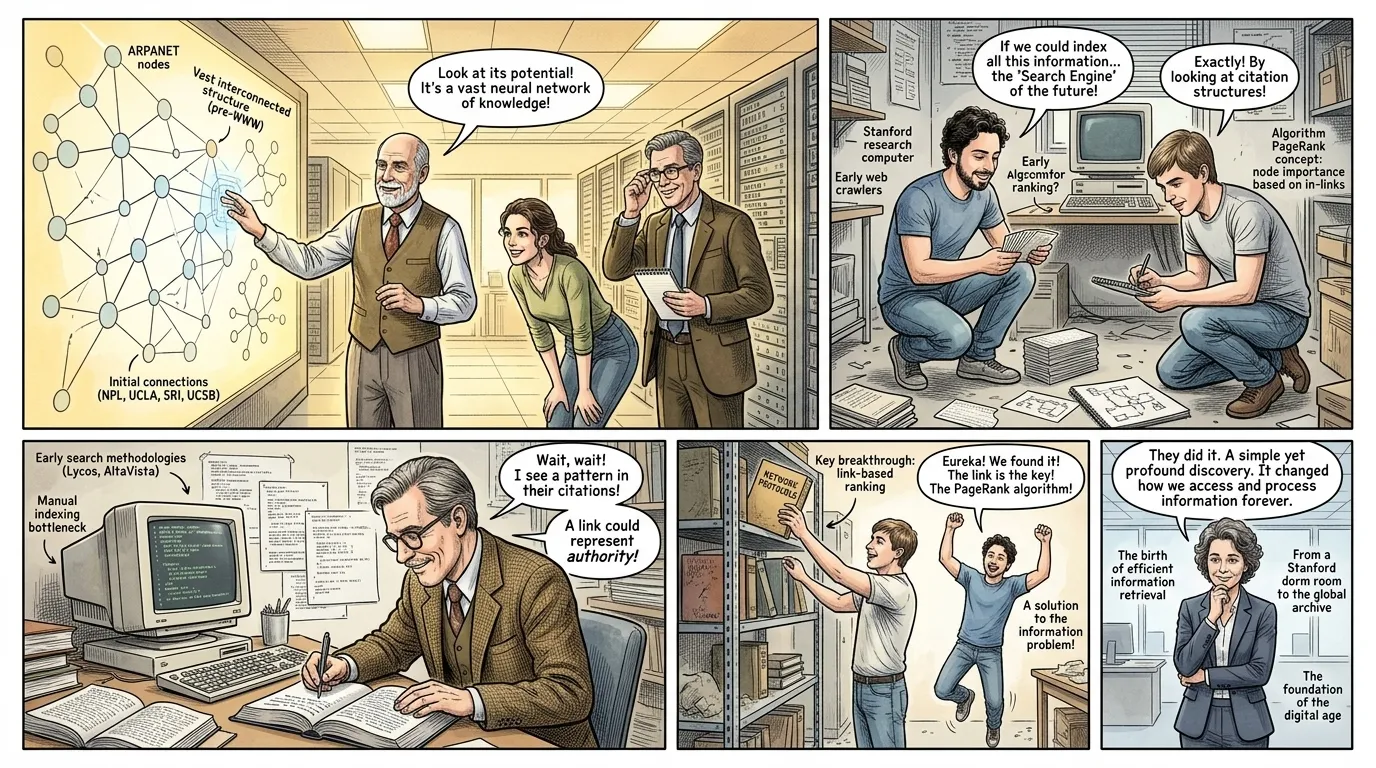
The late 20th century saw an explosion of information, particularly with the rise of the World Wide Web. Initially conceived as a powerful network for sharing academic papers, the internet rapidly expanded into a vast, uncharted digital landscape. Yet, this boundless repository of knowledge presented a profound paradox: how could one locate anything specific amidst an ever-growing ocean of data? This was the monumental challenge facing early digital pioneers.
"Dr. Vinton Cerf, a key architect of the internet's protocols, once reflected on the early web's immense potential. "'The future belongs to those who believe in the beauty of their dreams,' Eleanor Roosevelt famously said. We dreamed of a connected world, but we quickly realized the dream required an index, a way to find that beauty amidst the sheer volume of new information.""
Page 2
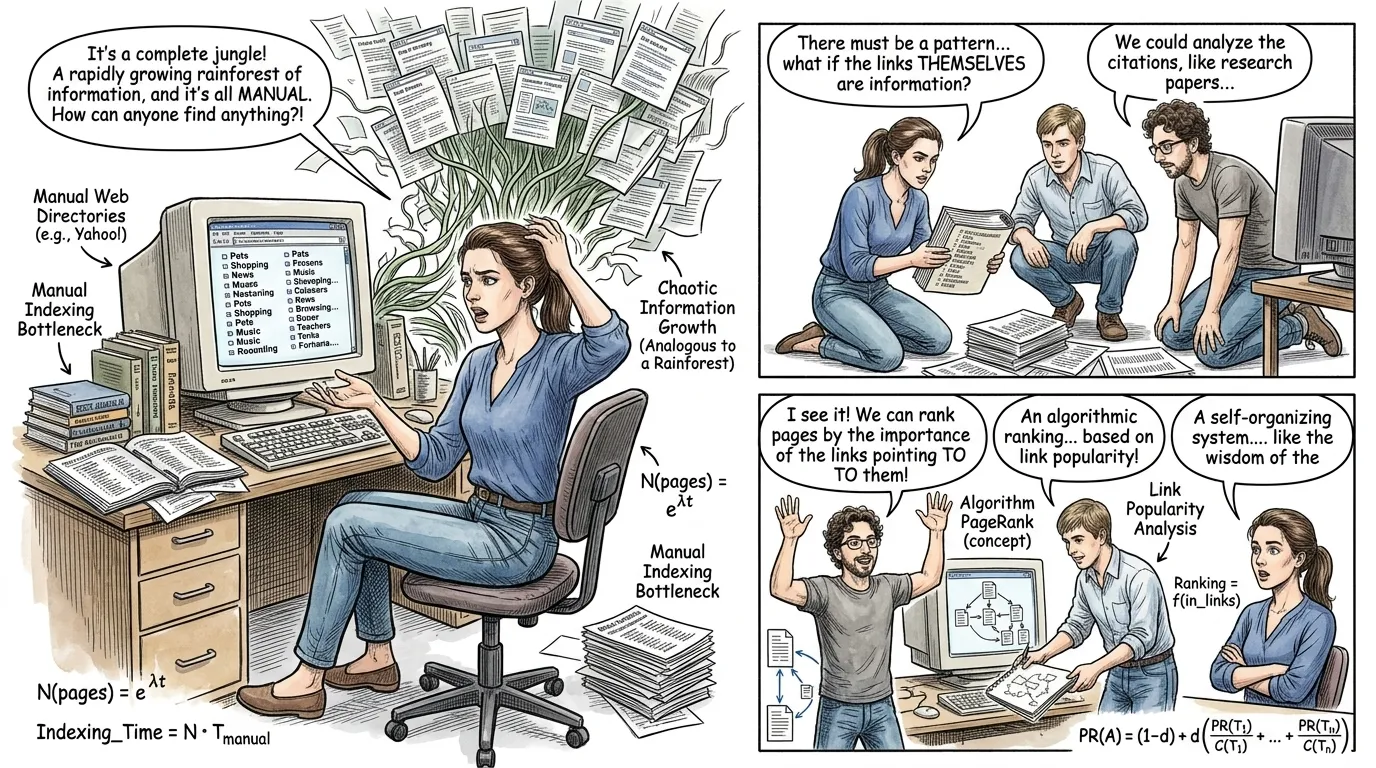
Before the advent of sophisticated search engines, users relied on human-curated directories, such as Yahoo!'s early catalog. These services meticulously organized websites into categories, much like a traditional library card catalog. While offering some structure, this manual approach was inherently limited, struggling to keep pace with the exponential growth of new web pages. Furthermore, basic keyword search tools of the era simply matched words, often yielding countless irrelevant results, obscuring genuine value.
"An early web designer, Elara Vance, working at her desk, expressed her exasperation. "I remember spending hours manually submitting sites to directories. We'd argue with curators over categories! It was like trying to organize a rainforest by hand. Every day, ten new trees grew, and we just couldn't keep up with the pruning. The web needed something far more intelligent, something that could see patterns we couldn't.""
Page 3
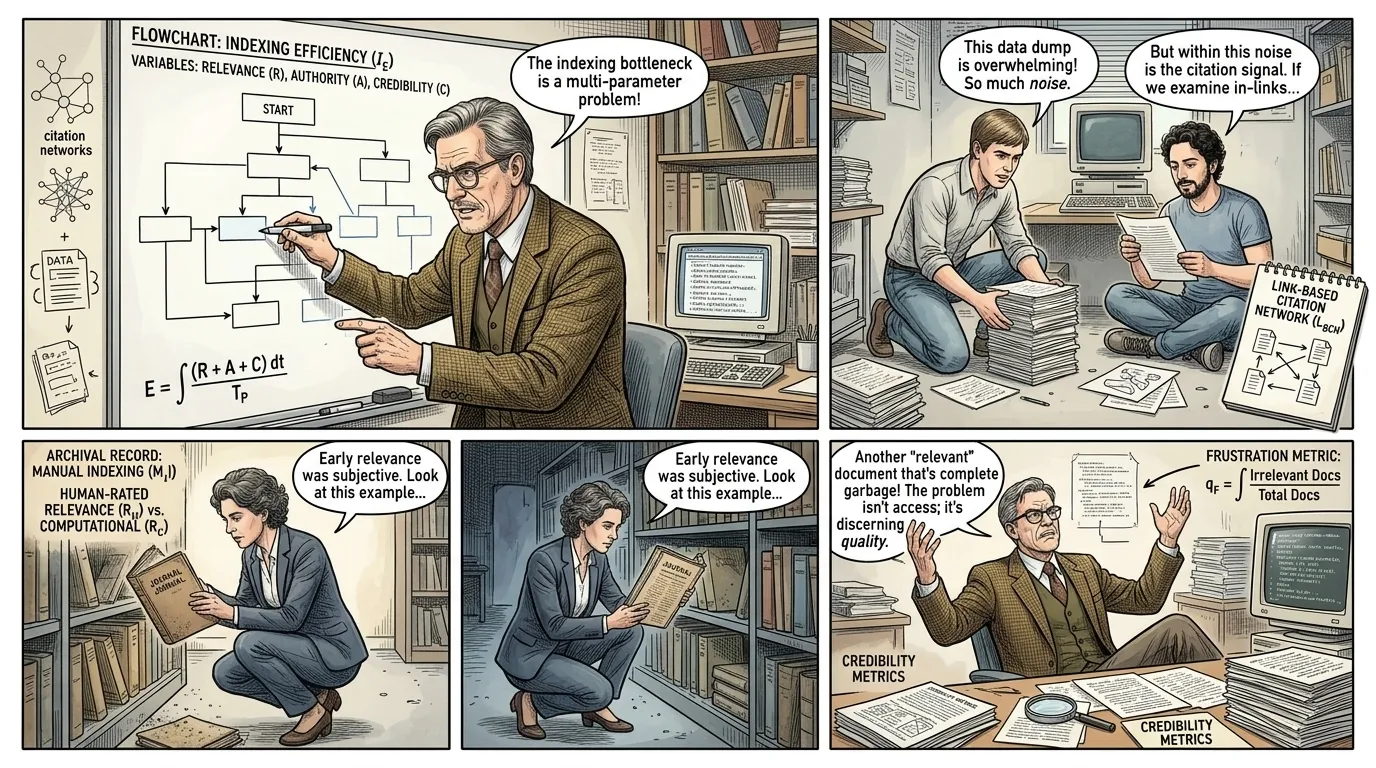
The fundamental problem wasn't merely finding web pages containing a specific word; it was identifying relevant and authoritative pages. A search for 'heart disease' might return thousands of results, from medical journals to personal blogs and advertisements. Without a mechanism to distinguish credibility, users were left to sift through an ocean of information, often unsure which sources could be trusted. This 'quality problem' was the critical hurdle that early web search mechanisms failed to overcome.
"Dr. Marcus Thorne, a frustrated academic researching online resources, discussed the challenge. "We desperately needed a filter, a quality indicator. The sheer volume of information was overwhelming, but the lack of discernment was paralyzing. As the Roman philosopher Seneca observed, 'It is not because things are difficult that we do not dare; it is because we do not dare that they are difficult.' The difficulty here was daring to invent a system that could truly understand the value of information, not just its presence.""
Page 4
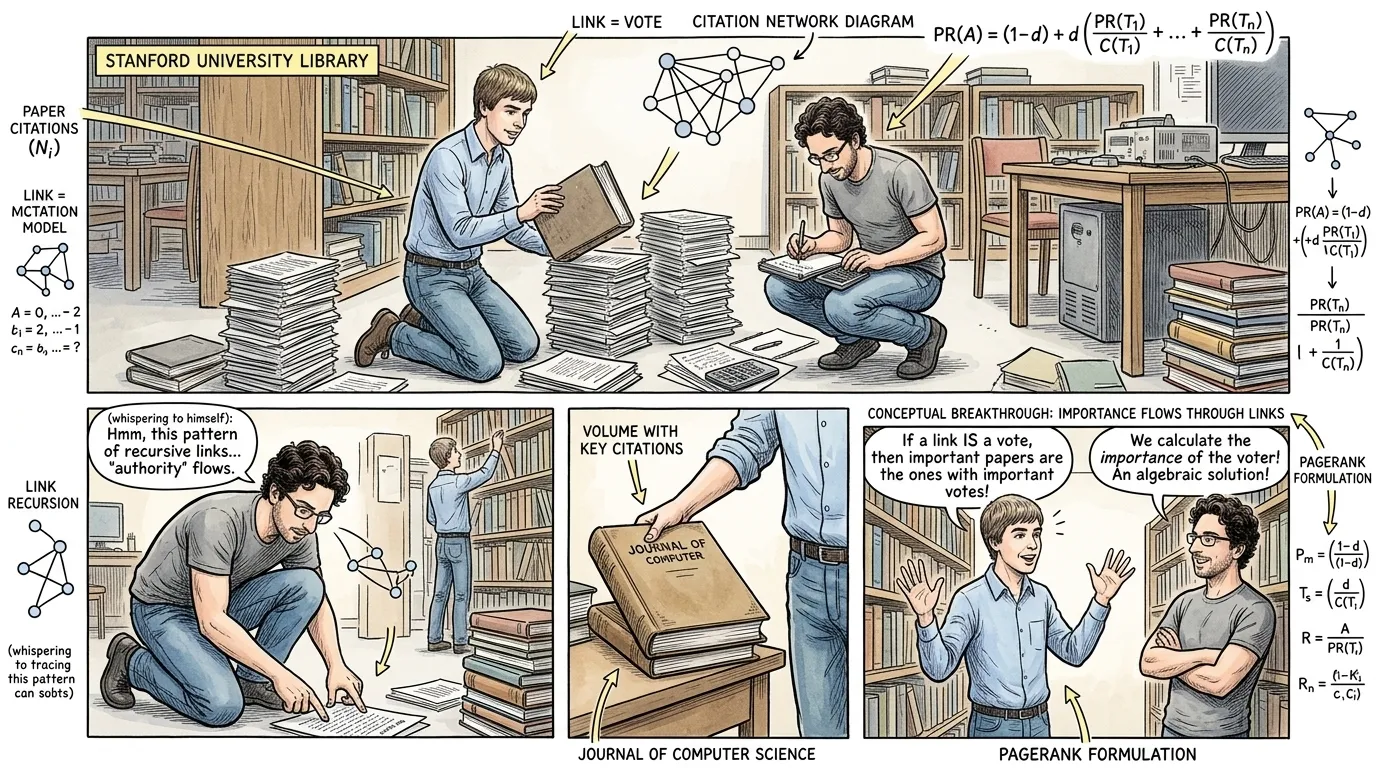
At Stanford University in the mid-1990s, two Ph.D. students, Larry Page and Sergey Brin, began researching this problem. They questioned the prevailing wisdom of simple keyword matching. Their radical insight emerged from analyzing the citation patterns of academic papers: a paper's importance is often determined by how many other significant papers cite it. They hypothesized that this principle could be applied to web pages, treating hyperlinks as 'citations' or 'votes'.
"Larry Page, a young, slim man with short, neatly parted light brown hair and a focused expression, wearing a casual button-down shirt, turned to Sergey Brin, an athletic-build man with dark, slightly curly hair, wearing glasses and a t-shirt. "Sergey, if 'knowledge itself is power,' as Francis Bacon said, then the links between pieces of knowledge must reveal its true strength. What if we don't just count mentions, but weigh them? A link from a major university's site should mean more than a link from a personal blog, shouldn't it?""
Page 5
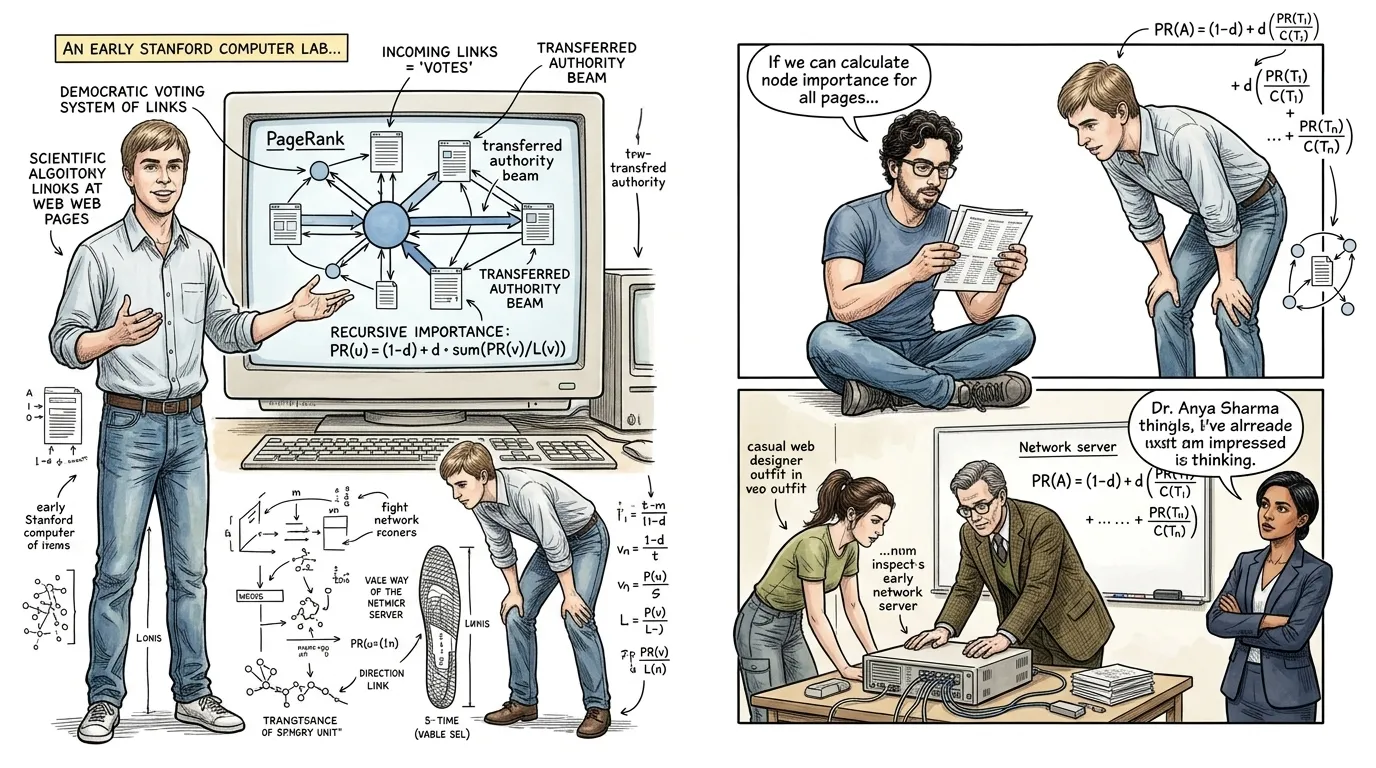
Page and Brin named their innovative ranking system 'PageRank,' after Larry Page. Its core mechanism was deceptively simple yet profoundly effective: the importance of a web page is determined by the number and quality of pages linking to it. A link from a highly-ranked page conferred more 'authority' than a link from a low-ranked page. This created a recursive system where a page's importance was continuously recalculated based on the importance of its inbound links.
"Larry Page gestured at a schematic on their monitor. "Think of it as a democratic system for web pages. Every link is a vote. But, unlike a simple tally, the weight of your vote depends on your own influence. If the New York Times links to a page, that's a much stronger endorsement than a link from an obscure hobby site. We call this 'transferred authority.'""
Page 6
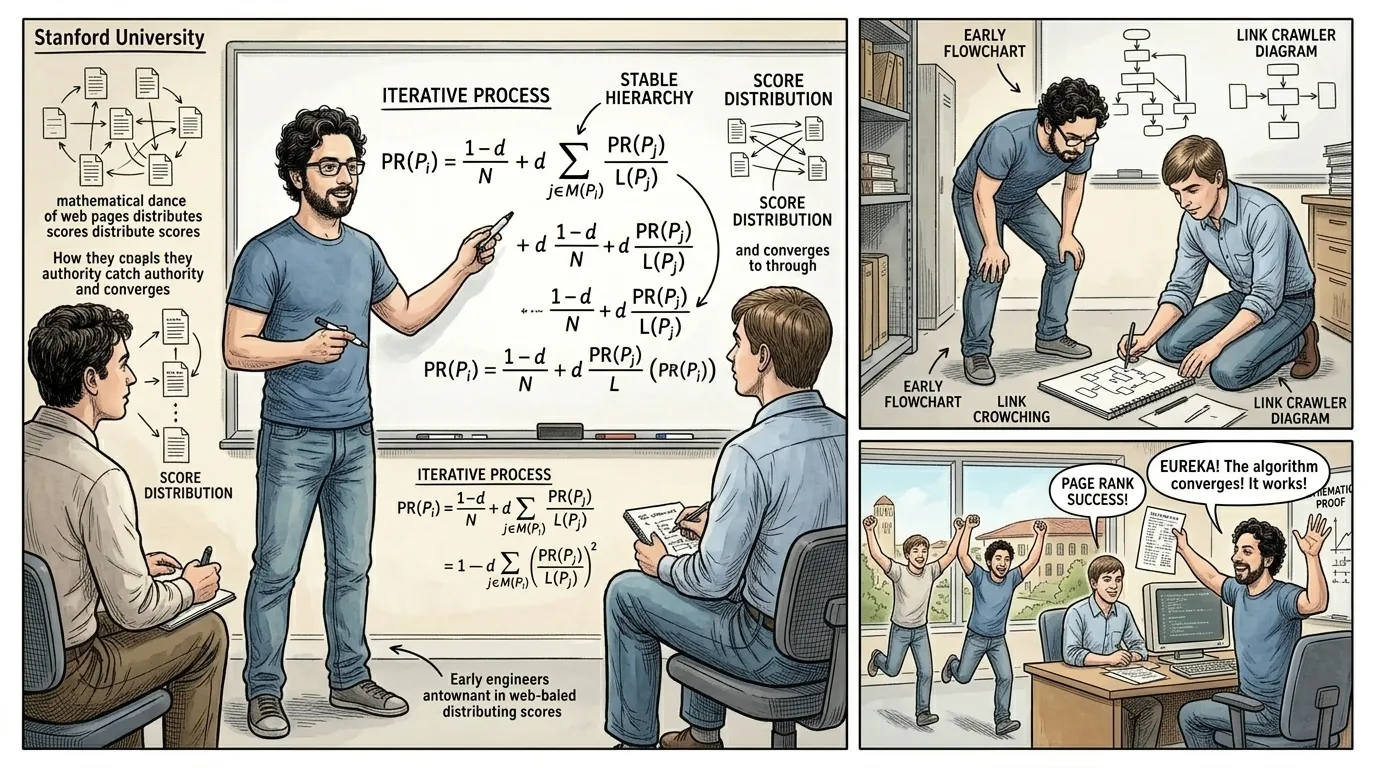
The PageRank algorithm functions as an iterative calculation. It begins by assigning an initial, equal PageRank score to every page on the web. In successive steps, this score is distributed among the pages they link to. A page's new score is a sum of the PageRank it receives from its incoming links, proportionally divided by the number of outbound links from the source page. This process repeats, refining the scores until they converge, creating a stable hierarchy of web page importance.
"Sergey Brin, holding a pen and pointing to a complex equation on a whiteboard, explained the process to a group of early engineers. "It's a mathematical dance, really. Each iteration refines the scores. Imagine throwing a ball around a room; the more times a page 'catches' the ball from important players, the higher its score. The beauty lies in its self-correcting nature. It finds its own equilibrium of authority. This wasn't merely about finding words; it was about understanding relationships.""
Page 7
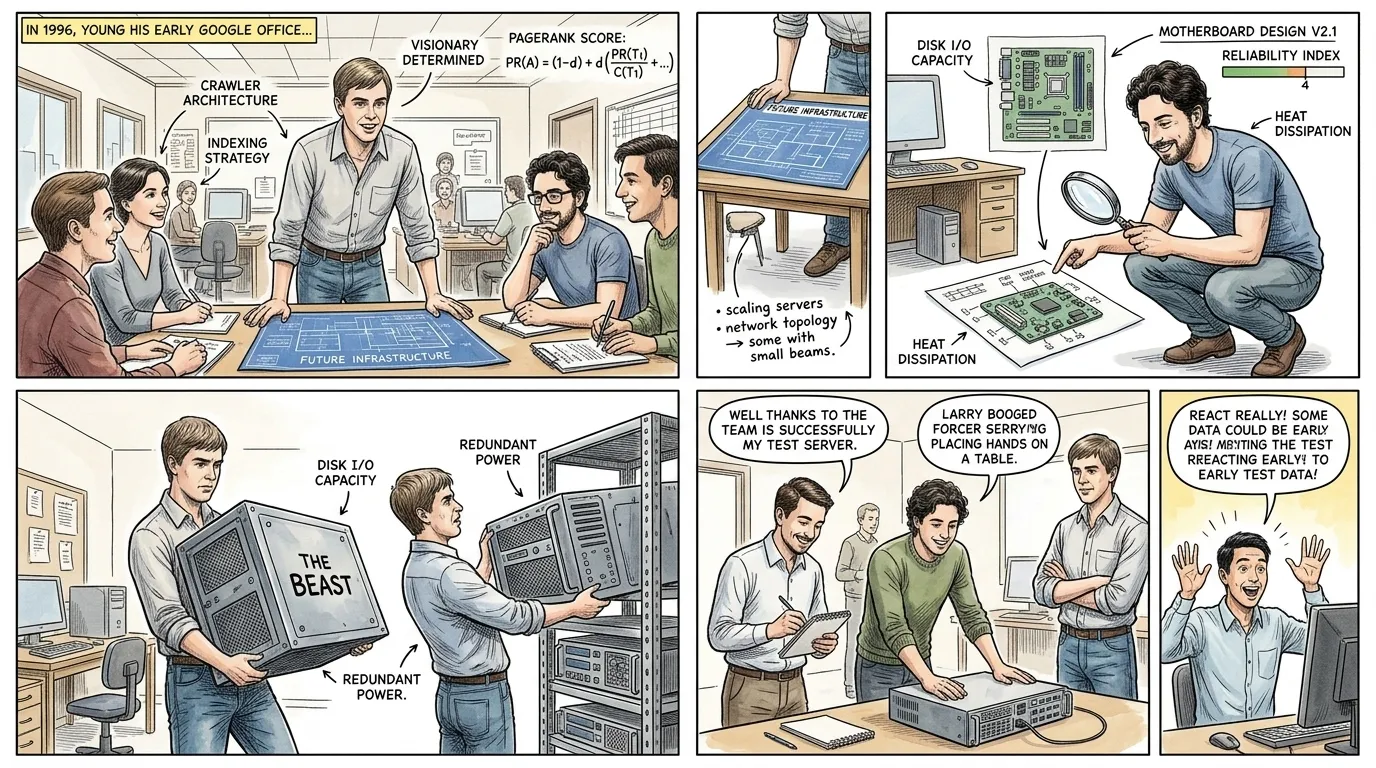
The BackRub project, powered by PageRank, proved immensely effective in ranking web pages. Recognizing its revolutionary potential, Page and Brin shifted their focus from academic research to building a company. In September 1998, Google Inc. was officially founded. Their search engine, leveraging PageRank, consistently delivered superior results to existing competitors, emphasizing speed, accuracy, and user experience. The iterative PageRank algorithm, though computationally intensive, was meticulously scaled to handle the burgeoning web, forever changing how information was accessed.
"Larry Page, standing in their nascent Google office, addressed a small team. "This isn't just a better search engine; it's a new way of organizing the world's information. We've built the engine; now we must build the infrastructure to make it accessible to everyone. The challenge is immense, but the impact will be profound. We're not just finding pages; we're illuminating knowledge.""
Page 8
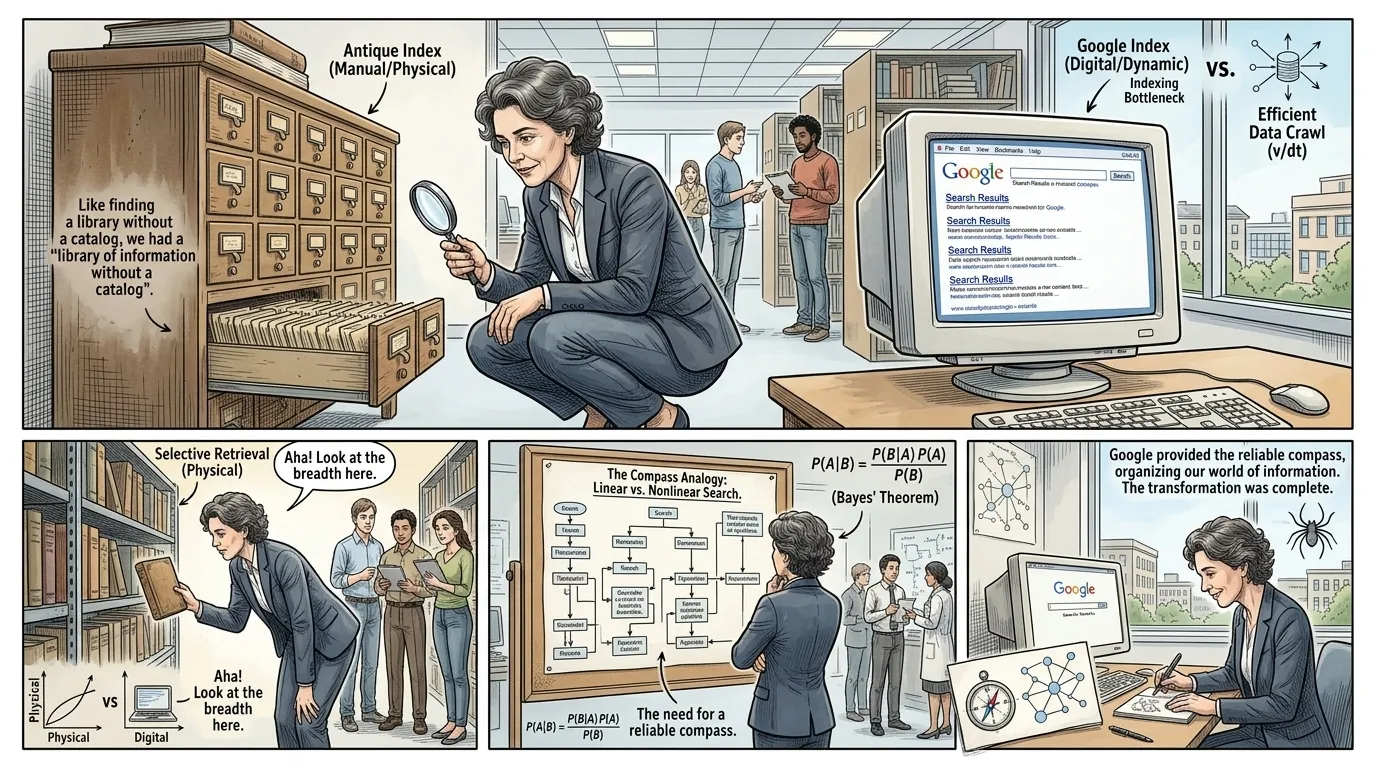
Google's public launch dramatically reshaped the digital landscape. Its speed, clean interface, and, most importantly, the relevance of its search results, quickly made it the dominant search engine. Users no longer had to navigate labyrinthine directories or contend with overwhelming, low-quality results. Google's PageRank algorithm provided a reliable compass for the vast digital wilderness, empowering individuals to quickly find answers, conduct research, and connect with information like never before. The internet was finally searchable.
"Dr. Elena Petrova, a technology historian, reflected on this pivotal moment. "Before Google, the web was a library without a catalog, or perhaps a book with all its pages torn out and scattered. Suddenly, we had an index, a guiding hand. This was more than a technological advancement; it was a democratization of information, a gift of unparalleled access to human knowledge. It profoundly shifted our relationship with data.""
Page 9
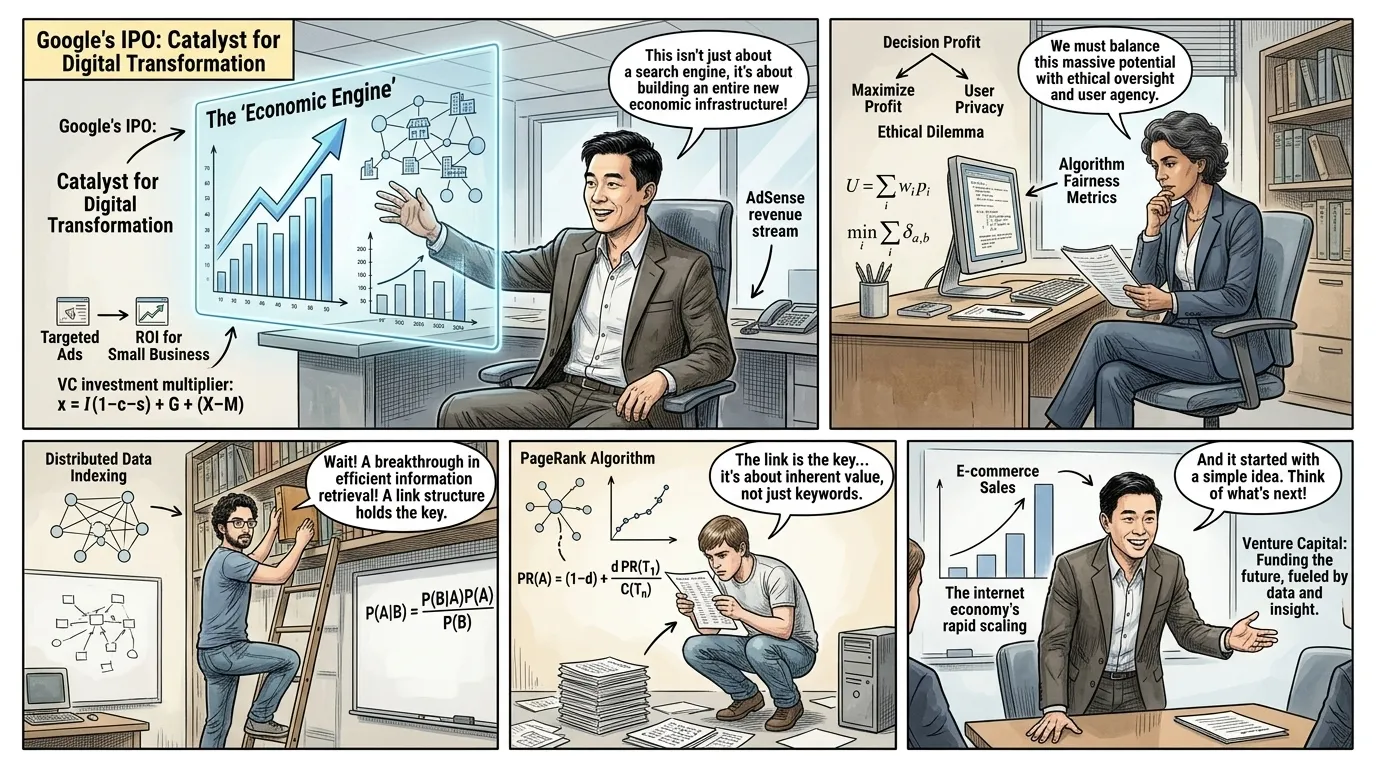
The search engine's success profoundly influenced global economics. It became the gateway through which businesses reached customers, transforming advertising from traditional media to targeted online campaigns. E-commerce flourished as consumers could easily find products and services. Google's innovative advertising model, AdWords, allowed businesses to bid on keywords, aligning advertising with user intent and creating a multi-billion-dollar industry. Search engines became the engine of the digital economy, fueling innovation and connecting markets worldwide.
"A venture capitalist, Robert Chen, discussing Google's impact in a 2004 interview, stated, "We saw this as more than just a tool; it was an economic engine. The ability to connect supply with demand so precisely, driven by user intent expressed through search queries, created entirely new markets. The economist John Maynard Keynes once said, 'The difficulty lies not in the new ideas, but in escaping from the old ones.' Google showed us how to escape old business models and embrace a digitally connected marketplace.""
Page 10
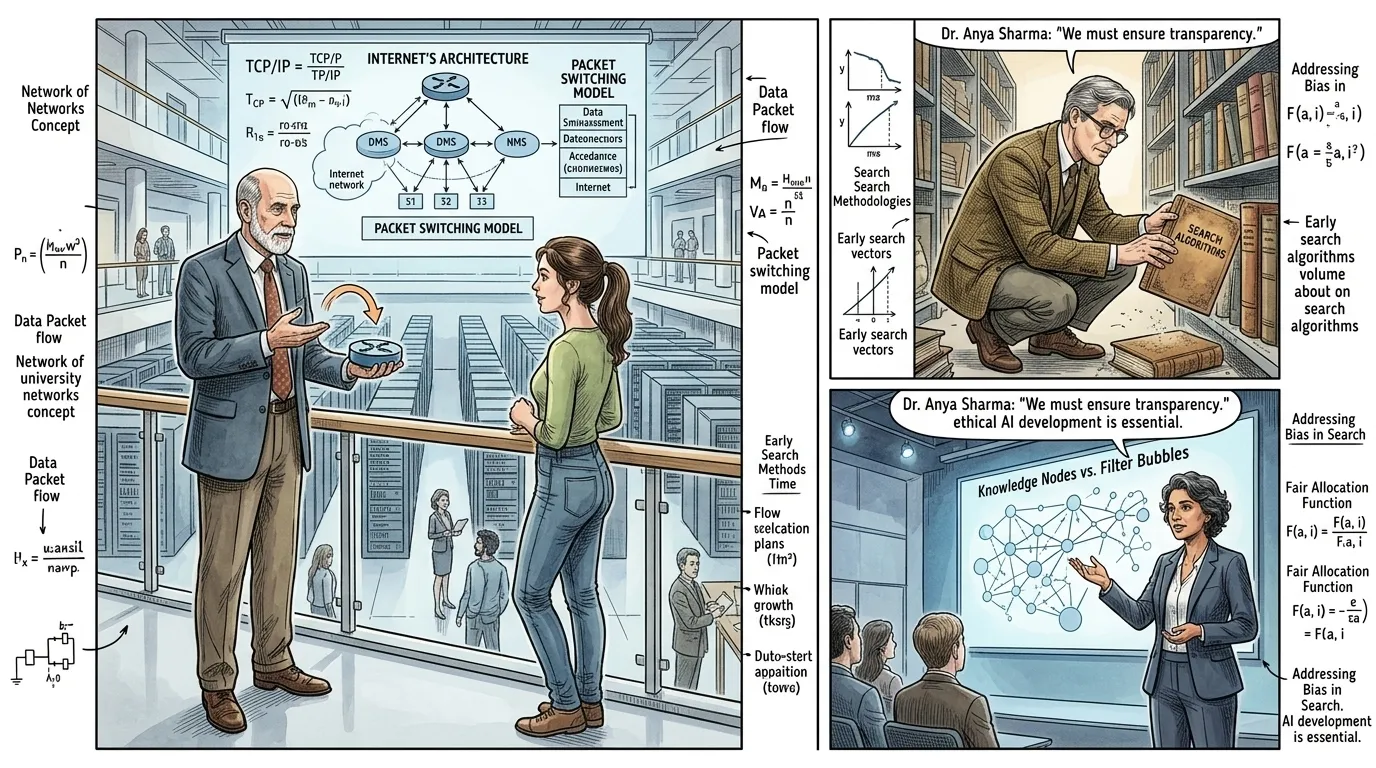
Today, search engines are indispensable, evolving far beyond simple text searches to encompass voice, image, and even augmented reality queries. They have democratized knowledge, enabled unprecedented connectivity, and driven countless innovations. Yet, their impact also raises complex questions about information gatekeepers, filter bubbles, and the spread of misinformation. The fundamental challenge that Page and Brin tackled – organizing the world's information – continues to evolve, pushing the boundaries of artificial intelligence and human-computer interaction.
"A leading AI ethicist, Dr. Anya Sharma, concluded a recent panel discussion. "The search engine gave us a map, but now we must ensure it's a map to wisdom, not just data. The architects of the early web solved a monumental problem, but the next frontier demands we solve for responsible, equitable access to truth. The journey of organizing human knowledge is far from over.""
About this story
- Location: Global
- Audience: general readers
Read Wonder Inventions on your phone
Wonder Inventions is available on Android. Get Wonder Inventions on Google Play.