Satellite Communication
Satellite Communication — an illustrated inventions story, set in Global. 10 illustrated pages, free to read on Wonder Inventions.
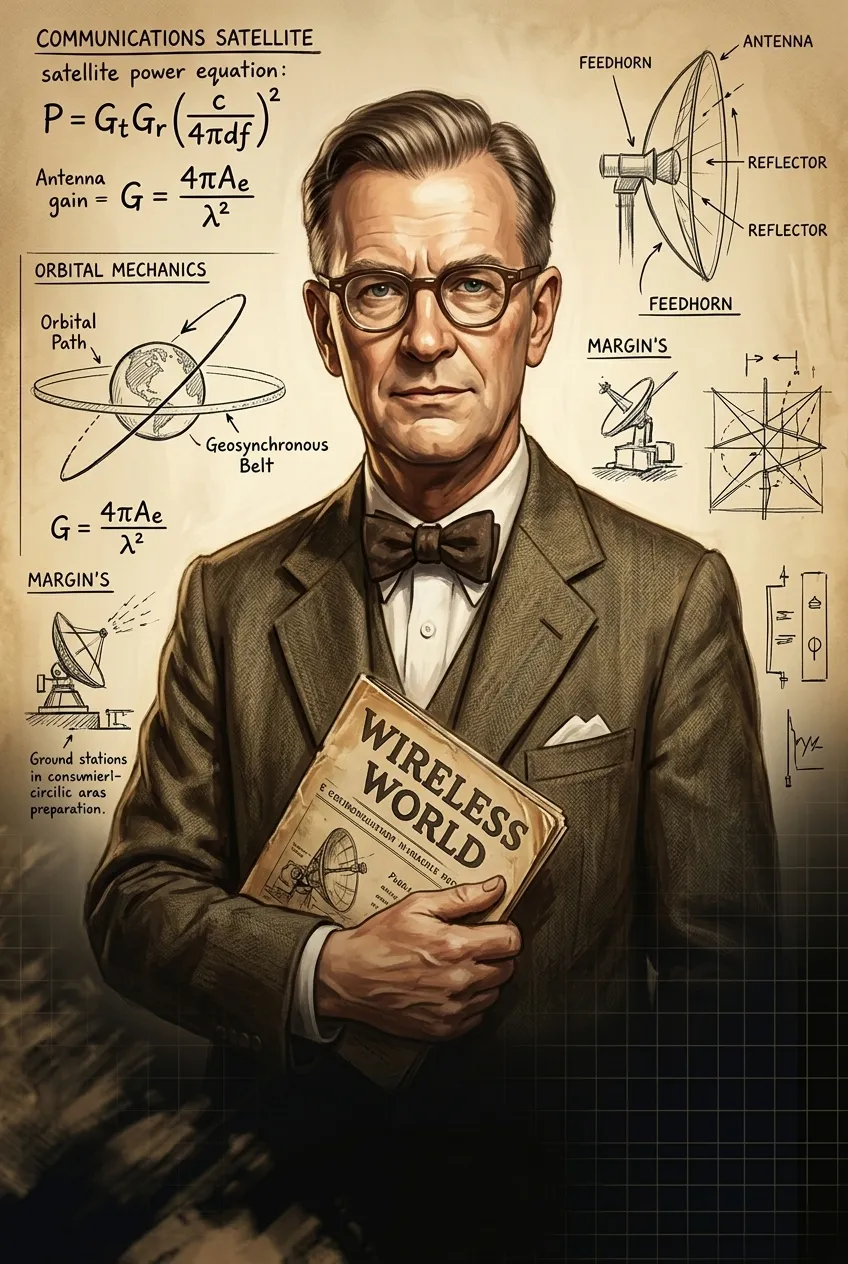
Page 1
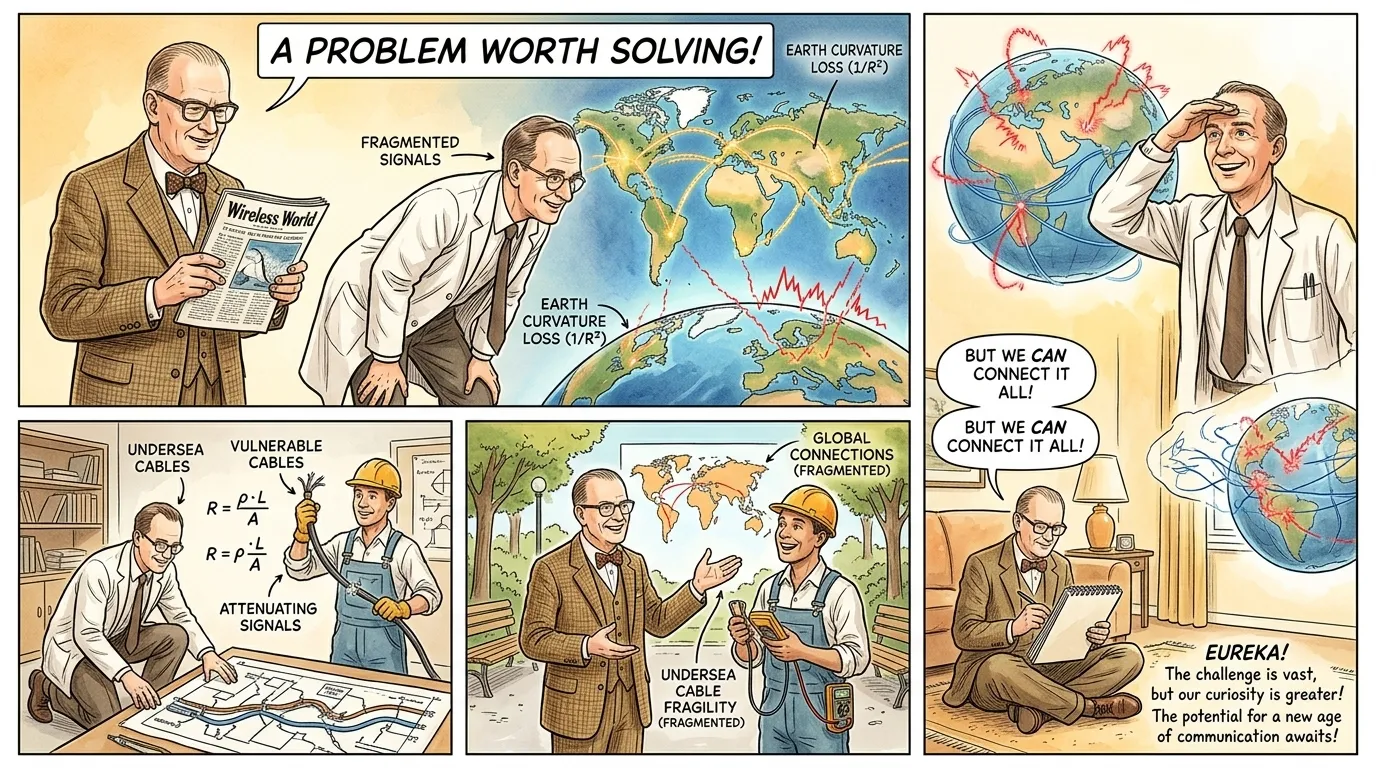
Before the advent of satellite communication, global connectivity faced immense challenges. Long-distance communication relied on vulnerable undersea cables and unreliable shortwave radio transmissions. These methods were prone to interruption, limited in bandwidth, and suffered from the inherent curvature of the Earth and atmospheric interference, rendering truly instantaneous worldwide communication a distant dream. The vastness of oceans and continents served as profound barriers, segmenting the human experience and delaying critical information exchange across the globe.
Page 2
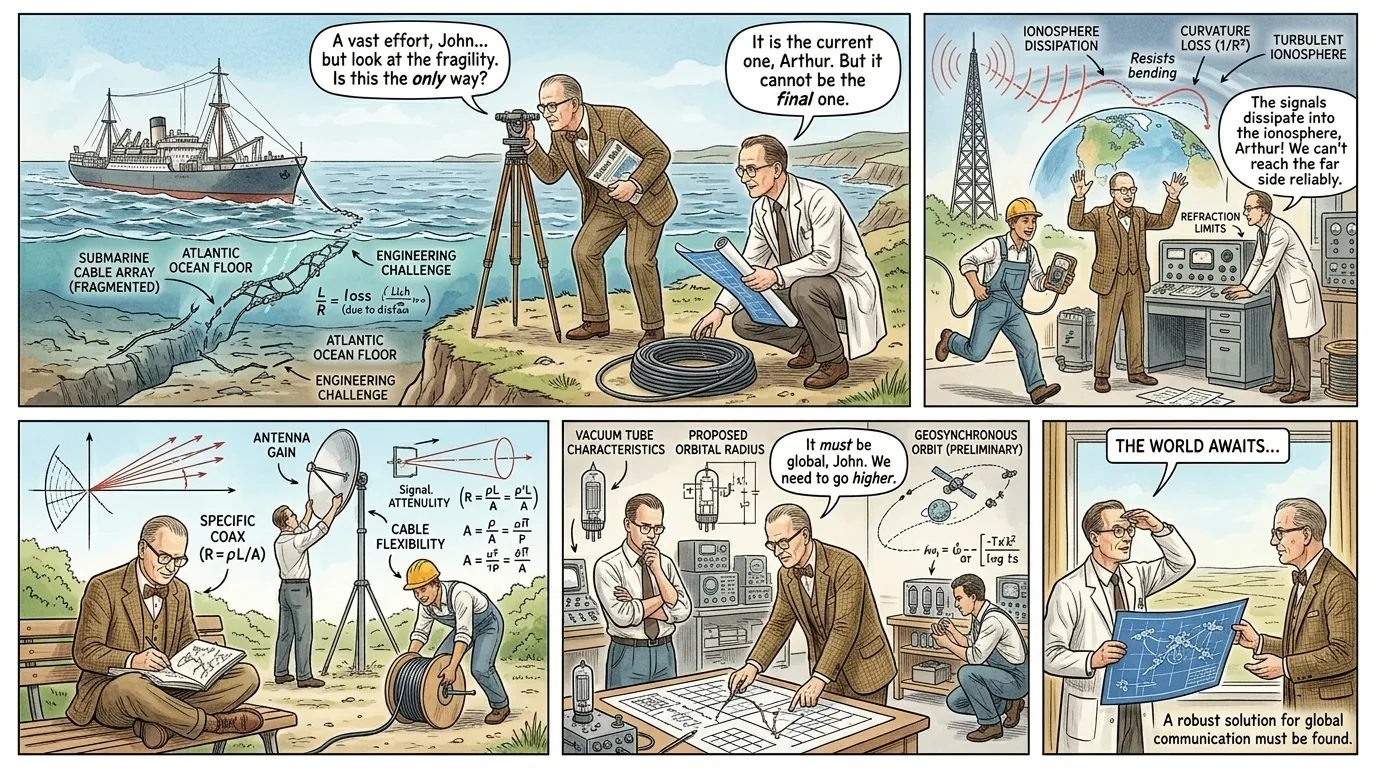
The primary conduits for transoceanic communication were submarine telegraph and later telephone cables, a monumental feat of engineering yet inherently limited. Laying and maintaining these cables across thousands of miles of ocean floor was incredibly expensive, time-consuming, and susceptible to damage from geological events or ship anchors. Meanwhile, terrestrial radio signals struggled with the Earth's curvature, limiting their effective range, and were further hampered by the ionosphere's unpredictable behavior, causing signal fading or complete loss. This fragmented landscape meant that a truly global, high-capacity communication network remained an elusive but vital necessity for an increasingly interconnected world.
Page 3
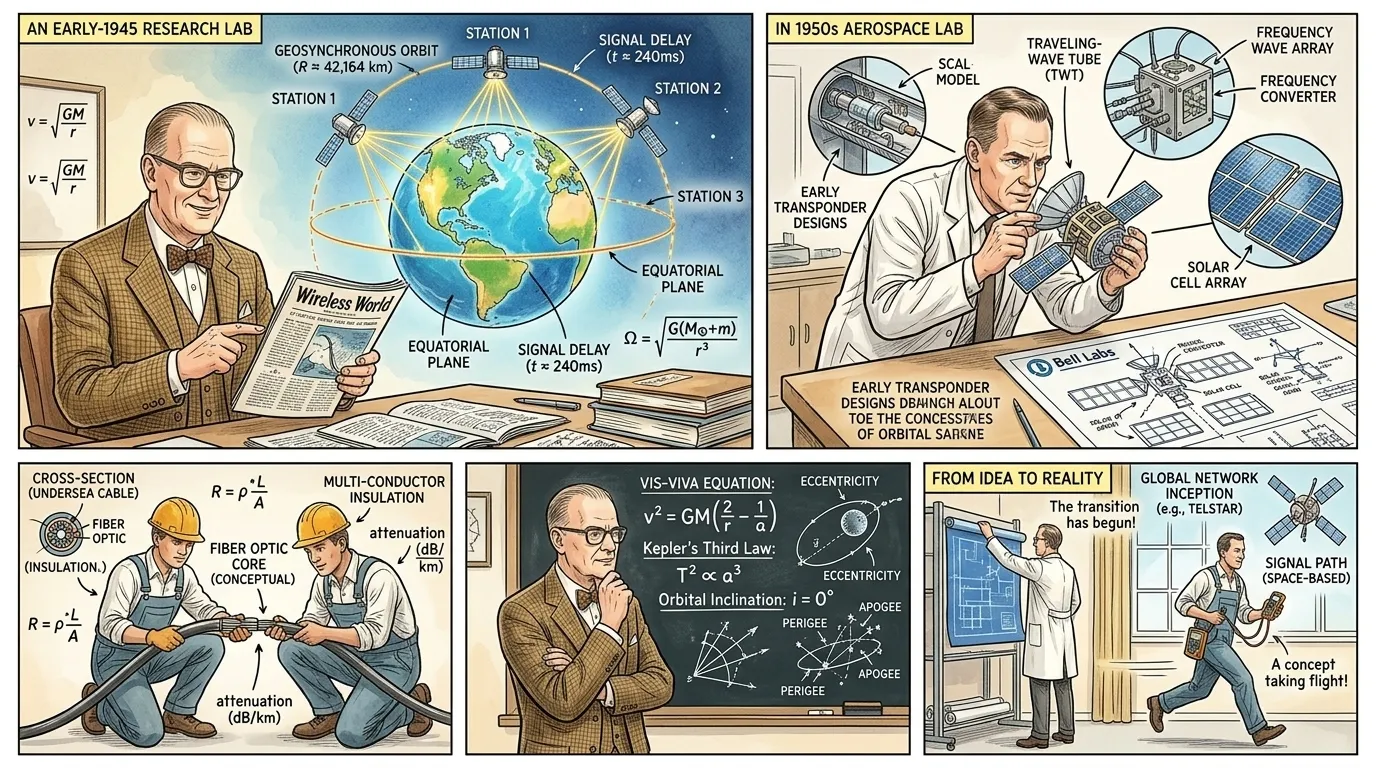
In 1945, Arthur C. Clarke, a British science fiction writer and visionary, published an article titled 'Extra-Terrestrial Relays' in Wireless World magazine. In it, he proposed a revolutionary concept: a network of three crewed space stations positioned in geostationary orbit around Earth. Each station would receive signals from one hemisphere and re-transmit them to another, effectively bypassing terrestrial limitations. While the idea of manned stations proved impractical, the fundamental principle of using high-altitude orbital platforms to overcome line-of-sight issues and provide continuous, global coverage laid the groundwork for all future satellite communication. This intellectual leap recognized that Earth's geometry, previously an impediment, could be overcome by an elevated, distant relay.
Page 4
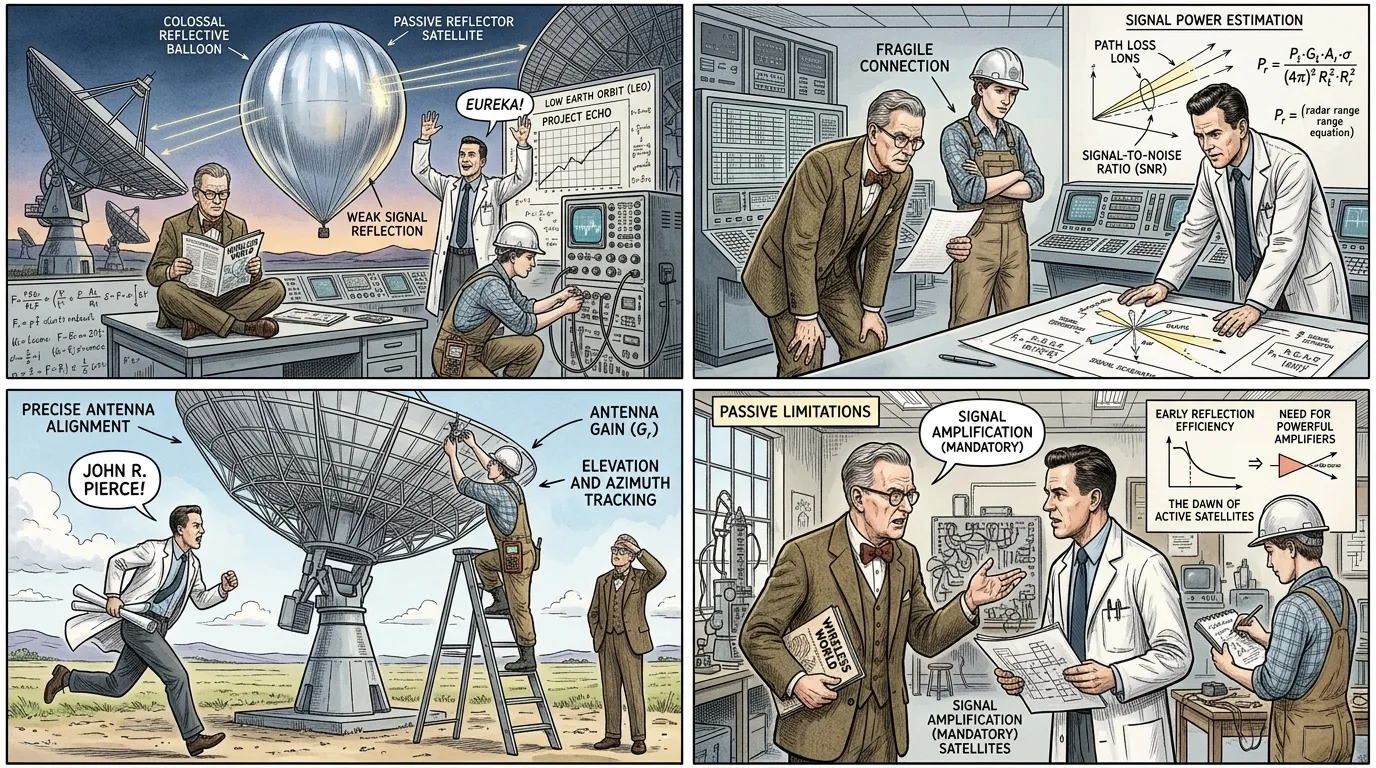
Clarke's theoretical framework, though initially seen as science fiction, ignited serious contemplation among engineers and scientists. The challenge was not just launching objects into space, but ensuring they could function as reliable communication relays. Early attempts, primarily in the late 1950s and early 1960s, focused on passive satellites. These were essentially large, reflective balloons, like Project Echo I and II, designed to simply bounce radio signals back to Earth. While demonstrating the feasibility of space-based reflection, their inherent limitations—weak signals, requiring massive ground antennas and powerful transmitters, and no ability to amplify or process signals—made them inefficient for practical, high-volume communication.
Page 5
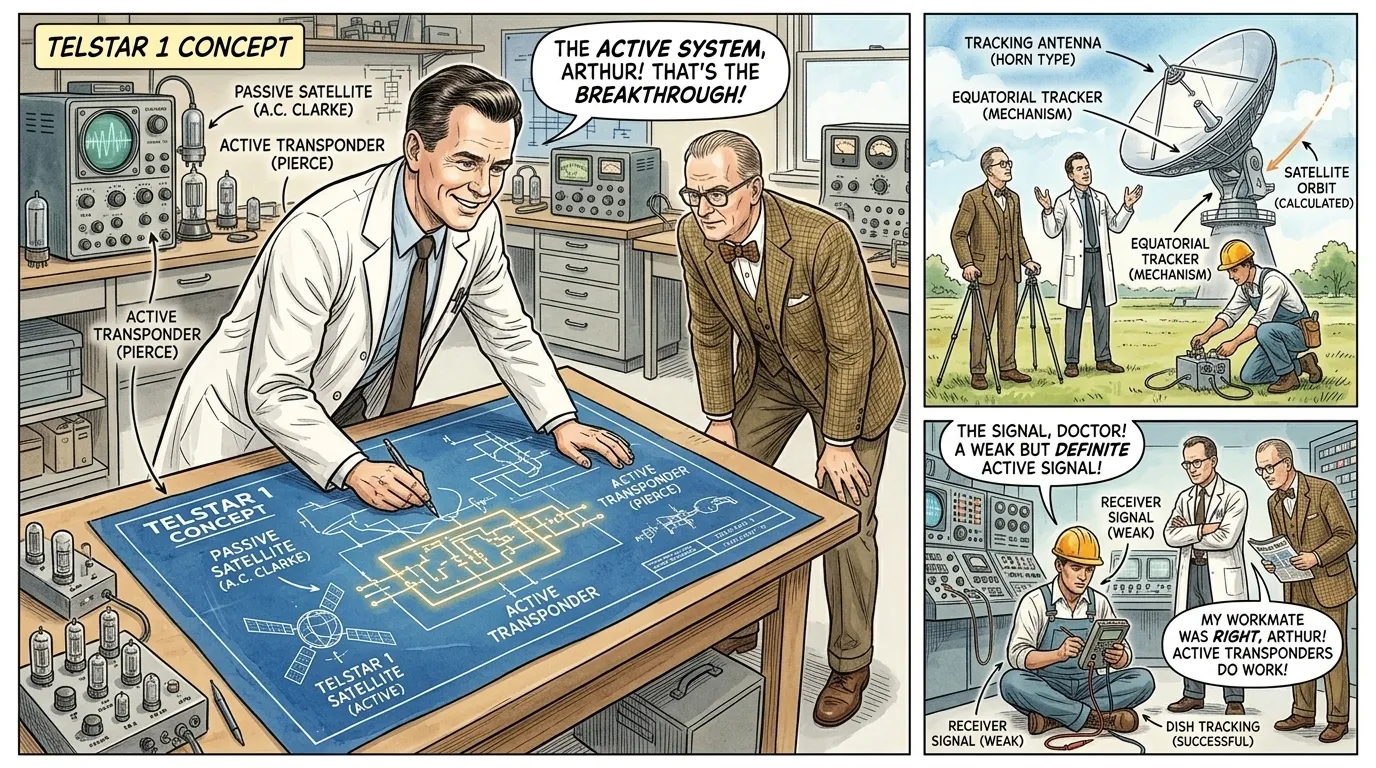
The true revolution came with active satellites, which could receive, amplify, and retransmit signals. This required a device known as a transponder. Building on early work, including Project SCORE in 1958 which demonstrated 'store-and-forward' voice messages, the race intensified. Bell Labs engineer John R. Pierce championed the idea of direct-relay active satellites. He faced skepticism, but his persistence, combined with advances in transistor technology, made the vision tangible. The first true active direct-relay communication satellite, Telstar 1, was a pivotal achievement, transforming theory into practical application and paving the way for instantaneous global links.
"'The only way of discovering the limits of the possible is to venture a little way past them into the impossible,' reflected Arthur C. Clarke years later, perfectly capturing the spirit of the engineers pushing these boundaries."
Page 6
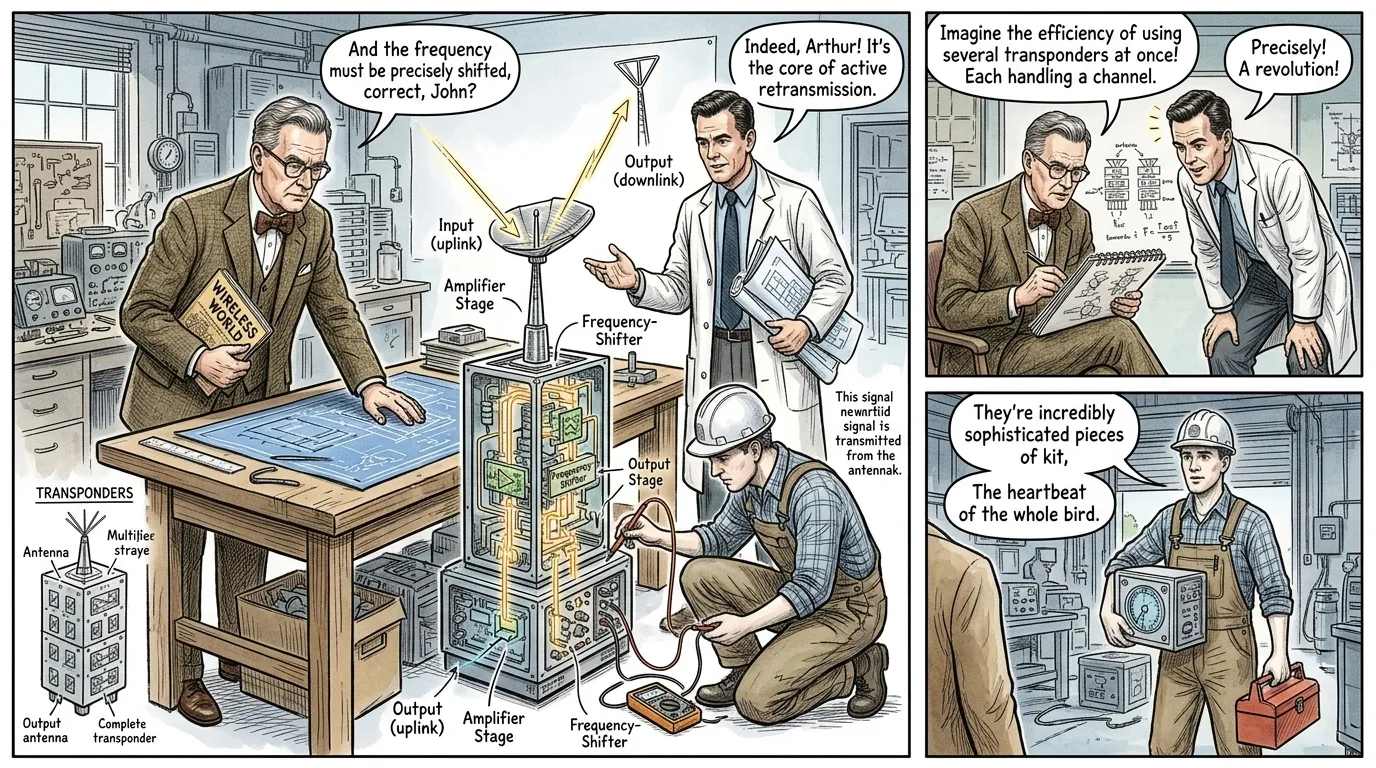
At the heart of an active communication satellite is the transponder, a sophisticated electronic device designed for signal relay. When an Earth-based ground station transmits a signal (the 'uplink'), the satellite's antenna receives it. The transponder then performs three crucial steps: first, it amplifies the weak incoming signal to restore its strength; second, it shifts the signal's frequency to prevent interference between the uplink and downlink paths; and third, it retransmits the amplified, frequency-shifted signal (the 'downlink') back to a different ground station on Earth. This process allows signals to traverse vast distances without significant loss or degradation, overcoming the very limitations that plagued terrestrial radio. Several transponders can operate simultaneously on a single satellite, handling multiple communication channels.
Page 7
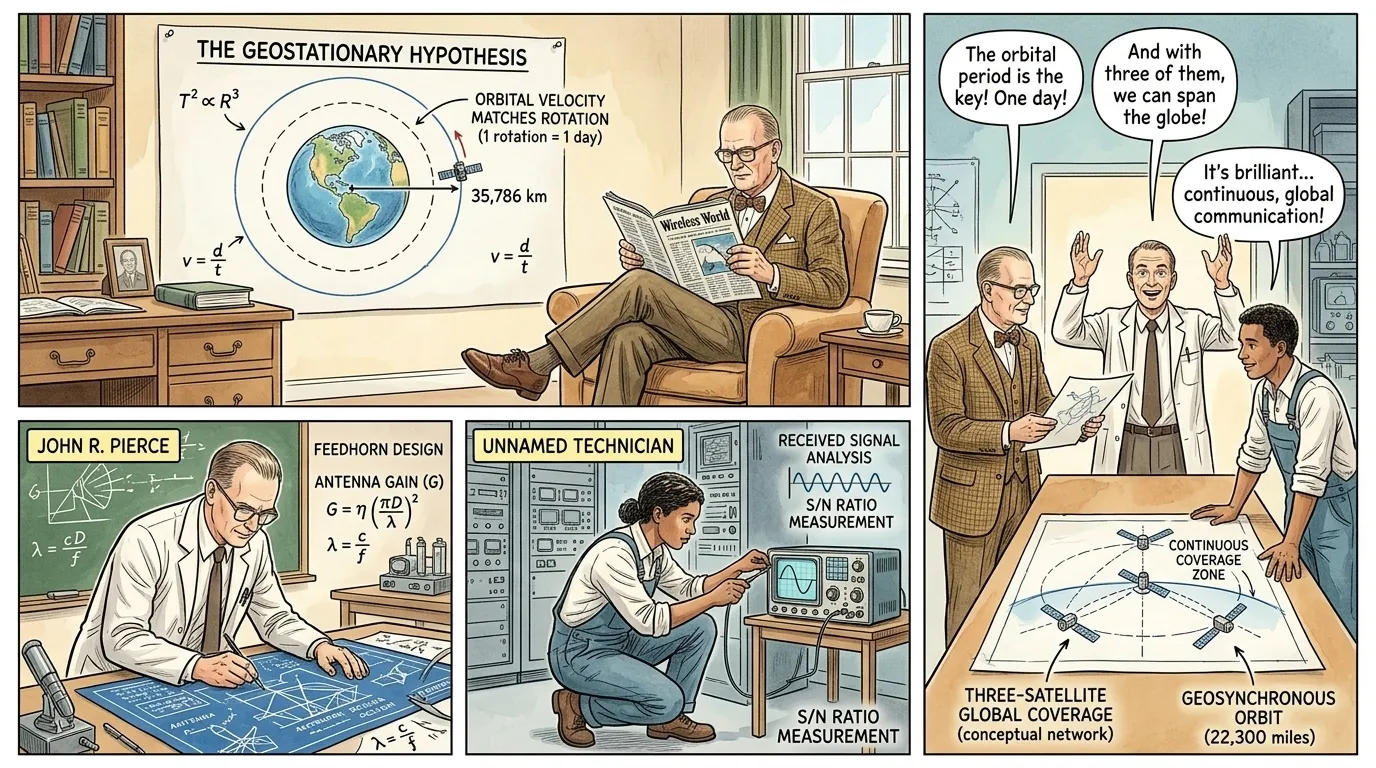
The final critical element, as envisioned by Clarke, was the geostationary orbit. At an altitude of approximately 35,786 kilometers (22,236 miles) directly above the Earth's equator, a satellite completes one orbit in precisely the same amount of time it takes for the Earth to rotate once on its axis—23 hours, 56 minutes, 4 seconds. From the ground, such a satellite appears to hover motionless in the sky. This 'stationary' position is incredibly advantageous, allowing ground antennas to be fixed in one direction, providing continuous, uninterrupted coverage over a vast geographical area. A network of just three geostationary satellites can provide nearly complete global coverage, revolutionizing connectivity by maintaining constant links across continents and oceans.
Page 8
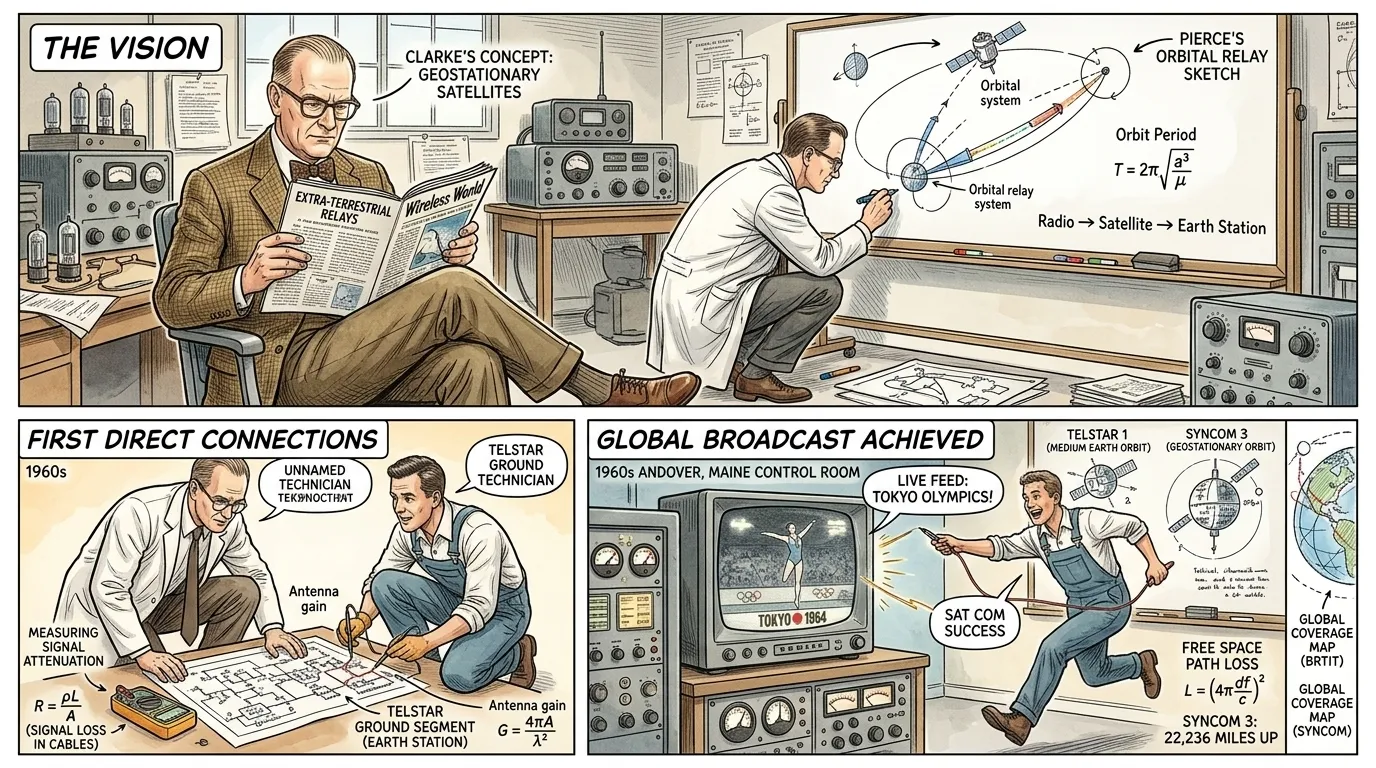
With the successful launch of Telstar 1 in 1962 and the subsequent deployment of active geostationary satellites like Syncom 3 in 1964, the age of global satellite communication truly began. Syncom 3 notably transmitted live footage of the 1964 Tokyo Olympics to the United States, a monumental public demonstration of the technology's potential. This breakthrough led to the rapid formation of international consortia, such as INTELSAT, which established a global network of communication satellites. Suddenly, television broadcasts, telephone calls, and data could travel across continents and oceans with unprecedented speed and reliability. The once-fragmented world began to shrink, connected by invisible bridges of information high above the Earth. The understanding of the specific orbital mechanics, a concept explored on Page 7, proved instrumental in making this continuous, reliable coverage a reality, overcoming the persistent signal limitations discussed on Page 2.
Page 9
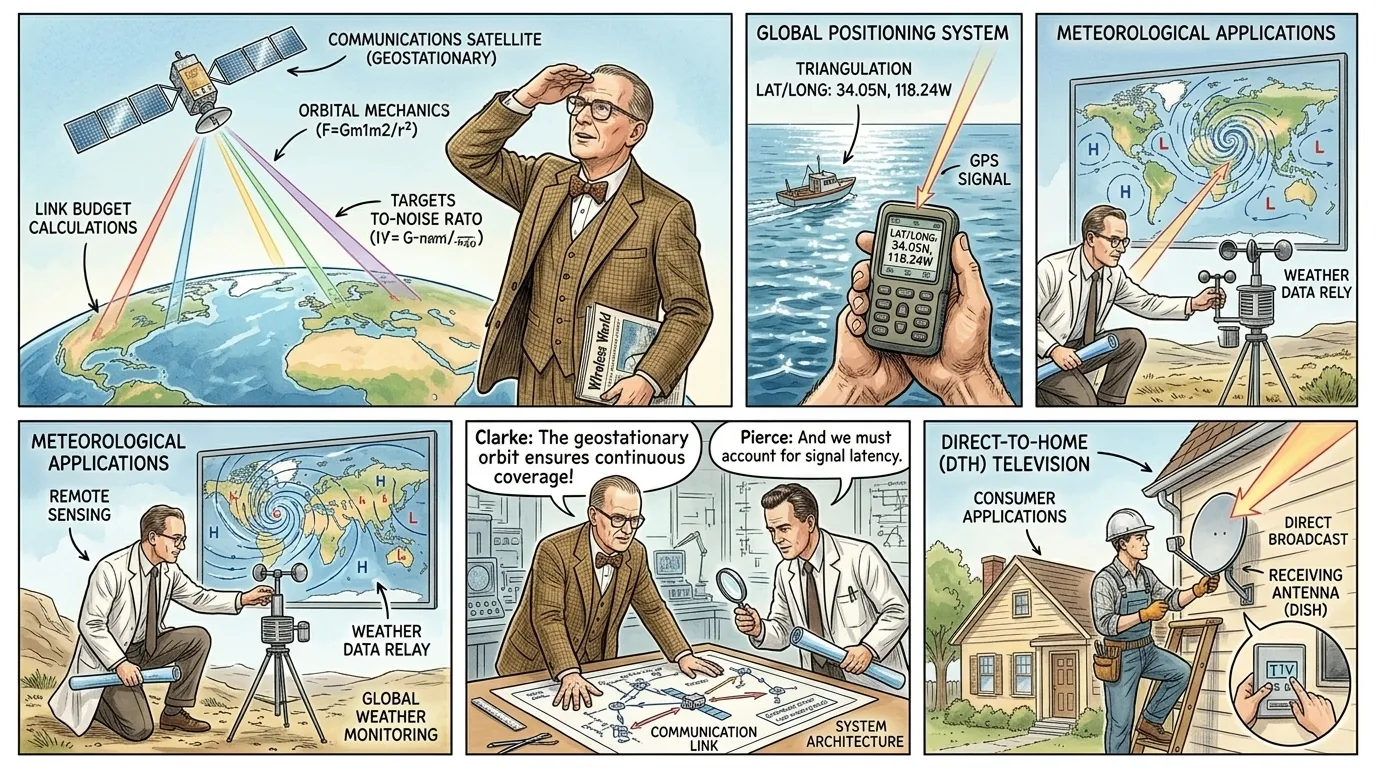
Beyond basic telephone and television relay, satellite communication quickly diversified. The constant, widespread reach of satellites proved invaluable for a multitude of applications. Navigation systems like GPS rely on satellite signals for precise location data, transforming transportation and mapping. Weather satellites provide critical meteorological data, improving forecasting and disaster preparedness. Direct broadcast satellites deliver television and radio channels directly to homes, bypassing traditional cable infrastructure. Furthermore, satellites became essential for military intelligence, remote sensing, environmental monitoring, and providing internet access to underserved or remote regions. This expansion showcased the incredible versatility and adaptability of the fundamental technology first envisioned by Clarke, adapting to ever-increasing societal demands for connectivity and information.
Page 10
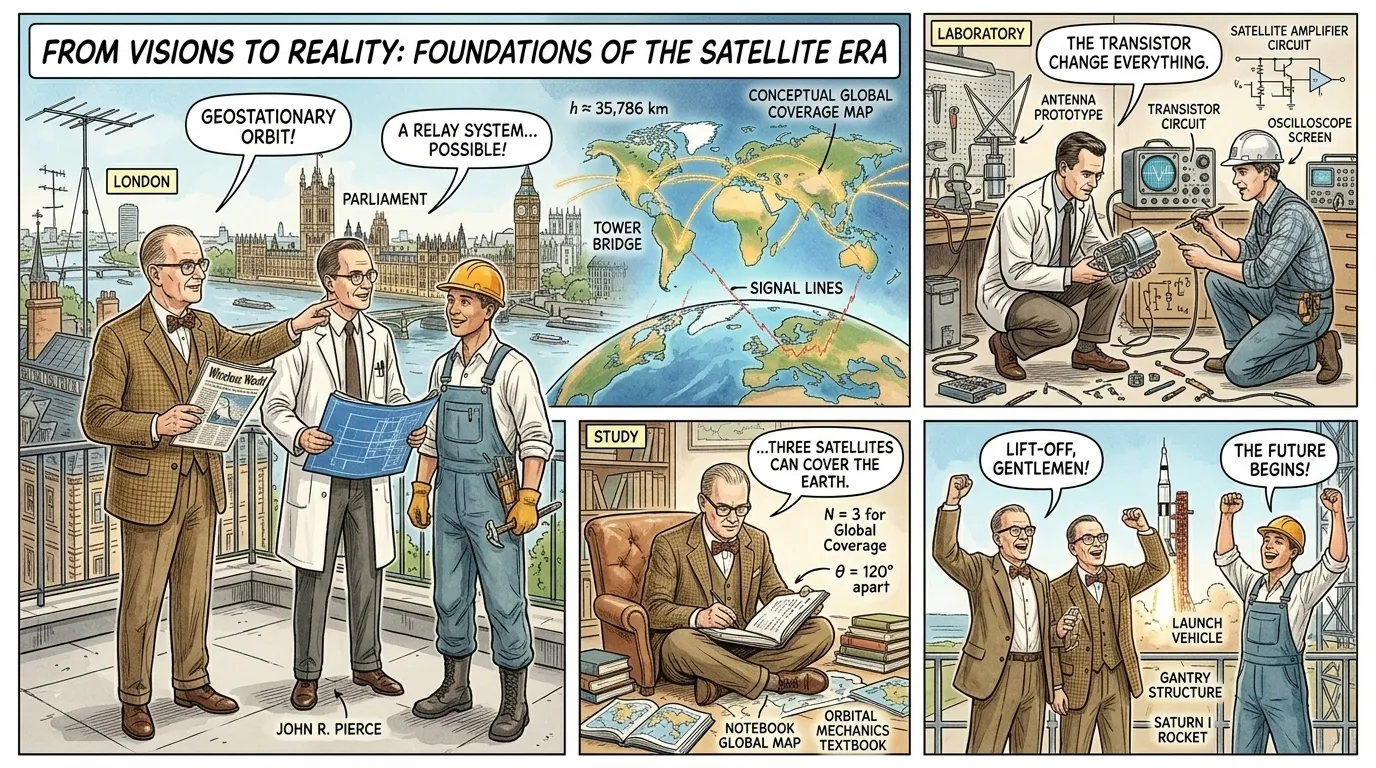
Today, satellite communication is an indispensable pillar of global infrastructure, silently facilitating billions of interactions every day. It underpins international finance, enables instant news dissemination, supports disaster relief efforts, and connects remote communities that would otherwise remain isolated. From everyday cell phone calls routed through satellite links to the intricate data streams guiding space probes, the impact is pervasive and profound. Arthur C. Clarke's initial vision, once a speculative theory, has not only been realized but has far exceeded its initial scope, fundamentally reshaping human civilization into a truly interconnected global society. It stands as a testament to the power of visionary thought combined with relentless engineering, continuously evolving to meet the demands of an ever-shrinking world.
About this story
- Location: Global
- Audience: general readers
Read Wonder Inventions on your phone
Wonder Inventions is available on Android. Get Wonder Inventions on Google Play.