Quantum Computer
Quantum Computer — an illustrated inventions story, set in Global. 10 illustrated pages, free to read on Wonder Inventions.
Page 1
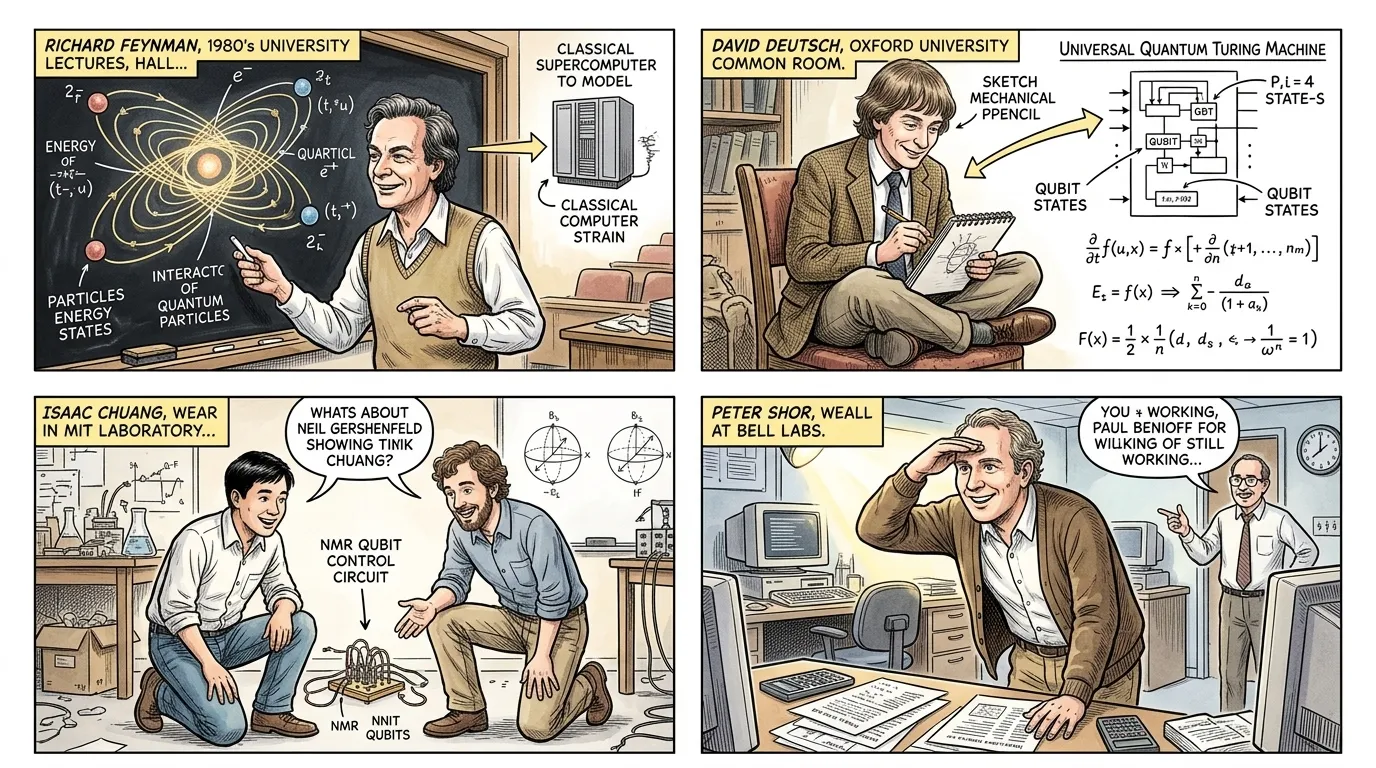
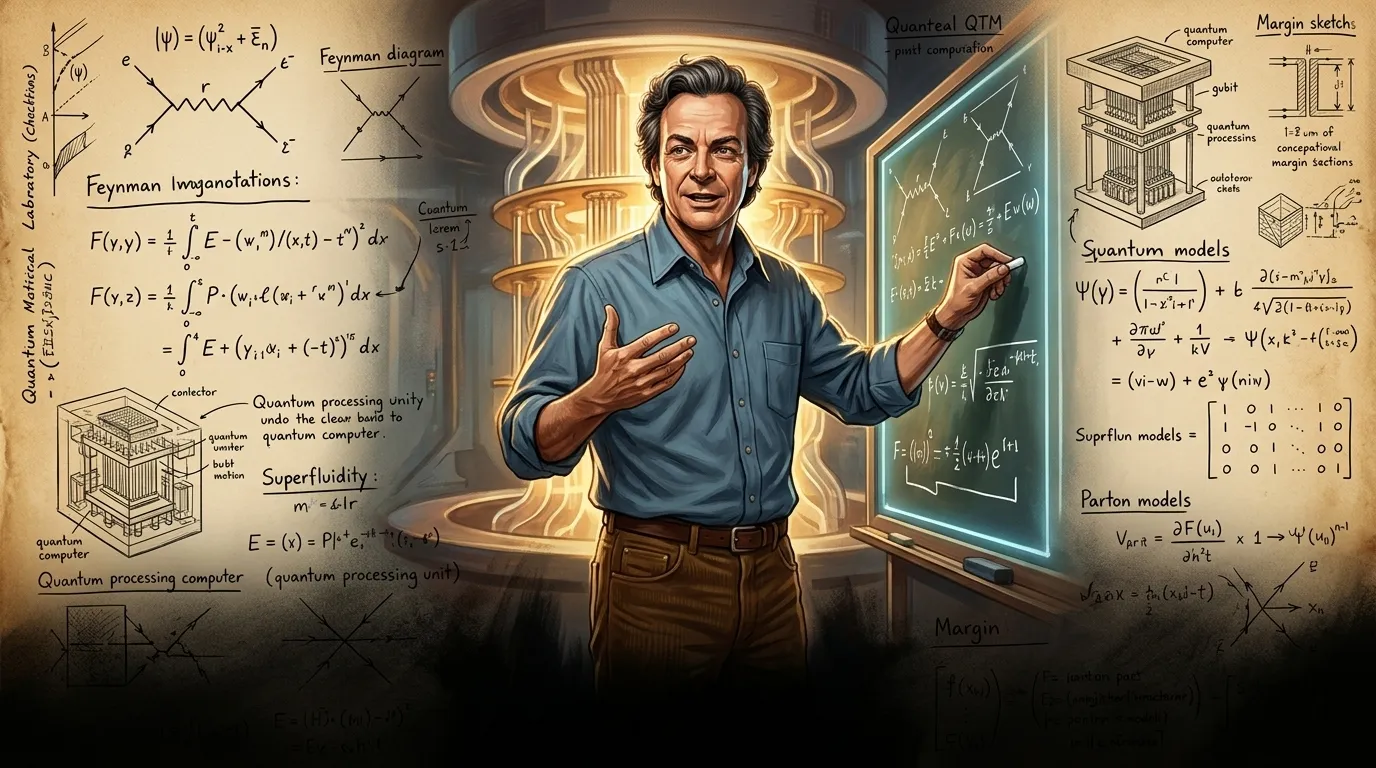
For decades, classical computing pushed the boundaries of what was possible, processing vast datasets and enabling unimaginable advancements. Yet, a fundamental limit emerged for truly complex problems, especially those rooted in quantum mechanics itself. Simulating the intricate behaviors of atoms and molecules, or factoring immense numbers, became computationally intractable for even the most powerful supercomputers, demanding a radically new approach.
"Richard Feynman, a visionary physicist, once pondered, 'It seems to me that the problem of simulating quantum mechanics is an excellent one for the computer to attack; but that it's not going to be an easy thing to do on a classical computer.' His insight, articulated in the early 1980s, laid the theoretical bedrock for an entirely new paradigm in computation."
Page 2
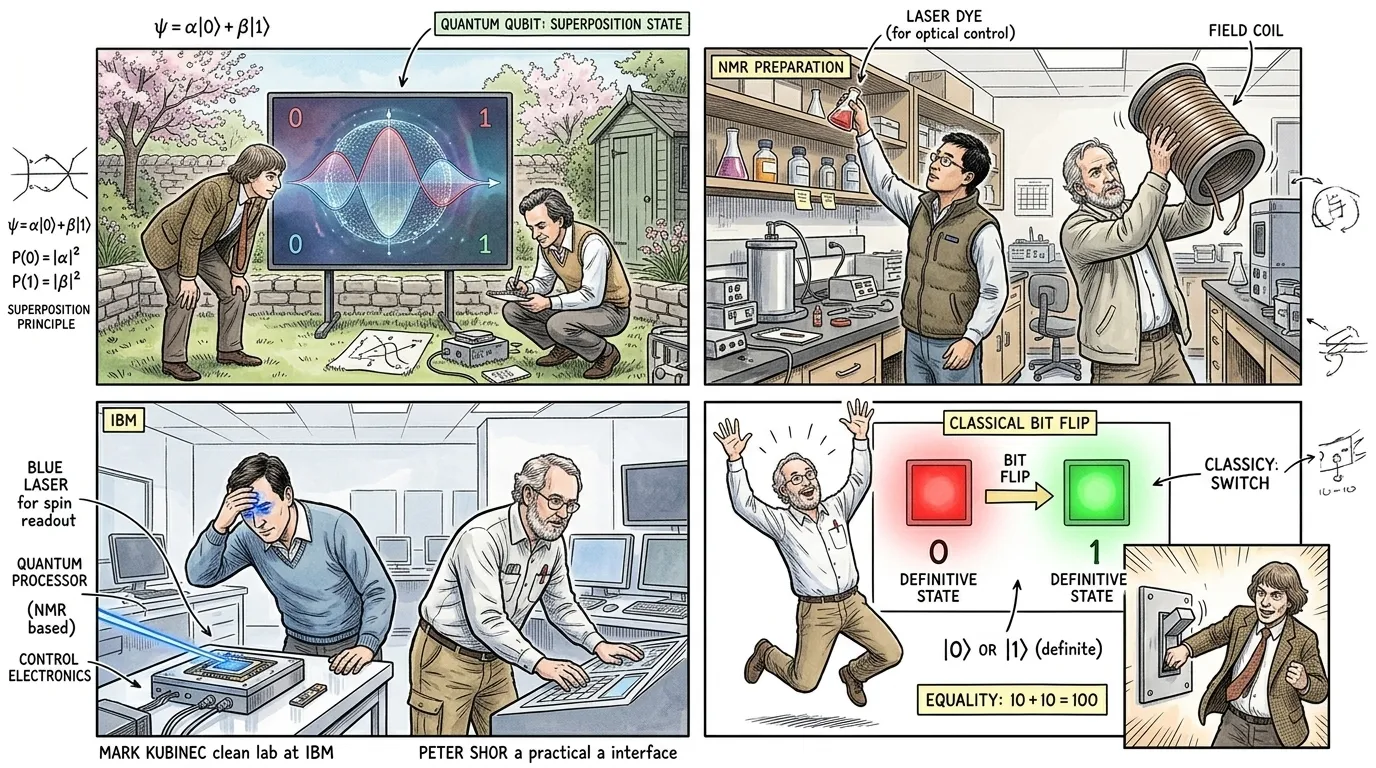
At the heart of every classical computer lies the 'bit', a binary unit of information that can exist in one of two definitive states: either a '0' or a '1'. This digital certainty has powered the information age, building logical gates that process instructions sequentially. However, for problems requiring the exploration of countless possibilities simultaneously, this binary limitation becomes a severe bottleneck.
"The proposed solution, the 'qubit' or quantum bit, emerged as a piece of knowledge unique to quantum mechanics. Unlike its classical counterpart, a qubit leverages quantum phenomena to exist not just as 0 or 1, but as a complex blend of both simultaneously. This revolutionary concept hinted at an exponential leap in computational power, fundamentally redefining what a 'state' could represent."
Page 3
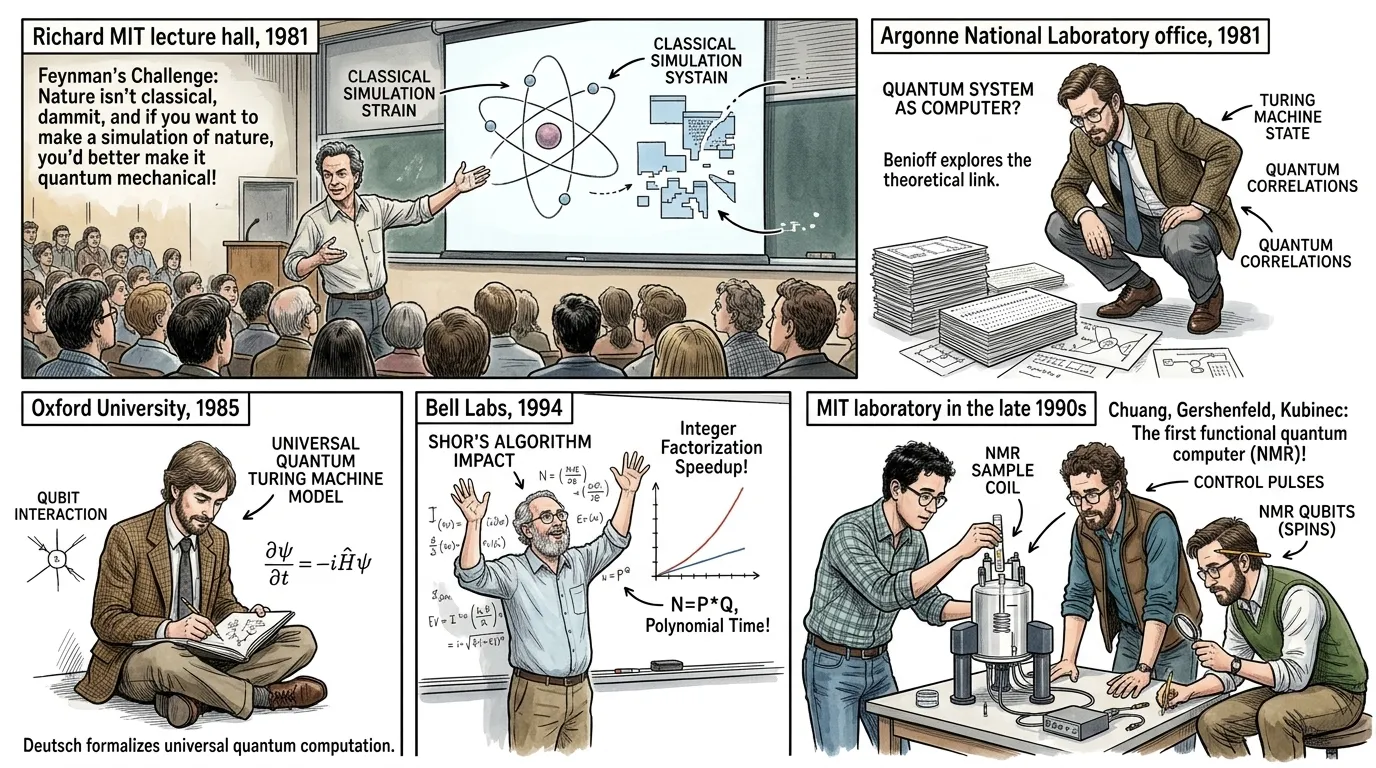
Richard Feynman, during his renowned 1981 'Physics of Computation' conference talk at MIT, eloquently articulated the challenge: classical computers struggled immensely to simulate the true complexity of quantum systems. Their exponential resource demands meant that modeling even relatively simple quantum interactions became quickly impossible. Feynman's profound insight was to consider a computer that wasn't just about quantum mechanics, but was quantum mechanical itself.
"He proposed, 'If you want to make a simulation of nature, you'd better make it quantum mechanical.' This wasn't merely a theoretical musing; it was a blueprint for a machine designed to leverage the very laws of physics that classical systems attempted, and failed, to mimic. His proposal catalyzed a nascent field, challenging scientists to envision how quantum principles could be harnessed for computation."
Page 4
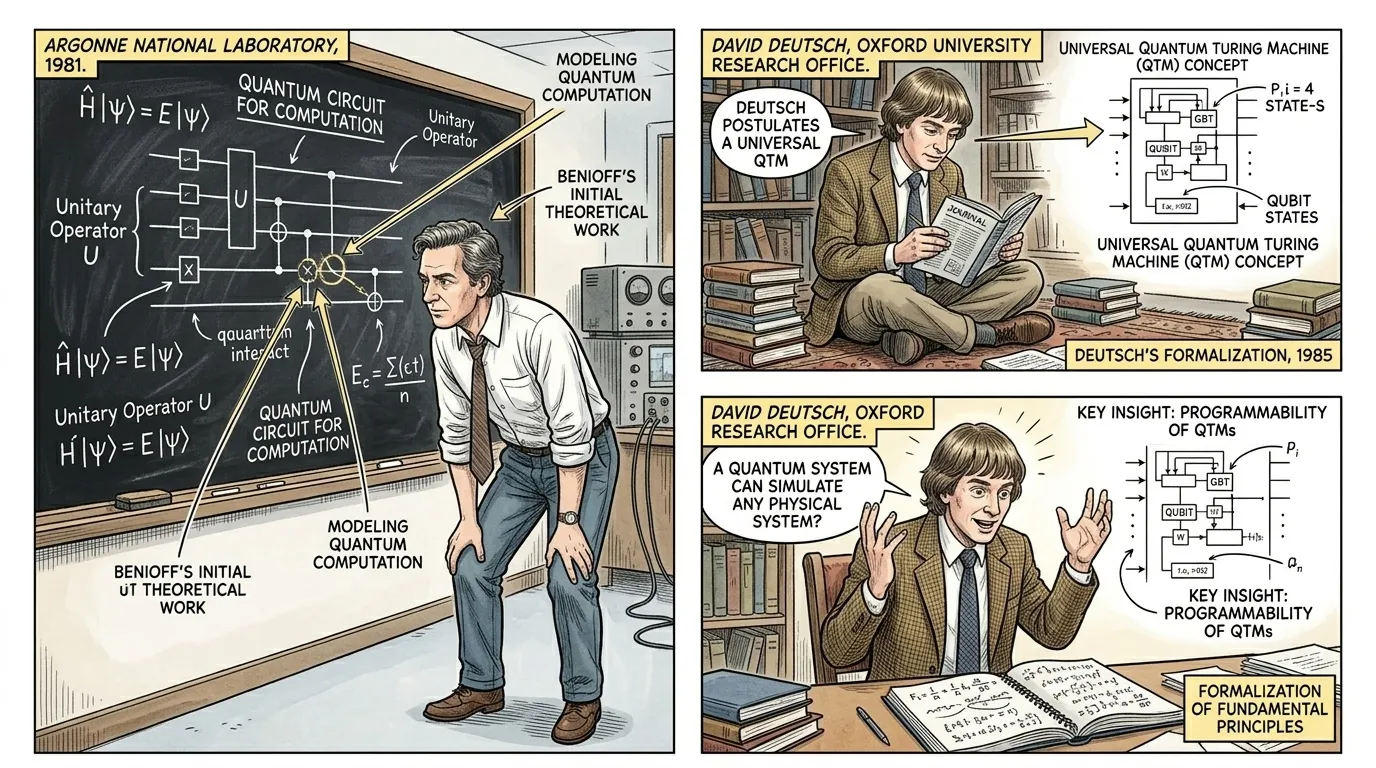
Feynman's conceptual spark soon ignited rigorous theoretical development. In the same year, 1981, Paul Benioff at Argonne National Laboratory published a paper demonstrating that a quantum system could perform computations. His work provided the first detailed theoretical model of a quantum computer, outlining how quantum mechanical laws could indeed execute a computation in a reversible, quantum-mechanical way, thereby addressing thermodynamic constraints.
"Building on this, David Deutsch of Oxford University further formalized the concept in 1985 by describing a universal quantum Turing machine. This theoretical construct proved that any problem solvable by a classical computer could also be solved by a quantum computer, and crucially, it established that a quantum computer could simulate any other quantum system. The 'knowledge' of how to formalize these operations into a computational model was critical."
Page 5
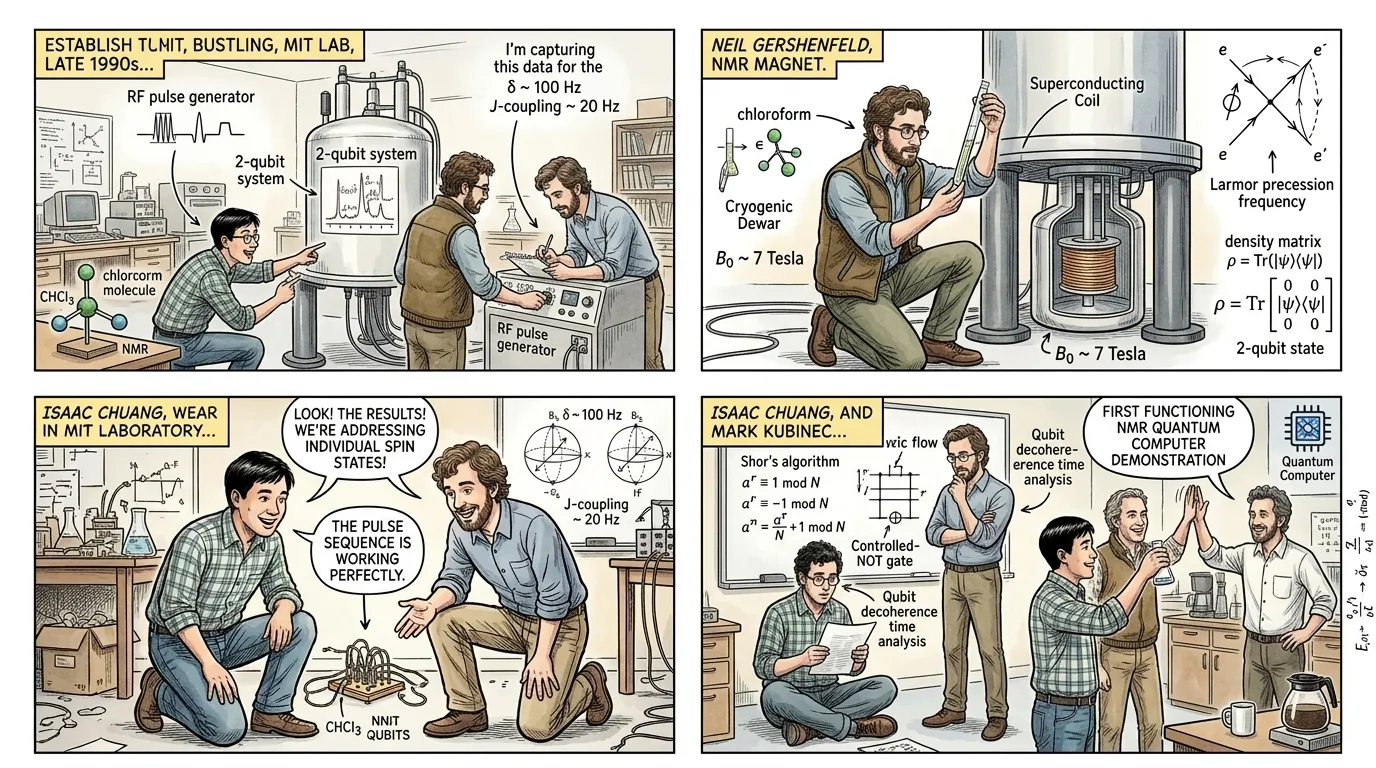
Translating these profound theoretical constructs into a physical machine presented immense challenges. The delicate nature of quantum states meant they were incredibly susceptible to interference from their environment, a phenomenon known as 'decoherence'. Any stray vibration, temperature fluctuation, or electromagnetic field could cause the quantum information to collapse, rendering computation impossible. Early attempts focused on isolating qubits to maintain their fragile coherence.
"Despite these hurdles, the late 1990s saw significant experimental breakthroughs. In 1998, a team led by Isaac Chuang, Neil Gershenfeld, and Mark Kubinec at IBM and MIT achieved a seminal feat: they demonstrated the first functioning quantum computer using nuclear magnetic resonance (NMR) of a chloroform molecule. Their 2-qubit machine successfully ran Grover's algorithm, proving that quantum computation was not just theory but a tangible reality, albeit on a very small scale."
Page 6
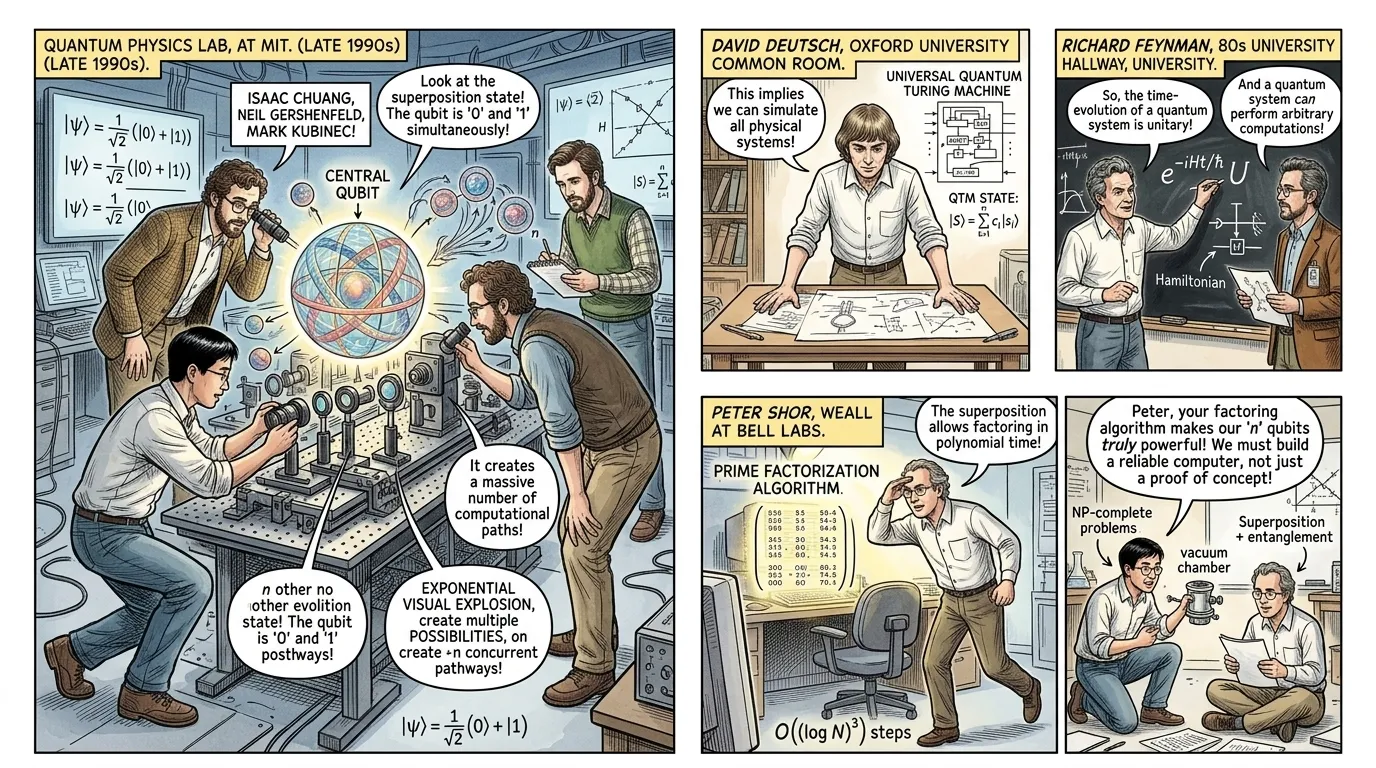
The true operational power of a quantum computer stems from two extraordinary quantum mechanical phenomena. The first, 'superposition', allows a single qubit to exist in multiple states simultaneously—not just 0 or 1, but a probabilistic combination of both. Imagine a coin spinning in the air: it is neither heads nor tails until it lands. A qubit in superposition is like that spinning coin, embodying all possibilities at once.
"This unique ability to hold multiple states concurrently is a direct 'payoff' from the quantum mechanical knowledge introduced earlier. It means that with 'n' qubits, a quantum computer can store and process 2 n possibilities simultaneously. For complex problems, this offers an exponential speedup, allowing the exploration of vast computational spaces in parallel, far beyond the capacity of classical systems that must evaluate each possibility sequentially."
Page 7
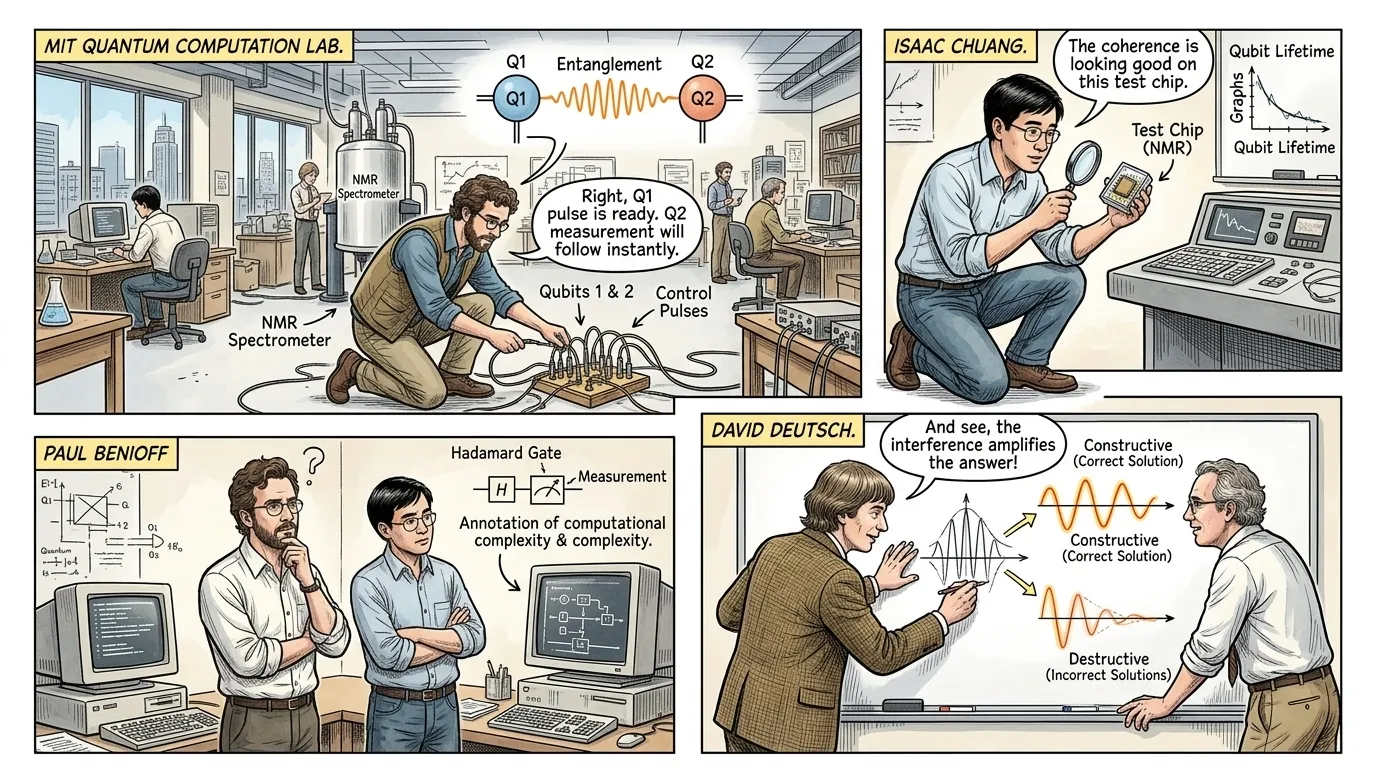
The second cornerstone of quantum computation is 'entanglement'. When two or more qubits become entangled, their fates are inextricably linked, regardless of the physical distance between them. Measuring the state of one instantly reveals the state of its entangled partner. This non-local correlation creates a profoundly powerful resource, allowing qubits to work together in ways impossible for independent classical bits.
"Combined with 'quantum interference', these entangled states are carefully manipulated. Like waves interfering to create crests and troughs, quantum algorithms are designed to amplify the probability of correct answers while diminishing the probability of incorrect ones. This sophisticated orchestration of quantum states to guide a computation towards the desired result is the ultimate 'payoff' of mastering these quantum mechanical principles, allowing for probabilistic yet powerful solutions."
Page 8
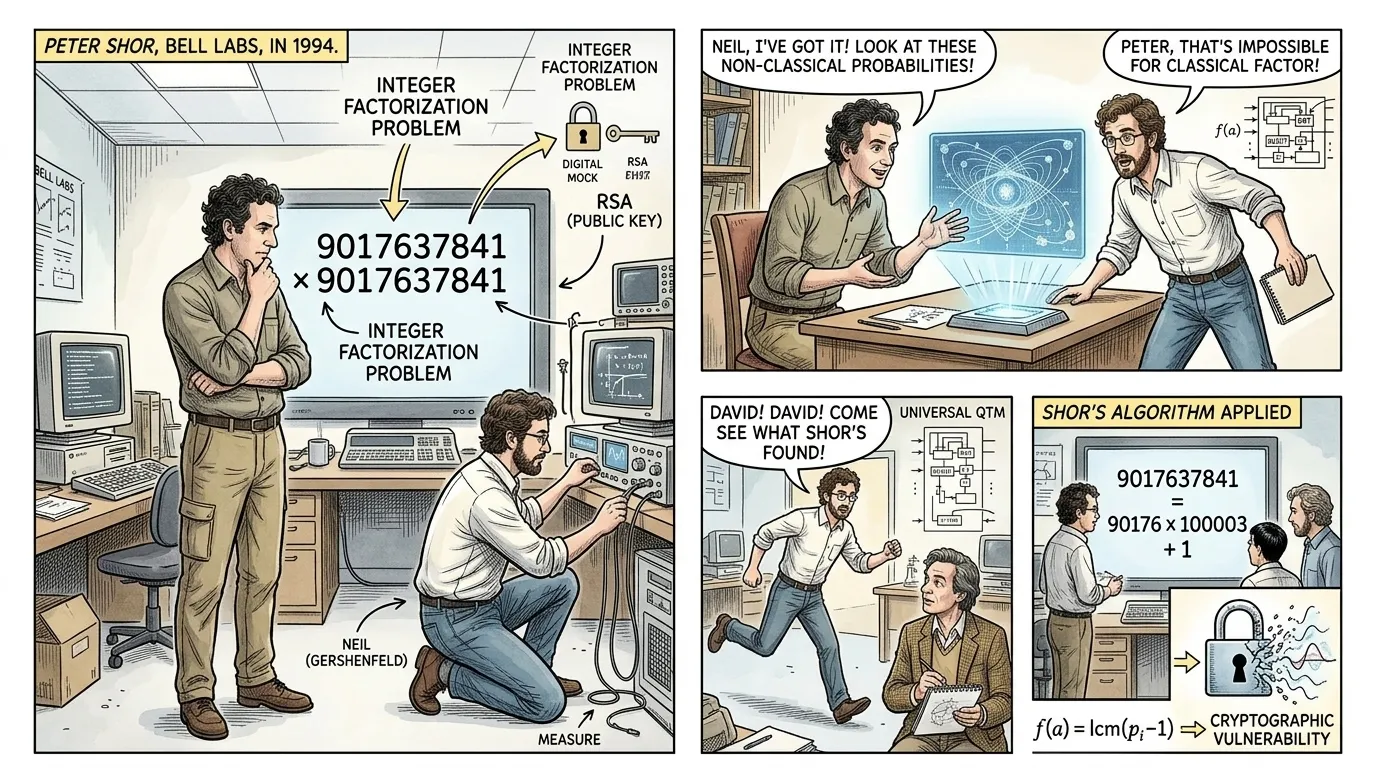
In 1994, Peter Shor, then at Bell Labs, introduced an algorithm that dramatically underscored the potential of quantum computing. His algorithm proved that a sufficiently powerful quantum computer could factor large integers exponentially faster than any known classical algorithm. This was not a minor improvement; it represented a fundamental threat to the security infrastructure of the modern digital world.
"Much of contemporary cryptography, including the widely used RSA encryption system, relies on the classical computational difficulty of factoring large numbers. Shor's algorithm, a direct application of quantum principles, demonstrated that a quantum computer could dismantle these encryption schemes with ease. The implications were profound, demanding a global race to develop 'post-quantum cryptography' to safeguard sensitive information in a quantum-enabled future. It was a clear demonstration of quantum computing's transformative, and potentially disruptive, power."
Page 9
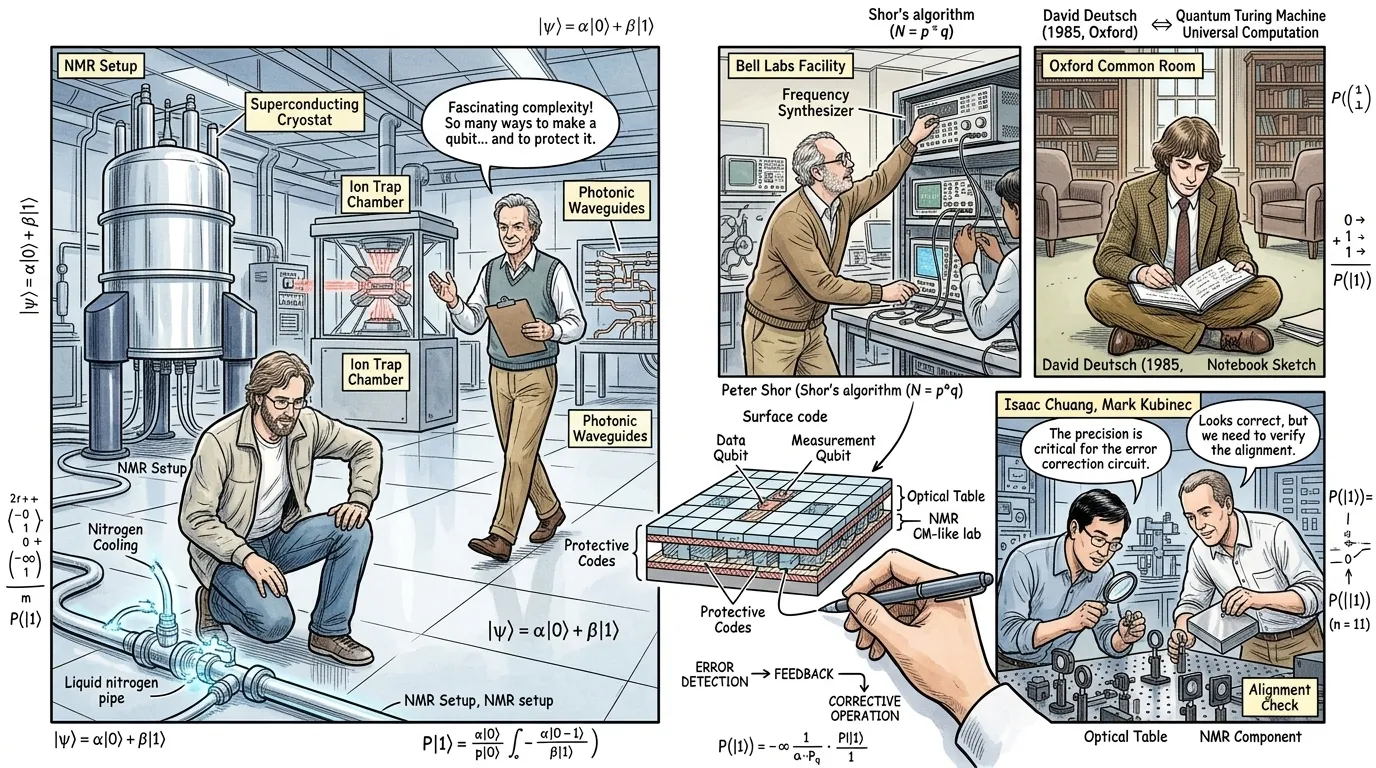
The theoretical brilliance of quantum computing slowly began its arduous transition into physical hardware. Today, several prominent architectures are being pursued: superconducting qubits, which operate at temperatures colder than deep space; trapped ions, where charged atoms are suspended and manipulated by lasers; and photonic systems, using light particles as qubits. Companies like IBM, Google, Rigetti, and D-Wave have invested billions into building and scaling these complex machines.
"While still in its nascent stages, the era of 'Noisy Intermediate-Scale Quantum' (NISQ) devices offers a glimpse into quantum computing's potential. These machines, though prone to errors, are powerful enough to tackle specific, challenging problems that push classical limits. The ongoing research into quantum error correction is vital, aiming to protect the fragile quantum states from decoherence and enable fault-tolerant quantum computers, bringing the vision closer to widespread practical application."
Page 10
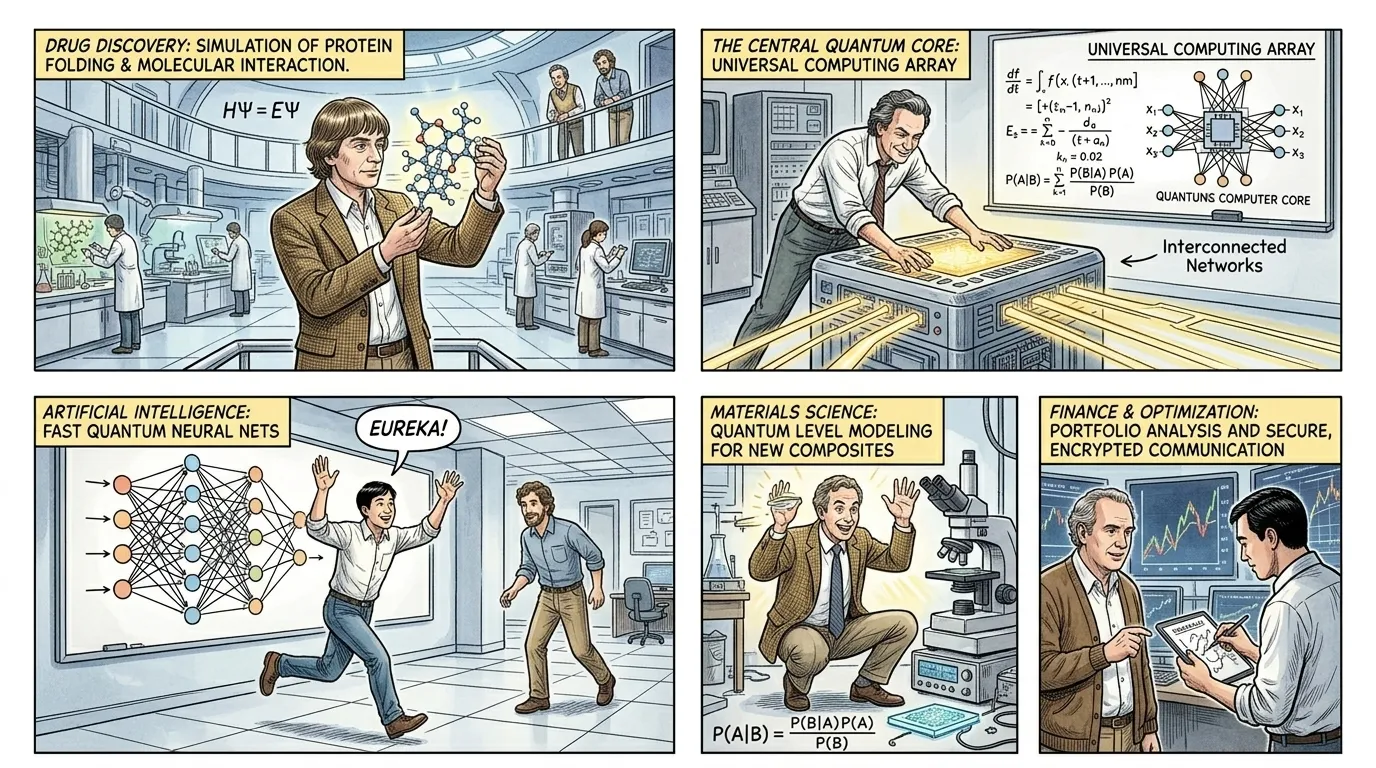
The quantum computer stands on the precipice of revolutionizing numerous fields. In drug discovery, it promises to simulate molecular interactions with unprecedented accuracy, leading to novel pharmaceuticals and personalized medicine. Material science could unlock designs for new superconductors or catalysts. Artificial intelligence stands to gain immense processing power for complex learning models, and financial institutions could optimize portfolios with unmatched precision. Its long-term impact on cryptography, ensuring secure communication, also remains a critical pursuit.
"The journey from Feynman's theoretical proposal to functional quantum machines has been long and complex. While challenges persist, the fundamental principles of superposition and entanglement have been harnessed, charting a course toward computational capabilities that were once confined to the realm of science fiction. The quantum computer promises not just to solve existing problems faster, but to unlock entirely new realities, transforming our understanding of science, technology, and the very fabric of the physical world."
About this story
- Location: Global
- Audience: general readers
Read Wonder Inventions on your phone
Wonder Inventions is available on Android. Get Wonder Inventions on Google Play.