Printing Ink
Printing Ink — an illustrated inventions story, set in Global. 10 illustrated pages, free to read on Wonder Inventions.

Page 1
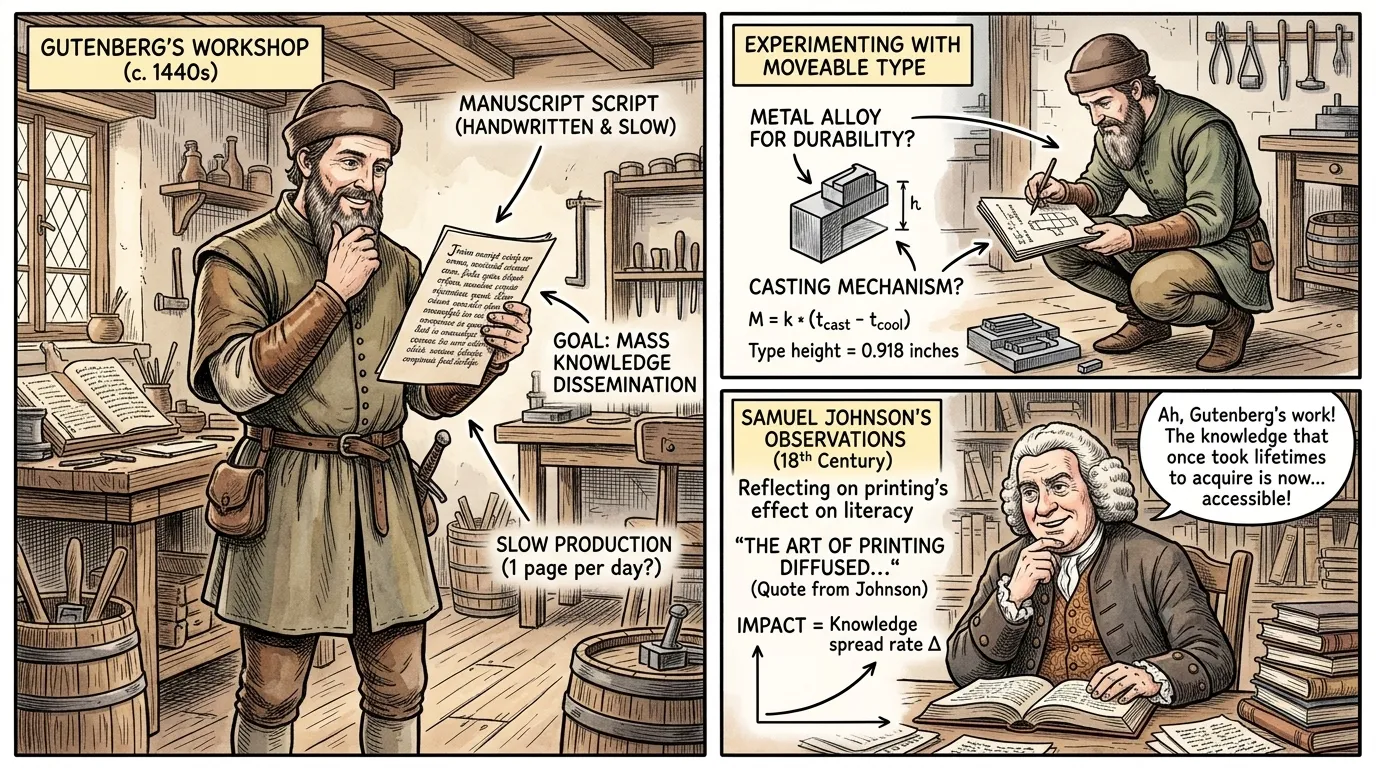
For millennia, the dissemination of knowledge was a slow and painstaking endeavor. Before the advent of modern printing, texts were painstakingly copied by hand, a process that rendered books scarce and prohibitively expensive. The very act of writing, though transformative, placed immense limitations on access to information and education. Johannes Gutenberg, a visionary craftsman from Mainz, Germany, faced this profound challenge in the mid-15th century.
"He understood that mere mechanical reproduction was insufficient; a new medium was needed to bind text to paper efficiently. As the renowned author and critic, Samuel Johnson, would later reflect on the impact of printing, he observed: "What is written without effort is in general read without pleasure." Gutenberg sought to ensure that every printed word would be clear, consistent, and durable, a stark contrast to the often-fading, inconsistent quality of hand-copied scripts."
Page 2
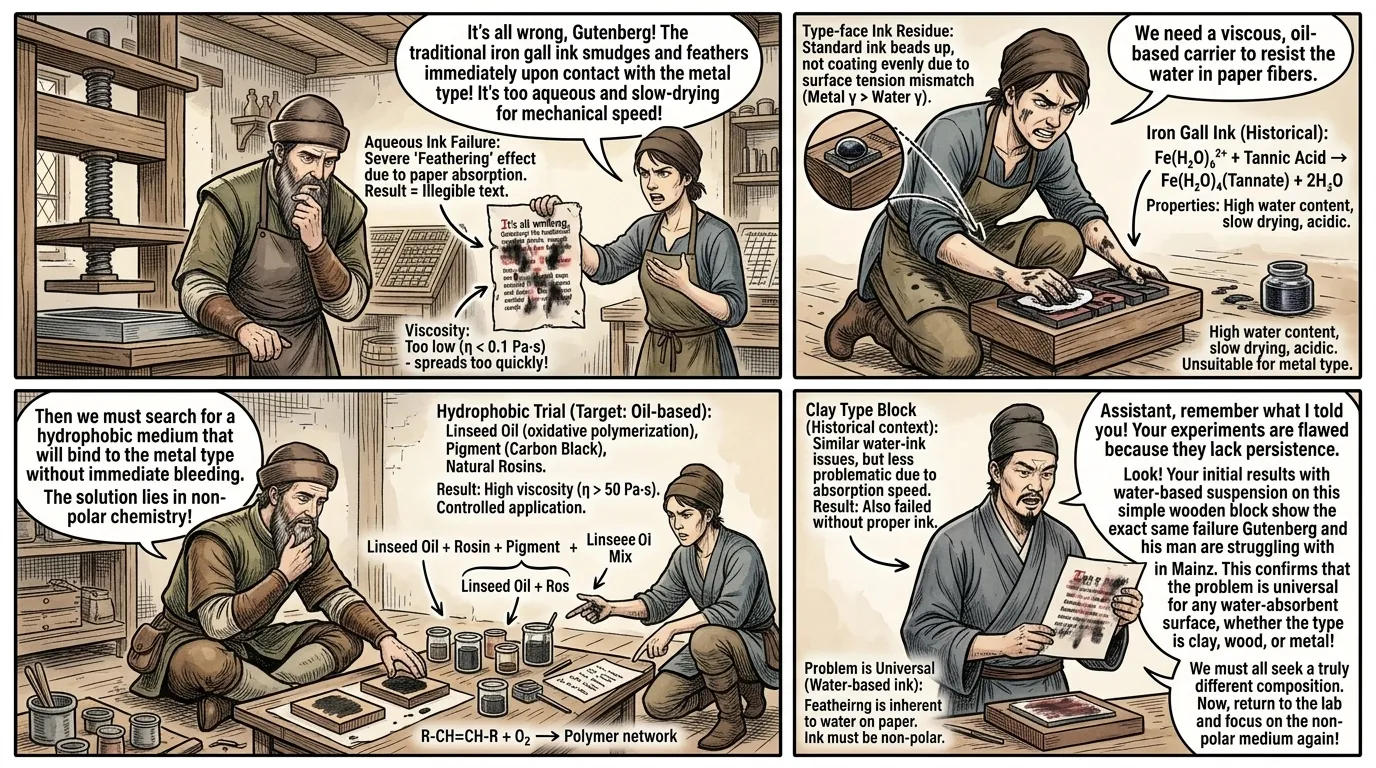
The existing inks of Gutenberg's era, primarily water-based formulations like iron gall ink or carbon black suspensions, were optimized for quills and brushes. These inks were absorbed by parchment or paper fibers, often bleeding or creating feathery edges, and requiring long drying times. Such properties made them utterly unsuitable for the mechanical, high-speed demands of printing, where crisp, uniform transfer was paramount.
"Historical accounts suggest that early experiments with traditional writing inks on printing presses yielded disappointing results. They either soaked too deeply into the paper, losing definition, or refused to adhere properly to the metal type. As a contemporary chronicler might have mused, contemplating the limitations: "The spirit of knowledge yearns to spread, yet the very liquid that carries its form betrays its purpose when pressed." This frustration underscored the critical need for a dramatically different ink composition."
Page 3
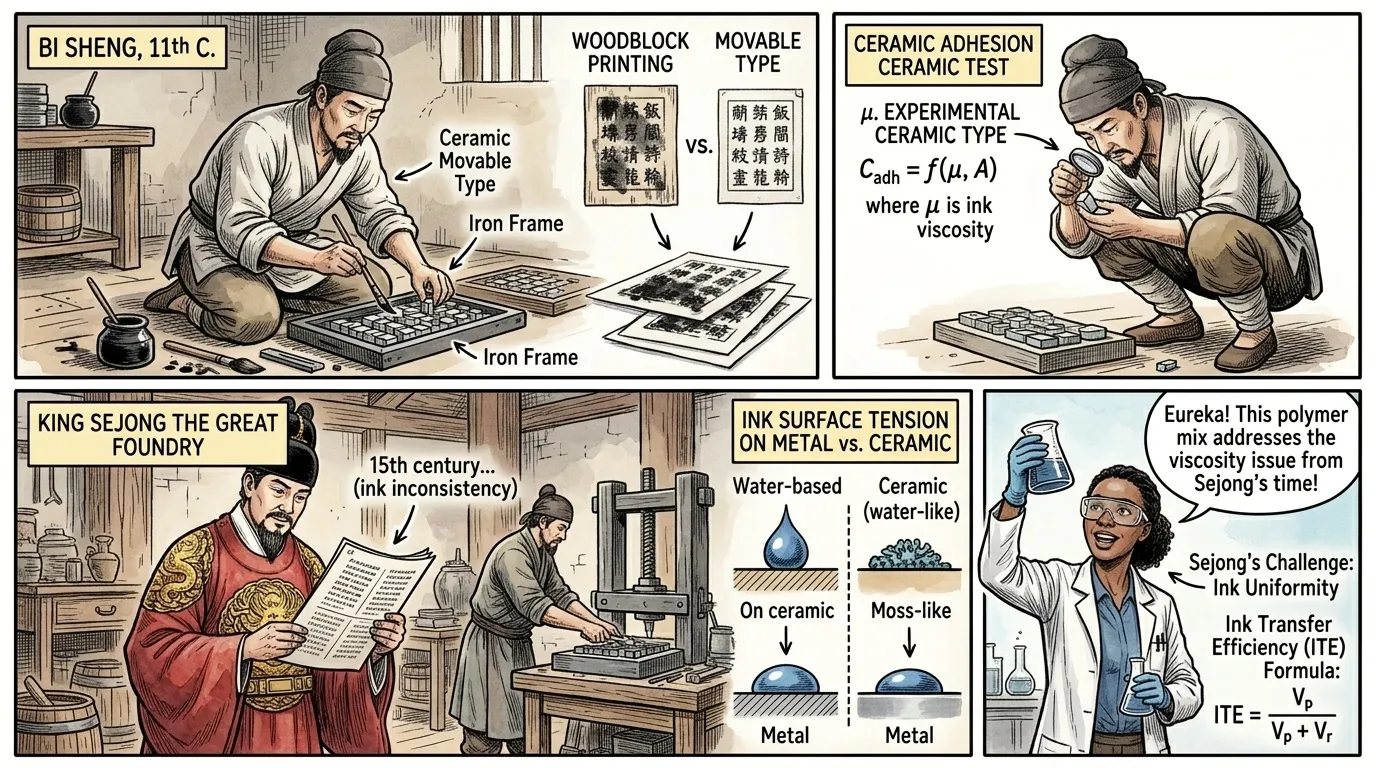
While Europeans struggled with hand-copied manuscripts, rudimentary printing techniques had long existed in East Asia. Woodblock printing, which emerged centuries earlier, employed a simpler, often water-based ink that was dabbed onto carved wooden blocks. This method, while a step forward, still presented challenges with ink consistency and adhesion, often resulting in blurred or uneven prints. The transition to movable metal type in the West demanded an even greater leap in ink technology.
"The Chinese printer Bi Sheng's innovation of movable type in the 11th century, although not widely adopted with his ceramic types, highlighted the potential. Later, King Sejong the Great of Korea oversaw the development of cast metal type in the early 15th century. A chronicler observing these processes might remark: "To replicate text swiftly and clearly, the ink must cling to the characters like moss to stone, yet release as readily as breath on a winter's morn." This desire for both adherence and clean release would define Gutenberg's quest."
Page 4
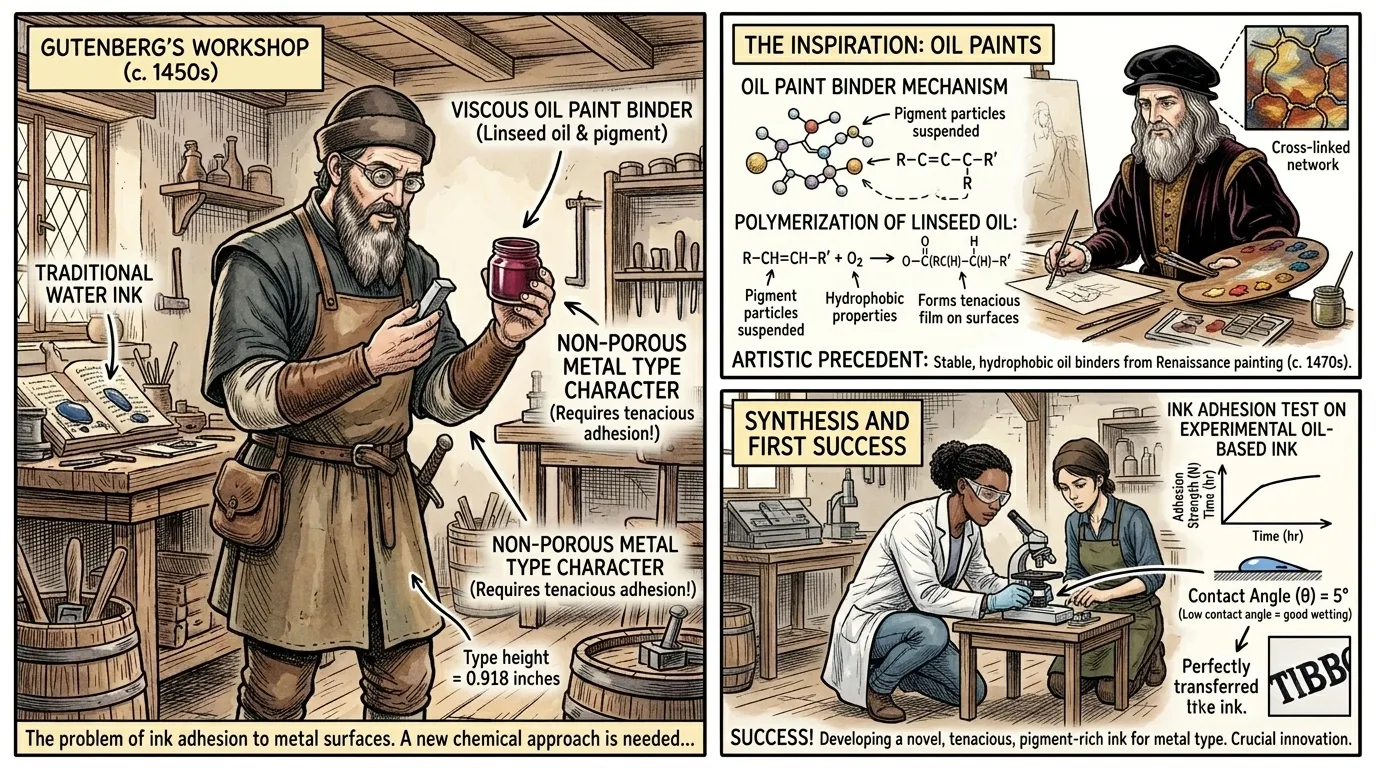
Johannes Gutenberg, himself a goldsmith by trade, was acutely aware of material properties. He understood that metal type, unlike absorbent woodblocks or paper, required an ink that would cling to its non-porous surface. Traditional water-based inks simply beaded up or slid off, yielding no clean transfer. His challenge was immense: how to create a substance that was liquid enough to be applied, viscous enough to stay put, and permanent enough to endure.
"His stroke of genius came from an unlikely source: oil painting. Renaissance artists had already mastered the art of creating durable pigments suspended in drying oils for canvases. 'The problem is not the pigment itself,' Gutenberg might have mused, examining a sample of lampblack, 'but the carrier.' As Leonardo da Vinci, a contemporary figure, famously declared, 'Study the science of art. Study the art of science. Develop your senses – especially learn how to see.' Gutenberg's solution lay in truly 'seeing' the potential of an entirely different chemical foundation for his ink, one that would revolutionize communication."
Page 5
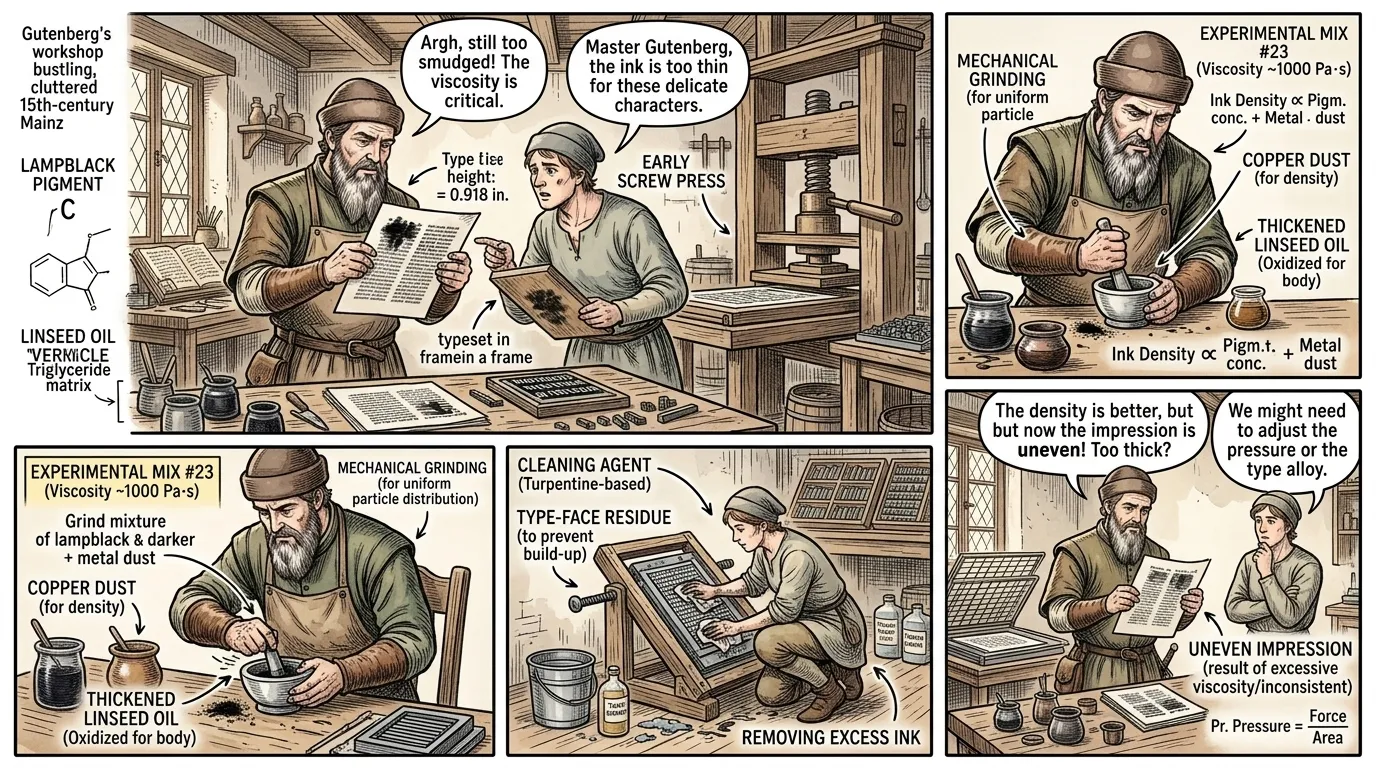
Gutenberg's initial forays into oil-based inks were far from perfect. He experimented with different lampblacks—fine soot collected from burning oils or resins—and various oils as binders. Early mixtures were often too thin, spreading uncontrollably and blurring the meticulously cast letters. Others were too thick, clinging stubbornly to the type and refusing to transfer completely to the paper, leaving gaps or uneven impressions. Each failure brought him closer to understanding the critical balance required.
"The exact 'recipe' for Gutenberg's ink was a closely guarded secret, but it involved painstaking adjustment of ingredients. A hypothetical assistant might have observed: "Master, this batch clings too much, yet the last bled like a wound! There must be a perfect measure." Indeed, the pursuit of optimal viscosity, drying time, and adherence was a grueling process of elimination. As the philosopher Karl Popper eloquently put it: "The only way to learn to do science is to do science." Gutenberg's workshop was a testament to empirical, iterative experimentation."
Page 6
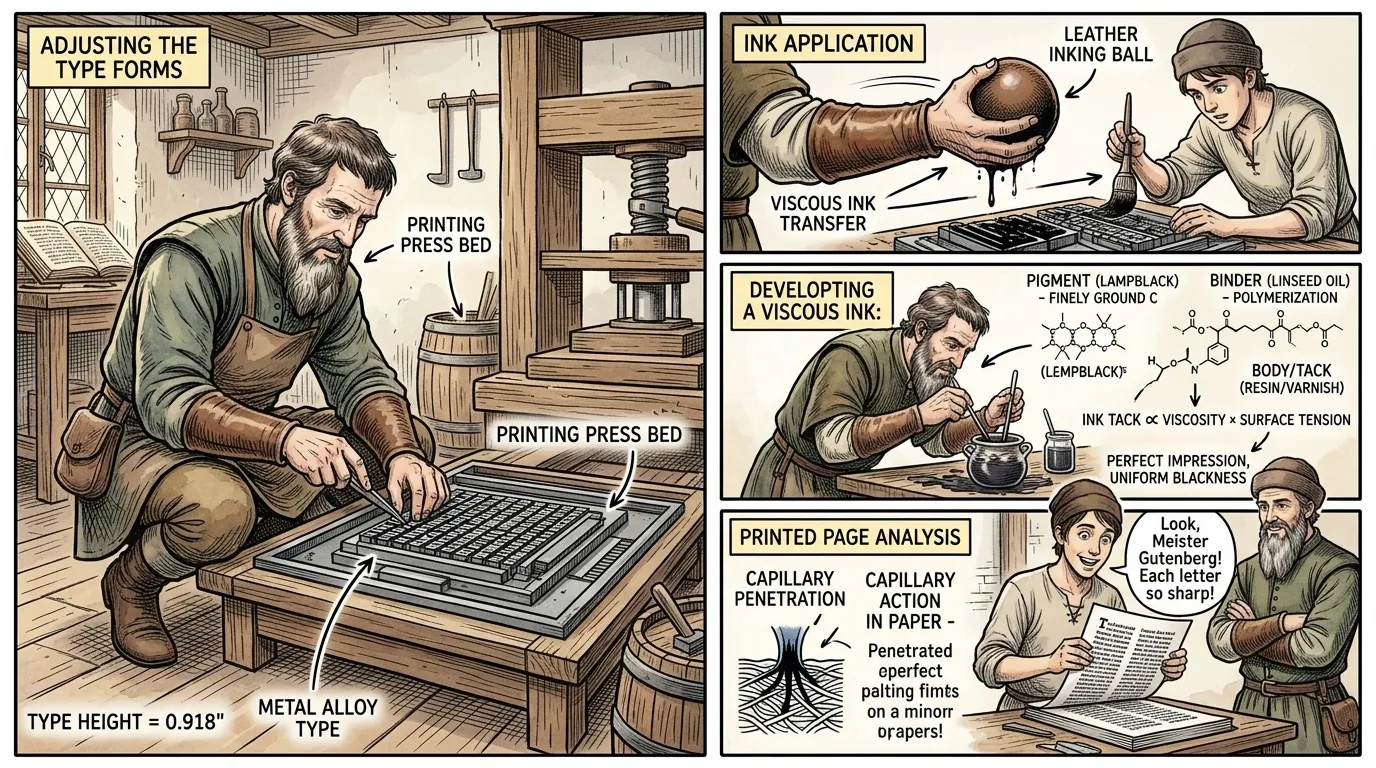
Gutenberg's ultimate breakthrough lay in creating a printing ink that was fundamentally different from any writing ink. He developed a highly viscous, oil-based formula combining three key components: finely ground lampblack pigment for deep color, linseed oil (a 'drying oil') as a binder, and a resin or varnish for body and tack. This ingenious mixture allowed the ink to sit on the surface of the metal type, rather than being absorbed into it, providing a consistent, sharp impression.
"This innovation was revolutionary. The ink's 'tack' — its stickiness — was crucial. It meant the ink would readily transfer from the metal type to the paper under pressure, but then release cleanly. The linseed oil, when exposed to air, would undergo a process called polymerization, gradually hardening and drying to a durable, permanent film. An amazed apprentice observing the first successful print might exclaim, 'It clings so perfectly to the type, yet leaves the paper so clean and bold!' This balance transformed the potential of the press. As physicist and philosopher Ernst Mach noted, 'The goal which is aimed at by the physical investigator is not the actual drawing of a picture of the world, but the production of a symbolical representation of it.' Gutenberg's ink was precisely that: a symbolic representation, perfectly rendered."
Page 7
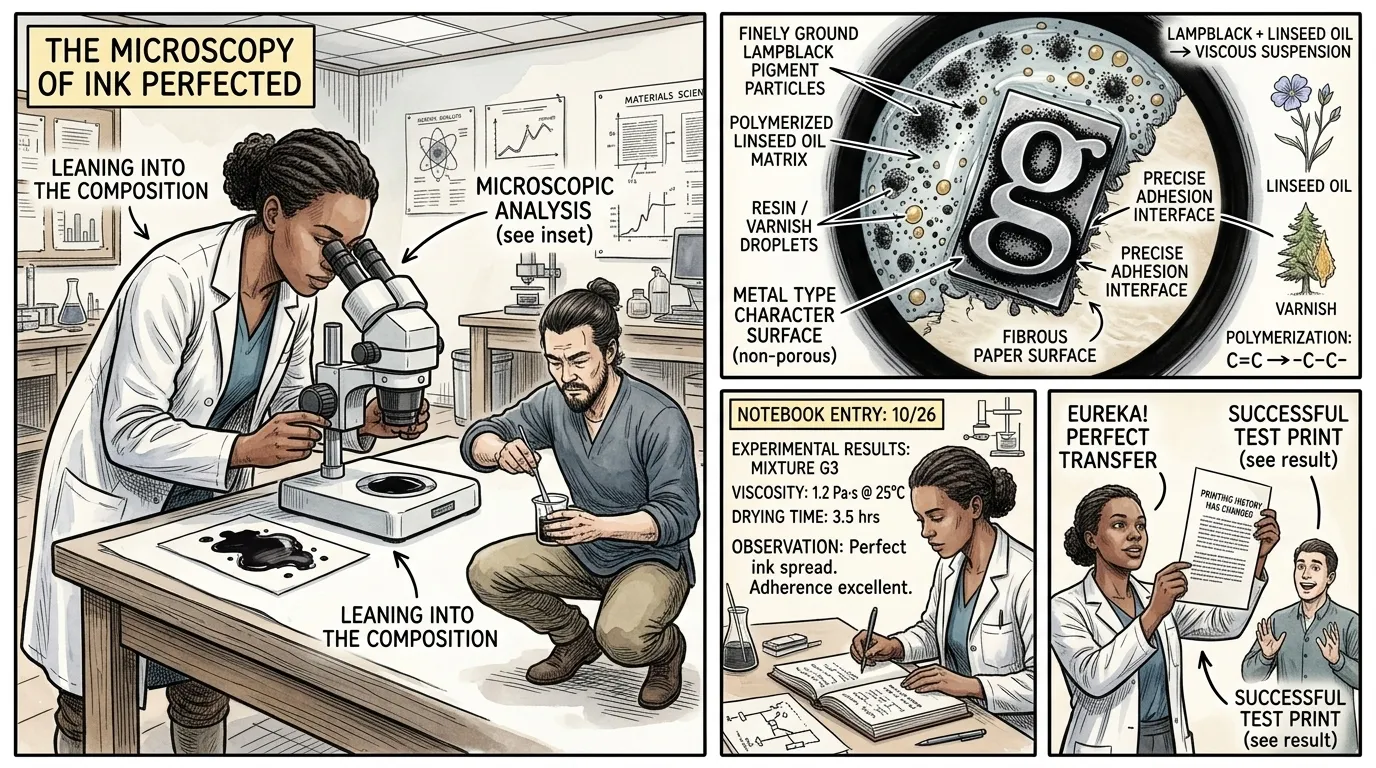
The genius of Gutenberg's ink lay in its precise chemical composition and the interplay of its components. Lampblack, a pure carbon pigment, provided unparalleled depth and lightfastness, ensuring the printed text would remain dark and legible for centuries. The linseed oil, specially treated (often boiled and aged) to achieve the desired viscosity and drying characteristics, acted as a powerful binder. Unlike water, oil did not saturate the paper fibers but rather coated them, allowing for sharp edges.
"The addition of resin or varnish, likely derived from pine sap, provided crucial 'tack' and body, preventing the ink from blurring or smudging during the printing process. This complex interaction meant the ink could be evenly distributed across the type and then cleanly released onto the paper. It was a chemical triumph. As the great chemist Antoine Lavoisier famously stated, 'Nothing is lost, nothing is created, everything is transformed.' In Gutenberg's ink, simple components were transformed into a medium capable of revolutionizing the human experience by giving permanence to thought and word."
Page 8
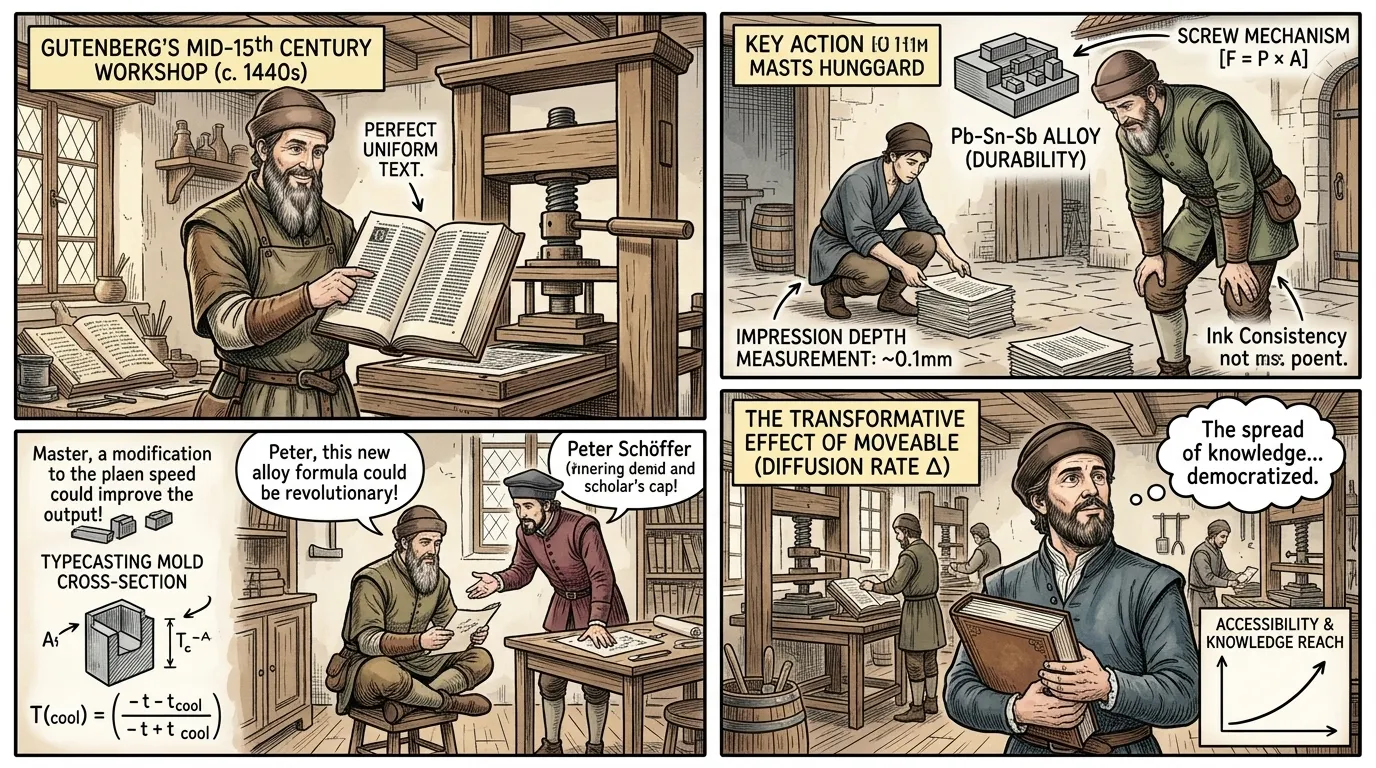
With his perfected printing press and revolutionary oil-based ink, Johannes Gutenberg embarked on his most ambitious project: the printing of the Bible. Completed around 1455, the Gutenberg Bible was a masterpiece of typography and ink application, setting an unprecedented standard for quality. Each page showcased uniform, deep black text that was both beautiful and durable, proving the efficacy of his entire system. The creation of such a monumental work marked a pivotal moment in human history, heralding an age of unprecedented information exchange.
"The success of the Gutenberg Bible demonstrated that complex, high-quality texts could be mass-produced, something previously unimaginable. This innovation rapidly spread across Europe, driving down the cost of books and democratizing access to knowledge. Reflecting on this profound shift, Peter Schöffer, Gutenberg's apprentice who later became a prominent printer, or perhaps a contemporary observer, famously proclaimed: "What the hammer, the forge, and the press are to the human body, the press, the ink, and the paper are to the human mind." This quote encapsulates the transformative power unleashed by Gutenberg's ink, an invention that literally put ideas into the hands of many."
Page 9
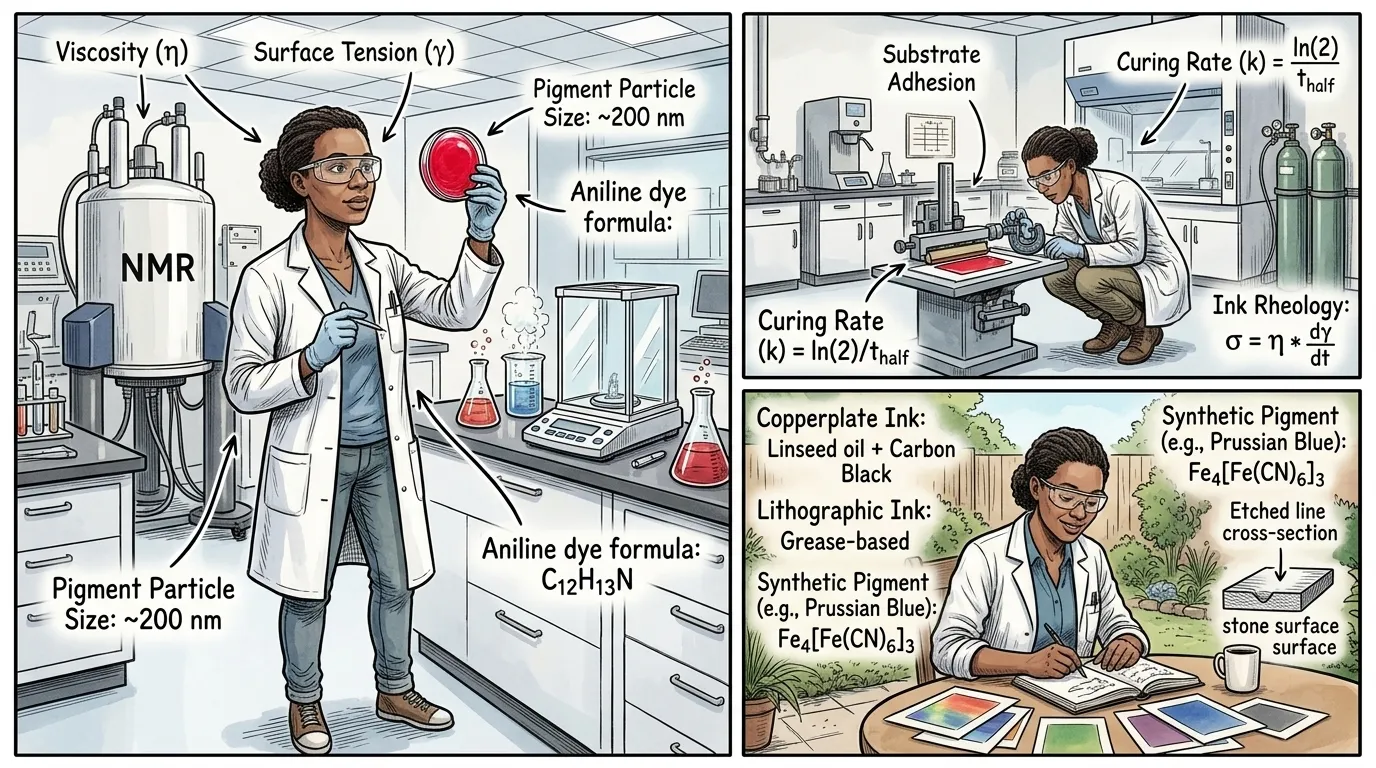
Following Gutenberg's foundational achievement, printing ink continued its evolutionary journey. As new printing techniques emerged, from copperplate engraving to lithography and eventually rotary presses, ink formulations adapted. The demand for color saw the introduction of new pigments derived from minerals and plants, expanding the printer's palette beyond basic black and red. The Industrial Revolution brought faster presses and cheaper paper, necessitating inks that dried even more rapidly without smudging, and adhered to diverse surfaces.
"The development of aniline dyes in the 19th century and synthetic pigments in the 20th century further revolutionized ink color and stability. The needs of newspapers for high-speed, inexpensive printing led to newsprint inks, while fine art books demanded archival quality. A modern materials scientist, reflecting on this ongoing adaptation, might assert: 'Every substrate, every speed, every desired property demands a unique molecular dialogue between pigment, binder, and additive. The quest for the perfect ink is endless, a continuous refinement of chemistry and application.' This continuous innovation underscores the dynamism of ink science, constantly pushing boundaries. As American poet Ralph Waldo Emerson wrote, 'Speech is power: speech is to persuade, to convert, to compel.' Printing ink, in all its forms, continues to be an essential tool in this powerful process."
Page 10

Today, printing ink is far more than just black pigment and oil. It is a sophisticated chemical marvel, integral to virtually every aspect of modern life. From the dense text of a legal document to the vibrant graphics on consumer packaging, the security features on currency, and the conductive traces in advanced electronics, ink plays a silent, yet indispensable, role. Its enduring legacy is a testament to Gutenberg's original insight: that information needs a perfect, permanent medium to truly transform the world.
"The principles established over five centuries ago — the careful selection of pigments, the precise chemistry of binders, and the engineering of application — continue to guide ink development. From traditional publishing to cutting-edge functional applications like smart packaging and biomedical sensors, ink remains a frontier of materials science. 'The whole art of teaching is only the art of awakening the natural curiosity of young minds,' observed Anatole France. Printing ink, in its myriad forms, has been and continues to be the silent, yet most potent, tool in awakening, preserving, and sharing human knowledge across generations, fundamentally shaping our informed world."
About this story
- Location: Global
- Audience: general readers
Read Wonder Inventions on your phone
Wonder Inventions is available on Android. Get Wonder Inventions on Google Play.