Dmitri Mendeleev
Dmitri Mendeleev — an illustrated biography story, set in Global. 10 illustrated pages, free to read on Wonder People.
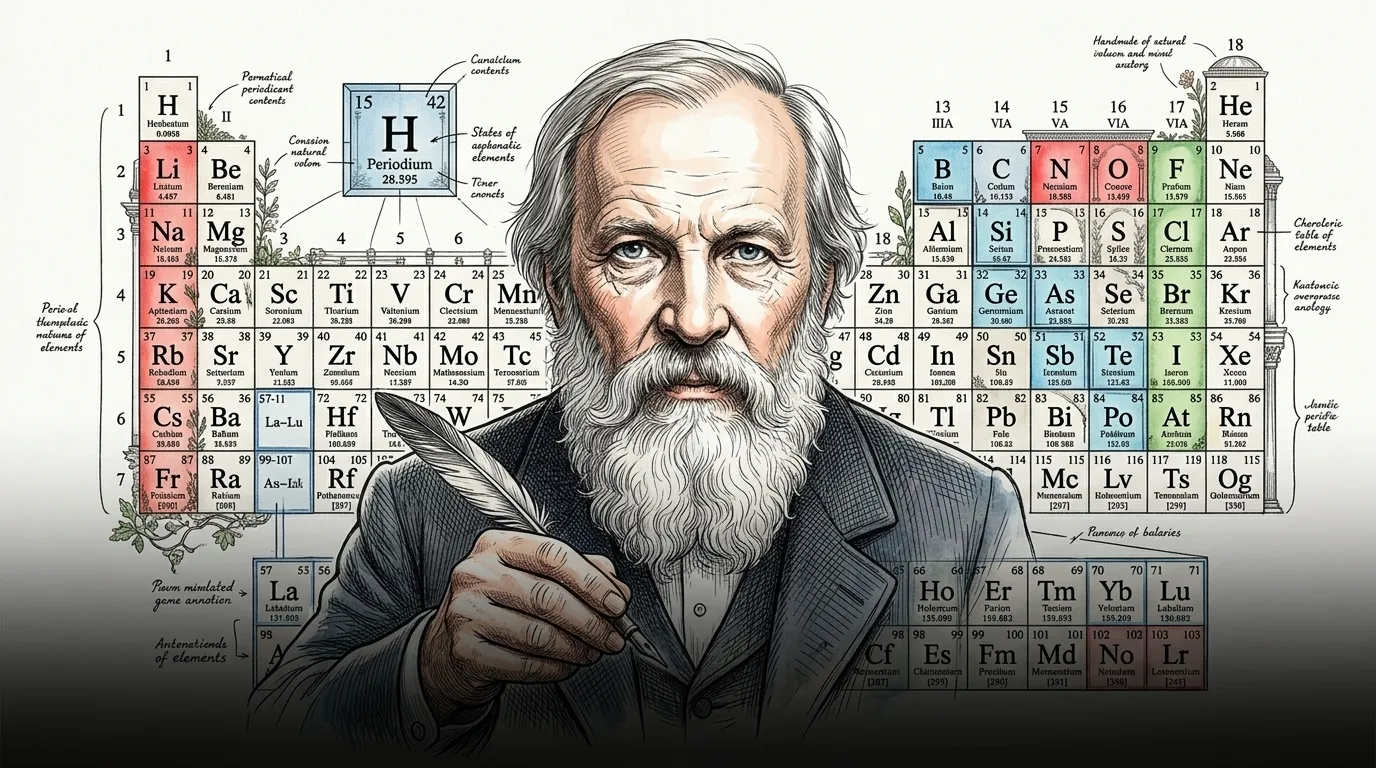
Page 1
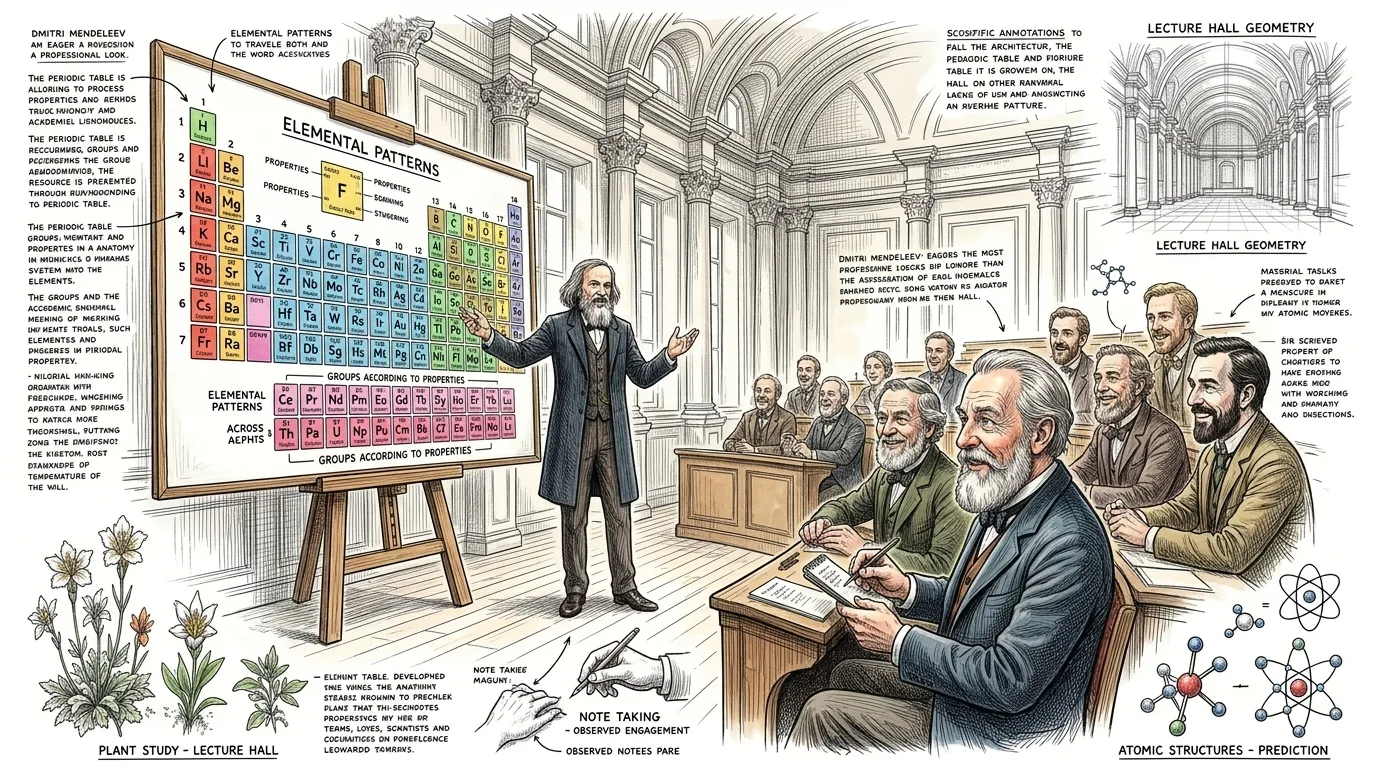
In the bustling intellectual hub of Saint Petersburg, Russia, in 1869, a quiet revolution took hold. Before a gathering of esteemed scientists, including the venerable President of the Russian Chemical Society, Nikolai Zinin, Dmitri Mendeleev presented a paradigm-shifting construct. His meticulously arranged Periodic Table, detailing 63 known elements, not only brought order to chaos but audaciously predicted the existence and precise properties of new, undiscovered elements. The scientific world would never again view matter the same way; in this moment, the architecture of the universe began to yield its secrets to one man's vision.
Biographical Fact: Event: Dmitri Mendeleev presents the first draft of the Periodic Table to the Russian Chemical Society. Location: University of Saint Petersburg, Russia. Year: 1869. Key achievement: Organized 63 elements and predicted unknown ones.
Page 2

Dmitri Mendeleev's journey began far from academic grandeur, in Tobolsk, Siberia. Born into a large family, his early life was marked by hardship: his father's blindness and eventual death, followed by the devastating fire that destroyed his mother's glass factory. Yet, his mother, Maria Dmitrievna Mendeleeva, recognized his extraordinary intellect. Driven by an unwavering conviction in her youngest son's potential, she embarked on an arduous 1,500-mile journey across Russia, bringing him to Saint Petersburg and Moscow, solely to secure his higher education. This profound maternal sacrifice ignited a lifelong intellectual fire within Mendeleev, shaping his resolve.
Biographical Fact: Event: Young Dmitri Mendeleev travels with his mother from Siberia to Saint Petersburg to pursue higher education, following family hardship. Period: Mid-1840s.
Page 3
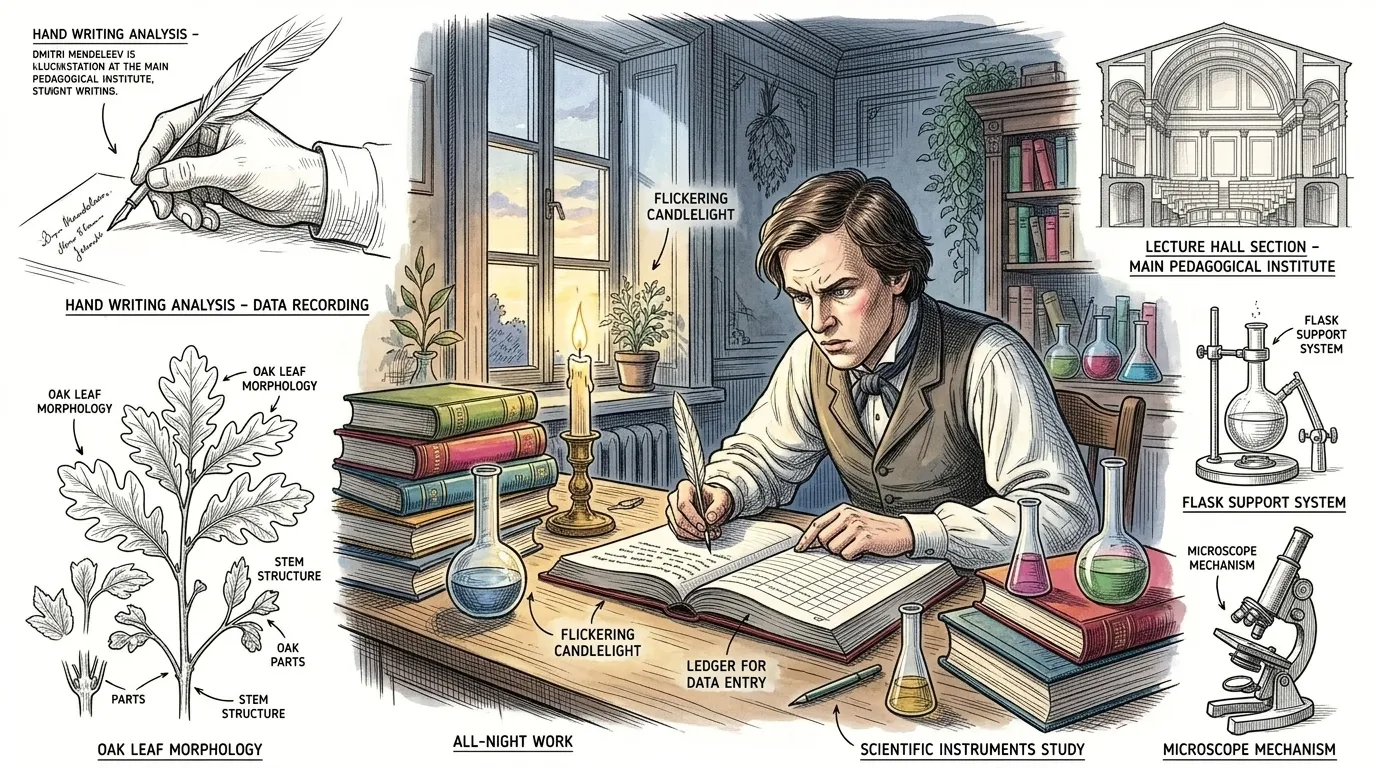
Entering the Main Pedagogical Institute in Saint Petersburg, Mendeleev faced new challenges. Despite bouts of tuberculosis and meager funds, his voracious appetite for knowledge drove him. He immersed himself in scientific study, often working through the night, challenging established theories and engaging in vigorous debate with his peers and professors. This period forged his analytical prowess and cemented his reputation as a formidable intellect. He did not merely absorb information; he interrogated it, laying the groundwork for a career defined by questioning the fundamental order of the natural world.
Biographical Fact: Event: Dmitri Mendeleev intensely studies at the Main Pedagogical Institute, Saint Petersburg, developing his scientific foundation amidst personal hardship. Period: Early 1850s.
Page 4
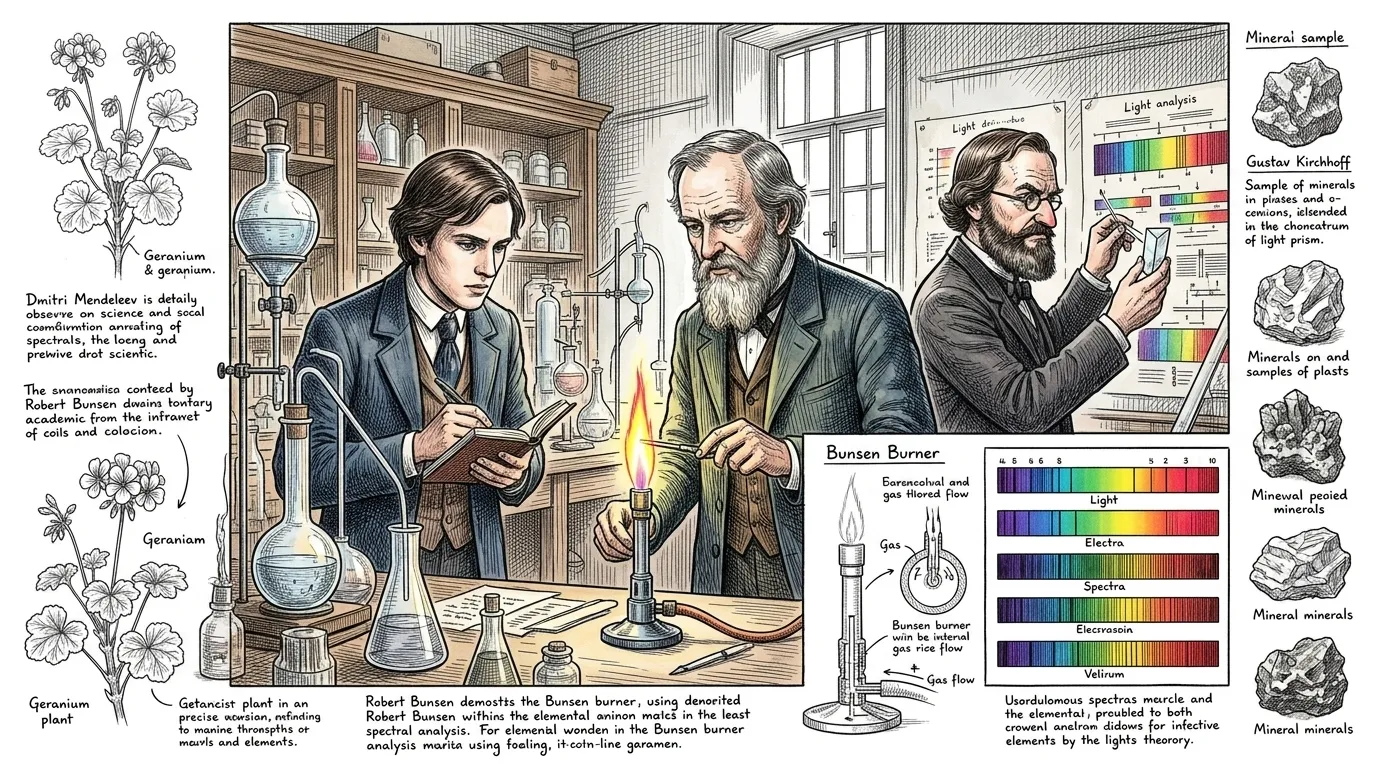
A fellowship allowed Mendeleev to travel to Germany, where he spent two formative years in Heidelberg. There, he worked in the laboratories of leading chemists like Robert Bunsen and Gustav Kirchhoff, absorbing the cutting-edge developments in spectroscopy and atomic theory. He engaged in rigorous experimentation, witnessed the first applications of spectral analysis to identify elements, and synthesized new organic compounds. This international exposure was critical, broadening his perspective beyond Russian academic traditions and equipping him with the latest empirical data and theoretical frameworks necessary for his future groundbreaking work.
Biographical Fact: Event: Dmitri Mendeleev conducts research and learns new techniques in European laboratories, engaging with leading chemists like Robert Bunsen and Gustav Kirchhoff. Location: Heidelberg, Germany. Period: Late 1850s/early 1860s.
Page 5
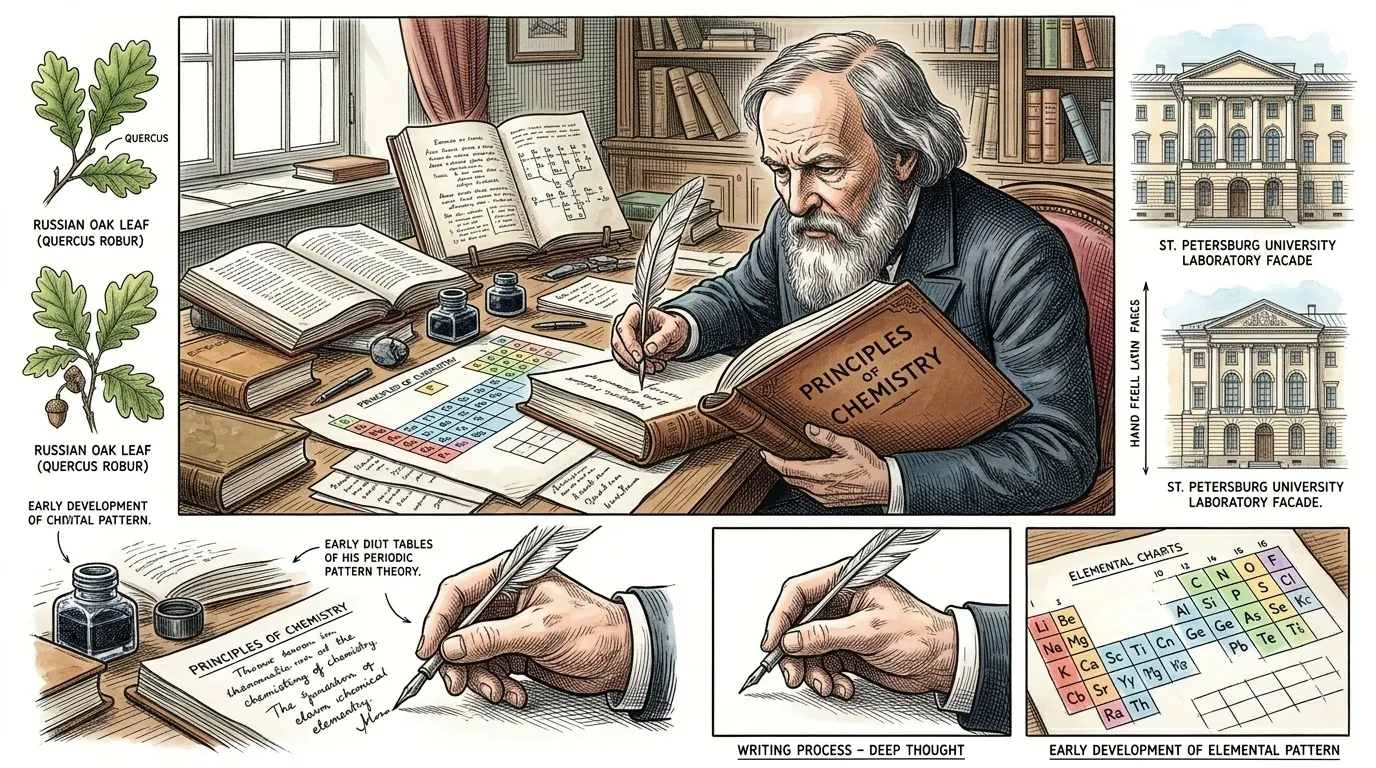
Upon his return to Saint Petersburg and appointment as professor, Mendeleev faced a stark reality: the lack of a modern, comprehensive chemistry textbook in Russian. This deficiency spurred him to write his own, 'Principles of Chemistry,' intended to rationalize the vast and often disorganized body of chemical knowledge for his students. As he meticulously compiled and explained each element, he found himself grappling with their relationships. This act of pedagogical organization became the crucible where his revolutionary ideas on elemental periodicity began to coalesce, forcing him to confront the underlying order of nature that other chemists had overlooked.
Biographical Fact: Event: Dmitri Mendeleev begins writing his comprehensive textbook, 'Principles of Chemistry,' an endeavor that forces him to organize elemental knowledge and reveals underlying patterns. Location: His study in Saint Petersburg. Period: Late 1860s.
Page 6
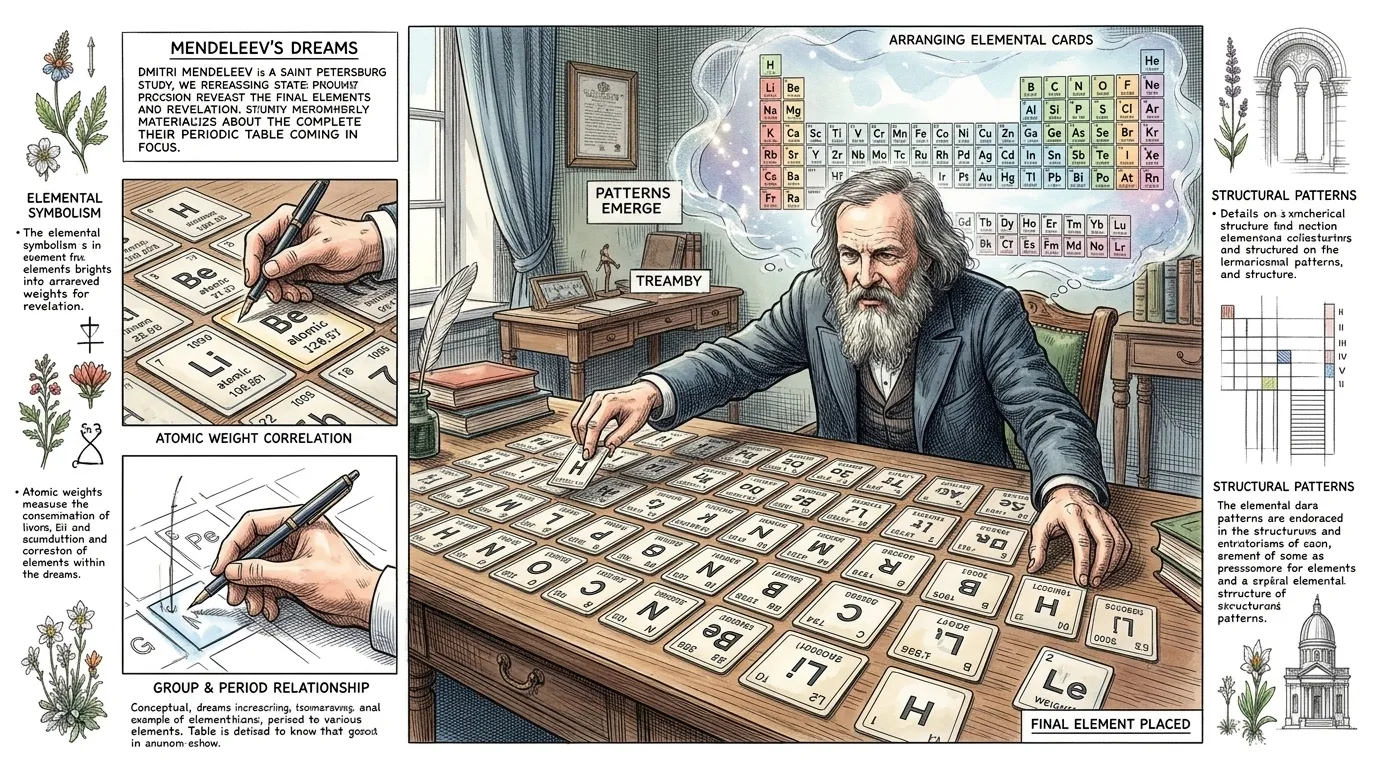
The challenge of organizing the elements weighed heavily on Mendeleev. The sheer volume of data, the varying atomic weights, and the elusive patterns consumed him. Then, on a cold February day in 1869, exhausted from his labors, he drifted into a dream. In this visionary state, he saw all the elements fall into place, arranged in rows and columns according to their properties and atomic weights. Waking with a start, he immediately transcribed this structure onto cards, playing 'chemical solitaire' at his desk, solidifying the layout that had appeared to him. This moment of profound insight, combining diligent work with intuitive leap, marked the birth of the Periodic Table.
Biographical Fact: Event: Mendeleev experiences a breakthrough dream, arranging elements on cards according to their atomic weights and properties, forming the basis of the Periodic Table. Location: His study in Saint Petersburg. Date: February 17, 1869 (Gregorian).
Page 7
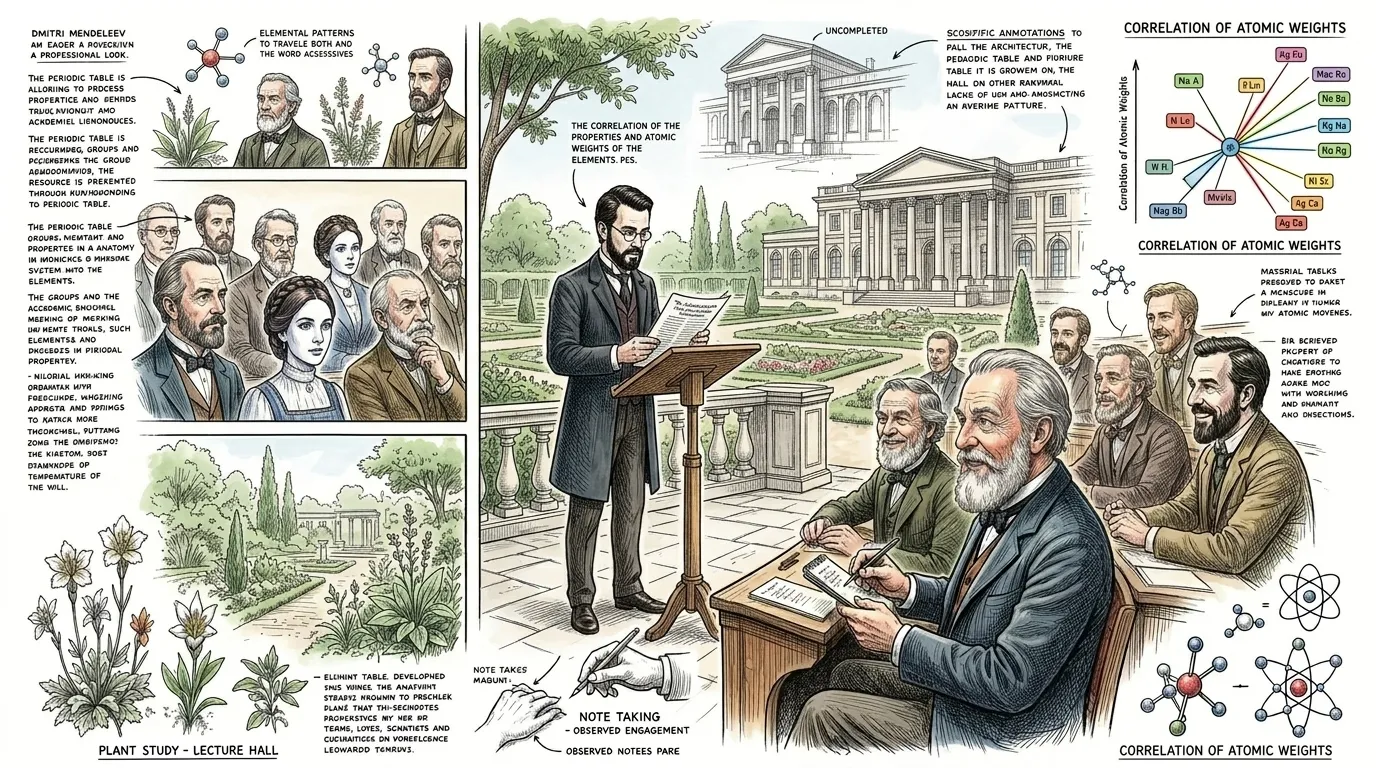
Though the full weight of his discovery was profound, Mendeleev was too ill to personally present his findings to the Russian Chemical Society. Instead, on March 6, 1869, he entrusted his paper, 'The Correlation of the Properties and Atomic Weights of the Elements,' to his colleague, Professor Nikolai Menshutkin. Menshutkin read Mendeleev's revolutionary proposal, introducing the concept of periodicity to a gathering of skeptical but intrigued minds. It was a quieter introduction than the full unveiling, but it served as the critical first step in disseminating his ideas, setting the stage for the dramatic validation that would follow.
Biographical Fact: Event: Professor Nikolai Menshutkin reads Dmitri Mendeleev's paper on elemental periodicity to the Russian Chemical Society, marking the first public presentation of the concept. Location: Russian Chemical Society meeting, Saint Petersburg. Date: March 6, 1869.
Page 8
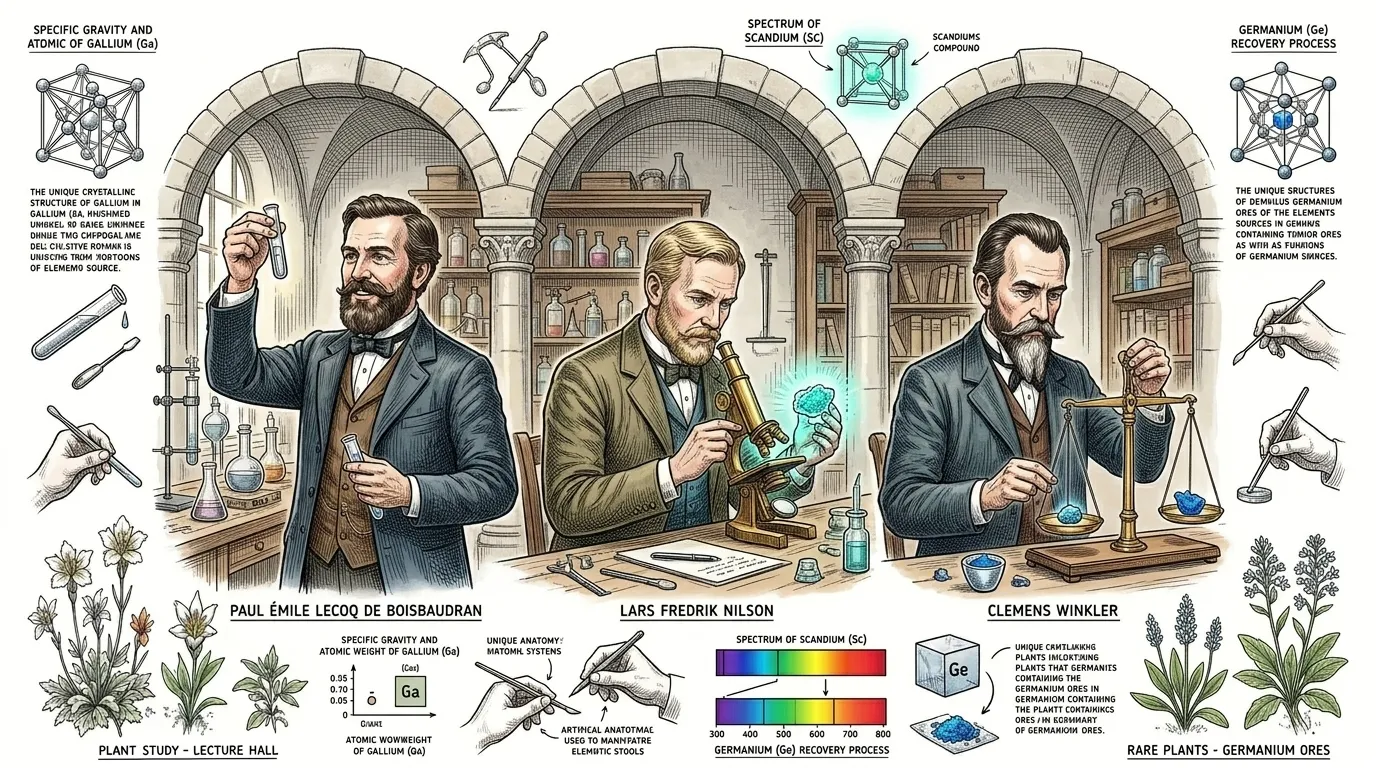
For years, Mendeleev's table was admired but not universally accepted. The true validation arrived with the discovery of three new elements: Gallium in 1875 by Paul Émile Lecoq de Boisbaudran, Scandium in 1879 by Lars Fredrik Nilson, and Germanium in 1886 by Clemens Winkler. Each time, their atomic weights and, crucially, their chemical properties precisely matched Mendeleev's bold predictions for 'eka-aluminum,' 'eka-boron,' and 'eka-silicon.' These discoveries were not mere additions; they were concrete proof of the Periodic Table's predictive power, transforming skepticism into widespread scientific acceptance and solidifying Mendeleev's genius.
Biographical Fact: Event: The discovery and verification of Gallium (1875), Scandium (1879), and Germanium (1886) confirm Mendeleev's predictions, securing the Periodic Table's scientific acceptance. Location: Various European laboratories. Period: 1870s-1880s.
Page 9
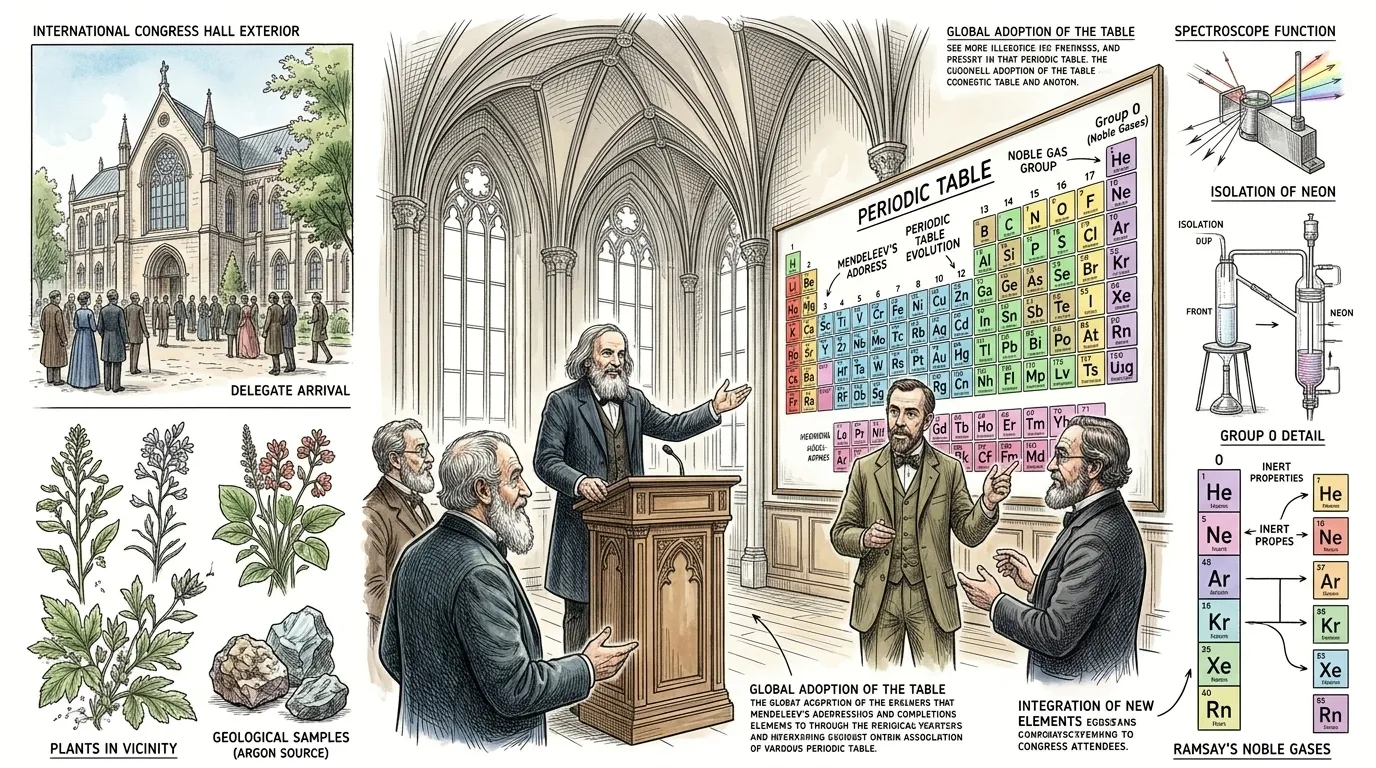
With the validation of his predictions, the Periodic Table rapidly gained international recognition, becoming the fundamental organizing principle of chemistry. Mendeleev traveled extensively, lecturing at prestigious institutions and attending international conferences where his work was celebrated. While he steadfastly defended his original framework, he also witnessed its evolution, notably the integration of new element groups like the noble gases by Sir William Ramsay. The table became a living document, adapting to new discoveries and perpetually guiding chemists worldwide, a testament to its enduring power and the robust elegance of Mendeleev's initial vision.
Biographical Fact: Event: Mendeleev engages with the international scientific community, witnessing the global adoption and refinement of his Periodic Table, including the integration of new elements like the noble gases. Location: International scientific congress, likely London or Paris. Period: 1880s-1890s.
Page 10

Dmitri Mendeleev passed in 1907, but his legacy transcended his lifetime. His Periodic Table remains the bedrock of chemistry, an indispensable tool for students, researchers, and industries worldwide. It is a testament to the power of observation, logical deduction, and a fearless willingness to predict the unknown. In 1955, his profound impact was permanently etched into the scientific lexicon with the naming of element 101, Mendelevium (Md), an honor reserved for a select few who fundamentally reshape human understanding. His vision continues to light the path for new discoveries, an eternal framework for the elements that compose our universe.
Biographical Fact: Event: Mendeleev's lasting legacy is visualized through the ubiquitous presence of the Periodic Table in modern science and the naming of element 101, Mendelevium (Md), in his honor. Period: Modern day, referencing historical impact.
About this story
- Location: Global
- Audience: general readers
Questions and answers
Read Wonder People on your phone
Wonder People is available on Android. Get Wonder People on Google Play.