Eli Whitney
Eli Whitney — an illustrated biography story, set in Global. 10 illustrated pages, free to read on Wonder People.
Page 1
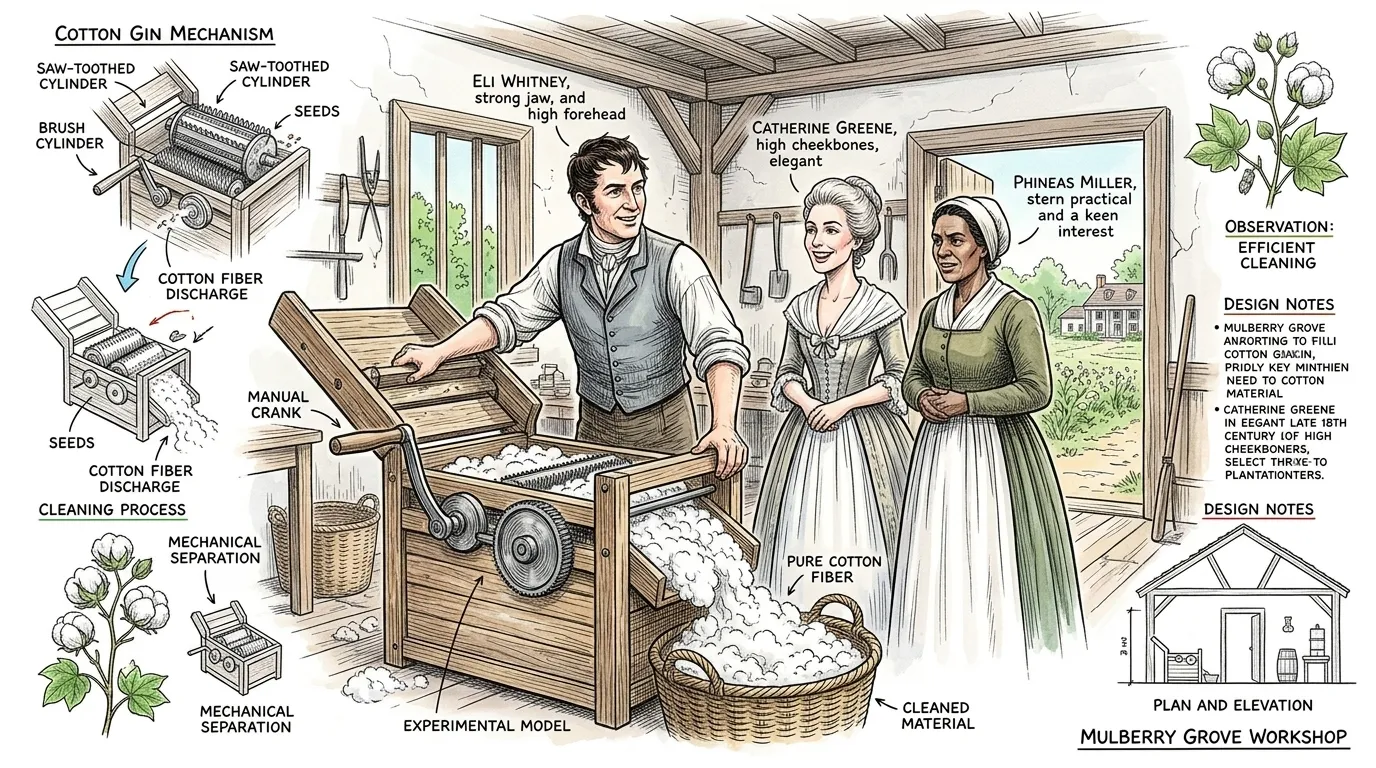
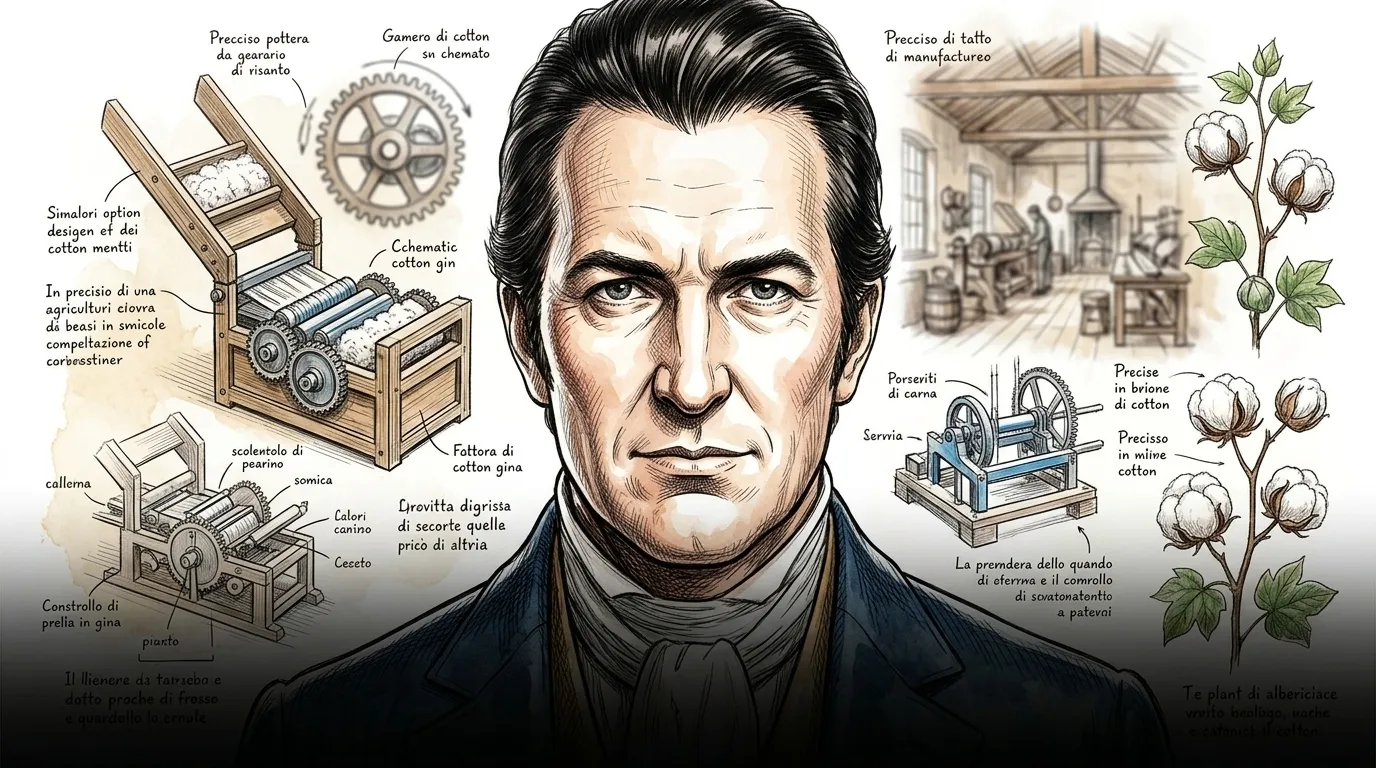
At Mulberry Grove Plantation, Georgia, in the autumn of 1793, Eli Whitney finally revealed his innovation. Before Catherine Greene, the plantation proprietress, and her manager Phineas Miller, Whitney demonstrated the machine that could separate short-staple cotton fiber from its tenacious seeds with unprecedented speed. What once required hours of human labor for a single pound, his 'cotton gin' now processed up to fifty pounds a day, transforming the future of American agriculture in a single, decisive moment.
Biographical Fact: Mulberry Grove Plantation, Georgia, 1793. Eli Whitney's cotton gin processed cotton 50 times faster than manual labor.
Page 2
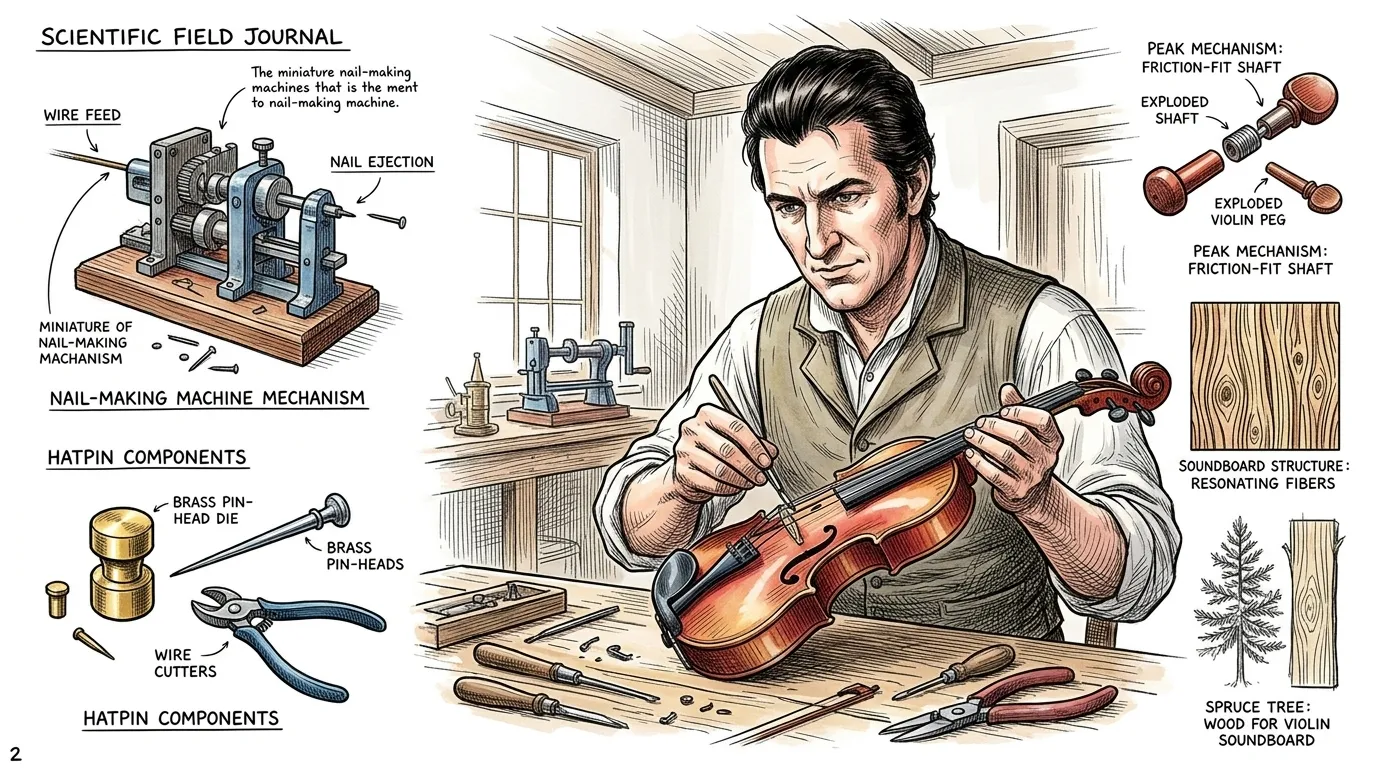
Born in Westborough, Massachusetts, in 1765, Eli Whitney displayed an uncanny aptitude for mechanics from a young age. While still a boy, he independently repaired a violin, then built a nail-making machine and a device for manufacturing hatpins. His father, a prosperous farmer, provided access to a workshop and tools, fostering an environment where young Eli's innate curiosity found practical outlets, revealing a prodigious talent for deconstructing and improving complex systems.
Biographical Fact: Westborough, Massachusetts, circa 1777. Young Eli Whitney demonstrated early mechanical genius, building machines and repairing instruments.
Page 3
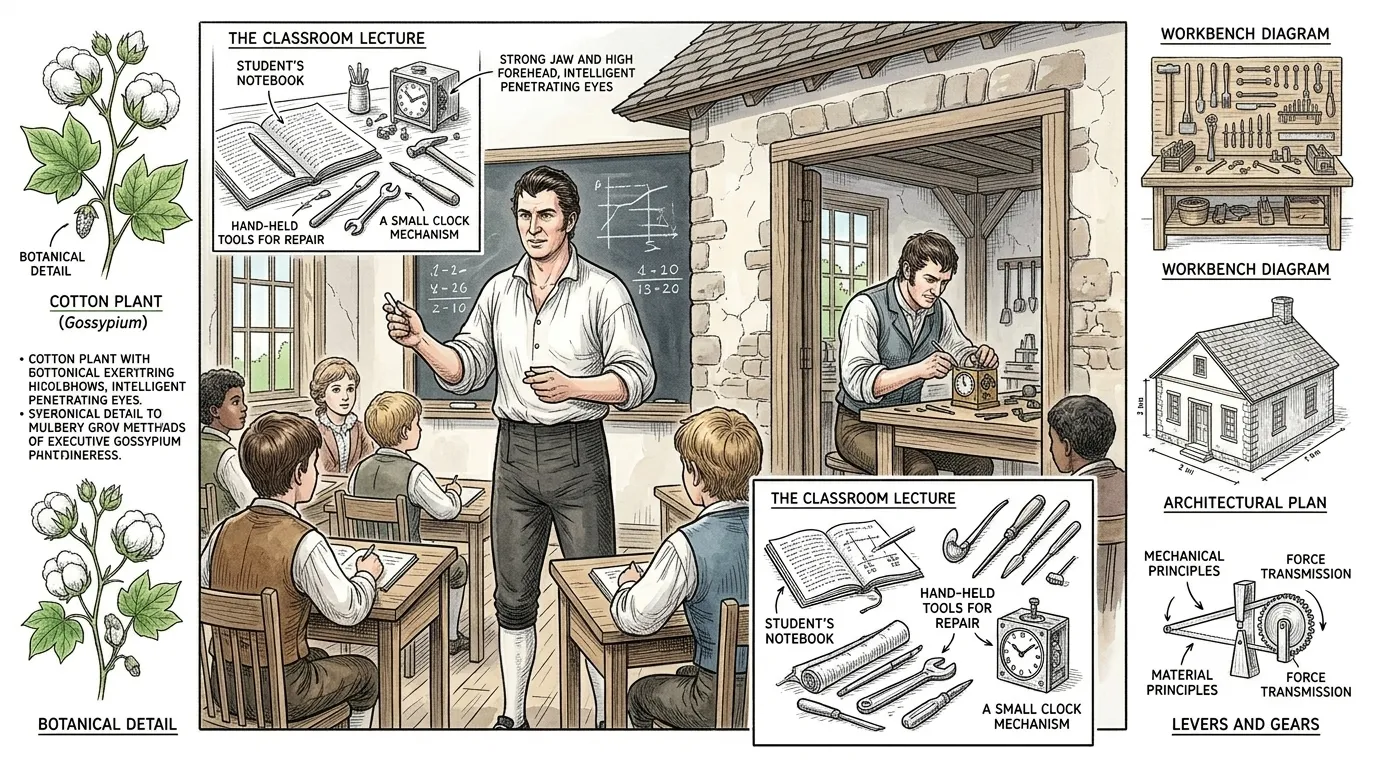
Despite his mechanical genius, Whitney's ambition stretched beyond the workshop to intellectual pursuits. At twenty-three, he resolved to attend Yale College, a decision that plunged him into financial precarity. To fund his education, he worked relentlessly as a schoolteacher and a mechanic, applying his practical skills to earn the necessary tuition. This period forged his resilience, instilling a deep understanding of hard work and resourcefulness, fundamental to his later achievements.
Biographical Fact: New Haven, Connecticut, late 1780s. Eli Whitney self-funded his Yale education through teaching and mechanical work, shaping his resolve.
Page 4
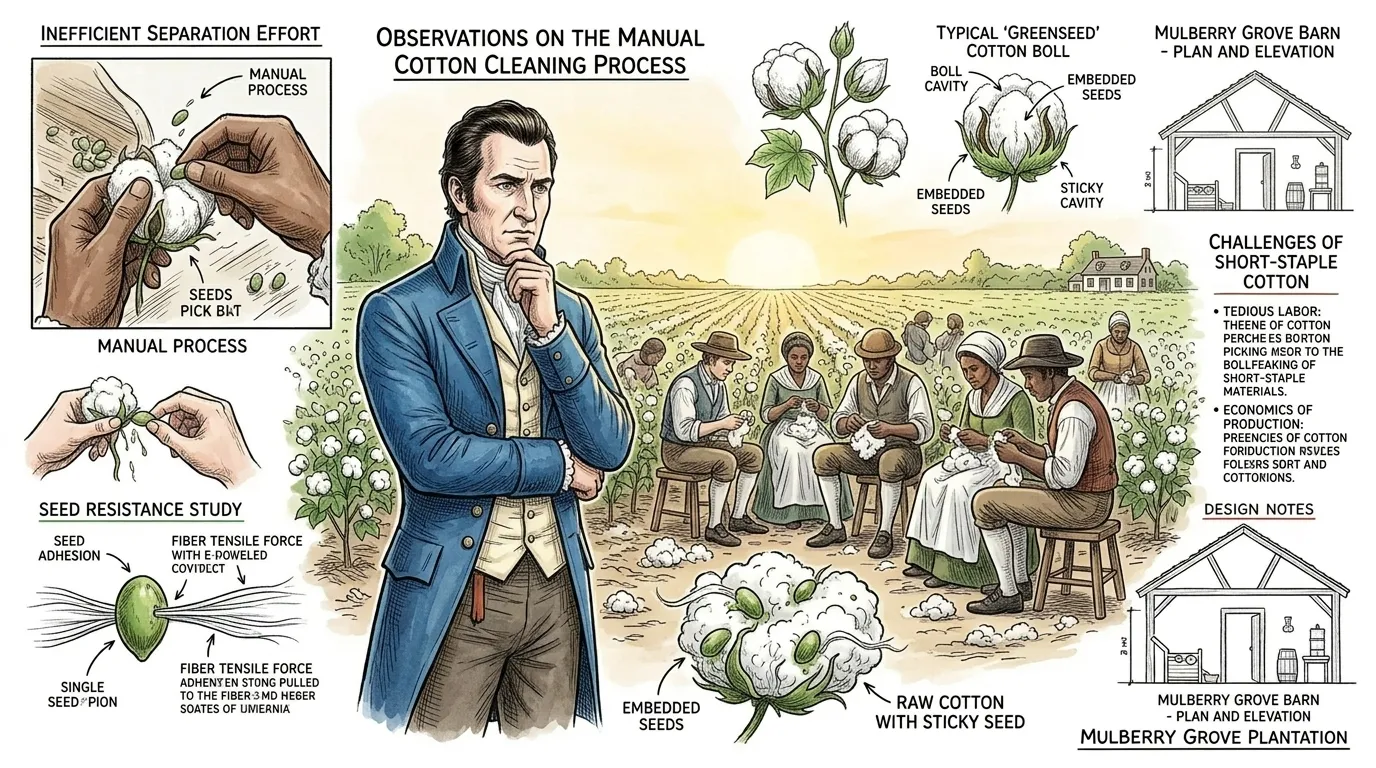
Upon graduating from Yale in 1792, Whitney traveled south, accepting a tutoring position at Catherine Greene's Mulberry Grove. There, he witnessed the core economic dilemma of the South: while long-staple cotton was easy to process, its cultivation was limited to coastal islands. The more widespread short-staple cotton, with its sticky, green seeds, required agonizing hours of manual separation, rendering large-scale cultivation economically unfeasible and tying the region to immense, inefficient labor.
Biographical Fact: Mulberry Grove Plantation, Georgia, 1792. Eli Whitney observed the arduous process of separating short-staple cotton, a critical agricultural bottleneck.
Page 5
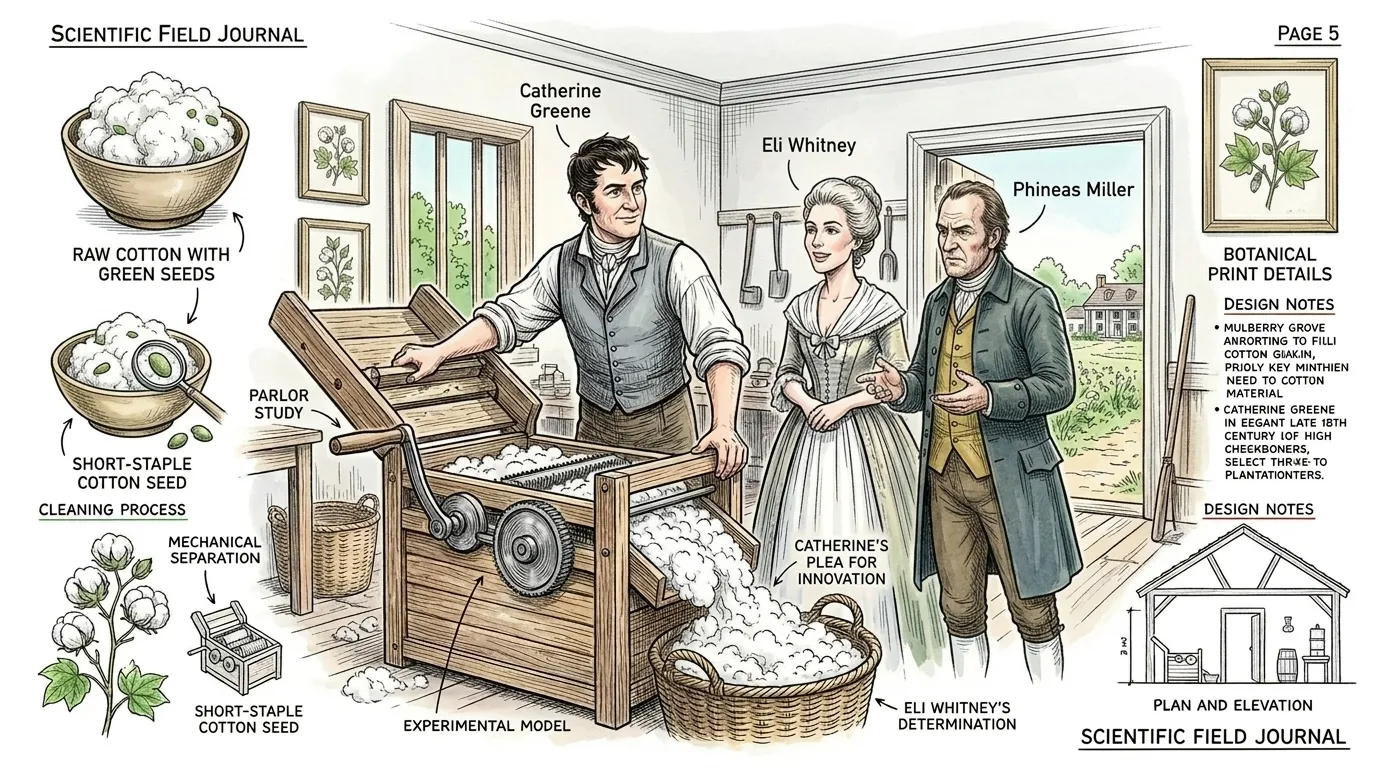
Catherine Greene, recognizing Whitney's ingenuity, presented him with the challenge directly: to create a machine that could efficiently clean short-staple cotton. Phineas Miller, her business partner, seconded the plea, emphasizing the immense economic opportunity if such a device existed. Whitney, understanding the profound need, accepted the audacious task, knowing a successful invention would transform the Southern economy and his own destiny.
Biographical Fact: Mulberry Grove Plantation, Georgia, 1793. Catherine Greene and Phineas Miller challenge Eli Whitney to invent a cotton-cleaning machine.
Page 6
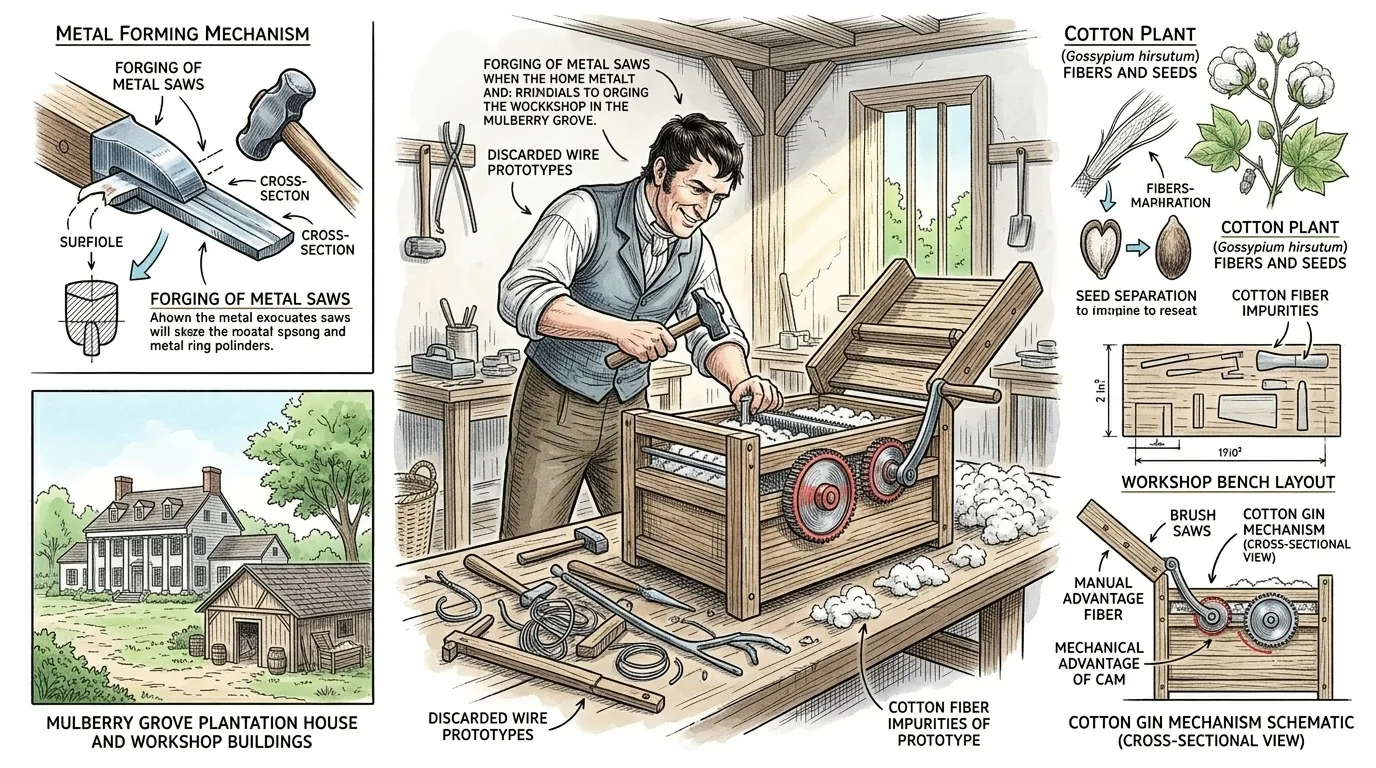
Secluding himself in a small workshop at Mulberry Grove, Eli Whitney embarked on months of intensive labor. He experimented with various mechanisms, his hands calloused from shaping metal and wood, his mind wrestling with engineering complexities. Iteration after iteration failed to achieve the necessary efficiency without damaging the fibers, but Whitney's persistence never faltered, driven by the belief that a solution was within reach.
Biographical Fact: Mulberry Grove Plantation, Georgia, 1793. Eli Whitney spent months in solitary invention, battling technical challenges to perfect his machine.
Page 7
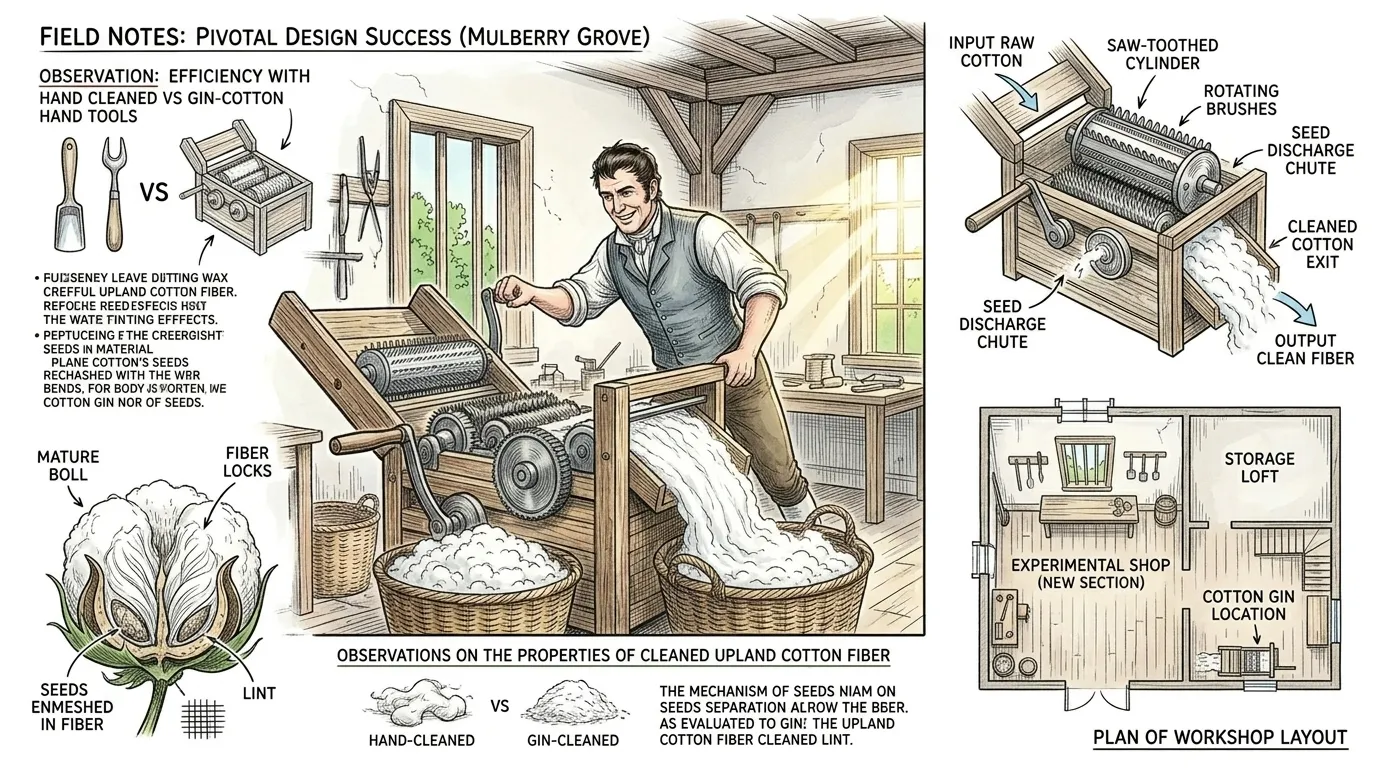
After countless trials and modifications, Whitney conceived the crucial innovation: a cylinder armed with wire teeth, combined with a rotating brush that swept the cleaned cotton away. The synergy was immediate, the results undeniable. He cranked the handle, and pure cotton, free of seeds, flowed from the machine, a testament to his vision. In that moment, the cotton gin transitioned from concept to an undeniable, powerful reality, ready to reshape a continent.
Biographical Fact: Mulberry Grove Plantation, Georgia, 1793. Eli Whitney's final design for the cotton gin achieved unprecedented efficiency, heralding a new era.
Page 8
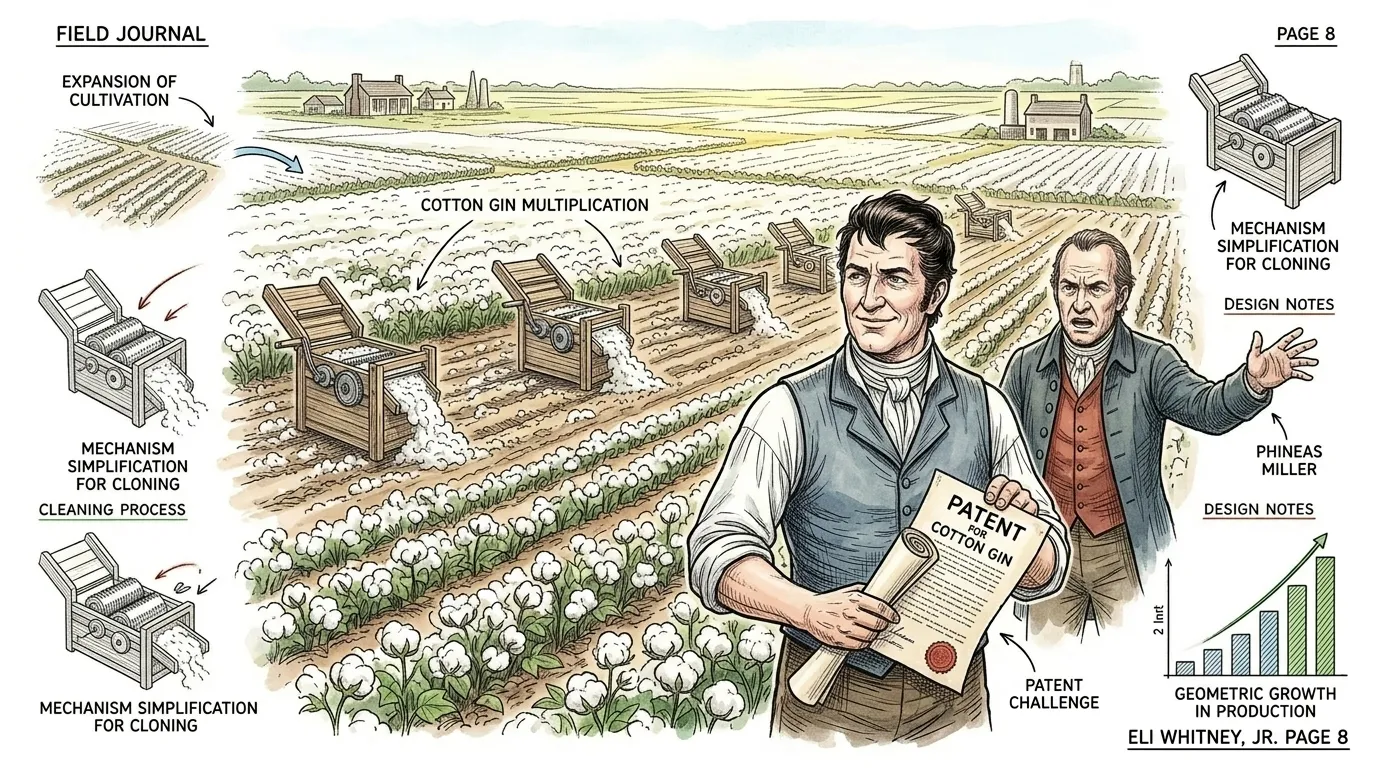
The cotton gin's impact was immediate and profound, exploding cotton cultivation across the American South. Whitney and Miller secured a patent, but their attempts to enforce it were largely unsuccessful, as infringers widely duplicated the simple design. Years of costly, draining legal battles consumed their fortunes, leaving Whitney financially frustrated even as his invention fueled an economic boom that tragically intensified the demand for enslaved labor across the South.
Biographical Fact: Southern United States, late 1790s. The cotton gin's rapid proliferation led to massive agricultural expansion and intensified slavery, while Eli Whitney faced persistent patent infringement.
Page 9
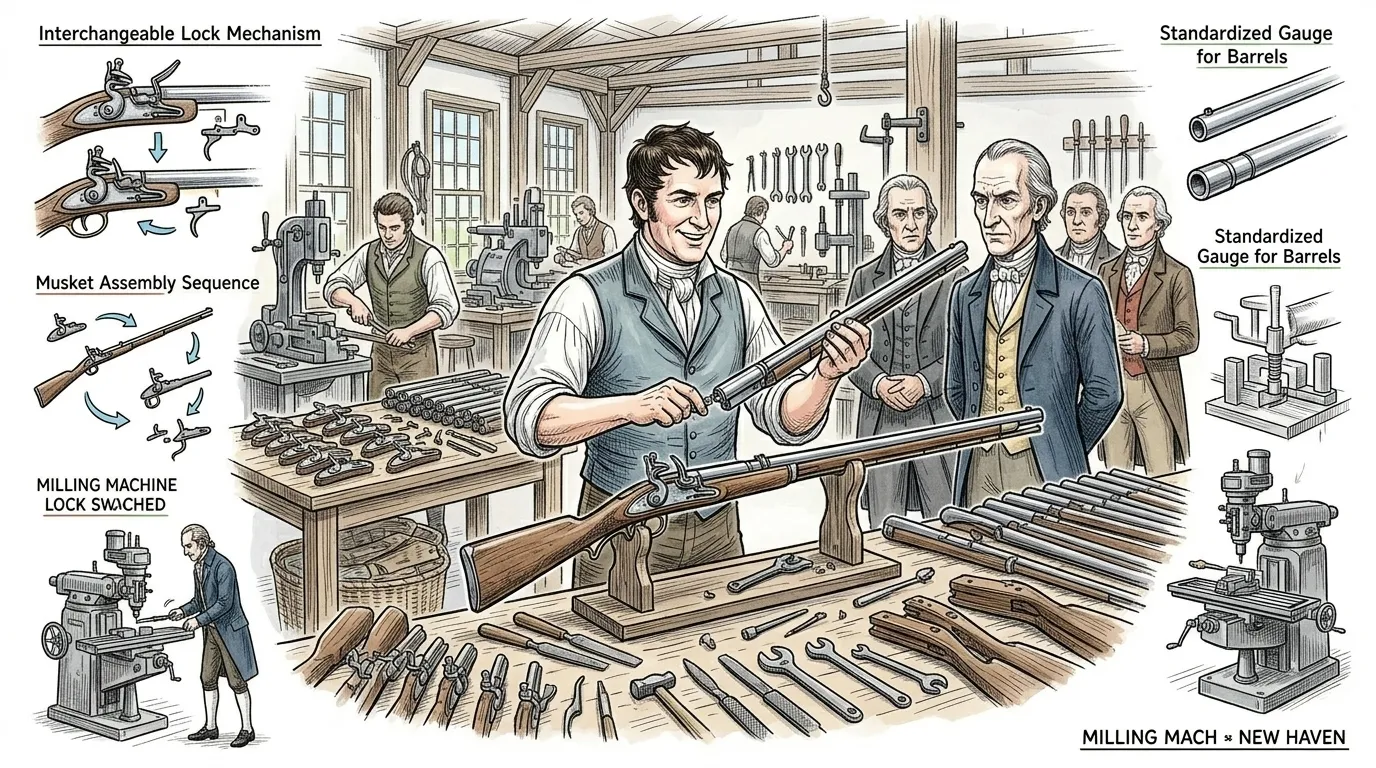
Disillusioned by the legal battles over the cotton gin, Eli Whitney shifted his focus entirely, turning to manufacturing. In 1798, he secured a contract with the U.S. government to produce 10,000 muskets, a colossal undertaking. Here, Whitney pioneered the concept of 'interchangeable parts,' demonstrating to Secretary of the Treasury Oliver Wolcott Jr. and other officials how uniform, mass-produced components could revolutionize factory output, laying the groundwork for modern assembly line production.
Biographical Fact: New Haven, Connecticut, 1798. Eli Whitney pioneered interchangeable parts for musket production, demonstrating it to government officials including Oliver Wolcott Jr.
Page 10
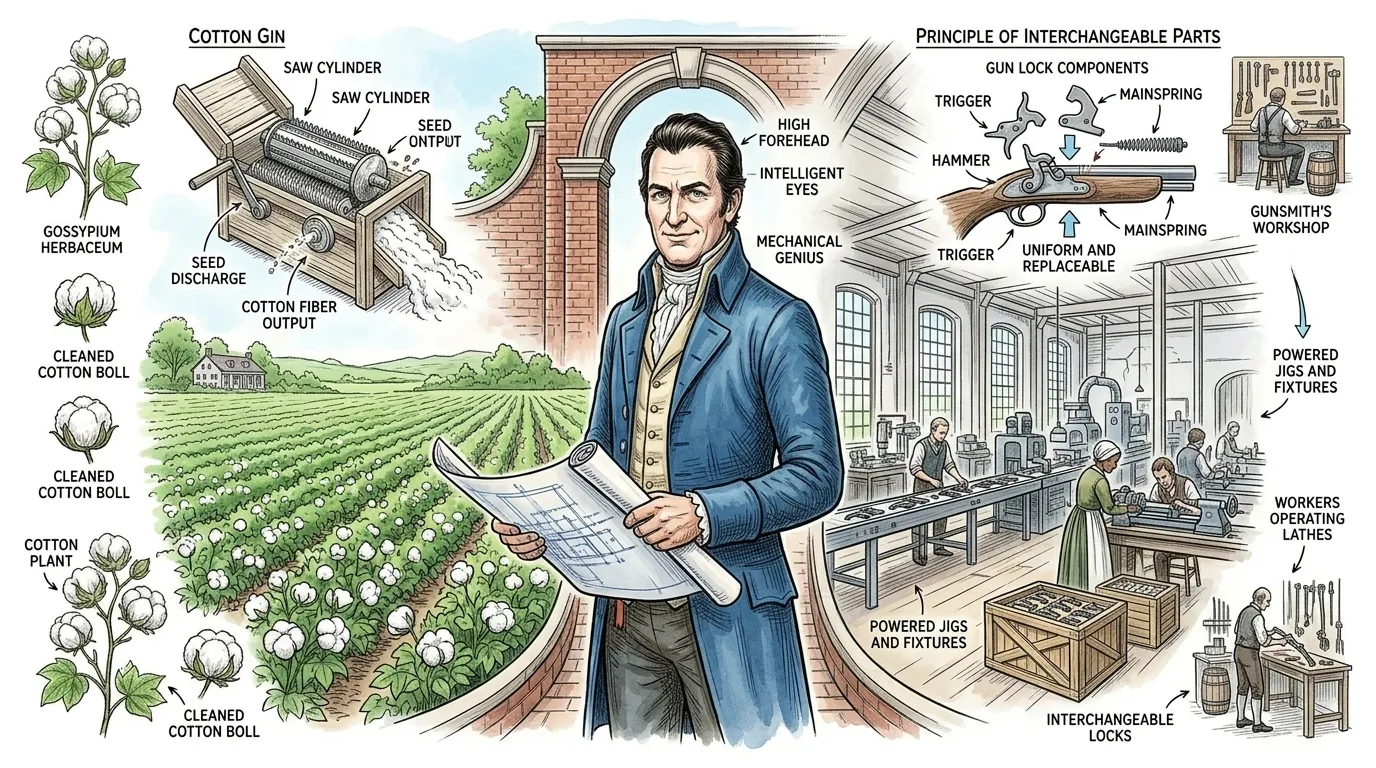
Eli Whitney's legacy unfurled across two distinct, yet interconnected, revolutions. The cotton gin irrevocably shaped the American South, driving its agricultural economy and, tragically, reinforcing the institution of slavery for generations. Simultaneously, his pioneering work on interchangeable parts and mass production in manufacturing laid the foundational principles for the industrial age, creating the blueprint for factories worldwide. His vision, born of necessity and mechanical genius, permanently altered both agrarian and industrial landscapes, marking him as a pivotal figure in global transformation.
Biographical Fact: Eli Whitney's dual legacy: The cotton gin's profound impact on agriculture and society, and the enduring principles of interchangeable parts in modern manufacturing.
About this story
- Location: Global
- Audience: general readers
Questions and answers
Read Wonder People on your phone
Wonder People is available on Android. Get Wonder People on Google Play.