George de Mestral
George de Mestral — an illustrated biography story, set in Global. 10 illustrated pages, free to read on Wonder People.
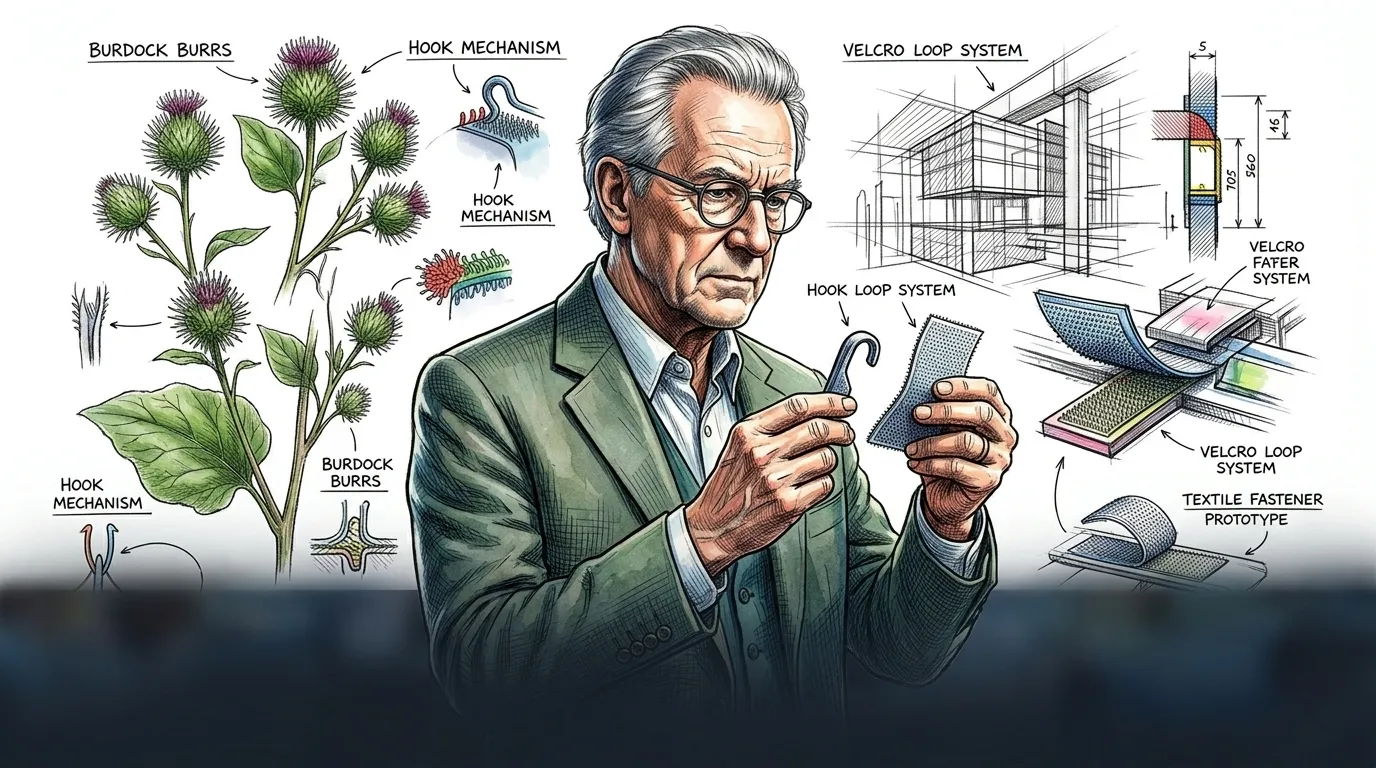
Page 1
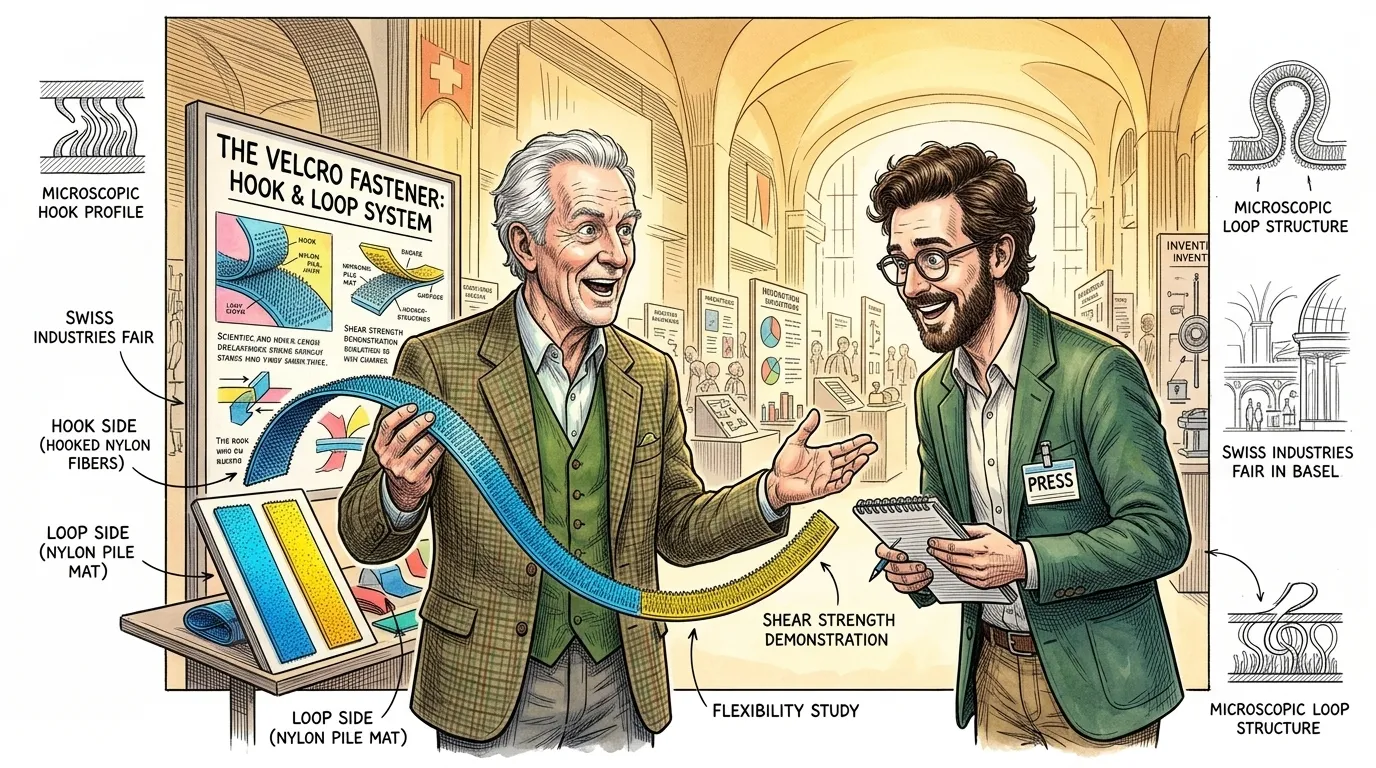
In 1955, at the bustling Swiss Industries Fair in Basel, the world witnessed the debut of an invention that would change daily life. George de Mestral, a meticulous Swiss engineer, stood beside a vibrant display of his revolutionary hook-and-loop fastener.
"De Mestral explained, 'This new system offers unparalleled versatility and strength. We call it VELCRO, a fusion of 'velours' and 'crochet,' velvet and hook.' A journalist, Pierre Dubois, inquired, 'Monsieur de Mestral, you project millions of yards of production; how can a simple fastener achieve such scale?' De Mestral responded, 'Its simplicity is its genius. Imagine its uses, from aerospace to everyday apparel.'"
Biographical Fact: The Swiss Industries Fair in Basel was a prominent annual event showcasing Swiss innovation. George de Mestral's introduction of VELCRO marked a significant moment in fastening technology, promising a future of ease and adaptability.
Page 2
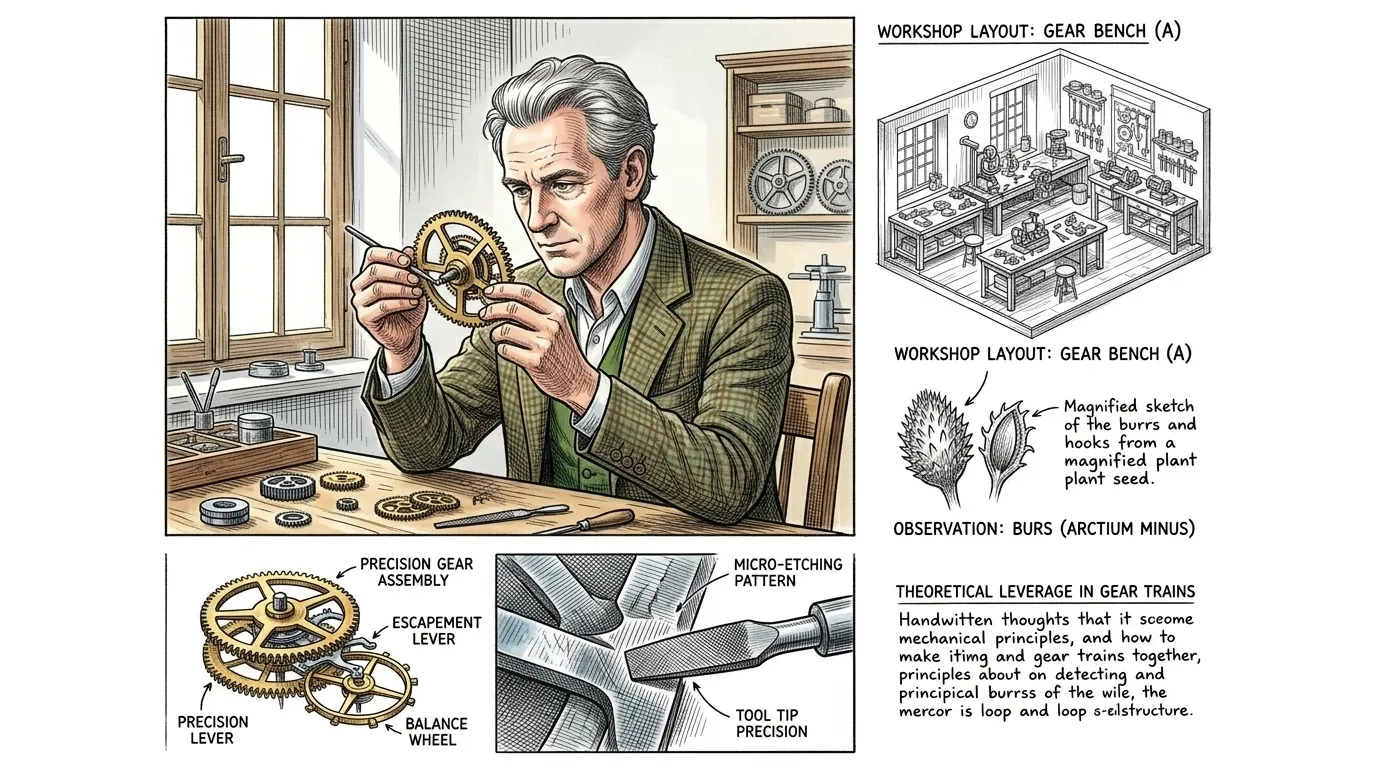
Years prior, in his quiet Swiss workshop near Commugny, George de Mestral, a young mechanical engineer, often reflected on the complex elegance of natural design. His early career as an engineer had instilled in him a profound appreciation for functional simplicity.
"De Mestral mused aloud, examining a precise gear mechanism, 'The universe is filled with solutions, if only we observe closely enough. As the American inventor Charles F. Kettering once said, 'A problem well-stated is a problem half-solved.' My challenge is to accurately define the problem before seeking the answer.' He paused, adjusting a small tool on his workbench, then added, 'I search for that inherent elegance in nature, much like a blueprint waiting to be understood.'"
Biographical Fact: George de Mestral, trained as a mechanical engineer, possessed a methodical approach to problem-solving. His workshop served as a crucible for his early ideas, where he applied principles of design and efficiency.
Page 3
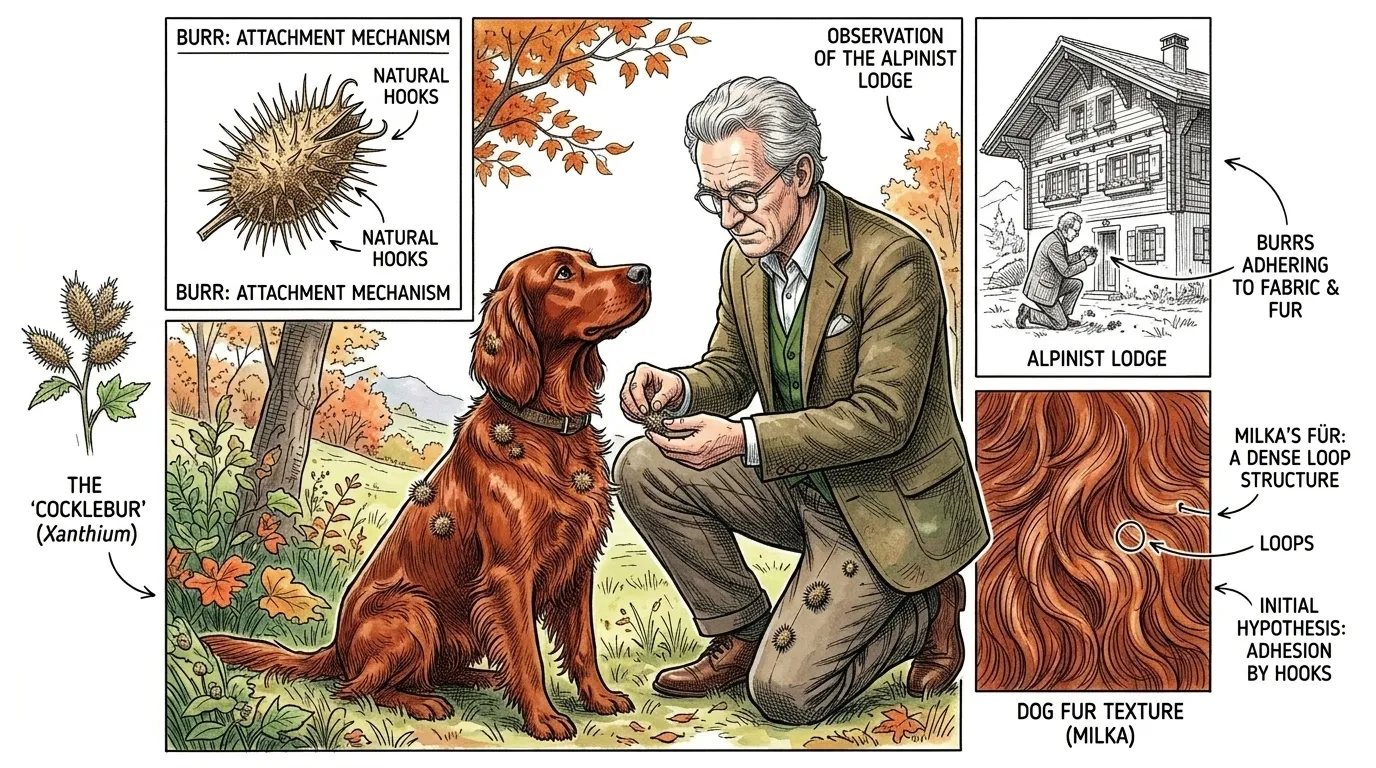
A defining moment arrived during a routine autumn walk in the Swiss countryside. De Mestral returned home with his Irish Setter, Milka, both covered in tenacious burrs. This seemingly mundane nuisance ignited his curiosity.
"De Mestral knelt, gently pulling a burr from Milka's fur. 'Milka,' he observed, 'these small seed pods cling with remarkable determination.' He showed one to the dog (or, to himself, verbalizing his thoughts), 'See how they stick to your coat, and to my woolen trousers, without any adhesive?' He then added, 'There is a principle at work here, a natural fastening mechanism that is both powerful and easily released. This little burr holds a secret.'"
Biographical Fact: The common burdock burr, known for its tenacious grip, became the unexpected catalyst for de Mestral's most famous invention. This observation epitomized the concept of biomimicry—drawing inspiration from nature's designs.
Page 4
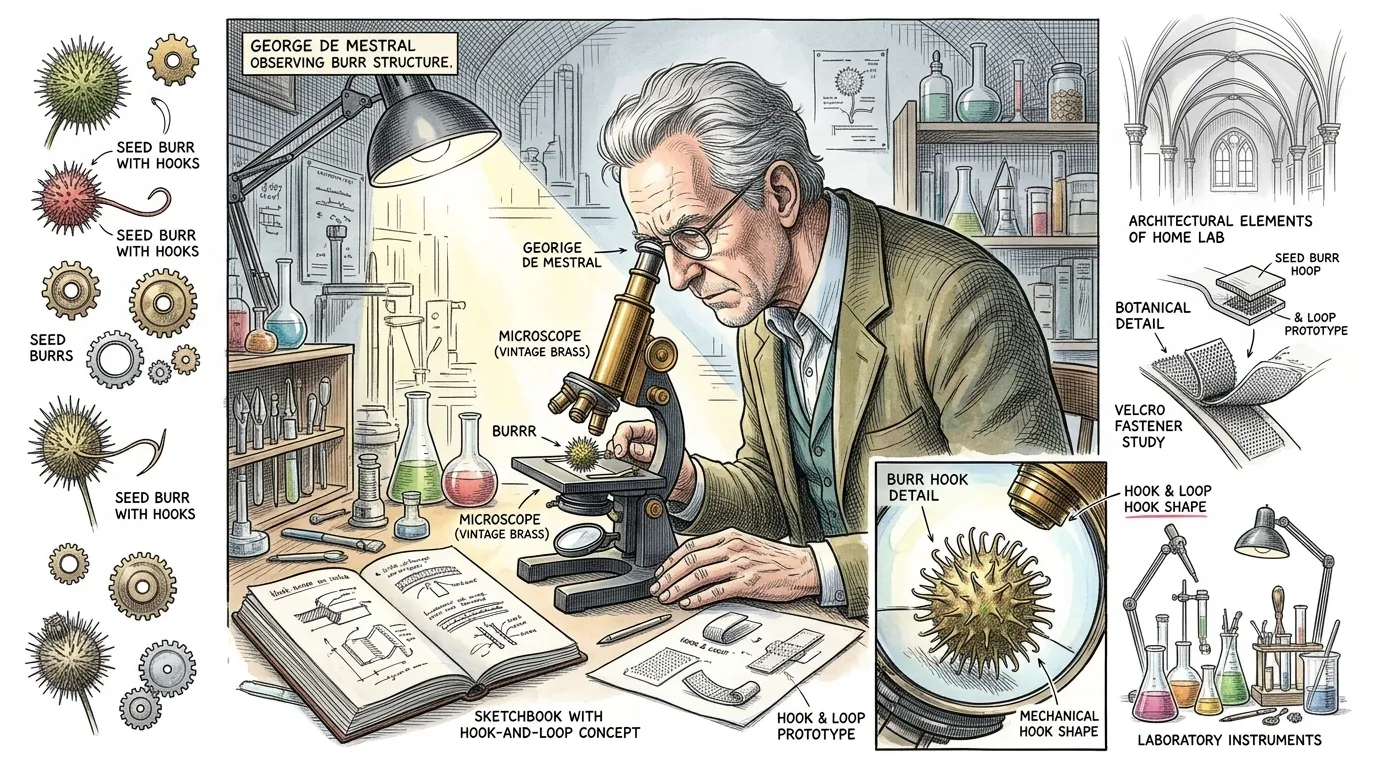
Driven by the burr's insistent cling, de Mestral retreated to his home laboratory. He placed the small, spiky seed pod under his microscope, a tool that had long served his engineering precision. What he discovered would unlock a new world of fastening.
"As he peered into the eyepiece, de Mestral exclaimed, 'Remarkable! Under magnification, I see hundreds of tiny, resilient hooks!' He then described aloud what he observed, 'These aren't simply thorns; they are flexible, spring-like structures, perfectly designed to snag onto the microscopic loops of fabric and fur. This is the precise 'knowledge' of their adhesion!' He sketched rapidly in a notebook beside the microscope, documenting the intricate hook-and-loop structure he had just unveiled."
Biographical Fact: Utilizing his microscope, de Mestral identified the burr's secret: a multitude of tiny, flexible hooks. This revelation formed the foundational 'knowledge' for his innovative fastener, directly demonstrating biomimicry in action.
Page 5
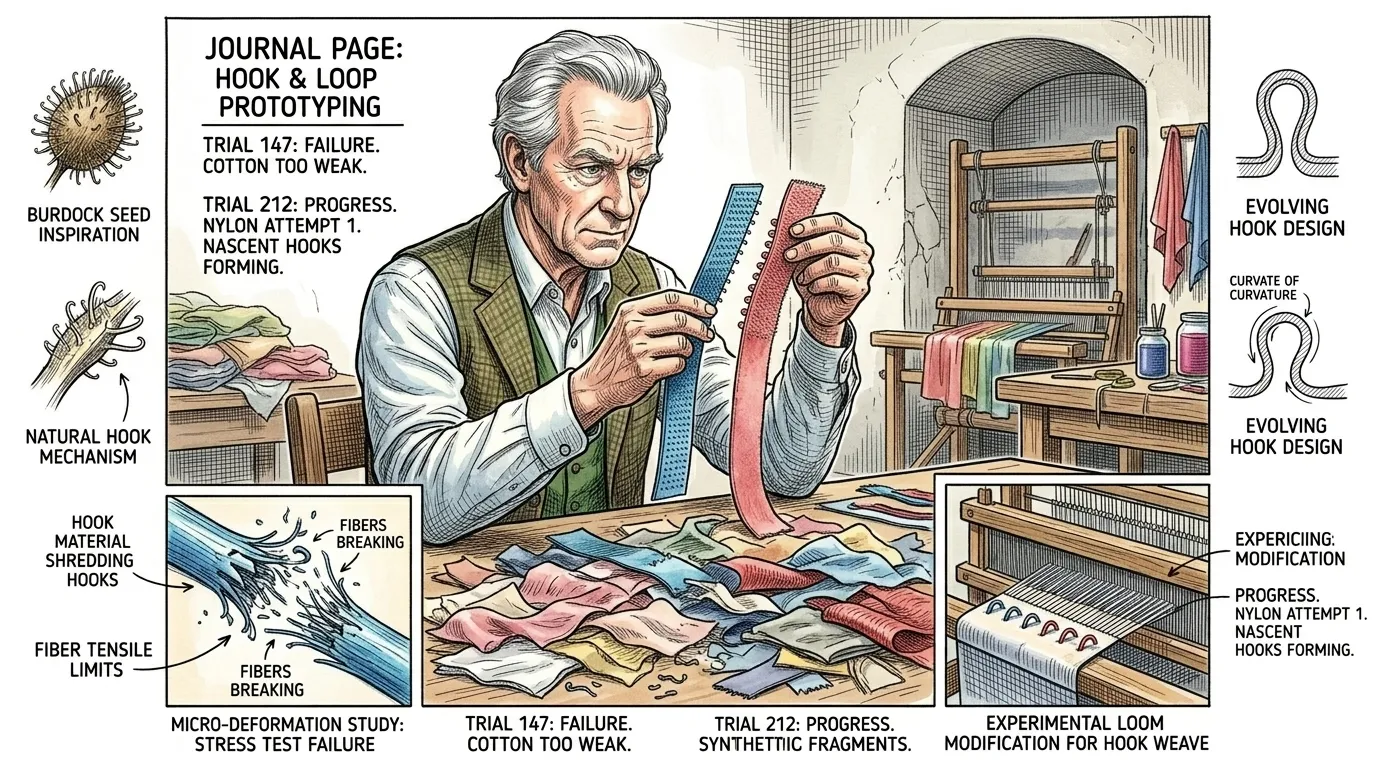
Understanding the burr's mechanism was merely the first step. De Mestral embarked on years of relentless experimentation, attempting to replicate nature's design. His workshop became a crucible of trial and error, filled with a myriad of discarded materials.
"De Mestral held up two strips of fabric, one with nascent hooks, the other with loops, trying to press them together. 'The challenge is immense,' he stated to himself (or an unseen, generic workshop helper for the sake of dialogue, still trying to keep it adult documentary, or perhaps a dog looking at him). 'How do I create these microscopic hooks robustly, and the corresponding loops, in a material durable enough for repeated use? Silk proved too delicate, cotton too weak.' He gestured to a pile of failed samples. 'Each failure reveals a new pathway, but the perfect material eludes me.'"
Biographical Fact: The journey from observation to functional invention was fraught with challenges. De Mestral experimented with countless materials and weaving techniques, facing numerous setbacks in his quest to perfectly replicate the burr's hook-and-loop system.
Page 6
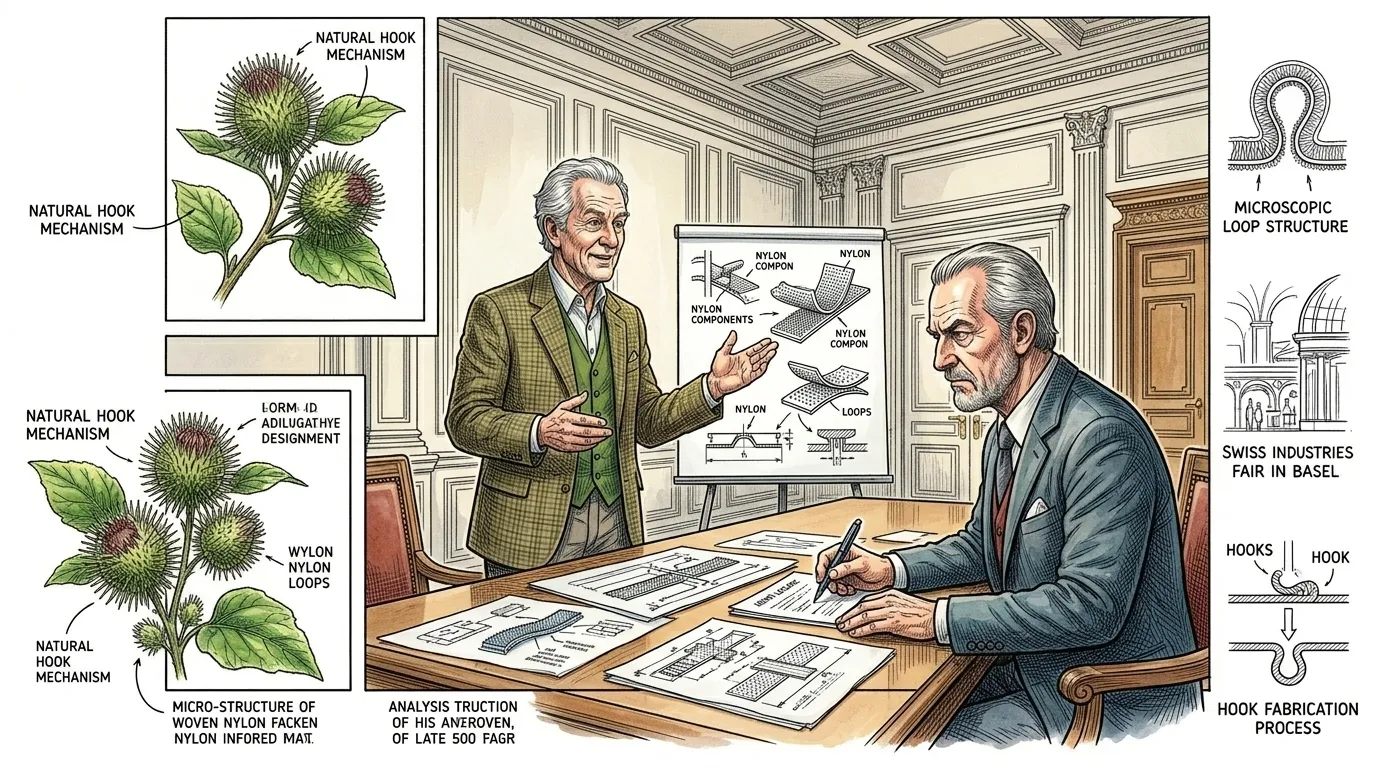
After eight years of dedicated development, George de Mestral refined his design, eventually settling on nylon for its resilience. In 1951, he took a decisive step, filing for a patent that would protect his unique hook-and-loop invention.
"In a formal meeting room, de Mestral presented detailed drawings to a patent officer, Henri Leclerc, a severe-looking man in his late 50s. De Mestral explained, 'This invention provides a secure, reusable fastening system, utilizing thousands of tiny nylon hooks on one strip, and corresponding loops on another.' Leclerc, examining the documents, questioned, 'The claims for utility and novelty are strong, Monsieur de Mestral, but what about the durability of these microscopic components in mass production?' De Mestral responded confidently, 'We have developed a method using nylon that retains its form and strength, even after thousands of attachments and detachments.'"
Biographical Fact: Securing the patent in 1951 for his 'hook-and-loop fastener' was crucial. This legal protection allowed de Mestral to control the production and distribution of his invention, laying the groundwork for its commercial success.
Page 7
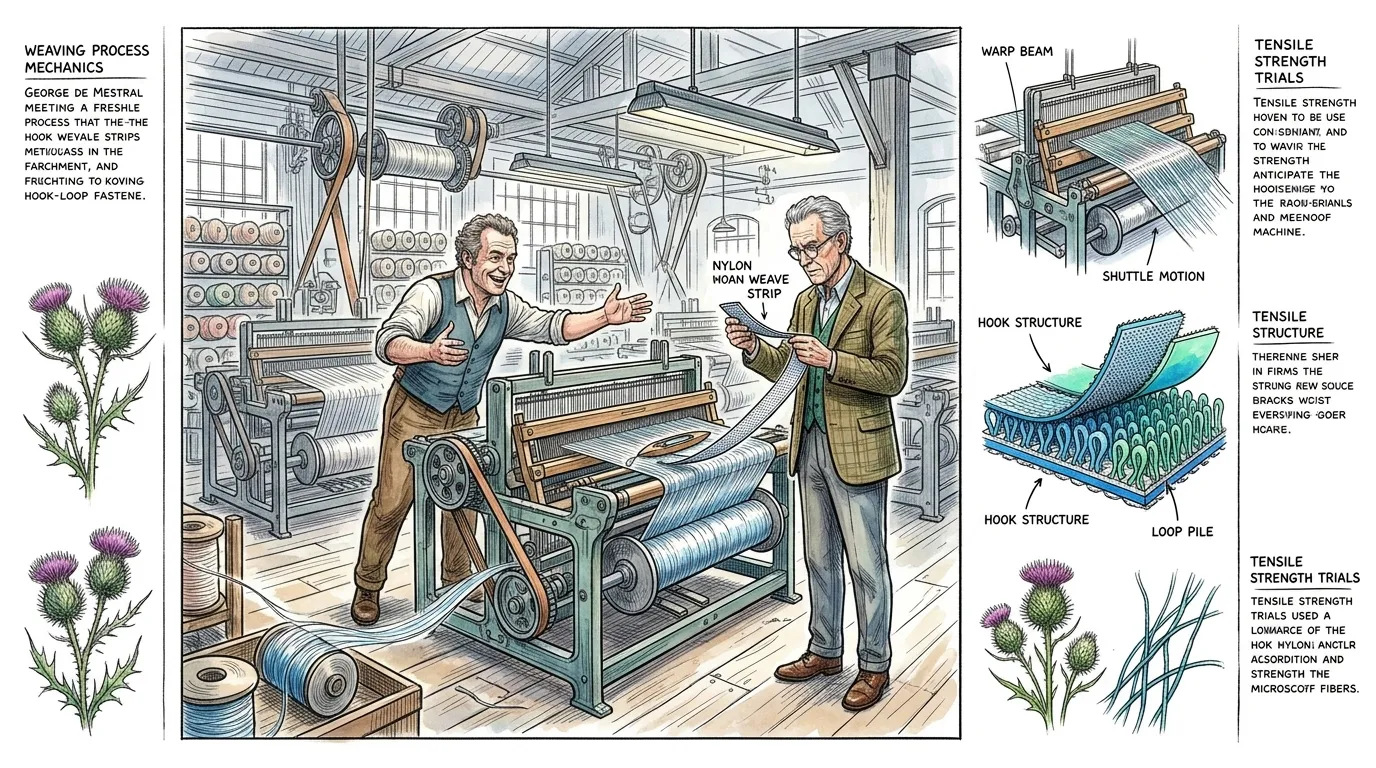
The challenge shifted from invention to industrialization. De Mestral partnered with textile engineers, notably Jean Pingeon at Nylon SA, to develop machinery capable of mass-producing the intricate nylon hooks and loops with consistent quality.
"Inside a noisy textile factory, de Mestral stood beside Jean Pingeon, a robust textile engineer in his late 40s, both observing a specialized loom. Pingeon shouted over the din, 'The heat treatment for the hooks is critical for durability, George! Too much, and they collapse; too little, and they lack tensile strength.' De Mestral nodded, examining a newly woven strip. 'Indeed, Jean. The precise cutting of the loops to create the ideal opening is equally vital. This consistent quality in mass production is what will bring the 'knowledge' of the burr's design to every home.' Pingeon grinned, 'We are making history, one strip at a time!'"
Biographical Fact: The transition from prototype to mass production required significant engineering prowess. Collaborating with textile experts, de Mestral overcame the technical hurdles of creating durable, high-quality hook-and-loop fasteners on an industrial scale.
Page 8

By the late 1960s, VELCRO had transcended its initial applications. Its secure yet easily releasable fastening system proved invaluable in environments demanding reliability and speed, from outer space to medical facilities, demonstrating the full 'payoff' of de Mestral's initial discovery.
"De Mestral watched a news report on a small black-and-white television in his study, showing astronauts inside a spacecraft, securing equipment with VELCRO. He remarked, 'The simplicity of that burr, the 'item' that started it all, has now journeyed to the moon! Who would have imagined such a reach?' His wife, Anne, seated nearby, added, 'And in hospitals, doctors are using it to quickly secure bandages and braces. Its utility is truly universal, George.' De Mestral smiled, 'Indeed, the application of natural mechanics is boundless.'"
Biographical Fact: VELCRO's adoption by NASA for space missions in the 1960s dramatically boosted its credibility. This, alongside its increasing use in medical and sports equipment, cemented its status as a versatile and reliable fastener, validating de Mestral's vision.
Page 9
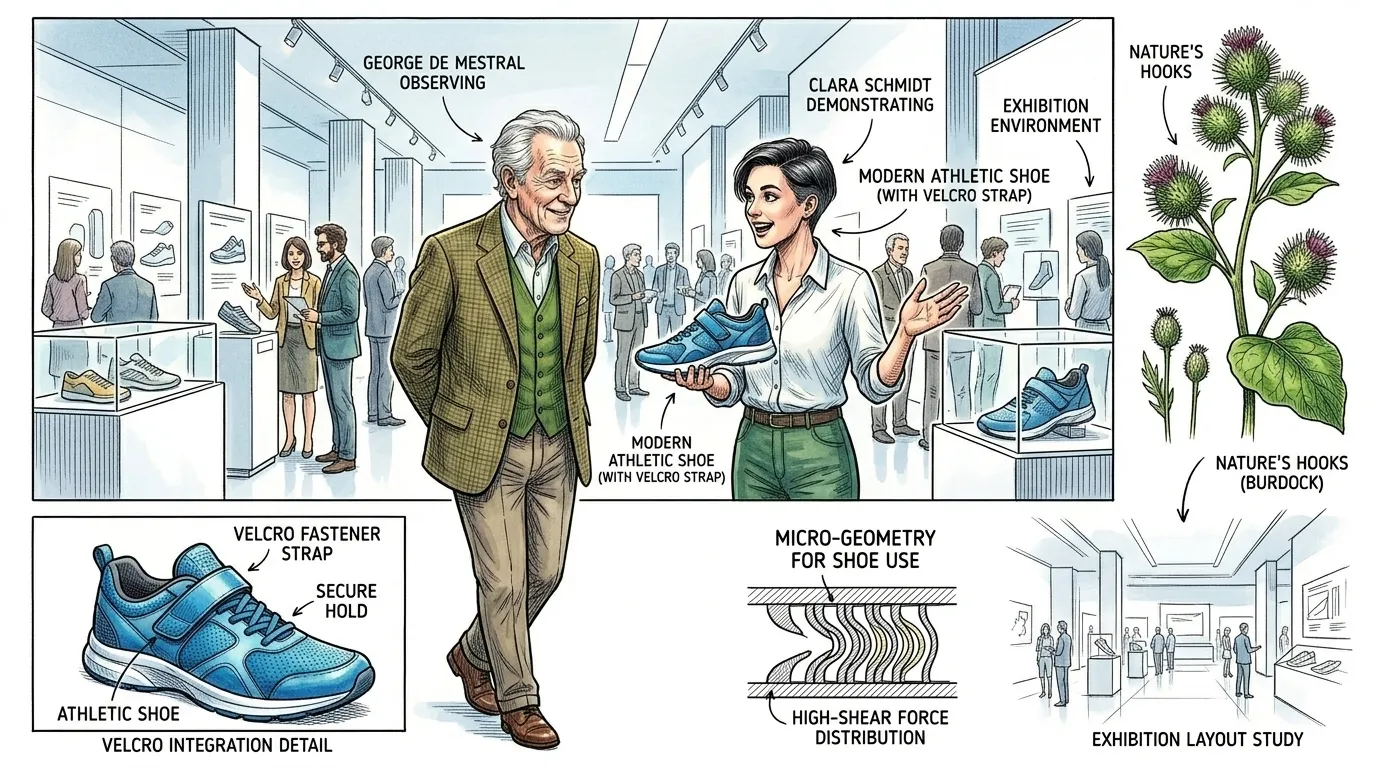
Decades after its invention, VELCRO continued to evolve and diversify. Its basic principle, derived from the natural world, found new life in countless industries, transforming product design and user interaction across the globe.
"De Mestral, now an elderly man, walked through a modern exhibition showcasing innovative product designs, many of which incorporated his fastener. He observed a designer, Clara Schmidt, approximately 30 years old, with a modern haircut, explaining a new athletic shoe. Schmidt enthusiastically explained, 'Our latest running shoe uses VELCRO for a customizable, secure fit, allowing athletes to adjust tension precisely during training.' De Mestral remarked to his companion (perhaps a family member or former colleague, who is simply listening), 'It's incredible how new generations continue to discover fresh applications for a principle I observed on a simple walk. The elegant solution from nature's 'item' still drives innovation!'"
Biographical Fact: VELCRO's adaptability led to its widespread integration into fashion, automotive interiors, and various consumer goods. Its continued relevance highlights the power of biomimicry and de Mestral's foundational insight.
Page 10
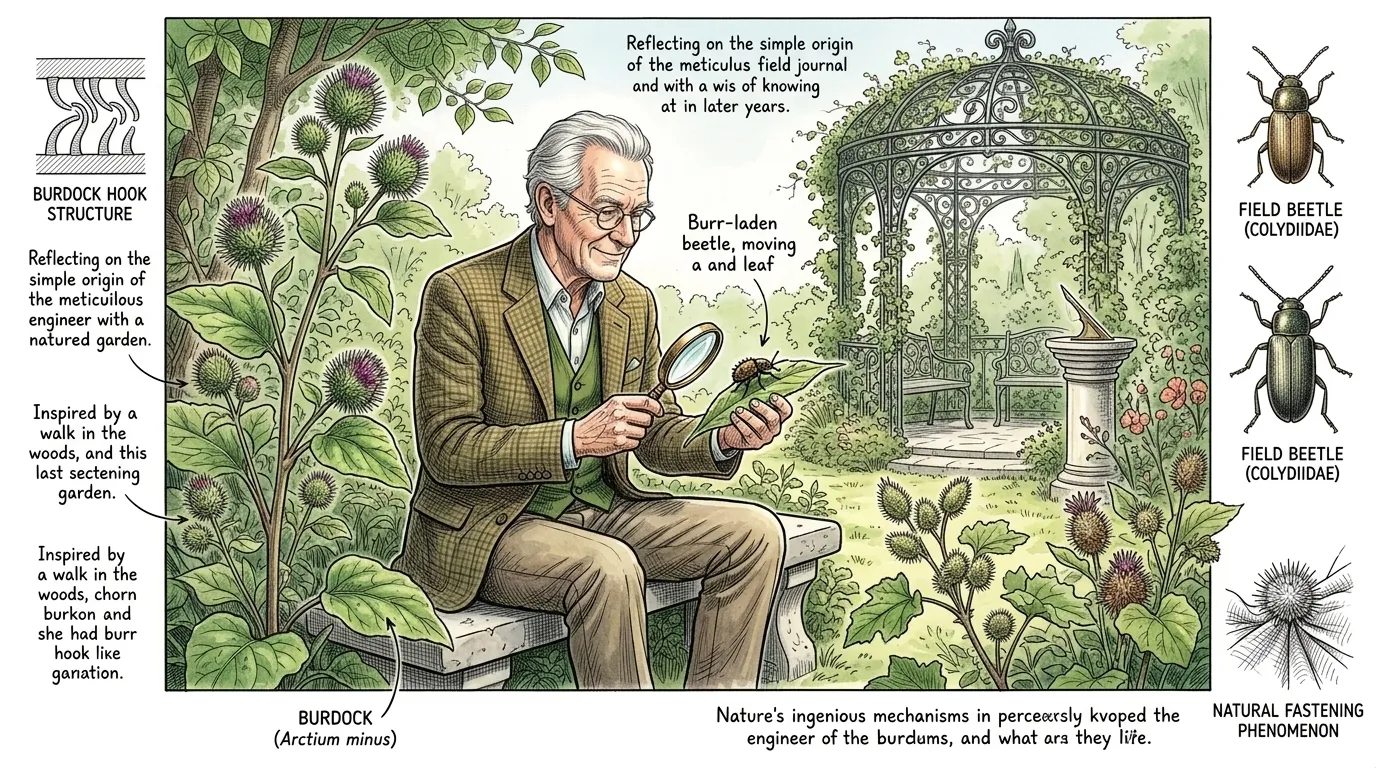
George de Mestral's life demonstrated the profound impact of patient observation and engineering ingenuity. His invention, born from a simple walk in the woods, transcended its origins to become a global phenomenon, an everyday marvel of biomimicry.
"George de Mestral, in his later years, sat in a quiet garden, observing a small insect. He reflected, 'Nature never ceases to inspire. My greatest lesson was that the solutions to our most complex problems often lie hidden in the most unassuming natural forms.' He smiled gently, then concluded, 'The burr taught me to look closer, to understand the 'why' behind the 'what.' This is the enduring legacy I hope to leave: that innovation is everywhere, if only we take the time to truly see it.'"
Biographical Fact: George de Mestral's legacy extends beyond a mere fastener; he exemplified the power of biomimicry, demonstrating how nature's elegant designs can inspire world-changing technological solutions. His work continues to influence inventors and designers.
About this story
- Location: Global
- Audience: general readers
Questions and answers
Read Wonder People on your phone
Wonder People is available on Android. Get Wonder People on Google Play.