Guglielmo Marconi
Guglielmo Marconi — an illustrated biography story, set in Global. 10 illustrated pages, free to read on Wonder People.
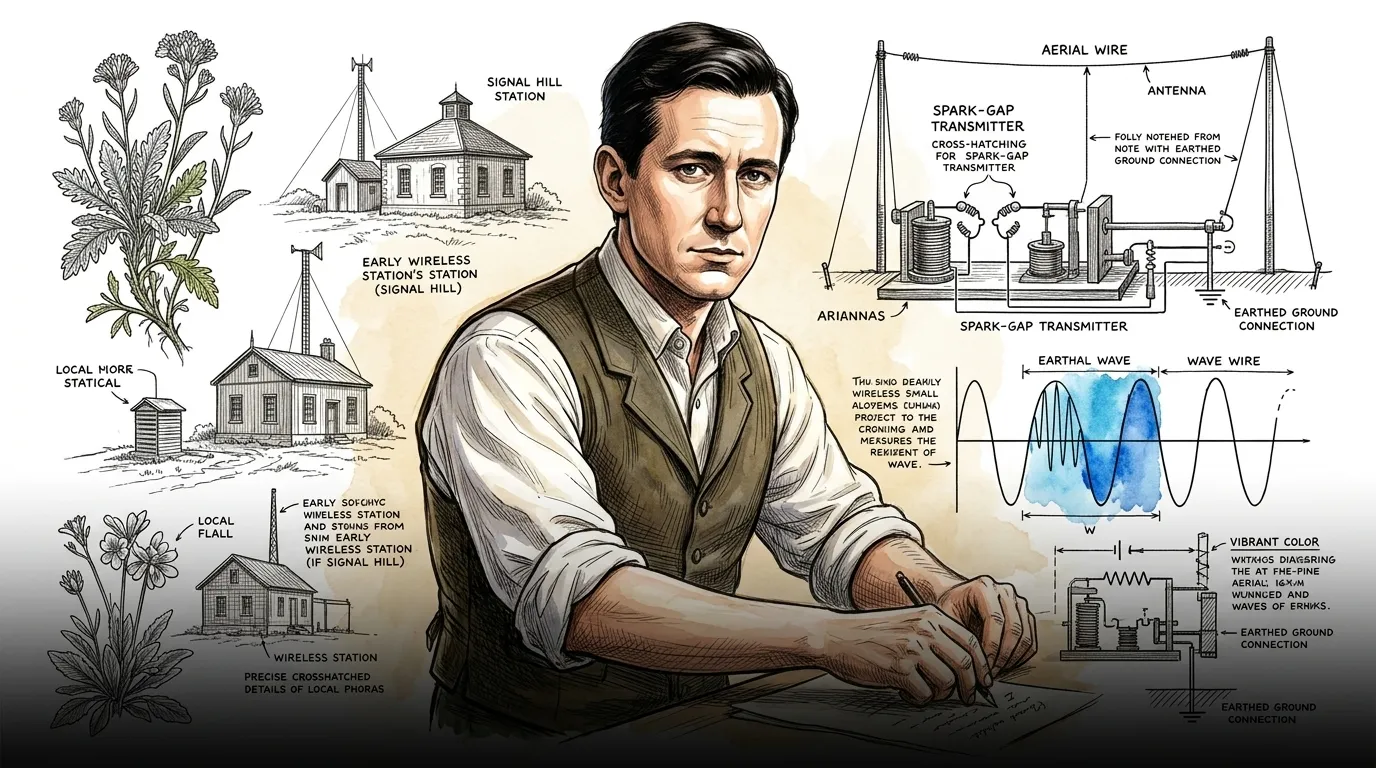
Page 1
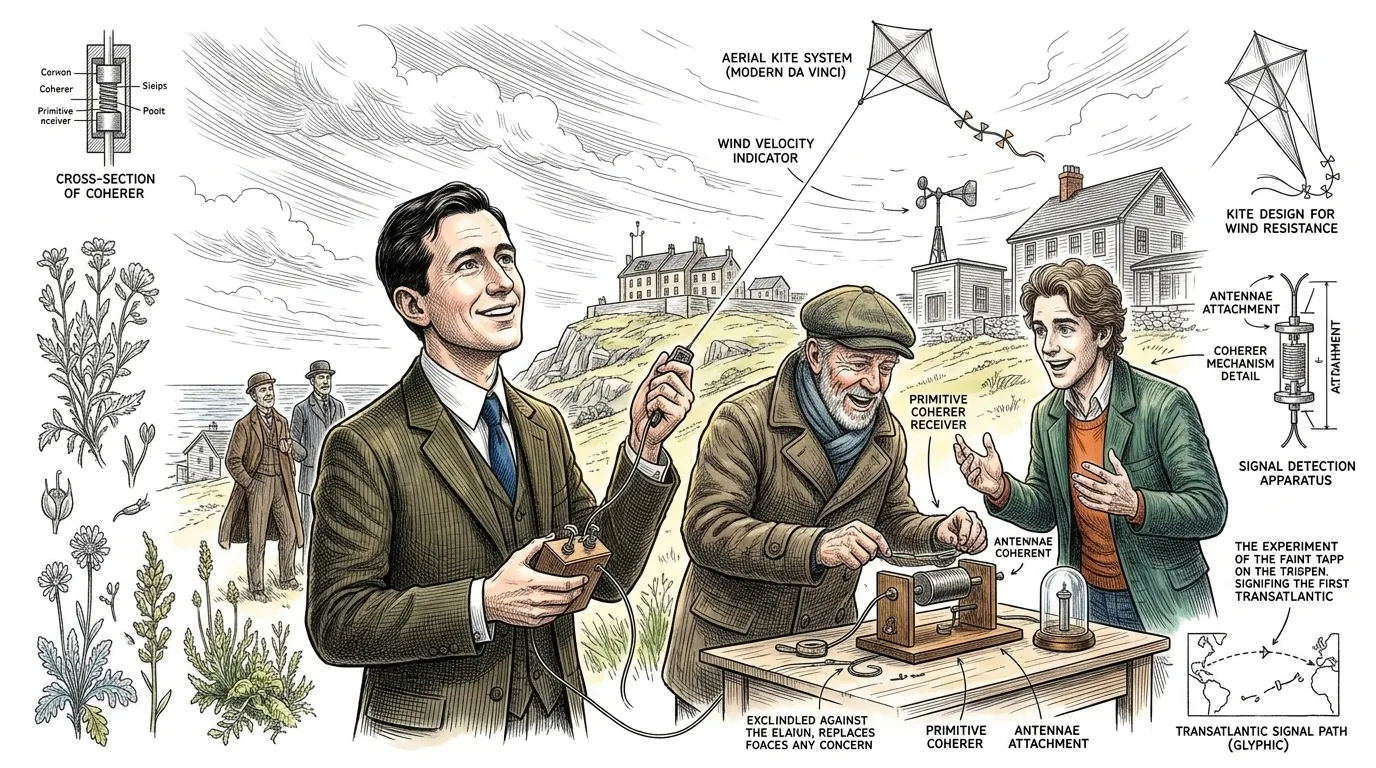
A fierce gale whipped across Signal Hill in St. John's, Newfoundland, on December 12, 1901. Guglielmo Marconi, alongside his assistants George Kemp and Percy Paget, braced against the wind, their faces etched with anticipation as a kite carried their aerial aloft. Suddenly, within the primitive coherer, a faint tapping began—three distinct clicks. "The letter 'S', Mr. Marconi!" Kemp exclaimed, confirming the first electromagnetic signal had spanned 2,200 miles across the Atlantic Ocean.
""The letter 'S', Mr. Marconi!" George Kemp exclaimed, his voice cutting through the wind as he focused on the coherer. "It's truly there, just as we hoped!" Guglielmo Marconi nodded, a profound sense of triumph dawning in his eyes, knowing this single event had just remade global communication. Percy Paget stood beside them, a testament to the colossal effort that had brought them to this monumental, world-changing moment."
Page 2
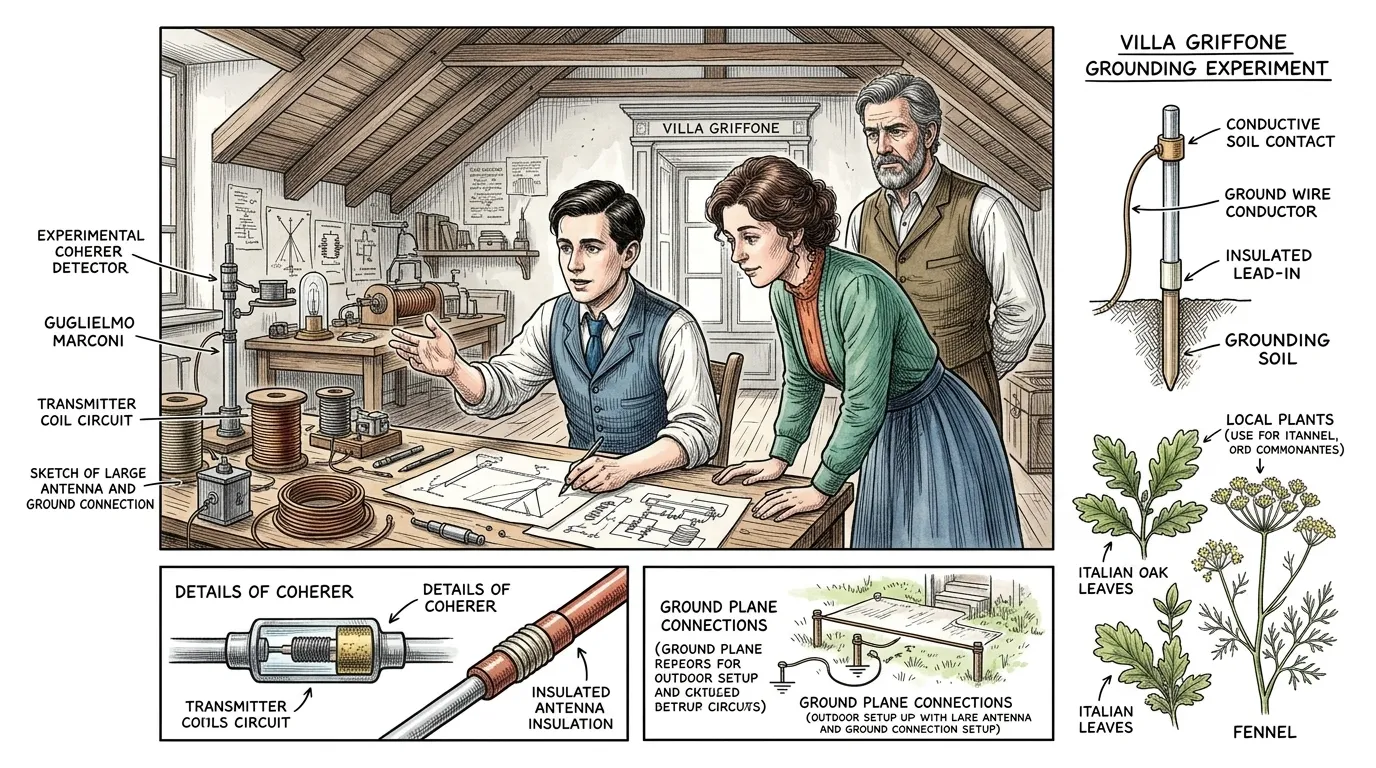
Years prior, at his family's Villa Griffone in Pontecchio, Italy, a young Guglielmo Marconi meticulously assembled his first crude instruments. He studied the work of Heinrich Hertz, whose experiments demonstrated electromagnetic waves but concluded their practical range was limited. Marconi, however, envisioned a different reality, meticulously sketching designs for larger antennas and ground connections.
""Father, Mother, this is not merely a spark; these 'Hertzian waves' are a language waiting to be heard across vast distances," a determined 20-year-old inventor, with earnest eyes and dark hair, explained, gesturing towards his workbench. "The textbooks say these waves travel only a short distance, but I believe that by raising the aerial higher and grounding the transmitter, we can overcome that limitation." His mother, Annie Jameson Marconi, listened with supportive interest, while his father, Giuseppe Marconi, observed skeptically, urging caution. "It's a bold claim, Guglielmo," his father cautioned, "against what established science dictates.""
Page 3
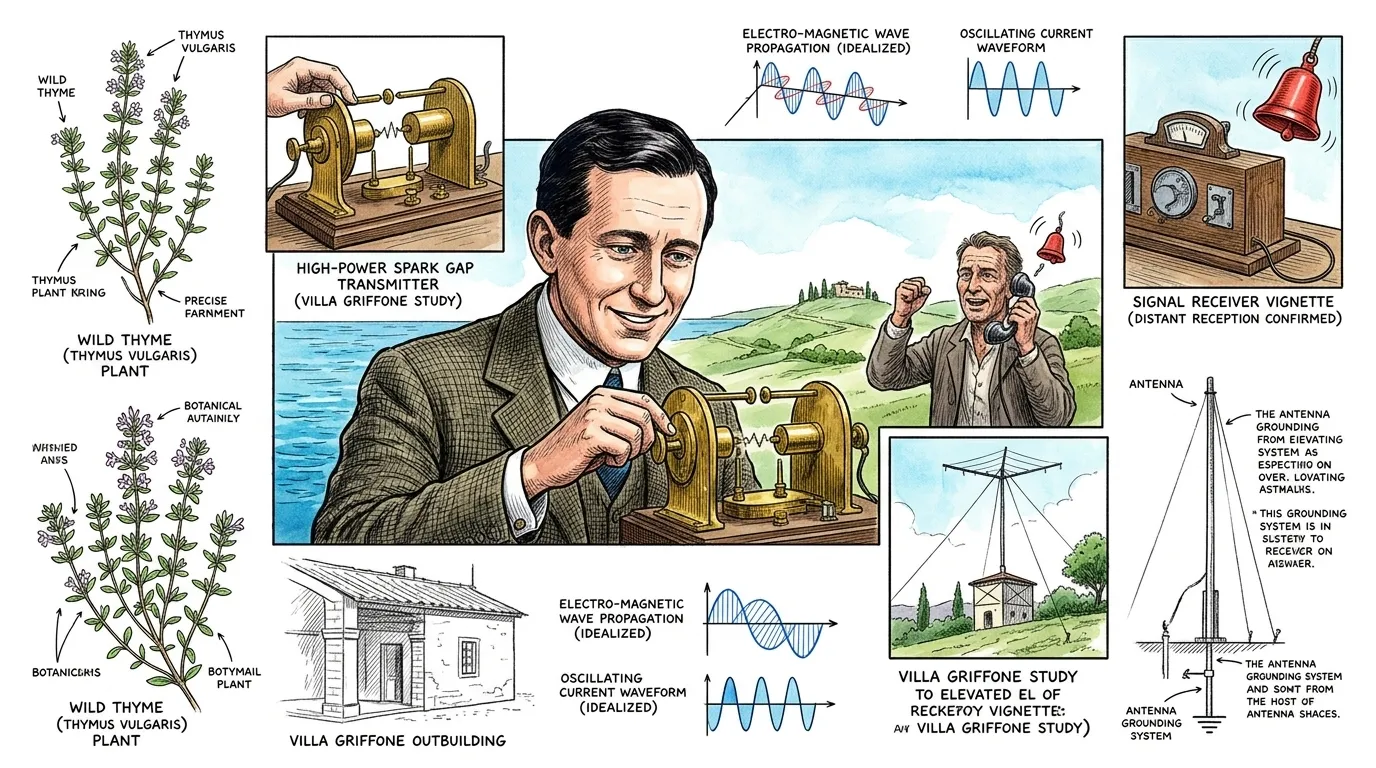
Marconi relentlessly pursued his theories, transforming the Italian countryside around Villa Griffone into his proving ground. He refined his equipment, increasing the power of his spark transmitter and developing more sensitive receivers. This focused effort culminated in his first undeniable success, extending wireless communication beyond the walls of his laboratory.
""Silvano, go to the other side of the hill, take this receiver, and signal back when you hear my tap!" a determined 21-year-old inventor, Guglielmo Marconi, instructed his estate manager, Silvano Ghini, his eyes alight with anticipation. Silvano, a middle-aged man with a weathered face, nodded, clutching the receiver. Moments later, back at the transmitter, Marconi carefully adjusted his apparatus. A distant tap confirmed it: the bell on Silvano's receiver rang over a mile away, proving his system could conquer obstacles. "It works, Silvano! The signal passed the obstacle!" Marconi exclaimed, a triumphant smile spreading across his face."
Page 4
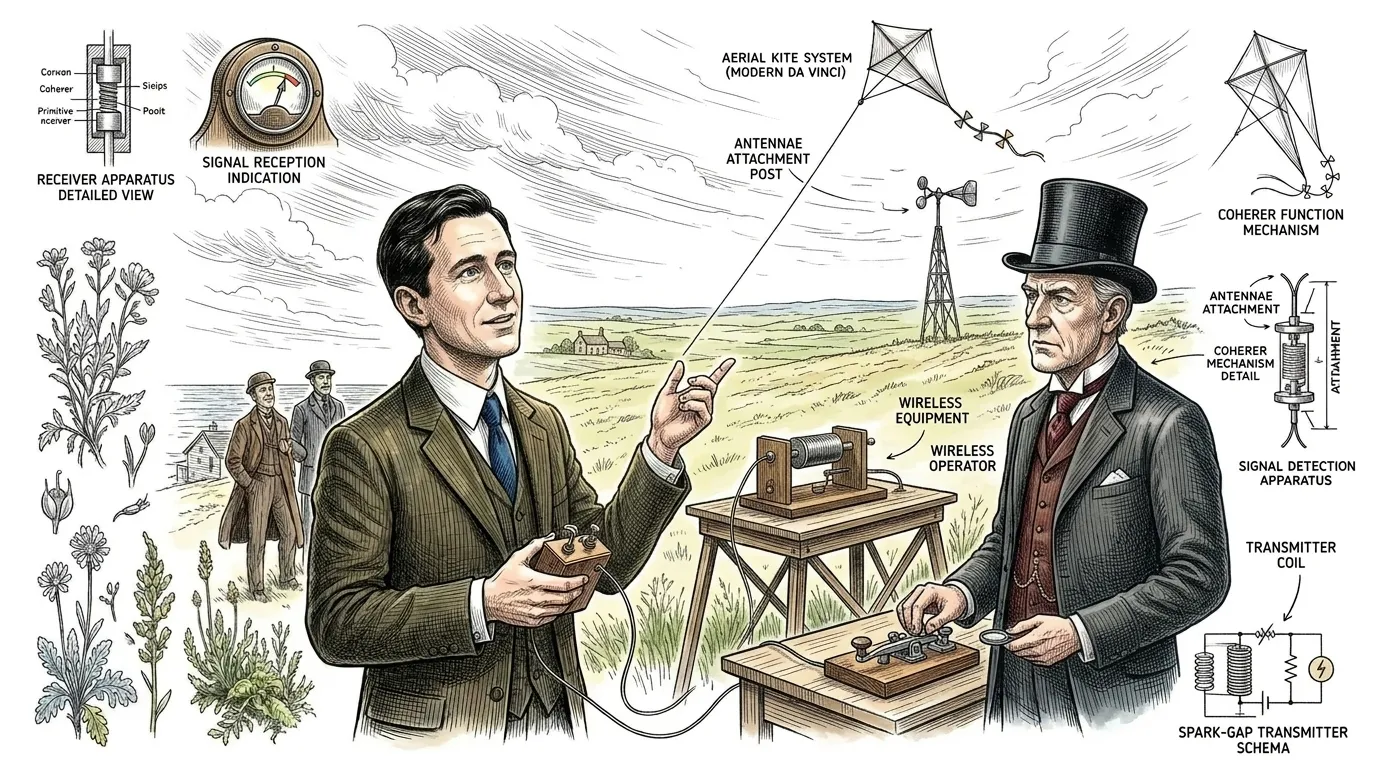
Marconi recognized the critical need to demonstrate the practical range and reliability of his system to a wider, more influential audience. With little interest from the Italian government, he moved to England, a nation with vast colonial interests and a powerful navy. There, in 1896, he began a series of demonstrations that would irrevocably alter the course of communication.
""Mr. Preece, observe this!" a confident 22-year-old inventor, Guglielmo Marconi, declared, gesturing towards his equipment on Salisbury Plain in England. "My signals can now reach a distance of nine miles, proving their potential for communication without wires." William Preece, Chief Engineer of the British Post Office, a distinguished man with a stern expression and formal Victorian attire, watched intently as Marconi's assistant sent signals. "This is indeed remarkable, young man," Preece stated, his skepticism slowly giving way to awe, "a significant advancement beyond anything previously achieved." The successful demonstration was a pivotal moment, securing crucial support for Marconi's future endeavors."
Page 5
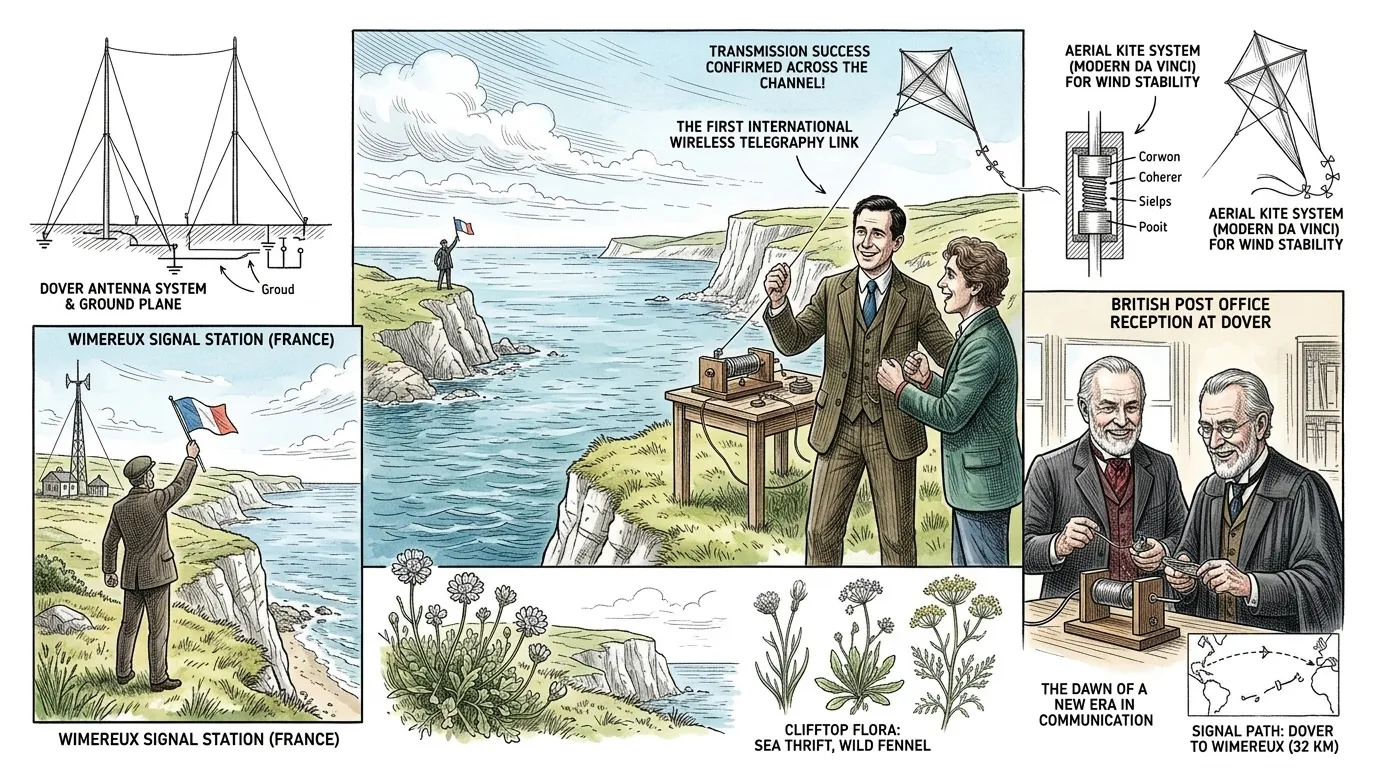
The successful trials on Salisbury Plain opened doors, leading to increasingly ambitious demonstrations. Marconi understood that wireless communication held immense potential for maritime use, a critical application for island nations. In 1899, he achieved a significant milestone, proving his system could reliably connect two countries separated by water.
""The signal has been received, Mr. Marconi!" a jubilant engineer, dressed in a dark suit, shouted across the English Channel from Wimereux, France. "We hear Dover clearly!" Guglielmo Marconi, now 25, stood on the cliffs of Dover, England, a triumphant smile on his face, overseeing the transmission. "Excellent! This proves our system's reliability over water, a critical step for maritime safety," he responded to his British Post Office colleagues gathered nearby, their faces reflecting the shared victory. "Imagine the lives this could save at sea," one colleague murmured, a deep understanding of the future implications dawning on him."
Page 6
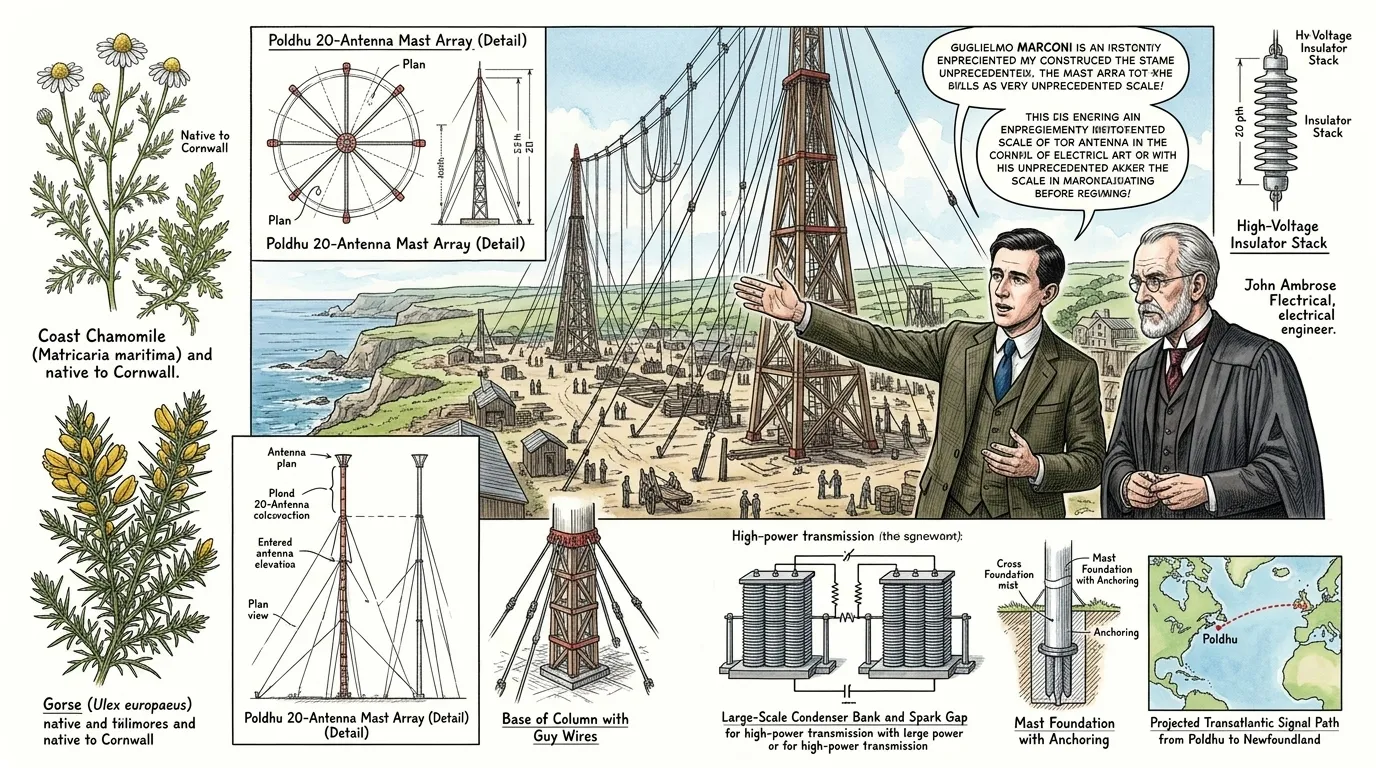
Driven by an audacious vision, Marconi resolved to conquer the ultimate wireless challenge: bridging the Atlantic Ocean. This endeavor demanded an unprecedented scale of engineering. In 1900, he began constructing the Poldhu Wireless Station in Cornwall, England, a massive complex designed to broadcast signals with unparalleled power.
""Professor Fleming, this station at Poldhu is our absolute best chance," a resolute 26-year-old inventor, Guglielmo Marconi, explained, gesturing across the vast construction site. "We require immense power, a scale unseen before, to attempt the transatlantic transmission." John Ambrose Fleming, a distinguished British electrical engineer and physicist with a serious, contemplative expression, dressed in formal academic attire, examined the colossal antenna array under construction. "The sheer magnitude of this undertaking is staggering, Mr. Marconi," Fleming replied, his voice filled with a mix of awe and concern. "The engineering challenges are immense, and the risks of failure are substantial for such an unprecedented feat.""
Page 7
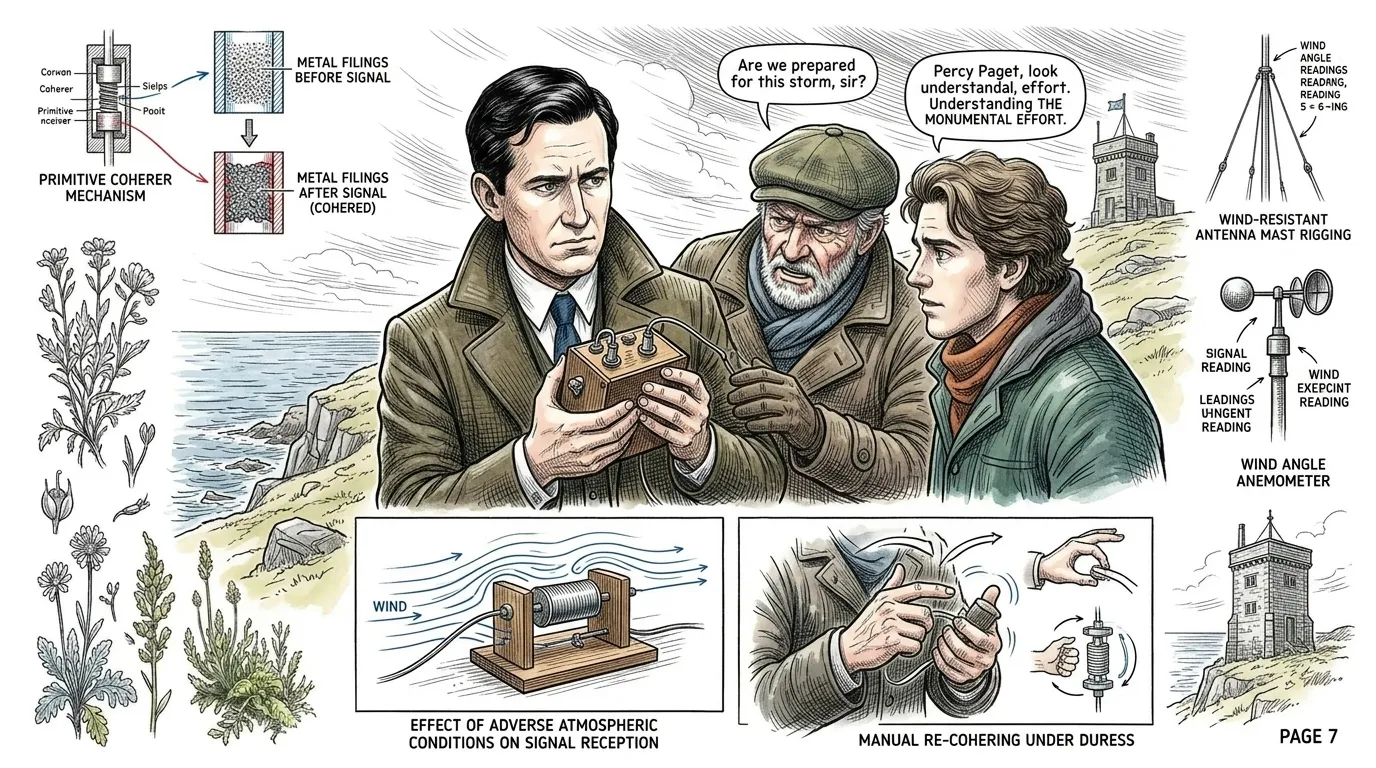
At the Poldhu station, Marconi's team began transmitting, aiming for Newfoundland. Thousands of miles away, on Signal Hill, Marconi himself waited, battling fierce weather and growing skepticism. The success of the attempt hinged on whether the signals, transmitted from England, could curve around the Earth's curvature without dissipating. "As Horace Mann once said, 'A teacher affects eternity; he can never tell where his influence stops'," Marconi muttered to George Kemp, reflecting on his own pursuit of knowledge.
""The conditions are brutal, Mr. Marconi. Are you certain Poldhu can transmit through this storm?" George Kemp, bundled against the wind, asked his employer, his face grim with concern on Signal Hill. Guglielmo Marconi, now 27, gripped his receiver, his expression stern yet resolute. "We must maintain hope, George. The waves will find a way, if our theory of reflecting off the ionosphere holds true." He paused, reflecting on the profound leap of faith involved. "As Horace Mann once said, 'A teacher affects eternity; he can never tell where his influence stops.' We are testing the very limits of what is known, and our influence, if successful, will be boundless." Percy Paget, standing nearby, nodded, observing the sheer determination in Marconi's eyes."
Page 8
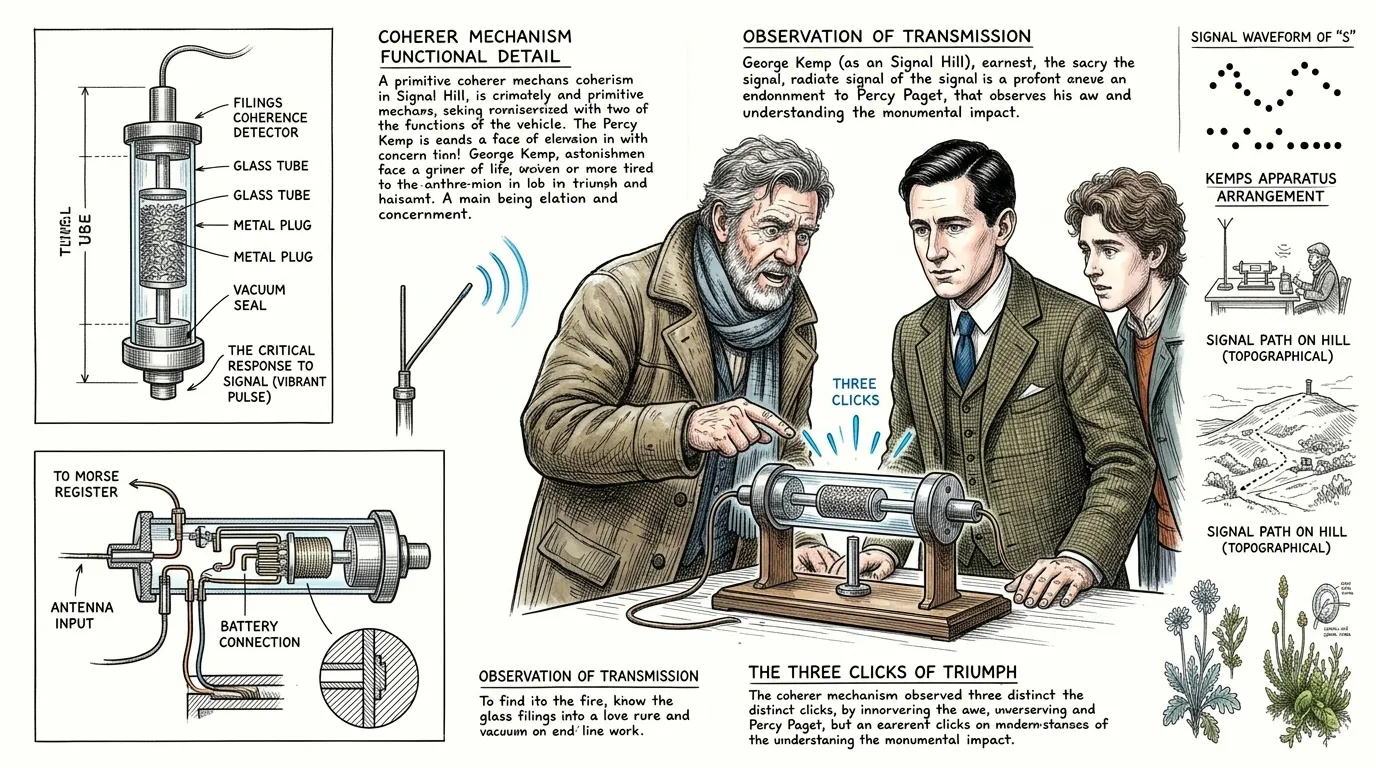
The sustained effort across 2,200 miles finally bore fruit. At Signal Hill, the distinct clicks of the letter 'S' were unmistakably received, a testament to Marconi's radical ideas. This moment did not merely confirm a theory; it ignited a global communication revolution, shrinking the world and binding distant continents.
""It's here again, Mr. Marconi! Three distinct clicks!" George Kemp exclaimed, his voice trembling with excitement as he pointed to the coherer. Guglielmo Marconi, his face now a mask of elation, confirmed the signal. "The high aerials and the grounding—our theory was correct, George! The waves curve around the Earth after all!" The success proved his radical ideas about antenna design and ground connections were instrumental. "This isn't just a signal, it's a bridge across an ocean," Percy Paget added, awe-struck, recognizing the monumental impact. "The world will never be the same after this.""
Page 9
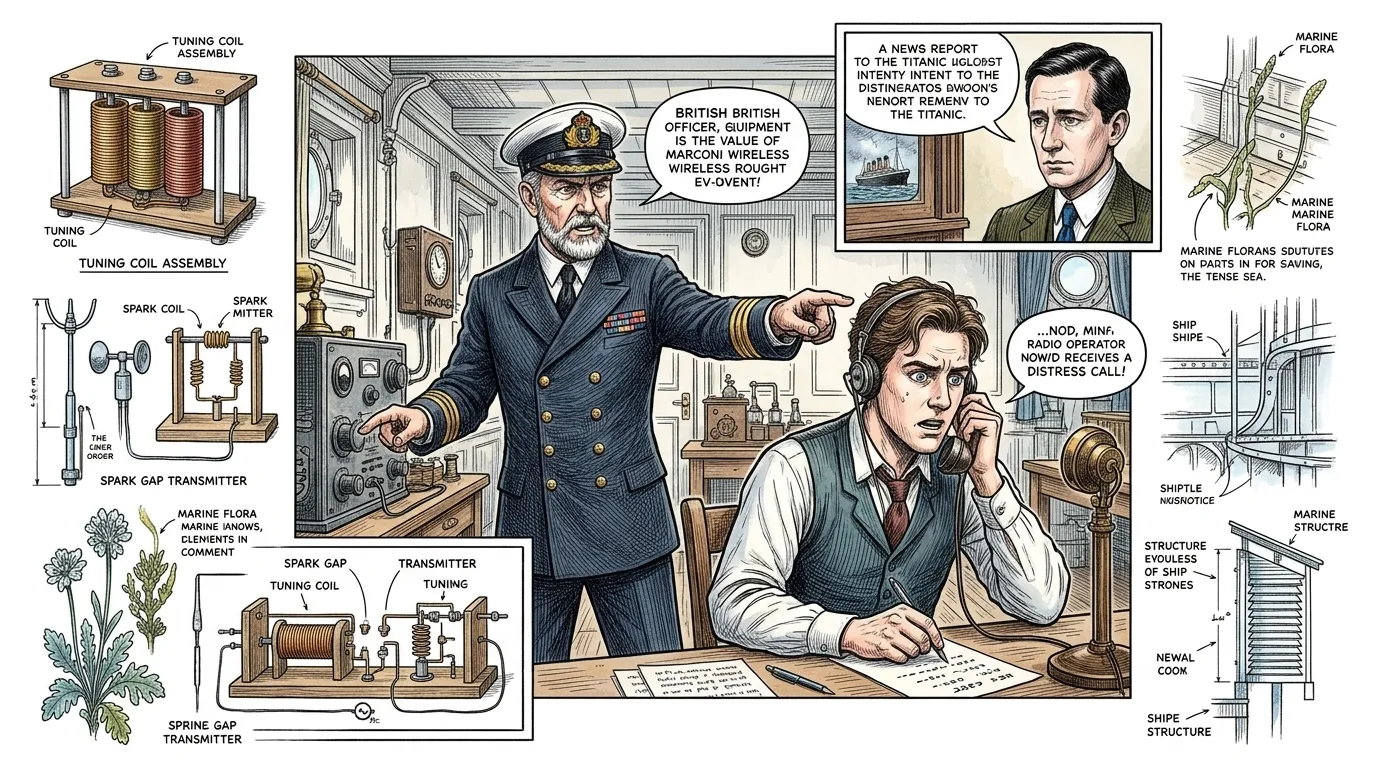
The transatlantic triumph transformed Marconi into a global figure, accelerating the commercialization and widespread adoption of wireless technology. His invention rapidly became indispensable, particularly for maritime safety. Within a decade, ship-to-shore communication became standard, proving critical in moments of crisis.
""This Marconi wireless is invaluable!" a British naval officer, stern-faced and in uniform, declared, pointing to the ship's wireless room. "It has revolutionized safety at sea, saving countless lives." A younger radio operator, his eyes wide with urgency, nodded. "Indeed, Captain. We just received distress calls from the Titanic, reporting they struck an iceberg." Guglielmo Marconi, now a distinguished 37-year-old, is seen in a separate inset, intently listening to a news report about the event, his expression somber, understanding the profound consequence of his work. "The demand for wireless technology now crosses every ocean," the officer emphasized, acknowledging the immediate and urgent need for this crucial invention."
Page 10
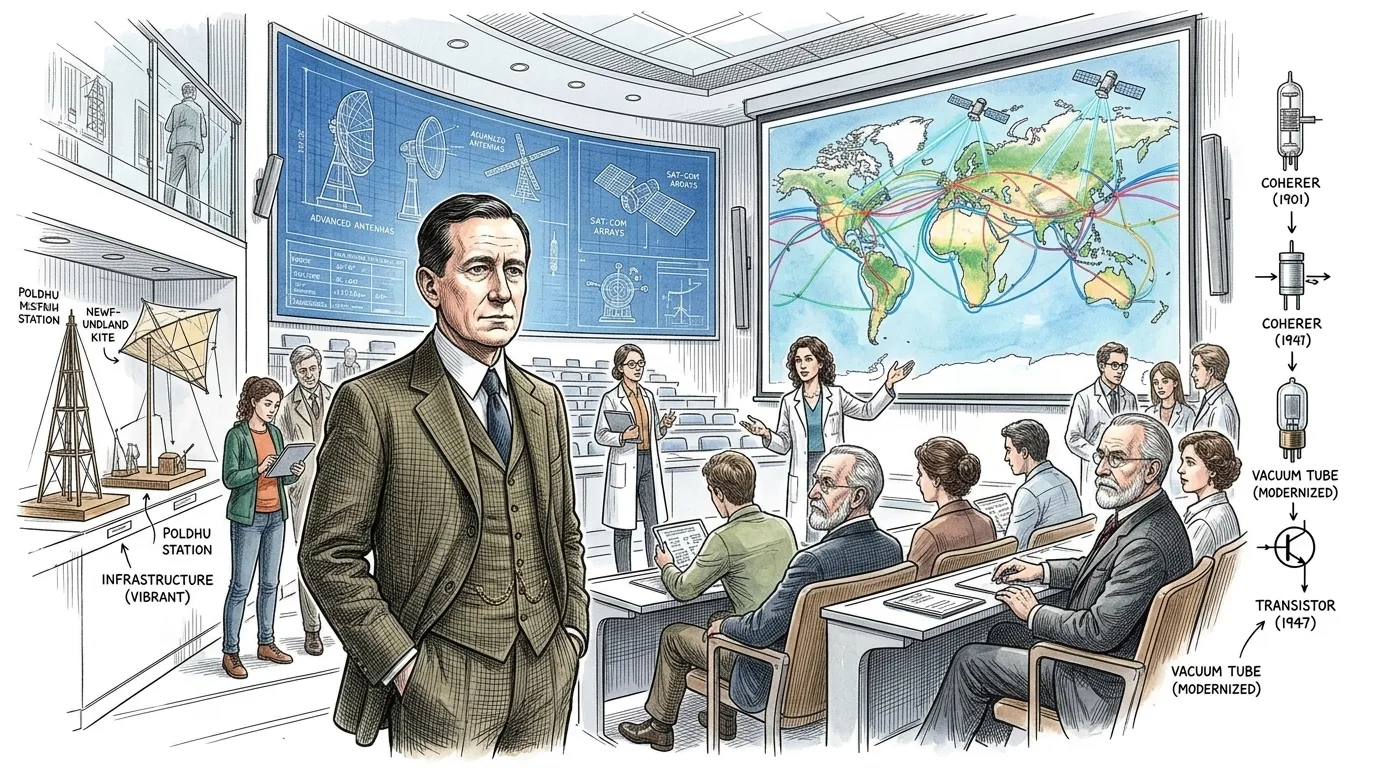
Guglielmo Marconi's vision transcended mere scientific curiosity; he forged the pathways of global connectivity. From scattered sparks, he engineered a ubiquitous medium that would define the 20th century and beyond. His pioneering work earned him the Nobel Prize in Physics in 1909 and laid the fundamental groundwork for all subsequent wireless communication.
""Marconi's work didn't just transmit signals; it connected humanity across oceans and continents," a voice, perhaps of a contemporary scientist, states in a hypothetical academic setting, reflecting on his legacy. "His commitment to practical application, from his early experiments to the grand scale of transatlantic communication, transformed society." Another, perhaps a historian, adds, "The Nobel Prize was just one recognition of a lifetime dedicated to bridging distances, establishing the very foundation for radio, television, and even today's internet." Guglielmo Marconi, envisioned as an older, distinguished statesman of science, looks out, a timeless symbol of innovation."
About this story
- Location: Global
- Audience: general readers
Questions and answers
Read Wonder People on your phone
Wonder People is available on Android. Get Wonder People on Google Play.