Gottlieb Daimler
Gottlieb Daimler — an illustrated biography story, set in Global. 10 illustrated pages, free to read on Wonder People.
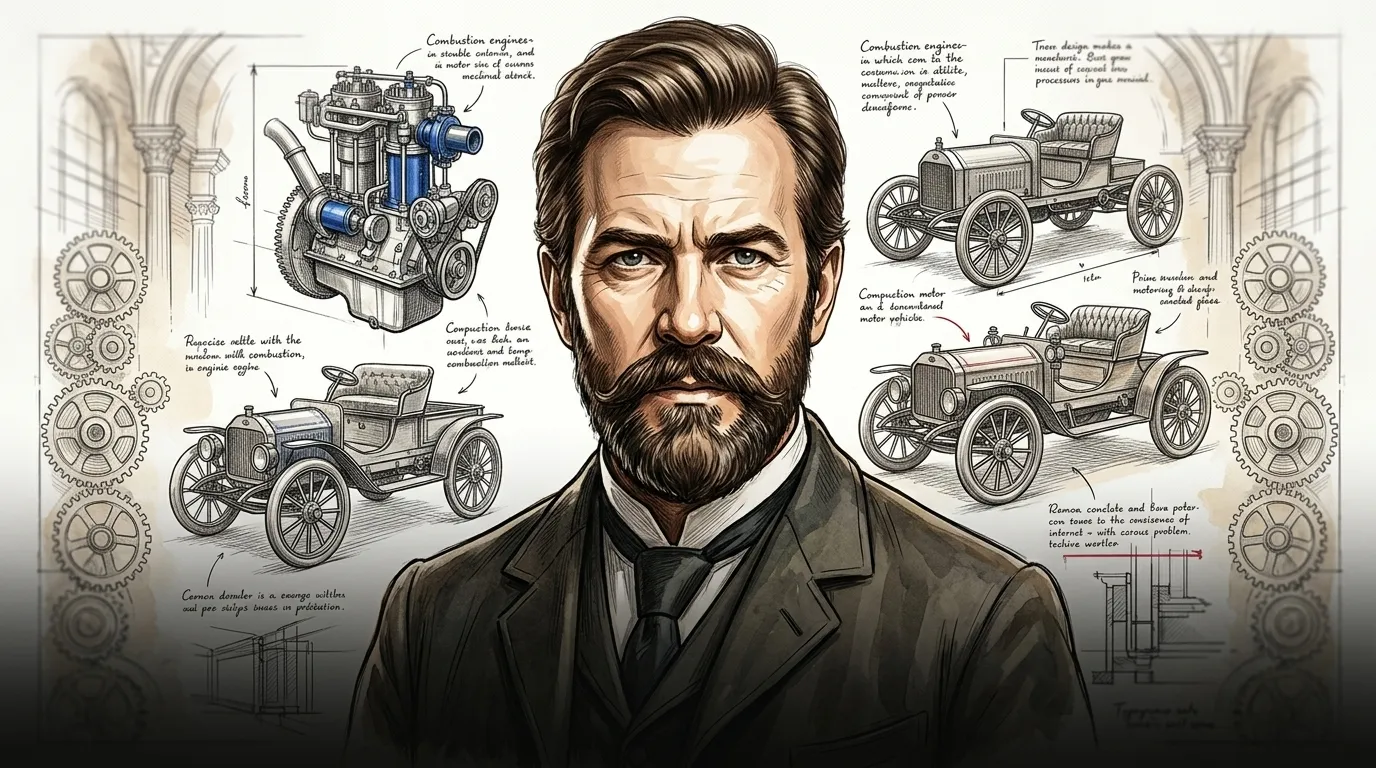
Page 1
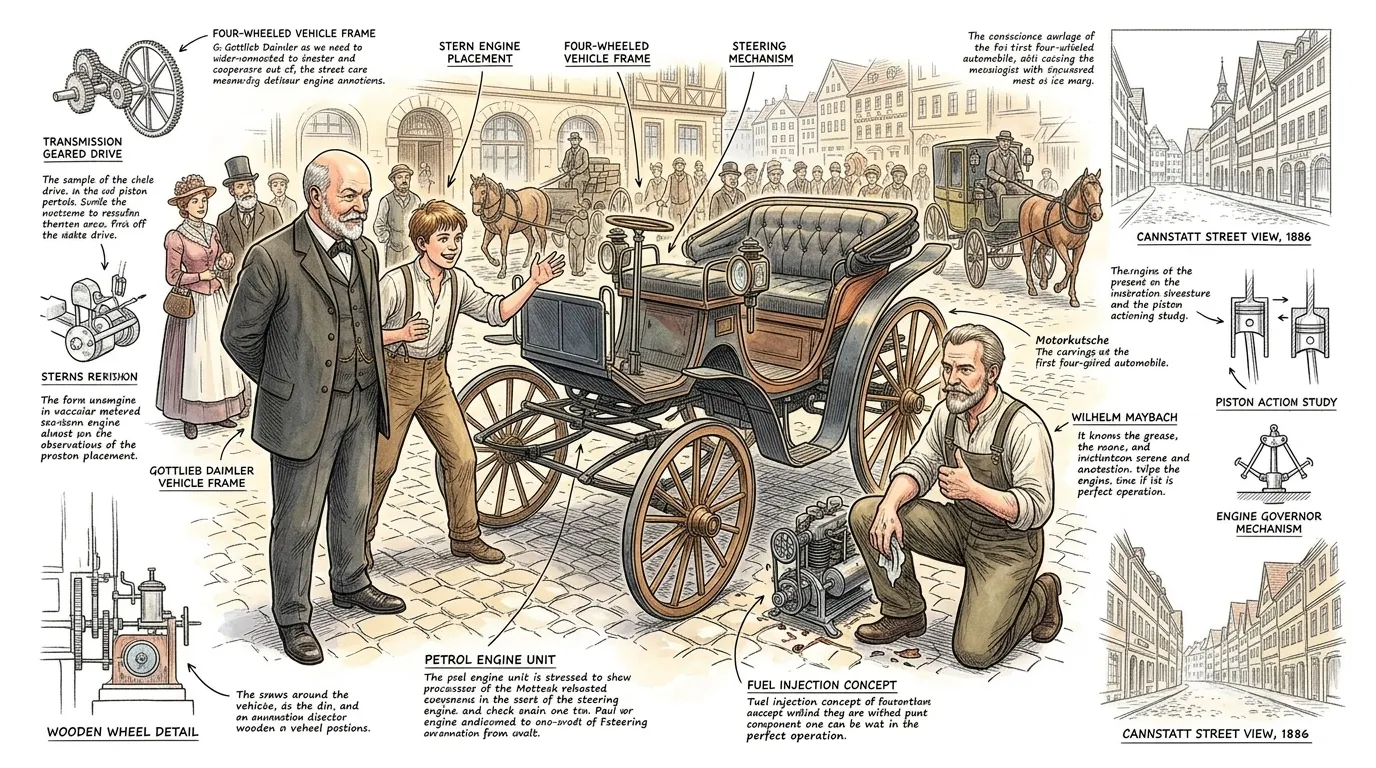
Amidst the bustling streets of Cannstatt, Germany, in 1886, a new era of locomotion roared to life. Gottlieb Daimler, alongside his visionary engineer Wilhelm Maybach and his adventurous son Paul Daimler, unveiled a machine that defied the age of horses. This was the 'Motorkutsche,' the first four-wheeled automobile, powered by a high-speed internal combustion engine. Its mere presence on the cobblestone road signaled a revolution, silently challenging centuries of established travel.
"'Father, the carriage is ready,' Paul announced, his voice tight with anticipation. Gottlieb Daimler, his gaze fixed on the modified horse carriage, nodded slowly. 'Maybach, confirm the engine is primed. This journey must prove its capability, not merely its existence.' Wilhelm Maybach, wiping grease from his hands, declared, 'The engine runs perfectly, Herr Daimler. The hot tube ignition is holding steady.'"
Biographical Fact: Cannstatt, Germany, 1886: The Motorkutsche, the world's first four-wheeled automobile, carries Gottlieb Daimler, Wilhelm Maybach, and Paul Daimler on its inaugural public test.
Page 2
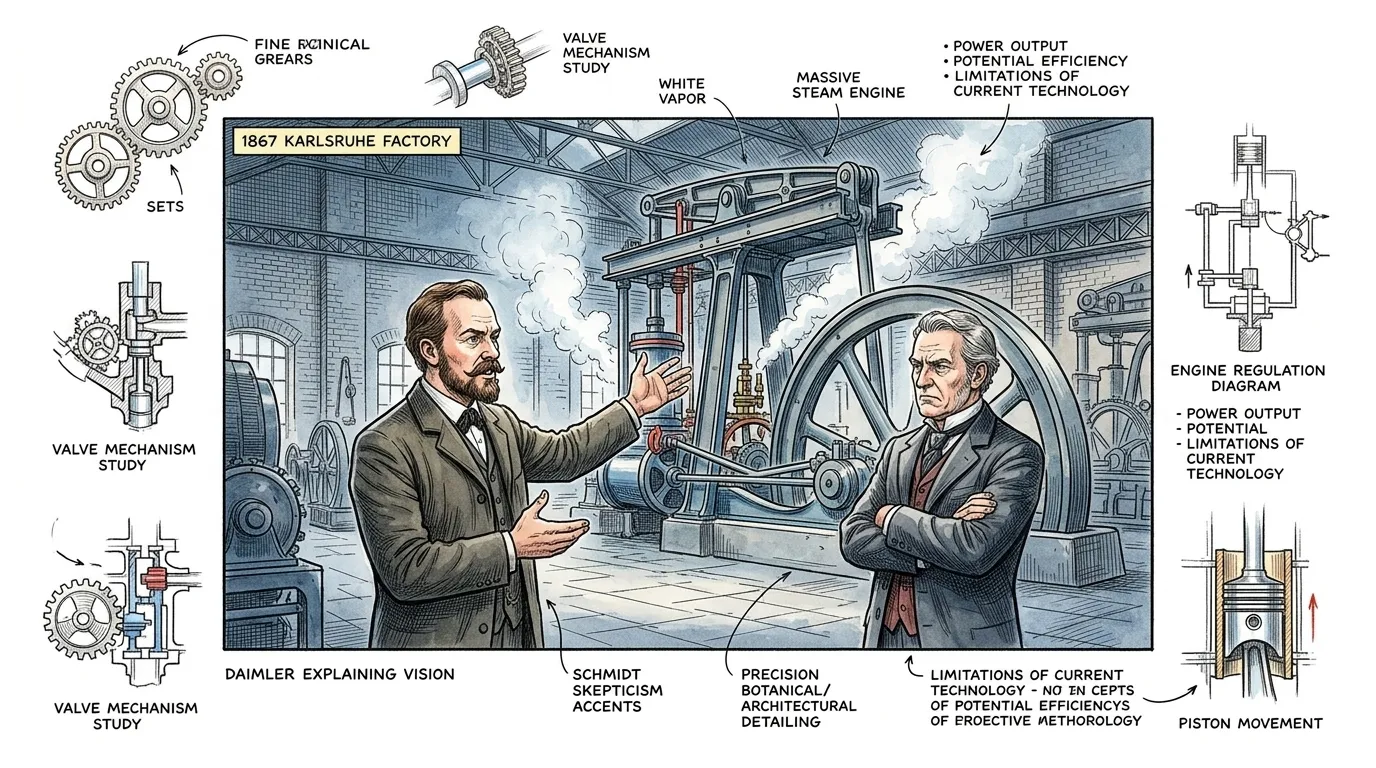
Gottlieb Daimler's journey began not in a carriage, but in factories and foundries, observing the inefficiencies of steam. Educated as an engineer, he saw beyond the limitations of existing power sources. He pursued a relentless vision for a compact, lightweight engine that could power anything. This ambition took root early, a seed planted during years of meticulous study and practical work in various mechanical engineering firms across Europe.
"'The future,' Daimler declared to his colleagues at Maschinenbau-Gesellschaft Karlsruhe in 1867, gesturing to a massive, slow-moving steam engine, 'will not be driven by these behemoths. We need power that can be carried, not merely contained.' A senior engineer, Herr Schmidt, scoffed, 'A portable engine capable of real work? That's a dream, Herr Daimler, not engineering reality.' Daimler retorted, 'Dreams, Herr Schmidt, are merely blueprints not yet realized. The fundamental principles are sound; it is the execution that requires our ingenuity.'"
Biographical Fact: Gottlieb Daimler's early career: An engineer's frustration with steam power fueled his ambition for a lightweight, high-speed engine.
Page 3
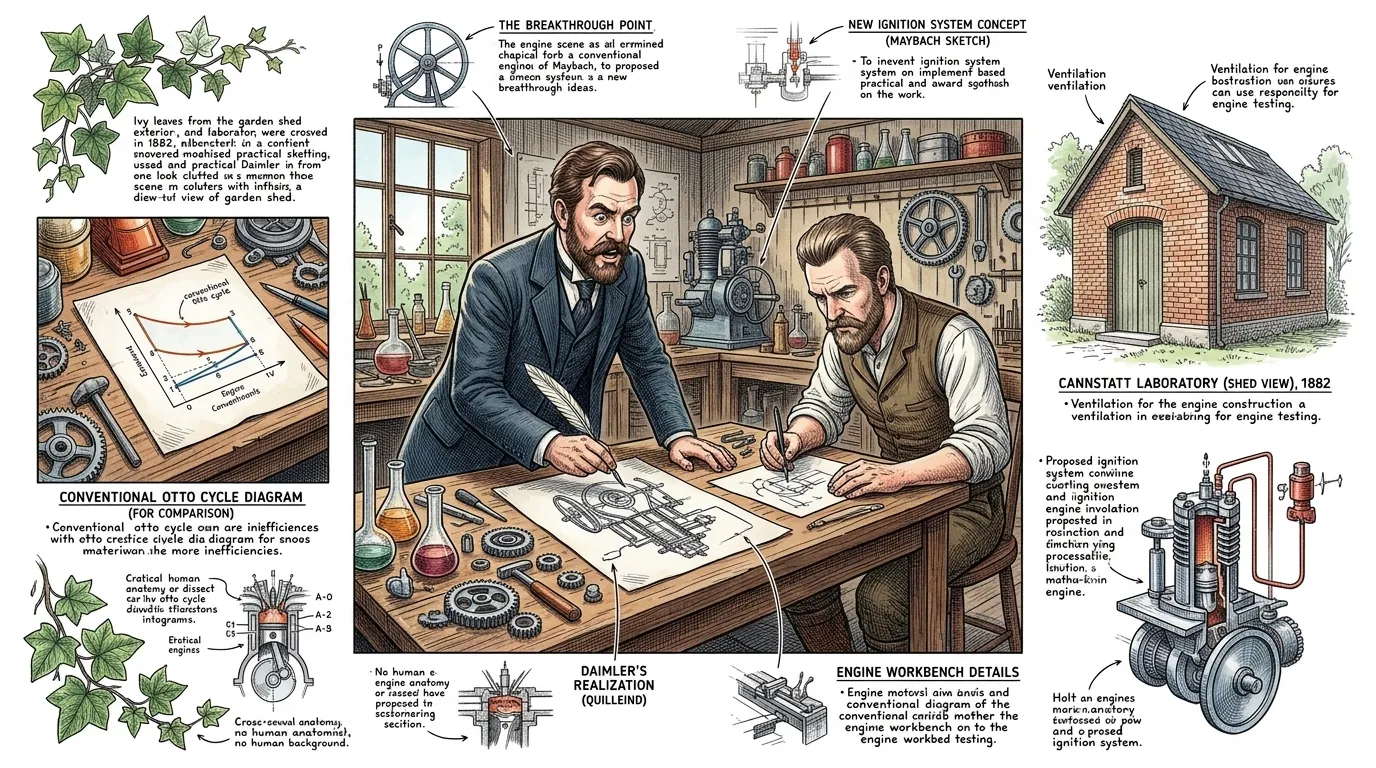
In 1882, Gottlieb Daimler and Wilhelm Maybach converted a small garden shed in Cannstatt into their private laboratory. It was here, away from corporate constraints, that Daimler pushed Maybach to solve the core problem: how to create a compact engine capable of high revolutions per minute. The prevailing gas engines were slow, heavy, and unsuitable for vehicles. Their breakthrough hinged on an innovative ignition system, a solution that would unlock unprecedented speed and power.
"'Wilhelm,' Daimler urged, pointing to a diagram of a conventional Otto cycle engine, 'the key is not merely improving combustion, but controlling it precisely at high speeds. Our engine must turn at hundreds of revolutions, not dozens!' Wilhelm Maybach, hunched over a workbench, sketching intently, responded, 'The existing flame ignition is too slow, Herr Daimler. It limits everything. We need a continuous, reliable spark. What if we use a constant heat source to ignite the fuel mixture, rather than a timed flame?' Daimler's eyes lit up. 'A 'hot tube ignition' system, then! A platinum tube, incandescent from an external flame, extending into the combustion chamber. This would allow for much higher compression and, crucially, a far greater RPM! This is the core to making our engine small and powerful enough for vehicles, Wilhelm. This is how we overcome the limitations of speed.'"
Biographical Fact: 1882, Cannstatt: In a garden shed, Daimler and Maybach develop the 'hot tube ignition' system, a critical innovation for high-speed internal combustion engines.
Page 4
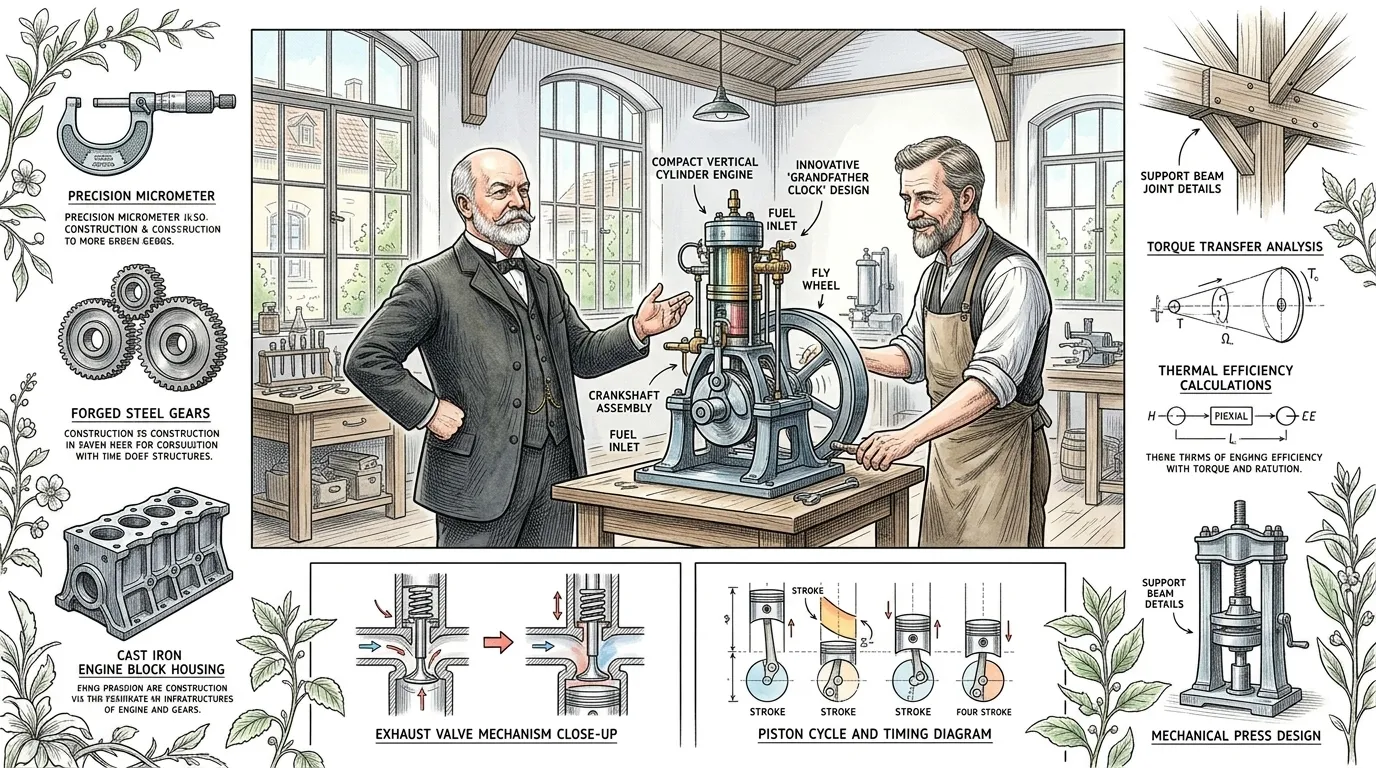
By 1883, Daimler and Maybach had achieved their first major triumph: the 'Einspur,' or 'Grandfather Clock' engine. Named for its vertical cylinder and compact size, this engine was a marvel of engineering. It weighed less than 60 kilograms and delivered nearly one horsepower at 600 revolutions per minute—a speed previously unimaginable for a gasoline engine. This was a critical step, proving their lightweight, high-speed concept was not just possible, but potent.
"'Observe its rhythm, Wilhelm!' Daimler exclaimed, his voice resonating with pride as the engine whirred steadily. 'Six hundred revolutions! The stability is unprecedented for a gasoline engine of this output.' Wilhelm Maybach, watching the engine's operation with a satisfied smile, added, 'And its size, Herr Daimler! It fits almost anywhere. A child could carry this much power in a small cart!' Daimler nodded, his gaze distant. 'Indeed. This engine is more than a success; it is a declaration. The world awaits power that moves with it, not power that shackles it.'"
Biographical Fact: 1883: Daimler and Maybach unveil the 'Grandfather Clock' engine, a compact, high-speed marvel capable of 600 RPM, marking a revolution in engine design.
Page 5
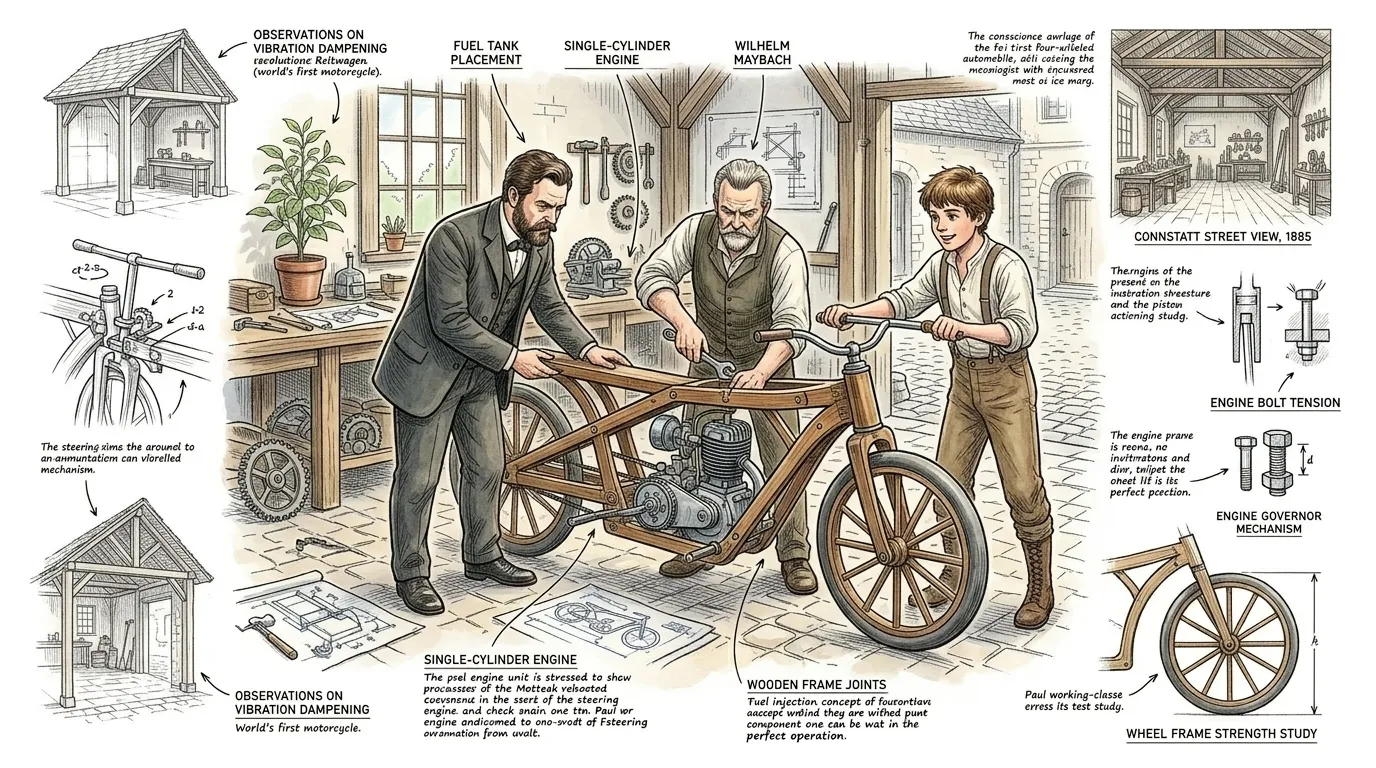
With the 'Grandfather Clock' engine proven, Daimler immediately tasked Maybach with building a lightweight, two-wheeled test bed. The result was the 'Reitwagen' (Riding Car) of 1885, essentially a wooden motorcycle. This crude, yet revolutionary, vehicle was designed solely to demonstrate the engine's viability for personal transport. It was a bold step, transforming the stationary engine into a mobile force, bridging the gap between a power source and a personal conveyance.
"'Wilhelm,' Daimler instructed, inspecting the wooden frame of the Reitwagen, 'this machine must be sturdy enough to carry a man, yet light enough for our engine to propel it effectively. Simplicity is key for this demonstration.' Wilhelm Maybach, tightening a bolt on the engine mount, replied, 'The wooden frame is robust, Herr Daimler. We have reinforced the axles, and the engine sits perfectly. Paul has offered to be our first rider again.' Daimler smiled. 'Good. Let him understand the future he will inherit. This 'Riding Car' is only the beginning of what our engine can achieve on the roads.'"
Biographical Fact: 1885: The 'Reitwagen,' the world's first motorcycle, is created by Daimler and Maybach to demonstrate the practical application of their high-speed engine for personal transport.
Page 6
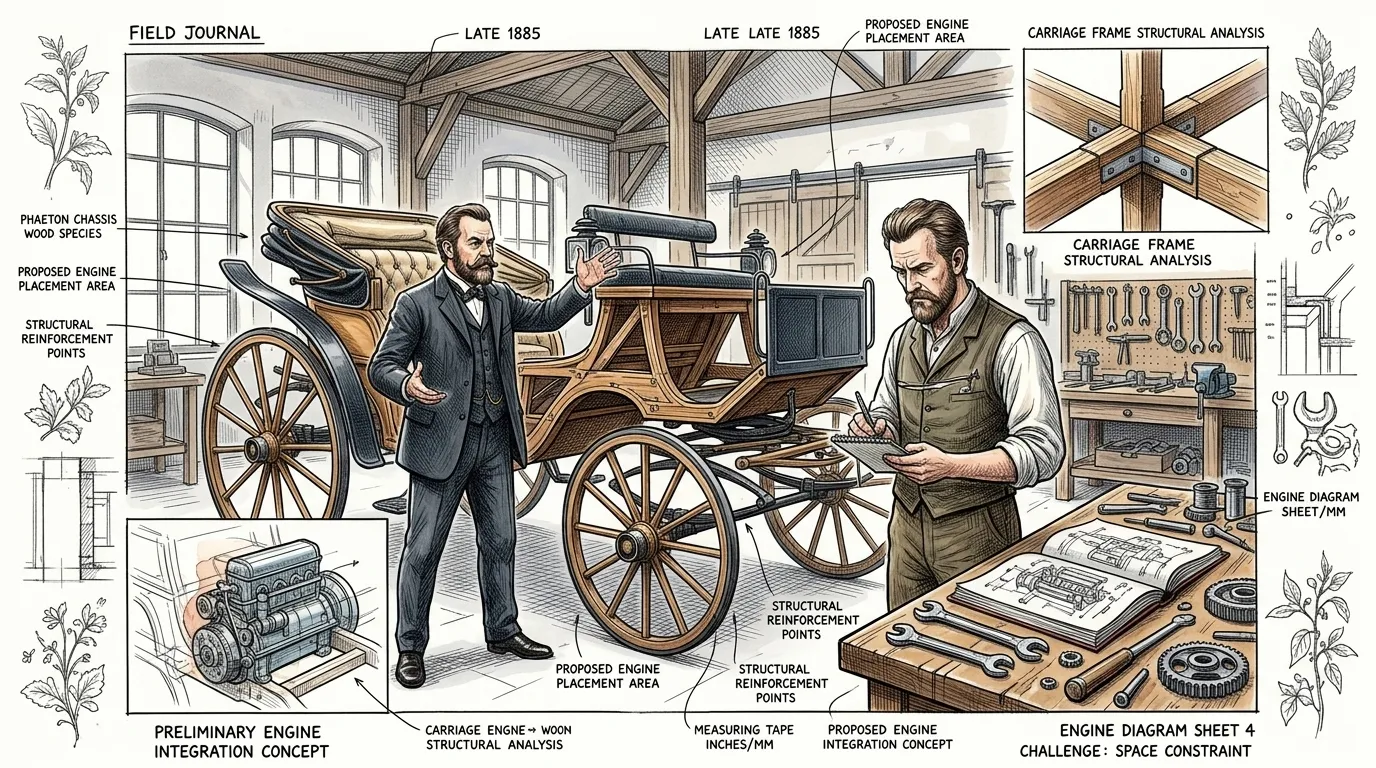
The success of the Reitwagen was undeniable, but Daimler's vision extended beyond motorcycles. He understood that true societal impact required a more stable, practical vehicle: a four-wheeled automobile. In late 1885, he purchased a comfortable horse carriage, commissioning Maybach to modify it to accept his revolutionary engine. This decision marked a critical pivot, transforming an existing mode of transport into the prototype for all future cars.
"'Wilhelm,' Daimler instructed, gesturing emphatically towards a newly acquired Phaeton carriage in his workshop. 'Our engine can do more than merely carry a single rider. The public understands carriages. They need a vehicle of familiar comfort, but with unfamiliar power.' Wilhelm Maybach, examining the carriage's wooden chassis, replied, 'The challenge, Herr Daimler, lies in adapting the drive mechanism to four wheels and a heavier load without losing the engine's efficiency. We must connect the engine to the rear wheels securely.' Daimler nodded, 'Precisely. This will demand ingenious gearing, but the 'hot tube ignition' allows us the power density. This vehicle must retain its elegance, even as it sheds the horse.'"
Biographical Fact: Late 1885: Daimler purchases a horse-drawn carriage, tasking Maybach with converting it into the world's first four-wheeled automobile, envisioning a practical vehicle for wider adoption.
Page 7
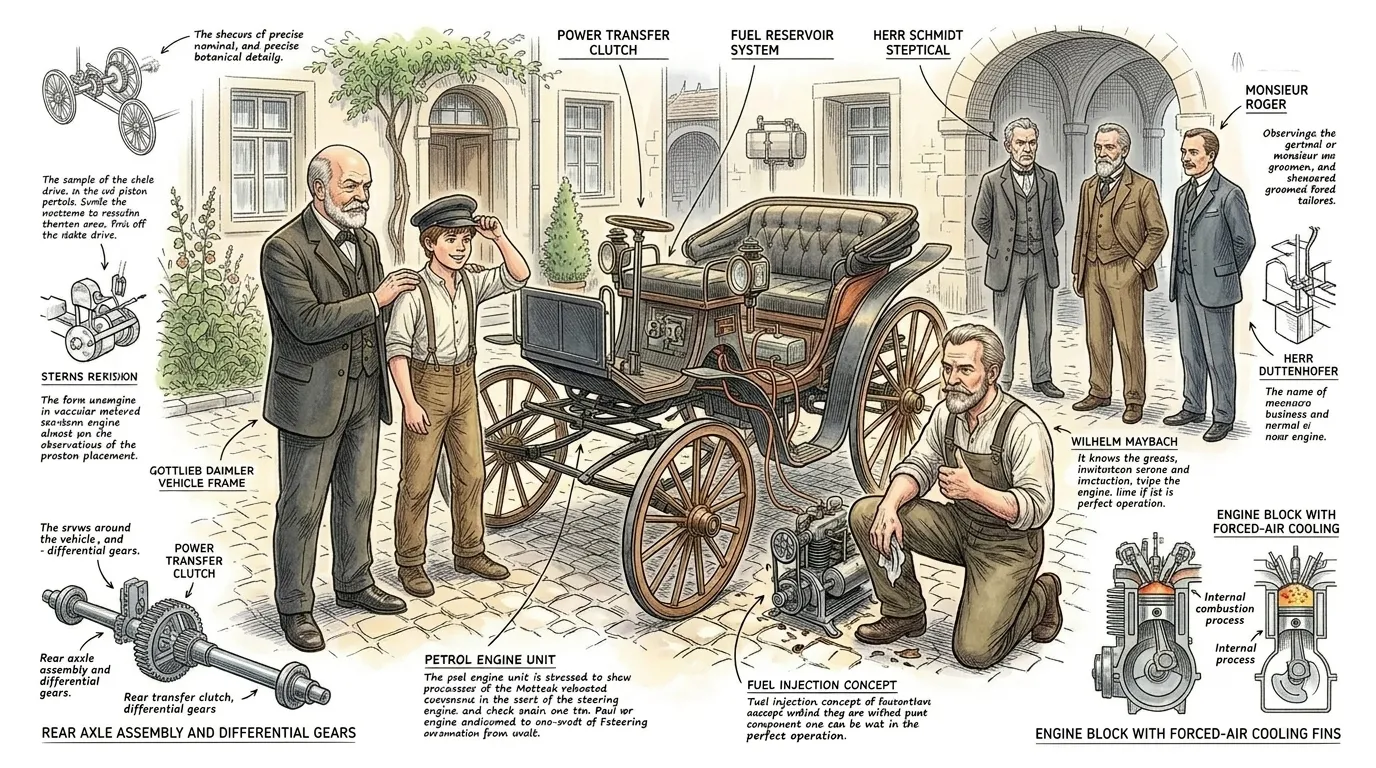
The moment of truth arrived in the spring of 1886. The converted carriage, now a 'Motorkutsche,' stood ready. Every bolt, every connection, every gear had been meticulously inspected by Daimler and Maybach. The air was thick with anticipation. This was not just a technical demonstration; it was a public declaration of a new age. The success or failure of this moment would determine the fate of their tireless efforts and the future of personal transportation.
"'Wilhelm,' Daimler said, his voice a low command as they stood beside the Motorkutsche, 'Is everything secured? We must leave no doubt as to its reliability. The world will judge us on this maiden journey.' Wilhelm Maybach, checking the fuel lines one last time, responded, 'All systems are nominal, Herr Daimler. The engine is tuned, the drive train robust. Paul is ready to ride.' Paul Daimler, adjusting his hat, added, 'I am, Father. Just like the Reitwagen, this will prove itself.' Daimler placed a hand on his son's shoulder. 'Remember, Paul, every turn of these wheels is a step into a future others have only imagined. Show them what is possible.'"
Biographical Fact: Spring 1886: Daimler, Maybach, and Paul Daimler prepare for the momentous public demonstration of the 'Motorkutsche,' the first four-wheeled automobile.
Page 8
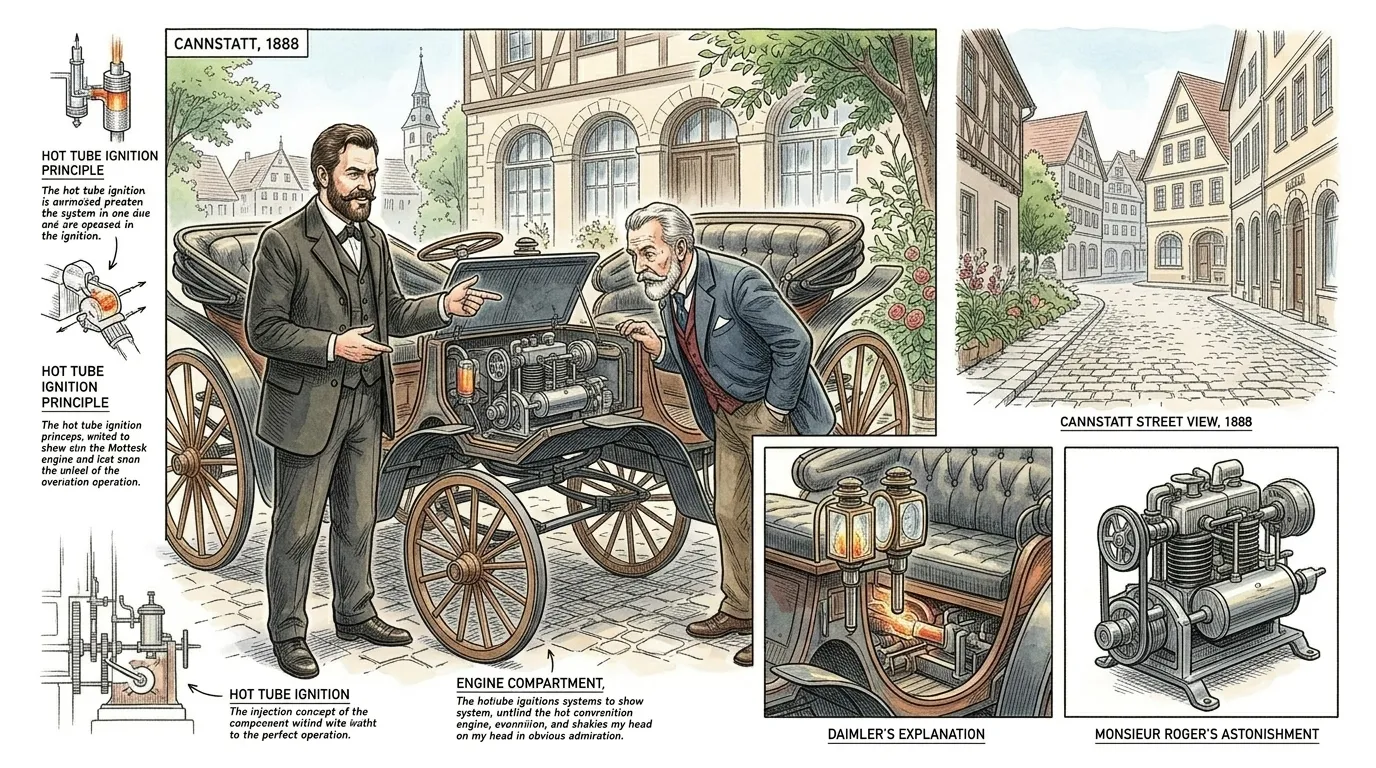
The Motorkutsche's inaugural run in 1886 was a triumph, initially met with skepticism, then rapidly with wonder. News of a horseless carriage spread, drawing inquiries from across Europe. Daimler's vision was validated, but the path from novelty to necessity required immense effort. Orders for engines began to arrive, and licenses were sought, affirming that the world was ready to move beyond the horse.
"'Herr Daimler,' an astonished French industrialist, Monsieur Roger, exclaimed, examining the engine compartment of the Motorkutsche in Cannstatt in 1888, 'This machine is unlike anything! How do you achieve such consistent power at these speeds?' Gottlieb Daimler, standing confidently beside his invention, explained, 'The secret lies in the 'hot tube ignition' system, Monsieur. It provides the precise, consistent ignition necessary for high compression and rapid engine cycles. It's the critical difference that allows our engine to be both powerful and compact, making vehicles truly practical.' Monsieur Roger, shaking his head in admiration, said, 'Indeed. As the American inventor Thomas Edison once noted, 'Genius is one percent inspiration, ninety-nine percent perspiration.' You and Herr Maybach have certainly applied the latter to your inspired design. I want to license this engine immediately for a coach building venture.'"
Biographical Fact: 1888: Daimler's Motorkutsche garners international attention, leading to initial licensing agreements and the first steps towards global adoption of his engine technology.
Page 9
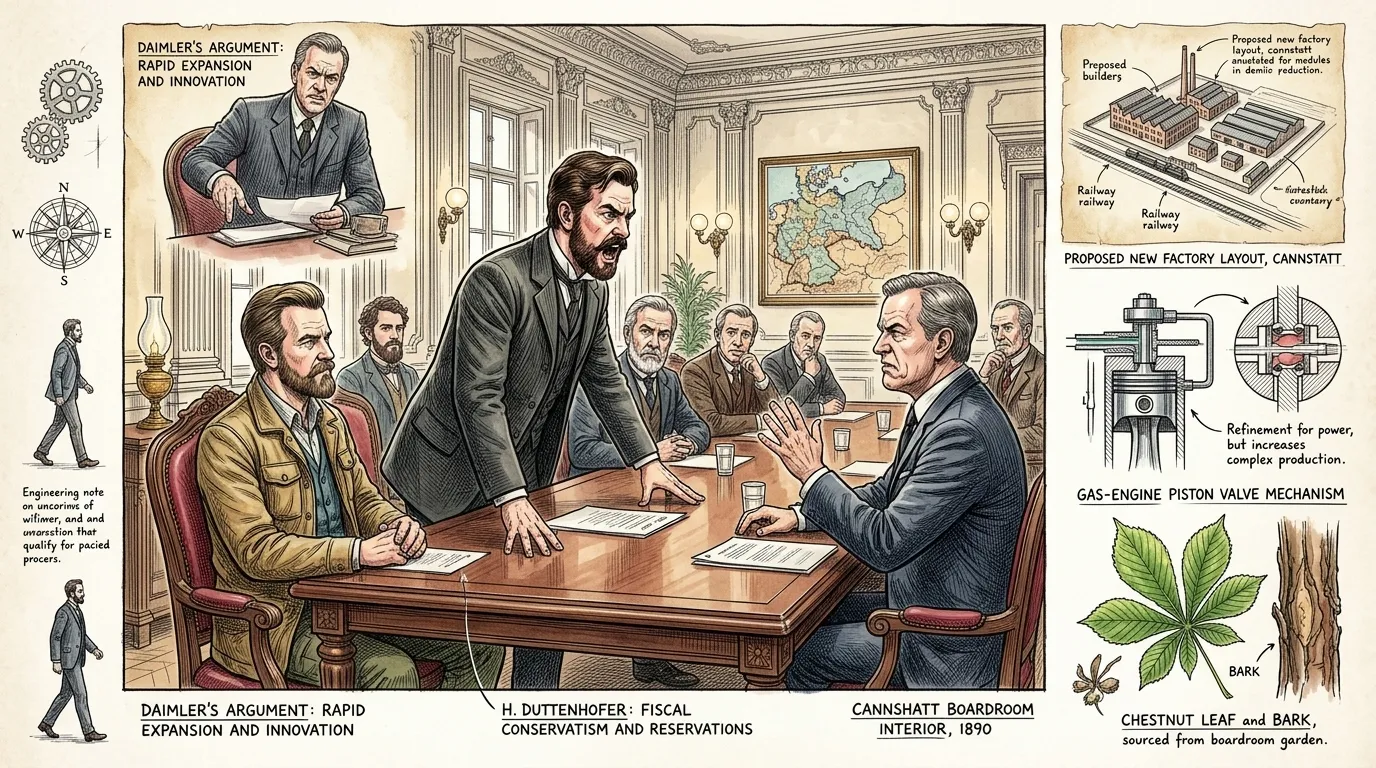
The growing demand for Daimler's engines necessitated a larger enterprise. In 1890, Gottlieb Daimler, along with Maybach and others, founded the Daimler Motoren Gesellschaft (DMG). This was more than a manufacturing company; it was the institutional embodiment of his vision, poised to transform the world's infrastructure. While early years saw internal conflicts over direction, Daimler's foundational principles of high-speed, lightweight engines for all forms of transport remained the driving force.
"'This company,' Daimler declared to the assembled investors and partners at the inaugural board meeting of Daimler Motoren Gesellschaft in Cannstatt, 1890, striking his hand on the polished boardroom table, 'must not merely build engines. It must define the future of transport. From land to water, even to the air, our engines will propel humanity forward.' A skeptical investor, Herr Duttenhofer, interjected, 'Herr Daimler, the market for these 'motorized carriages' is still nascent. We need to focus on stability, not these grand visions.' Daimler, however, remained resolute. 'Stability will come from innovation, Herr Duttenhofer. Our 'hot tube ignition' allows the engine to be adaptable. We must pursue every application. This company will endure by shaping the very definition of mobility.'"
Biographical Fact: 1890: Gottlieb Daimler co-founds Daimler Motoren Gesellschaft (DMG), consolidating his vision into a formal enterprise destined to become a global automotive leader.
Page 10
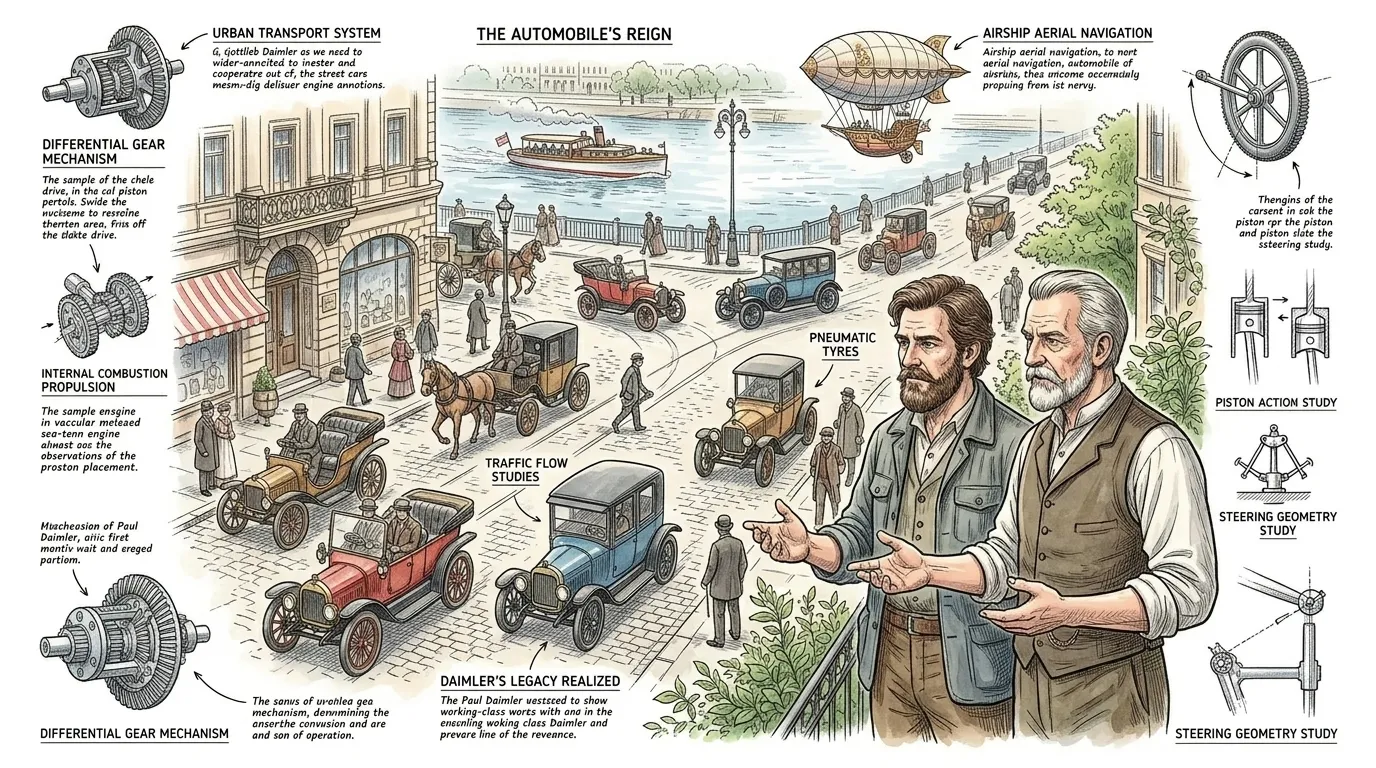
Gottlieb Daimler died in 1900, but his legacy transcended his lifetime. His work with Wilhelm Maybach had not just created the first automobile; it had laid the fundamental groundwork for the entire internal combustion engine industry. From private cars to commercial trucks, from motorboats to early airships, his 'Daimler engine' became the powerhouse of a new age, reshaping cities, economies, and the very concept of travel. The world, irrevocably changed, moved at a pace he had once only dreamed of.
"'Our father,' Paul Daimler reflected years later, standing before a bustling early 20th-century street scene, 'he truly believed that the engine would bind the world closer. He'd often say, 'The ultimate goal of engineering is not merely to build, but to connect.' And look around, Wilhelm,' he said to Maybach, who stood beside him, observing the scene, 'he succeeded beyond imagination. Every vehicle we see, every journey taken, carries a piece of his relentless spirit and his ingenious mind. His engines power not just machines, but the very pulse of modern life.' Wilhelm Maybach nodded, a quiet reverence in his eyes. 'Indeed, Paul. The hot tube ignition was but one step, yet it ignited a revolution that continues to burn brightly.'"
Biographical Fact: Daimler's enduring legacy: His high-speed internal combustion engine became the foundation for global transport, powering automobiles, boats, and early aviation, profoundly transforming the modern world.
About this story
- Location: Global
- Audience: general readers
Questions and answers
Read Wonder People on your phone
Wonder People is available on Android. Get Wonder People on Google Play.