Jack Kilby
Jack Kilby — an illustrated biography story, set in Global. 10 illustrated pages, free to read on Wonder People.
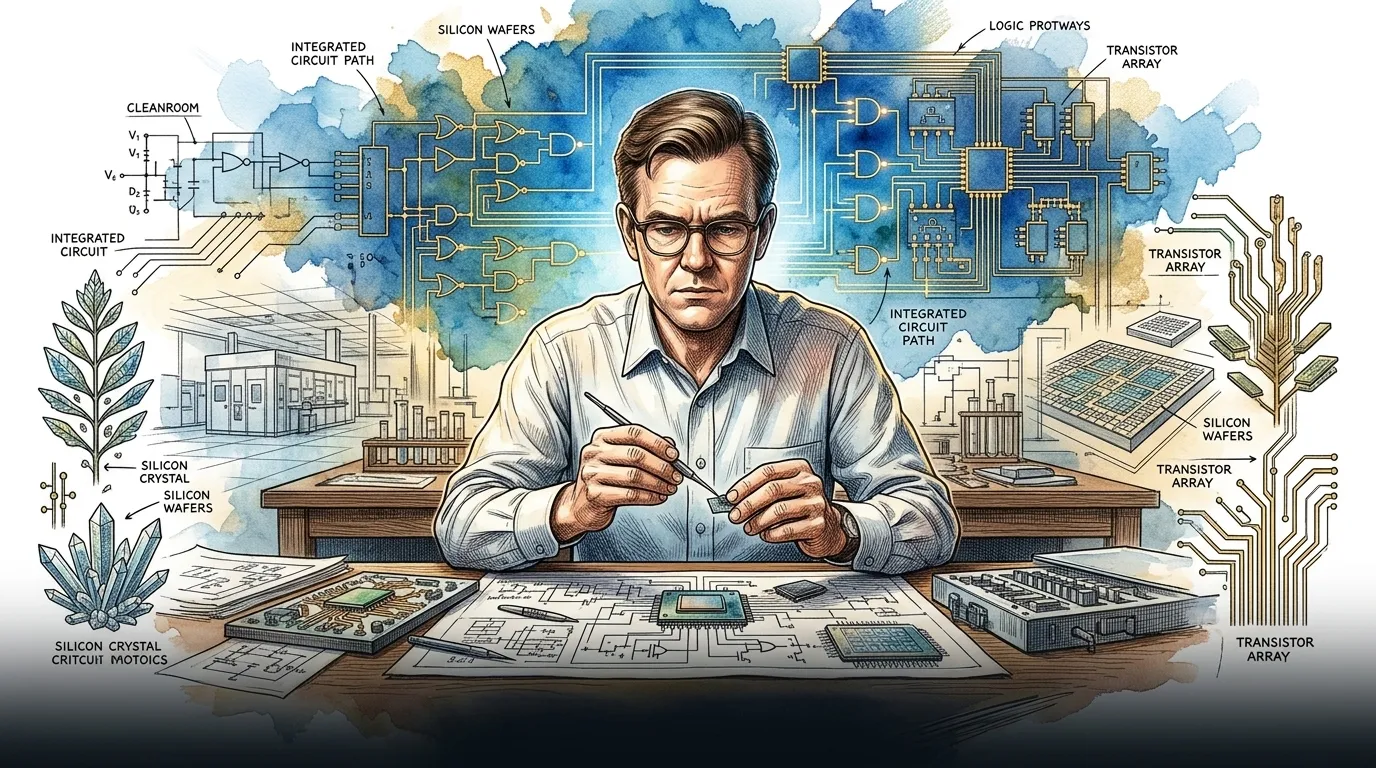
Page 1
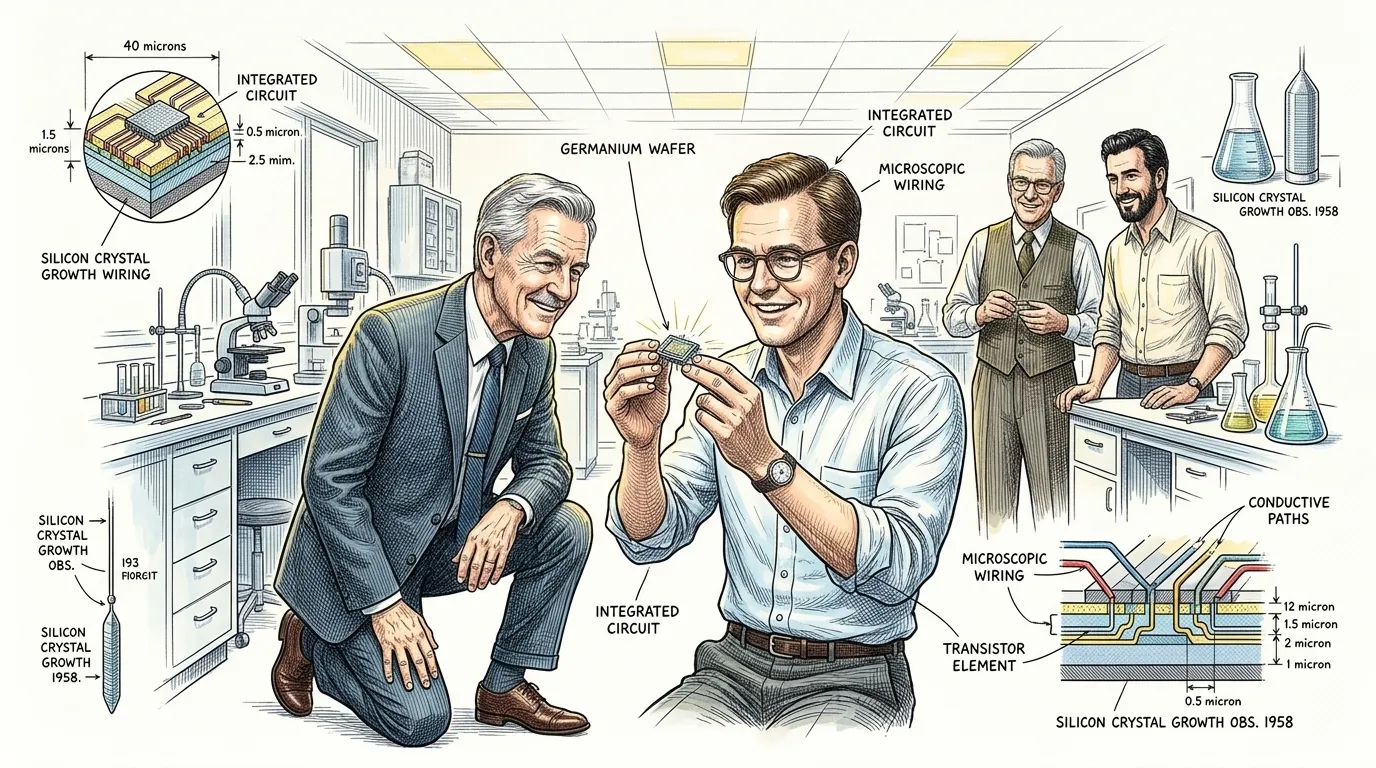
At Texas Instruments' semiconductor laboratory in Dallas, Texas, in the scorching summer of 1958, a quiet engineer named Jack Kilby held aloft a sliver of germanium. On this single piece of material, he had successfully integrated a complete electronic circuit. This functional phase-shift oscillator, measuring a mere 7/16 by 1/16 inches, contained all necessary components within its monolithic structure, an achievement previously deemed impossible. Cecil H. Green, co-founder of Texas Instruments, leaned forward intently, his gaze fixed on the minuscule device, understanding the profound shift it represented.
Biographical Fact: August 12, 1958, marked the public demonstration of Jack Kilby's integrated circuit, a moment that irrevocably changed the course of electronics. The phase-shift oscillator circuit proved that all components could exist on a single piece of semiconductor material.
Page 2

Jack Kilby, growing up in Great Bend, Kansas, experienced firsthand the limitations of communication technology. When ice storms downed telephone lines, he observed the fragility of interconnected systems. This early exposure to the vulnerability of discrete component electronics ignited a singular drive within him: to engineer robust, self-contained solutions. He pursued electrical engineering, instinctively seeking simplicity and integration.
"Jack often mused to his father, 'Every wire is a potential failure point. There has to be a better way to build these machines, a way to make them whole.'"
Biographical Fact: Kilby's formative years in rural Kansas, particularly the logistical challenges of maintaining electrical infrastructure, profoundly influenced his lifelong quest for miniaturization and integrated electronic design.
Page 3
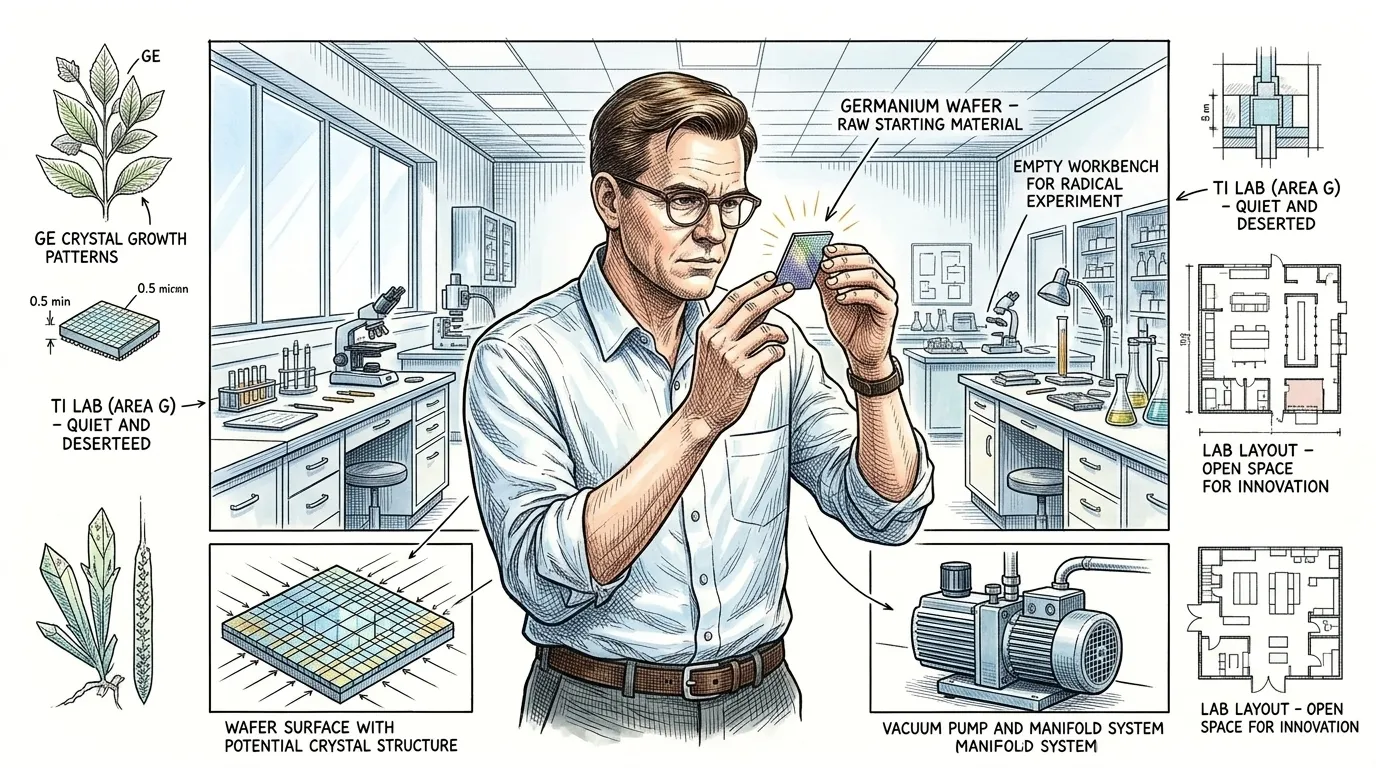
In May 1958, Jack Kilby arrived at Texas Instruments, a new hire. His colleagues departed for their annual summer vacation, leaving Kilby alone in the laboratory. This unplanned isolation became his decisive advantage. He recognized the chance to pursue his radical concept: building electronic components—resistors, capacitors, and transistors—directly onto a single block of semiconductor material, eliminating countless wires.
"Alone in the quiet lab, Jack turned to an empty bench. 'They've gone,' he noted, 'but the work of reducing complexity has just begun.' He picked up a fresh germanium wafer, contemplating its potential."
Biographical Fact: The 'Kilby Holiday' of summer 1958 provided Kilby with uninterrupted time to explore the then-unorthodox idea of integrating all circuit components onto a single semiconductor substrate, a concept largely dismissed by others at the time.
Page 4
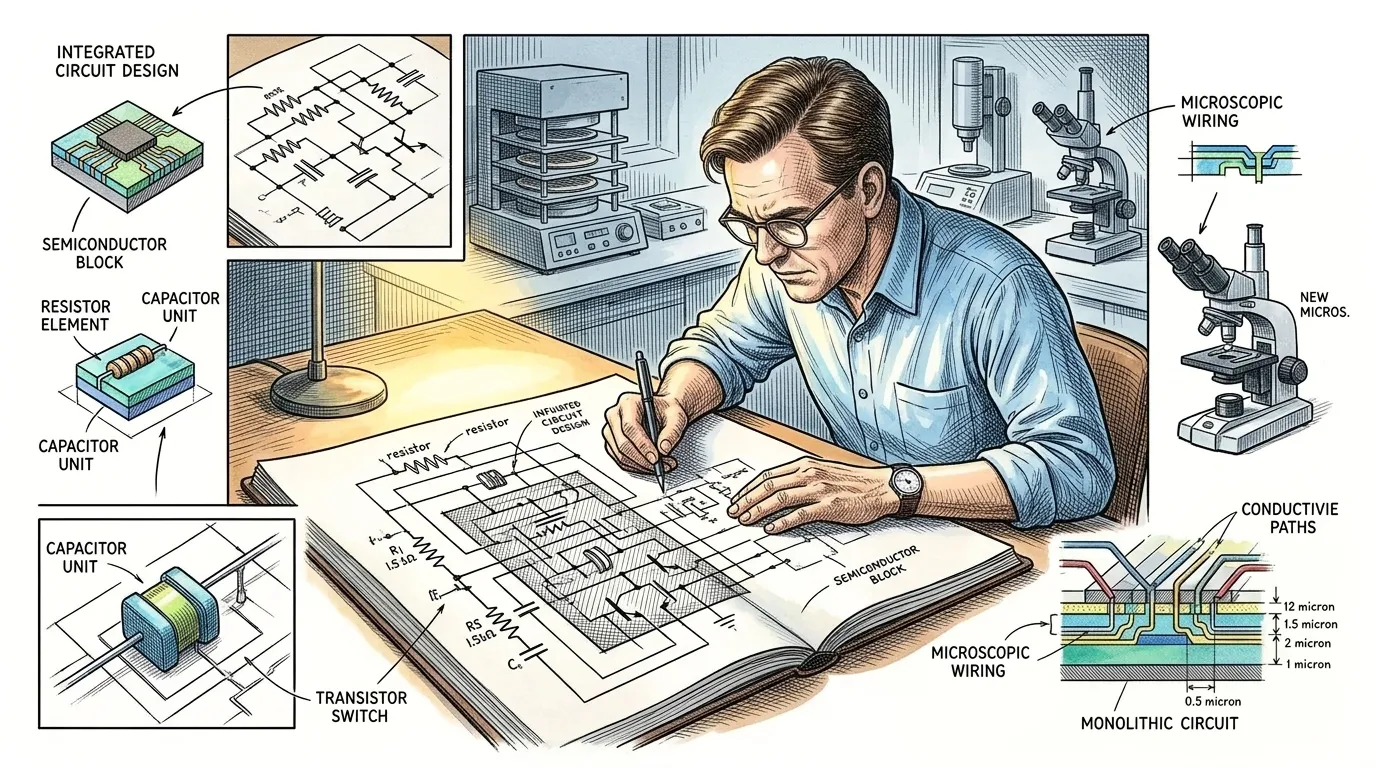
Kilby spent weeks in focused solitude, sketching intricate designs and performing calculations. He meticulously detailed how resistors, capacitors, and transistors could be fabricated in situ within a single block of silicon or germanium. His initial notebook sketches demonstrated the core principle: a complete circuit, not merely a collection of parts, residing on a single chip. This fundamental shift challenged decades of conventional electronics design.
"Jack sketched furiously in his notebook. 'The material itself must define the components,' he murmured. 'No more soldering, no more individual packaging. This is the only way to true miniaturization.'"
Biographical Fact: Kilby's conceptual breakthrough lay in understanding that different electronic functions could be realized using the bulk properties of semiconductor material itself, bypassing the need for separate, bulky components and their complex interconnections.
Page 5
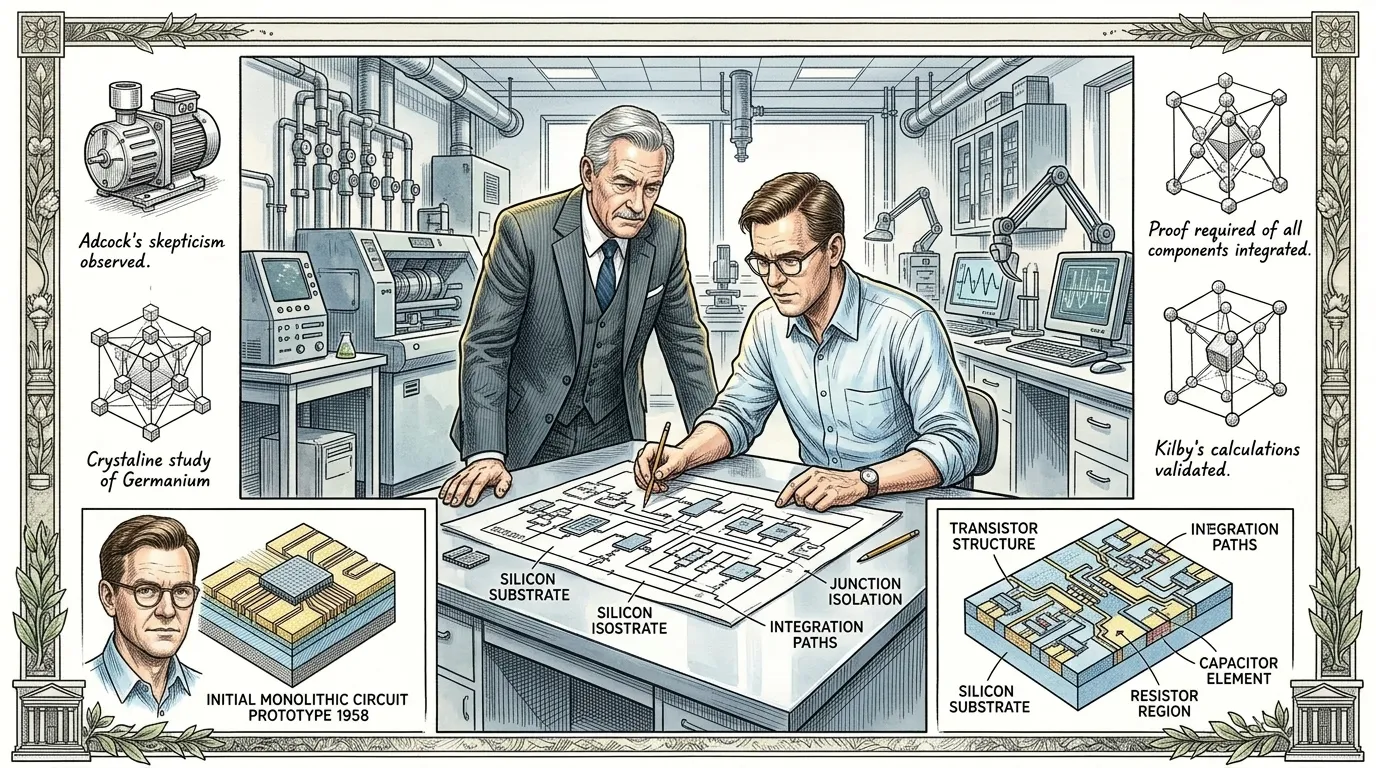
Upon their return, Kilby's colleagues and superiors, including Willis Adcock, then head of Texas Instruments' solid-state department, initially viewed his proposal with skepticism. The idea of manufacturing all components on one tiny chip seemed impractical, even impossible, given the limitations of 1958 technology. Undeterred, Kilby pushed forward, demonstrating his calculations and initial prototypes to prove the viability of his 'monolithic circuit' concept.
"Willis Adcock, standing over Kilby's shoulder, examined the diagrams. 'Kilby, this is ambitious,' he stated, 'but how will you isolate the components? The fabrication tolerances...' Jack interrupted, 'We will etch directly onto the substrate, Mr. Adcock. The challenge is immense, but the principle is sound.'"
Biographical Fact: The prevailing engineering wisdom favored assembling discrete components. Kilby faced significant resistance, as his monolithic approach required new thinking in fabrication and material science, pushing the boundaries of what was technologically possible.
Page 6
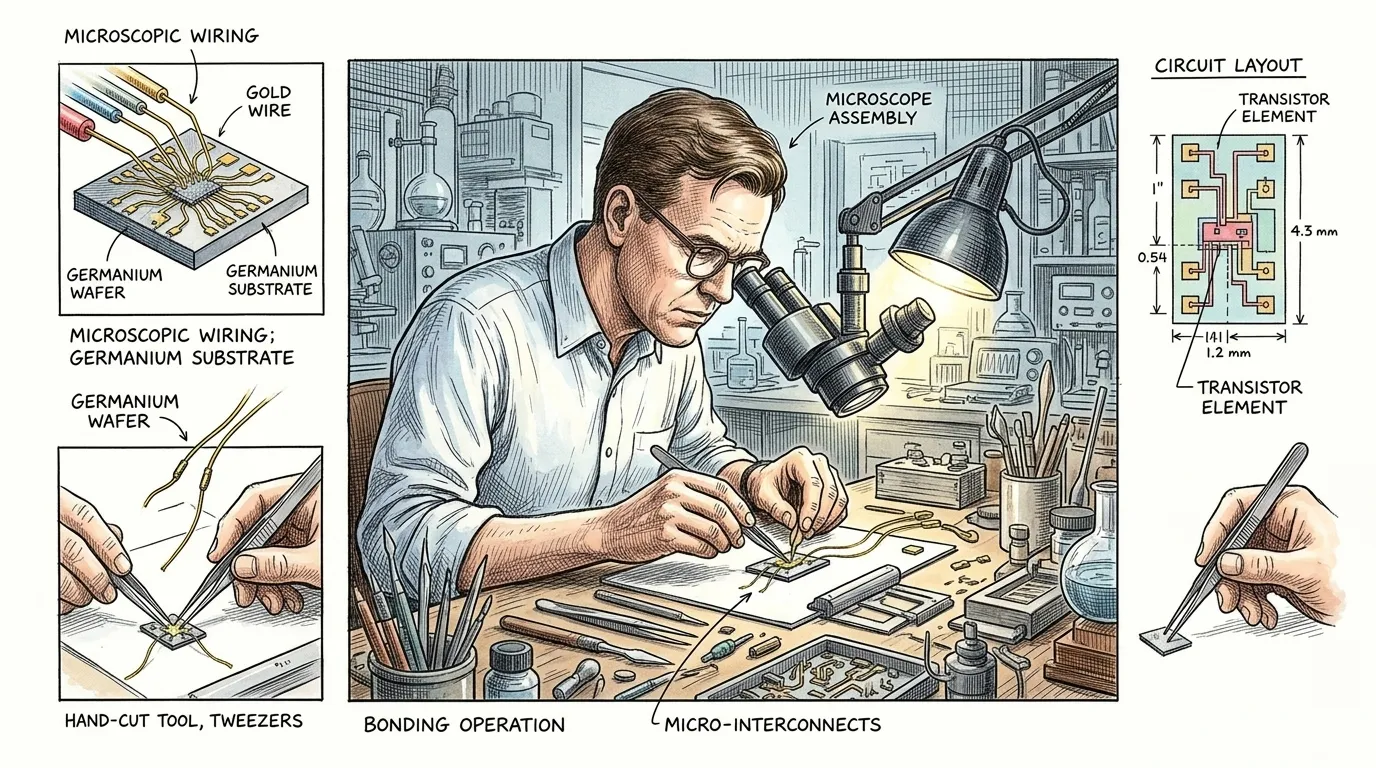
With partial approval, Kilby began the painstaking process of fabricating his first integrated circuit. He utilized germanium because Texas Instruments had more experience with it than silicon. Each step—from etching the tiny components to depositing the gold wires for external connections—was performed with crude, improvised tools, often hand-cut and assembled. The margin for error was infinitesimal, demanding meticulous precision and relentless experimentation.
"Jack hunched over a microscope, manipulating tiny gold wires with tweezers. 'Every connection must be perfect,' he muttered, 'a single stray electron, a single impurity, and the whole concept fails.' He paused, adjusting a delicate tool. 'As Marie Curie once said, 'Nothing in life is to be feared, it is only to be understood.''"
Biographical Fact: The primitive manufacturing techniques of the 1950s made Kilby's work extraordinarily challenging. His success relied on careful hand assembly and a deep understanding of semiconductor physics, transforming his conceptual designs into a tangible device.
Page 7
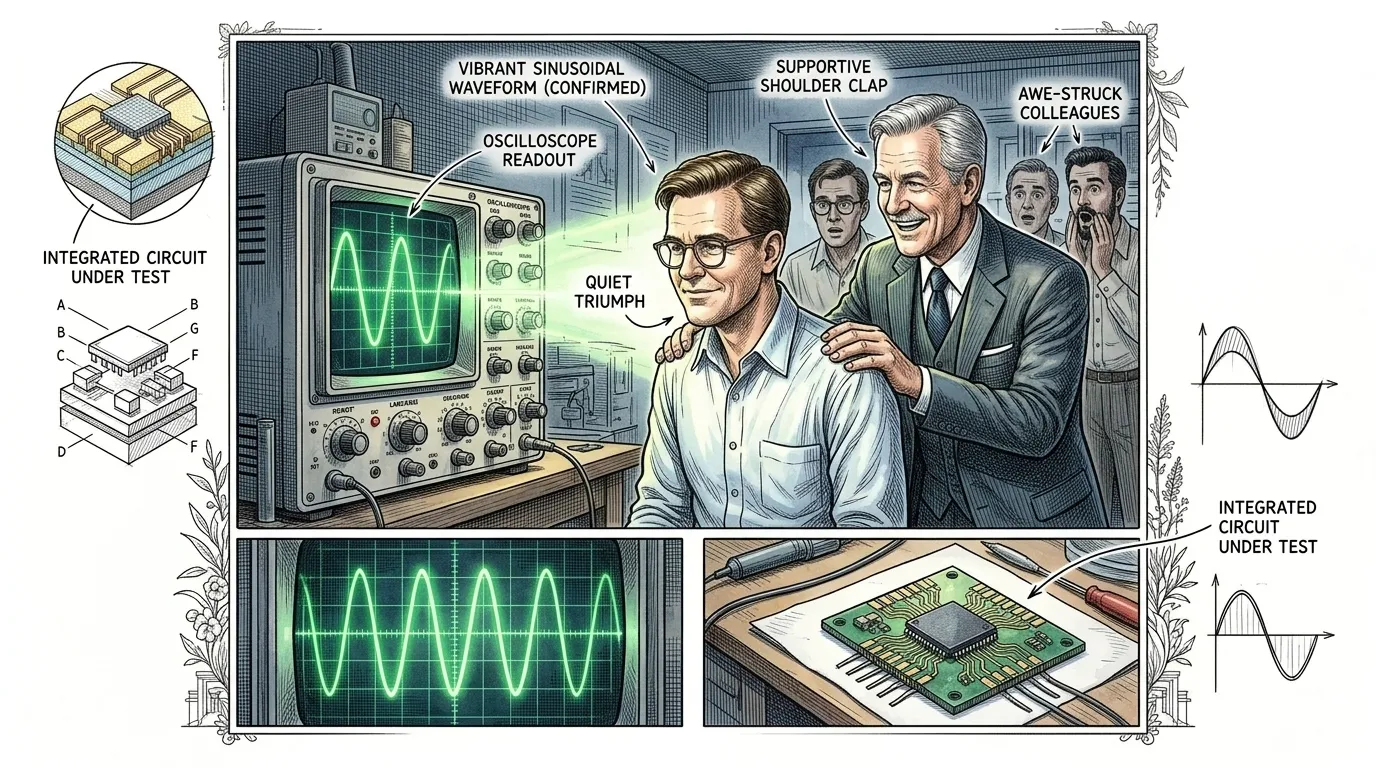
The assembled integrated circuit, encapsulated in a small metal canister, was connected to a test setup. Colleagues gathered, their skepticism still palpable. Kilby connected the power, and the oscilloscope screen, previously flatlining, displayed a perfect sinusoidal wave. The phase-shift oscillator was working. The room erupted in a mixture of gasps and relieved exclamations. The tiny germanium chip had just proven a revolutionary principle.
"Jack watched the oscilloscope, his breath held. As the waveform appeared, he let out a long sigh. 'It works,' he stated simply, a profound sense of accomplishment in his voice. Willis Adcock clapped him on the shoulder, his face now beaming. 'Kilby, you've done it!'"
Biographical Fact: September 12, 1958, marked the successful operation of Kilby's integrated circuit. This demonstration validated his concept, transforming a theoretical possibility into a functional reality and silencing his critics.
Page 8
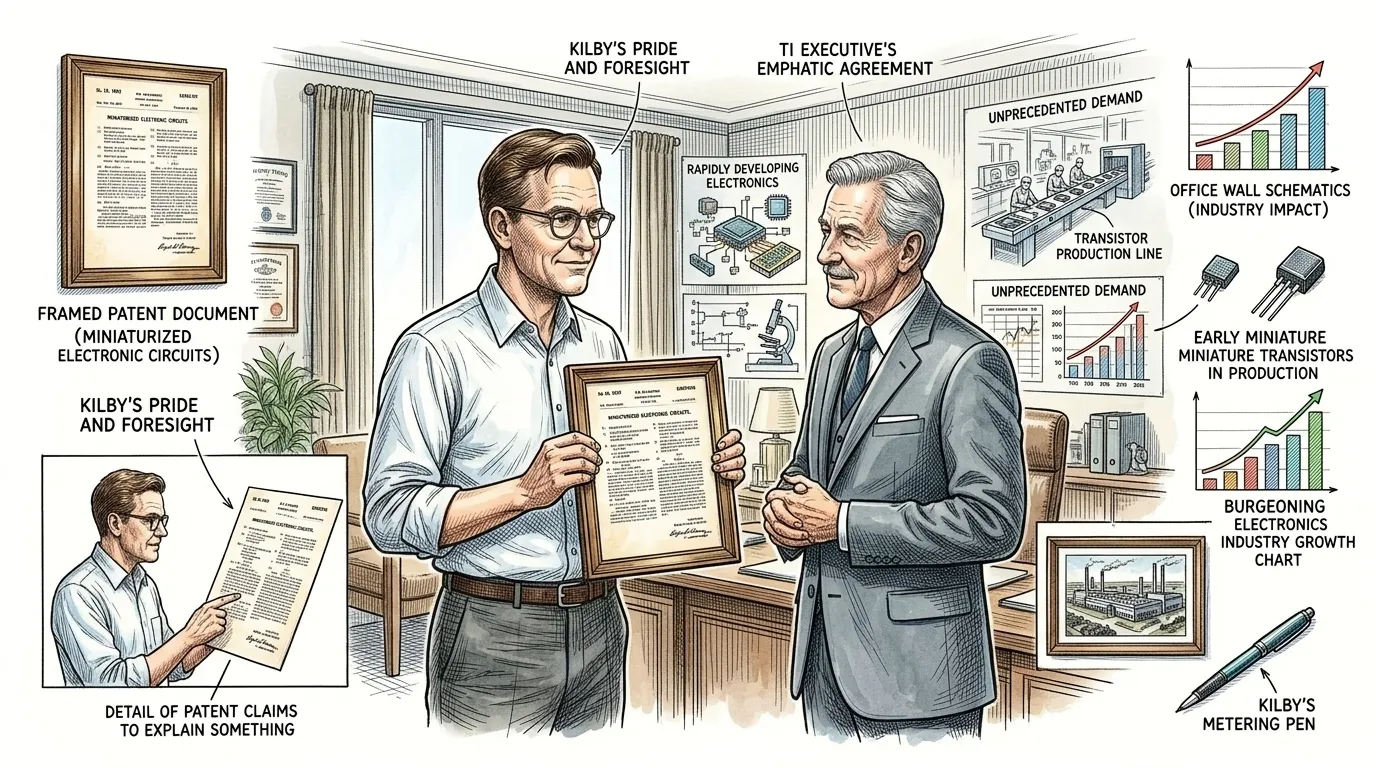
The success of Kilby's integrated circuit at Texas Instruments sparked a revolution. The company immediately moved to patent his invention, filing for 'Miniaturized Electronic Circuits' in February 1959. Suddenly, the impossible became the inevitable. Other companies, notably Fairchild Semiconductor with Robert Noyce's planar process, rapidly developed their own versions. The race to commercialize this groundbreaking technology transformed the electronics industry, laying the foundation for modern computing.
"Jack, now holding a framed patent document, remarked to a Texas Instruments executive, 'This isn't just about a patent, it's about a new way of thinking about electronics. This will change everything.' The executive nodded, 'Indeed, Mr. Kilby. The demand is already unprecedented.'"
Biographical Fact: Texas Instruments filed U.S. Patent 3,138,743 for 'Miniaturized Electronic Circuits' on February 6, 1959. This landmark patent, alongside Robert Noyce's advancements at Fairchild, ignited the microchip industry, driving rapid innovation and competition.
Page 9
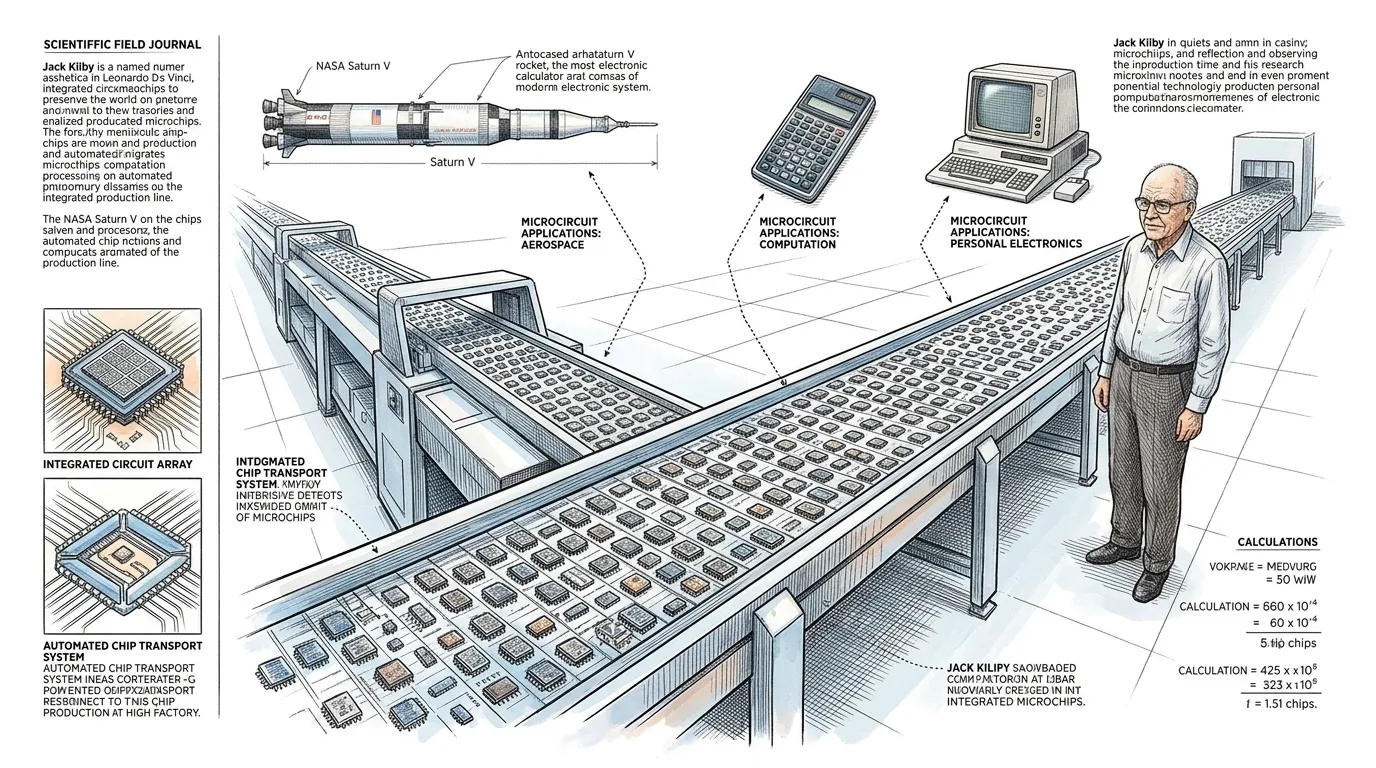
Within years, Kilby's integrated circuit moved beyond laboratory curiosities. It powered early NASA rockets, revolutionized handheld calculators, and became the foundational building block for personal computers. The ability to pack more computing power into ever-smaller spaces ignited the digital age. This monolithic device transformed every aspect of human life, from communication and commerce to science and entertainment, fulfilling Kilby's early vision of reducing complexity.
"Years later, observing a production line of microchips, Jack reflected, 'Every one of these tiny chips represents countless individual components that no longer need to be assembled. We removed the wires, and in doing so, we opened up a universe.'"
Biographical Fact: The integrated circuit's impact was profound and immediate, miniaturizing electronics to an unprecedented degree. It enabled the development of microprocessors, memory chips, and eventually, the entire ecosystem of digital technology, fundamentally reshaping modern society.
Page 10
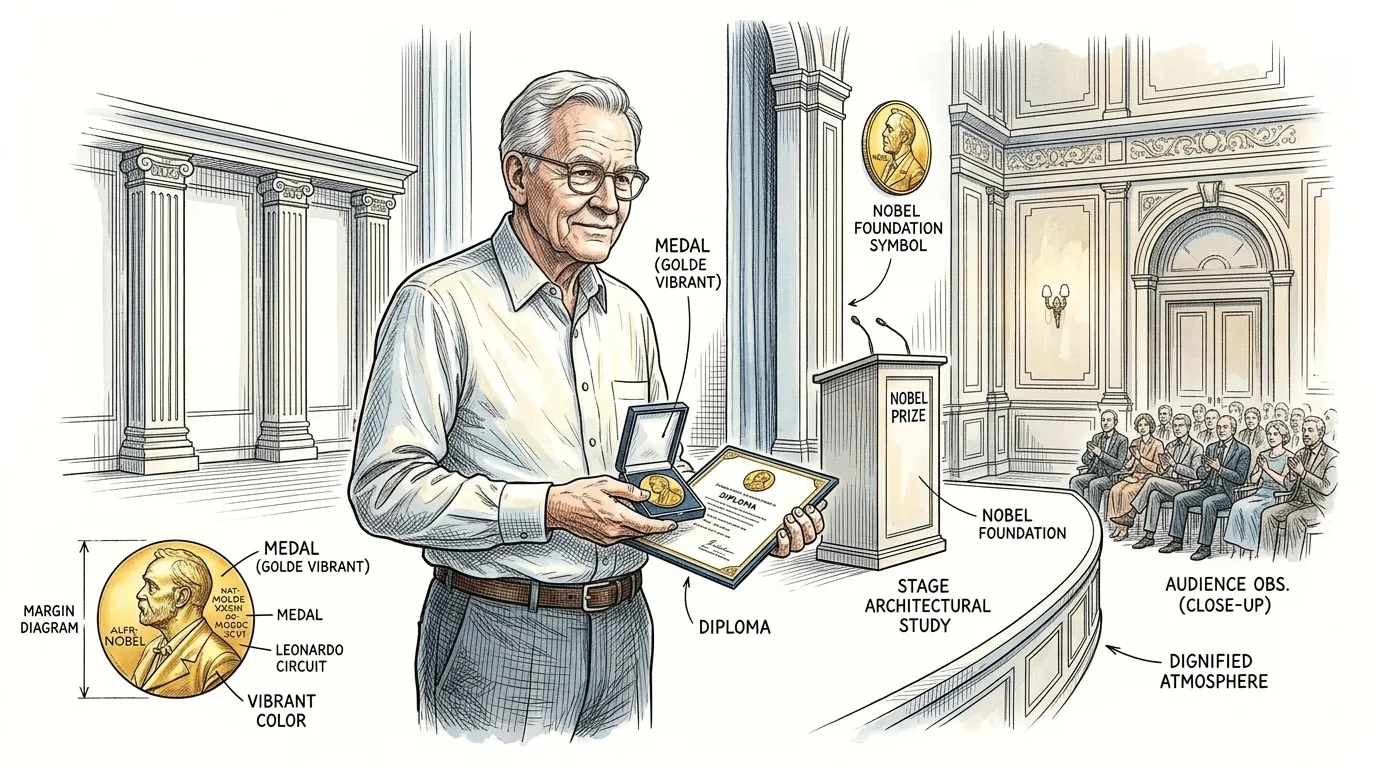
Jack Kilby received the Nobel Prize in Physics in 2000, honoring his 'part in the invention of the integrated circuit.' This recognition cemented his place as one of the architects of the digital revolution. His quiet determination, coupled with a profound understanding of material science, led to an invention that remains indispensable. The integrated circuit continues to shrink, expand, and power every facet of our connected world, a testament to Kilby's foundational insight.
Biographical Fact: Kilby's Nobel Prize acknowledged the pivotal role his invention played in the evolution of electronics. The integrated circuit, now ubiquitous, continues to drive technological advancement, making him a central figure in the history of the digital age.
About this story
- Location: Global
- Audience: general readers
Questions and answers
Read Wonder People on your phone
Wonder People is available on Android. Get Wonder People on Google Play.