James Watt
James Watt — an illustrated biography story, set in Global. 10 illustrated pages, free to read on Wonder People.
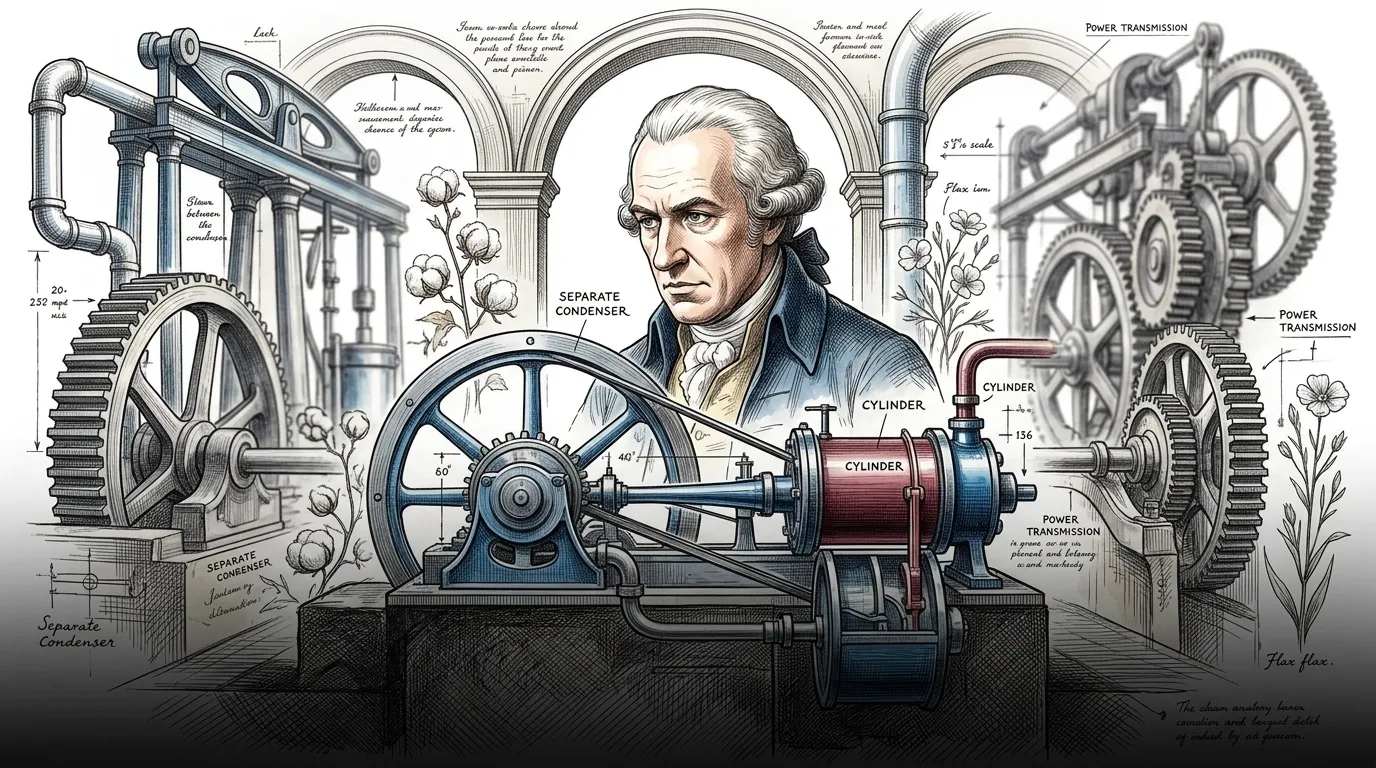
Page 1
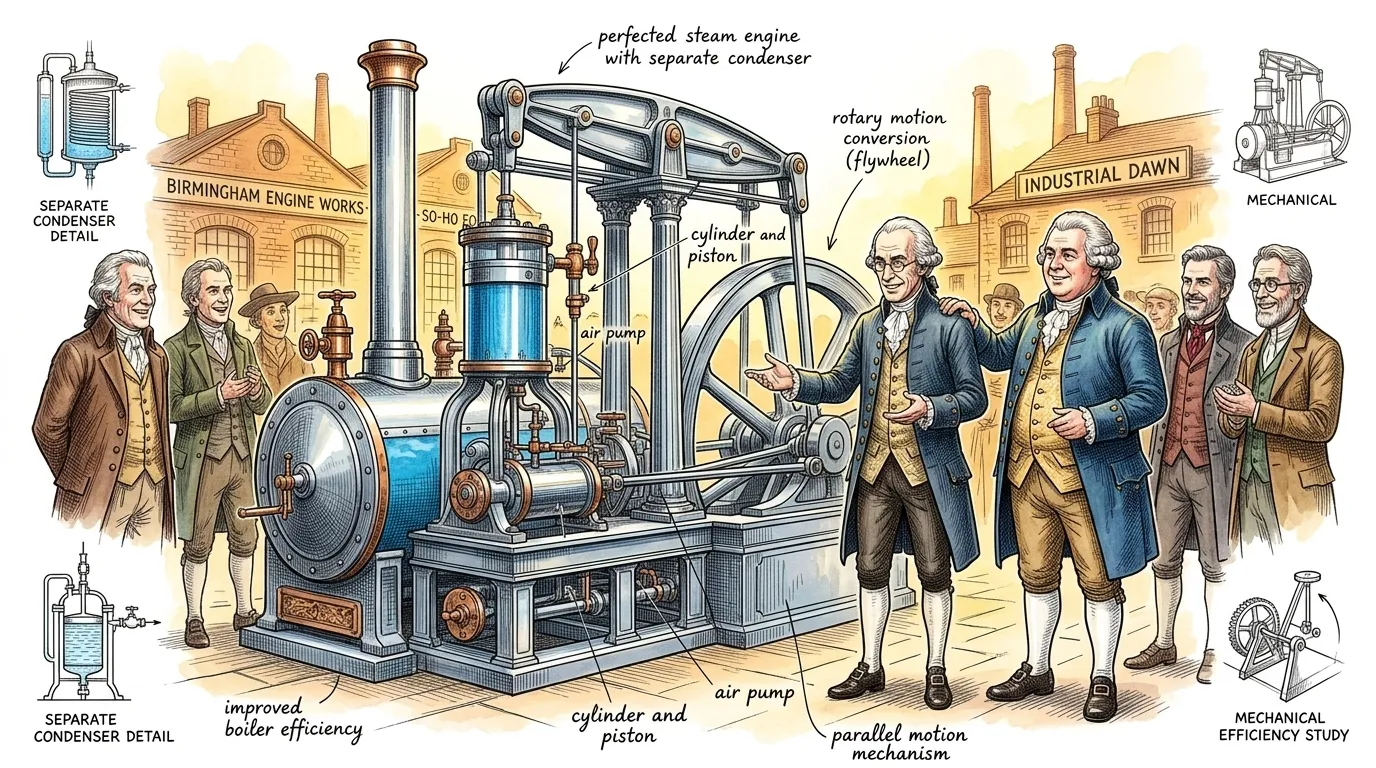
In the bustling heart of Birmingham, England, in the year 1776, James Watt unleashed a revolution. Before a gathering of keen industrialists and eager investors, his perfected steam engine stood, a monumental testament to mechanical ingenuity. This engine, equipped with its groundbreaking separate condenser, promised a future of unprecedented power and efficiency, consuming up to 75% less fuel than its predecessors. With Matthew Boulton, his financier and partner, observing proudly, Watt's creation signaled the dawn of a new industrial era. The world watched, sensing an irreversible shift in the very fabric of industry and human capability.
Biographical Fact: The Boulton & Watt partnership began commercially in 1775. The first commercial engines were installed shortly after. Watt's patent for the separate condenser was granted in 1769.
Page 2
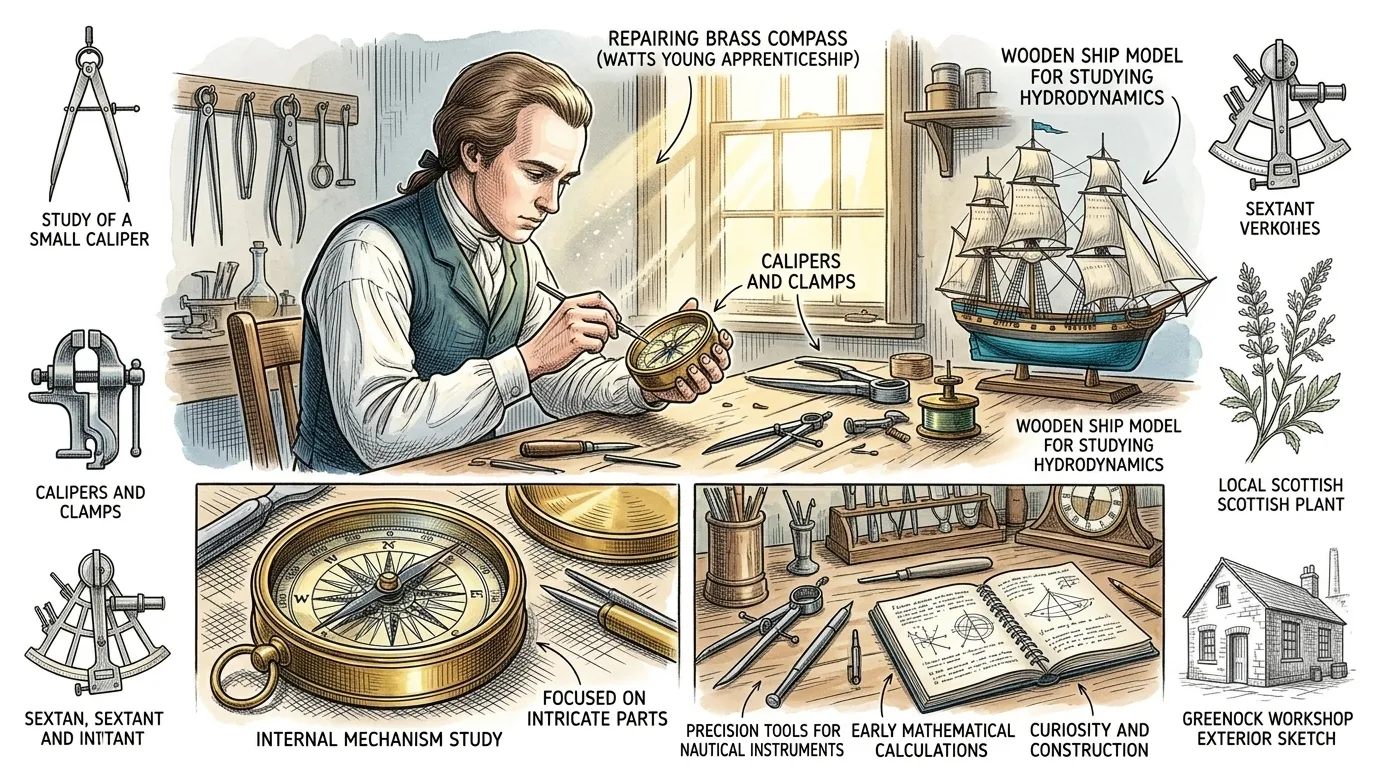
Born in Greenock, Scotland, in 1736, James Watt's childhood was defined by a delicate constitution and an insatiable curiosity for the mechanics of the world. Unable to endure the rigors of formal schooling consistently, he found his education in his father's workshops, a carpenter, shipwright, and mathematical instrument maker. There, amidst the precision tools and intricate designs, Watt absorbed the principles of construction and repair. His hands became adept at mending compasses, quadrants, and other instruments, laying a foundational mastery that would eventually reshape the course of human endeavor. It was in this environment that his profound understanding of materials and forces began to forge.
Biographical Fact: Watt's father was James Watt Sr., a merchant and shipwright. His mother, Agnes Muirhead, was from a distinguished family and was highly educated, influencing Watt's early learning.
Page 3
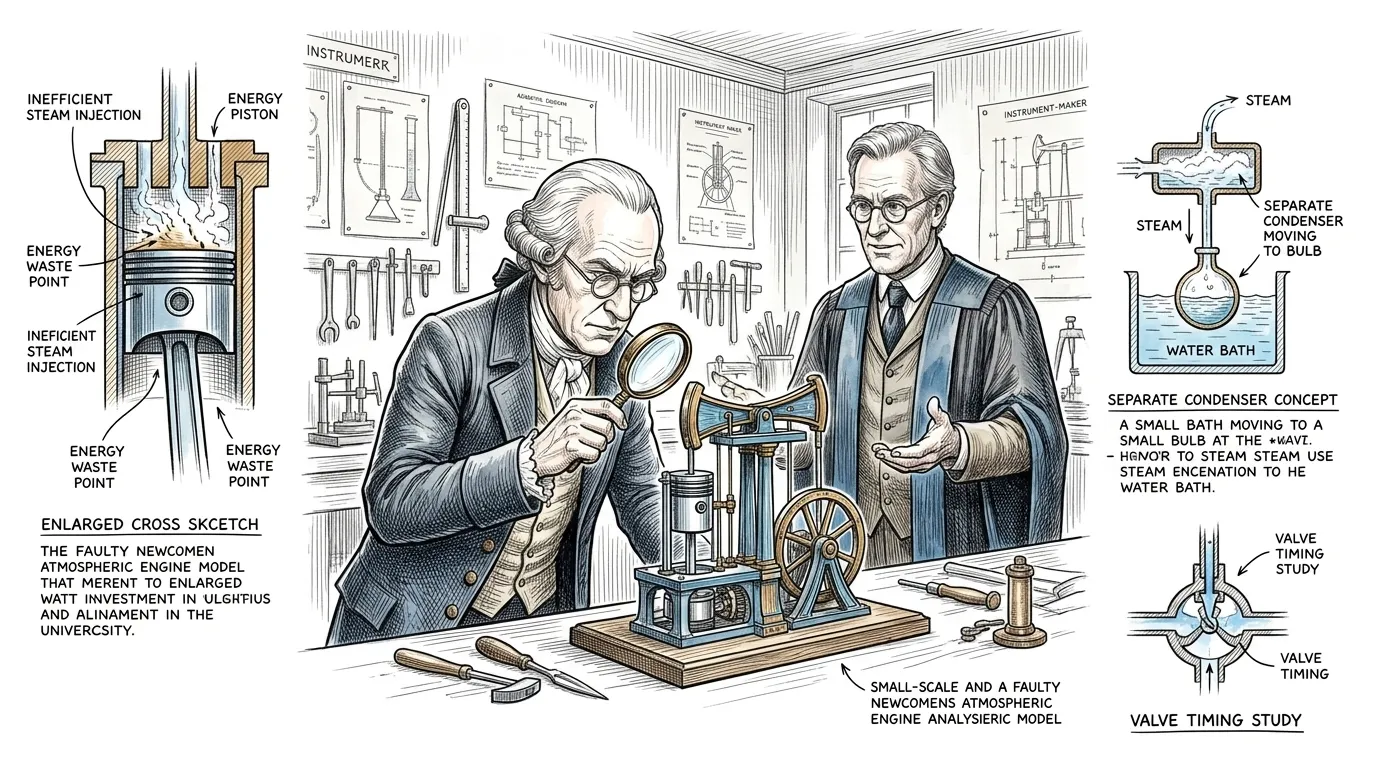
By 1764, James Watt established himself as an instrument maker at the University of Glasgow, a position that brought both steady work and unexpected challenges. It was here that Professor John Anderson presented him with a crucial task: repair a small demonstration model of a Newcomen atmospheric engine, a technology that had served industry for over fifty years but remained profoundly inefficient. Watt's examination of the faulty model revealed its inherent design flaws, particularly its massive waste of steam. This seemingly simple repair ignited a relentless intellectual pursuit, compelling him to understand and ultimately transcend the limitations of existing power generation.
Biographical Fact: The Newcomen engine, invented in 1712, was primarily used for pumping water out of mines. Its major inefficiency stemmed from alternately heating and cooling the same cylinder.
Page 4
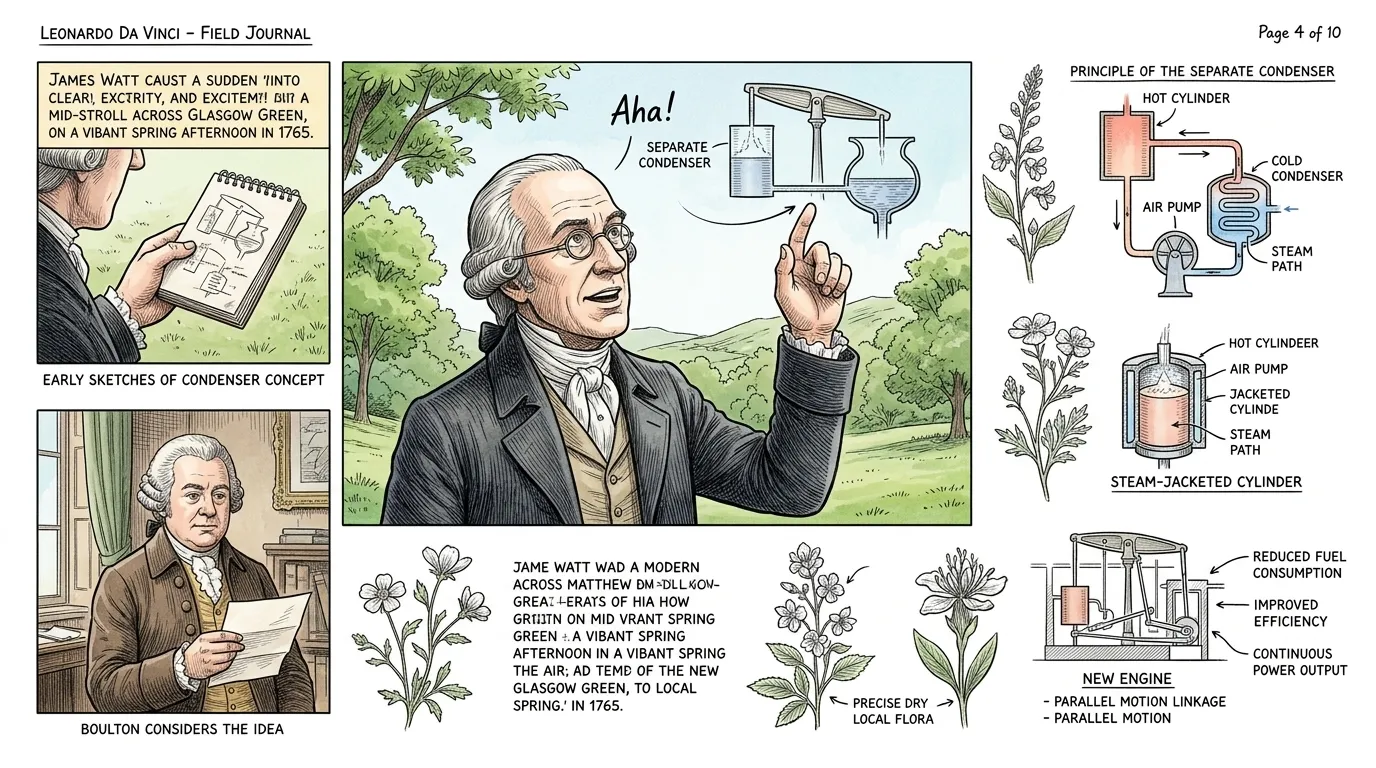
The problem of the Newcomen engine consumed Watt. He walked daily, wrestling with the immense fuel consumption caused by the cylinder's constant heating and cooling. Then, during a stroll across Glasgow Green on a spring afternoon in 1765, the solution materialized with sudden clarity. He realized that if the condensation of steam could occur in a separate vessel, the main cylinder could remain perpetually hot. This 'separate condenser' concept was not merely an improvement; it was a fundamental re-imagining of the steam engine's core operation, an elegant simplification that unlocked immense power previously lost to inefficiency. In that moment, the trajectory of industrial technology irrevocably shifted.
Biographical Fact: This 'Aha!' moment is one of the most celebrated epiphanies in engineering history, marking the invention of the separate condenser. The idea was simple but revolutionary.
Page 5
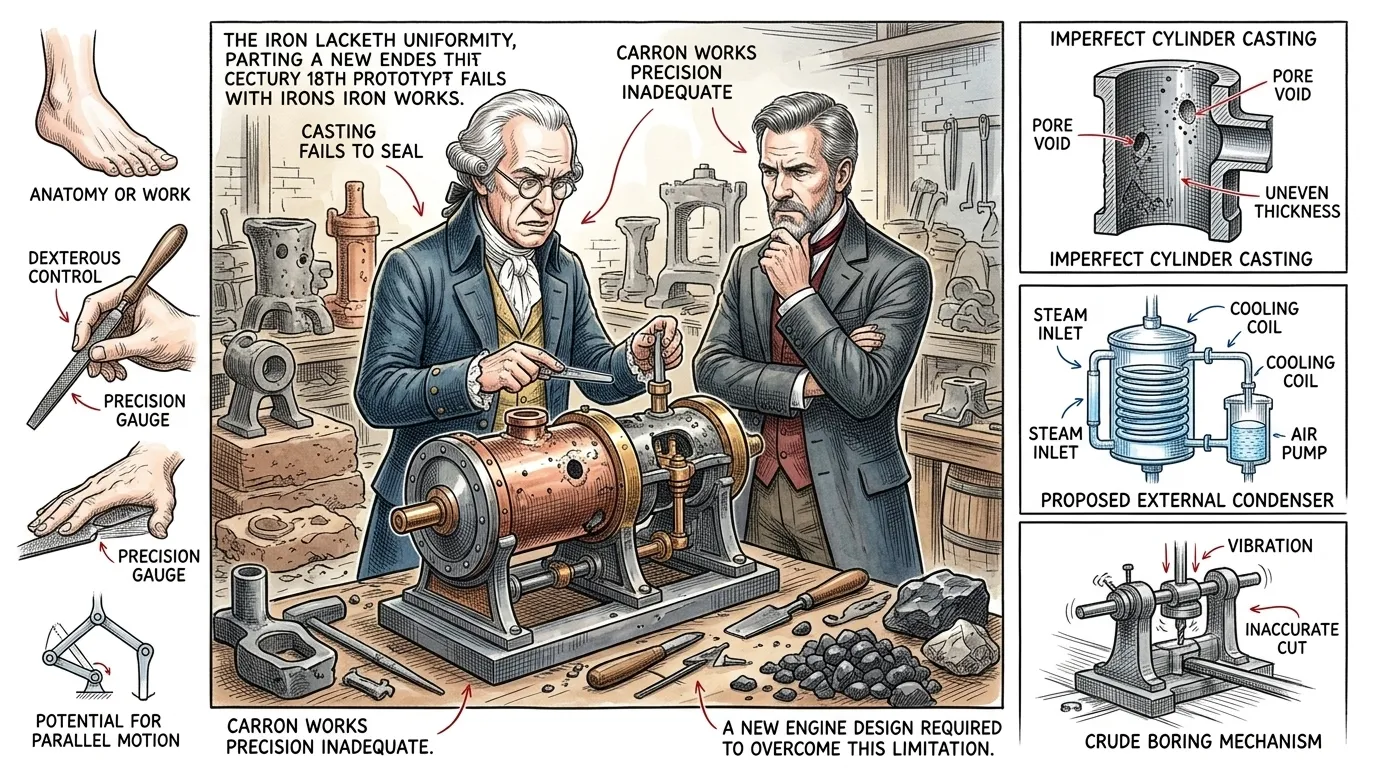
Translating the separate condenser from concept to working prototype proved a monumental undertaking. James Watt found an early supporter in John Roebuck, a wealthy industrialist and founder of the Carron Iron Works. Roebuck financed Watt's experiments and became his partner, believing in the engine's potential. Yet, the limitations of 18th-century manufacturing, particularly the inability to cast cylinders with sufficient precision, plagued their progress. Watt faced constant frustration, his designs hampered by technology that could not yet match his vision. The financial strain on Roebuck mounted, creating immense pressure on Watt to deliver a working engine.
Biographical Fact: John Roebuck acquired a two-thirds share of Watt's patent in exchange for clearing his debts and financing further development. Roebuck's financial difficulties would later lead to his bankruptcy.
Page 6
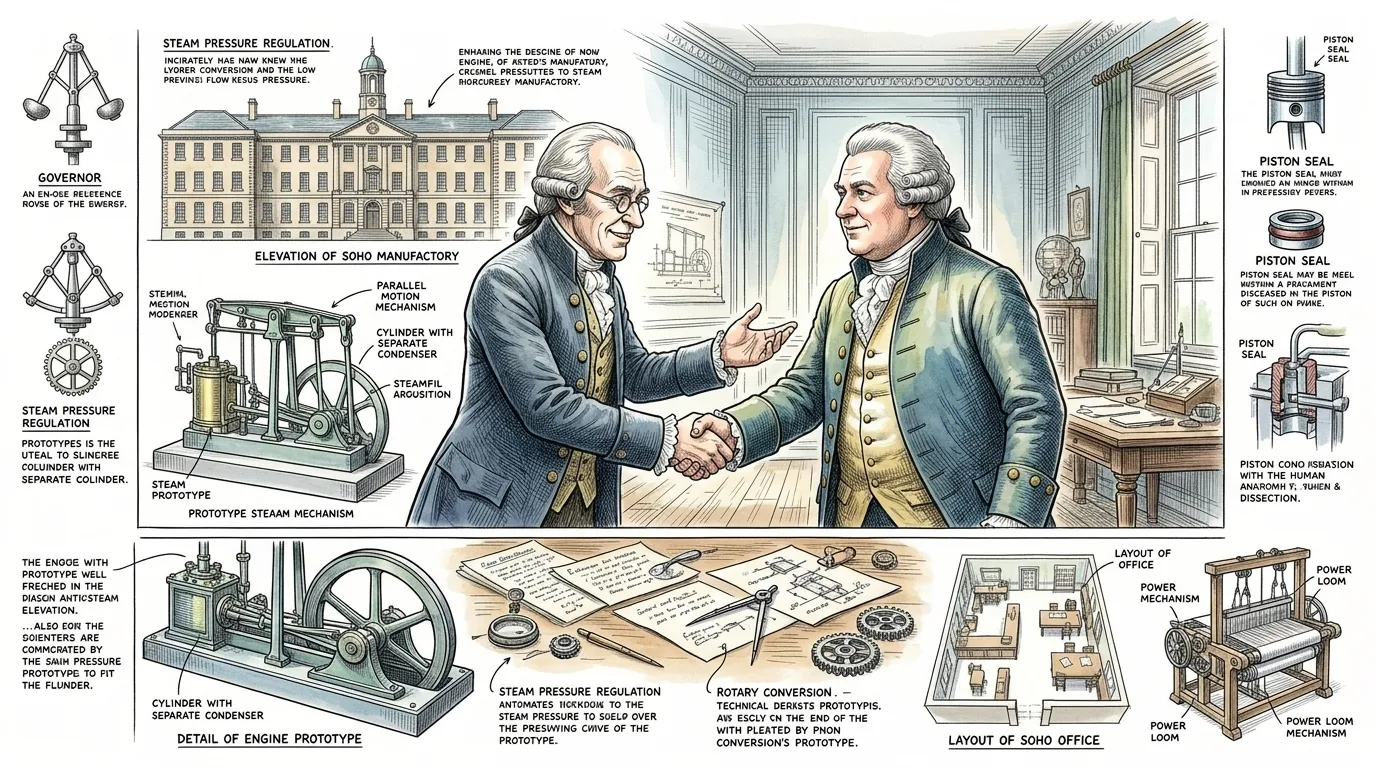
Roebuck's financial ruin nearly extinguished Watt's steam engine. However, the future of the invention was secured by the timely intervention of Matthew Boulton, a shrewd and visionary Birmingham manufacturer. In 1775, Boulton acquired Roebuck's share of Watt's patent, forming the enduring Boulton & Watt partnership. Boulton offered not just capital but also a world-class manufacturing facility—the Soho Manufactory—and a keen understanding of marketing and business. This alliance was pivotal; it transformed Watt's isolated genius into a commercial force, providing the resources and infrastructure necessary to bring his revolutionary engine to the world. It was a union of invention and enterprise, destined to change the course of history.
Biographical Fact: Matthew Boulton's business acumen and industrial facilities were crucial. He saw the engine not just as an improvement, but as a universal prime mover for all industries.
Page 7
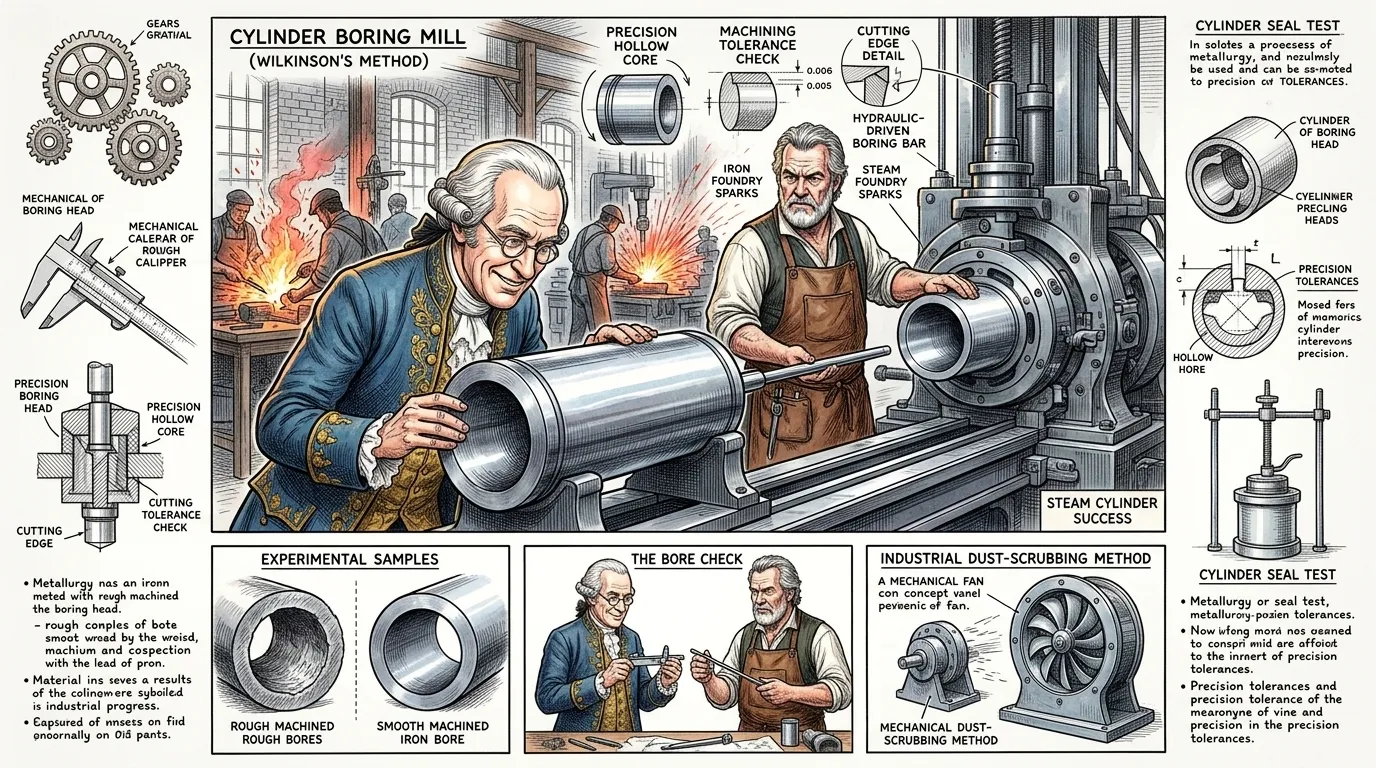
The greatest manufacturing hurdle—producing perfectly circular cylinders—was finally overcome through the ingenuity of John Wilkinson, the 'Iron King.' Wilkinson, known for his precision boring machine originally designed for cannon, adapted his technology to create the tight-fitting pistons and cylinders Watt's engine demanded. This breakthrough in metallurgy and machining allowed for the minimal steam leakage essential for the separate condenser's efficiency. With Wilkinson's precision, Boulton & Watt could finally construct robust, reliable engines at scale. The convergence of Watt's design and Wilkinson's manufacturing prowess marked a critical turning point, pushing the engine from theoretical triumph to practical reality.
Biographical Fact: John Wilkinson's boring machine was initially used for cannons, achieving unprecedented precision. Its adaptation for steam engine cylinders was a game-changer for the industrial revolution.
Page 8
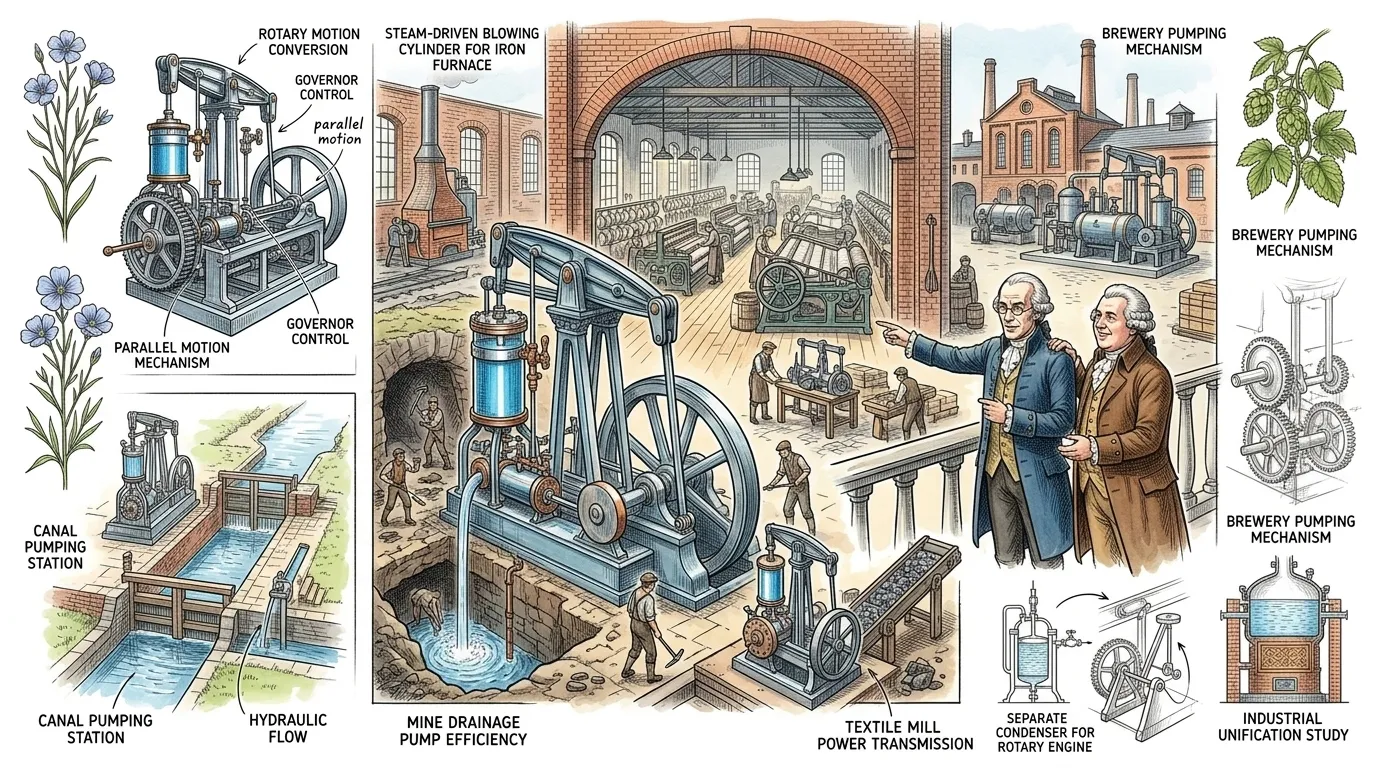
With manufacturing challenges resolved, the Boulton & Watt engine rapidly became the driving force of the Industrial Revolution. Their engines were deployed across Britain and beyond, primarily in coal and tin mines, where they efficiently pumped water, allowing deeper excavation and greater output. Beyond mining, Watt's engines began powering textile mills, breweries, and factories, transforming previously manual processes into mechanized production. The clanking rhythm of the steam engine became the heartbeat of modern industry, multiplying human output and permanently altering landscapes, labor, and economic structures. The world was now reacting to the power Watt had unleashed.
Biographical Fact: By the late 18th century, Watt engines were critical infrastructure, enabling the expansion of mining and driving factory production, particularly in the burgeoning textile industry.
Page 9
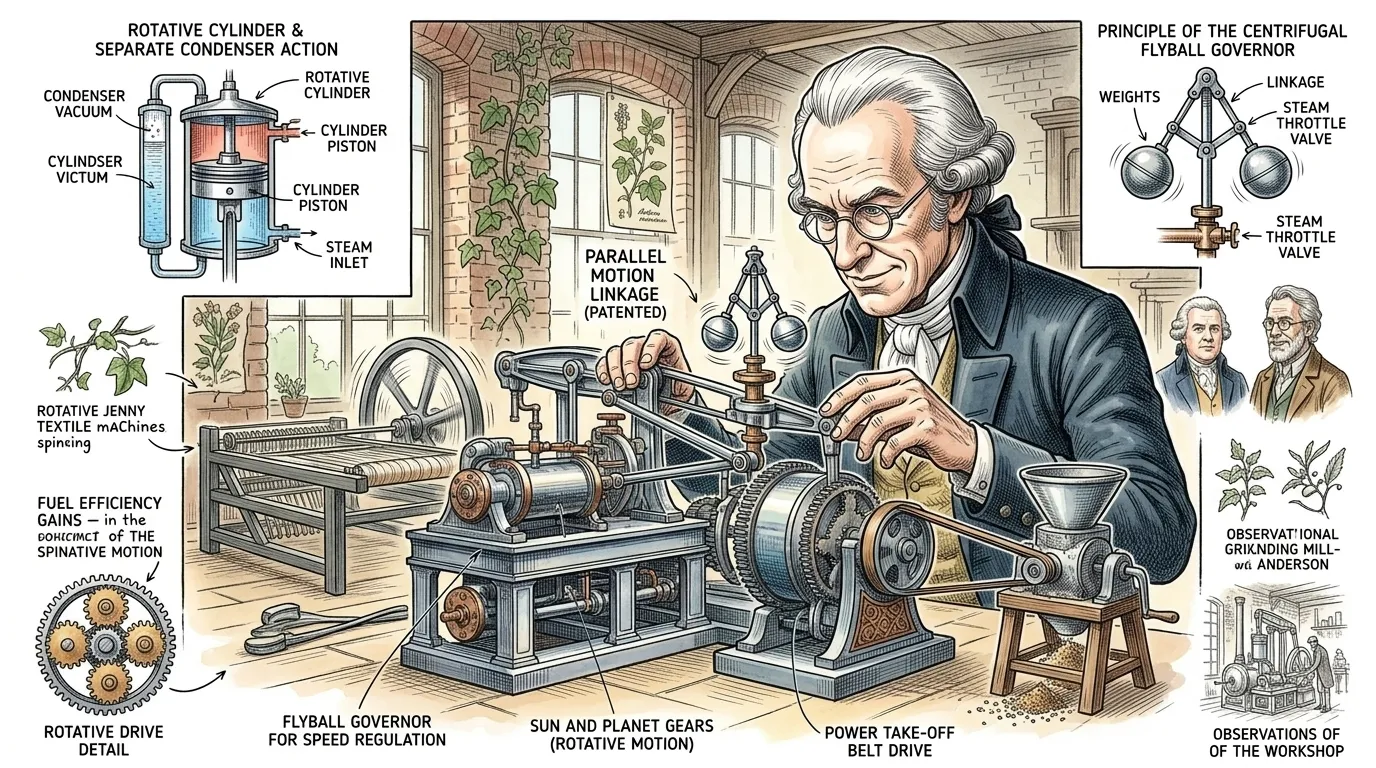
James Watt's relentless pursuit of improvement extended beyond the separate condenser. Recognizing the limitations of simply pumping water, he developed the 'rotative' engine, which converted the reciprocating motion into rotary motion. This innovation, coupled with his 'parallel motion' linkage and the centrifugal 'flyball governor' for speed regulation, dramatically broadened the steam engine's applications. It could now power machinery directly, from spinning jennies to grinding mills, making it adaptable to almost any industry. Watt's continued refinements cemented the steam engine as the versatile, indispensable workhorse that would propel humanity into the modern age, laying the foundation for an unprecedented era of technological advancement.
Biographical Fact: The rotative engine (patented 1781) and parallel motion (patented 1784) were key innovations that transformed the engine from a specialized pump into a universal power source for factories.
Page 10
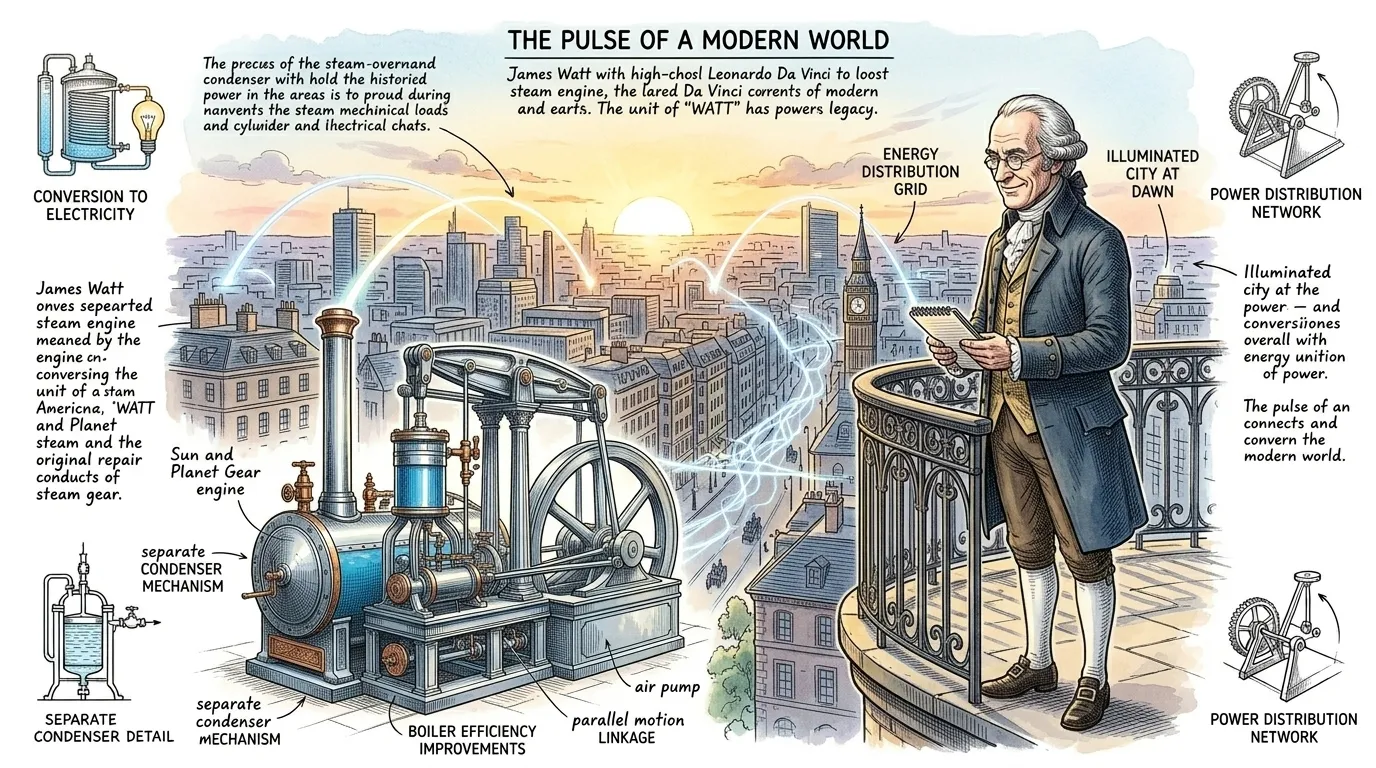
James Watt retired a wealthy man, his name synonymous with industrial progress. Though he passed away in 1819, his impact far outlived him. His refinements to the steam engine powered the Industrial Revolution, fundamentally transforming economies, societies, and the very concept of work. Cities grew, transport advanced, and the scale of human production exploded. In recognition of his monumental contributions, the international unit of power, the Watt, was named in his honor in 1889, a century after his most prolific period. From the glow of a lightbulb to the silent hum of an electric motor, the legacy of James Watt pulses through every facet of the modern world, a constant reminder of how one individual's ingenuity can redefine civilization.
Biographical Fact: The Watt (W) is a unit of power in the International System of Units (SI), equivalent to one joule per second. It was named in honor of James Watt for his contributions to the development of the steam engine.
About this story
- Location: Global
- Audience: general readers
Questions and answers
Read Wonder People on your phone
Wonder People is available on Android. Get Wonder People on Google Play.