Michael Faraday
Michael Faraday — an illustrated biography story, set in Global. 10 illustrated pages, free to read on Wonder People.
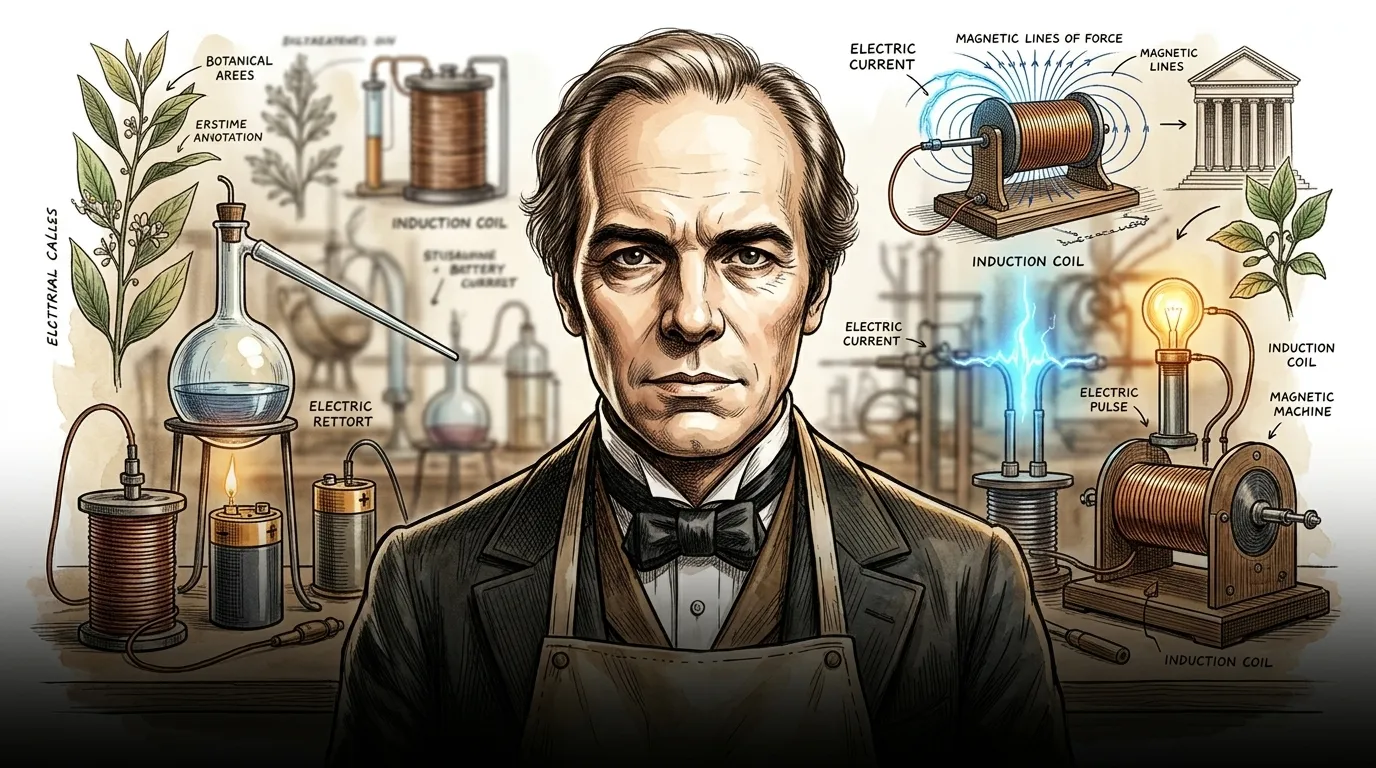
Page 1
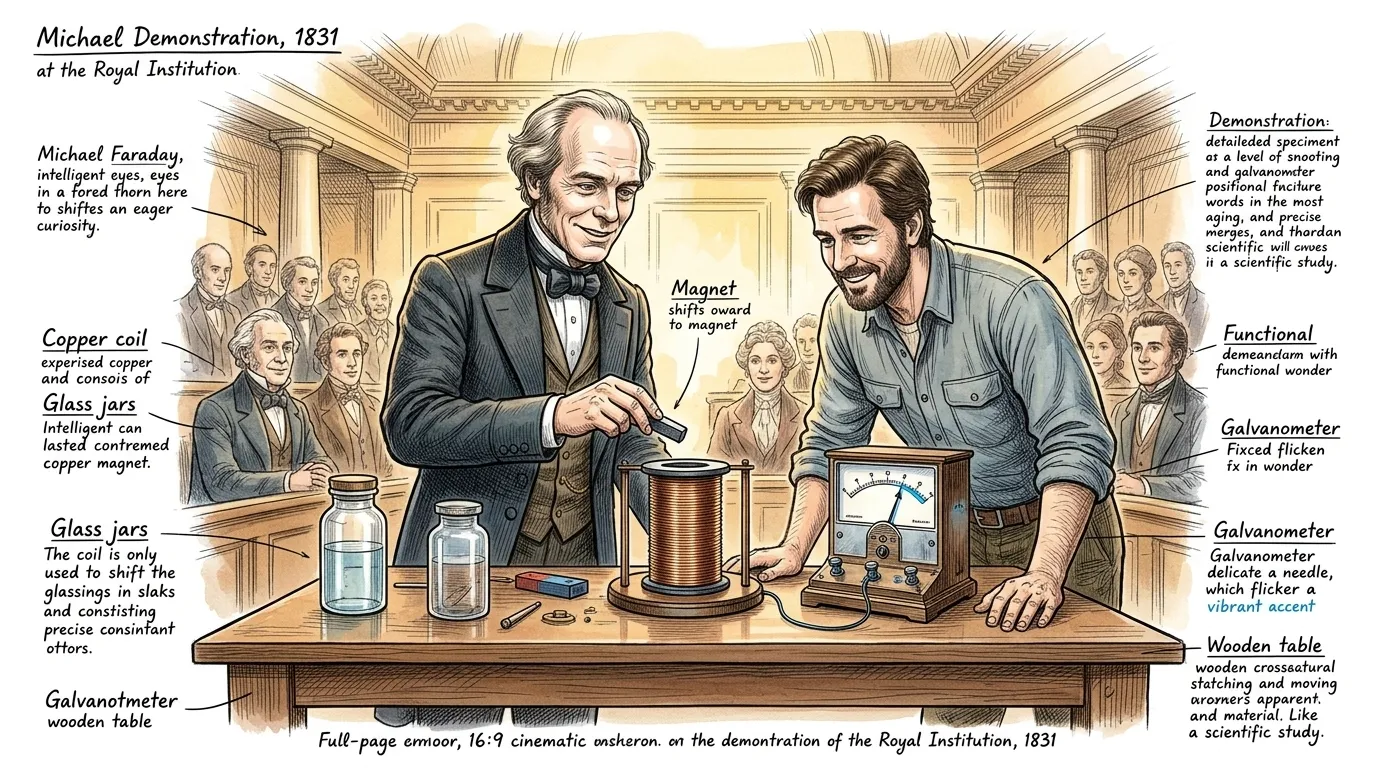
At the Royal Institution in London, 1831, Michael Faraday commanded the attention of Europe's scientific elite. He moved with intense focus, revealing a profound connection between forces previously thought separate. With a coil, a magnet, and a galvanometer, he shifted the magnet, and the needle moved, proving that magnetism could generate electricity. In that decisive moment, before an assembly that included Charles Anderson, his loyal assistant, Faraday demonstrated electromagnetic induction, fundamentally altering humanity's relationship with power.
"Faraday announced, "The current exists only during the relative motion! This proves a transient current from a magnet!" Anderson, observing the galvanometer, confirmed, "The needle truly responds, Mr. Faraday, a momentary flicker each time!""
Page 2
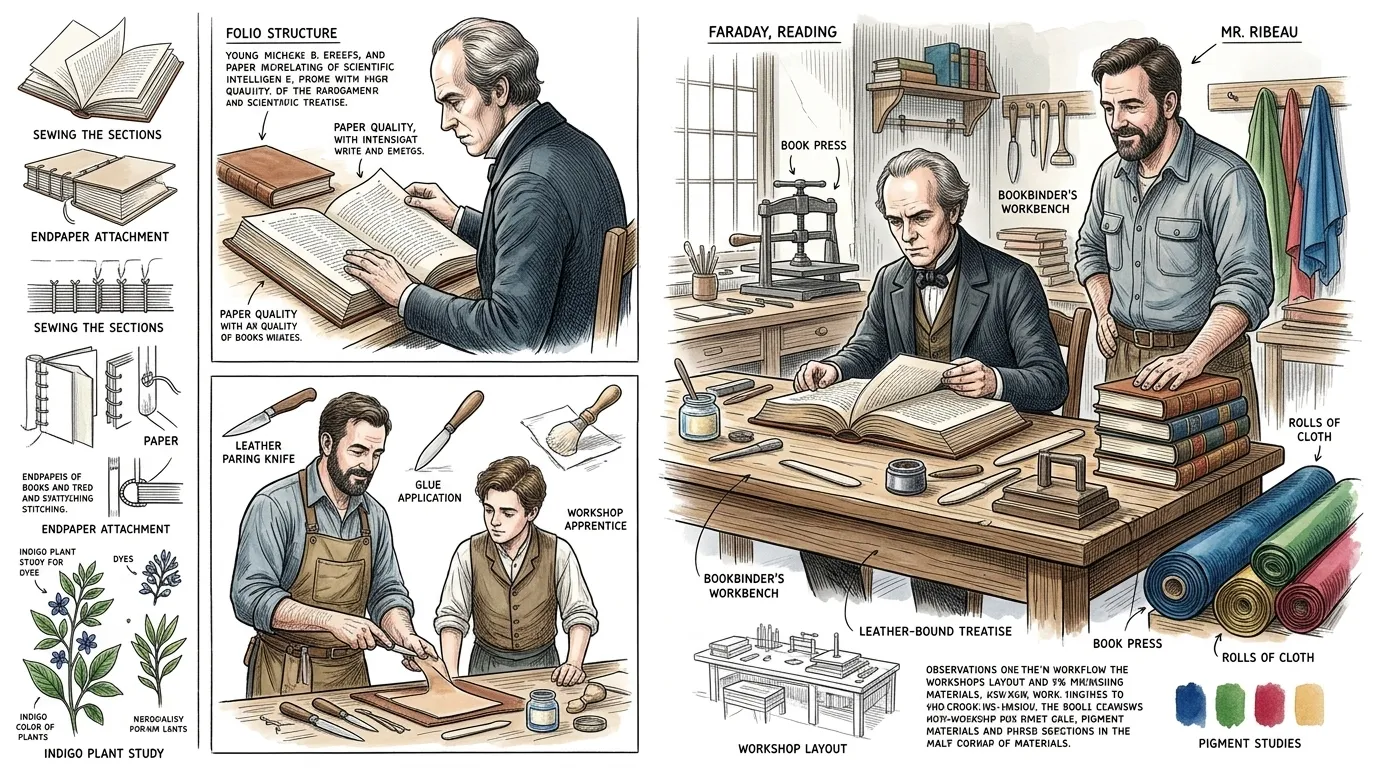
Born into humble circumstances, Michael Faraday's formal education ended early, yet his hunger for understanding persisted. As a bookbinder's apprentice in London, he found his true school within the pages of the volumes he repaired. Night after night, he absorbed scientific treatises, his mind grappling with the underlying principles of the universe.
"Young Faraday, turning a page in a heavy volume, mused aloud, "The chemist Sir Humphry Davy believes all forces are connected, a profound 'unity of natural powers.' It suggests the world is far more interwoven than we commonly perceive." His master, Mr. Ribeau, glanced over, "Keep reading, Michael, but mind the glue!""
Page 3
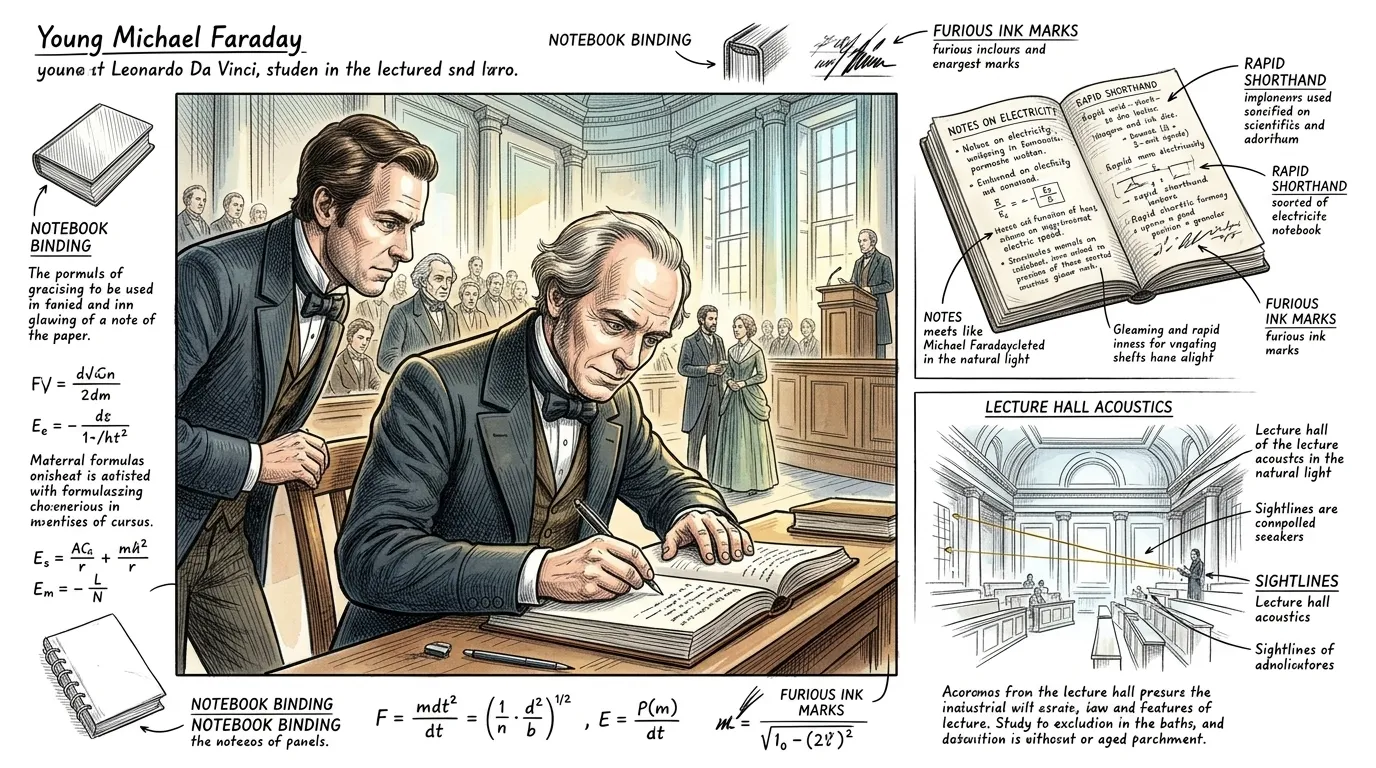
Faraday's dedication transcended his station. He secured tickets to Sir Humphry Davy's lectures at the Royal Institution, a pivotal experience that ignited his ambition. There, he meticulously transcribed every word, every experiment, committing Davy's groundbreaking insights into electrochemistry to paper.
"Faraday leaned over his notebook, furiously writing, saying, "Davy's explanation of chlorine as an element, not a compound, changes everything. His precision, his logic—it's a revelation!" A nearby lecture-goer, a serious man in a dark suit, murmured, "Indeed, the man's brilliance is undeniable. To miss a single word would be a tragedy.""
Page 4
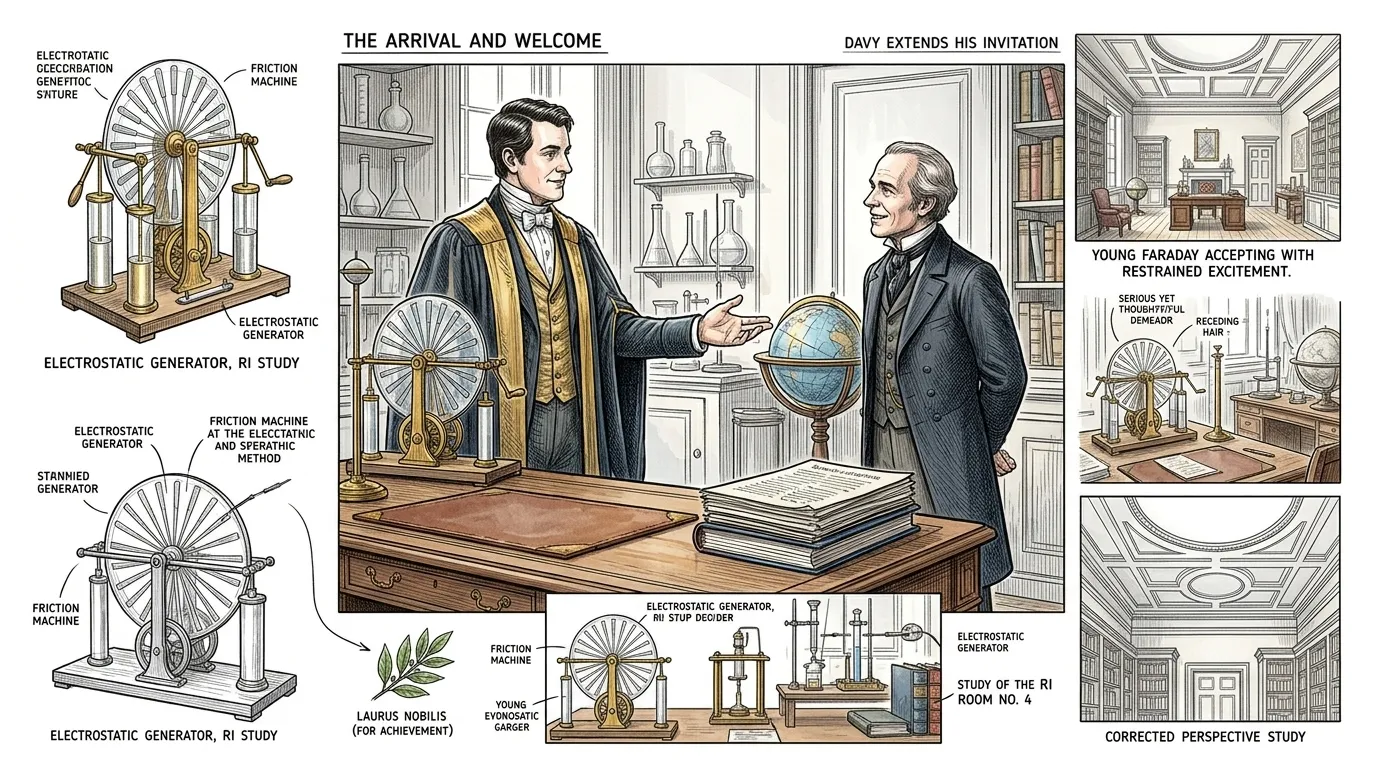
His detailed, elegantly bound lecture notes, sent to Sir Humphry Davy, were a testament to his intellect and drive. Impressed by this extraordinary effort, Davy offered the young bookbinder a position: chemical assistant at the Royal Institution. Faraday, then just 21, seized this opportunity, stepping into the very crucible of scientific discovery.
"Sir Humphry Davy, a commanding figure in a dark academic robe, extended a hand to Faraday, saying, "Your diligence is commendable, young Faraday. I require an assistant of your caliber. Will you join me at the Royal Institution?" Faraday, his eyes wide with restrained excitement, replied, "Sir, it would be my highest honor. I accept without hesitation.""
Page 5
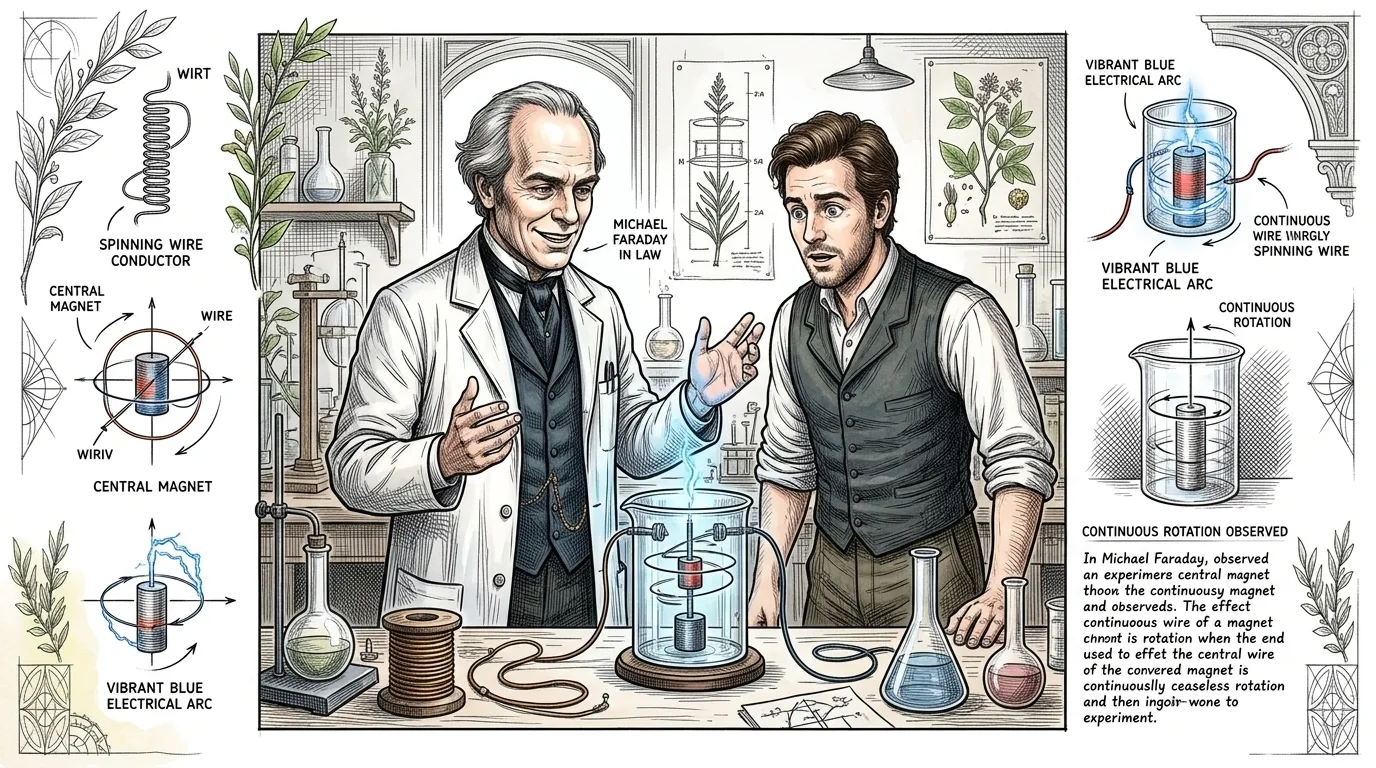
Eight years into his tenure, Faraday's genius erupted independently. Building upon Oersted's discovery of electromagnetism, he conceived of an apparatus where a wire carrying current would continuously rotate around a magnet. In 1821, he constructed the first device to convert electrical energy into mechanical motion, laying the cornerstone for the electric motor.
"Faraday, his face illuminated by the flickering light of his experimental setup, declared, "Observe! The wire spins continuously around the magnet! This demonstrates a new form of electromagnetic action, a ceaseless rotation!" Charles Anderson, standing by, gasped, "It works, Mr. Faraday! A truly continuous motion from mere electricity!""
Page 6
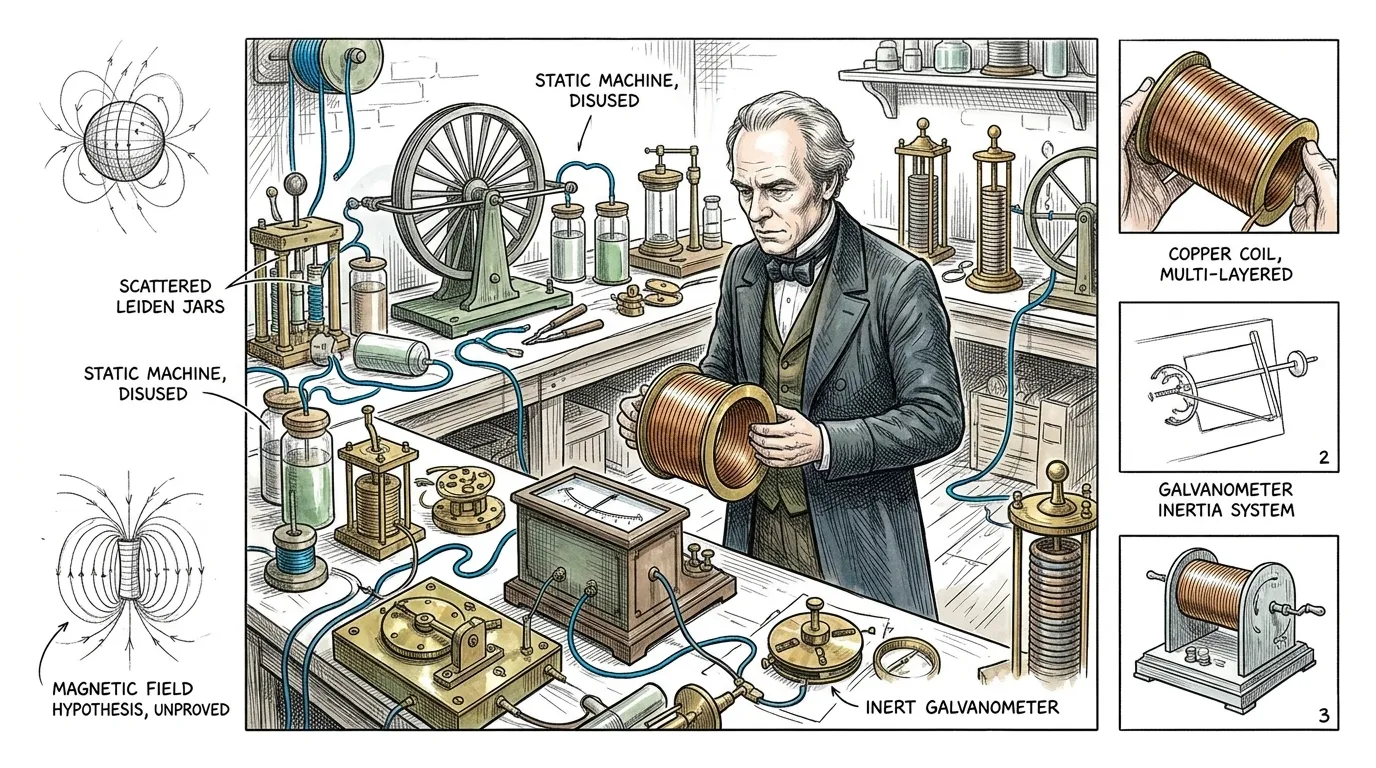
Despite the success of the electric motor, Faraday was not satisfied. He harbored a deeper conviction: if electricity could produce magnetism, then magnetism must, in turn, be able to produce electricity. For nearly a decade, he pursued this elusive connection, experimenting tirelessly, enduring countless failures, convinced a fundamental truth lay hidden.
"Faraday, in his lab, mused, "For so long, we've produced magnetism from electricity. The reverse must also be true. There is a symmetry in nature, a balance." He turned a coil, scrutinizing a dormant galvanometer. "The challenge lies in finding the precise condition, the trigger, to reveal it.""
Page 7
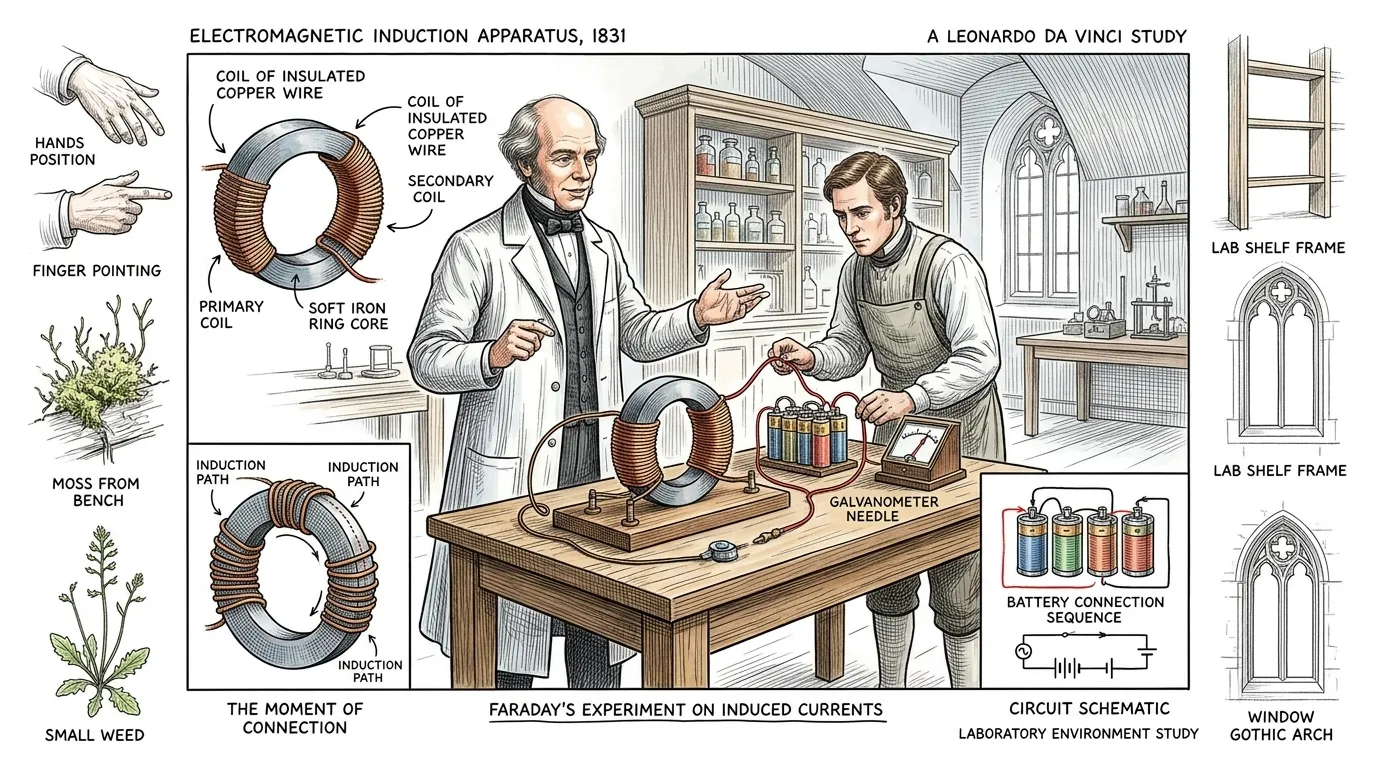
The key, Faraday eventually realized, lay not in static presence, but in motion or change. He devised a crucial experiment: an iron ring wrapped with two separate coils of wire. He believed that connecting and disconnecting a battery to one coil would induce a fleeting current in the other, like a distant whisper between forces.
"Faraday directed Charles Anderson, saying, "Connect the battery to the primary coil. Watch the galvanometer on the secondary circuit. It is not the presence of current, but the change which holds the secret." Anderson, connecting the wires, replied, "I shall observe closely, Mr. Faraday, for any tremor.""
Page 8
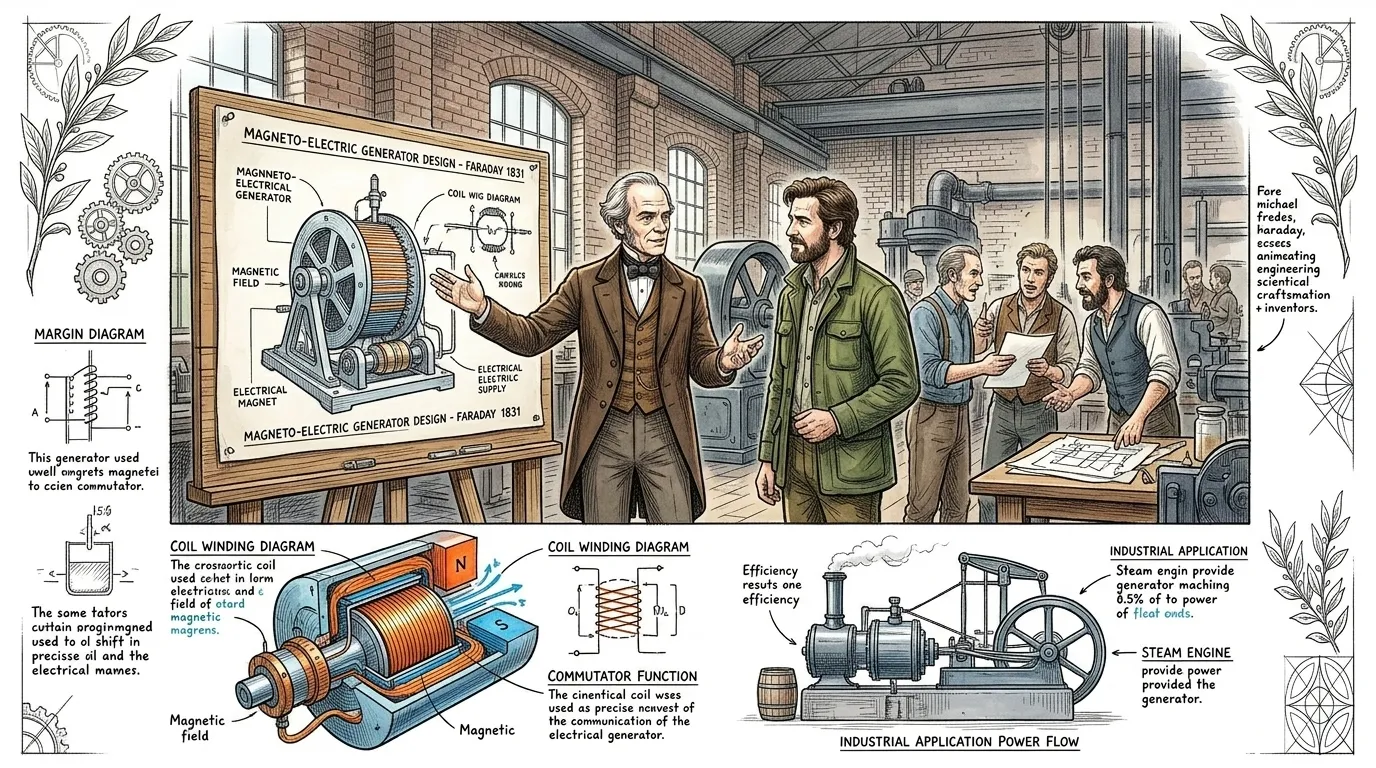
Faraday's discovery of electromagnetic induction sparked an immediate and profound shift. Engineers and inventors across the globe began to conceptualize and build the first dynamos and generators, machines that would harness his principle to produce continuous, abundant electricity. The world, once reliant on muscle and flame, now envisioned a future powered by an invisible force.
"Faraday, gesturing towards a schematic of an early electrical generator being discussed by a group of engineers, declared, "This device embodies the unity of forces I once read about as an apprentice. As my own words echo, 'Nothing is too wonderful to be true, if it be consistent with the laws of nature.' My experiments confirm that all powers of nature are mutually dependent." An engineer, in a working-class suit, responded, "Indeed, Mr. Faraday, this changes everything for industry.""
Page 9
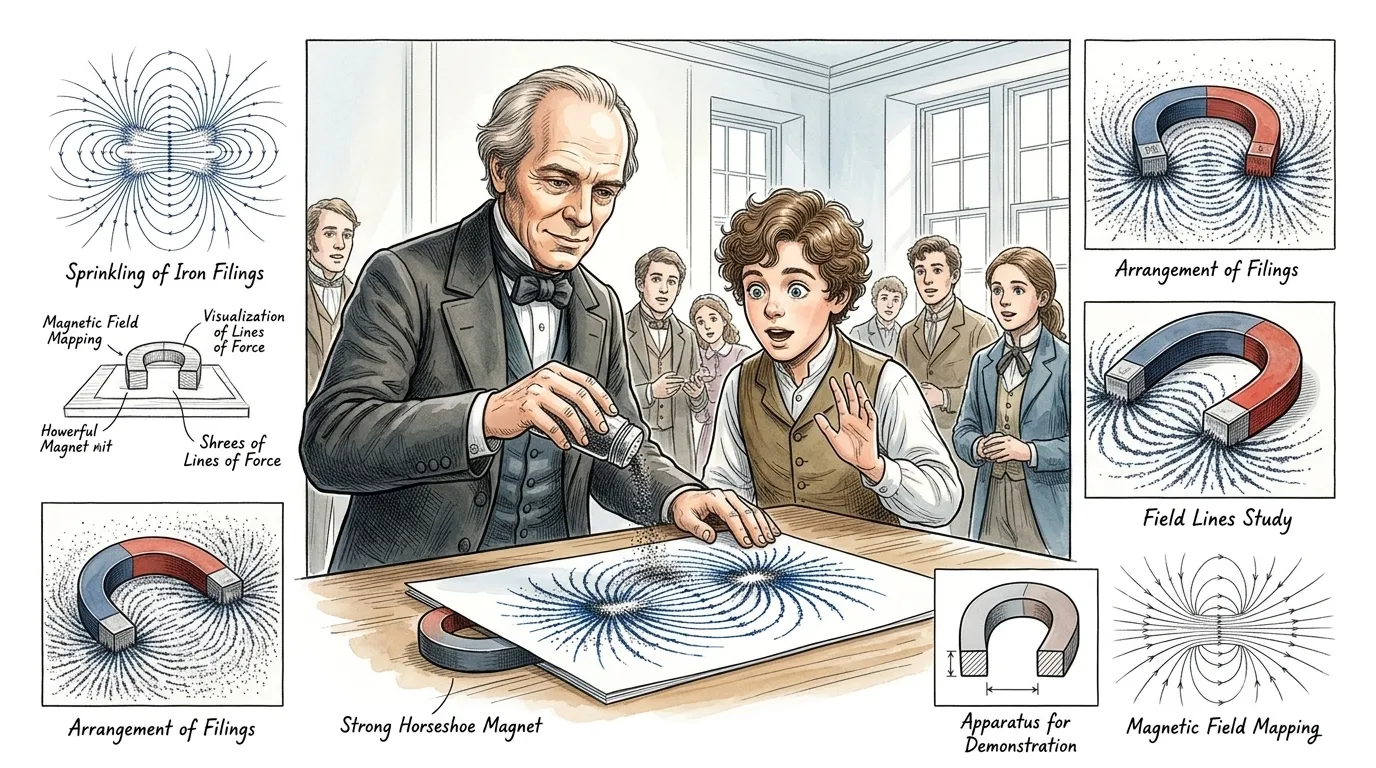
Beyond induction, Faraday continued to explore the fundamental nature of forces. His experiments with diamagnetism and his revolutionary concept of 'lines of force' radiating through space provided a visual and conceptual framework for understanding magnetic and electric fields. He showed how iron filings could map these invisible influences, transforming abstract theory into tangible patterns.
"Faraday, sprinkling iron filings onto a paper over a magnet, explained to a small group of students, "Observe how the iron filings arrange themselves, revealing the 'lines of force' emanating from the magnet. These are not mere mathematical constructs; they represent a real physical state, an invisible tension in space." A young student, with wide eyes, gasped, "It's as if the magnet breathes a pattern into the very air!""
Page 10
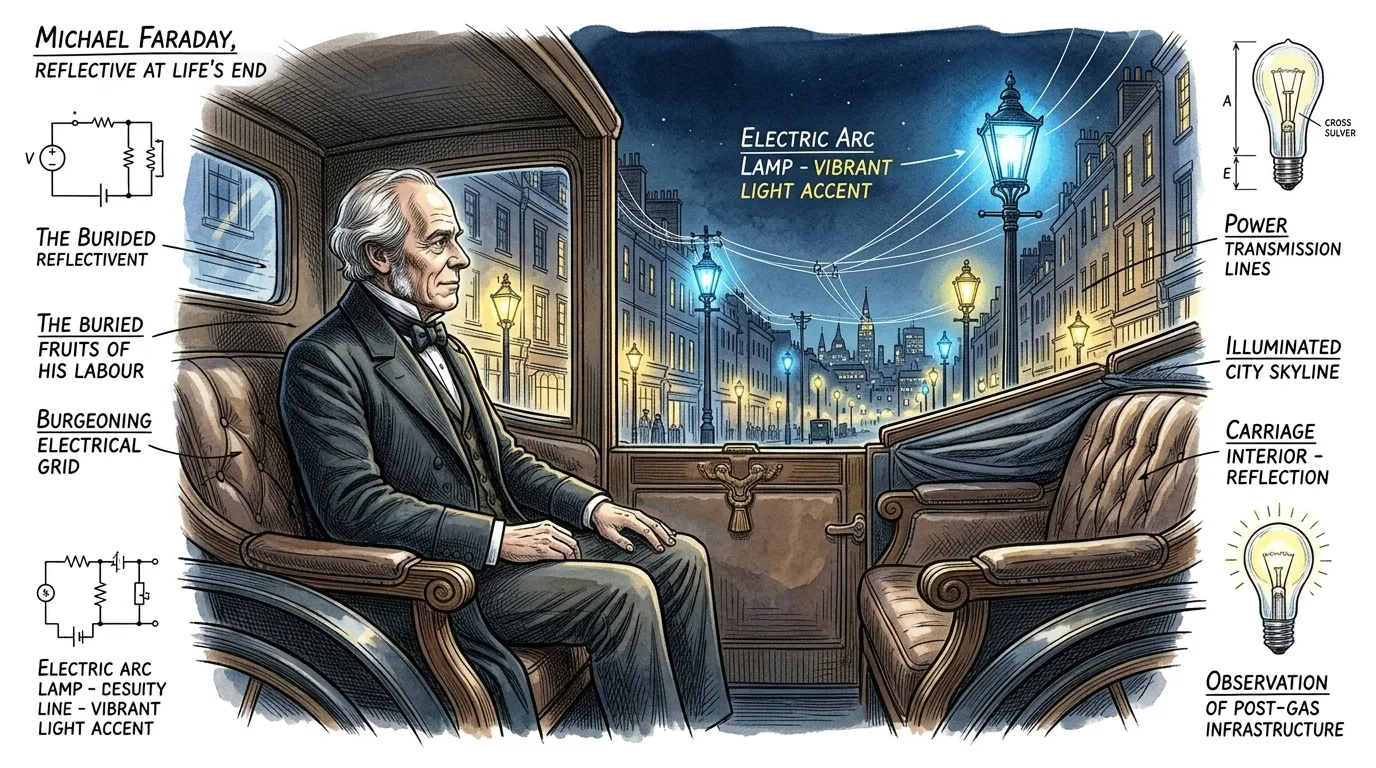
Michael Faraday, a man who rose from the bindery to redefine the very fabric of physical reality, left an indelible mark. His discoveries, born of relentless experimentation and profound insight, laid the foundation for the entire age of electricity. The motors that power industry, the generators that illuminate cities, the very grid of interconnected energy that defines modern civilization — all trace their lineage directly back to his singular genius.
"Faraday, now elderly and reflective, observed the burgeoning electrical infrastructure of London from a carriage window, whispering, "The world is now illuminated by what was once an unseen force. What began as a mere flicker on a galvanometer has become a torrent, shaping the very course of human endeavor." A distant bell chimed, marking the onset of the electrified era he had prophesied."
About this story
- Location: Global
- Audience: general readers
Questions and answers
Read Wonder People on your phone
Wonder People is available on Android. Get Wonder People on Google Play.