Maurice Merleau-Ponty
Maurice Merleau-Ponty — an illustrated philosophy story. 10 illustrated pages, free to read on Wonder Philosophy.
Page 1
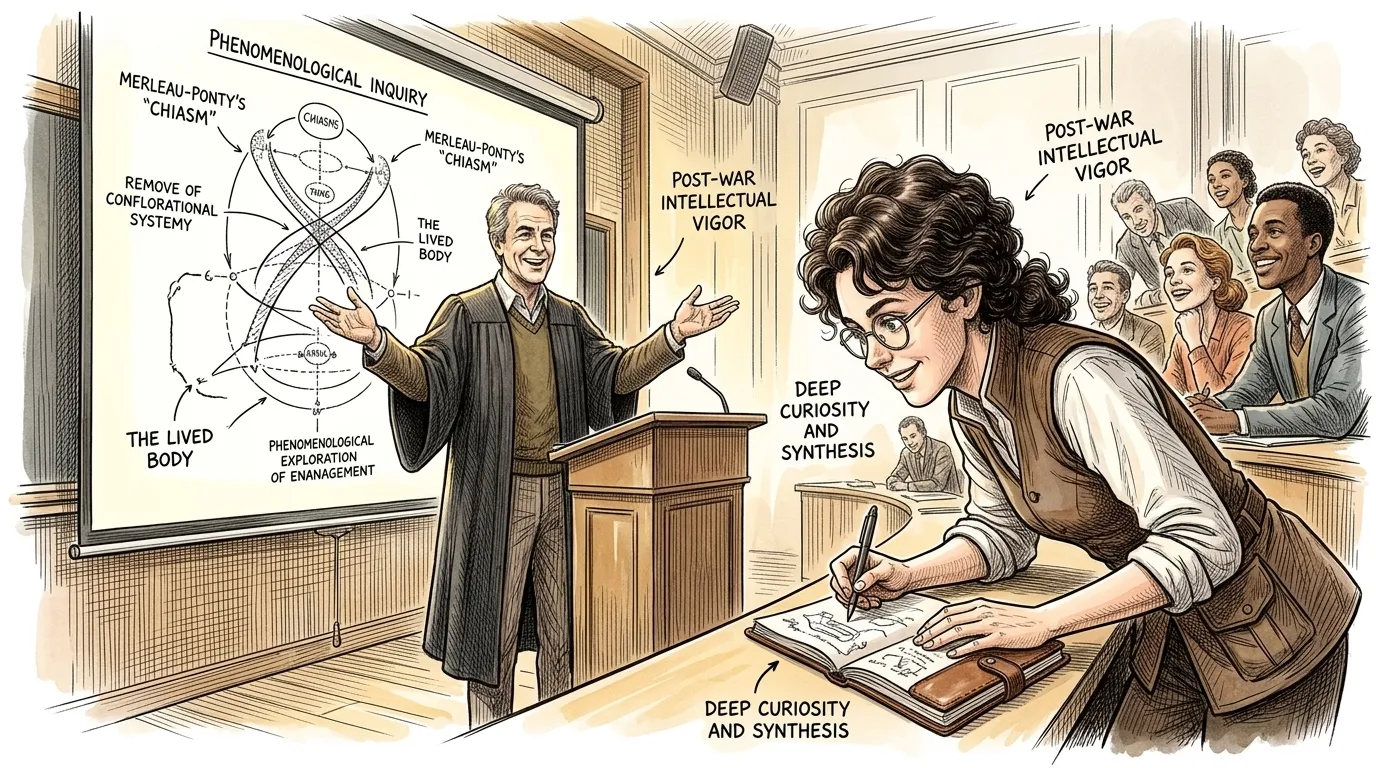
A palpable energy fills the lecture hall in post-war Paris, buzzing with students and intellectuals eager to grasp the emerging philosophical currents. Dr. Aris Thorne gestures towards a complex diagram on a large screen, explaining how Merleau-Ponty challenged traditional views of consciousness. Elara Vance takes notes intently, absorbing the atmosphere of profound intellectual inquiry.
"'Today, we delve into Maurice Merleau-Ponty, a philosopher who profoundly redefined our understanding of existence,' Dr. Thorne announced, his voice carrying clearly across the expectant room. 'He didn't see the mind and body as separate, but as utterly intertwined, our very means of being in the world.' Elara leaned forward, asking, 'So, he believed our bodies aren't just vessels, but active participants in shaping our reality?'"
Philosophy Note: Maurice Merleau-Ponty (1908–1961) was a French phenomenological philosopher, deeply influenced by Husserl and Heidegger. His seminal work, 'Phenomenology of Perception' (1945), posited that the body is not merely an object in the world but our primary means of engaging with and making sense of it, challenging Cartesian dualism.
Page 2
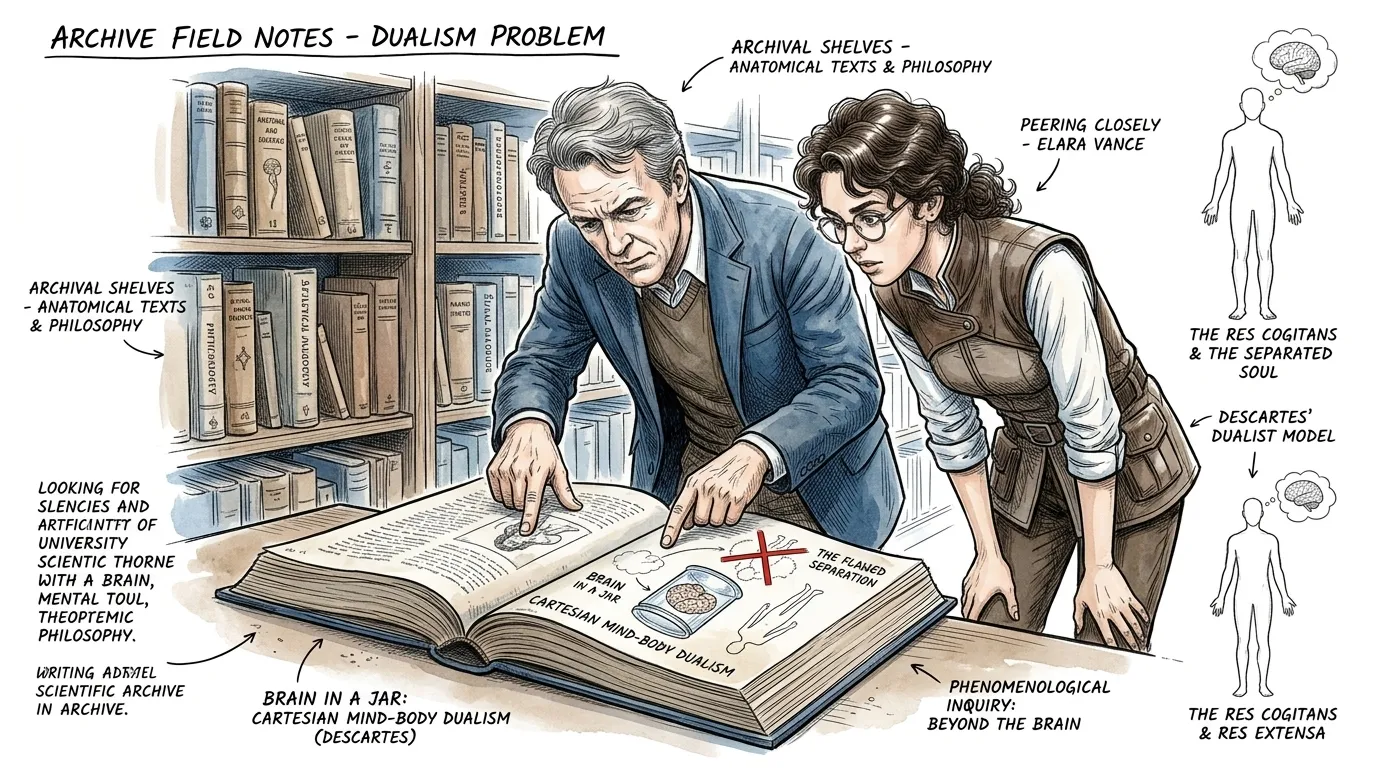
Dr. Thorne led Elara to a quiet corner of the archive, where old anatomical drawings and philosophical texts lined the shelves. He pulled out a dusty volume, pointing to an illustration of Descartes' famous mind-body separation, explaining the historical problem Merleau-Ponty confronted.
"'For centuries, René Descartes' idea dominated Western thought,' Dr. Thorne explained, tapping a finger on a diagram showing a detached brain in a jar. 'He famously stated, 'I think, therefore I am,' suggesting our essence is purely mental, distinct from our physical bodies.' Elara observed the diagram closely. 'So, our body was just a machine, a temporary container for our true selves, our minds?' Dr. Thorne nodded. 'Precisely. Merleau-Ponty found this view deeply problematic, arguing it failed to capture the richness of lived experience.'"
Philosophy Note: René Descartes (1596–1650) famously proposed mind-body dualism, asserting that the mind (res cogitans) and body (res extensa) are distinct substances. This view profoundly influenced Western philosophy and science for centuries, but also created complex problems regarding their interaction.
Page 3
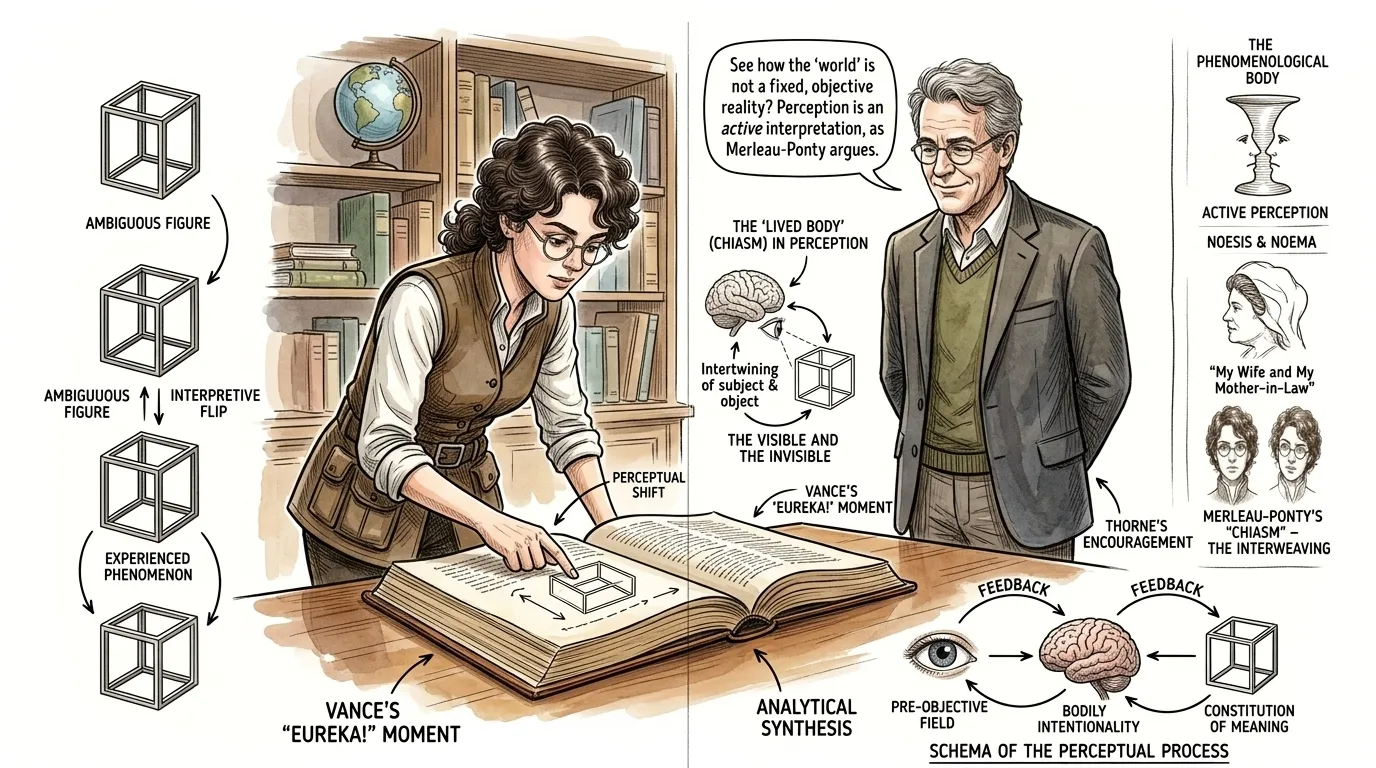
Elara found an old book open to a page featuring an optical illusion—a classic Necker cube diagram. She traced its lines with her finger, watching the cube seem to flip its orientation with her shifting gaze, and she shared her observation with Dr. Thorne.
"'Look at this, Dr. Thorne,' Elara said, pointing to the line drawing of the cube. 'It keeps changing. Is it facing up or down? My mind can see both, but my eyes are only seeing lines!' Dr. Thorne smiled. 'Ah, the Necker cube! It perfectly illustrates Merleau-Ponty's point: our perception isn't passive, it's an active interpretation. Our body isn't just a place where our mind observes; it's the very instrument through which we engage and make sense of the world.' Elara paused, deep in thought. 'So, the body isn't just something I have, but something I am?'"
Philosophy Note: Merleau-Ponty argued for the concept of the 'body-subject,' stating that consciousness is not detached but always 'situated' and 'embodied.' Our body is not merely a tool for our mind, but our primary mode of access to the world and others, foundational to our experience and understanding.
Page 4
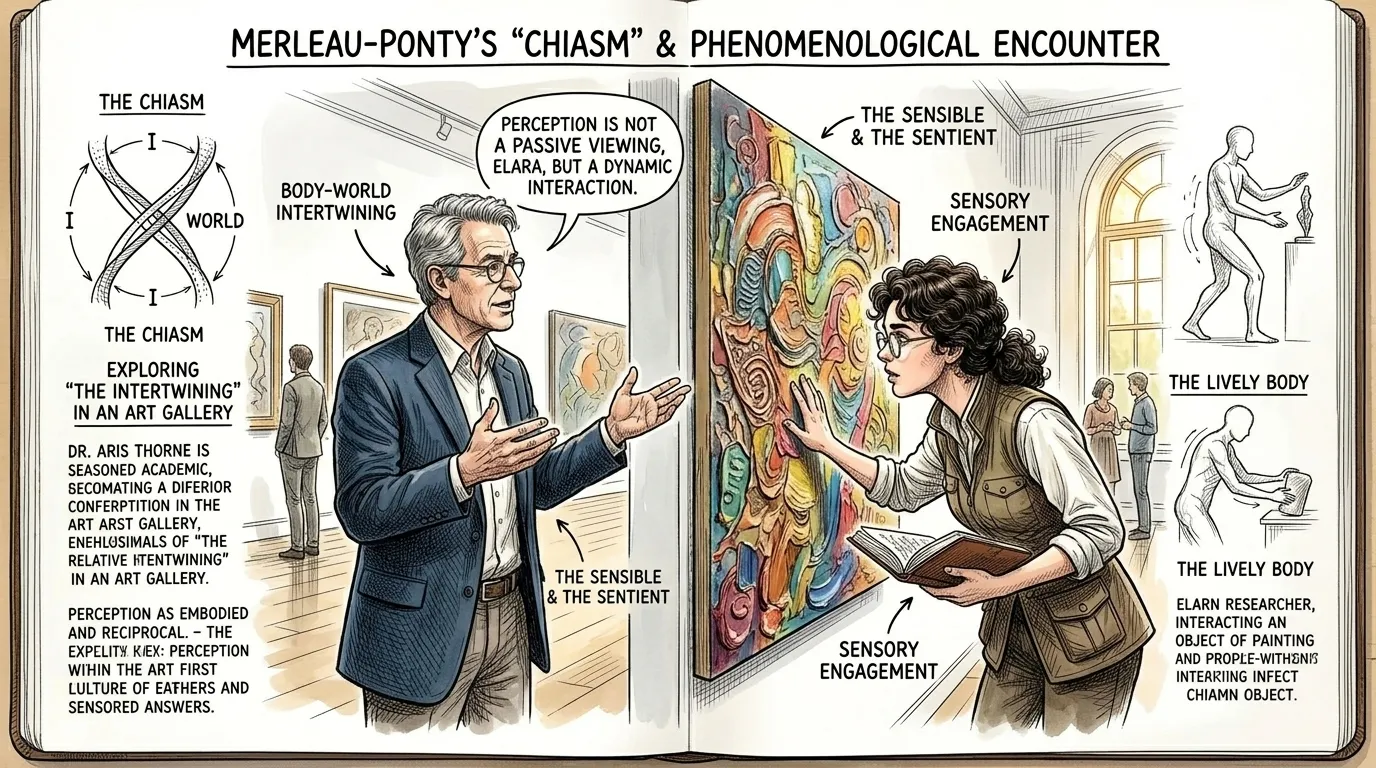
Dr. Thorne led Elara to a gallery displaying abstract art, encouraging her to experience the paintings not just as images, but as forms demanding engagement. He explained how Merleau-Ponty saw perception as a dynamic interaction, not a static observation.
"'Merleau-Ponty called this the 'primacy of perception',' Dr. Thorne elaborated, gesturing toward a textured abstract painting. 'He believed our first encounter with the world isn't intellectual, but through our senses, our movements, our felt experience. We don't just 'see' a painting; we feel its depth, its texture, its presence.' Elara stepped closer, tilting her head. 'So, the world isn't an objective stage for our minds, but a rich tapestry we're always actively weaving with our bodies and senses?' Dr. Thorne nodded. 'Exactly. It's a world we live and breathe, not just observe.'"
Philosophy Note: For Merleau-Ponty, 'the primacy of perception' meant that our most fundamental interaction with the world occurs through our lived body. Perception is an active, interpretative process, not a mere reception of data, shaping our understanding before any intellectual reflection.
Page 5
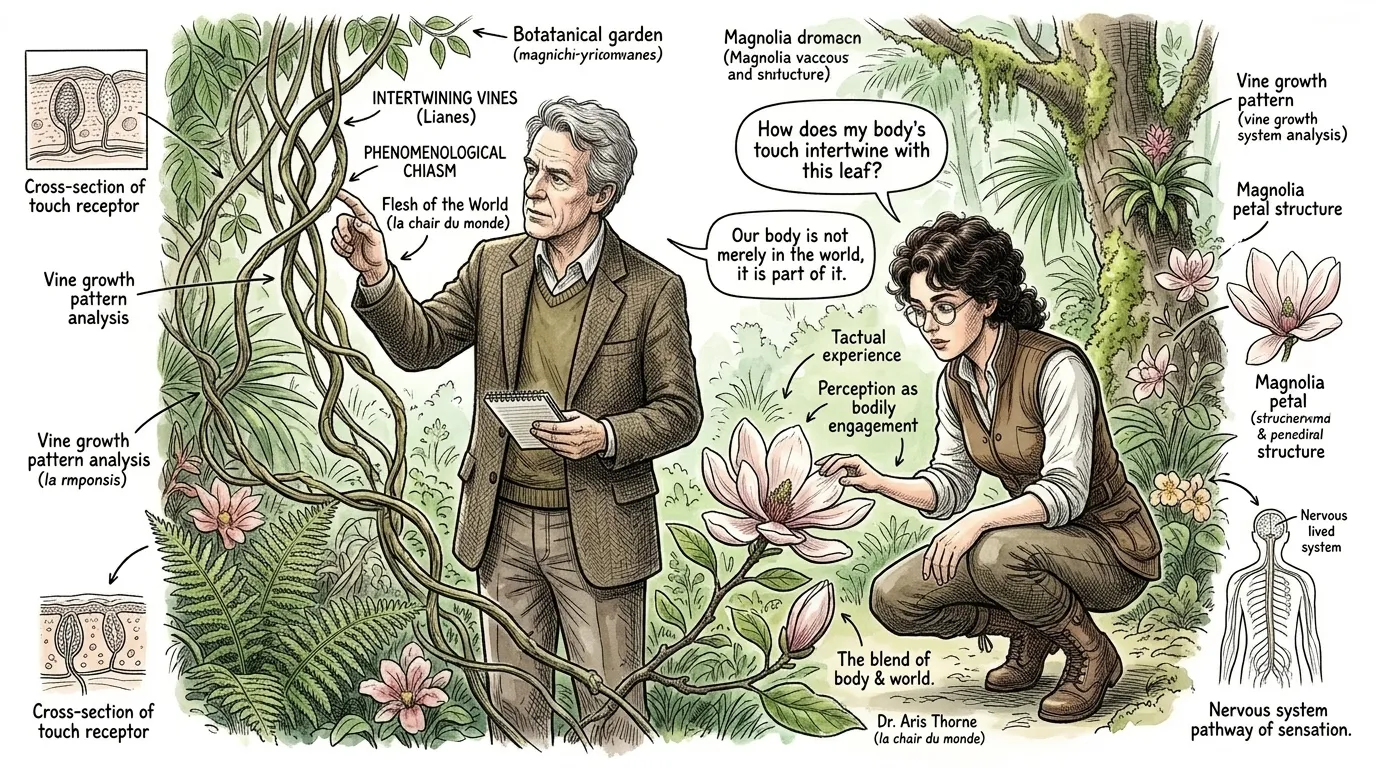
Dr. Thorne and Elara continued their discussion in a botanical garden, observing the intertwining vines and branches. Dr. Thorne explained Merleau-Ponty's profound concept of 'intertwining,' suggesting a deep connection between our sensing bodies and the sensed world.
"'This idea of the 'intertwining' is central,' Dr. Thorne mused, tracing the winding path of a vine. 'Merleau-Ponty used the term 'the flesh of the world' to describe how we, as embodied beings, are not separate from the world, but are literally part of its fabric. When I touch this leaf, I am both the one touching and the one being touched, in a sense.' Elara gently touched a soft petal. 'So, the boundary between my body and the world around me isn't a sharp line, but a soft blend?' Dr. Thorne smiled. 'Precisely. We are always both subject and object, woven into the texture of reality itself.'"
Philosophy Note: The concept of 'intertwining' (le chiasme) and 'the flesh of the world' (la chair du monde) describes Merleau-Ponty's non-dualistic understanding of reality. It suggests an inherent reciprocity between the embodied subject and the world, where they are mutually constitutive and inseparable.
Page 6
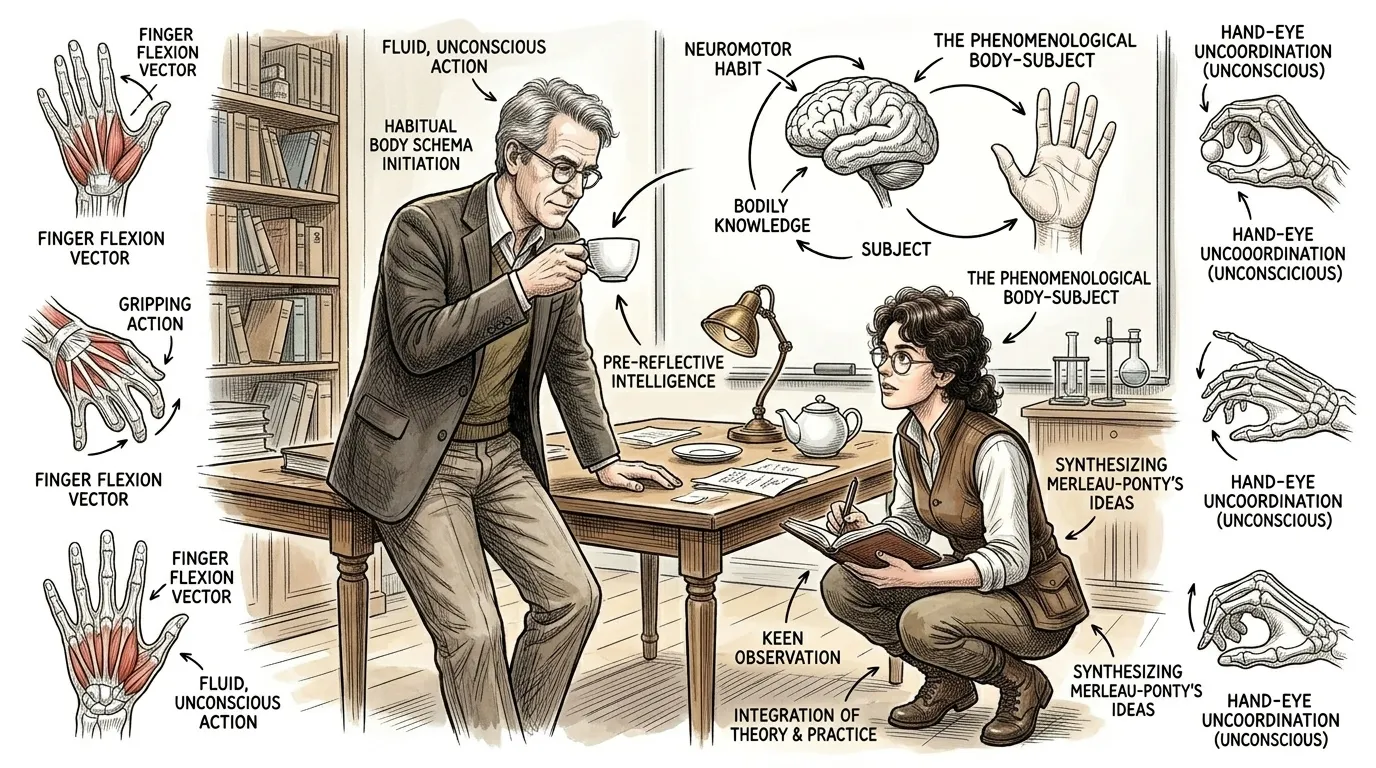
Dr. Thorne demonstrated a simple action, like reaching for a cup, without consciously thinking about each muscle movement. Elara observed, recognizing how much of our daily existence operates through this unconscious, embodied knowledge, or 'body schema.'
"'Consider how you ride a bicycle, or play an instrument,' Dr. Thorne explained, seamlessly picking up a nearby teacup without looking. 'You don't consciously calculate every muscle contraction. Your body 'knows' how. This is your 'body schema' – a dynamic, lived understanding of your own body in space, built through habit.' Elara watched his fluid motion. 'It's like an unconscious mastery! So, our body isn't just following orders from the brain; it possesses its own intelligence, learned through countless interactions?' Dr. Thorne nodded. 'Indeed. The body accumulates skills, making us intimately attuned to our environment.'"
Philosophy Note: Merleau-Ponty introduced the 'body schema' (corps propre) as the pre-reflective, practical understanding of one's own body in action. It's an unconscious system of motor habits and spatial orientation that allows us to navigate the world skillfully, without explicit calculation.
Page 7
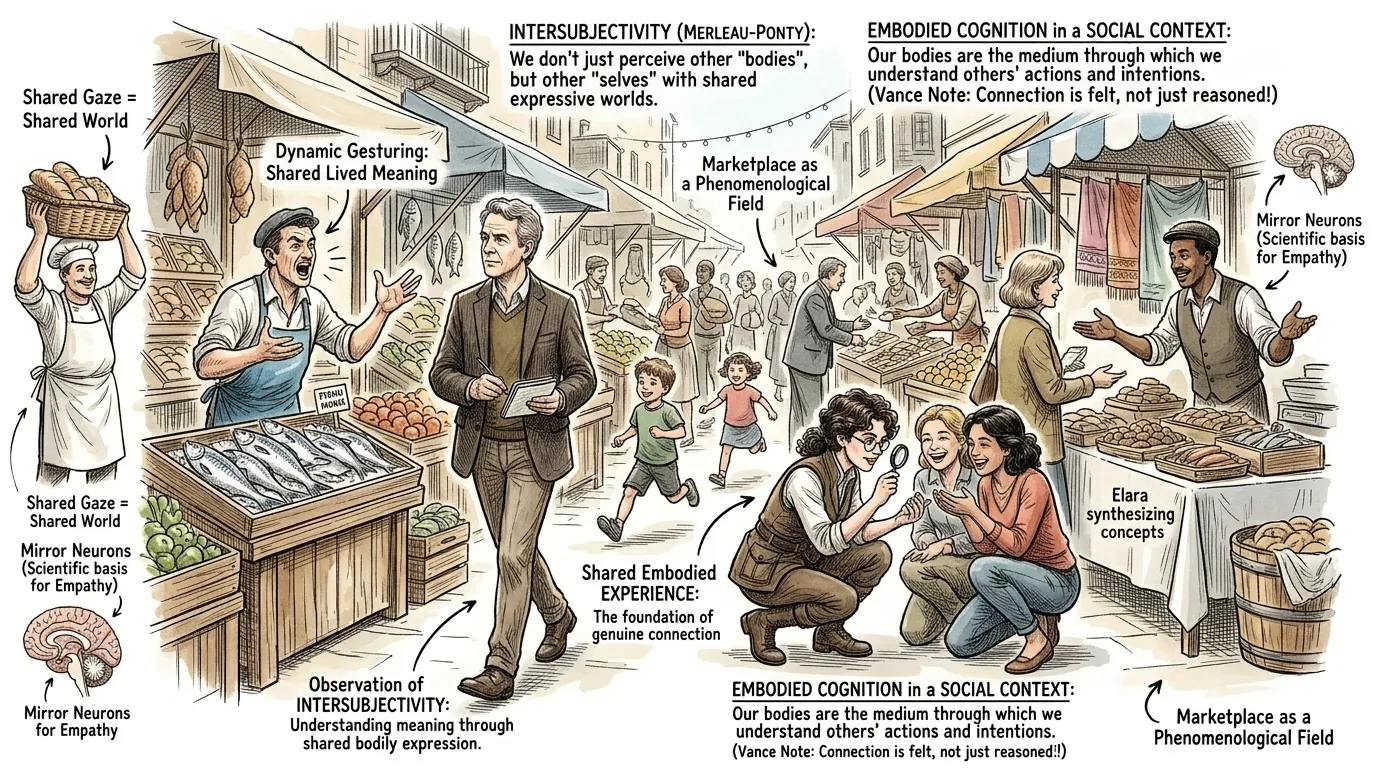
Dr. Thorne and Elara walked through a busy marketplace, observing people interacting. Dr. Thorne explained how Merleau-Ponty extended his philosophy to understand how we perceive and connect with other people through our shared embodied experience.
"'Merleau-Ponty's ideas also transform how we understand others,' Dr. Thorne said, watching a vendor gesticulate. 'We don't just deduce another person's emotions from their movements; we feel them, in a way, through our own embodied understanding. Their smile isn't just a facial contraction; it resonates with our own capacity for joy.' Elara watched two friends laugh. 'So, when I see someone smile, my own body instinctively grasps what that means, almost mirroring it?' Dr. Thorne affirmed, 'Yes. We perceive others through a shared 'intercorporeality,' a deep bodily resonance that connects us before words.'"
Philosophy Note: Merleau-Ponty's concept of 'intersubjectivity' emphasizes that our perception of others is not based on inference but on a pre-reflective, embodied understanding. We grasp the meaning of another's gestures, expressions, and intentions through a shared 'intercorporeality,' a mutual intertwining of lived bodies.
Page 8
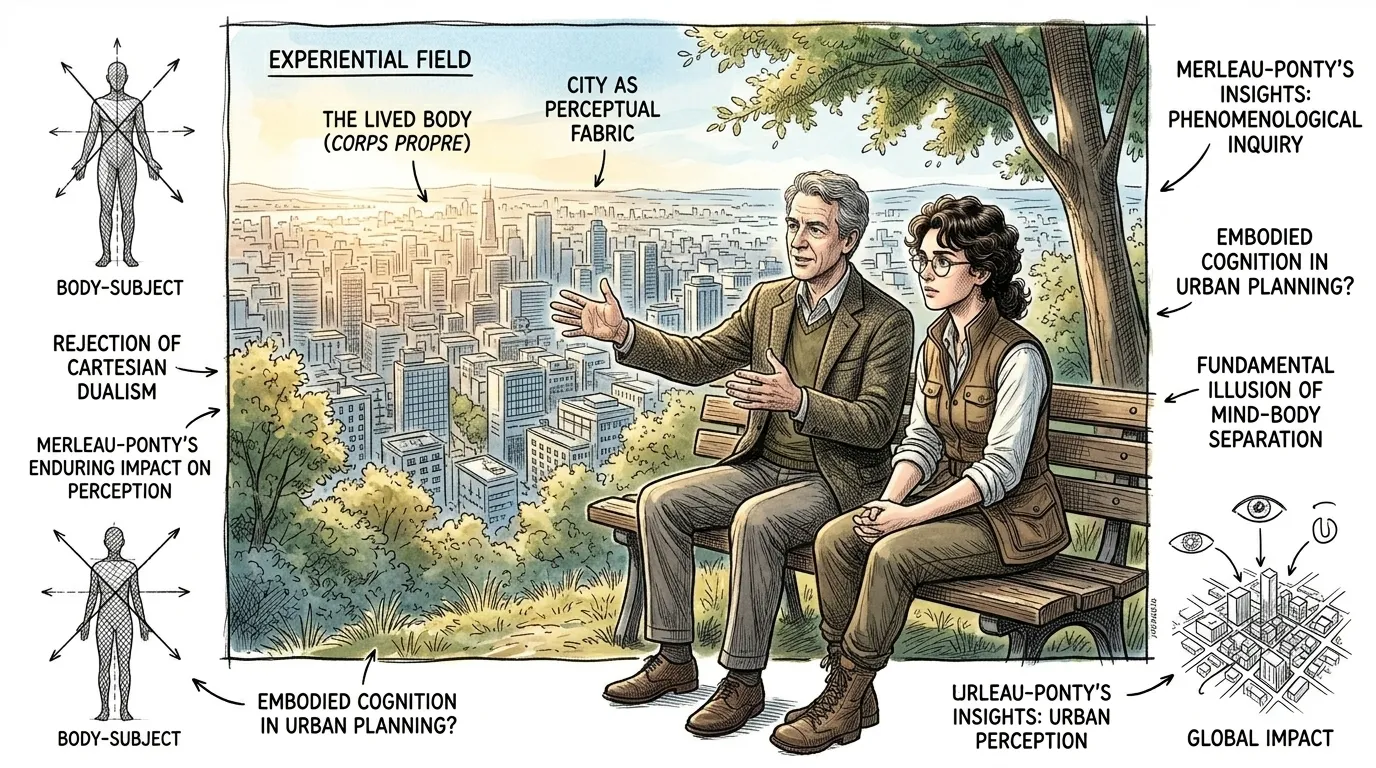
Elara recalled the Necker cube, realizing how Merleau-Ponty's entire philosophy was like unraveling an even grander illusion—the idea that our minds exist separate from our bodies and the world. Dr. Thorne elaborated on the enduring impact of this insight.
"'That Necker cube, Elara, showed us how our embodied perception actively shapes what we see,' Dr. Thorne explained, as they sat on a park bench, the city stretching out before them. 'Merleau-Ponty expanded that to everything. The world isn't 'out there' for a disembodied mind to observe; it's always 'here,' lived through and with our bodies.' Elara nodded slowly. 'So, the world is not what I think, but what I live,' she quoted, remembering Merleau-Ponty's words. 'He completely uprooted the old ways of thinking, showing that our very presence, our embodied being, creates meaning.'"
Philosophy Note: Merleau-Ponty's philosophy represents a foundational shift, emphasizing that consciousness is always embodied and situated. He argued that the world is not merely an object for detached thought but is constituted through our active, sensory, and motor engagement, famously stating: 'The world is not what I think, but what I live.'
Page 9
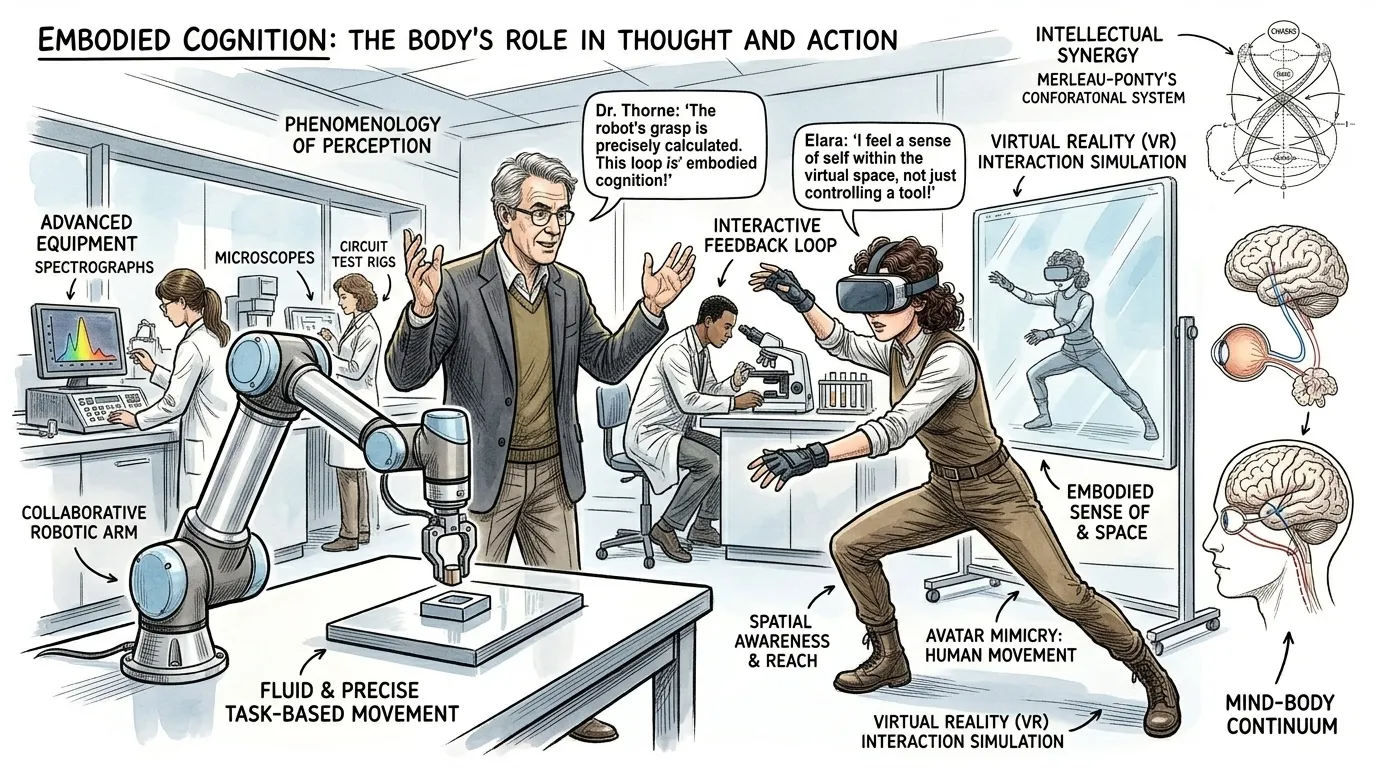
Dr. Thorne and Elara visited a modern university laboratory, discussing how Merleau-Ponty's insights continue to resonate in fields like cognitive science and artificial intelligence. They observed researchers working with robotics and virtual reality systems.
"'Merleau-Ponty's ideas about embodied cognition are profoundly relevant in fields like AI,' Dr. Thorne explained, as a robotic arm moved fluidly in the lab. 'To truly understand intelligence, we must move beyond simply programming rules and consider how bodies learn through interaction, adapting to the world.' Elara observed a virtual reality simulation. 'So, even in virtual worlds, our embodied sense of self and space is crucial? It's not just about what the computer 'thinks,' but what the avatar 'feels' and 'does'?' Dr. Thorne smiled. 'Exactly. His work guides us to build systems that learn from doing, from being-in-the-world, not just from abstract data.'"
Philosophy Note: Merleau-Ponty's work has profoundly influenced cognitive science, psychology, and artificial intelligence, particularly in theories of embodied cognition. His emphasis on the body's role in perception and meaning-making guides research on how intelligence emerges from an organism's interaction with its environment, rather than purely abstract computation.
Page 10
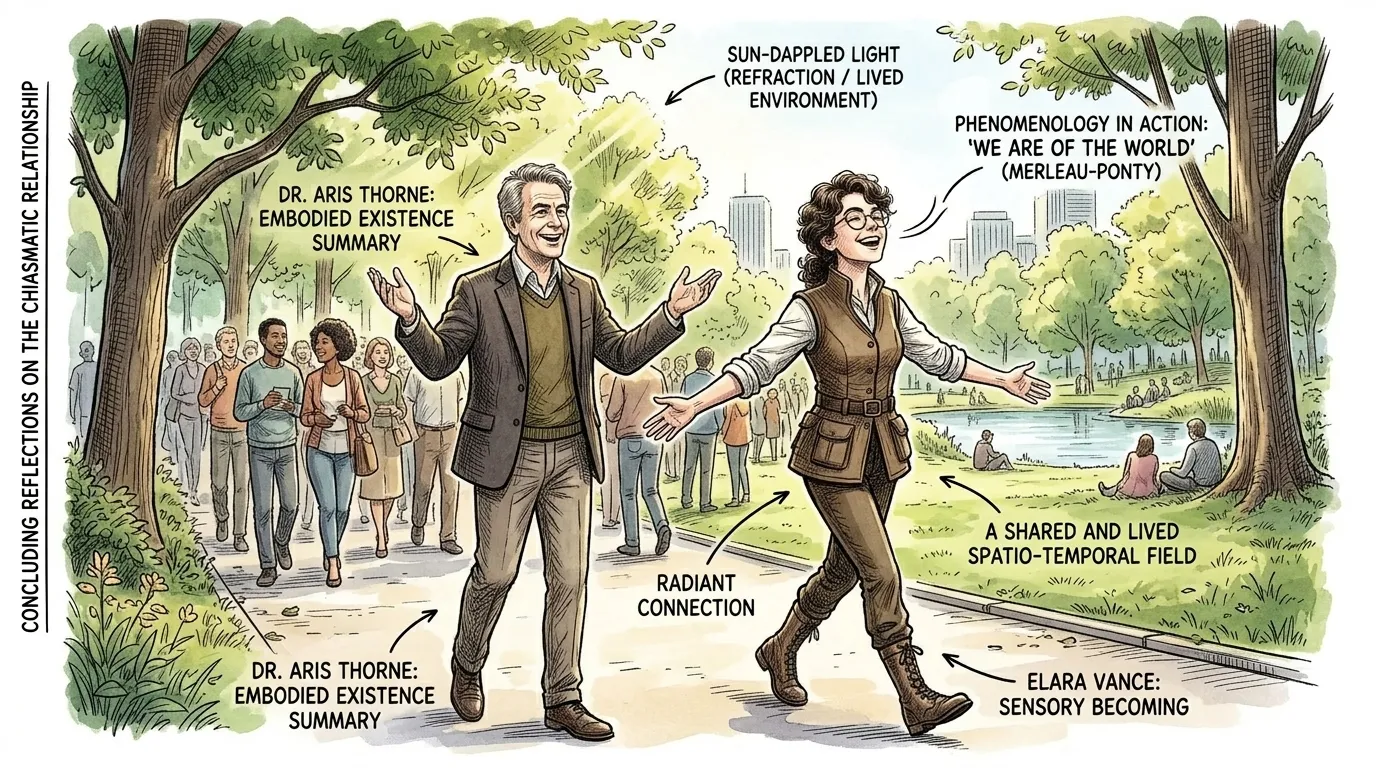
Walking through a vibrant city park, Dr. Thorne and Elara reflected on Merleau-Ponty's ultimate legacy. His insights offer a richer, more connected way of experiencing life, emphasizing our deep connection to the world and each other through our shared embodied existence.
"'Merleau-Ponty teaches us to truly inhabit our bodies, to pay attention to our sensory experiences, and to appreciate our deep connection to the world around us,' Dr. Thorne summarized, looking out at the diverse crowd enjoying the park. 'It's a philosophy that makes us more present, more attuned.' Elara took a deep breath of the crisp air. 'It makes everything feel more vibrant, more real. Understanding him helps us see that our bodies aren't limits, but gateways to profound meaning and connection with everything.' Dr. Thorne smiled warmly. 'Indeed. The world truly comes alive when we embrace it through our embodied selves.'"
Philosophy Note: Merleau-Ponty's enduring legacy lies in his profound re-evaluation of human experience. By emphasizing the 'primacy of perception' and the body as the site of meaning, his philosophy encourages a more integrated understanding of self, others, and the world, influencing fields from art criticism to psychotherapy, and offering a richer way of being.
About this story
- Audience: general readers
Questions and answers
Read Wonder Philosophy on your phone
Wonder Philosophy is available on Android and iPhone and iPad. Get Wonder Philosophy on Google Play · Get Wonder Philosophy on the App Store.