Plato
Plato — an illustrated philosophy story. 10 illustrated pages, free to read on Wonder Philosophy.
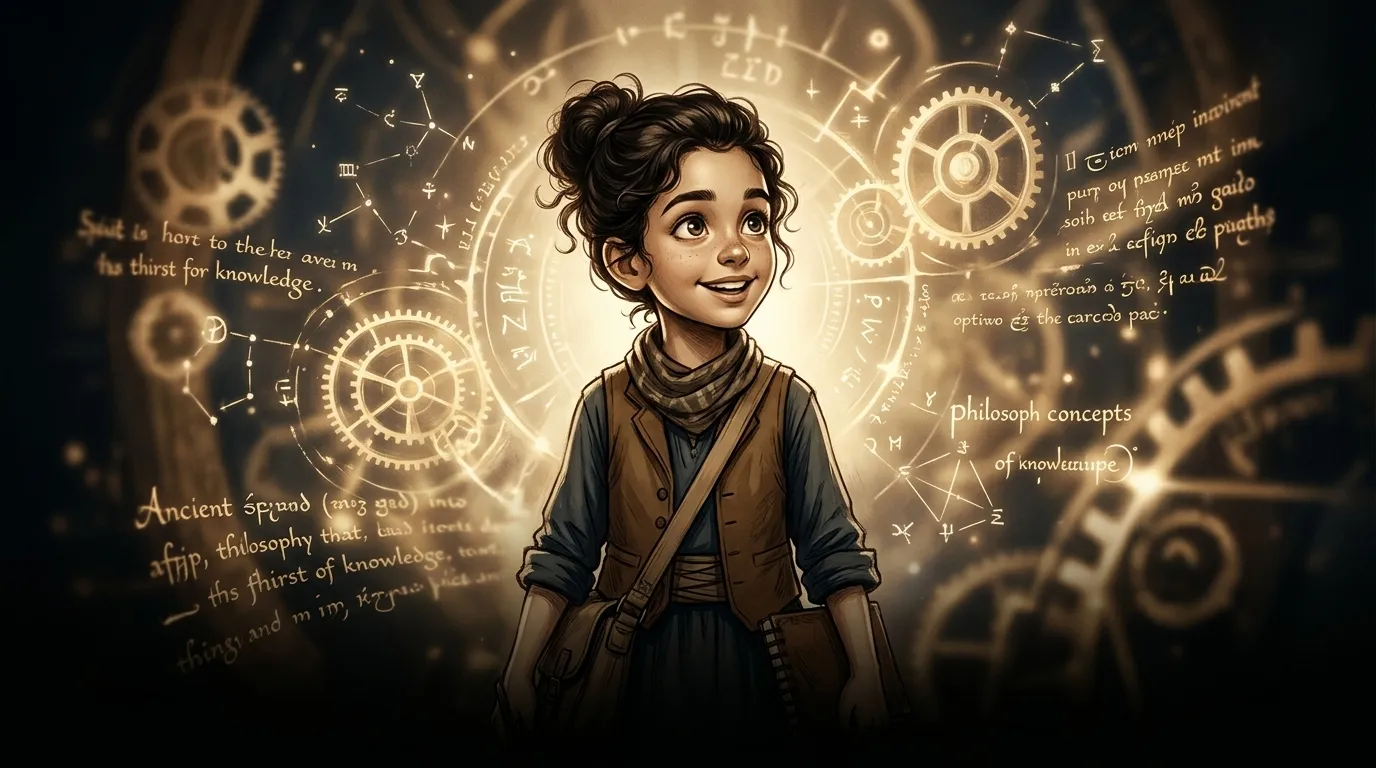
Page 1
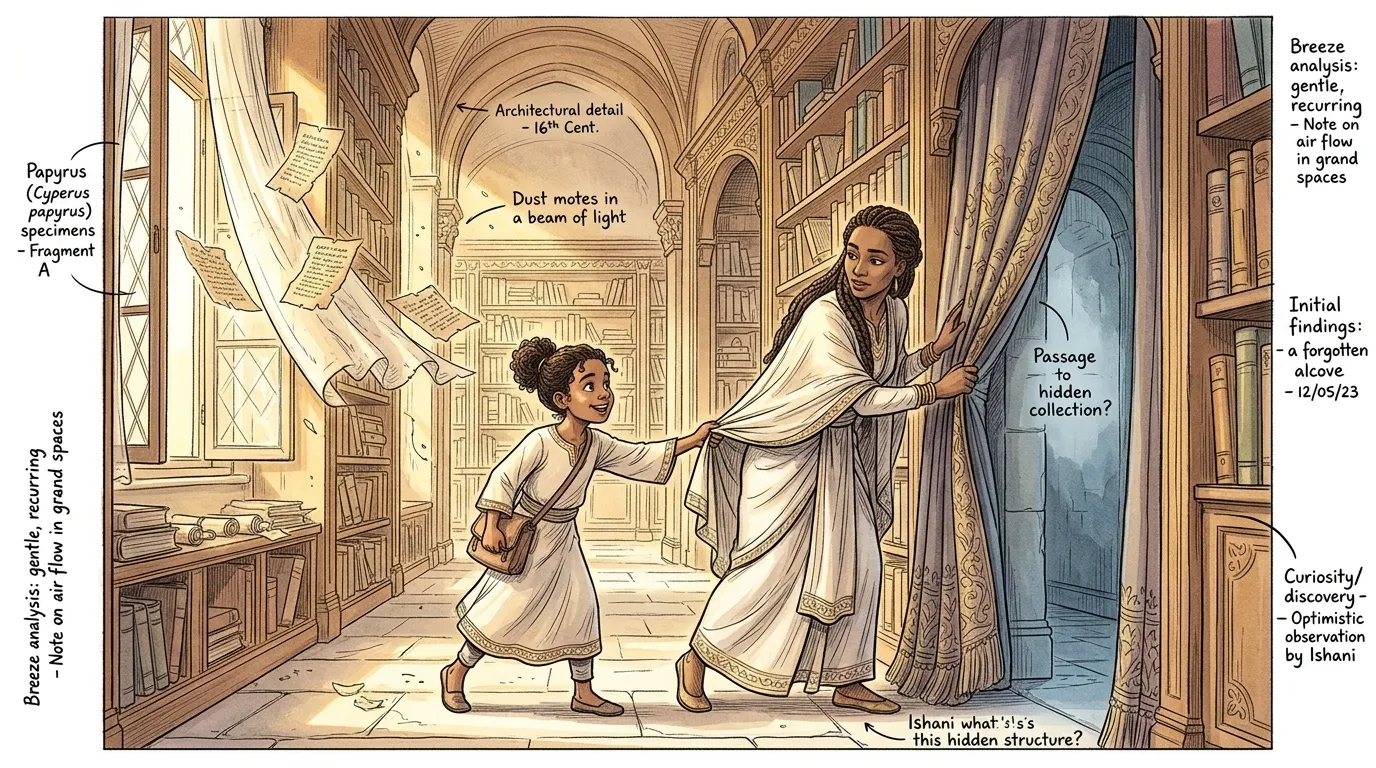
A gentle breeze rustled the ancient papyrus hanging in the half-open window, its whispers carrying through the vast, quiet halls of the old library. Luciana, her eyes wide with curiosity, tugged gently on Moana's sleeve, pointing toward a dimly lit alcove they hadn't noticed before. 'Look, Moana,' she whispered, 'it's like a secret passage!'
"'It certainly looks like it,' Moana replied, her voice soft but thoughtful, as she carefully pushed aside a heavy, embroidered curtain. 'This part of the library feels different, older, almost as if it's holding onto forgotten stories.' They stepped inside, the air cool and still."
Philosophy Note: Plato (c. 428/427 or 424/423 – 348/347 BC) was a Greek philosopher, student of Socrates, and teacher of Aristotle. His ideas form the bedrock of Western philosophy, profoundly influencing political theory, metaphysics, ethics, and epistemology.
Page 2
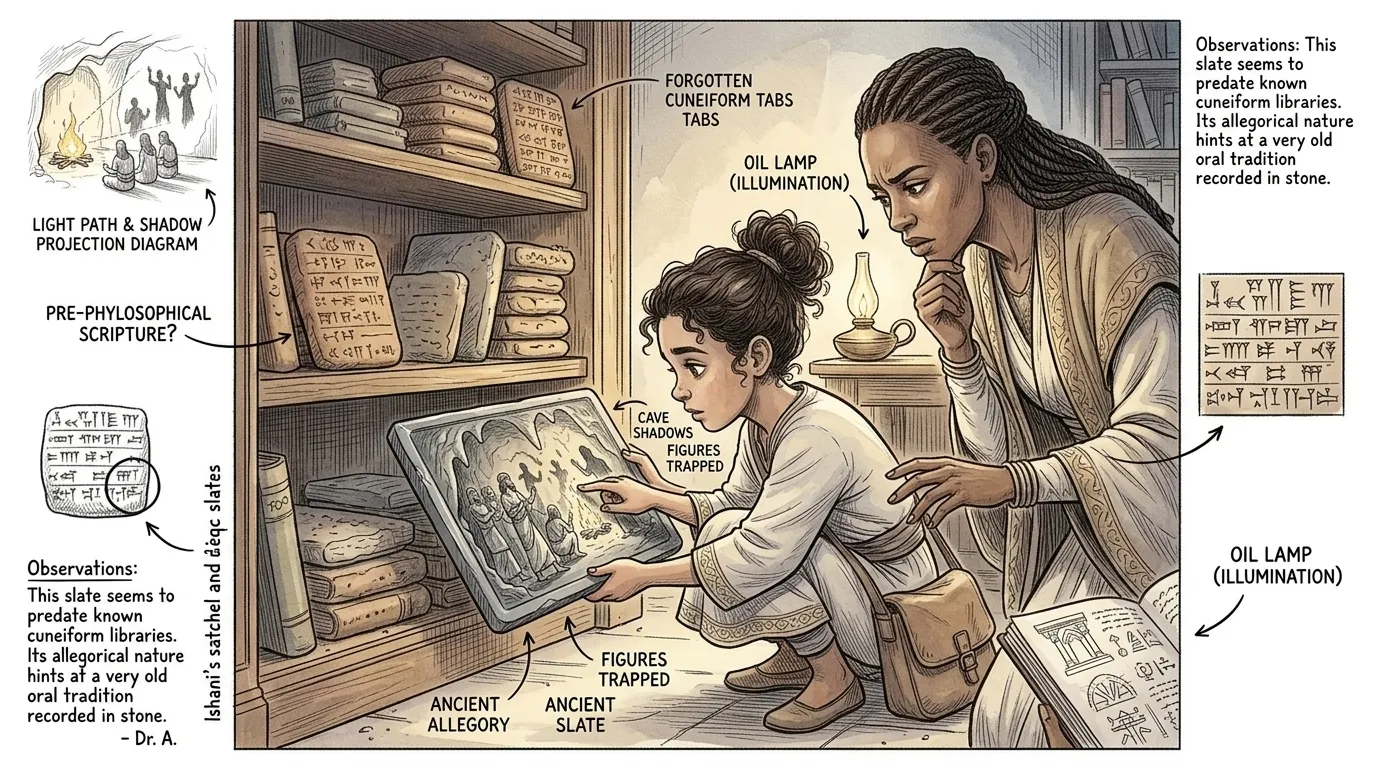
Deep within the alcove, hidden beneath a forgotten stack of clay tablets, Luciana's small fingers brushed against something smooth and cold. She pulled out a flat, polished slate, intricately carved with a strange scene. It showed figures chained inside a cave, watching shadows dance on a wall, with a fire flickering behind them.
"'What is this, Moana?' Luciana asked, tracing the carving with her finger. 'It looks like a story, but I don't understand it.' Moana leaned closer, her brow furrowed in thought. 'It's very old. See these symbols? They talk about 'seeing' and 'believing.' It's a puzzle about what is real and what is just a reflection.'"
Philosophy Note: The Allegory of the Cave, presented in Plato's 'Republic,' is a foundational metaphor exploring perception, reality, and education. It illustrates how our senses can deceive us and the struggle involved in seeking true knowledge.
Page 3
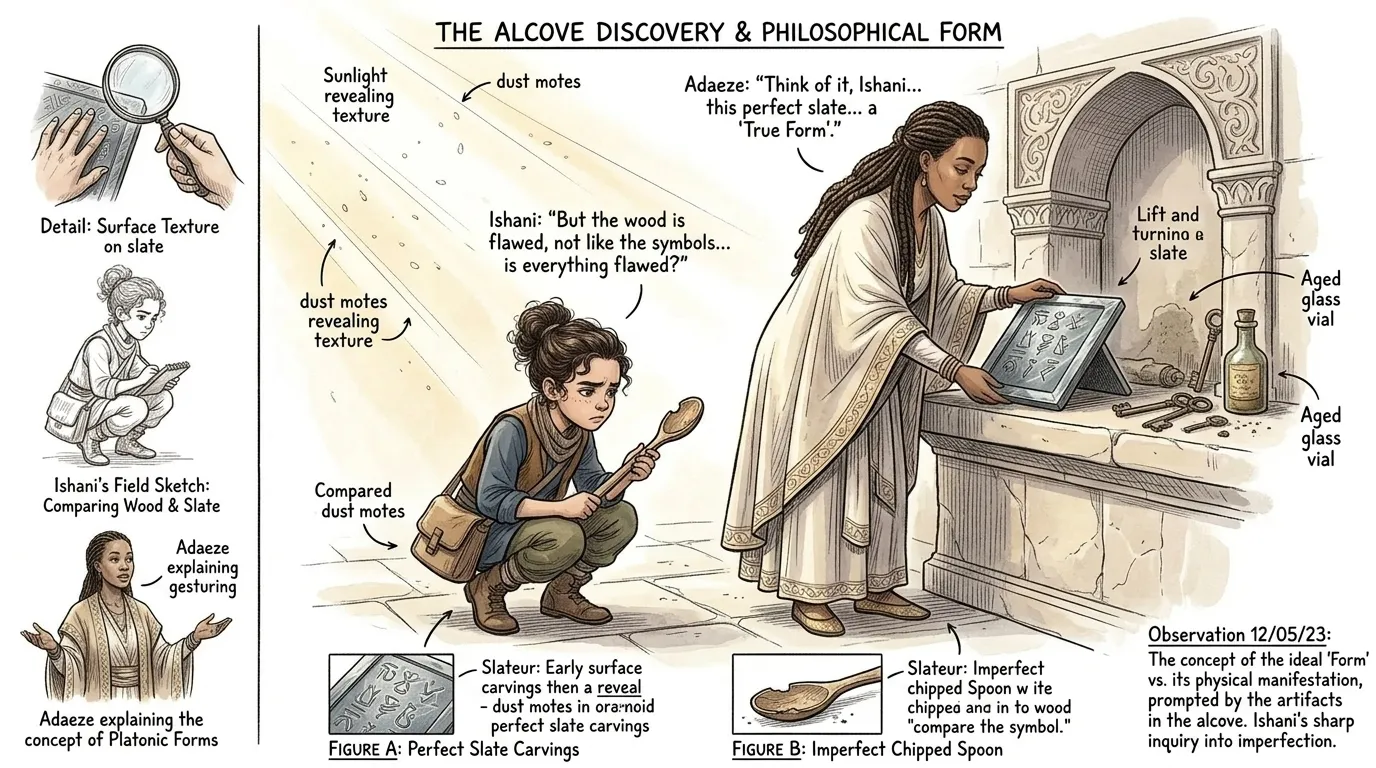
Moana carefully turned the slate over, revealing more carved symbols. 'This part speaks of 'true forms' that exist somewhere else, perfect and unchanging. It says the things we see every day are just like the shadows on the cave wall – imperfect copies of those perfect forms.' Luciana frowned, looking around at the dusty, imperfect objects in the alcove.
"'So, the carved spoon I saw earlier, with the chipped handle... that's just a shadow of a truly perfect spoon?' Luciana asked, a hint of confusion in her voice. Moana nodded slowly. 'Exactly! And if we only ever saw chipped spoons, we might never know what a perfect spoon really looks like. This slate is asking us to look beyond what we can immediately see.'"
Philosophy Note: Plato's Theory of Forms posits that non-physical, perfect, and unchanging Forms or Ideas exist independently of the sensible world. These Forms are the true reality, and the objects we perceive with our senses are merely imperfect copies.
Page 4
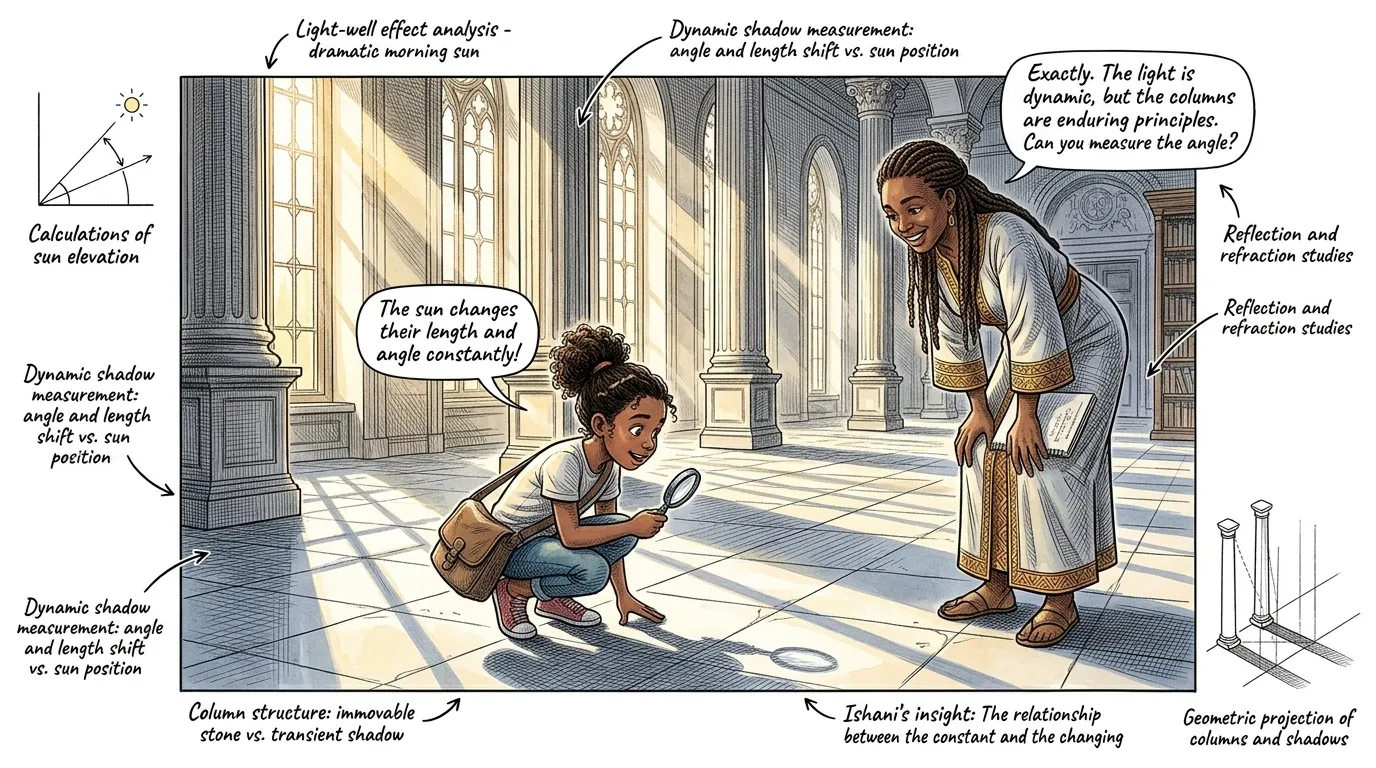
Stepping back into the main hall, Luciana noticed how the morning sunlight streamed through the windows, casting long, wavering shadows of the columns across the floor. She pointed. 'Look! The shadows are changing as the sun moves. But the columns themselves stay solid and the same.'
"'That's a great observation, Luciana!' Moana exclaimed, a smile breaking across her face. 'The columns are more 'real' than their shadows, aren't they? The shadows are just appearances, reflections of the columns' true shape. It's like the slate says, we have to learn to see past the changing shadows to the true form.'"
Philosophy Note: For Plato, true knowledge (episteme) comes from understanding the Forms, not from sensory experience (doxa), which can be deceptive and fleeting. He believed philosophers, through reason, could access this higher realm of reality.
Page 5
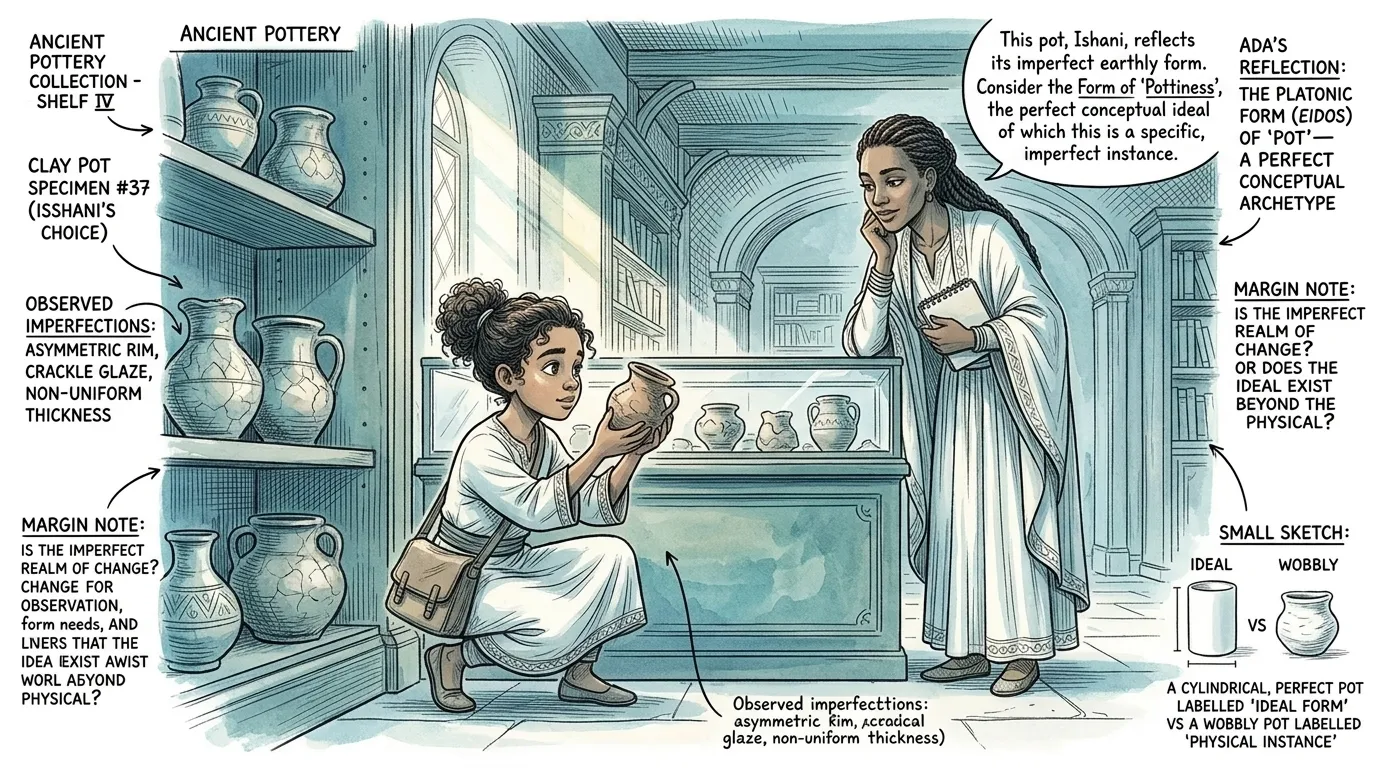
As they continued through the library, they came across a collection of old clay pots, each one slightly different. Some were lopsided, others had cracks, and no two were exactly alike. Luciana picked up a tiny, misshapen pot.
"'If there's a perfect idea of a spoon, is there a perfect idea of a pot too?' Luciana asked, turning the pot in her hands. Moana nodded. 'Yes, according to the slate's idea! Imagine the most perfectly round, perfectly balanced, perfectly smooth pot you can. That's the 'Form' of the pot. All these clay pots are just attempts to copy that perfect idea, and some are better copies than others.'"
Philosophy Note: The physical world is constantly changing and perceived differently by each individual, making it unreliable for attaining true knowledge. The Forms, however, are constant and accessible through rational thought and contemplation.
Page 6
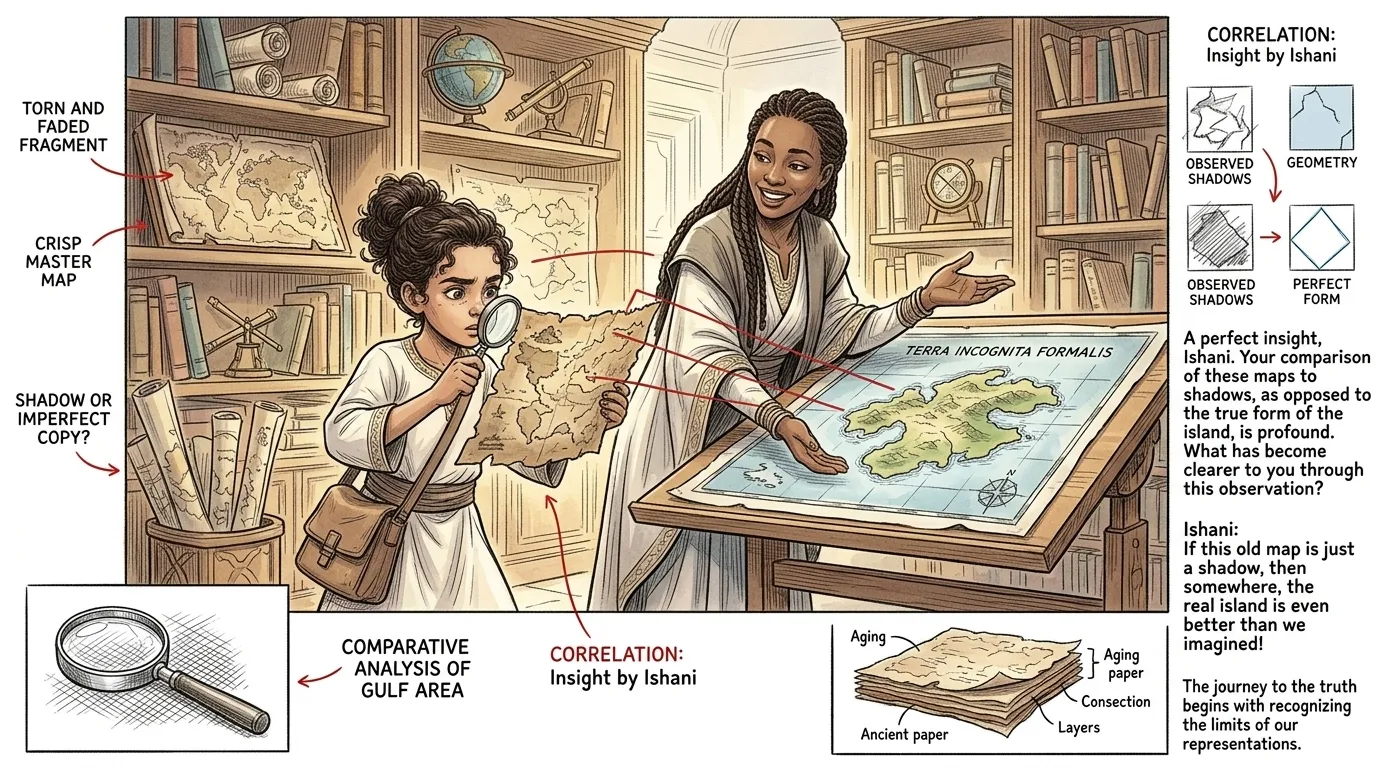
They found themselves in a section of the library dedicated to ancient maps and navigational tools. One map was torn and faded, its lines almost indistinguishable, while another was crisp and clear, though still a representation of a real place. Luciana pointed to the damaged map, then to the intact one.
"'This torn map is like a really blurry shadow,' Luciana observed, 'and the clear map is a better shadow, even if neither one is the real island.' Moana smiled. 'Exactly! And the person who made the clear map understood the 'Form' of the island better than the person who made the blurry one. They tried harder to show its true shape.'"
Philosophy Note: Plato used concepts like beauty, justice, and goodness as primary examples of Forms. He argued that all beautiful things in the world participate in the single Form of Beauty, making them beautiful.
Page 7
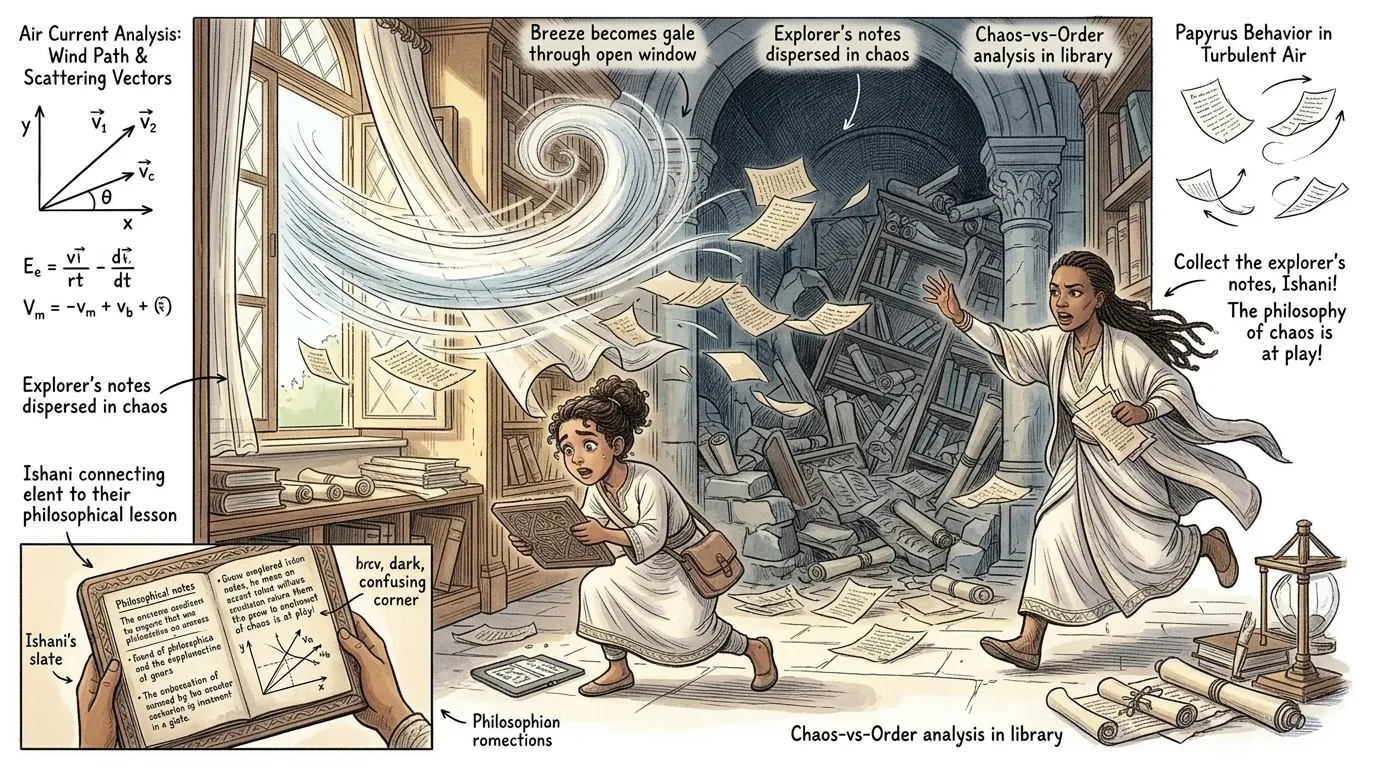
Suddenly, a strong gust of wind swept through an open window, scattering several loose sheets of papyrus from a nearby desk. The papers fluttered into a dark, confusing corner of the library, creating a dizzying array of shifting white shapes. Luciana gasped.
"'Oh no, the old explorer's notes!' Moana exclaimed, seeing the scattered papers. 'We need to collect them. But it's so dark, and everything looks like a ghost in the shadows!' Luciana looked at the shadowy corner, then back at the carved slate they had found. 'We have to remember the 'true forms' of the papers,' she said, 'not just their wobbly shadows.'"
Philosophy Note: The distinction between appearance and reality is central to Plato. He believed that our senses can be misled, and it is only through intellectual insight that we can grasp the unchanging truths of the Forms.
Page 8
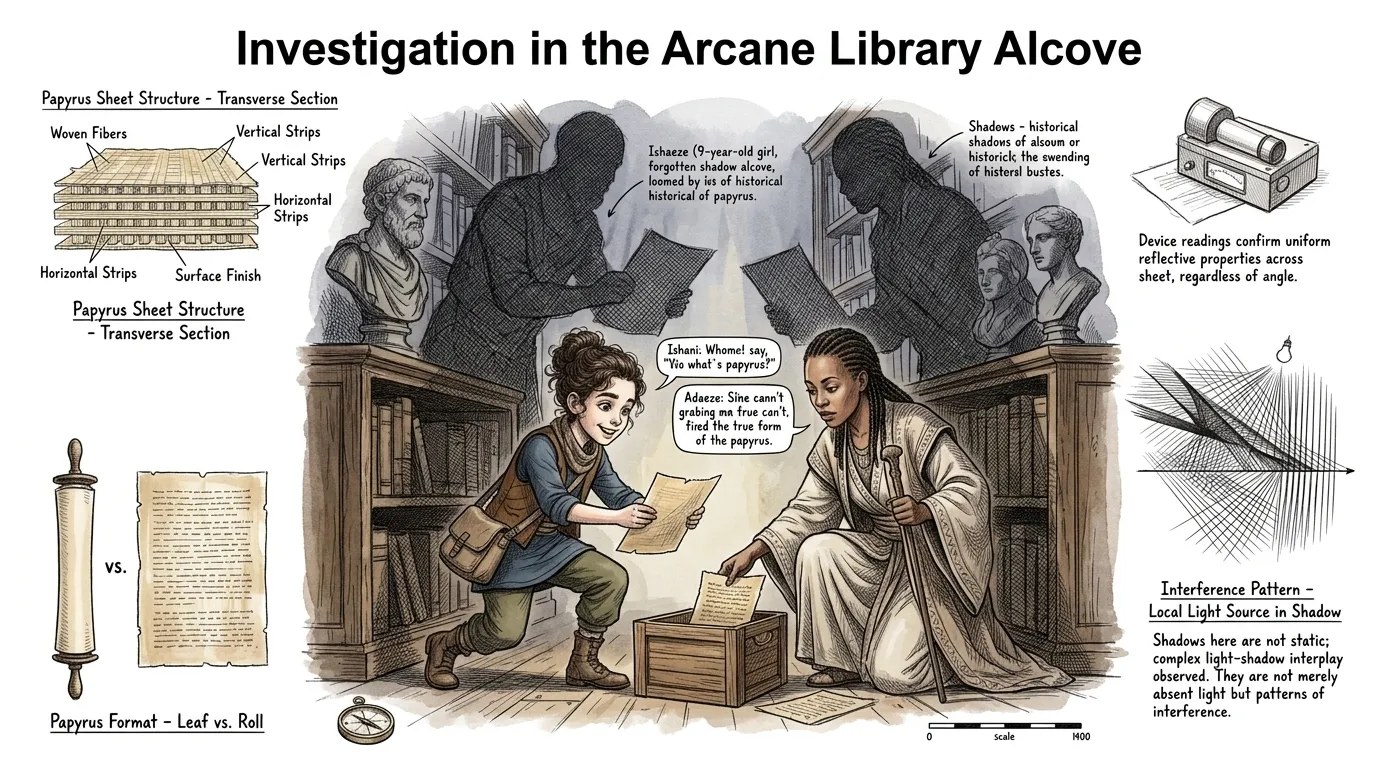
Taking a deep breath, Luciana and Moana carefully stepped into the shadowy corner. Instead of focusing on the fleeting white shapes, they concentrated on the 'idea' of a papyrus sheet: rectangular, flat, with distinct edges. They ignored the distracting, flickering shadows that tried to trick their eyes. Slowly, they began to gather the sheets.
"'There's one!' Luciana said triumphantly, picking up a sheet. 'And another!' Moana added, grabbing one from behind a small crate. 'We're not letting the shadows confuse us anymore! By remembering what the actual paper looks like, its true form, we can find them all.' Their discovery of the carved slate had given them a new way to see."
Philosophy Note: The ability to look past sensory data to understand underlying structures and concepts is a critical skill, applicable in many fields from scientific inquiry to ethical reasoning, echoing Plato's philosophical pursuit.
Page 9
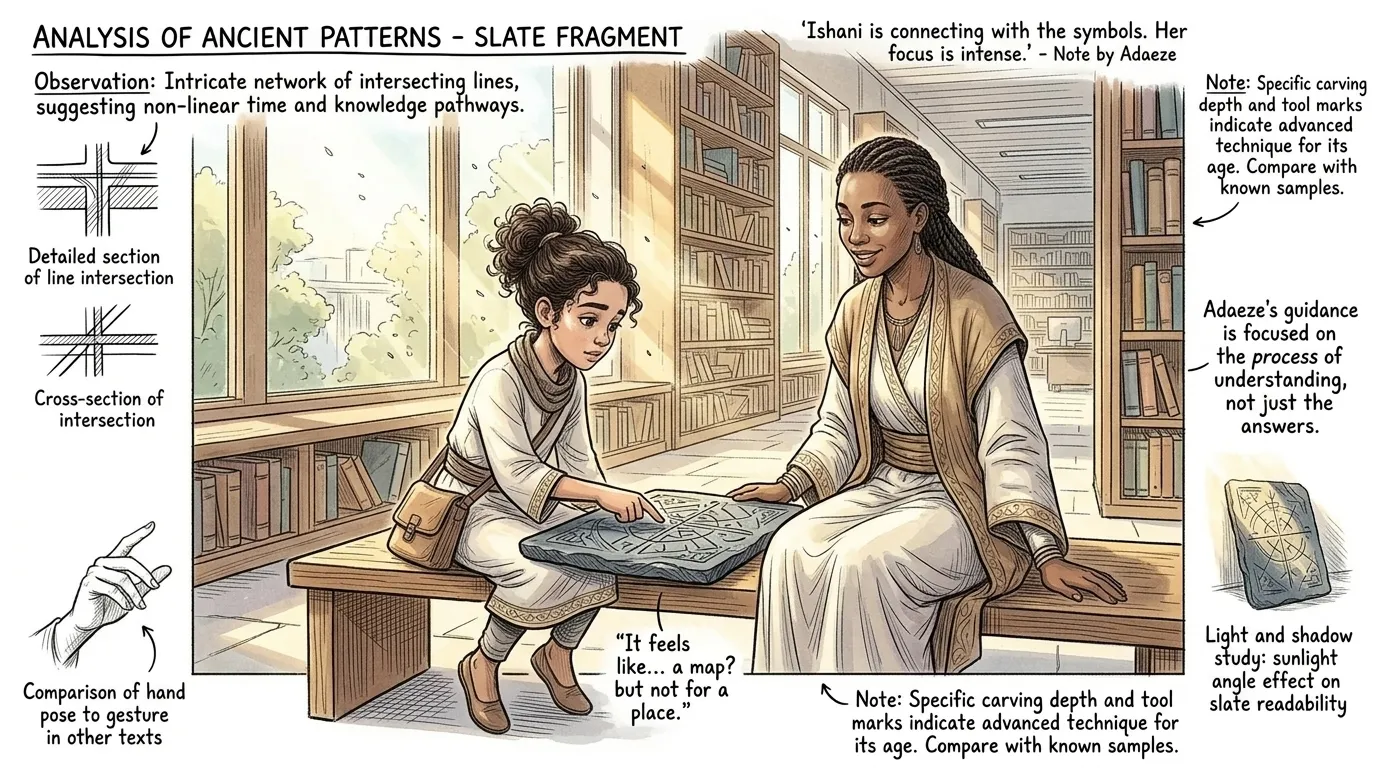
With all the explorer's notes safely gathered, Luciana and Moana sat on a sun-drenched bench, the carved slate between them. The adventure had not only been about retrieving papers but about understanding a deeper truth. Moana smiled, looking at Luciana, who was thoughtfully tracing the lines on the slate.
"'You know,' Moana said, 'it reminds me of something a very wise scientist, Albert Einstein, once said: 'The important thing is not to stop questioning. Curiosity has its own reason for existence.' He was right. Because we kept questioning, we learned to see beyond just the shadows.'"
Philosophy Note: Plato's work profoundly impacted Western thought, inspiring countless philosophers to question the nature of reality, the source of knowledge, and the ideals that should guide human life and society.
Page 10
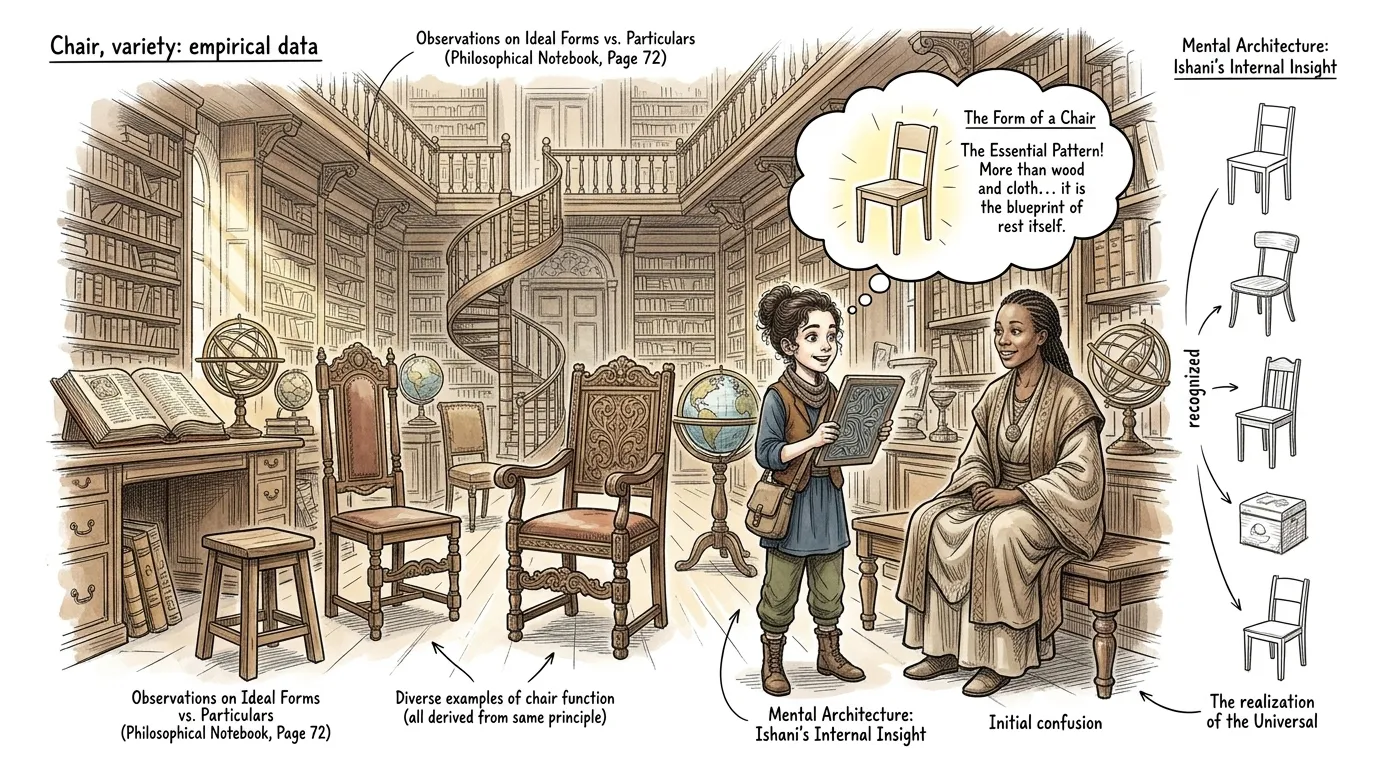
Luciana looked from the slate to the world around her, seeing it with new eyes. The idea of 'true forms' existing beyond what we physically see helped her understand why things might look different, yet still be the 'same thing.' It was a way to think about the world, to question appearances.
"'So, even though we see many different kinds of chairs,' Luciana mused, 'they all share the 'idea' of a chair, something perfect for sitting. And that's what this old carving from Plato is trying to teach us!' Moana nodded, 'Exactly. It teaches us to think deeper, to always look for the true ideas behind everything we experience.'"
Philosophy Note: Plato's inquiries into abstract concepts continue to resonate, encouraging us to critically examine our assumptions about reality, justice, and knowledge, and to strive for a deeper understanding of the world around us.
About this story
- Audience: kids (ages 6–12)
Questions and answers
Read Wonder Philosophy on your phone
Wonder Philosophy is available on Android and iPhone and iPad. Get Wonder Philosophy on Google Play · Get Wonder Philosophy on the App Store.