Roland Barthes
Roland Barthes — an illustrated philosophy story. 10 illustrated pages, free to read on Wonder Philosophy.

Page 1

Roland Barthes, a towering figure in 20th-century French thought, fundamentally reshaped how we understand the language of culture, moving beyond mere words to analyze the unspoken messages embedded in everyday objects and rituals. His profound insights into semiotics, the study of signs and symbols, revealed that what often appears 'natural' or 'self-evident' in our world is, in fact, a carefully constructed system of meaning designed to subtly reinforce dominant ideologies. This critical lens, allowing us to see beyond surface appearances into the deeper layers of cultural communication, remains indispensable for navigating the complex narratives that shape our modern societies and personal perceptions.
Philosophy Note: Roland Barthes (1915-1980), French Literary Theorist and Semiotician. Era: Mid-20th Century.
Page 2
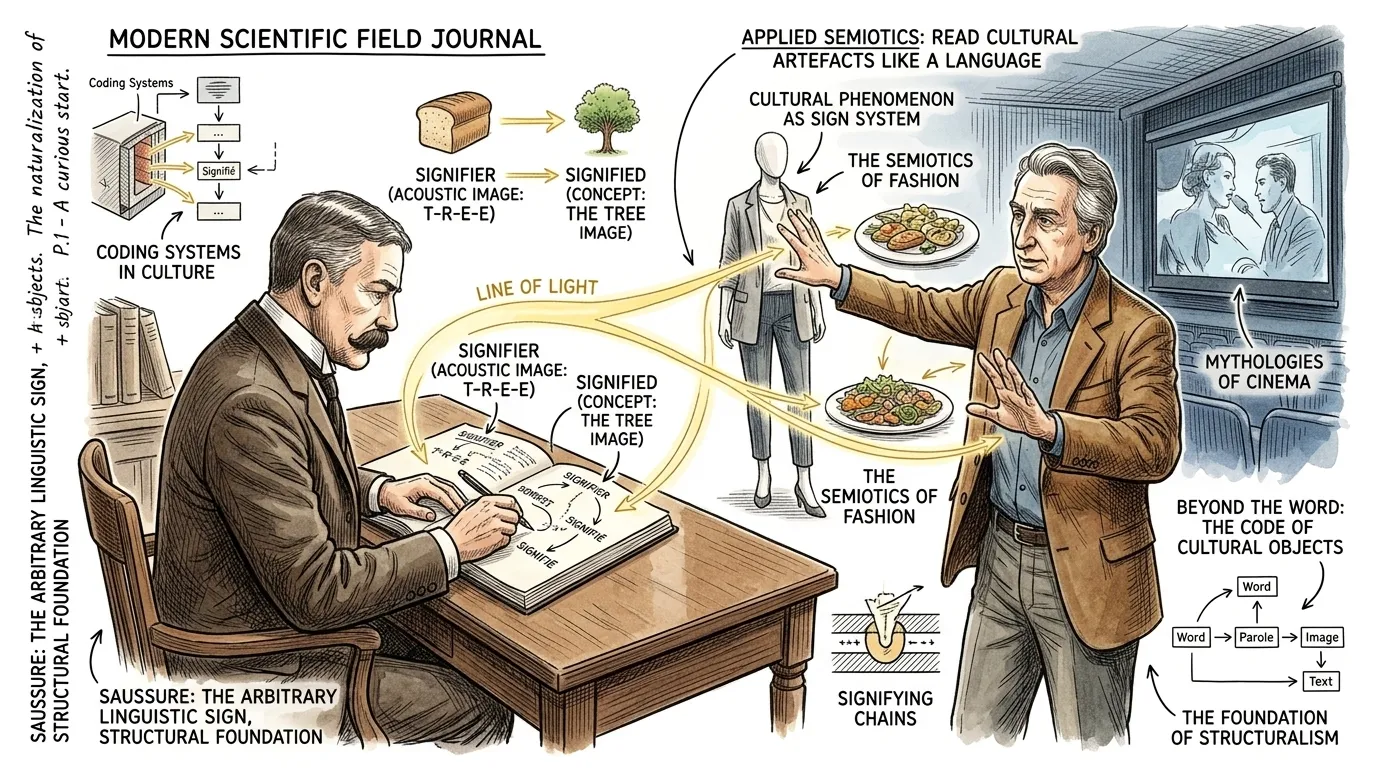
Barthes' groundbreaking work did not emerge from a vacuum; it built critically upon the foundations laid by earlier linguistic theory, particularly the structuralist linguistics of Ferdinand de Saussure, who profoundly altered our understanding of language itself. Saussure proposed that language is a system of signs, each composed of a 'signifier' – the sound-image or written word – and a 'signified' – the concept it represents, where the relationship between these two is arbitrary yet systematically structured within the language system. This revolutionary framework, introduced at the turn of the 20th century, provided Barthes with the essential tools to extend semiotics beyond mere words to encompass the entire realm of cultural phenomena, viewing everything from fashion to food as a complex language waiting to be deciphered.
"Ferdinand de Saussure famously posited, 'Language is a system of interdependent terms in which the value of each term results solely from the simultaneous presence of the others.'"
Philosophy Note: Ferdinand de Saussure (1857-1913), Swiss Linguist. Concept: Structural Linguistics, Signifier/Signified.
Page 3
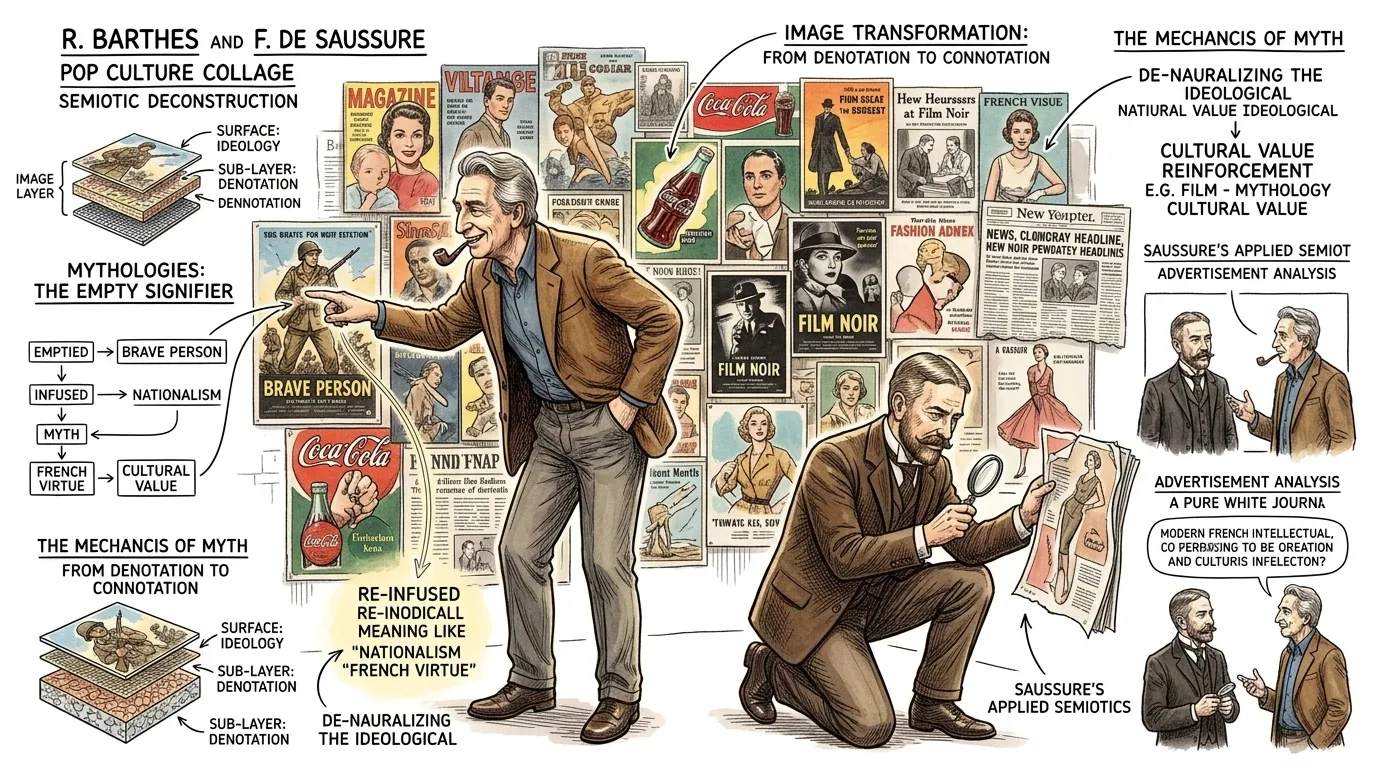
While Saussure provided the structural blueprint for language, Barthes realized that cultural practices and mass media generated meanings far more complex than simple linguistic signs, often operating in a 'second-order' semiological system that he termed 'mythologies.' He observed that cultural myths absorb existing signs, empty them of their original, transparent meaning, and then re-infuse them with a new, ideologically charged significance, thereby transforming history into a seemingly natural state. This process subtly persuades us to accept certain cultural narratives as inherent truths rather than as manufactured constructs, revealing the powerful, often invisible, mechanics by which societies reinforce their values through everyday objects and popular culture.
"As Barthes explained in his seminal work, 'Myth is a type of speech... it is a message.'"
Philosophy Note: Barthes' 'Mythologies' (1957). Concept: Second-order semiological system, naturalization of ideology.
Page 4

Barthes meticulously detailed how myth operates, explaining it as a sophisticated ideological maneuver where history is paradoxically both erased and reinscribed, ultimately making cultural constructs appear timeless and universal, as if dictated by nature itself. This process first takes a specific, historically conditioned image or event, then strips it of its original context and ambiguities, effectively 'emptying' its form of its primary meaning. Subsequently, this now-hollowed-out form is filled with a new, ideologically convenient 'concept' or value, which then appears to be an intrinsic quality of the object itself, thus obscuring its manufactured origins and rendering any challenge to it as unnatural or absurd.
"Barthes wrote, 'Myth does not deny things, on the contrary, its function is to talk about them; simply, it purifies them, it makes them innocent, it gives them a natural and eternal justification.'"
Philosophy Note: Example from 'Mythologies': The Black Soldier on the 'Paris Match' Cover. Concept: Denotation, Connotation, Naturalization.
Page 5

In one of his most provocative and enduring essays, Barthes declared 'The Death of the Author,' a radical proposition that challenged centuries of literary criticism centered on the author's biography, intentions, and historical context as the ultimate source of a text's meaning. He argued that assigning a single, definitive meaning to a text based on the author's presumed intent stifles interpretation and limits the text's potential, transforming the act of reading into a mere passive reception rather than an active creation. By proclaiming the author's 'death,' Barthes liberated the text, asserting that meaning is not fixed at its origin but is instead generated in the dynamic, subjective engagement of the reader, thereby empowering individual interpretation above all else.
"Barthes famously stated in his essay, 'The birth of the reader must be at the cost of the death of the Author.'"
Philosophy Note: 'The Death of the Author' (1967). Concept: Reader-response theory, textual meaning construction.
Page 6
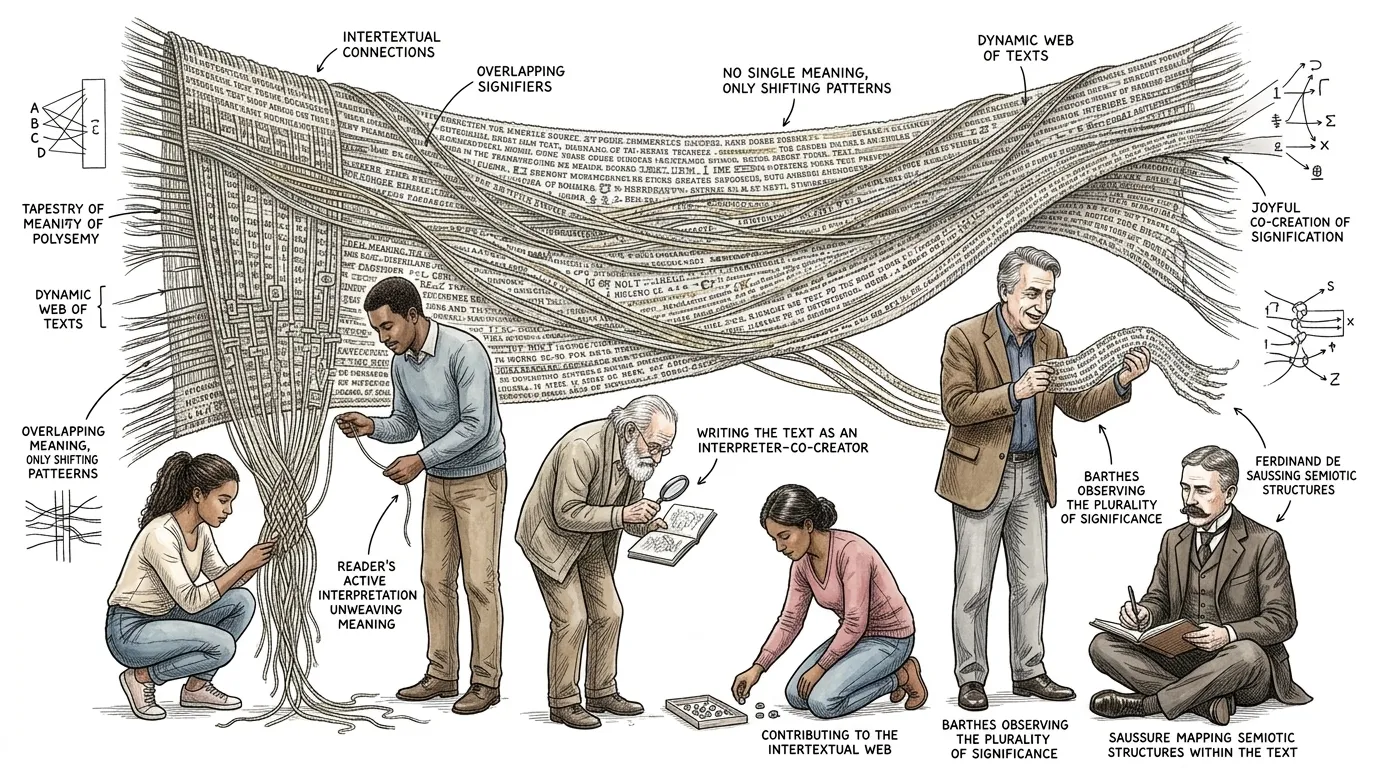
The ramifications of 'The Death of the Author' were profound, fundamentally reorienting literary criticism and cultural studies by shifting the locus of meaning from the solitary genius of the creator to the vibrant, pluralistic interpretations of the audience, encouraging a more playful and expansive engagement with texts. This new perspective transformed texts from static, closed objects with a single, discoverable meaning into dynamic, open 'webs' or 'tapestries' of signs and codes that invite endless possibilities for interpretation and creative interaction. Consequently, reading became an active, generative process, where readers are no longer passive recipients of an author's message but rather co-creators, weaving their own meanings from the intricate fabric of language and cultural context.
Philosophy Note: Impact: Reader-response criticism, polysemy, de-centering of authorial intent.
Page 7
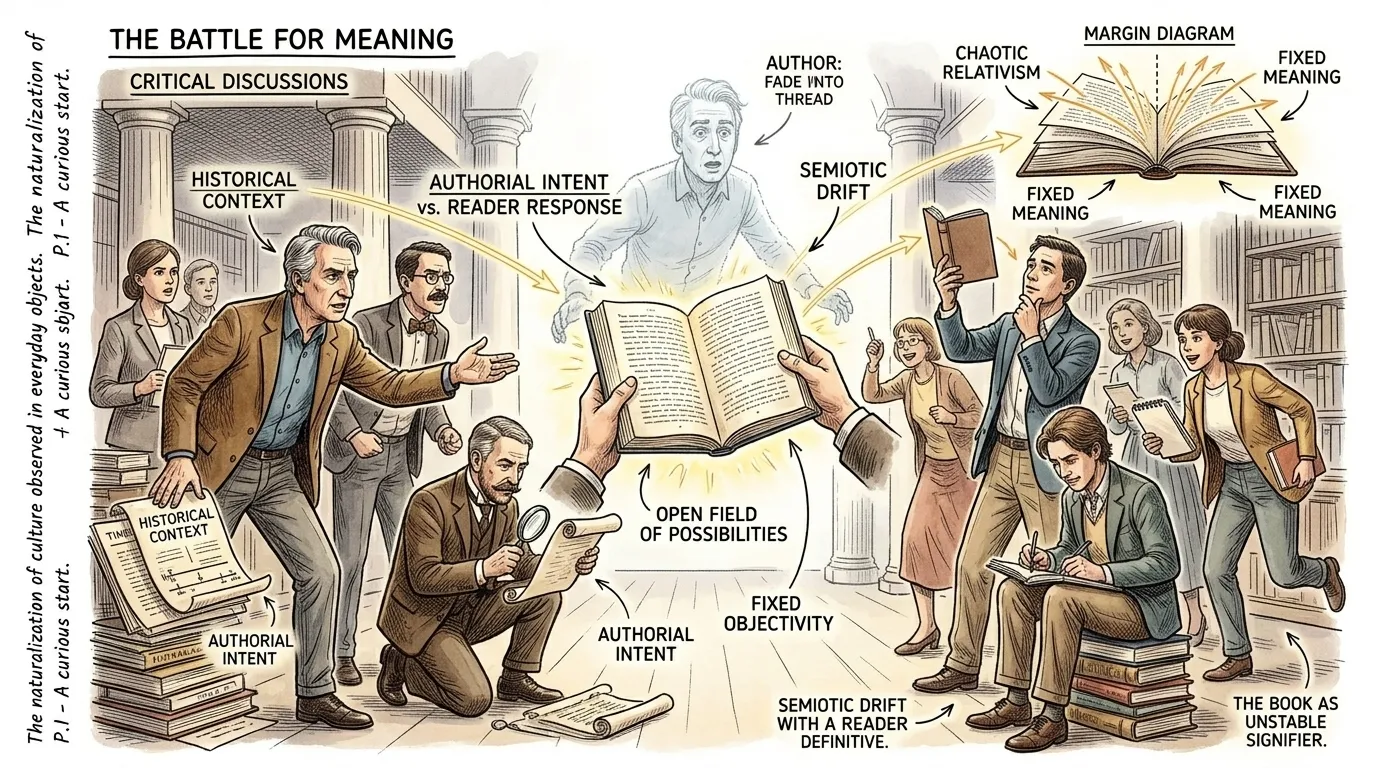
Despite its revolutionary impact, 'The Death of the Author' naturally provoked considerable debate and criticism, particularly from those who argued that entirely disregarding authorial intent or historical context risks divorcing a text from its crucial origins and potentially rendering all interpretations equally valid, thus leading to a potentially chaotic relativism. Critics contended that authors, as historically situated individuals, inevitably bring their unique perspectives, experiences, and intentions to their creations, which contribute significantly to a text's meaning and cultural resonance, offering important insights into its historical moment. This tension highlights a fundamental philosophical question: whether meaning resides inherently within the text, solely within the reader, or in a complex interplay between the two, an ongoing discourse that continues to shape contemporary critical thought.
"One common counter-argument to 'The Death of the Author' suggested that to fully ignore the author is to 'lose the thread of historical connection' between the text and its social genesis."
Philosophy Note: Criticisms: Historical context, authorial intentionality, potential relativism of meaning. Ongoing debates in literary theory.
Page 8

Barthes' intellectual journey was one of constant evolution, famously moving from the more systematic and structuralist analyses of his early work, such as 'Mythologies,' towards a more fluid, subjective, and even hedonistic engagement with texts and experience, culminating in his embrace of post-structuralist thought. While his early work sought to uncover and categorize the hidden structures of meaning, his later writings, exemplified by 'S/Z' and 'The Pleasure of the Text,' shifted focus towards the irreducible plurality of meaning, the play of language, and the sheer delight of reading, acknowledging the inherent instability and slipperiness of signification. This intellectual trajectory highlights Barthes' remarkable willingness to question his own frameworks, pushing the boundaries of critical inquiry into new, more personal and phenomenological realms, always prioritizing the richness of experience over rigid theoretical systems.
"Barthes once reflected on his intellectual shifts, stating, 'To refuse to fix meaning is, in a way, to refuse the totalitarian gesture.'"
Philosophy Note: Barthes' intellectual trajectory: From structuralism ('Mythologies') to post-structuralism ('S/Z,' 'The Pleasure of the Text').
Page 9

In our hyper-mediated 21st century, Roland Barthes' theories are more pertinent than ever, providing critical tools for understanding and deconstructing the pervasive 'mythologies' that saturate contemporary media, advertising, and political discourse. His insights enable us to dissect how seemingly neutral images, headlines, or social media trends are imbued with underlying ideological messages that shape public opinion and normalize specific values, often without our conscious awareness. From analyzing the implied promises in an advertisement to recognizing the 'naturalized' narratives in political speeches or celebrity culture, Barthes teaches us to actively read our world as a complex tapestry of signs, empowering us to discern the constructed nature of reality and challenge its often-unseen biases.
Philosophy Note: Contemporary relevance: Media literacy, advertising analysis, political rhetoric, social media. Tools for critical engagement.
Page 10
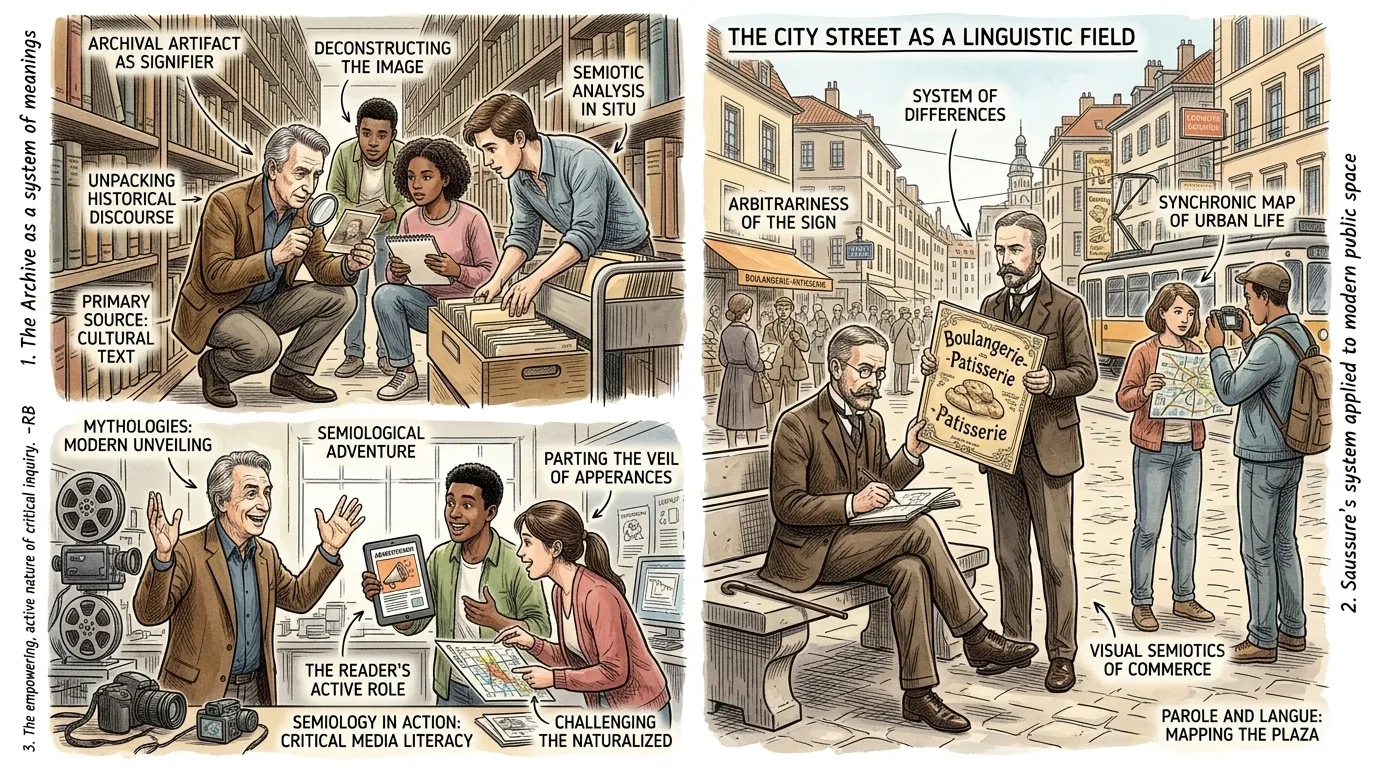
Roland Barthes' profound and multifaceted legacy is not merely a collection of theories but an invitation to adopt a radically active way of seeing and engaging with the world, transforming us from passive consumers of culture into conscious, questioning participants. He taught us to look beyond the immediate message, to probe the cultural assumptions that underpin what appears 'natural,' and to recognize the inherent constructedness of our shared reality, thereby fostering a deep skepticism toward easy answers and a robust appreciation for ambiguity. Ultimately, Barthes equips us with the invaluable intellectual courage to challenge dominant narratives, to embrace the plurality of meaning, and to perpetually ask not just what something is, but what it means and for whom, empowering generations to become critical, insightful readers of the complex cultural texts that define our human experience.
"Reflecting on Barthes' impact, cultural critic Susan Sontag noted, 'His work gives us tools to live more consciously, more intelligently, more joyfully.'"
Philosophy Note: Barthes' enduring legacy: Critical awareness, deconstruction, polysemy, active reading of culture. Impact on critical theory, cultural studies, and philosophy.
About this story
- Audience: general readers
Questions and answers
Read Wonder Philosophy on your phone
Wonder Philosophy is available on Android and iPhone and iPad. Get Wonder Philosophy on Google Play · Get Wonder Philosophy on the App Store.