Simone de Beauvoir
Simone de Beauvoir — an illustrated philosophy story. 10 illustrated pages, free to read on Wonder Philosophy.

Page 1

At the heart of Simone de Beauvoir's profound inquiry lies a fundamental challenge to received wisdom: the idea that human identity, particularly gender, is not merely given but actively forged through social and historical forces. Her work compels us to examine how society shapes our very sense of self, arguing that we are defined less by biology and more by the meanings and roles imposed upon us.
""One is not born, but rather becomes, a woman," Simone de Beauvoir declared, her words echoing through the cafes and lecture halls of mid-20th century Paris. "This statement encapsulates the central conflict of human existence—the tension between our biological reality and the vast, often constraining, architecture of our social world." Jean-Paul Sartre, her lifelong intellectual companion, nodded thoughtfully, his gaze fixed on her. "Indeed, Simone, it forces us to confront the profound question of freedom, and how society fabricates what we perceive as 'natural' roles.""
Philosophy Note: Simone de Beauvoir, Paris, Mid-20th Century. Core Idea: Gender as a Social Construct. Problem: How society shapes human identity beyond biology.
Page 2

Beauvoir's thought is deeply rooted in existentialism, the philosophy that emphasizes individual existence, freedom, and responsibility. For existentialists, there is no predetermined human essence; we are condemned to be free, constantly making choices that define who we are. This radical freedom, however, comes with the heavy burden of responsibility for creating our own meaning in a meaningless world.
""Our starting point, Jean-Paul, remains that 'existence precedes essence'," Simone emphasized, gesturing with a hand. "We are born into the world without inherent purpose or predefined nature; it is through our actions and choices that we construct ourselves." Sartre adjusted his spectacles, adding, "And this places an immense weight upon each individual—the freedom to define ourselves, but also the terrible responsibility for that definition." He picked up a worn copy of a book from the table. "Even historical texts reinforce this idea of essence. Consider, for instance, a line from Aristotle's Politics: 'The relation of male to female is by nature a relation of superior to inferior and ruler to ruled.' This ancient assertion of natural essence is precisely what we must dissect, Simone.""
Philosophy Note: Existentialism: Existence Precedes Essence. Aristotle's 'Politics' – a historical example of 'natural' roles.
Page 3

Beauvoir extended existentialist principles to analyze the social construction of gender, introducing the pivotal concept of 'The Other.' She argued that dominant groups define themselves as the 'Self' or 'the Subject,' simultaneously casting subordinate groups as 'The Other'—secondary, deviant, and defined primarily in relation to the primary subject. This mechanism of 'Othering' is central to understanding various forms of oppression.
""The problem, Jean-Paul, is how this freedom, this capacity for self-creation, is consistently denied to women by a society that designates them as 'The Other,'" Simone articulated, her voice firm. "Man positions himself as the Subject, the essential, the absolute, while woman is defined as the inessential, the object, the secondary." Sartre nodded slowly, tracing a finger along the spine of the ancient book. "This societal division, this existential dualism of 'Self' and 'Other,' permeates every aspect of culture, from mythology to law. It is the very foundation of patriarchal power." "Indeed," Simone agreed, "and it limits women's capacity for transcendence, for fully realizing their own projects and destinies.""
Philosophy Note: The Other: How dominant groups define themselves by marginalizing others. 'Man as Subject, Woman as Other'.
Page 4
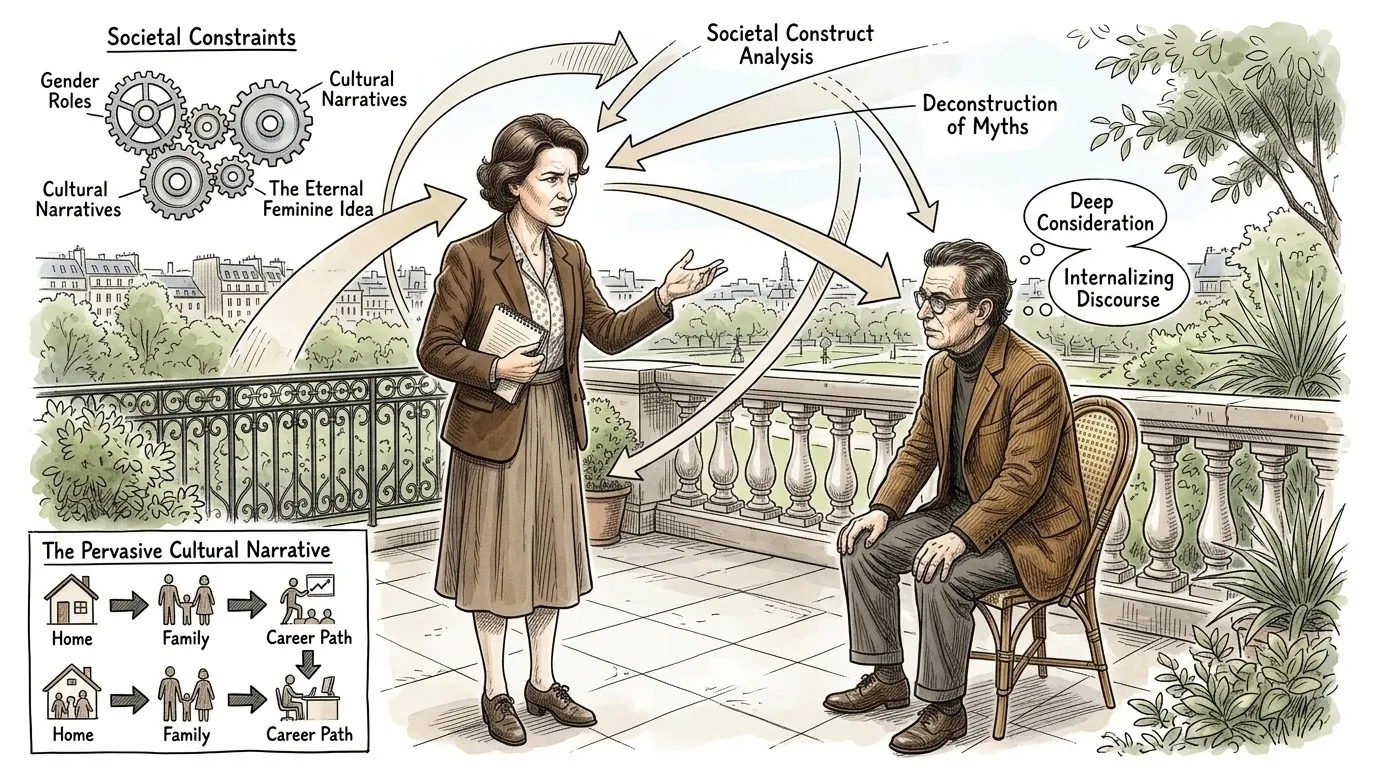
Beauvoir critically examined the notion of the 'eternal feminine'—the collection of perceived natural characteristics and roles assigned to women throughout history. She argued that these traits are not inherent but are instead culturally constructed ideals, designed to maintain women's subordinate position within patriarchal structures. These ideals prescribe women to roles of domesticity, beauty, and emotional support, limiting their potential.
""Society perpetuates the myth of the 'eternal feminine,'" Simone explained, her brow furrowed in concentration. "It insists on defining woman by her reproductive capacity, her supposed emotional nature, her role as wife and mother. But these are cages, Jean-Paul, not natural inclinations." Sartre leaned forward, considering her words. "These roles are deeply ingrained, certainly. They are taught from childhood, reinforced by cultural narratives, art, and even daily interactions. How can one escape such an encompassing web of expectation?" "By recognizing them for what they are," Simone replied, "not biological imperatives, but social fabrications that serve to deny women their full subjectivity and freedom.""
Philosophy Note: The 'Eternal Feminine': Socially constructed ideals limiting women's roles. From myth to modern expectation.
Page 5

A cornerstone of Beauvoir's existentialist feminism is the distinction between transcendence and immanence. She argued that true human existence involves transcendence—the active pursuit of projects, goals, and self-definition that propel us beyond our given circumstances. Immanence, conversely, is the state of being confined, objectified, and trapped within predefined roles. Beauvoir posited that women have historically been relegated to immanence, deprived of their capacity for transcendence.
""Human beings are fundamentally defined by their capacity for transcendence," Simone asserted, her gaze sweeping across the room. "To reach beyond our present condition, to set goals, to engage in projects that give our lives meaning. But women have been systematically constrained to immanence—trapped in repetitive tasks, defined by their bodies or their relationships to others." Sartre considered the idea deeply. "So, for women, liberation means reclaiming this power of transcendence, breaking free from the immanent sphere that society has imposed?" "Precisely," Simone confirmed, "it means asserting our own freedom and actively shaping our future, rather than passively accepting a pre-scripted destiny.""
Philosophy Note: Transcendence vs. Immanence: The pursuit of self-definition vs. confinement to predefined roles.
Page 6

Beauvoir's philosophy was not merely descriptive; it was prescriptive, offering concrete pathways for women's liberation. She argued that true freedom required not only a change in consciousness but also fundamental societal and economic shifts. Education and economic independence were paramount, allowing women to escape the necessity of defining themselves through men and to pursue their own autonomous projects.
""The first step to escaping immanence is consciousness, Jean-Paul, understanding that these roles are not natural," Simone stated, her voice resonating with conviction. "But consciousness alone is insufficient. Women need access to education, to meaningful work, to economic independence. Without these, their 'freedom' remains theoretical." Sartre nodded vigorously. "As Abraham Lincoln famously said, 'The best way to predict the future is to create it.' And for women, creating that future necessitates the material means to pursue their own projects, not just intellectual understanding." "Exactly," Simone replied, "economic autonomy provides the foundation for genuine individual choice and the pursuit of transcendence.""
Philosophy Note: Pathways to Liberation: Education, Economic Independence, and the creation of one's future (Lincoln quote).
Page 7

Beauvoir recognized that challenging deeply entrenched societal structures and philosophical traditions would face immense resistance. The transition from 'The Other' to autonomous subject is not a simple, individual act but a collective struggle that demands ongoing social and political action. Her work sparked fervent debate, both support and criticism, and continued to evolve as society grappled with these radical ideas.
""This transformation, Jean-Paul, from object to subject, from Other to Self, will not be an easy one," Simone observed, a touch of weariness in her voice. "Society clings fiercely to its established hierarchies and the comfortable illusions of 'natural' order." Sartre sighed, acknowledging the difficulty. "The inertia of tradition, the comfort of the familiar... these are formidable opponents to genuine liberation. Many will argue that these changes threaten the very fabric of society." "And they will be correct, in a sense," Simone conceded. "It threatens the fabric of their society, one built on unequal foundations. But a new, more just fabric can be woven, if we persist in revealing these structures for what they are.""
Philosophy Note: Resistance to Change: Society's inertia and the challenge of dismantling established hierarchies.
Page 8

Simone de Beauvoir's magnum opus, The Second Sex, fundamentally reshaped our understanding of gender, laying the groundwork for modern feminist theory. It moved beyond arguments for equality within existing systems to a deeper critique of the systems themselves, asserting that gender is a primary lens through which power operates in society. Her analysis continues to be a vital tool for critical inquiry.
""In The Second Sex," Simone began, holding a copy of her own book, "I sought to reveal that gender is not a destiny, but a dimension of human existence perpetually constructed and interpreted by culture." Sartre thoughtfully considered the work, a pivotal text in their shared intellectual journey. "And by deconstructing those interpretations, Simone, you offered a blueprint for recognizing how societal narratives, like those ancient assertions of 'natural' female roles we discussed earlier, are nothing more than fabricated justifications for dominance. You provided the means to truly see the architecture of 'Otherness' at play." "Indeed," Simone affirmed, "the work is a call to intellectual arms, empowering individuals to critically examine the forces that shape their identity and to resist becoming mere objects of circumstance.""
Philosophy Note: Legacy: The Second Sex and the deconstruction of gender as a societal construct, empowering critical analysis.
Page 9

While primarily focused on women, Beauvoir's framework of 'The Other' has proven profoundly influential in understanding other forms of oppression. Her analysis of how dominant groups define themselves by marginalizing others can be applied to race, class, sexuality, and nationality, providing a critical lens through which to examine power dynamics and systemic inequalities in various contexts. Her ideas transcend a single issue.
""The beauty of your concept of 'The Other', Simone," Jean-Paul began, gesturing expansively, "is its versatility. While born from your analysis of woman's condition, it illuminates far broader patterns of injustice. The dynamics you described, of defining a 'Self' by creating a marginalized 'Other', are universal." Simone considered this, a knowing look on her face. "Yes, whether it is race, class, or colonial status, the fundamental mechanism is the same: the dominant group solidifies its identity and power by systematically reducing another to its 'otherness', denying its full subjectivity." "It's a powerful tool, then," Jean-Paul concluded, "not just for feminist theory, but for any critical examination of human relations and power structures across society.""
Philosophy Note: Broader Applications: 'The Other' applied to race, class, sexuality, and colonial power dynamics.
Page 10

Simone de Beauvoir's ideas remain profoundly relevant today, continuously informing discussions on gender identity, intersectionality, and personal freedom. Her insistence that identity is a lifelong process of 'becoming' rather than a fixed state empowers individuals to question societal norms and actively shape their authentic selves. Her work serves as an enduring call to critically examine how social structures impact individual lives and to strive for a more equitable and free world for all.
""Even decades later, Simone, your insights on 'becoming' resonate profoundly," Jean-Paul observed, looking out towards a horizon bathed in the soft light of dawn. "The continuous process of self-creation, the refusal of fixed labels—it's a powerful message for every generation grappling with identity." Simone smiled faintly. "The struggle for freedom, for authentic existence, is perpetual. We must continually challenge the narratives that attempt to define us, to reduce us to 'Otherness.' Each individual choice, each act of transcendence, contributes to dismantling those old architectures." "And in doing so," Jean-Paul concluded, "we affirm the ultimate human project: to live authentically, fully, and freely defined by ourselves alone.""
Philosophy Note: Enduring Relevance: Gender Identity, Intersectionality, Authentic Self-Expression, and the continuous 'Becoming' of the self.
About this story
- Audience: general readers
Questions and answers
Read Wonder Philosophy on your phone
Wonder Philosophy is available on Android and iPhone and iPad. Get Wonder Philosophy on Google Play · Get Wonder Philosophy on the App Store.