W. V. O. Quine
W. V. O. Quine — an illustrated philosophy story. 8 illustrated pages, free to read on Wonder Philosophy.
Page 1

Priya, her brow furrowed, struggled to fit the last wooden piece into the elaborate mosaic. 'This one piece just won't go,' she sighed, pushing at it. Pavel, watching her gently, smiled. 'Sometimes, Priya,' she began, 'you can't understand one piece of a puzzle without seeing how it connects to everything else.'
"'This one piece just won't go,' Priya sighed, pushing at it. 'Sometimes, Priya,' Pavel began, 'you can't understand one piece of a puzzle without seeing how it connects to everything else.'"
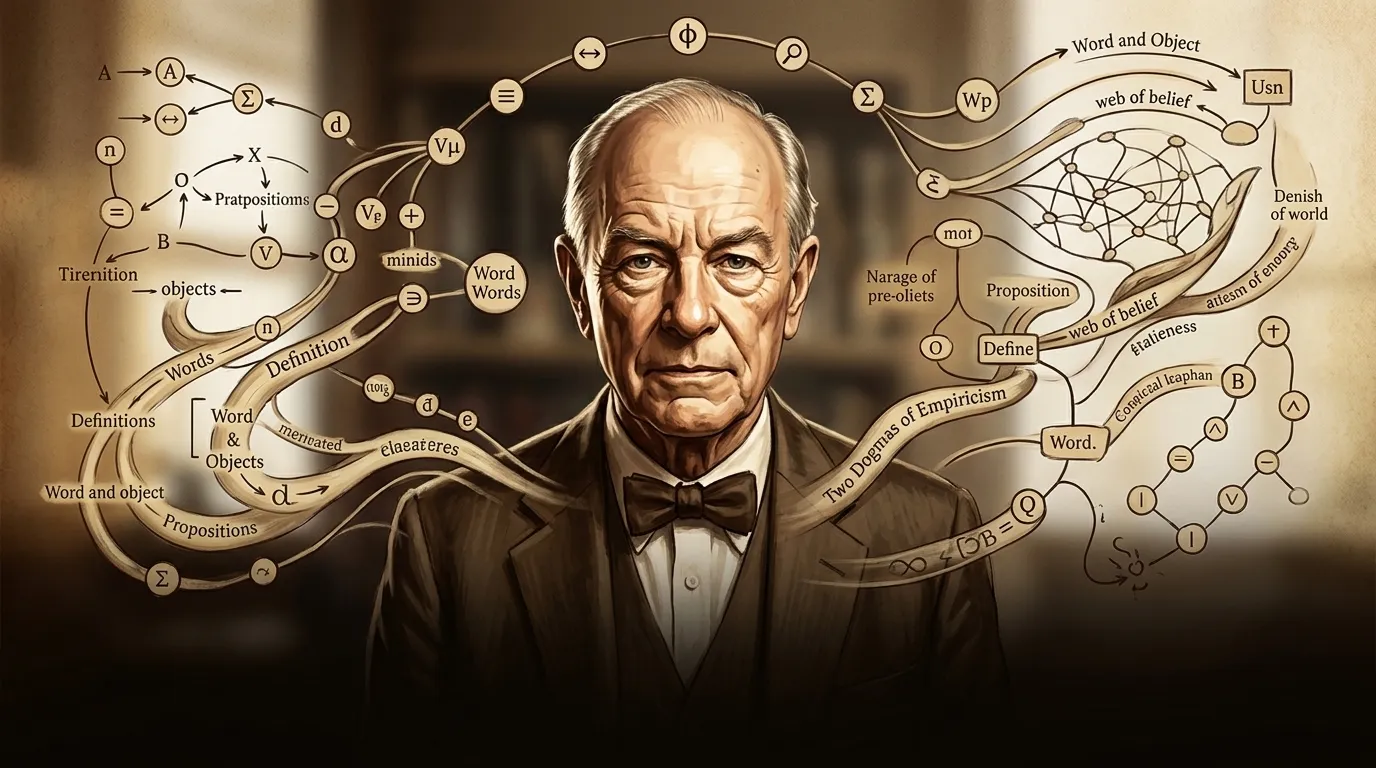
Philosophy Note: W. V. O. Quine's philosophy, particularly his concept of the 'web of belief,' suggests that our knowledge and understanding are not built from isolated facts, but from an interconnected network where each belief supports and is supported by others. This holistic view challenges traditional ideas about how we acquire and justify knowledge.
Page 2

'But some things are just true by themselves, aren't they?' Priya asked, looking up at Pavel. 'Like 'all circles are round'? That doesn't depend on other pieces.' Pavel picked up a set of old, interlocking wooden gears from a nearby table. 'A philosopher named Quine thought differently,' she explained, handing Priya a gear. 'He asked if any belief truly stands alone, completely separate from our experiences and other ideas.'
"'But some things are just true by themselves, aren't they?' Priya asked. 'Like 'all circles are round'? That doesn't depend on other pieces.' Pavel picked up a set of old, interlocking wooden gears. 'A philosopher named Quine thought differently,' she explained. 'He asked if any belief truly stands alone, completely separate from our experiences and other ideas.'"
Philosophy Note: Quine's seminal work 'Two Dogmas of Empiricism' specifically challenged two core tenets of analytic philosophy: the distinction between 'analytic' truths (true by definition) and 'synthetic' truths (true by experience), and 'reductionism' (the idea that complex statements can be reduced to simpler observational terms).
Page 3

'So, 'all bachelors are unmarried men' isn't just true on its own?' Priya wondered, turning the wooden gear in her hand. 'Quine argued that even such definitions are part of a larger linguistic web,' Pavel confirmed. 'Their meaning relies on how we use words, how we learn them, and how they connect to our understanding of the world. He showed that you can't really separate meaning from experience.'
"'So, 'all bachelors are unmarried men' isn't just true on its own?' Priya wondered, turning the wooden gear in her hand. 'Quine argued that even such definitions are part of a larger linguistic web,' Pavel confirmed. 'Their meaning relies on how we use words, how we learn them, and how they connect to our understanding of the world. He showed that you can't really separate meaning from experience.'"
Philosophy Note: Quine's critique of the analytic-synthetic distinction undermined the idea of truths immune to revision based on experience. He argued that all statements, even those seemingly true by definition, are ultimately answerable to our empirical observations and the overall coherence of our 'web of belief.'
Page 4

'If definitions aren't fixed, what about scientific facts?' Priya asked, tracing the gear's teeth. 'Do they also change?' Pavel nodded. 'Absolutely. Imagine scientists discovering planets don't orbit in perfect circles, but ellipses! That one change meant rethinking many other ideas about gravity and motion.' Pavel continued, 'This echoes what Thomas Kuhn described as 'paradigm shifts' in science, where whole ways of looking at the world transform.'
"'If definitions aren't fixed, what about scientific facts?' Priya asked, tracing the gear's teeth. 'Do they also change?' Pavel nodded. 'Absolutely. Imagine scientists discovering planets don't orbit in perfect circles, but ellipses! That one change meant rethinking many other ideas about gravity and motion.' Pavel continued, 'This echoes what Thomas Kuhn described as 'paradigm shifts' in science, where whole ways of looking at the world transform.'"
Philosophy Note: Quine's holism implies that no single belief, not even those from logic or mathematics, is entirely immune to revision if a radical enough re-evaluation of our entire 'web of belief' becomes necessary for empirical coherence. This perspective shares common ground with Thomas Kuhn's concept of 'paradigm shifts,' where scientific communities periodically abandon old conceptual frameworks for new ones.
Page 5
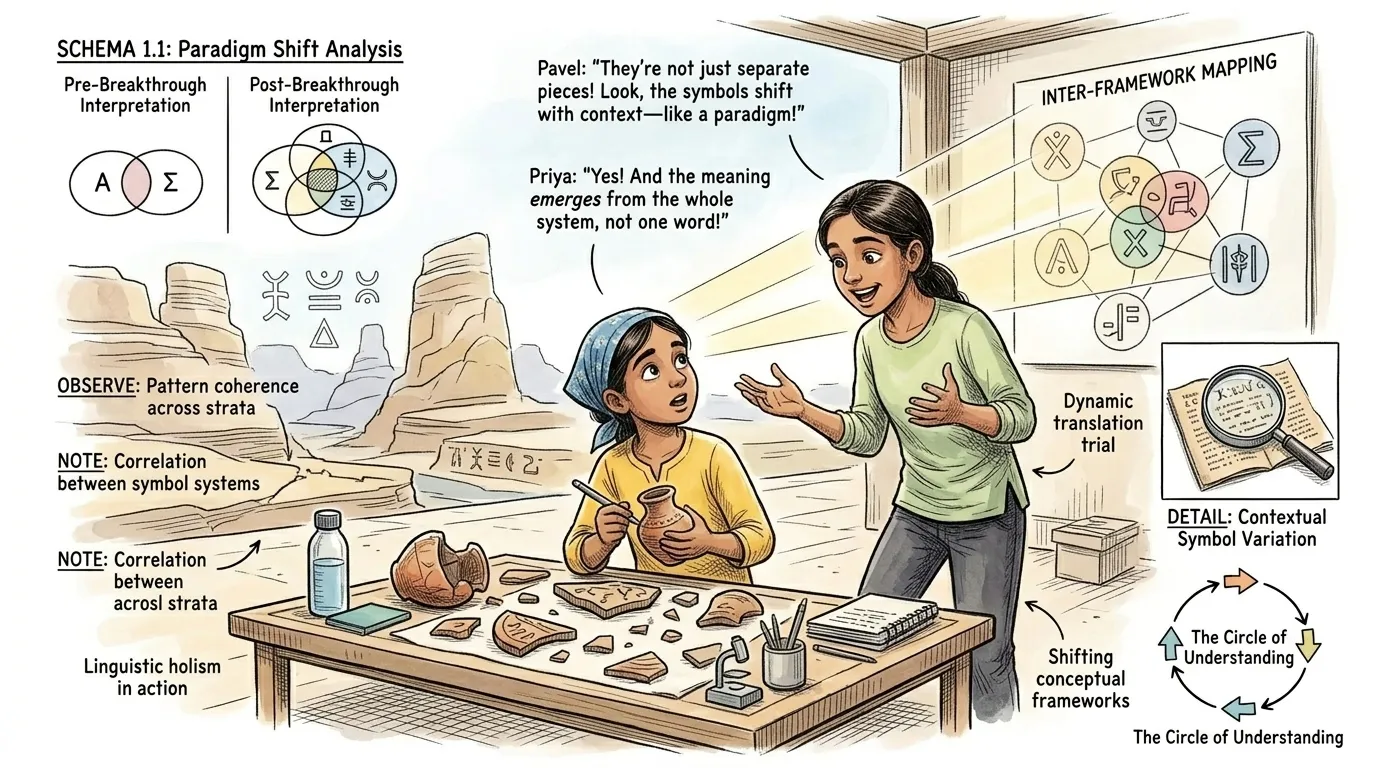
'So, a new discovery can make us look at everything differently?' Priya wondered aloud. 'Exactly!' Pavel exclaimed. 'Quine even said that when we try to understand a completely new language, there isn't one perfectly correct way to translate every word. Different ways of translating can still make perfect sense of what people say and do!'
"'So, a new discovery can make us look at everything differently?' Priya wondered aloud. 'Exactly!' Pavel exclaimed. 'Quine even said that when we try to understand a completely new language, there isn't one perfectly correct way to translate every word. Different ways of translating can still make perfect sense of what people say and do!'"
Philosophy Note: Quine's 'indeterminacy of translation' argument posits that multiple, equally valid translation manuals can be compatible with all possible observations of a speaker's behavior. This means there's no single 'fact of the matter' about what a foreign word truly means, reinforcing the holistic view that meaning is deeply contextual and not reducible to simple, one-to-one correspondences.
Page 6

'That sounds a bit unsettling,' Priya admitted. 'If nothing is truly fixed, how do we know what's real?' Pavel placed a comforting hand on Priya's shoulder. 'It's not about losing truth, but understanding its nature. Other thinkers, like Friedrich Nietzsche, also questioned fixed, objective truths, though in very different ways.' She added, 'Nietzsche believed we should question foundational ideas, especially those presented as absolute.'
"'That sounds a bit unsettling,' Priya admitted. 'If nothing is truly fixed, how do we know what's real?' Pavel placed a comforting hand on Priya's shoulder. 'It's not about losing truth, but understanding its nature. Other thinkers, like Friedrich Nietzsche, also questioned fixed, objective truths, though in very different ways.' She added, 'Nietzsche believed we should question foundational ideas, especially those presented as absolute.'"
Philosophy Note: Quine's anti-foundationalism, which rejects the idea of a secure, unshakeable bedrock of knowledge, resonates with broader critical traditions. Thinkers like Friedrich Nietzsche, though from a different philosophical lineage, also questioned universal objective truths and emphasized the interpretative nature of human understanding and the provisionality of our conceptual frameworks.
Page 7

'So, truth isn't just one solid thing we find?' Priya asked, looking intently at the wooden gears. 'It's more like how the gears connect and move?' Pavel nodded. 'Yes, like how a word's meaning can subtly shift in different sentences, even if its definition seems clear.' She continued, 'Jean-Paul Sartre and Simone de Beauvoir, for example, explored how our freedom to choose creates meaning, rather than finding it pre-made.'
"'So, truth isn't just one solid thing we find?' Priya asked. 'It's more like how the gears connect and move?' Pavel nodded. 'Yes, like how a word's meaning can subtly shift in different sentences, even if its definition seems clear.' She continued, 'Jean-Paul Sartre and Simone de Beauvoir, for example, explored how our freedom to choose creates meaning, rather than finding it pre-made.'"
Philosophy Note: Existentialist philosophers like Jean-Paul Sartre and Simone de Beauvoir, while distinct from Quine in their methodologies, share a critical stance against pre-given meanings and objective foundations. Their work emphasizes radical freedom and the human responsibility for creating meaning and value, which parallels Quine's view that our conceptual schemes are human constructs that are constantly subject to revision.
Page 8

'I think I understand,' Priya finally said, successfully interlocking all the gears into a moving system. 'It's like Albert Einstein once said: 'The important thing is not to stop questioning.'' She continued, 'Quine teaches us to be like a careful engineer, always checking how each part of our understanding affects the whole.' Pavel smiled, a look of pride on her face. 'Exactly, Priya. It's about being aware that our knowledge is a constantly evolving, interconnected system.'
"'I think I understand,' Priya finally said. 'It's like Albert Einstein once said: 'The important thing is not to stop questioning.'' She continued, 'Quine teaches us to be like a careful engineer, always checking how each part of our understanding affects the whole.' Pavel smiled. 'Exactly, Priya. It's about being aware that our knowledge is a constantly evolving, interconnected system.'"
Philosophy Note: Quine's philosophy encourages a humble and critical approach to knowledge. By recognizing that all our beliefs form an interconnected 'web' and that no statement is immune to revision, we cultivate intellectual flexibility, openness to new evidence, and a deeper understanding of how our conceptual schemes are constructed and evolve. This enduring lesson remains vital for critical thinking in any field.
About this story
- Audience: general readers
Questions and answers
Read Wonder Philosophy on your phone
Wonder Philosophy is available on Android and iPhone and iPad. Get Wonder Philosophy on Google Play · Get Wonder Philosophy on the App Store.