Hypatia
Hypatia — an illustrated science story, set in Global. 10 illustrated pages, free to read on Wonder Science.
Page 1
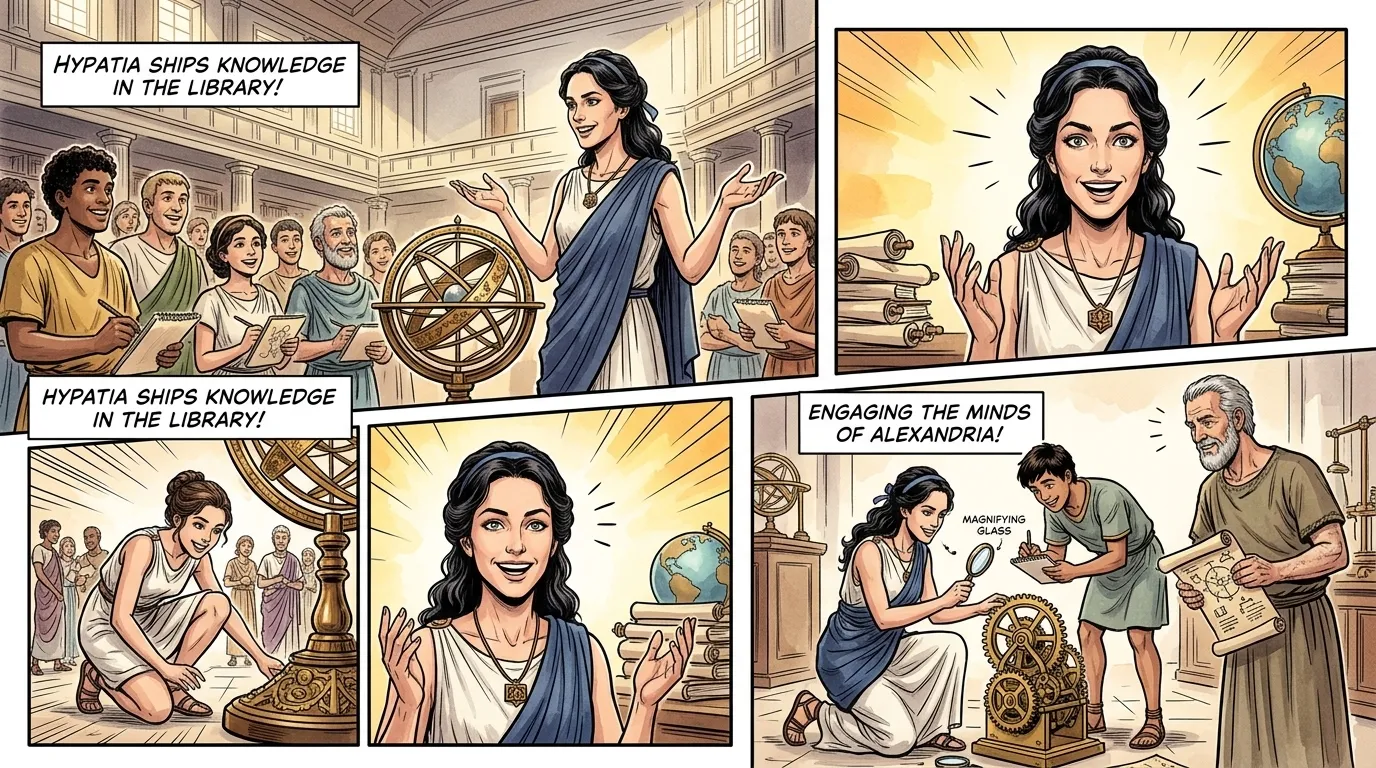
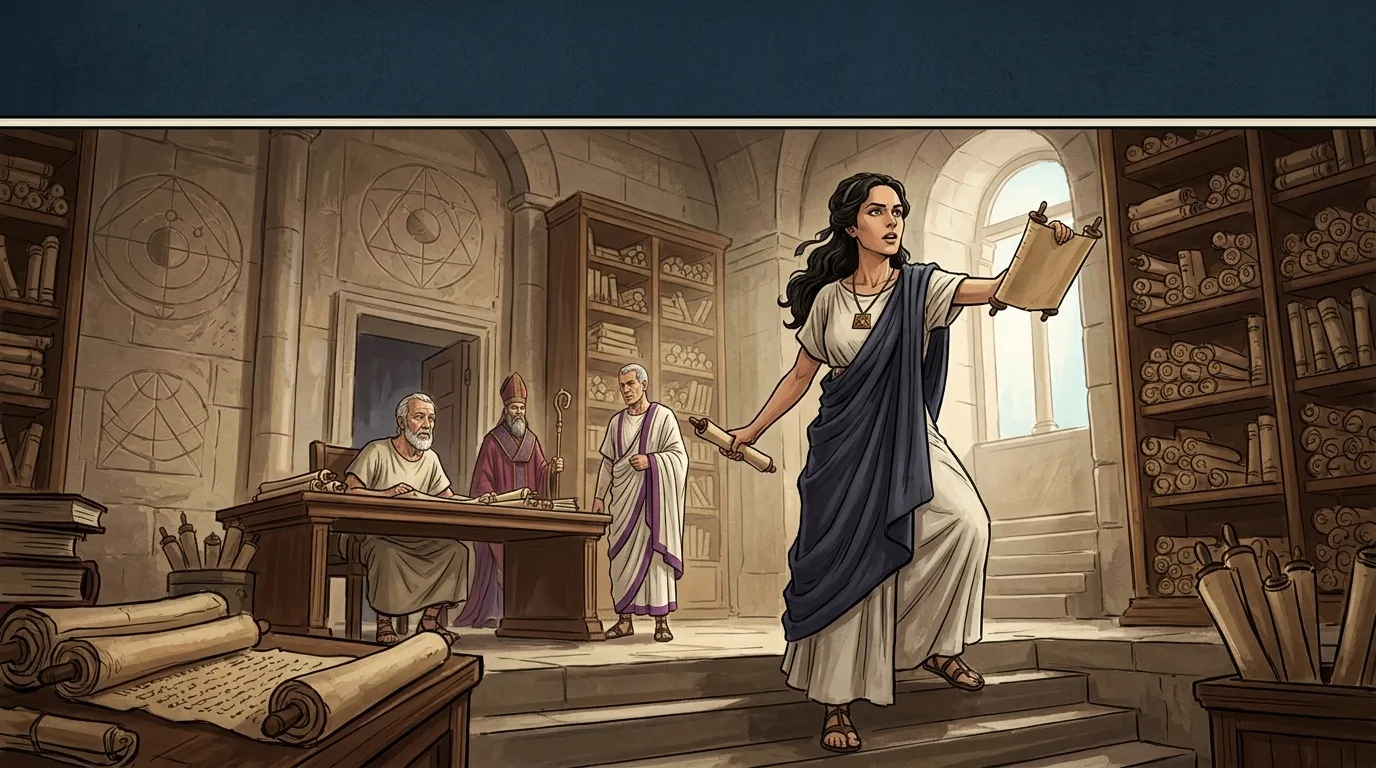
In the vibrant crucible of 4th century CE Alexandria, a city then renowned as the intellectual heart of the ancient world, Hypatia stood as a towering figure of scientific and philosophical inquiry. Born around 350-370 CE, she inherited a legacy of knowledge from her father, Theon, a celebrated mathematician and astronomer at the famed Library of Alexandria. Hypatia not only continued this tradition but expanded it, becoming the leading scholar of her time, lecturing on mathematics, astronomy, and Neoplatonic philosophy to an eager cosmopolitan audience. Her brilliance and intellect positioned her as a beacon of learning, influencing generations of students from across the Roman Empire and beyond. She became an anchor of scientific understanding in an era of profound societal and religious transition.
Page 2
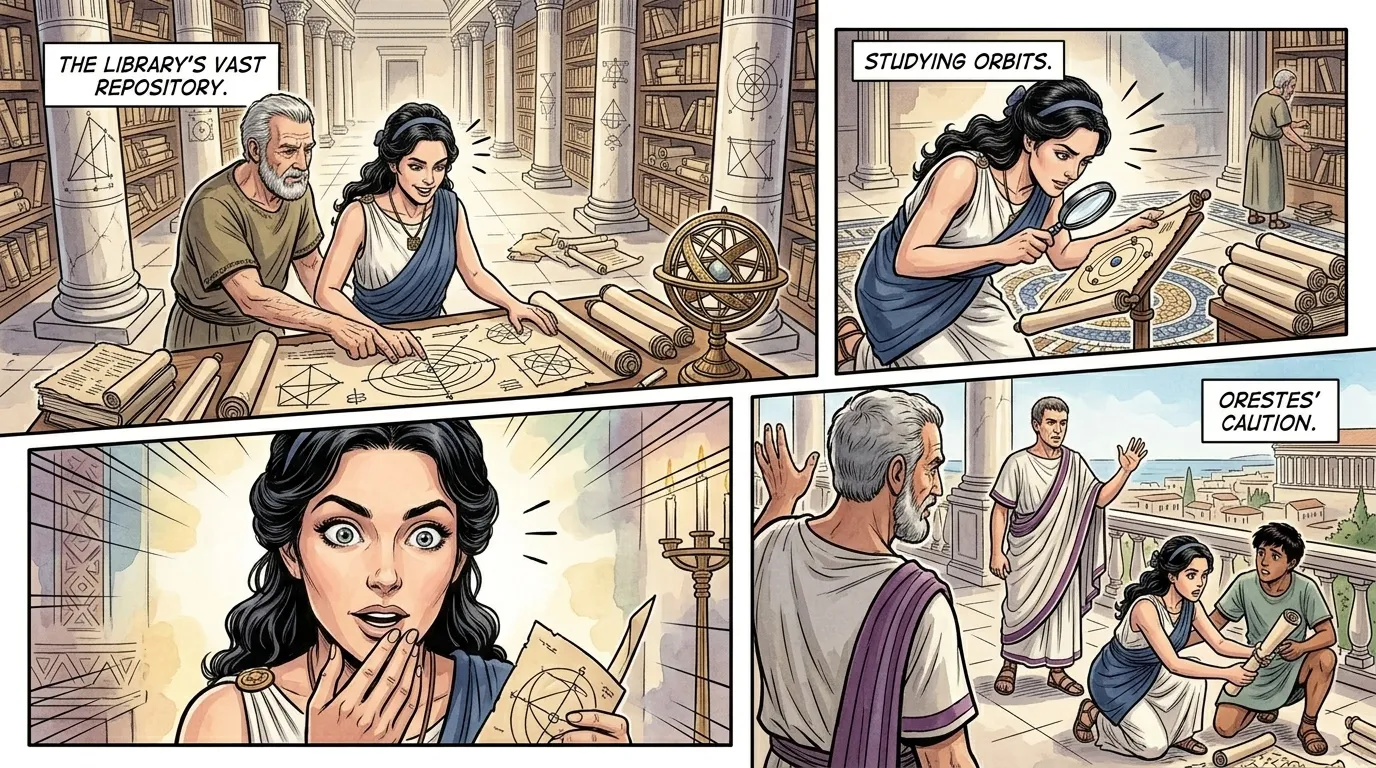
Alexandria was not merely a city; it was a global intellectual nexus, home to the Great Library and the Museion, institutions that drew the finest minds of the ancient world. This environment fostered unparalleled scientific progress, particularly in mathematics, astronomy, and engineering. Hypatia's father, Theon, was instrumental in this ecosystem, a scholar known for his editions of Euclid's Elements and Ptolemy's Almagest. It was within this rich tapestry of knowledge that Hypatia received her comprehensive education, far exceeding typical gender constraints of her era. Her deep immersion in these foundational texts would form the bedrock of her own groundbreaking work and teaching, solidifying Alexandria's role as a beacon of rational inquiry.
Page 3
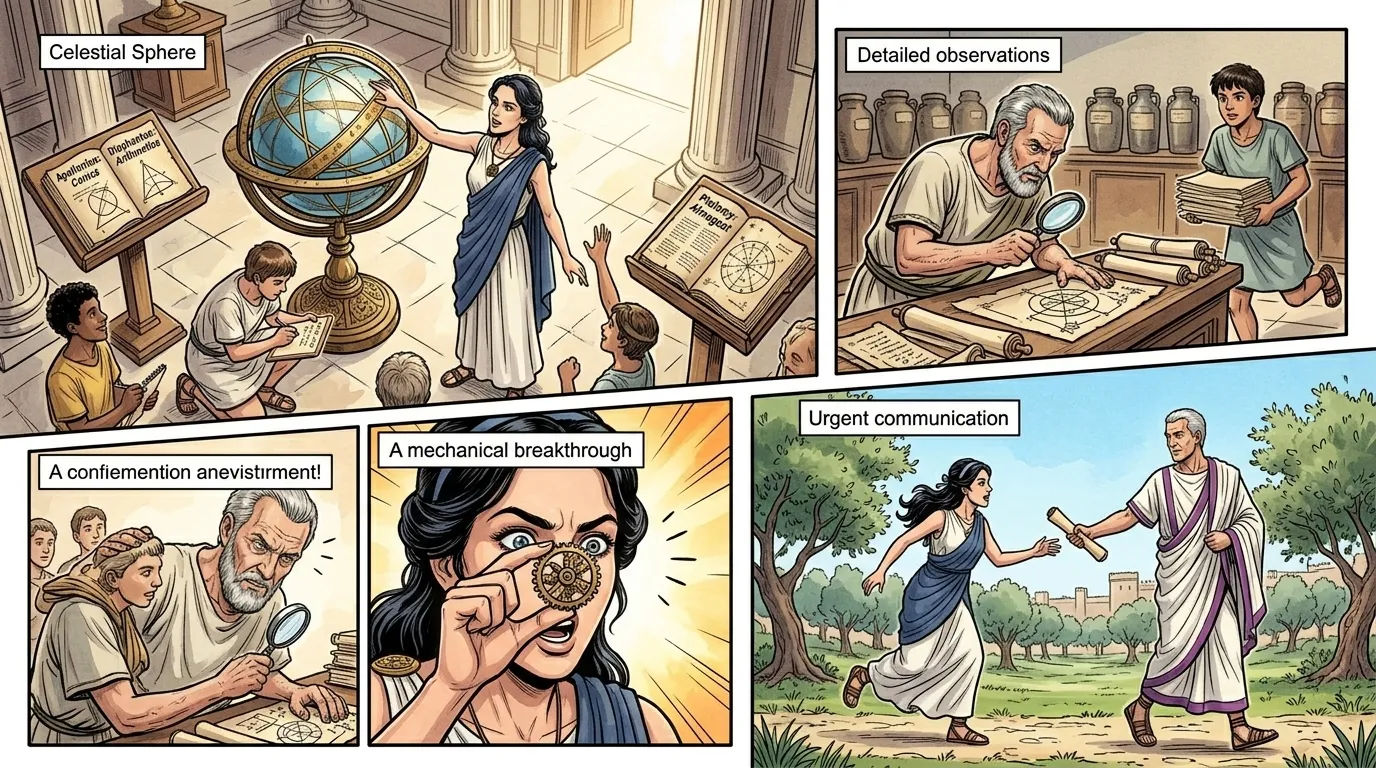
Hypatia's contributions spanned critical areas of knowledge. In mathematics, she wrote commentaries on Diophantus's Arithmetica, a pivotal work on number theory, and Apollonius's Conics, which explored the geometry of conic sections. These weren't mere transcriptions; her commentaries are believed to have made these complex texts more accessible and comprehensible to a wider audience, thereby preserving and advancing mathematical understanding. Her astronomical work focused on Ptolemy's Almagest, a monumental treatise that codified the geocentric model of the universe. Hypatia's teachings made these complex systems understandable, crucial for celestial observation and the development of early scientific instruments.
Page 4
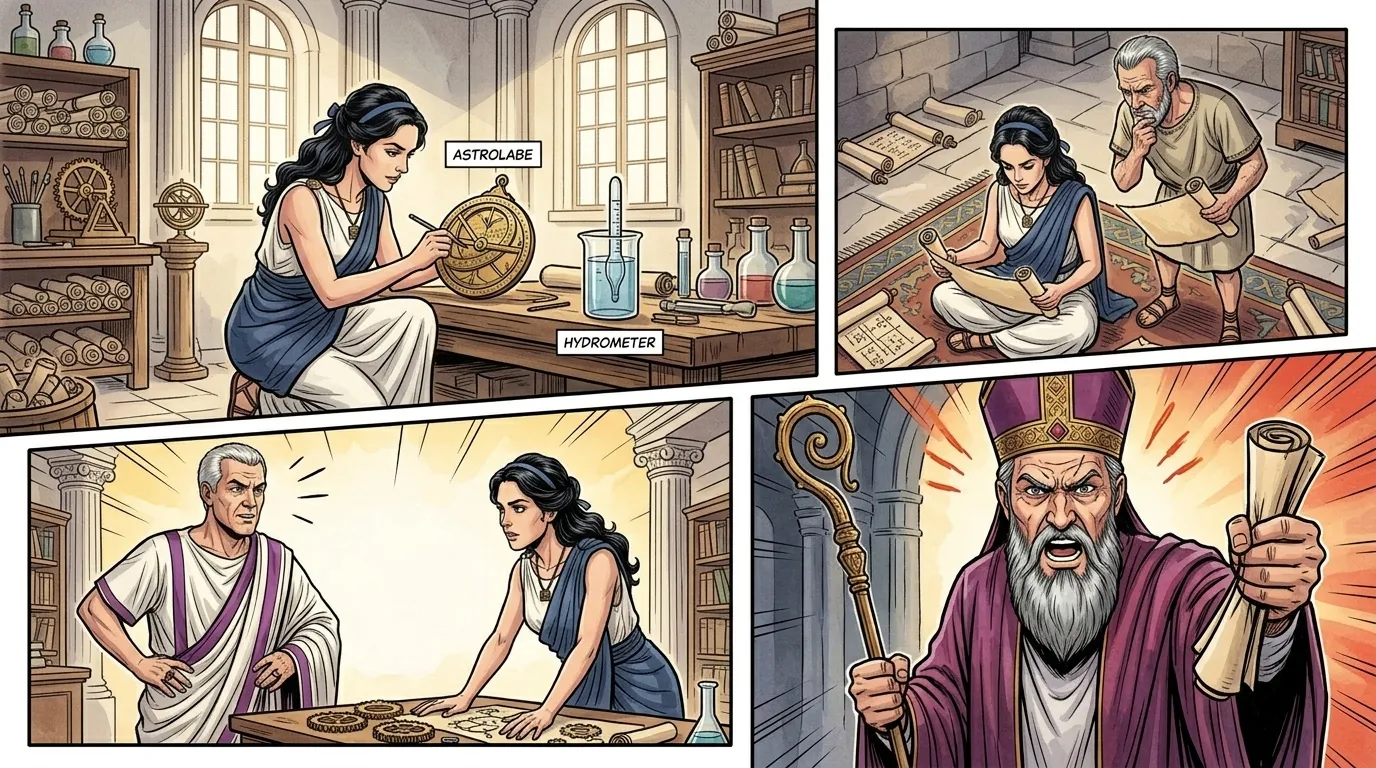
Beyond theoretical contributions, Hypatia also distinguished herself as an inventor and engineer, creating practical tools vital for scientific measurement and observation. She is credited with significant improvements to the astrolabe, an ancient analog computer capable of solving various problems in spherical astronomy, from determining the time of day or night to finding the positions of celestial objects. Additionally, she developed a hydrometer, an instrument used to measure the specific gravity of liquids. These inventions were not just academic curiosities; they were sophisticated instruments that empowered observers and researchers to gather more precise data, pushing the boundaries of ancient physics and astronomy.
Page 5
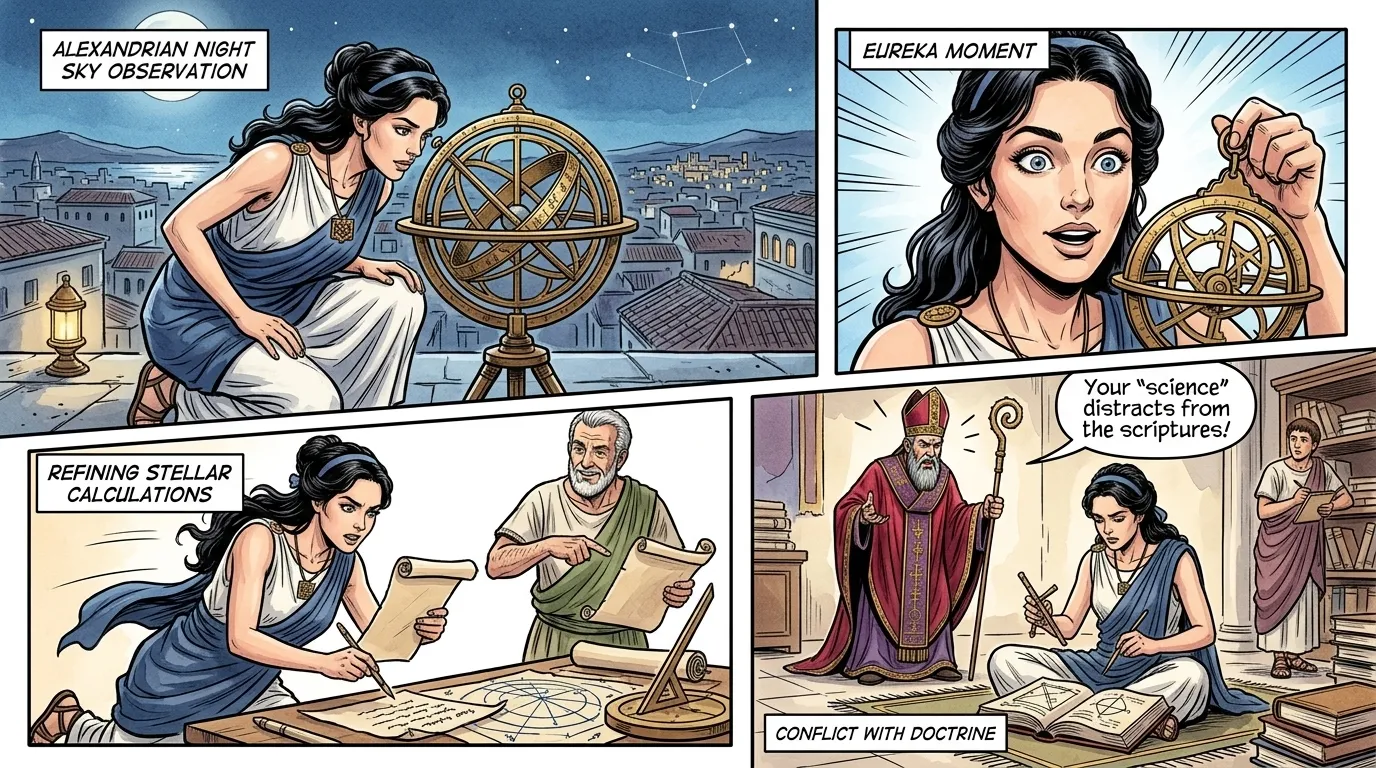
The astrolabe, refined by Hypatia, was a marvel of ancient engineering. Its flat, circular face, known as the mater, held interchangeable plates (tympanums) etched with grids representing celestial coordinates for specific latitudes. A rotating 'rete,' an open-worked frame depicting the stars and ecliptic, moved over these plates. By aligning the rete's star pointers with the current positions of observed stars, an astronomer could calculate a myriad of data: time, sunrise/sunset, planetary positions, and even survey distances. This allowed for practical applications in navigation, astrology, and precise timekeeping, fundamentally changing how the cosmos was observed and understood.
Page 6
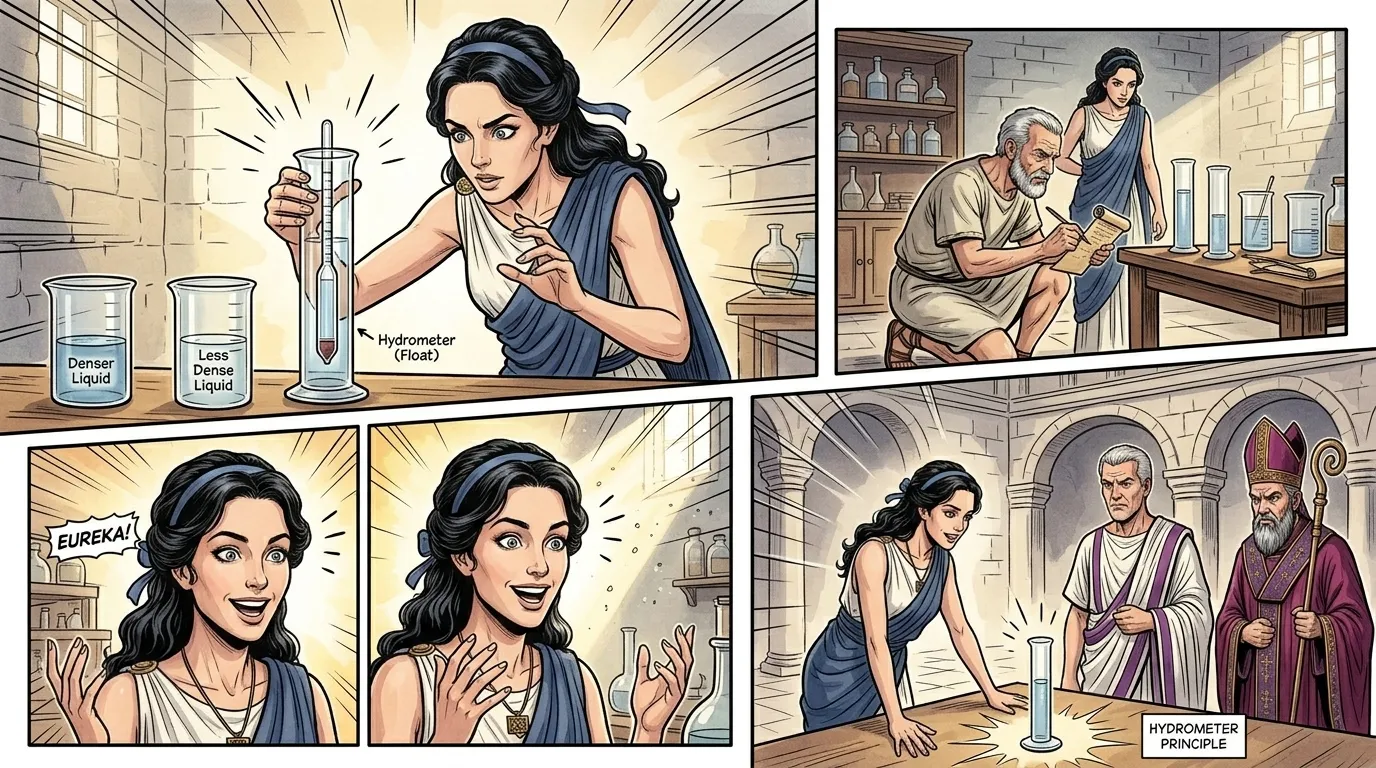
Hypatia's hydrometer applied principles of buoyancy, a concept famously explored by Archimedes centuries earlier. The instrument was typically a calibrated glass tube weighted at one end to make it float upright in liquid. The depth to which it sank directly correlated with the liquid's specific gravity, or density relative to water. If a liquid was denser, the hydrometer would float higher; in a less dense liquid, it would sink lower. This provided a simple yet effective method for various practical purposes, from checking the purity of water or wine to assessing the concentration of different solutions. It was a testament to the elegant application of fundamental physics.
Page 7
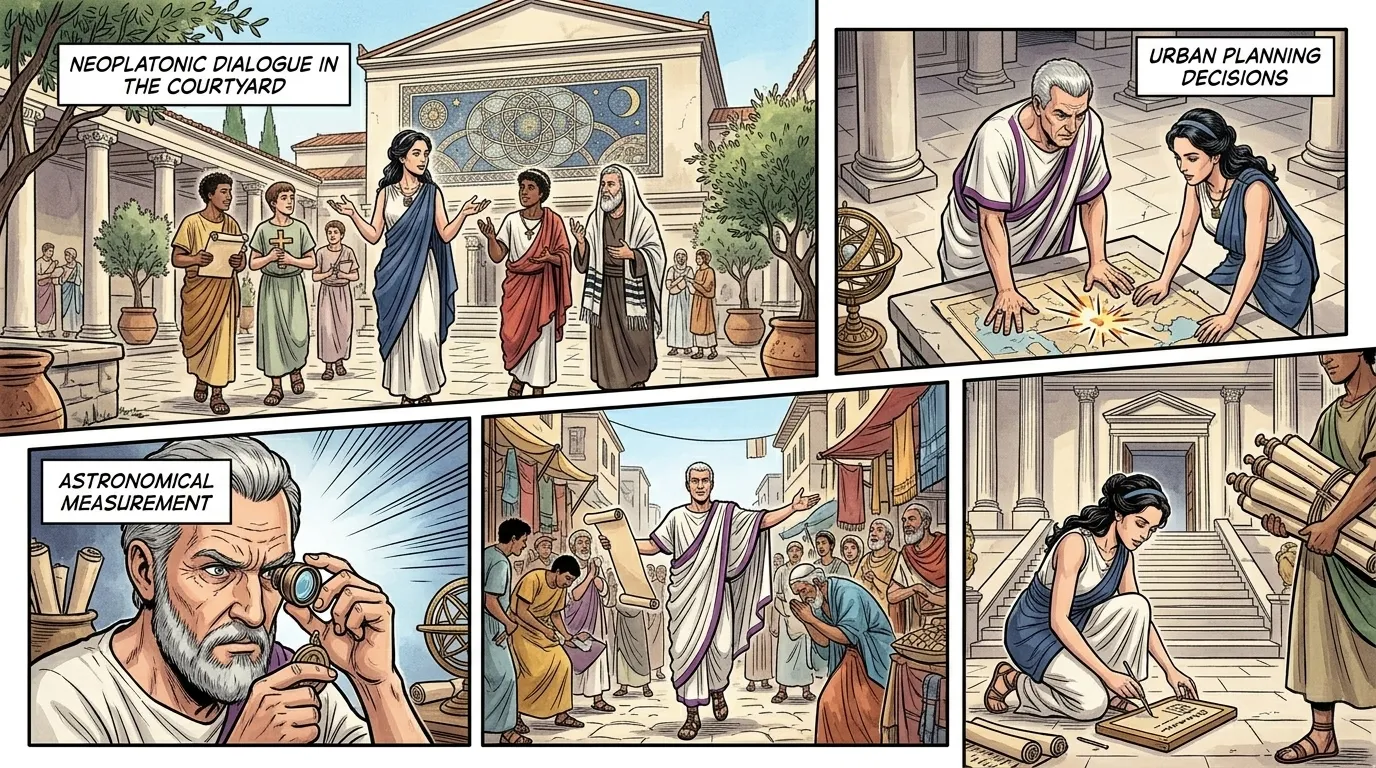
Hypatia's renown extended beyond her scientific innovations; she was a leading figure of the Neoplatonic school, a philosophical tradition that sought to integrate Greek philosophy with a deeper spiritual understanding of the universe. She taught that mathematical truths were pathways to understanding the divine order, bridging the gap between empirical observation and abstract thought. Her lectures attracted students from diverse backgrounds, including pagans, Christians, and Jews, who sought her wisdom. Her school became a vibrant hub where rigorous scientific methods intertwined with profound philosophical discussions, embodying the holistic intellectual approach characteristic of ancient Alexandrian scholarship.
Page 8

By the early 5th century CE, Alexandria was a city on the brink, grappling with escalating political and religious conflicts. The Roman Empire was officially Christian, and tensions between the Imperial Prefect Orestes, representing Roman secular authority, and Cyril, the powerful Christian Bishop of Alexandria, were reaching a fever pitch. Hypatia, a respected advisor to Orestes and a prominent pagan intellectual, found herself caught in the crossfire. Her philosophical school, open to all faiths, represented a form of independent thought that challenged the growing dogmatism of the era. Her refusal to align with any single faction, instead advocating for rational inquiry, made her a dangerous symbol to those seeking absolute control.
Page 9
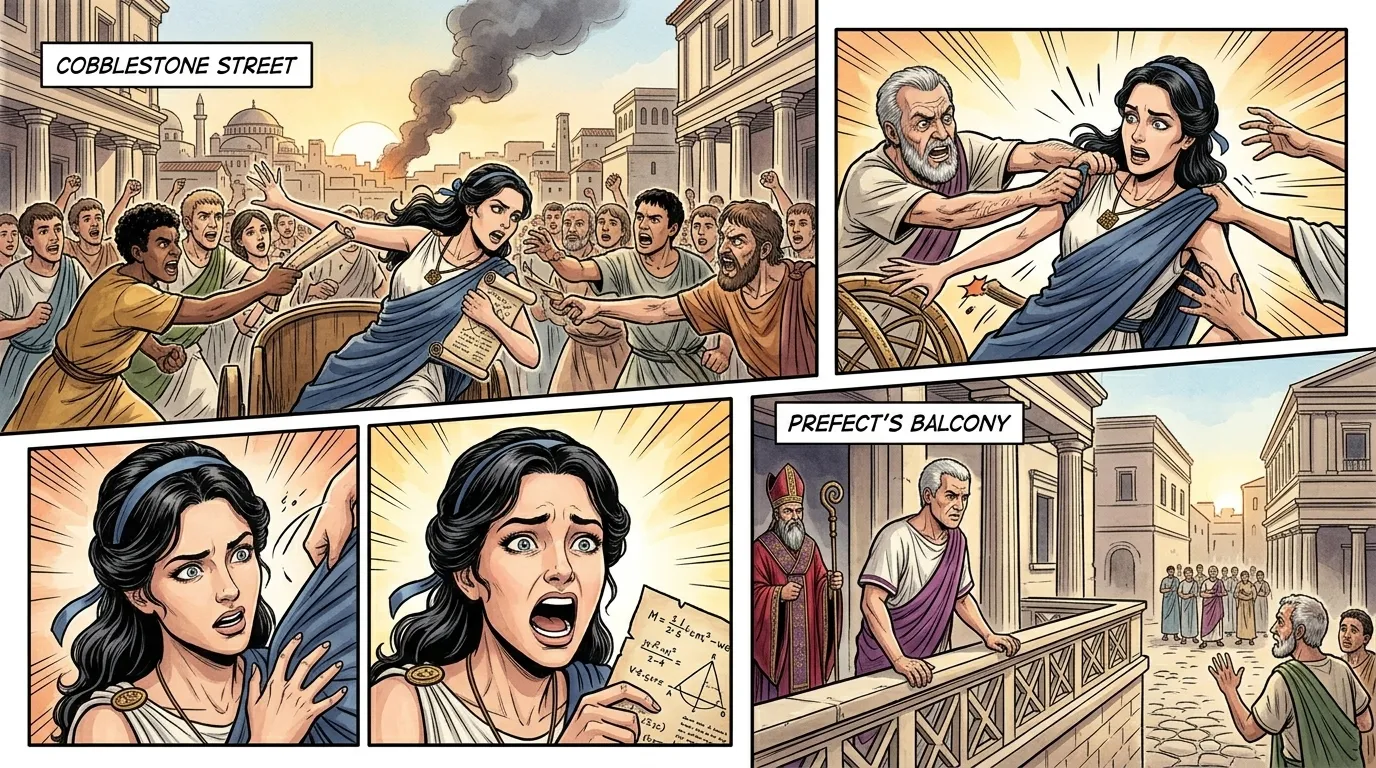
In March 415 CE, Hypatia's unwavering commitment to knowledge and her association with Orestes led to her brutal demise. She was attacked by a mob of Christian zealots, dragged from her chariot, and murdered, her body dismembered and burned. Her death sent shockwaves through the intellectual world and is often seen by historians as a symbolic turning point marking the decline of classical learning and the end of Alexandria's golden age of scholarship. While her specific written works largely vanished, her reputation as a brilliant, courageous polymath and a martyr for reason endured, resonating through subsequent centuries as a poignant reminder of the fragility of intellectual freedom amidst fanaticism.
Page 10
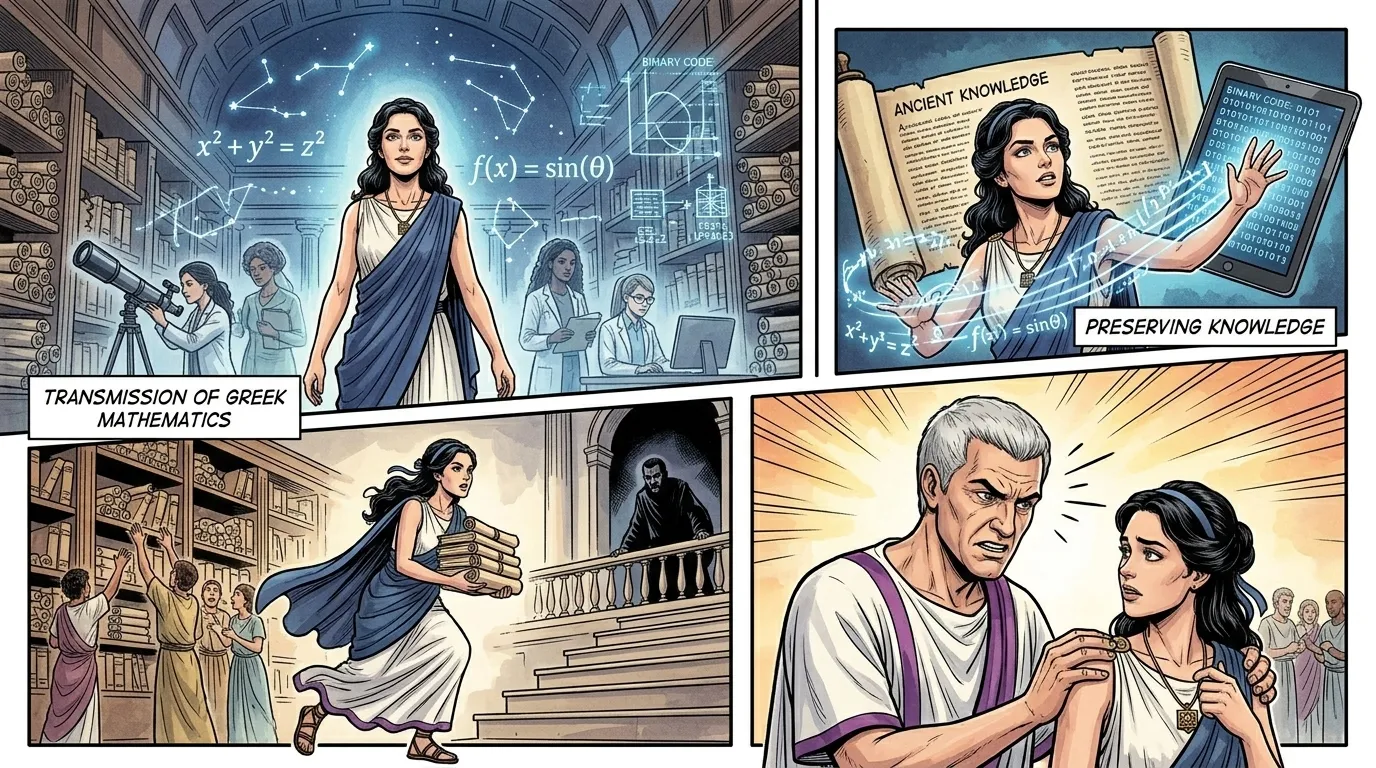
Hypatia's story transcends her tragic end, cementing her place as an enduring symbol of intellectual courage and a pioneer for women in science. Though much of her direct written work is lost, her impact on the transmission and advancement of Greek mathematics and astronomy is undeniable. Her life illuminated the critical role of rational inquiry and critical thinking, values that remain cornerstones of scientific progress today. Her legacy resonates in modern discussions on intellectual freedom, the challenges faced by women in STEM, and the importance of preserving knowledge against ideological pressures. Hypatia's memory serves as a vital reminder that the pursuit of truth, in all its forms, is a timeless and often perilous human endeavor.
About this story
- Location: Global
- Audience: general readers
Questions and answers
Read Wonder Science on your phone
Wonder Science is available on Android. Get Wonder Science on Google Play.