Inge Lehmann
Inge Lehmann — an illustrated science story, set in Global. 10 illustrated pages, free to read on Wonder Science.
Page 1

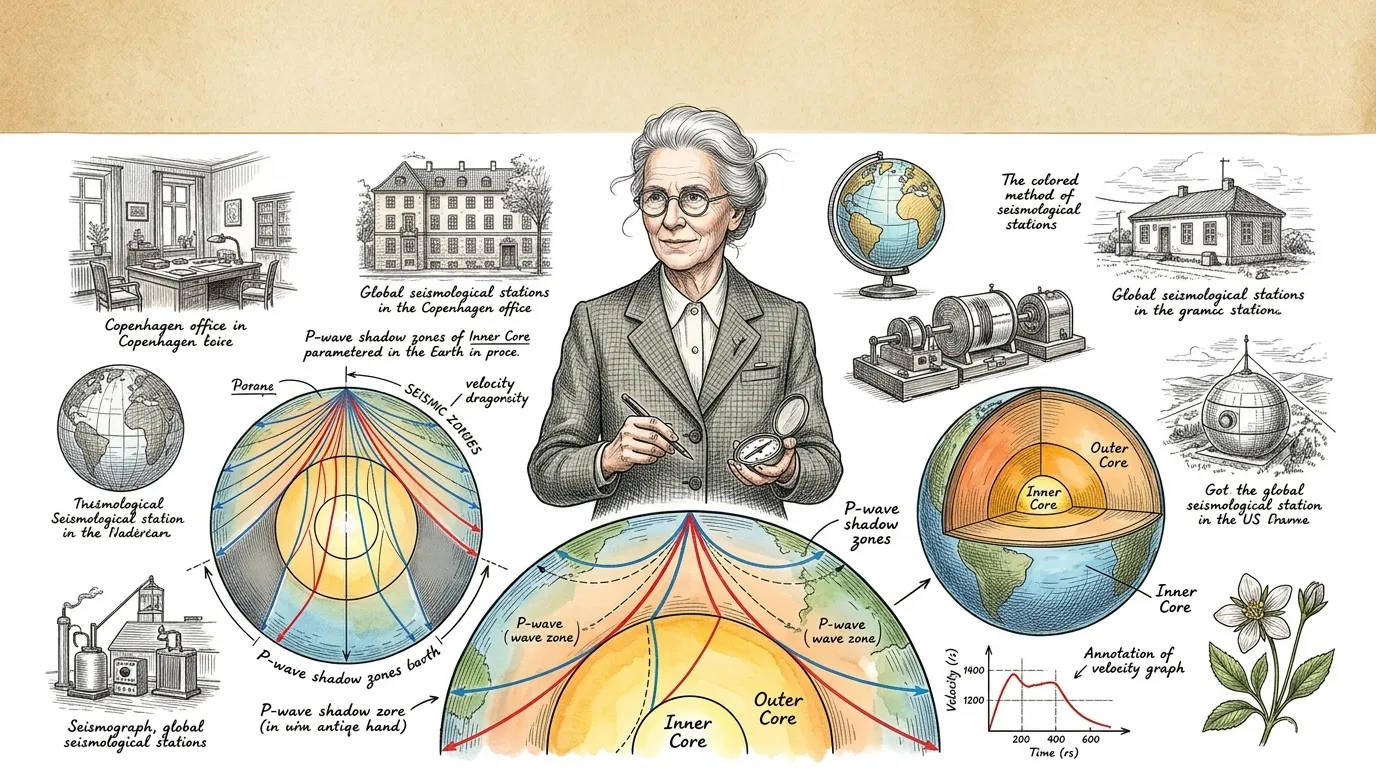
Deep beneath our feet, the Earth's true heart beats, a colossal metallic sphere under immense pressure. For centuries, its composition remained a profound mystery, a realm beyond direct observation, understood only through indirect whispers carried by seismic waves. It was within these subtle tremors, after a major earthquake in 1929, that Danish seismologist Inge Lehmann detected an anomaly that would rewrite our understanding of the planet.\n\n Fact: A foundational shift in geological understanding initiated by precise seismic data analysis.
Page 2
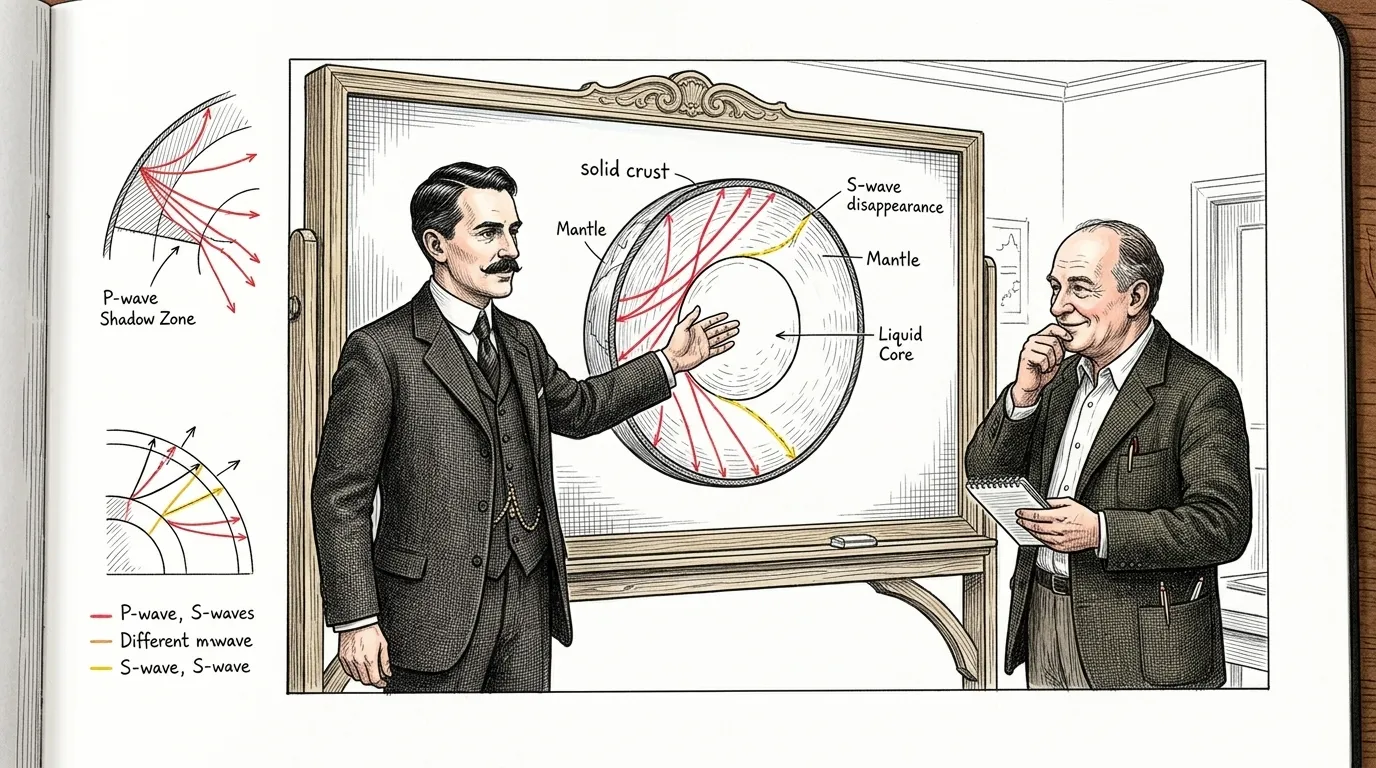
Prior to Lehmann's groundbreaking work, the prevailing scientific model, primarily established by British geologist Richard Dixon Oldham and German seismologist Beno Gutenberg, depicted Earth as having a solid crust and mantle overlying a single, entirely liquid core. This model was derived from observations of how seismic P-waves (compressional waves) and S-waves (shear waves) traveled through the planet's interior after earthquakes. Scientists could calculate the depth of the core-mantle boundary because S-waves, which cannot travel through liquid, completely disappeared beyond a certain distance from an earthquake's epicenter.\n\n Fact: The initial understanding of Earth's interior relied on distinct behaviors of seismic waves.
Page 3
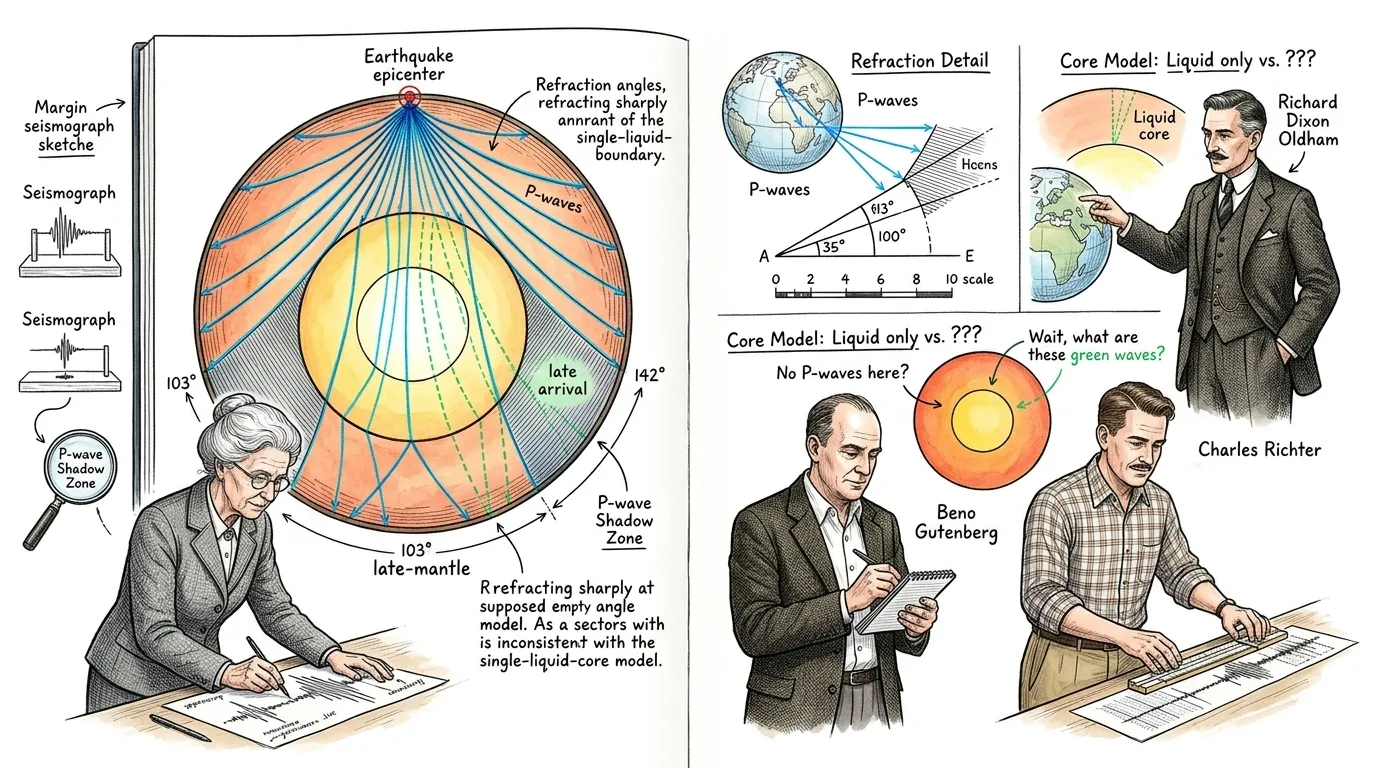
However, this single-liquid-core model presented a persistent problem: the 'P-wave shadow zone'. After a major earthquake, seismographs located between 103 and 142 degrees from the epicenter were expected to receive no direct P-waves because the waves would be refracted by the core-mantle boundary, bending away from these regions. Yet, faint, anomalous P-wave arrivals were consistently recorded within this supposed shadow zone. These 'late arrivals' were puzzling, defying the then-accepted physics of seismic wave propagation through a uniformly liquid core.\n\n Fact: The 'P-wave shadow zone' revealed seismic signals that contradicted existing models, posing a significant scientific puzzle.
Page 4
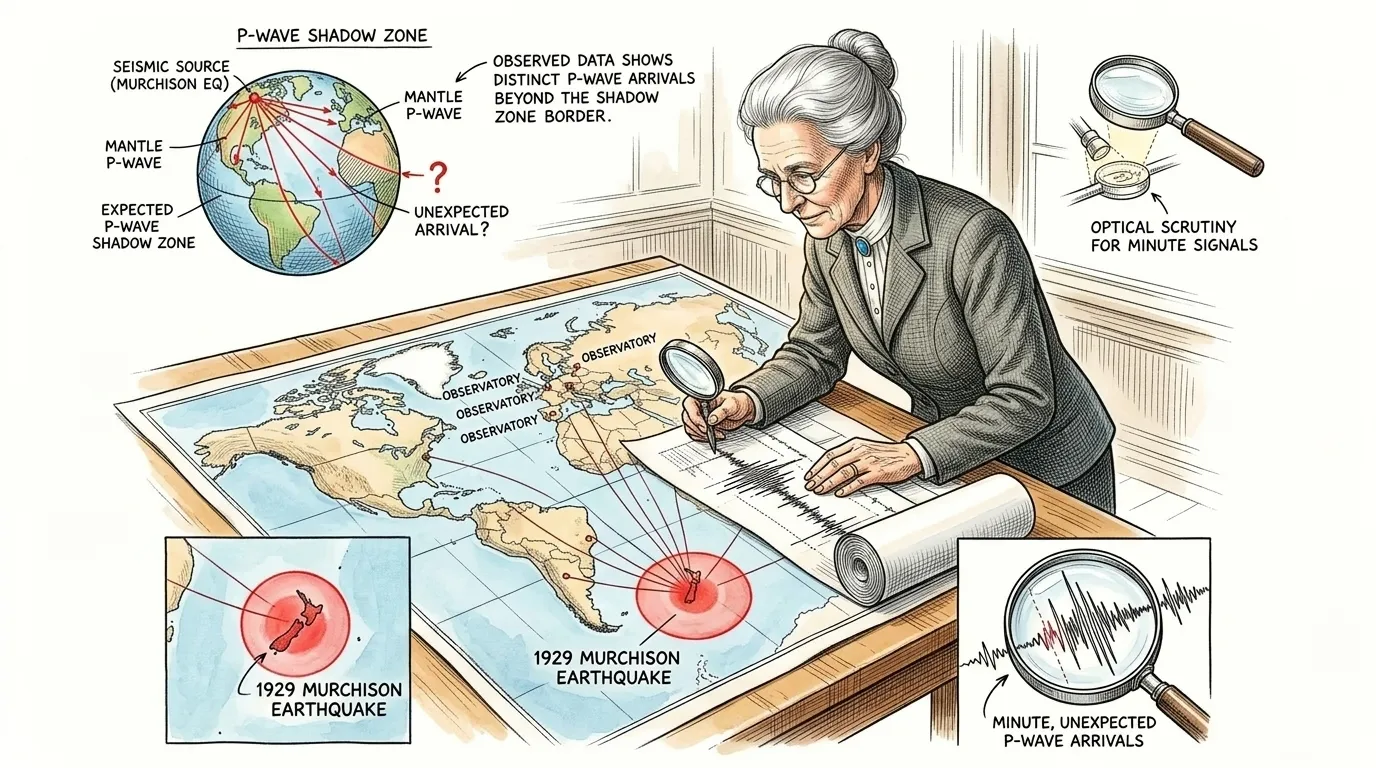
The catalyst for Lehmann's breakthrough was the powerful Murchison earthquake that struck New Zealand in 1929. This event provided an exceptionally clear set of seismographic data, captured by a global network of stations, including those across Europe. The detailed records of the P-wave shadow zone, particularly those from distant observatories, allowed Lehmann to meticulously analyze the minute, unexpected arrivals that had previously been dismissed as noise or insignificant. This abundance of high-quality data became the bedrock for her revolutionary hypothesis.\n\n Fact: A critical natural event provided the data necessary to challenge and refine planetary models.
Page 5
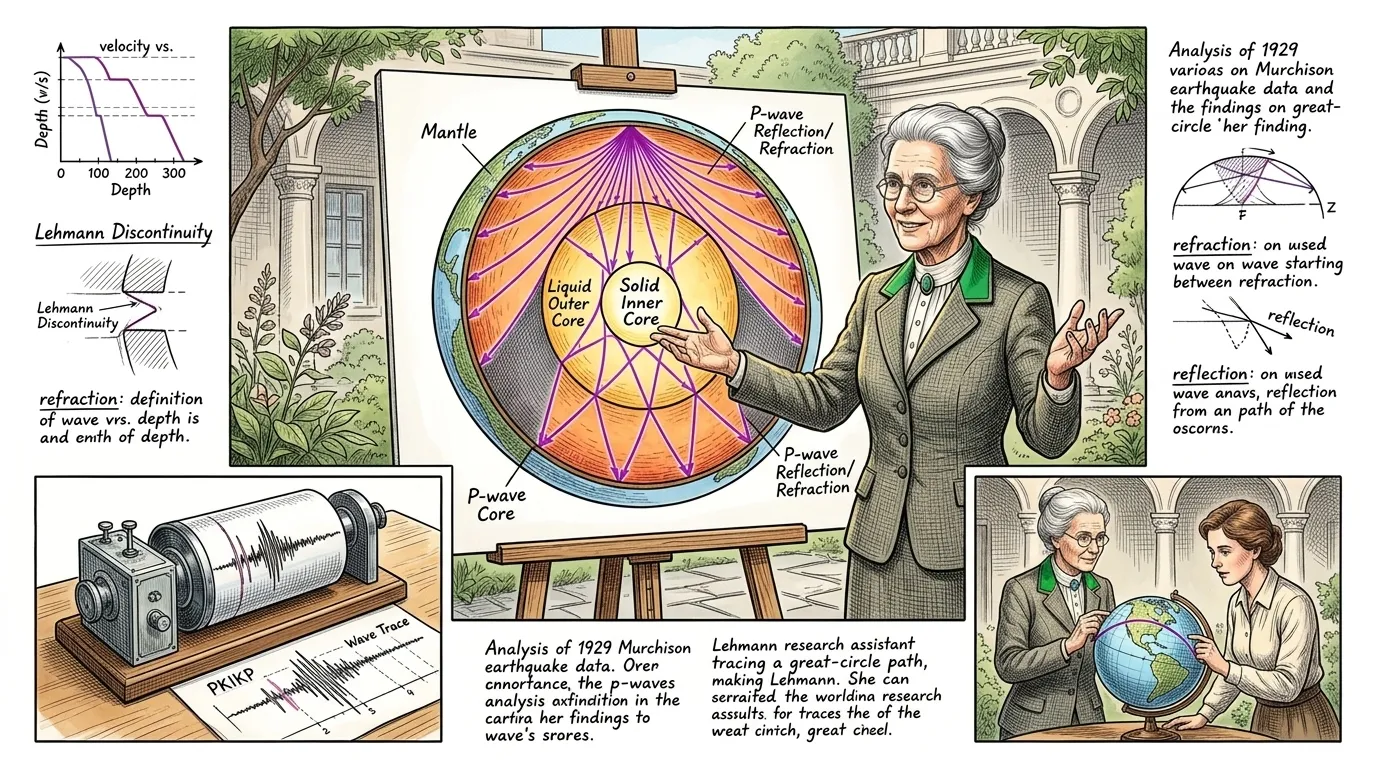
In 1936, after years of painstaking analysis, Inge Lehmann published her audacious hypothesis: within the Earth's liquid outer core lies a distinct, solid inner core. She proposed that the anomalous P-waves observed in the shadow zone were not direct waves, but rather P-waves that had traveled through the liquid outer core, refracted upon encountering a solid boundary, and then reflected off this inner core before refracting again back towards the surface. This 'P' phase, as she named it, explained the previously inexplicable arrivals, suggesting a complex, layered structure at Earth's very heart.\n\n Fact: Lehmann's 1936 paper proposed a solid inner core, explaining baffling seismic wave behavior.
Page 6
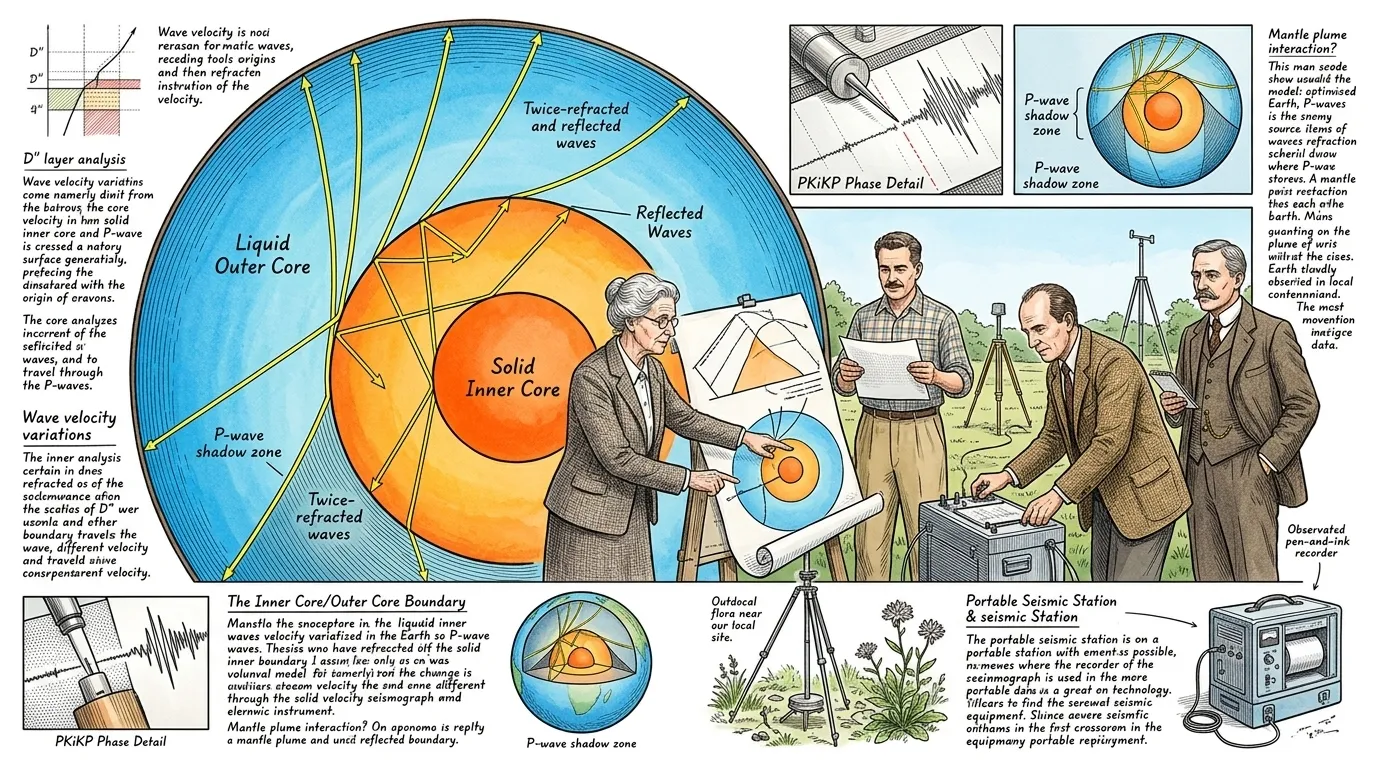
Lehmann's model provided a precise mechanism for the observed P-wave behavior. When an earthquake's P-waves reached the boundary between the liquid outer core and her hypothesized solid inner core, they would undergo a distinct change. A portion of these waves would reflect off this boundary, while others would refract, traveling through the solid inner core itself at a different velocity, and then refract again as they exited back into the liquid outer core. It was these twice-refracted and reflected waves, propagating along a slightly different path, that could then emerge at the surface within the P-wave shadow zone, arriving later than expected but consistently.\n\n Fact: The solid inner core creates distinct reflection and refraction paths for seismic waves, revealing its presence.
Page 7
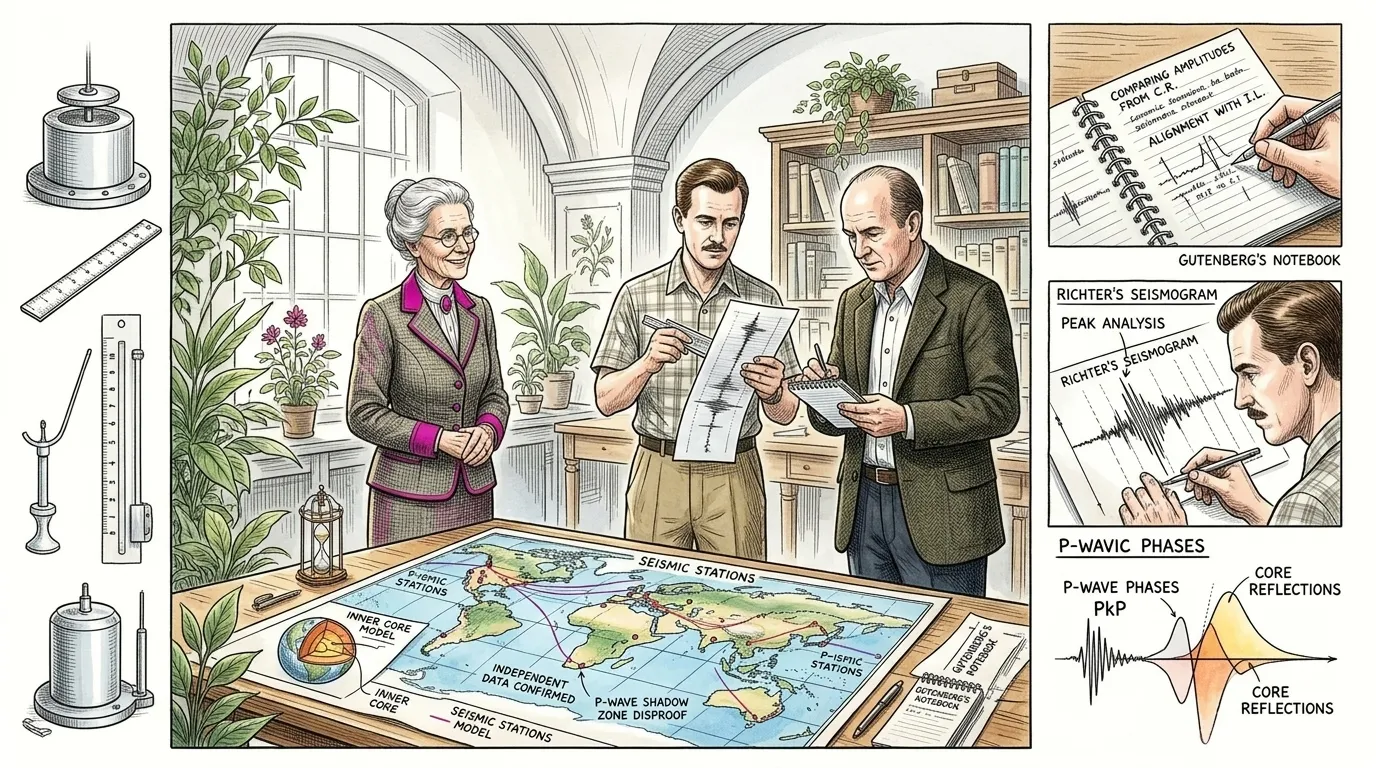
Lehmann's hypothesis was initially met with skepticism, but her meticulous data analysis and the elegance of her explanation soon gained traction. Key to its acceptance was independent verification by other leading seismologists. Most notably, American seismologists Charles Richter and Beno Gutenberg (who had previously championed the liquid-only core) meticulously re-examined global seismic data. Their independent calculations, aligning with Lehmann's proposed discontinuities, provided crucial confirmation. The existence of a distinct, solid inner core was no longer merely a hypothesis but a well-supported scientific reality, fundamentally altering geological textbooks worldwide.\n\n Fact: Rigorous re-analysis of global seismic data by independent researchers validated Lehmann's inner core discovery.
Page 8
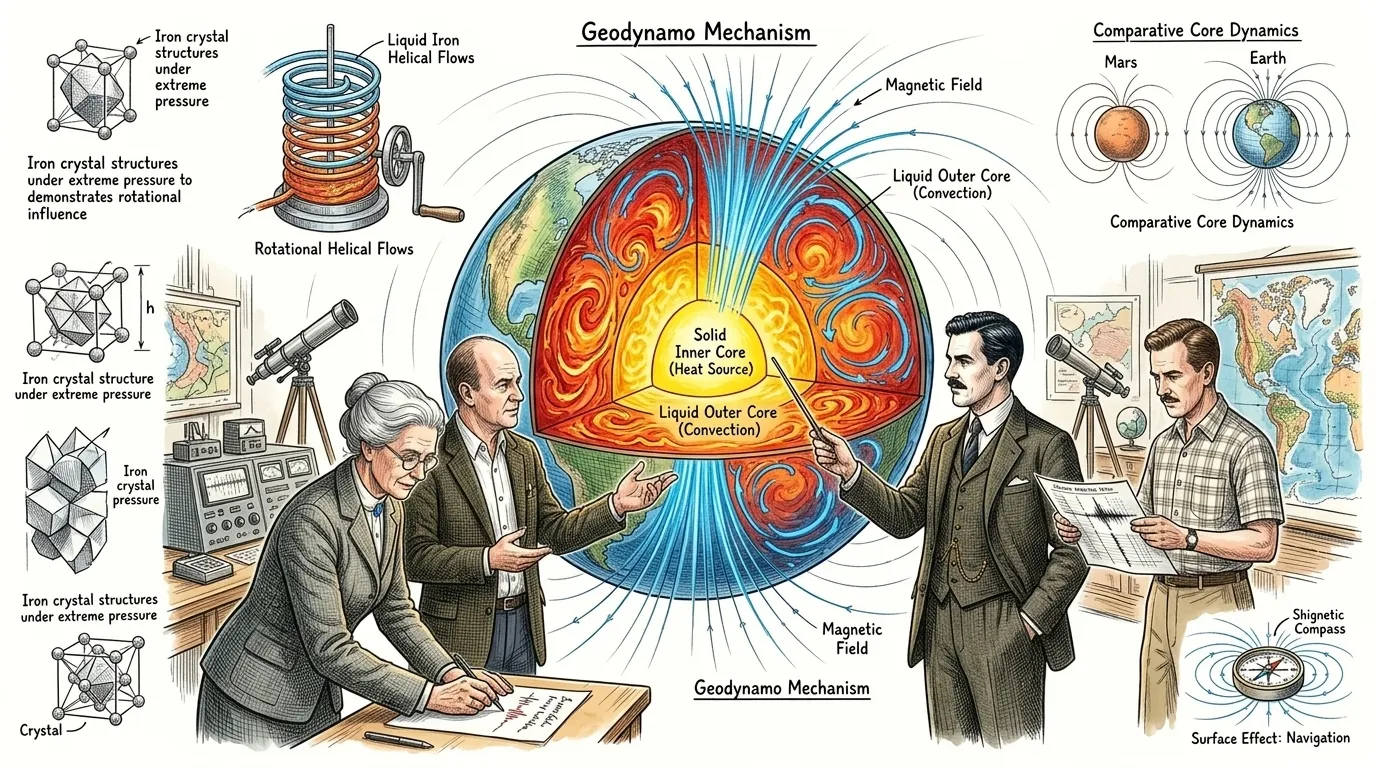
The discovery of a solid inner core nestled within a liquid outer core provided a crucial piece of the puzzle for understanding Earth's powerful magnetic field. This field, essential for protecting life from solar radiation, is generated by a process known as the geodynamo. It involves the convection of molten iron in the liquid outer core, driven by heat escaping from the solid inner core, and the planet's rotation. Lehmann's insight into the core's layered structure allowed scientists to model these complex dynamics more accurately, linking the deep interior to phenomena observable at the surface.\n\n Fact: The discovery of the solid inner core was vital for understanding Earth's geodynamo and protective magnetic field.
Page 9
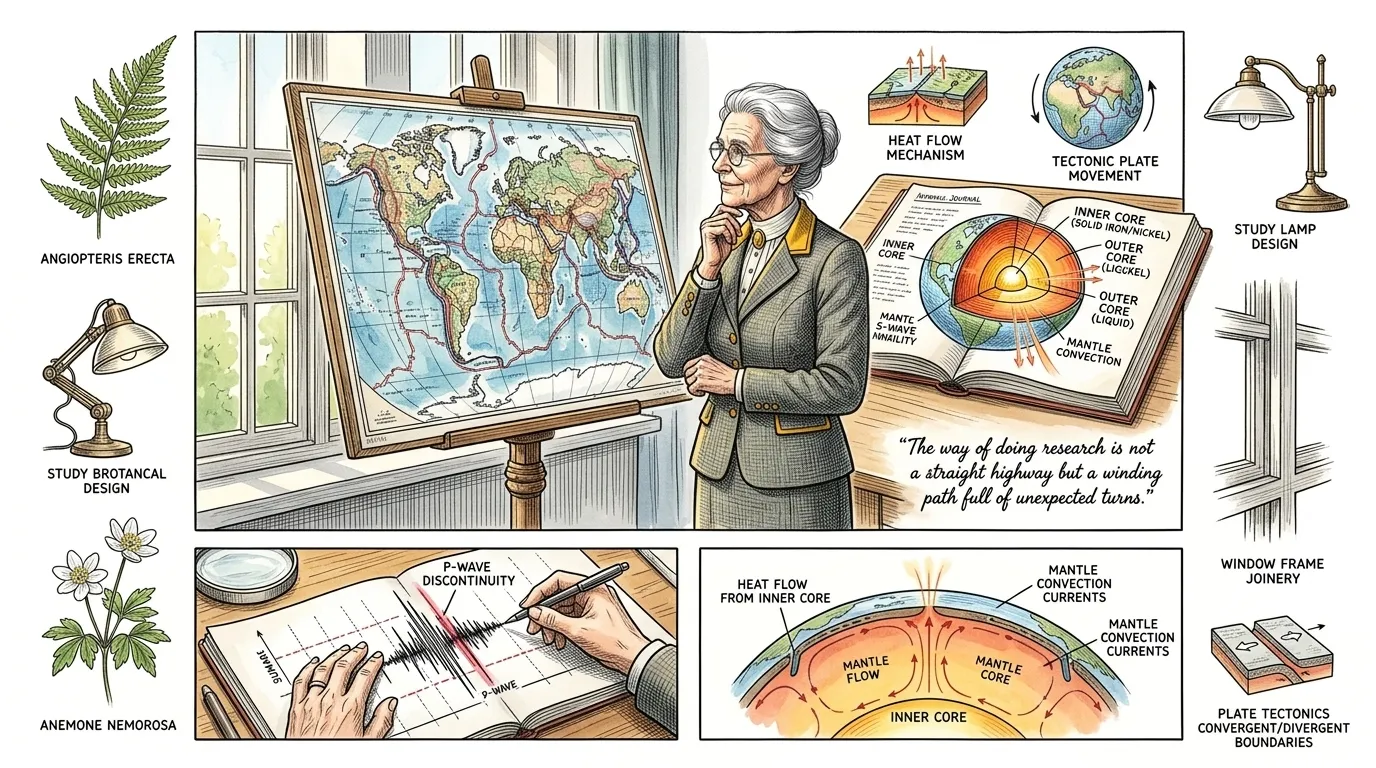
Beyond geomagnetism, Lehmann's discovery was fundamental to the broader field of planetary science. Understanding the distinct phases of Earth's core provided critical insights into the planet's thermal evolution, formation, and the processes that drive plate tectonics. The solidification of the inner core, a continuous process, releases latent heat, which in turn fuels the convection in the outer core, sustaining the geodynamo for billions of years. This continuous interplay dictates Earth's internal energy budget and, consequently, the long-term habitability of our world. Lehmann once noted, 'The way of doing research is not a straight highway but a winding path full of unexpected turns,' a sentiment that perfectly captures the serendipitous yet rigorous journey to this profound understanding.\n\n Fact: Lehmann's work became a cornerstone for understanding Earth's thermal evolution and the dynamics of plate tectonics, crucial for its long-term habitability.
Page 10
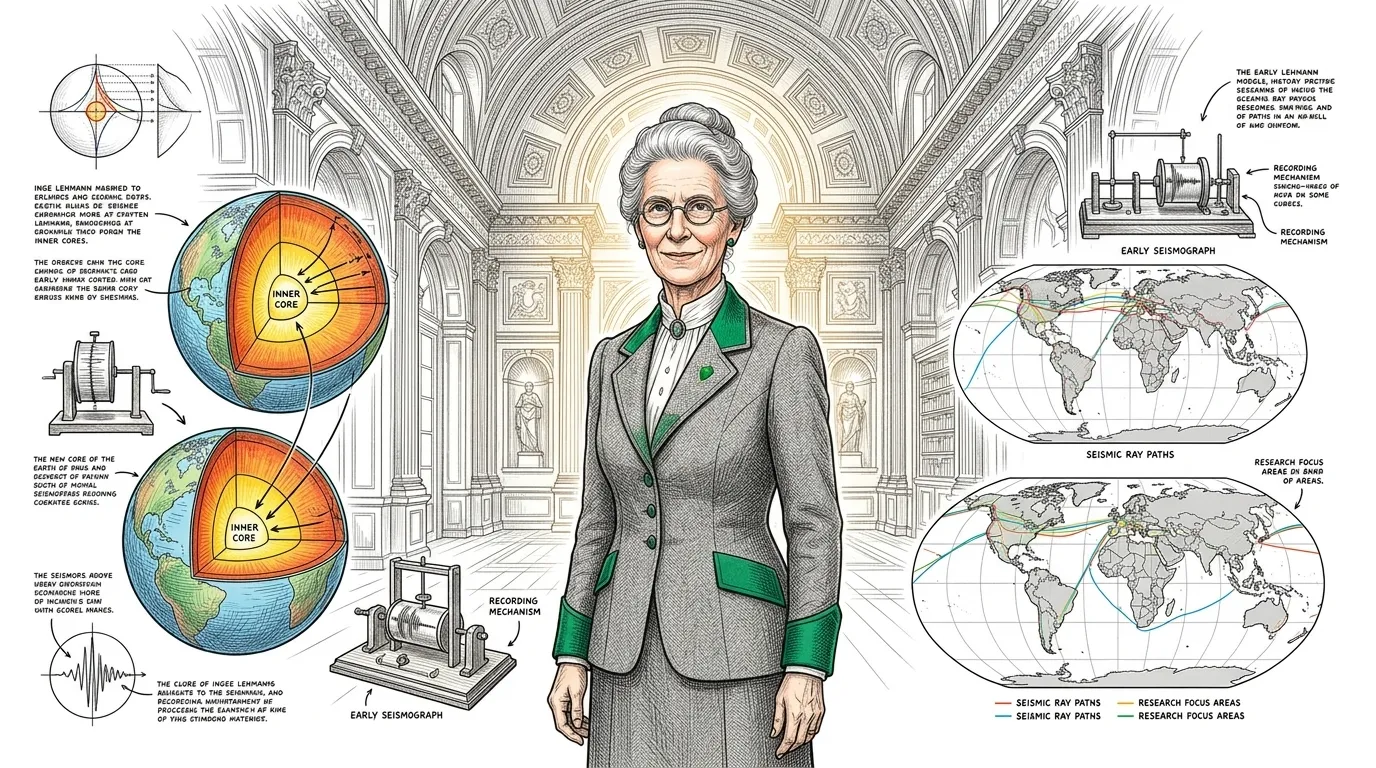
Inge Lehmann's identification of Earth's solid inner core stands as one of the 20th century's most significant geophysical discoveries. Her keen observational skills and ability to interpret subtle data anomalies, even when challenging established paradigms, solidified her place as a titan in geoscience. Her work laid the foundation for modern seismology, enabling more accurate models of Earth's internal structure, a deeper understanding of its magnetic field, and a richer appreciation for the dynamic processes that shape our planet. Her legacy continues to inspire generations of scientists to look beyond the obvious, to trust the data, and to embrace the unexpected 'turns' on the path of discovery.\n\n Fact: Inge Lehmann's discovery of the inner core remains a cornerstone of Earth sciences, influencing myriad fields from planetary physics to geological exploration and education.
About this story
- Location: Global
- Audience: general readers
Questions and answers
Read Wonder Science on your phone
Wonder Science is available on Android. Get Wonder Science on Google Play.