Mars: The Red Planet
Mars: The Red Planet — an illustrated science story. 10 illustrated pages, free to read on Wonder Science.
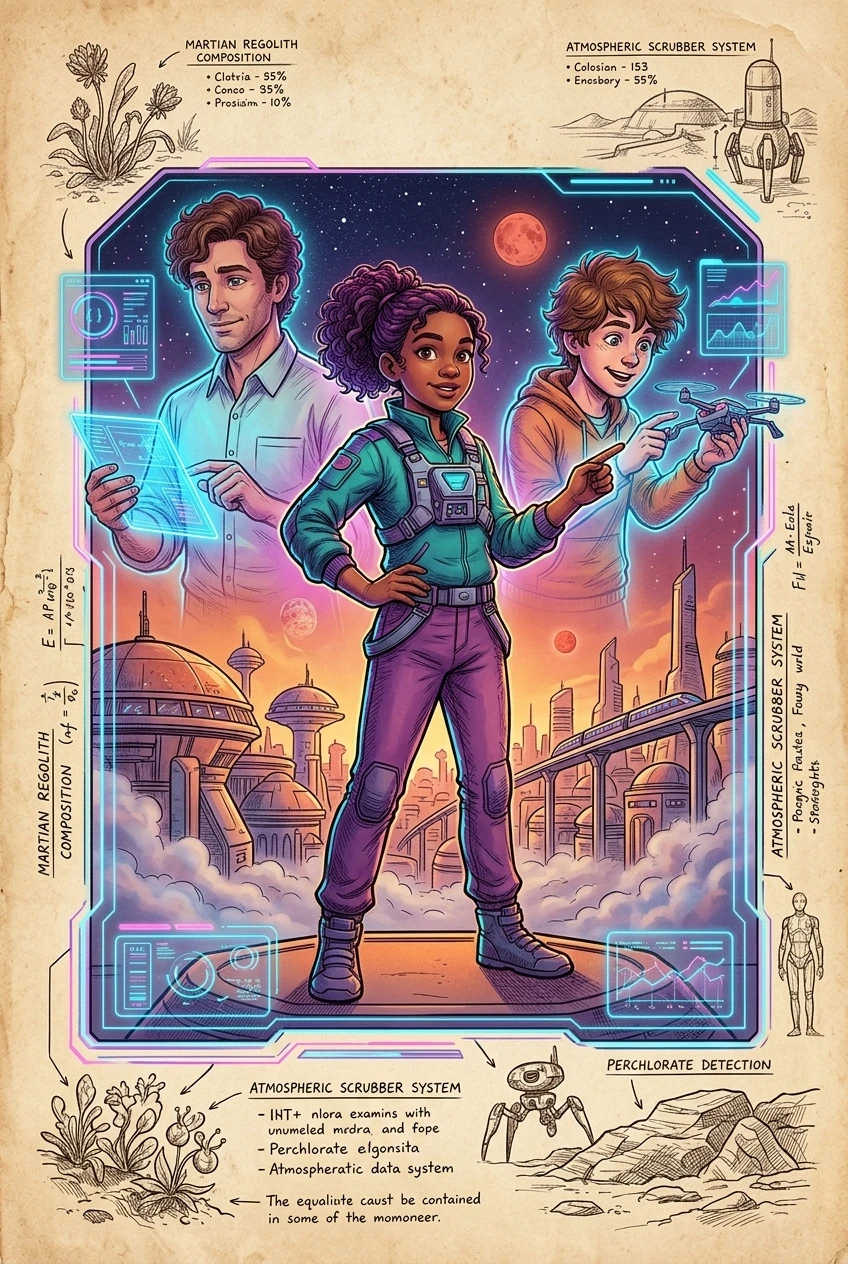
Page 1

'Nudge it forward, Leo!' Aya shouted, pointing at their small, homemade rover. The little machine whirred, its wheels spinning uselessly against a reddish rock on the garage floor. 'It's stuck! Why won't it climb over that one tiny pebble?' Leo groaned, flopping onto the concrete. 'Maybe we made it too heavy.'
Page 2

Aya's father walked in, smiling. 'Having trouble?' he asked, picking up the reddish rock. 'You know, this rock is why people call Mars the Red Planet.' Leo sat up, confused. 'It's red because of rocks? I thought it was just a big ball of red dust.' 'It is!' her father replied. 'But that dust is basically rust—tiny particles of iron oxide.'
Page 3

Suddenly, the garage seemed to fade away, replaced by a crowded room full of scientists in the 1970s. 'This is Mission Control, decades ago,' Aya whispered, observing the scene with wide eyes. Everyone stared intently at a large screen, their faces a mix of hope and anxiety. 'They're waiting for the first signal from the surface of Mars,' Leo realized, his voice hushed.
Page 4

A man with a kind, thoughtful face stepped forward, calming the room with his presence. 'That's Carl Sagan,' Aya's father's voice explained. 'He was an amazing astronomer who helped plan this mission, called Viking 1.' Sagan wasn't just a scientist; he dreamed of finding answers out there and sharing them with everyone on Earth.
Page 5

Sagan leaned forward, a glimmer of profound wonder in his eyes as the first grainy image began to form on the screen. 'Somewhere, something incredible is waiting to be known,' he had once said, and this was that moment. He wasn't just seeing data; he was looking at the landscape of another world for the very first time. Every scientist in the room held their breath, witnessing history.
Page 6

The picture from the Viking 1 lander finally cleared, revealing not a world of aliens, but a vast, silent desert of rocks under a pale pink sky. 'It's... empty,' Leo whispered, a little disappointed. 'It's not empty, it's new!' Aya corrected, her eyes sparkling. 'It's a whole new world we're seeing! Look at all those red rocks!'
Page 7

That first picture sparked decades of exploration, with rovers like Curiosity and Perseverance becoming our robotic fossil hunters. 'They found proof of ancient rivers and frozen water!' Aya exclaimed. 'Mars even has the biggest volcano in the solar system, Olympus Mons!' Her father's voice added a fun fact, 'Just like things on Mars expand and contract in the wild temperature swings, the Eiffel Tower actually grows about 15 centimeters taller in the summer!'
Page 8

They were back in the garage, the little rover still stuck on the red rock. 'Oh! I get it now!' Leo shouted, jumping to his feet. 'Our rover getting stuck is the same problem the real ones have on Mars!' Aya nodded enthusiastically. 'Exactly! We're not just building a toy; we're solving a real Mars exploration problem!' Her father smiled. 'That's how science works—one small problem at a time.'
Page 9

Aya pointed to her old bicycle leaning against the wall. 'Look! The rust on my bike chain is iron oxide, just like Mars.' Leo grabbed his skateboard. 'And my wheels need good grip to get over cracks in the sidewalk, just like the rover's wheels need to grip the Martian rocks!' 'It's all connected,' Aya's father said. 'The science out there helps us understand the world right here.'
Page 10

'So Mars is a cold, rusty desert now, but it used to be a world with water,' Aya summarized, writing it down in her notebook. She clicked her pen shut with a satisfied smile. Leo, already thinking ahead, looked at her father. 'If Mars has the biggest volcano in the whole solar system, what's the biggest one here on Earth?'
About this story
- Audience: kids (ages 6–12)
Questions and answers
Read Wonder Science on your phone
Wonder Science is available on Android. Get Wonder Science on Google Play.