Rita Levi-Montalcini
Rita Levi-Montalcini — an illustrated science story, set in Global. 10 illustrated pages, free to read on Wonder Science.
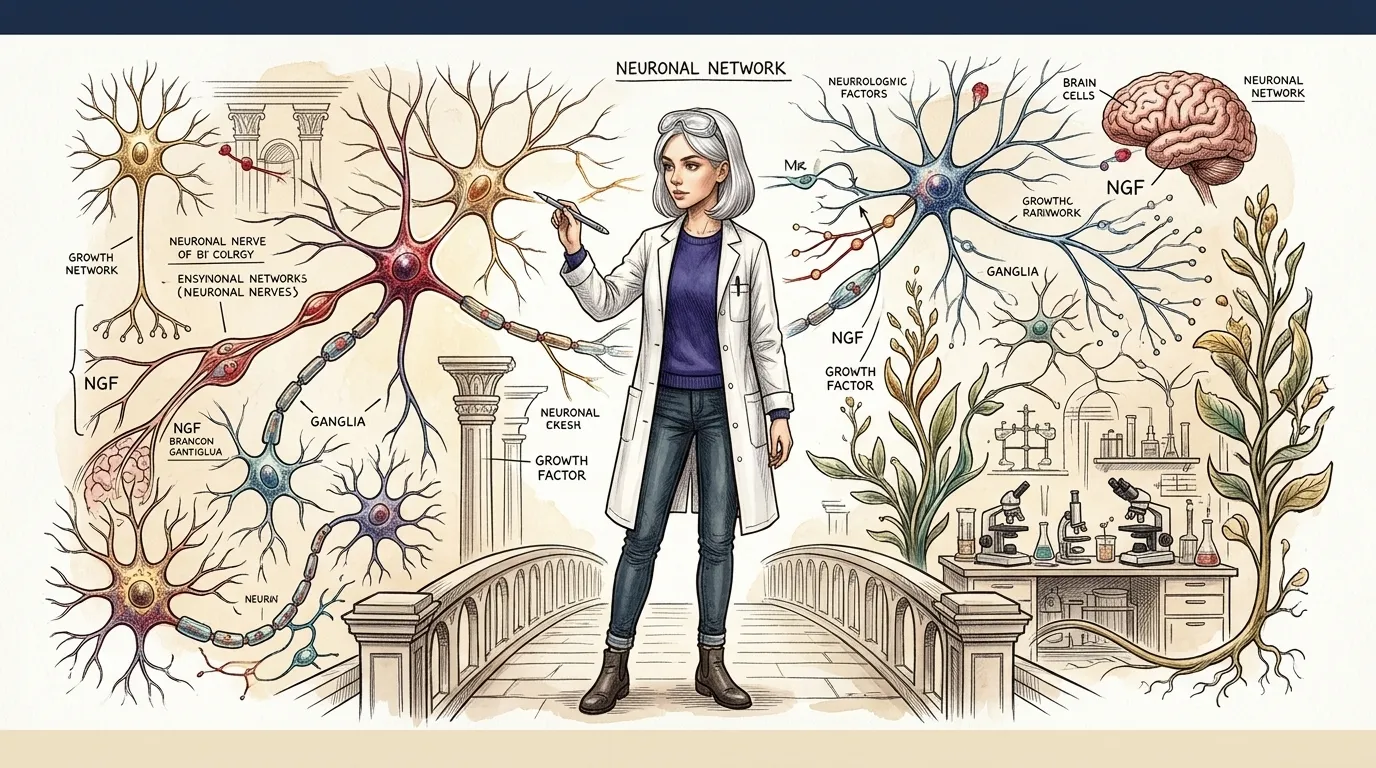
Page 1
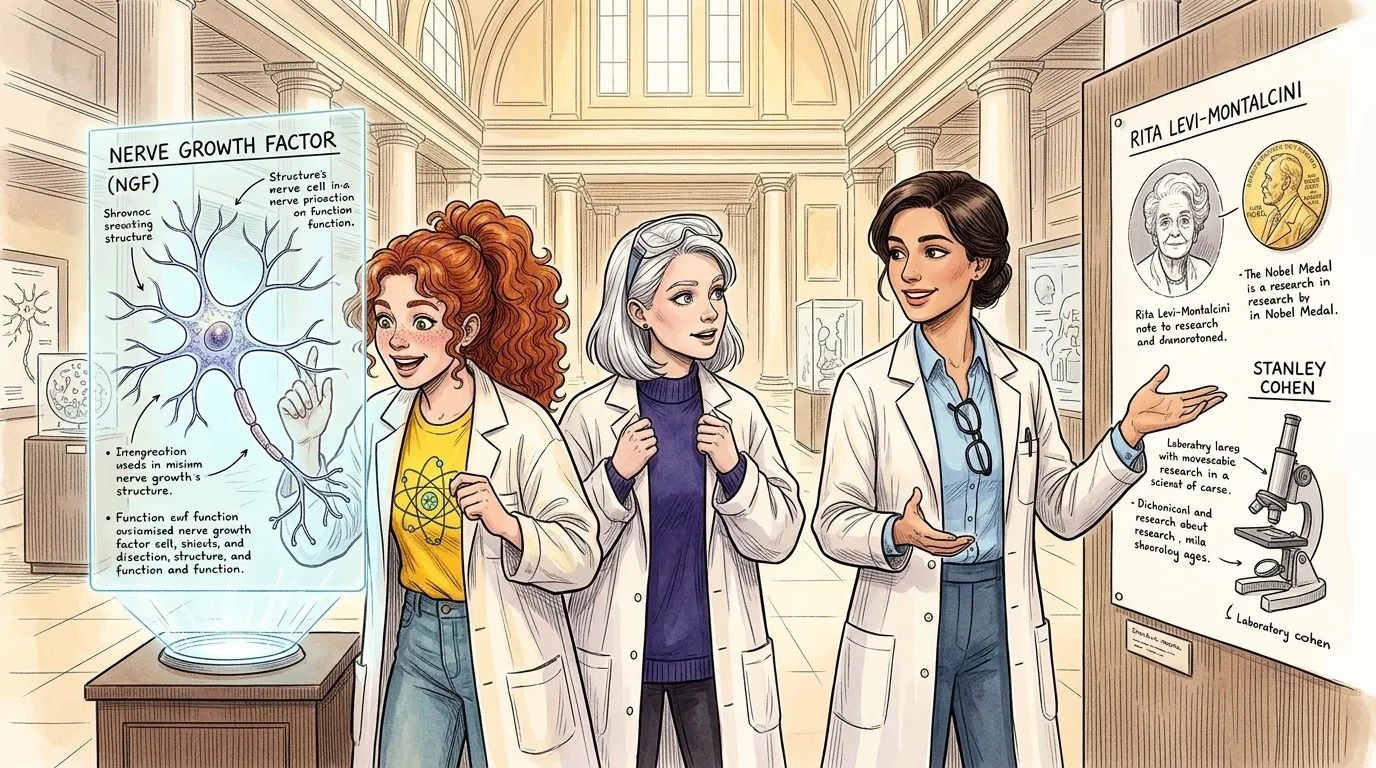
A quiet hum filled the grand hall of the science museum as Emilia, Winona, and Diego approached a dimly lit exhibit. "Welcome," Diego began, gesturing towards a display, "to the world of Rita Levi-Montalcini, a name synonymous with one of the most profound discoveries in neuroscience: Nerve Growth Factor."
"'Nerve Growth Factor?' Emilia murmured, her silver-white hair catching the ambient light. 'What exactly does that mean?' Winona, ever energetic, peered closer at a holographic projection. 'And who was Rita Levi-Montalcini, Diego?'"
Page 2
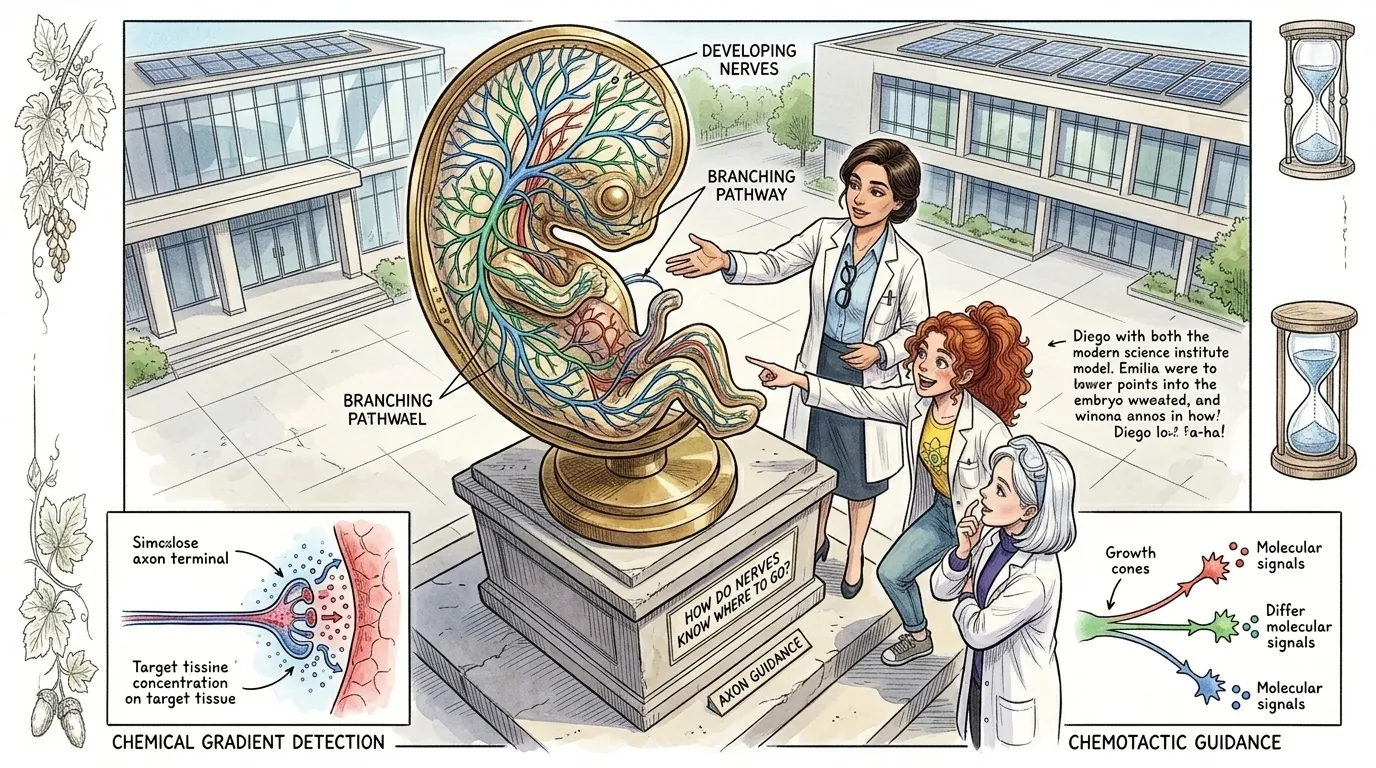
Diego pointed to a detailed anatomical model of a developing embryo, its tiny nerve fibers branching outwards. "For centuries," she explained, "scientists puzzled over how the intricate wiring of the nervous system formed so precisely."
"'It's like building a city without a map!' Emilia exclaimed, looking up at the towering model. Winona added, 'How do the nerves know where to go, or when to stop growing?' 'Exactly,' Diego affirmed. 'They knew nerves grew, but the 'what' that guided them, the invisible architect of their destiny, was a profound mystery.'"
Page 3
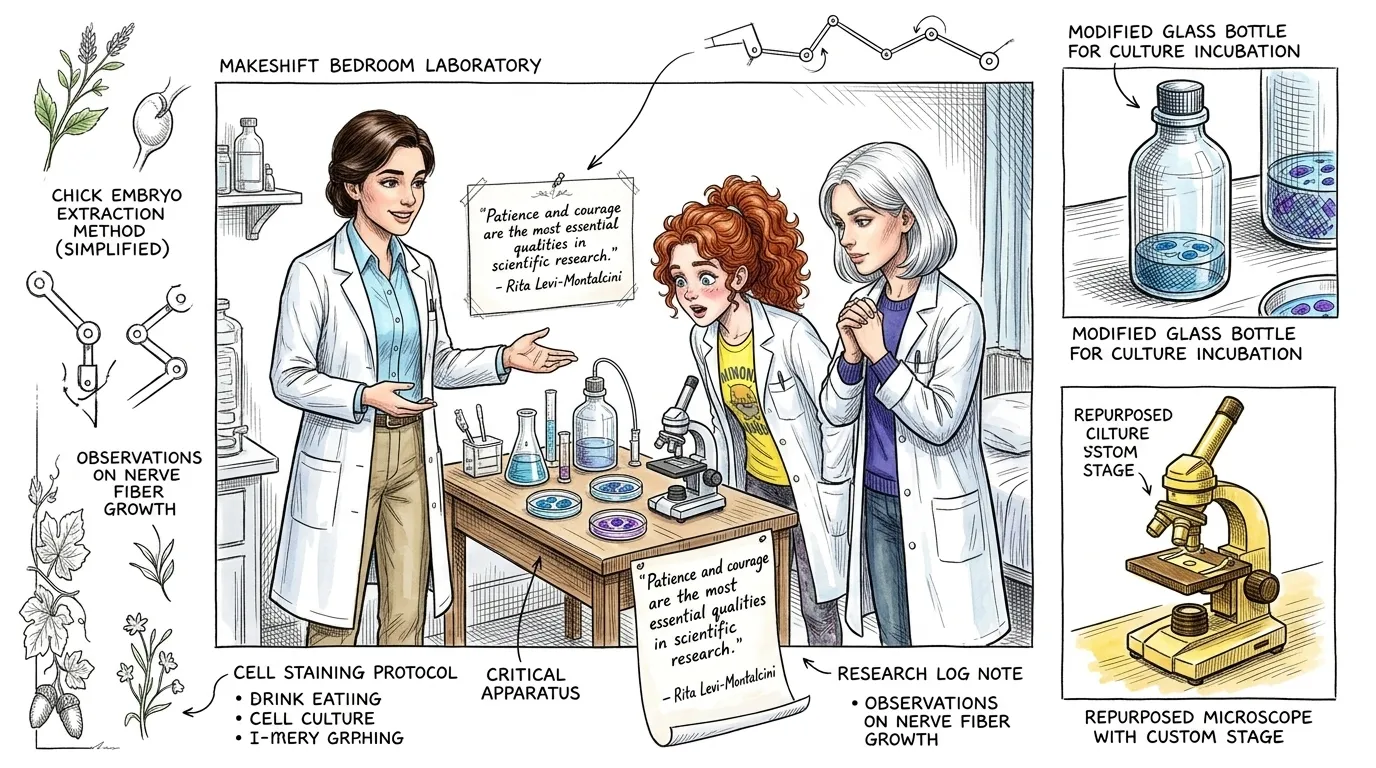
Diego led them to a recreation of a cramped, makeshift laboratory, filled with simple equipment. "In the early 1940s, facing racial laws in Italy that banned her from university, Rita Levi-Montalcini transformed her bedroom into a clandestine research space."
"'Wow, a secret lab!' Winona whispered, peering into the scene. Emilia observed the meticulous setup. 'She must have been incredibly determined.' Diego nodded, adding, "Indeed. She once said, 'The future is in the hands of those who are able to be patient in the long journey of research and have the courage of not giving up.' She carried that courage, even in such difficult times, searching for that guiding signal.""
Page 4
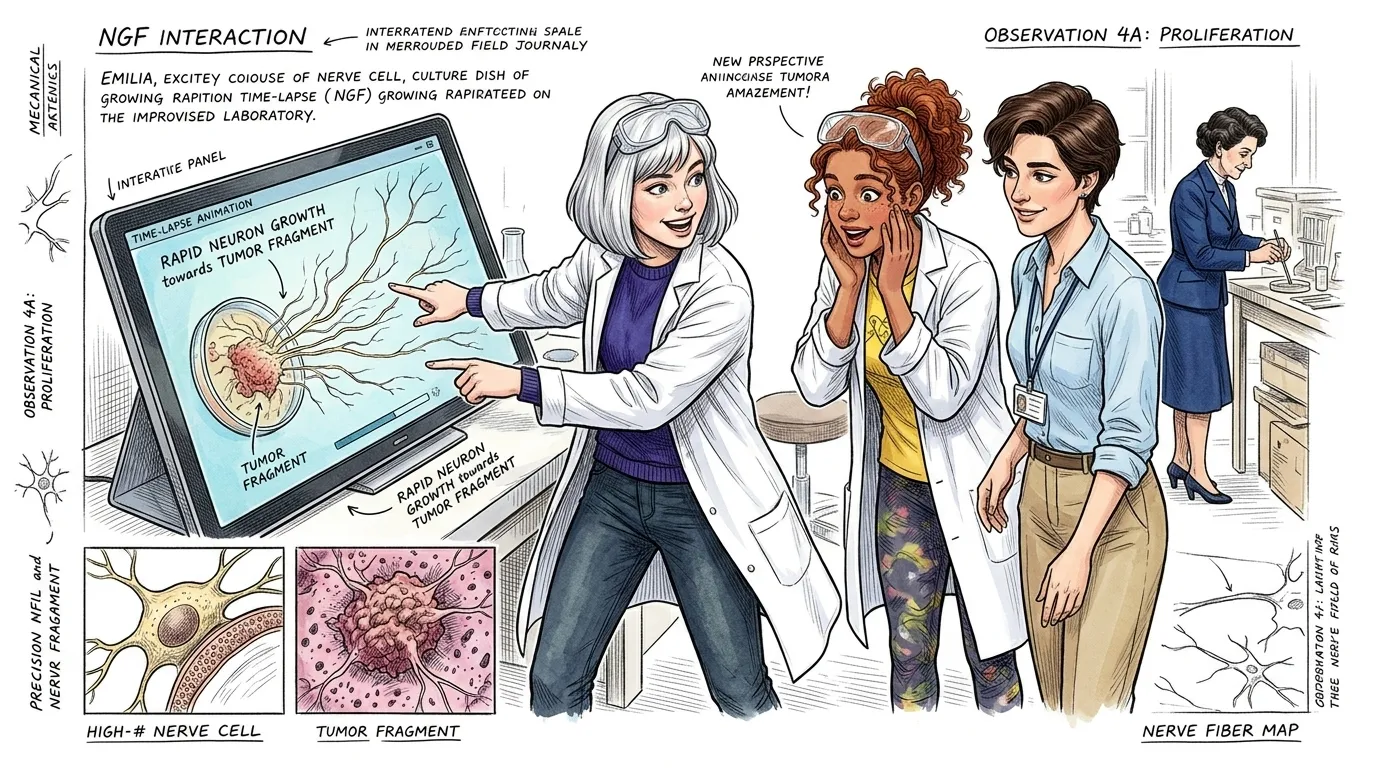
In her improvised lab, Rita Levi-Montalcini conducted experiments with chick embryo nerve cells, isolating them in culture dishes. She introduced fragments of mouse sarcoma, a type of tumor, next to the developing neural tissue. What she observed was extraordinary.
"'Look at that!' Emilia gasped, pointing at a large interactive screen now showing a time-lapse animation. Thin, almost invisible threads—nerve fibers—were rapidly growing towards the tumor fragment. Winona's eyes widened. 'It's like the tumor is pulling them in!' 'Indeed,' Diego confirmed. 'The tumor was secreting a substance, an unknown chemical signal, that dramatically stimulated the nerve cells to grow and branch towards it. This was her pivotal insight.'"
Page 5
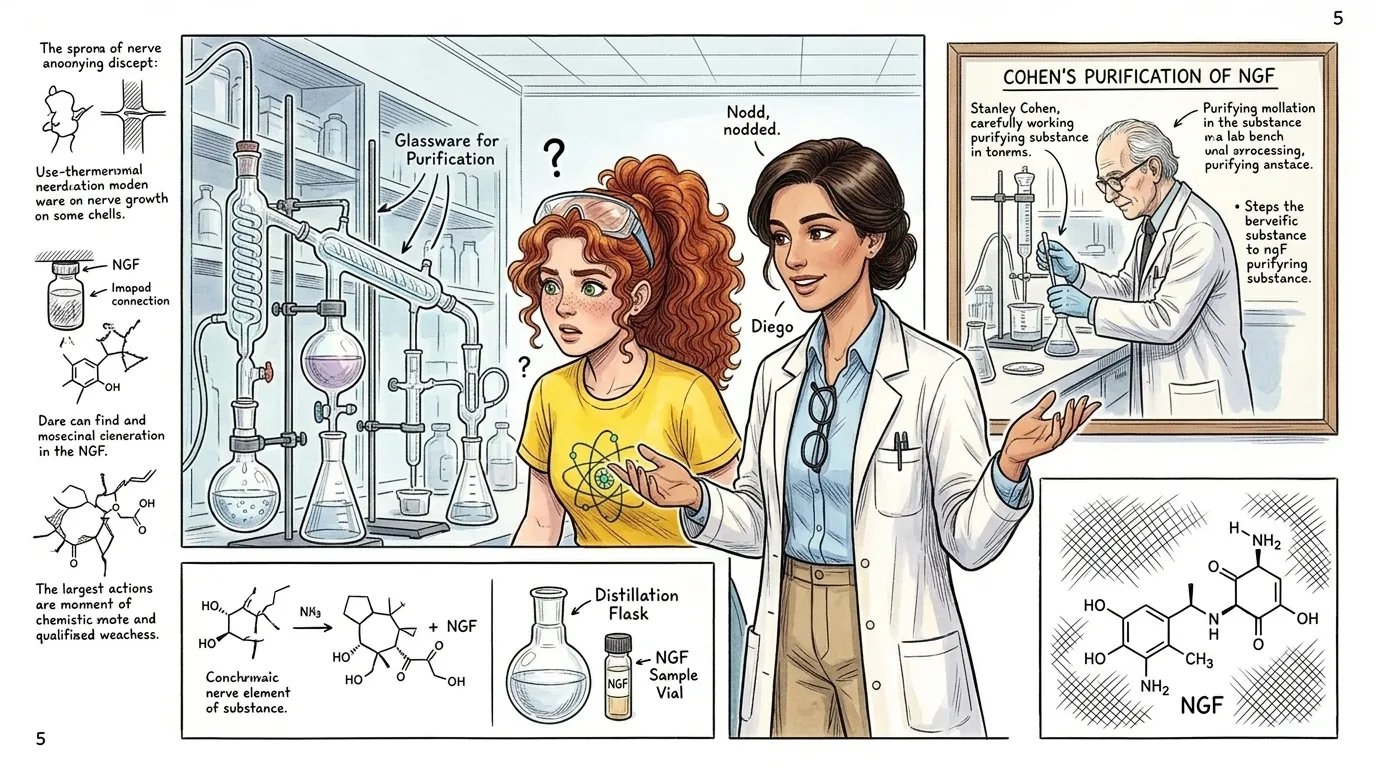
This groundbreaking observation, made during wartime, eventually led Rita Levi-Montalcini to St. Louis, Missouri. There, collaborating with biochemist Stanley Cohen, they began the arduous task of identifying the mysterious substance.
"'So, it wasn't just observing it, but finding out what it was?' Winona questioned, looking at a display of complex laboratory glassware. Diego nodded, "Precisely. Stanley Cohen then worked to purify this 'Nerve Growth Factor' or NGF, from the tumor cells. It was a painstaking process to isolate that exact chemical signal that guided nerve growth.""
Page 6
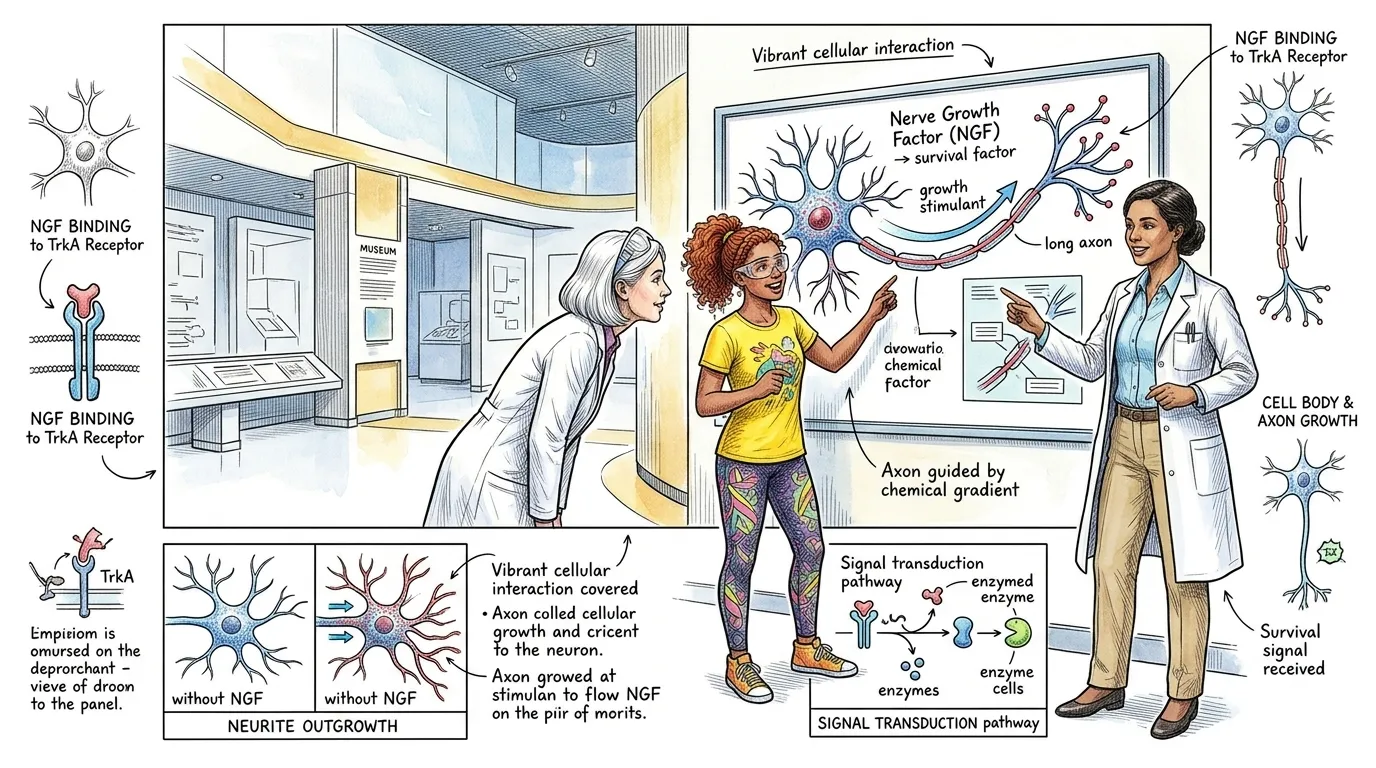
Once isolated, the true function of Nerve Growth Factor became clear. It wasn't just a growth stimulant; it was a fundamental survival factor, a molecular 'lifeblood' for developing neurons.
"'So it tells nerves to grow AND keeps them alive?' Emilia clarified, looking at a vibrant diagram. 'It's like a super nutrient for brain cells!' Winona added. 'Exactly,' Diego affirmed, pointing to a labeled graphic. 'NGF ensures that neurons connect correctly, survive the critical stages of development, and maintain their health throughout life. Without it, many nerve cells would simply perish.'"
Page 7
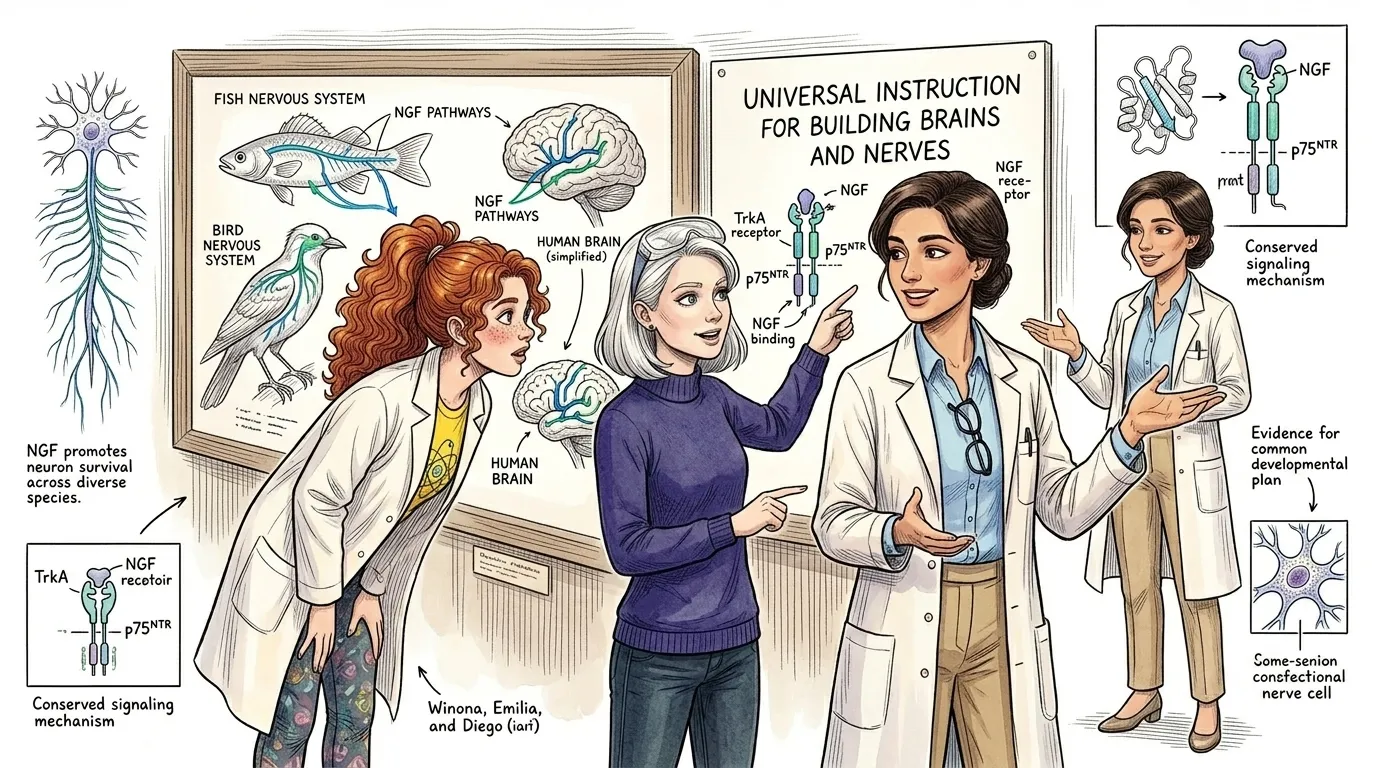
Further research revealed that NGF and its receptor proteins are remarkably conserved across many species, from fish to humans. This universality underscored its fundamental role in nervous system development.
"'So, this isn't just a human thing?' Winona asked, looking at a display of comparative anatomy. Diego shook her head. 'No, its presence across so many life forms means it's an ancient and essential biological mechanism.' Emilia pointed to a panel. 'It's like a universal instruction for building brains and nerves!'"
Page 8
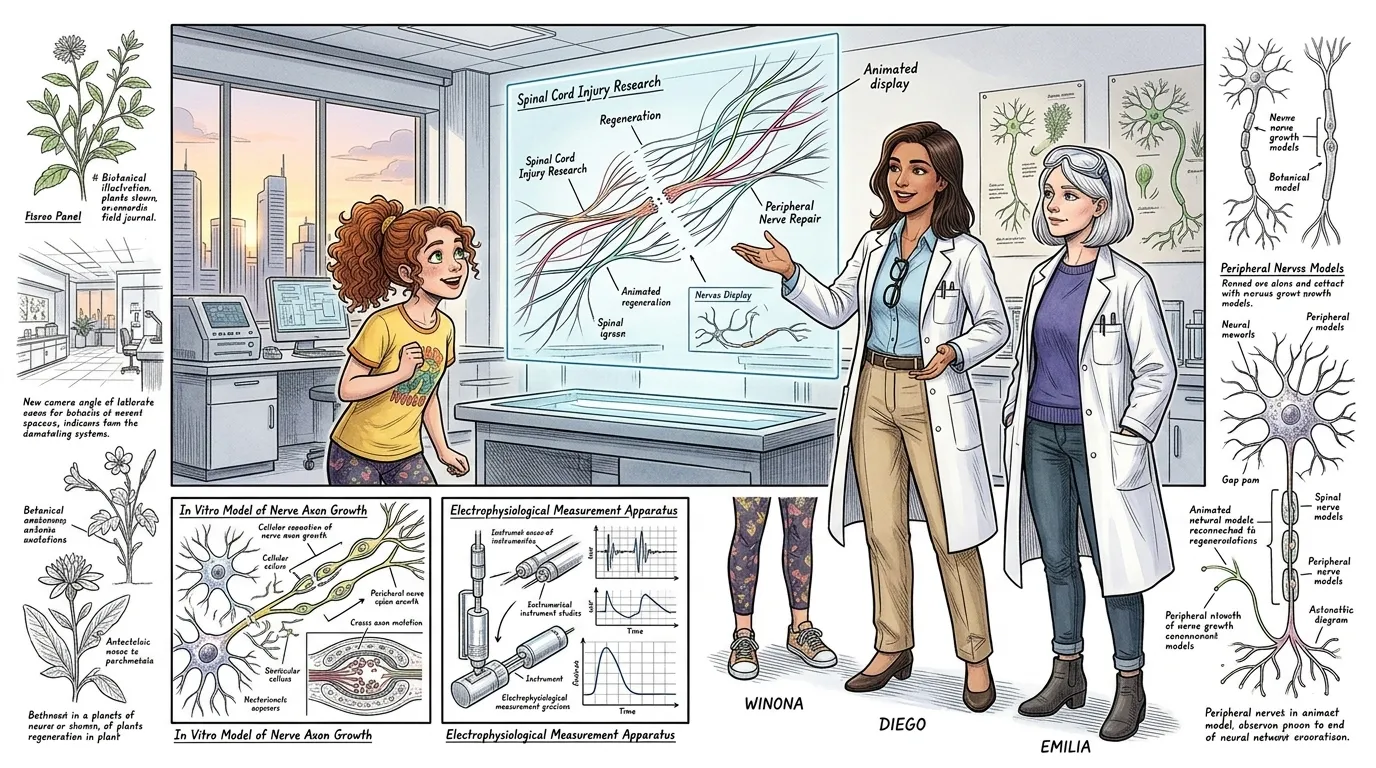
The discovery of NGF revolutionized our understanding of neurobiology and opened entirely new avenues for medical research. Scientists realized that if NGF guided growth and survival, it might also help repair damaged nerve tissue.
"'So, could NGF help people whose nerves are hurt?' Winona asked, looking up at an animated display of nerve regeneration. Diego smiled. 'That's exactly right, Winona! Insights from NGF's discovery have been crucial in research for treating spinal cord injuries or damaged peripheral nerves, helping them regrow and reconnect, just as that invisible architect guides them.' Emilia added, 'So the mystery signal could actually heal things!'"
Page 9
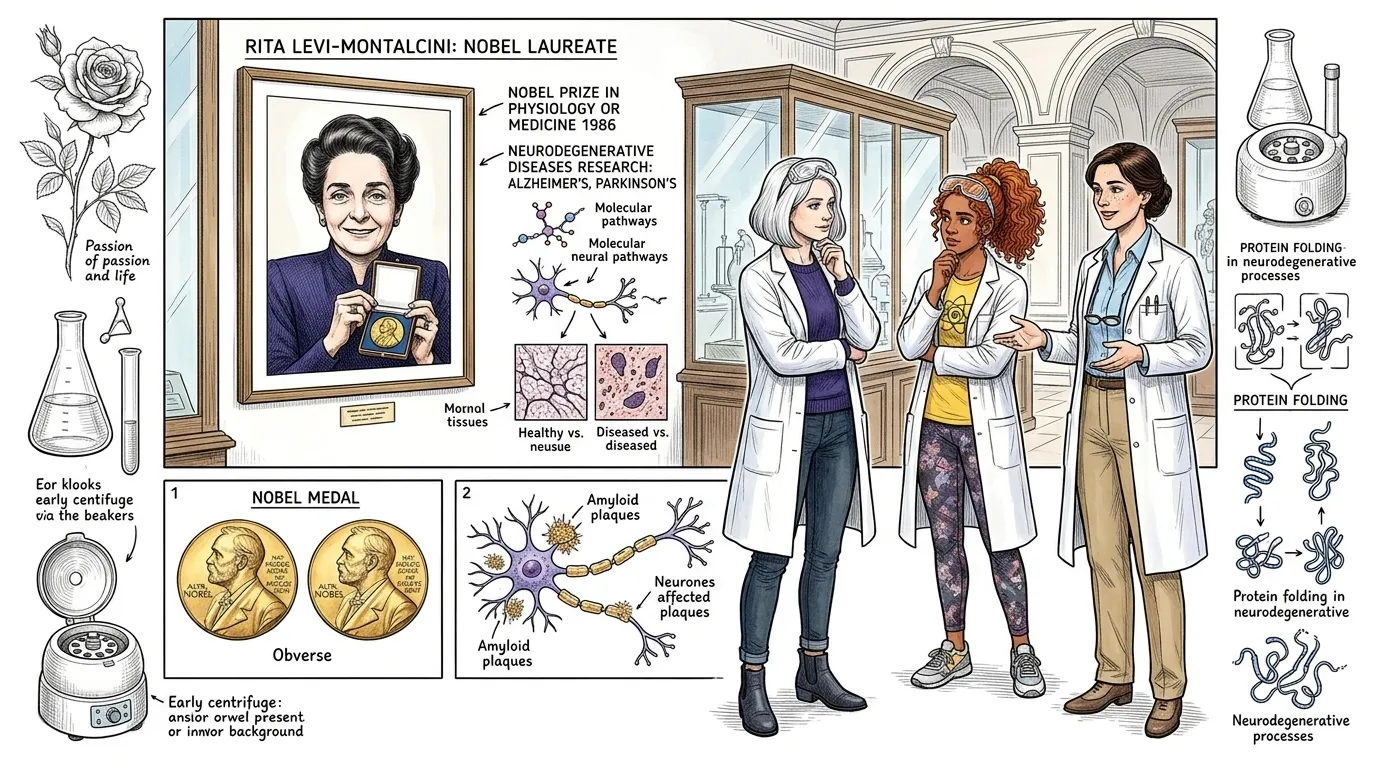
For their profound discovery, Rita Levi-Montalcini and Stanley Cohen were awarded the Nobel Prize in Physiology or Medicine in 1986. Their work continues to underpin research into some of the most challenging diseases.
"'A Nobel Prize! That's incredible!' Emilia exclaimed, looking at a photo of Rita Levi-Montalcini holding her Nobel medal. Diego affirmed, 'Their breakthrough transformed neurobiology. It laid the foundation for understanding neurodegenerative diseases like Alzheimer's and Parkinson's, where nerve cell survival is compromised.' Winona pondered, 'So, NGF could help us understand how to keep our brains healthy?'"
Page 10
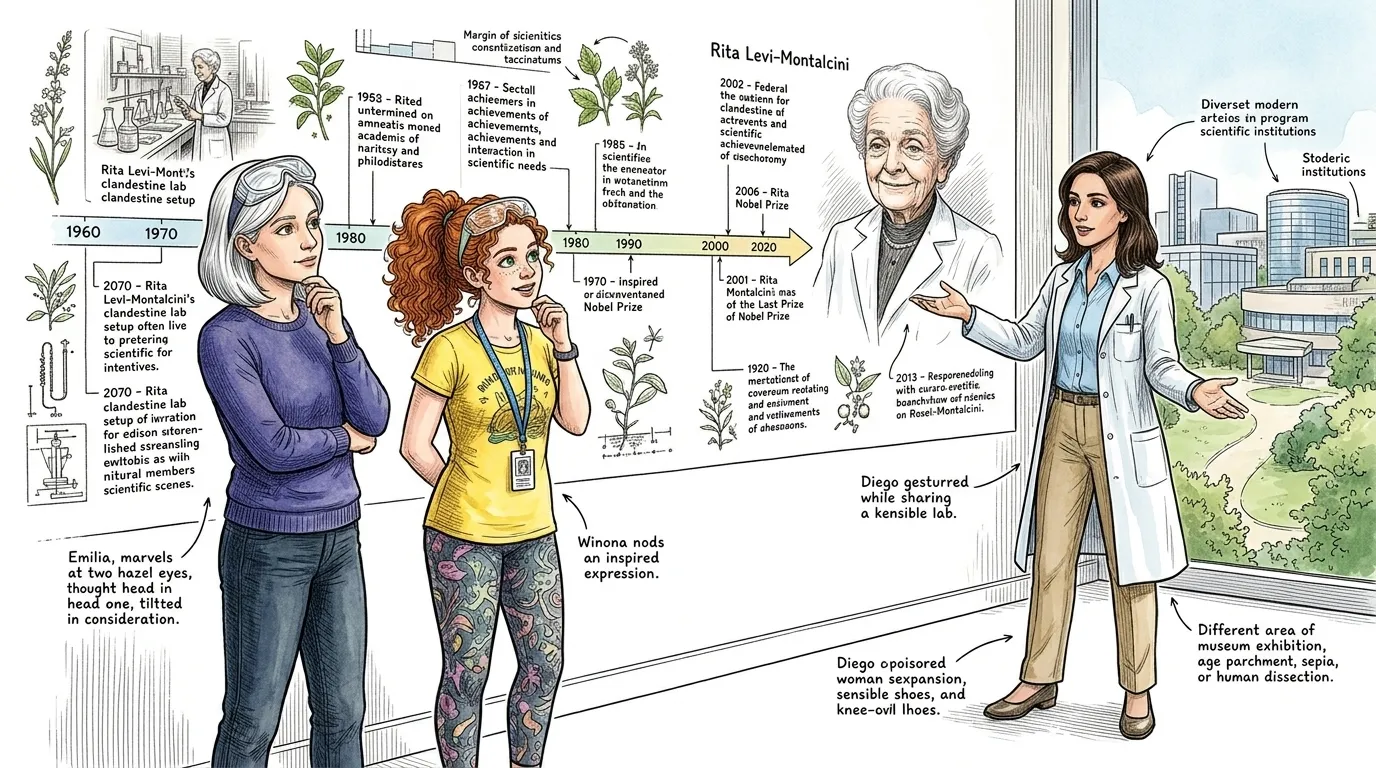
Rita Levi-Montalcini continued her scientific work for decades, living to be 103 years old, a testament to her lifelong passion for discovery. Her journey, from a clandestine lab to a Nobel Prize, inspires generations.
"'She kept discovering for so long!' Emilia marveled, looking at a timeline. Winona nodded. 'Her discovery changed everything about how we see our nerves.' Diego concluded, "Her work isn't just about NGF; it's a powerful narrative of resilience, intellectual courage, and the enduring human spirit to unveil life's deepest mechanisms. Rita Levi-Montalcini truly illuminated the unseen architecture of life.""
About this story
- Location: Global
- Audience: general readers
Questions and answers
Read Wonder Science on your phone
Wonder Science is available on Android. Get Wonder Science on Google Play.