Roger Penrose

Roger Penrose — an illustrated science story, set in Global. 10 illustrated pages, free to read on Wonder Science.

Roger Penrose — book cover — Wonder Science
Roger Penrose — an illustrated science story, set in Global. 10 illustrated pages, free to read on Wonder Science.

Page 1
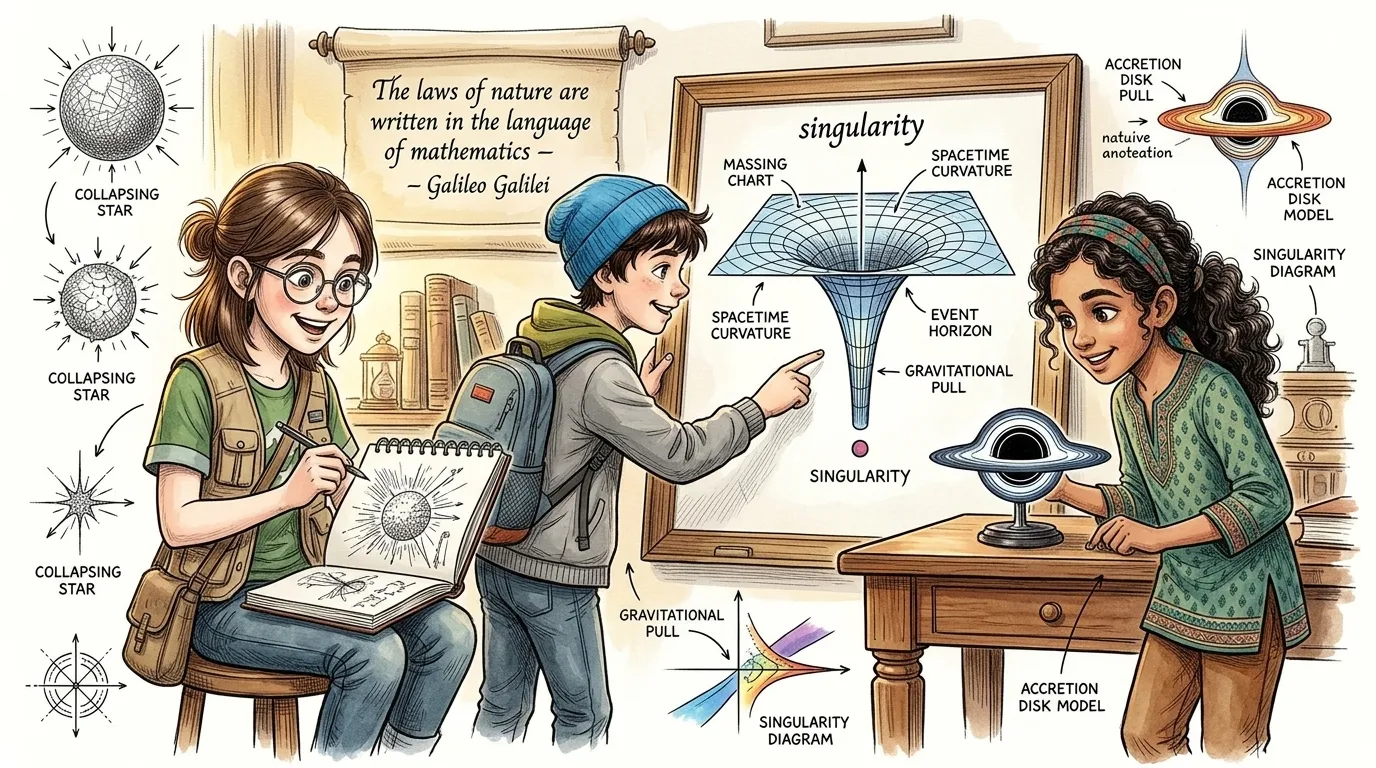
Imagine a star collapsing in on itself, its gravity so immense that it bends space and time into an infinitely small point – a singularity.
Imagine a star collapsing in on itself, its gravity so immense that it bends space and time into an infinitely small point – a singularity. This isn't science fiction; it's the realm of black holes, and Roger Penrose helped us understand their mathematical underpinnings. These ideas helped revolutionize astrophysics. "The laws of nature are written in the language of mathematics," Galileo Galilei once said, and Penrose proved it in the most extreme environments imaginable.

Imagine a star collapsing in on itself, its gravity so immense that it bends space and time into an infinitely small point – a singularity. This isn't science fiction; it's the realm of black holes, and Roger Penrose helped us understand their mathematical underpinnings. These ideas helped revolutionize astrophysics. "The laws of nature are written in the language of mathematics," Galileo Galilei once said, and Penrose proved it in the most extreme environments imaginable.

Page 2
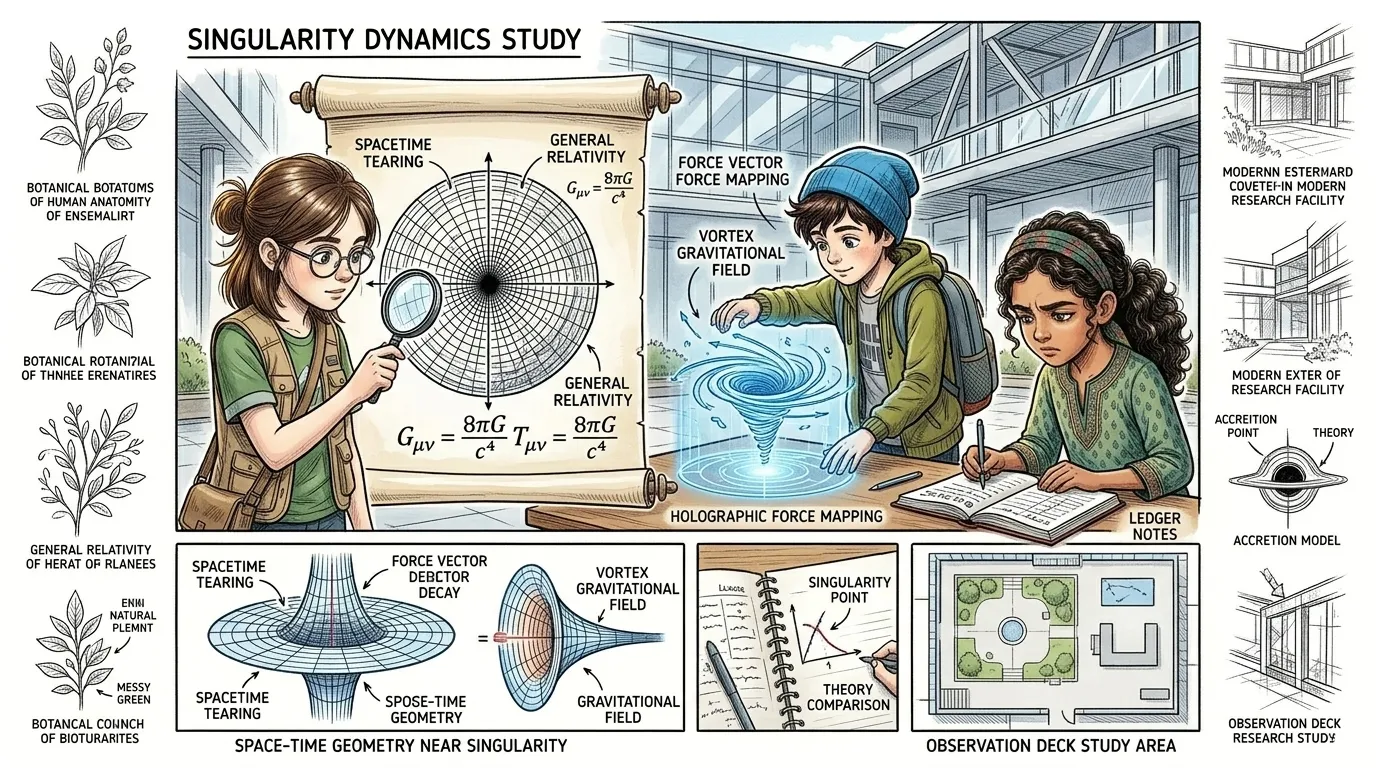
What exactly is a singularity? It's a point where the known laws of physics break down. Penrose proved that singularities weren't just a mathematical curiosity…
What exactly is a singularity? It's a point where the known laws of physics break down. Penrose proved that singularities weren't just a mathematical curiosity, but a necessary consequence of Einstein's theory of general relativity under certain conditions. This was a radical idea at the time. Before Penrose's work, many physicists hoped that singularities would disappear with a better understanding of quantum gravity.

What exactly is a singularity? It's a point where the known laws of physics break down. Penrose proved that singularities weren't just a mathematical curiosity, but a necessary consequence of Einstein's theory of general relativity under certain conditions. This was a radical idea at the time. Before Penrose's work, many physicists hoped that singularities would disappear with a better understanding of quantum gravity.

Page 3
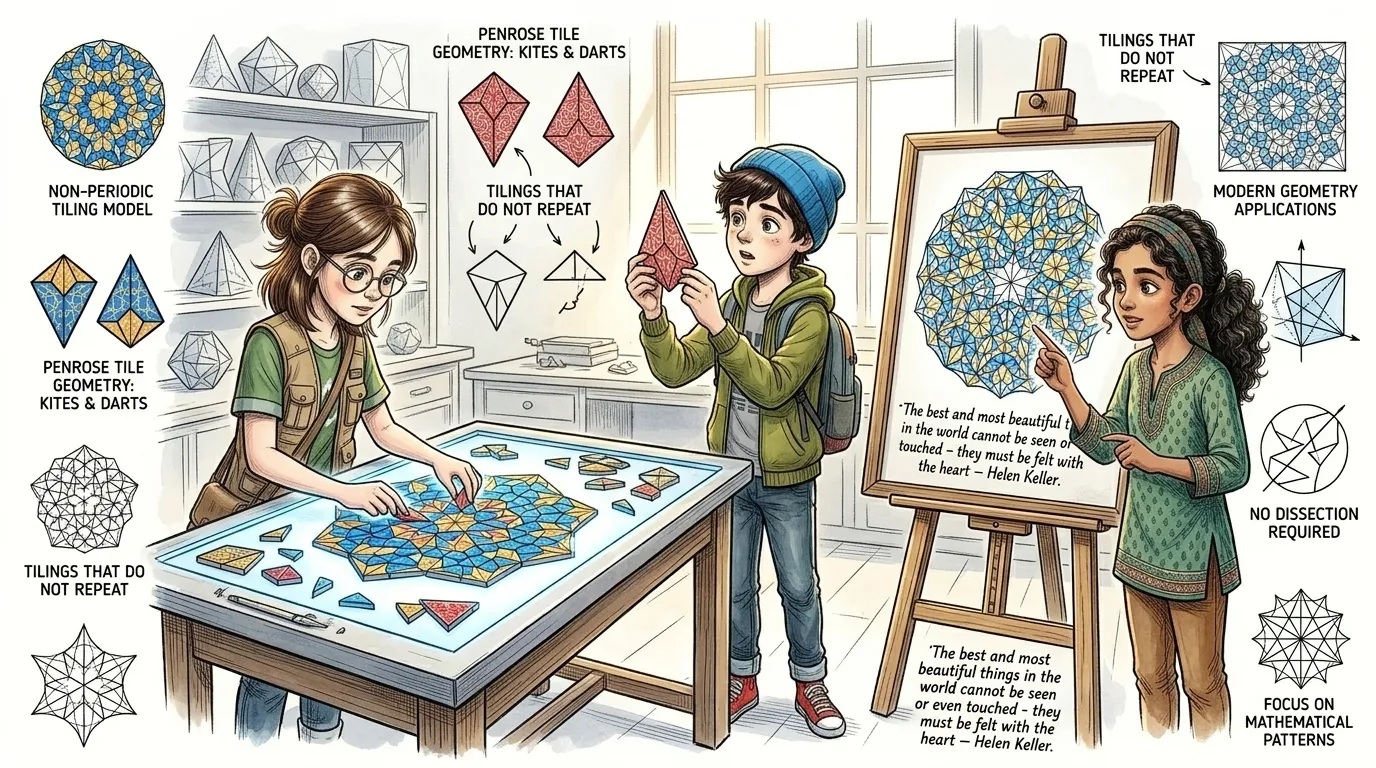
Penrose's work wasn't just about black holes. He also made significant contributions to tiling theory. Penrose tiles are non-periodic tilings, meaning they can…
Penrose's work wasn't just about black holes. He also made significant contributions to tiling theory. Penrose tiles are non-periodic tilings, meaning they can cover an infinite plane without ever repeating the same pattern. "The best and most beautiful things in the world cannot be seen or even touched - they must be felt with the heart," Helen Keller said, and Penrose felt the beauty of these mathematical structures, revealing their hidden order.

Penrose's work wasn't just about black holes. He also made significant contributions to tiling theory. Penrose tiles are non-periodic tilings, meaning they can cover an infinite plane without ever repeating the same pattern. "The best and most beautiful things in the world cannot be seen or even touched - they must be felt with the heart," Helen Keller said, and Penrose felt the beauty of these mathematical structures, revealing their hidden order.

Page 4
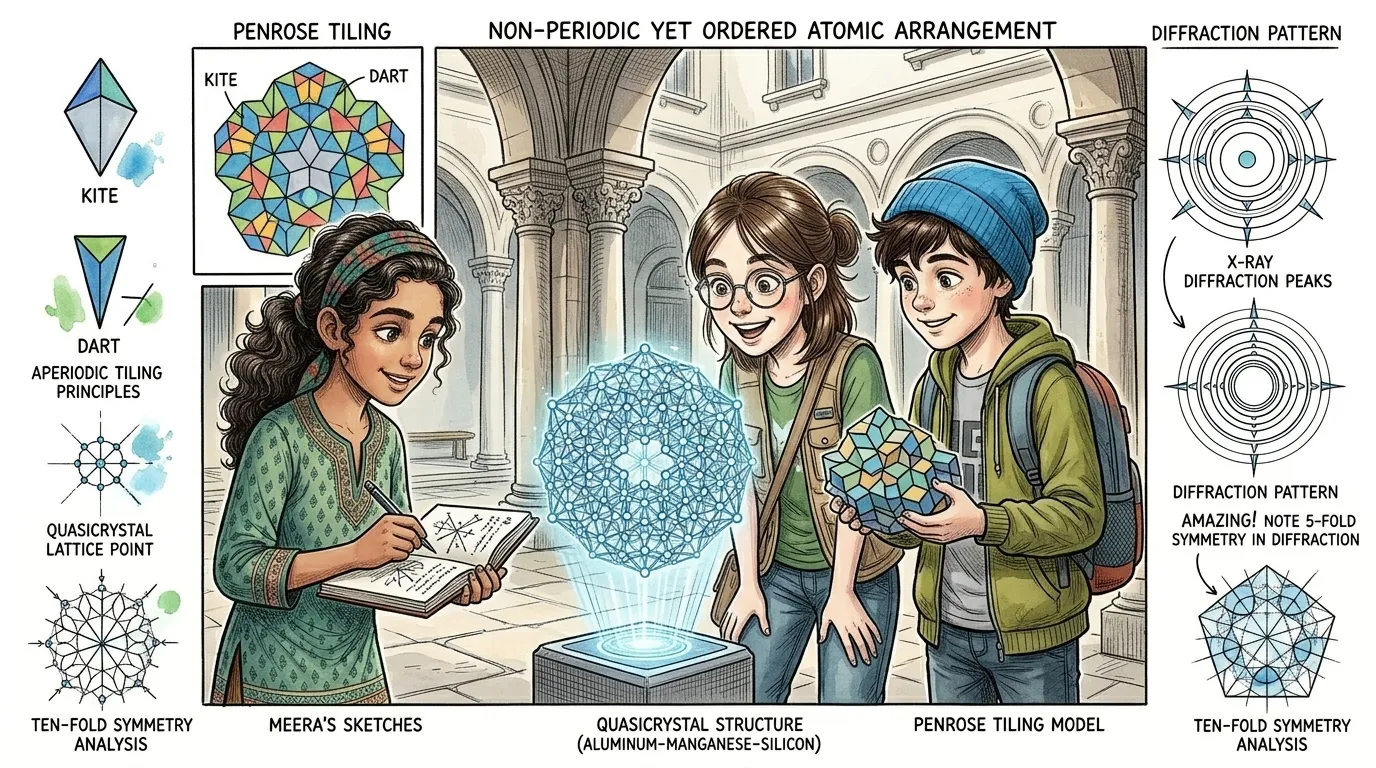
These tiles aren't just pretty patterns. They have real-world applications, even showing up in the structure of quasicrystals, a state of matter discovered in…
These tiles aren't just pretty patterns. They have real-world applications, even showing up in the structure of quasicrystals, a state of matter discovered in the 1980s. Quasicrystals have an ordered structure, but, like Penrose tiles, their patterns are non-repeating. This was a major surprise to scientists, challenging existing theories of crystal structure.

These tiles aren't just pretty patterns. They have real-world applications, even showing up in the structure of quasicrystals, a state of matter discovered in the 1980s. Quasicrystals have an ordered structure, but, like Penrose tiles, their patterns are non-repeating. This was a major surprise to scientists, challenging existing theories of crystal structure.

Page 5
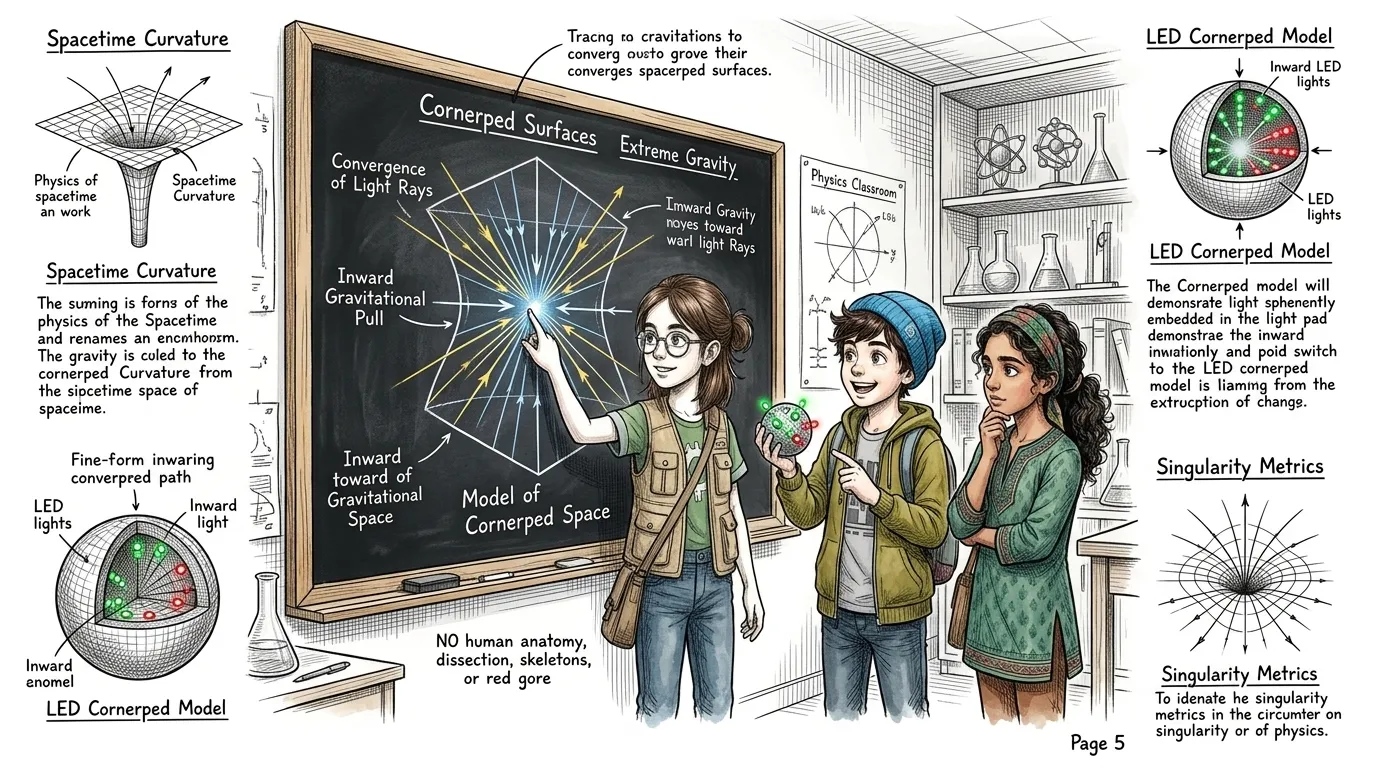
So how did Penrose prove the existence of singularities within black holes? He used a mathematical argument based on something called trapped surfaces.
So how did Penrose prove the existence of singularities within black holes? He used a mathematical argument based on something called trapped surfaces. A trapped surface is a region where light emitted from it is forced to converge inwards, no matter which direction it's emitted. This is a sign of extreme gravity.

So how did Penrose prove the existence of singularities within black holes? He used a mathematical argument based on something called trapped surfaces. A trapped surface is a region where light emitted from it is forced to converge inwards, no matter which direction it's emitted. This is a sign of extreme gravity.

Page 6
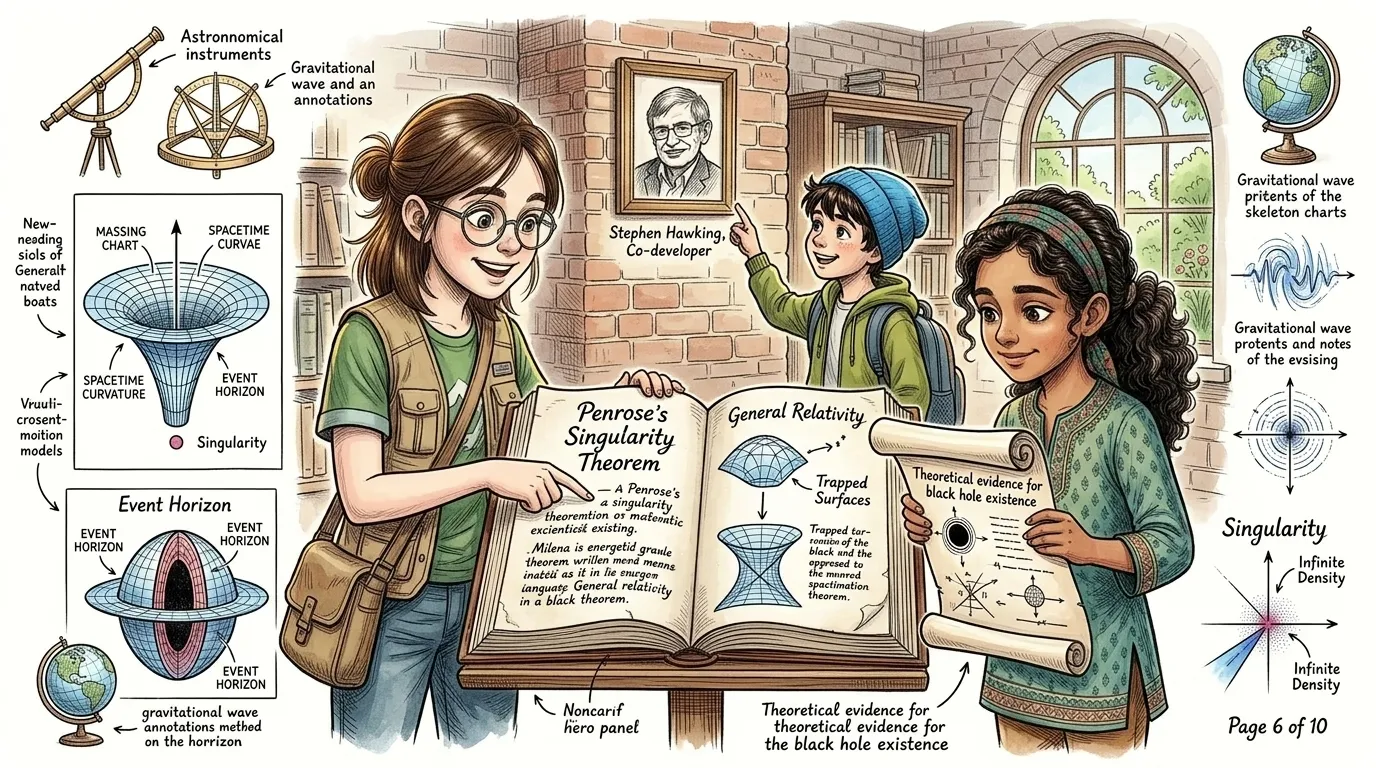
Penrose's singularity theorem, co-developed with Stephen Hawking, states that if general relativity is correct and there's enough matter in a region to form a…
Penrose's singularity theorem, co-developed with Stephen Hawking, states that if general relativity is correct and there's enough matter in a region to form a trapped surface, then a singularity must exist within that region. This theorem provided strong theoretical evidence for the existence of black holes, long before they were directly observed.

Penrose's singularity theorem, co-developed with Stephen Hawking, states that if general relativity is correct and there's enough matter in a region to form a trapped surface, then a singularity must exist within that region. This theorem provided strong theoretical evidence for the existence of black holes, long before they were directly observed.

Page 7
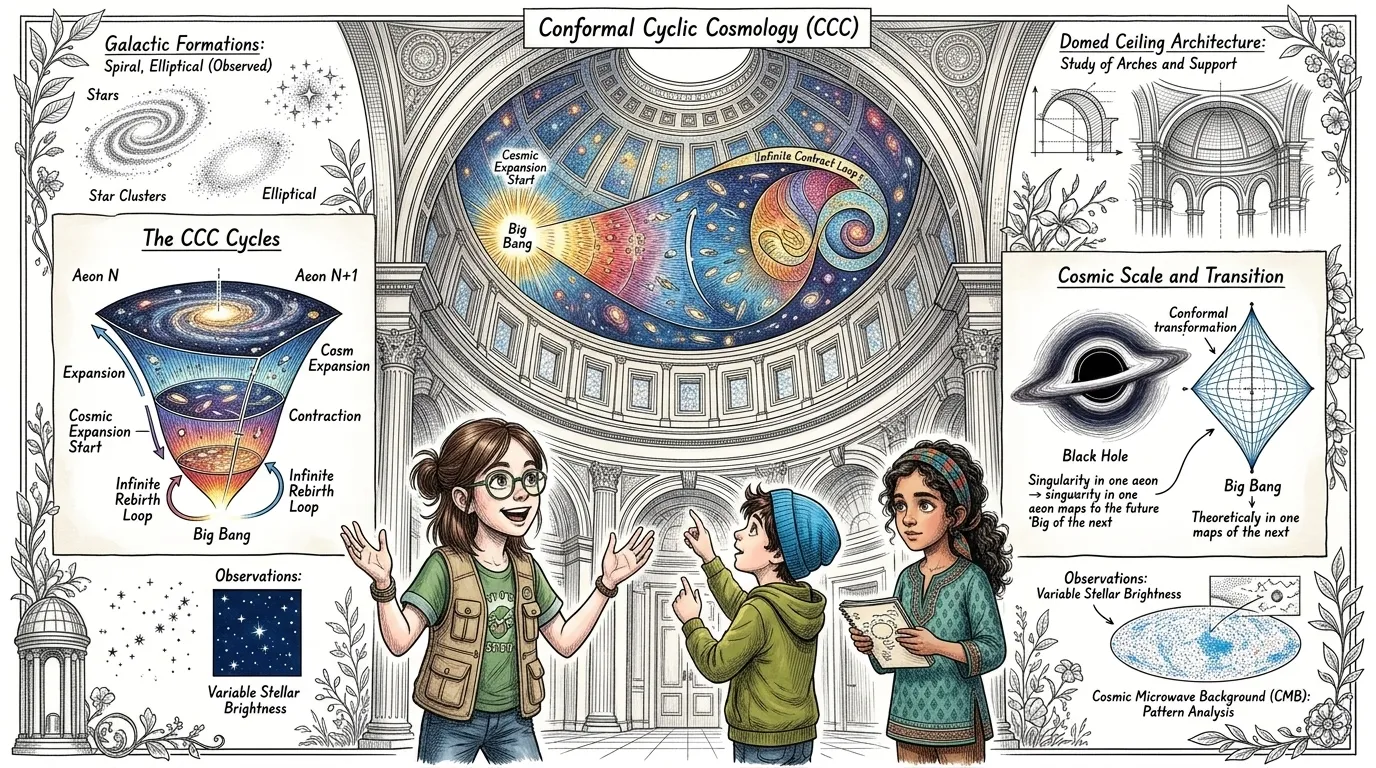
Penrose's influence extends beyond general relativity and tiling theory. He also proposed the idea of conformal cyclic cosmology (CCC), a highly speculative…
Penrose's influence extends beyond general relativity and tiling theory. He also proposed the idea of conformal cyclic cosmology (CCC), a highly speculative model of the universe. CCC suggests that the universe goes through infinite cycles of expansion and contraction, with each cycle ending in a Big Bang that starts the next.

Penrose's influence extends beyond general relativity and tiling theory. He also proposed the idea of conformal cyclic cosmology (CCC), a highly speculative model of the universe. CCC suggests that the universe goes through infinite cycles of expansion and contraction, with each cycle ending in a Big Bang that starts the next.

Page 8
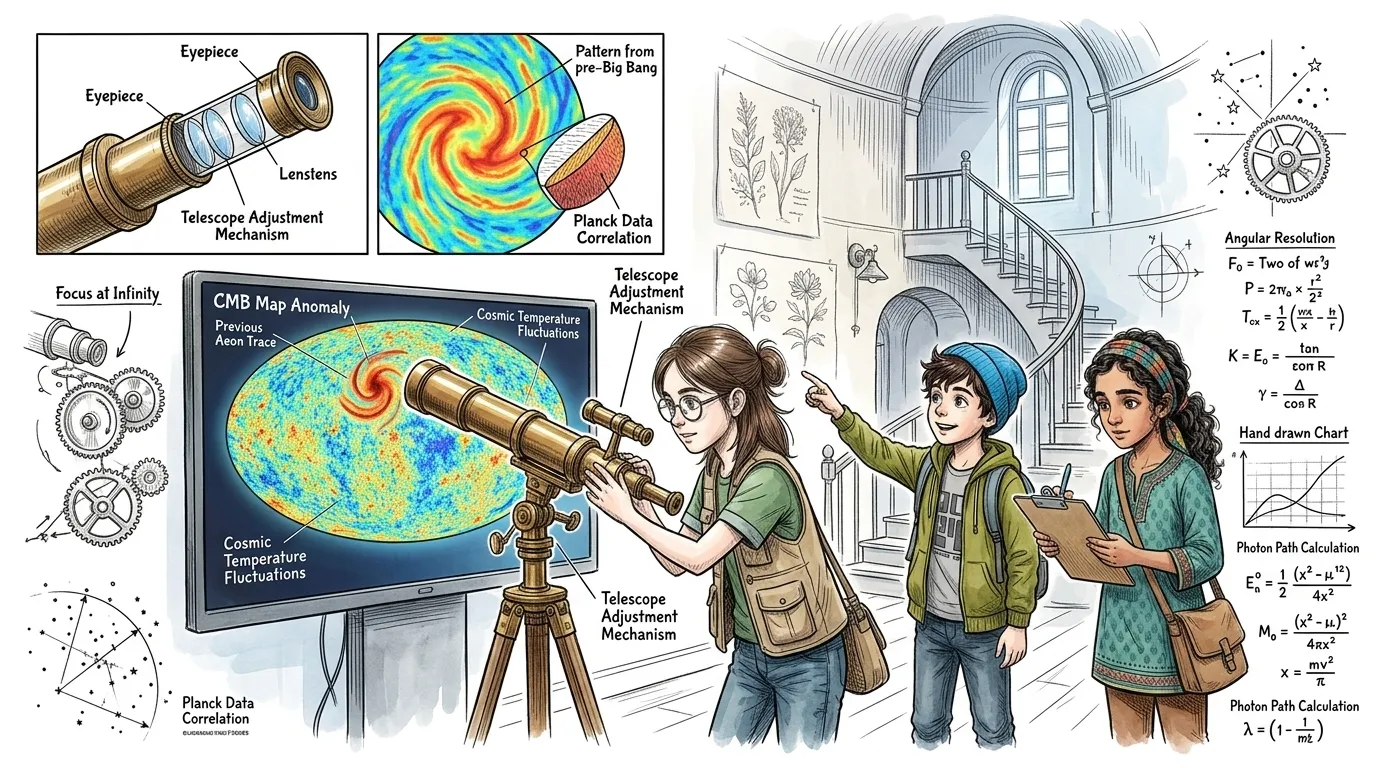
While still debated, CCC offers a potential explanation for some anomalies observed in the cosmic microwave background. It suggests that patterns from the…
While still debated, CCC offers a potential explanation for some anomalies observed in the cosmic microwave background. It suggests that patterns from the previous aeon could leave faint traces in the CMB, detectable with highly sensitive telescopes. The impact from Penrose's work reshaped our understanding of the universe.

While still debated, CCC offers a potential explanation for some anomalies observed in the cosmic microwave background. It suggests that patterns from the previous aeon could leave faint traces in the CMB, detectable with highly sensitive telescopes. The impact from Penrose's work reshaped our understanding of the universe.

Page 9

Roger Penrose's work is a testament to the power of theoretical physics. He showed that mathematics can provide deep insights into the nature of reality, even…
Roger Penrose's work is a testament to the power of theoretical physics. He showed that mathematics can provide deep insights into the nature of reality, even in the most extreme and counterintuitive environments. He received the Nobel Prize in Physics in 2020 for his discovery that black hole formation is a robust prediction of the general theory of relativity. Understanding the true importance of singularities will push us toward a greater understanding.

Roger Penrose's work is a testament to the power of theoretical physics. He showed that mathematics can provide deep insights into the nature of reality, even in the most extreme and counterintuitive environments. He received the Nobel Prize in Physics in 2020 for his discovery that black hole formation is a robust prediction of the general theory of relativity. Understanding the true importance of singularities will push us toward a greater understanding.

Page 10
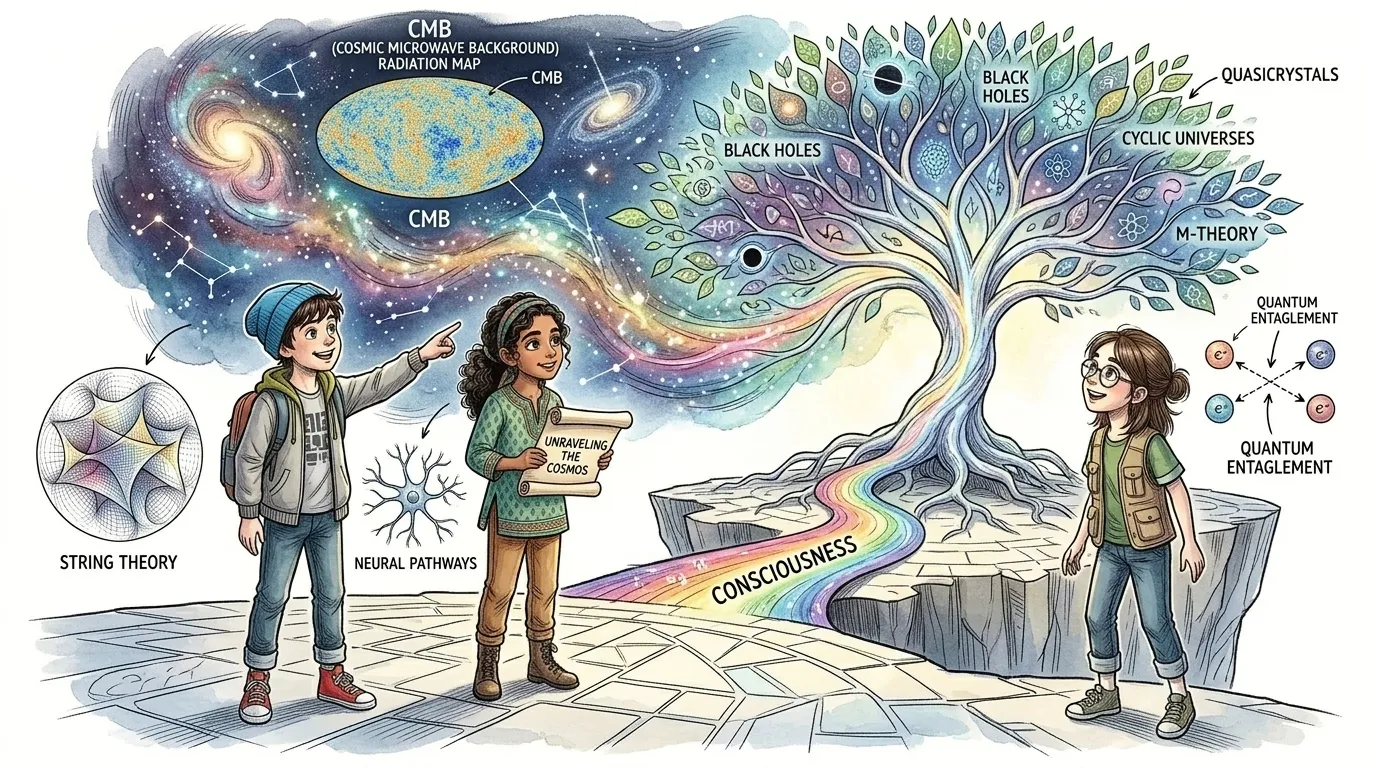
Penrose's legacy continues to inspire physicists and mathematicians around the world. From black holes to quasicrystals to cyclic universes, his ideas have…
Penrose's legacy continues to inspire physicists and mathematicians around the world. From black holes to quasicrystals to cyclic universes, his ideas have opened up new avenues of research and challenged our fundamental understanding of the cosmos. So, what's next for the field? Perhaps, exploring the nature of consciousness through the lens of physics. The universe is full of secrets, waiting to be unraveled.

Penrose's legacy continues to inspire physicists and mathematicians around the world. From black holes to quasicrystals to cyclic universes, his ideas have opened up new avenues of research and challenged our fundamental understanding of the cosmos. So, what's next for the field? Perhaps, exploring the nature of consciousness through the lens of physics. The universe is full of secrets, waiting to be unraveled.

About this story

  • Location: Global
  • Audience: kids (ages 6–12)

Read Wonder Science on your phone

Wonder Science is available on Android. Get Wonder Science on Google Play.

More Wonder Science stories

All Wonder Science stories · Open the library