Sapphire Light Bends Space and Time

Sapphire Light Bends Space and Time — an illustrated science story. 10 illustrated pages, free to read on Wonder Science.
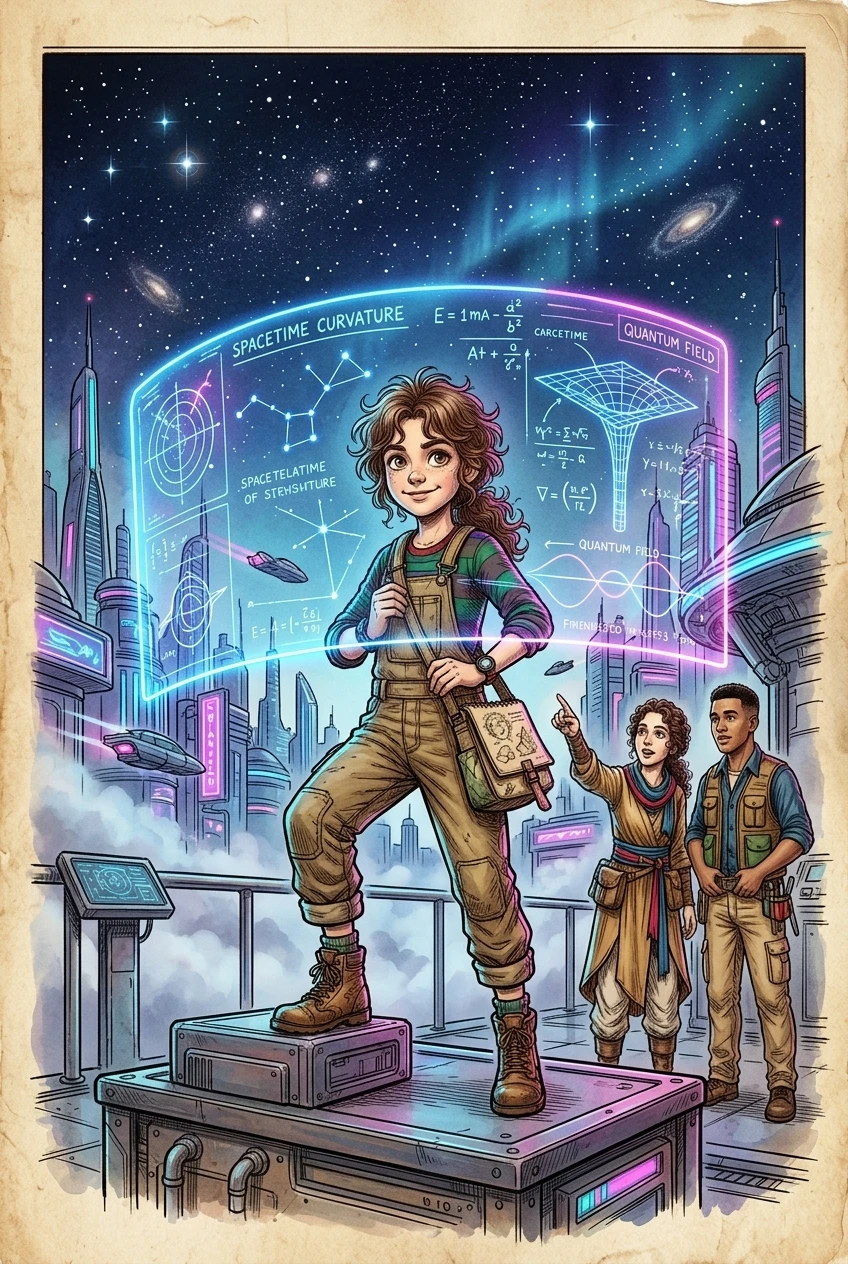
Sapphire Light Bends Space and Time — book cover — Wonder Science
Sapphire Light Bends Space and Time — an illustrated science story. 10 illustrated pages, free to read on Wonder Science.

Page 1
Inside the Morrison Planetarium, a brilliant sapphire-blue line of simulated starlight shot across the dark dome. "Look, it's traveling in a perfectly straight…
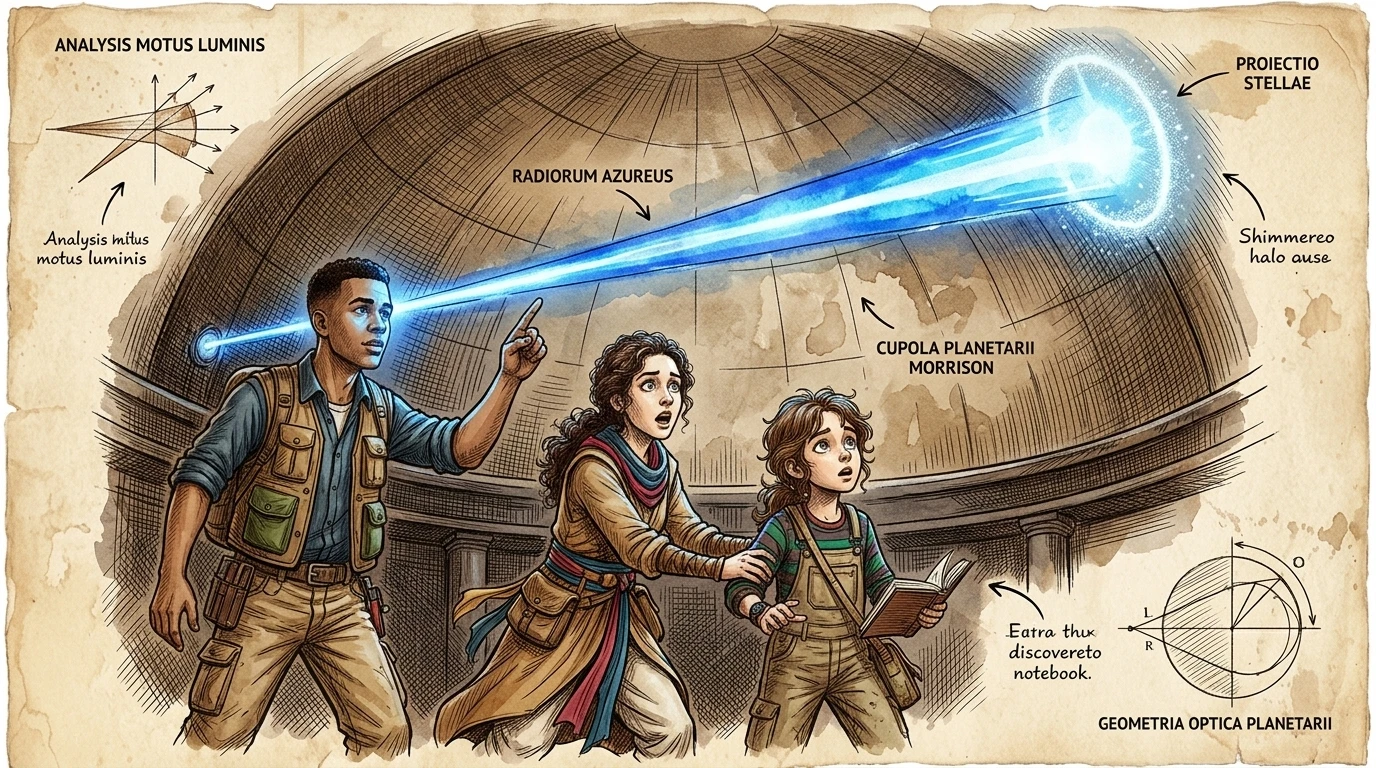
Inside the Morrison Planetarium, a brilliant sapphire-blue line of simulated starlight shot across the dark dome. "Look, it's traveling in a perfectly straight line!" Dev pointed upwards, his face lit by the cosmic display. But as the light passed a projected star, it curved slightly, creating a shimmering halo. "Whoa, did you see that?" Adriana gasped, grabbing Petra's arm, "Light just bent!"

Inside the Morrison Planetarium, a brilliant sapphire-blue line of simulated starlight shot across the dark dome. "Look, it's traveling in a perfectly straight line!" Dev pointed upwards, his face lit by the cosmic display. But as the light passed a projected star, it curved slightly, creating a shimmering halo. "Whoa, did you see that?" Adriana gasped, grabbing Petra's arm, "Light just bent!"

Page 2
"Light is supposed to be the fastest thing in the universe; nothing should be able to change its path," Dev said, looking puzzled.
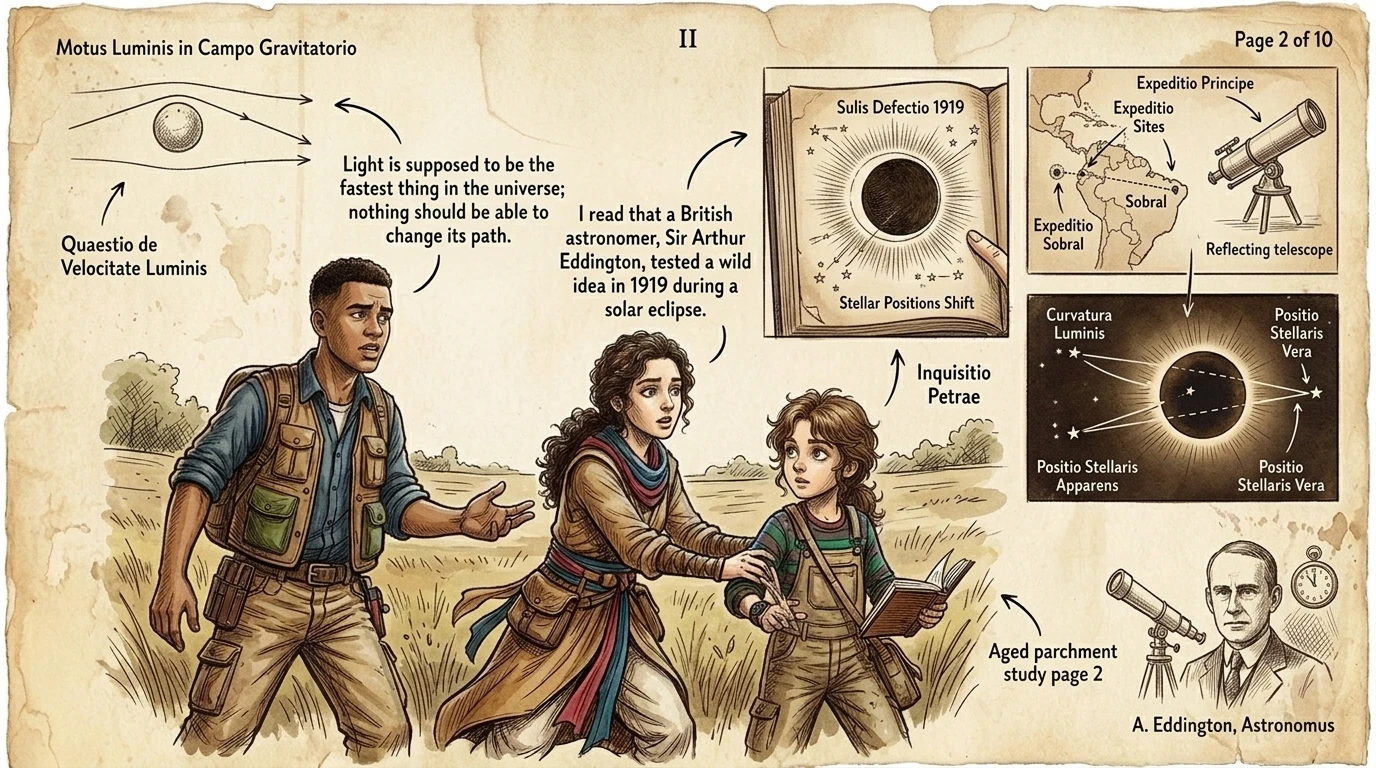
"Light is supposed to be the fastest thing in the universe; nothing should be able to change its path," Dev said, looking puzzled. Petra opened her discovery notebook. "I read that a British astronomer, Sir Arthur Eddington, tested a wild idea in 1919 during a solar eclipse," she explained, her pencil tapping the page. "He thought something really, really big could bend light—not like water does, but something much more powerful."

"Light is supposed to be the fastest thing in the universe; nothing should be able to change its path," Dev said, looking puzzled. Petra opened her discovery notebook. "I read that a British astronomer, Sir Arthur Eddington, tested a wild idea in 1919 during a solar eclipse," she explained, her pencil tapping the page. "He thought something really, really big could bend light—not like water does, but something much more powerful."

Page 3
To understand that idea, we have to travel back in time to the early 1900s, in a small apartment in Bern, Switzerland. A young patent clerk had a revolutionary…
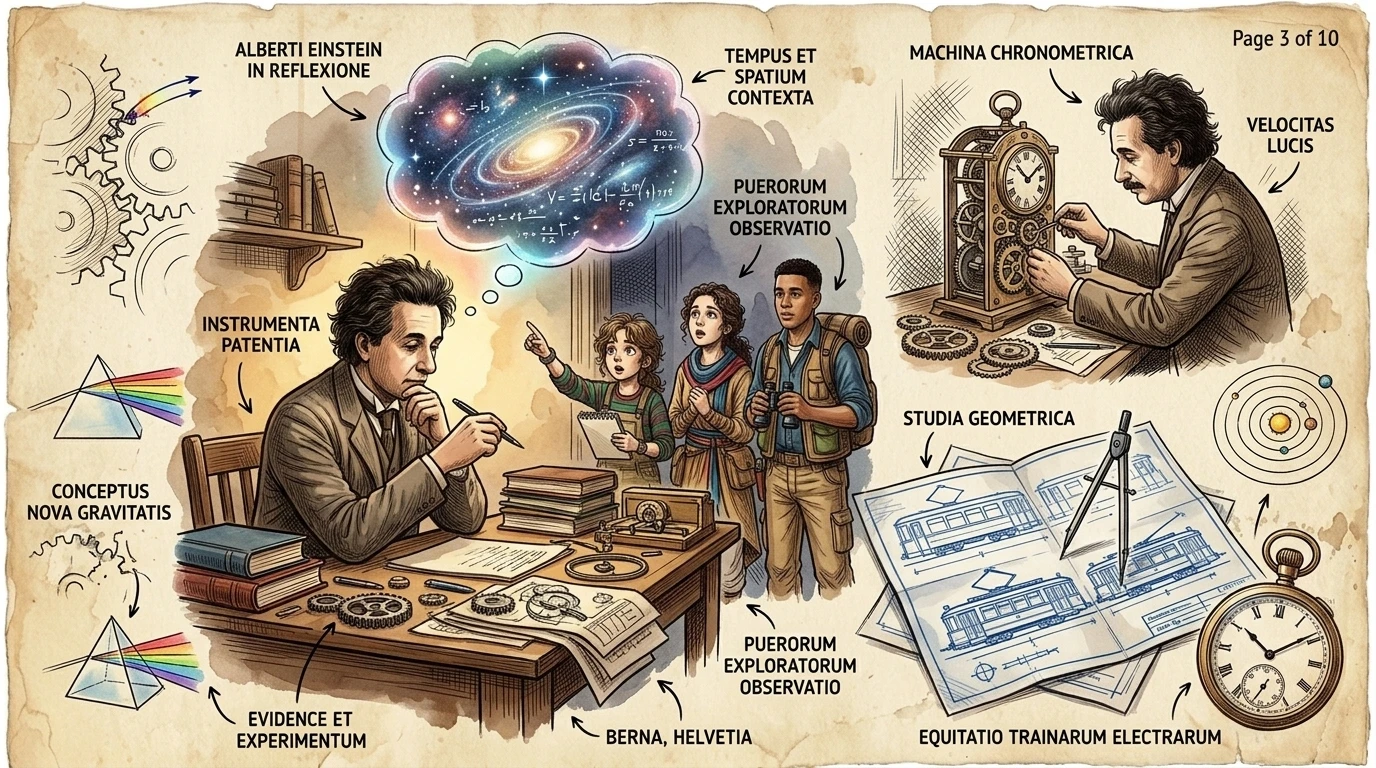
To understand that idea, we have to travel back in time to the early 1900s, in a small apartment in Bern, Switzerland. A young patent clerk had a revolutionary thought that wasn't about clocks or machines. It was about the very fabric of the universe itself.

To understand that idea, we have to travel back in time to the early 1900s, in a small apartment in Bern, Switzerland. A young patent clerk had a revolutionary thought that wasn't about clocks or machines. It was about the very fabric of the universe itself.

Page 4
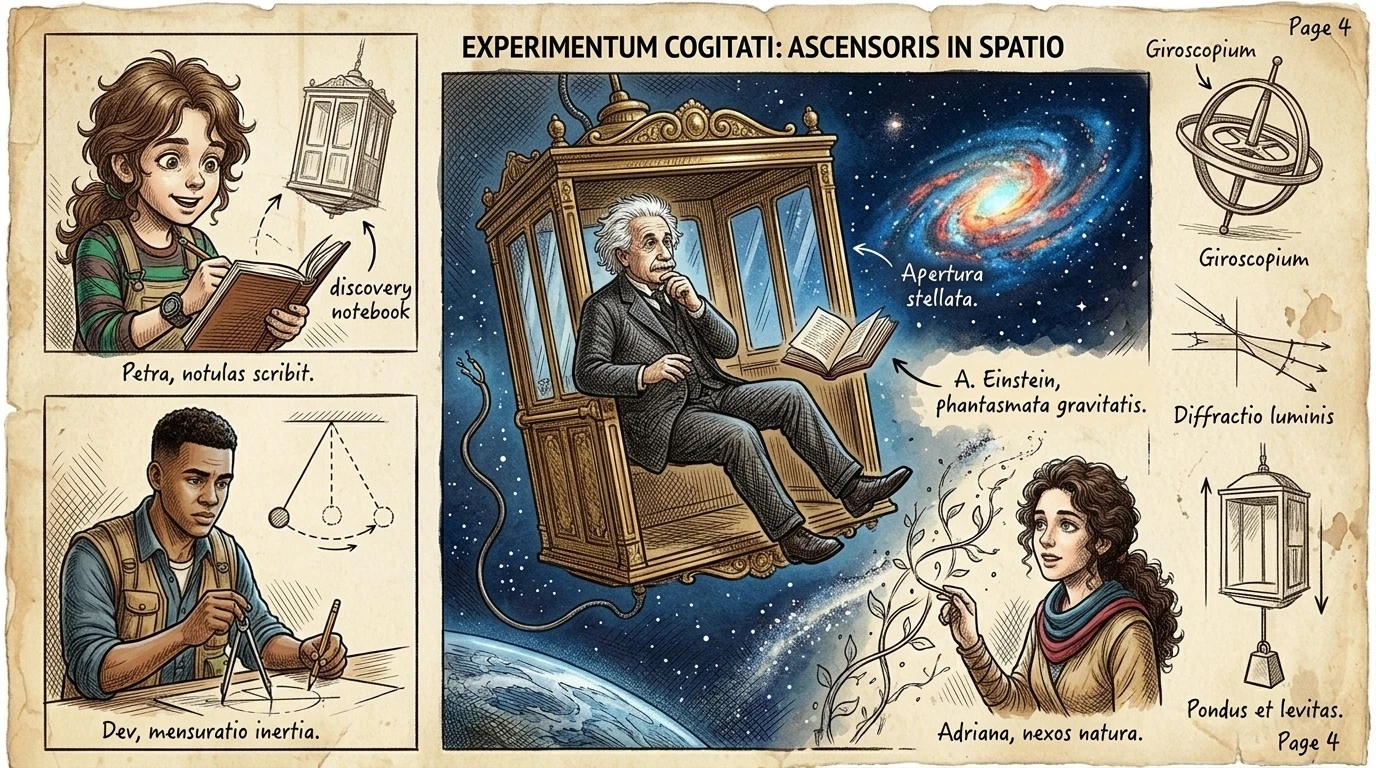
His name was Albert Einstein, and his playground was his own mind. He conducted "thought experiments," imagining situations that couldn't be tested in a lab.
His name was Albert Einstein, and his playground was his own mind. He conducted "thought experiments," imagining situations that couldn't be tested in a lab. "What would happen," he wondered, "if I were falling in an elevator in deep space?" He realized he would be weightless, floating just like an astronaut.

His name was Albert Einstein, and his playground was his own mind. He conducted "thought experiments," imagining situations that couldn't be tested in a lab. "What would happen," he wondered, "if I were falling in an elevator in deep space?" He realized he would be weightless, floating just like an astronaut.

Page 5
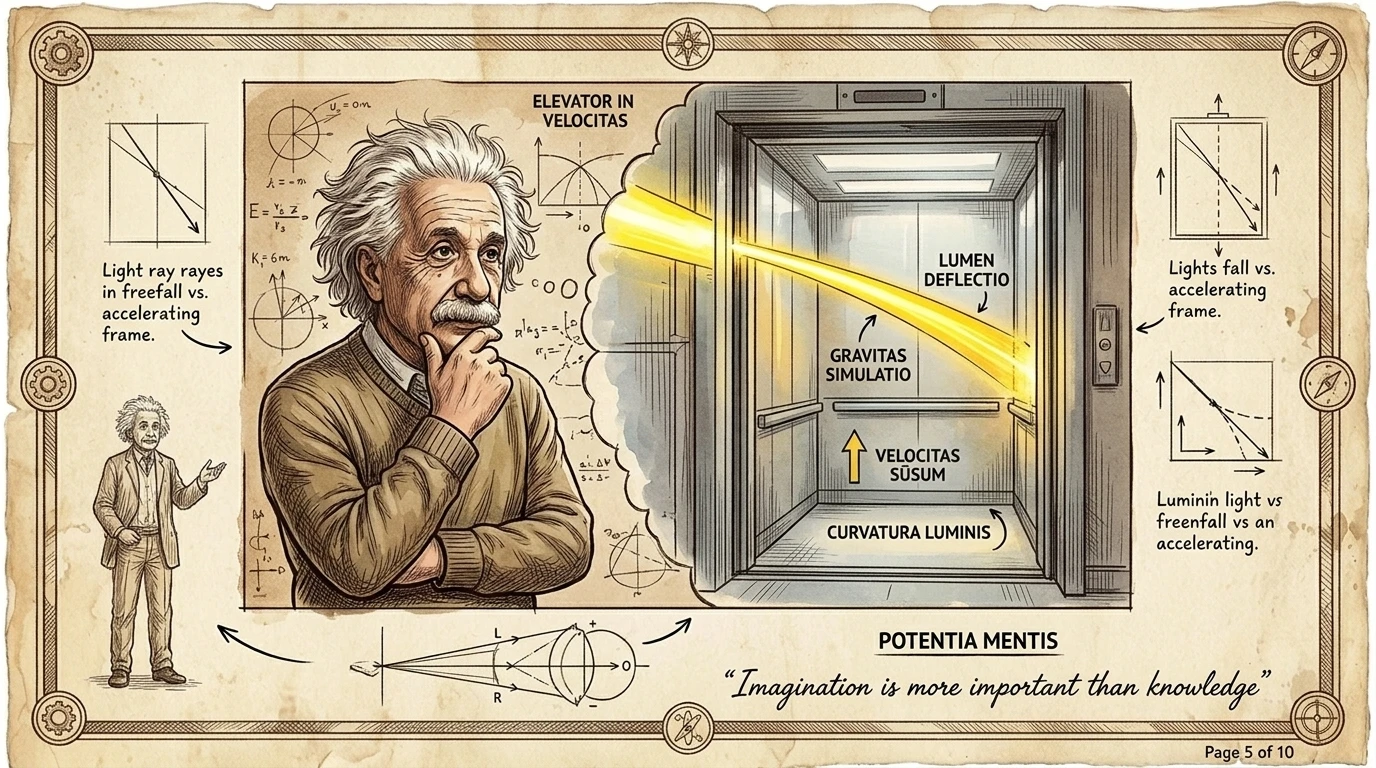
Then he imagined a beam of light shining through the elevator as it accelerated upwards. To him inside, the light would appear to bend downwards, as if pulled…
Then he imagined a beam of light shining through the elevator as it accelerated upwards. To him inside, the light would appear to bend downwards, as if pulled by gravity! This led to his big idea. As Einstein himself later said, 'Imagination is more important than knowledge,' because it was his imagination that unlocked a new view of the universe.

Then he imagined a beam of light shining through the elevator as it accelerated upwards. To him inside, the light would appear to bend downwards, as if pulled by gravity! This led to his big idea. As Einstein himself later said, 'Imagination is more important than knowledge,' because it was his imagination that unlocked a new view of the universe.

Page 6
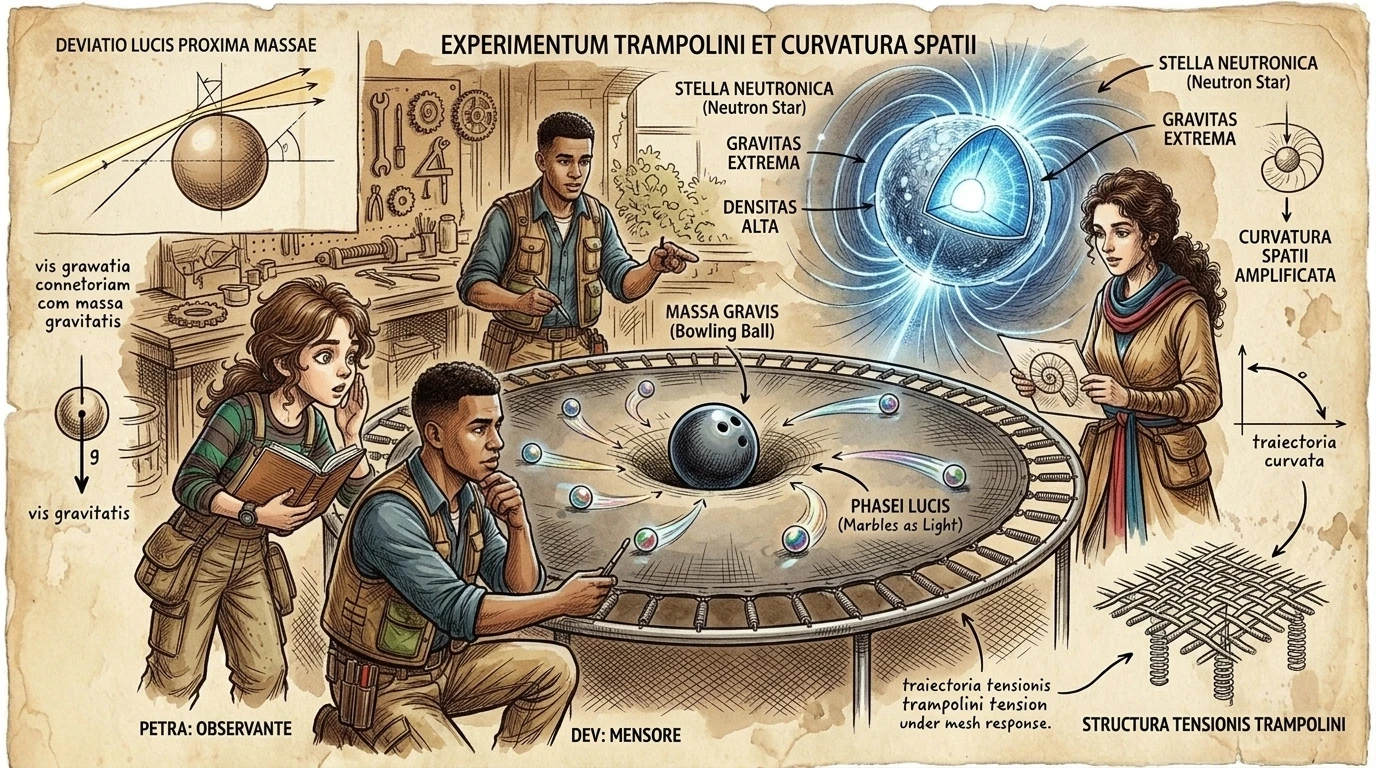
Einstein realized that gravity wasn't a force pulling things; it was a curve in space and time itself! Imagine a bowling ball on a trampoline—it creates a dip…
Einstein realized that gravity wasn't a force pulling things; it was a curve in space and time itself! Imagine a bowling ball on a trampoline—it creates a dip, and marbles rolling nearby will curve towards it. "That's what planets and stars do to spacetime," Petra whispered, watching the vision. "Objects with extreme gravity, like a neutron star, warp it so much that a teaspoon of one would weigh six billion tons!"

Einstein realized that gravity wasn't a force pulling things; it was a curve in space and time itself! Imagine a bowling ball on a trampoline—it creates a dip, and marbles rolling nearby will curve towards it. "That's what planets and stars do to spacetime," Petra whispered, watching the vision. "Objects with extreme gravity, like a neutron star, warp it so much that a teaspoon of one would weigh six billion tons!"

Page 7
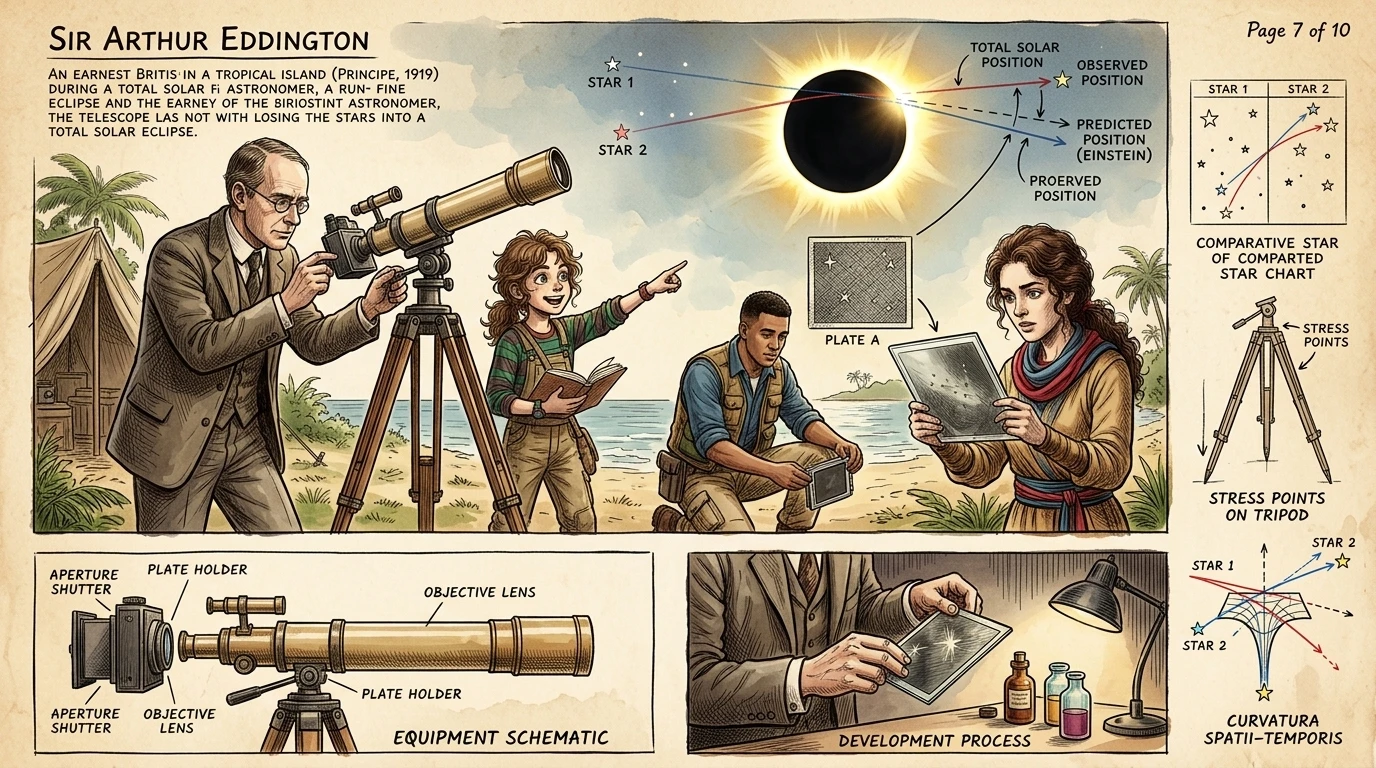
This was the very idea Sir Arthur Eddington set out to test in 1919. During a total solar eclipse, he photographed the stars near the sun.
This was the very idea Sir Arthur Eddington set out to test in 1919. During a total solar eclipse, he photographed the stars near the sun. His photographs proved it: the stars' light bent exactly as Einstein predicted! It was the first physical proof that the shape of the universe could be warped.

This was the very idea Sir Arthur Eddington set out to test in 1919. During a total solar eclipse, he photographed the stars near the sun. His photographs proved it: the stars' light bent exactly as Einstein predicted! It was the first physical proof that the shape of the universe could be warped.

Page 8
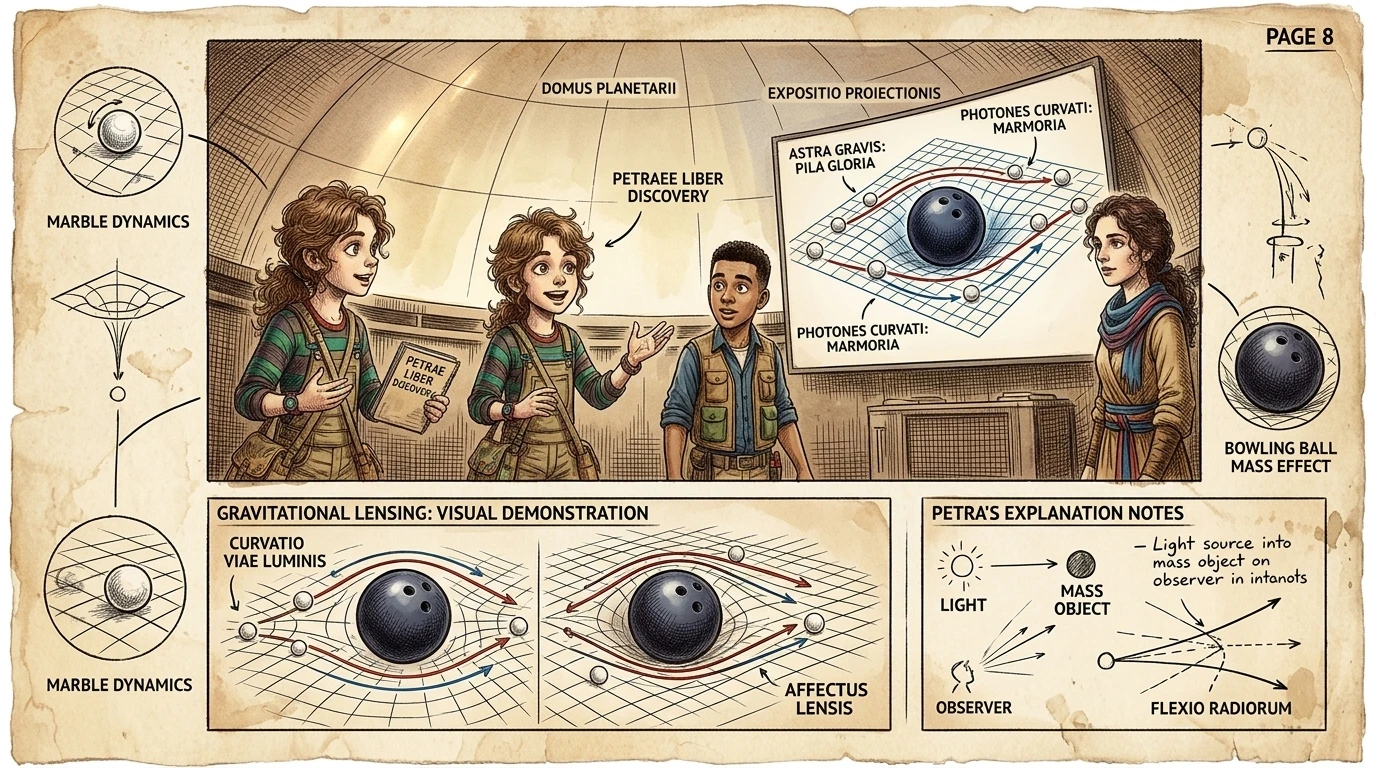
Back in the planetarium, the lights came up. "So the starlight we saw didn't just bend randomly," Petra said, turning to her friends.
Back in the planetarium, the lights came up. "So the starlight we saw didn't just bend randomly," Petra said, turning to her friends. "It was gravitational lensing! The light was following a curve in spacetime created by that star's gravity." Dev's eyes widened. "Oh! So a star is like a bowling ball, and the light is like a marble rolling past it!"

Back in the planetarium, the lights came up. "So the starlight we saw didn't just bend randomly," Petra said, turning to her friends. "It was gravitational lensing! The light was following a curve in spacetime created by that star's gravity." Dev's eyes widened. "Oh! So a star is like a bowling ball, and the light is like a marble rolling past it!"

Page 9
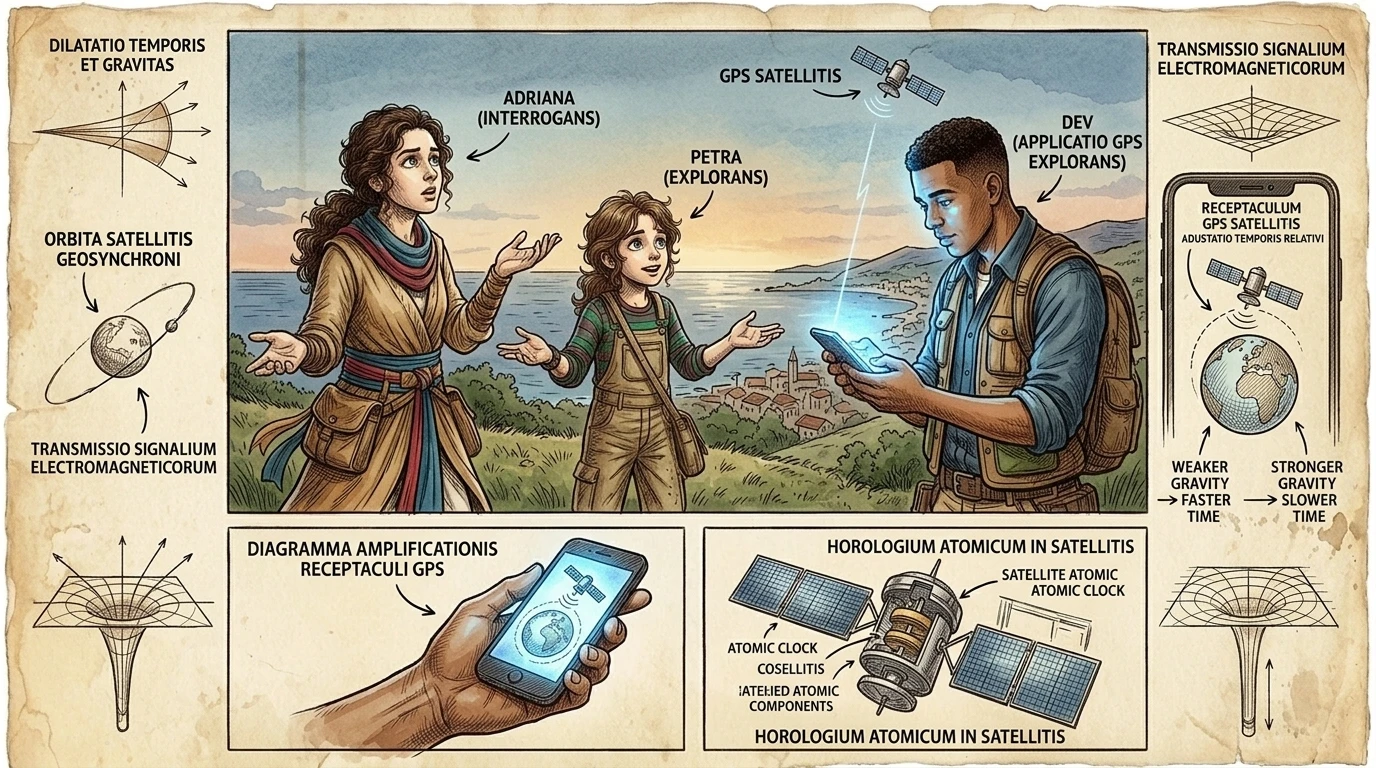
"Does this affect anything here on Earth?" Adriana asked. "Totally!" Petra exclaimed. "GPS satellites in space have to adjust for this!
"Does this affect anything here on Earth?" Adriana asked. "Totally!" Petra exclaimed. "GPS satellites in space have to adjust for this! Their clocks actually run slightly faster up there where gravity is weaker." Dev pulled out his phone. "So the map that got us here only works because it accounts for spacetime bending? That's amazing!"

"Does this affect anything here on Earth?" Adriana asked. "Totally!" Petra exclaimed. "GPS satellites in space have to adjust for this! Their clocks actually run slightly faster up there where gravity is weaker." Dev pulled out his phone. "So the map that got us here only works because it accounts for spacetime bending? That's amazing!"

Page 10
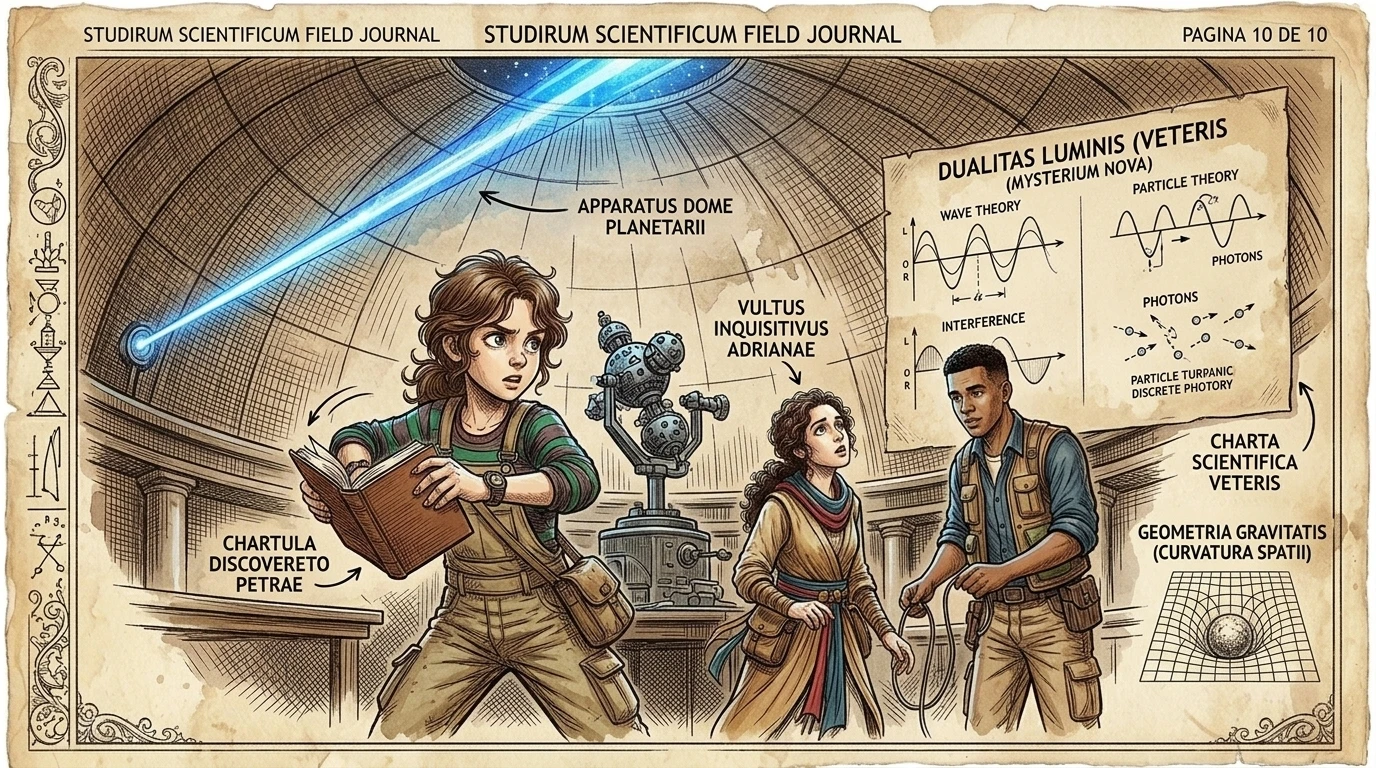
"So massive objects don't pull on light," Petra summarized, closing her notebook with a snap. "They bend the path it travels on." Adriana looked up at the dome…
"So massive objects don't pull on light," Petra summarized, closing her notebook with a snap. "They bend the path it travels on." Adriana looked up at the dome, a new question already forming. "Okay, so gravity bends light... but what is light, really? Is it a wave, or is it a particle?"

"So massive objects don't pull on light," Petra summarized, closing her notebook with a snap. "They bend the path it travels on." Adriana looked up at the dome, a new question already forming. "Okay, so gravity bends light... but what is light, really? Is it a wave, or is it a particle?"

About this story

  • Audience: kids (ages 6–12)

Read Wonder Science on your phone

Wonder Science is available on Android. Get Wonder Science on Google Play.

More Wonder Science stories

All Wonder Science stories · Open the library