Why Leaves Change Color
Why Leaves Change Color — an illustrated science story, set in England. 10 illustrated pages, free to read on Wonder Science.
Page 1

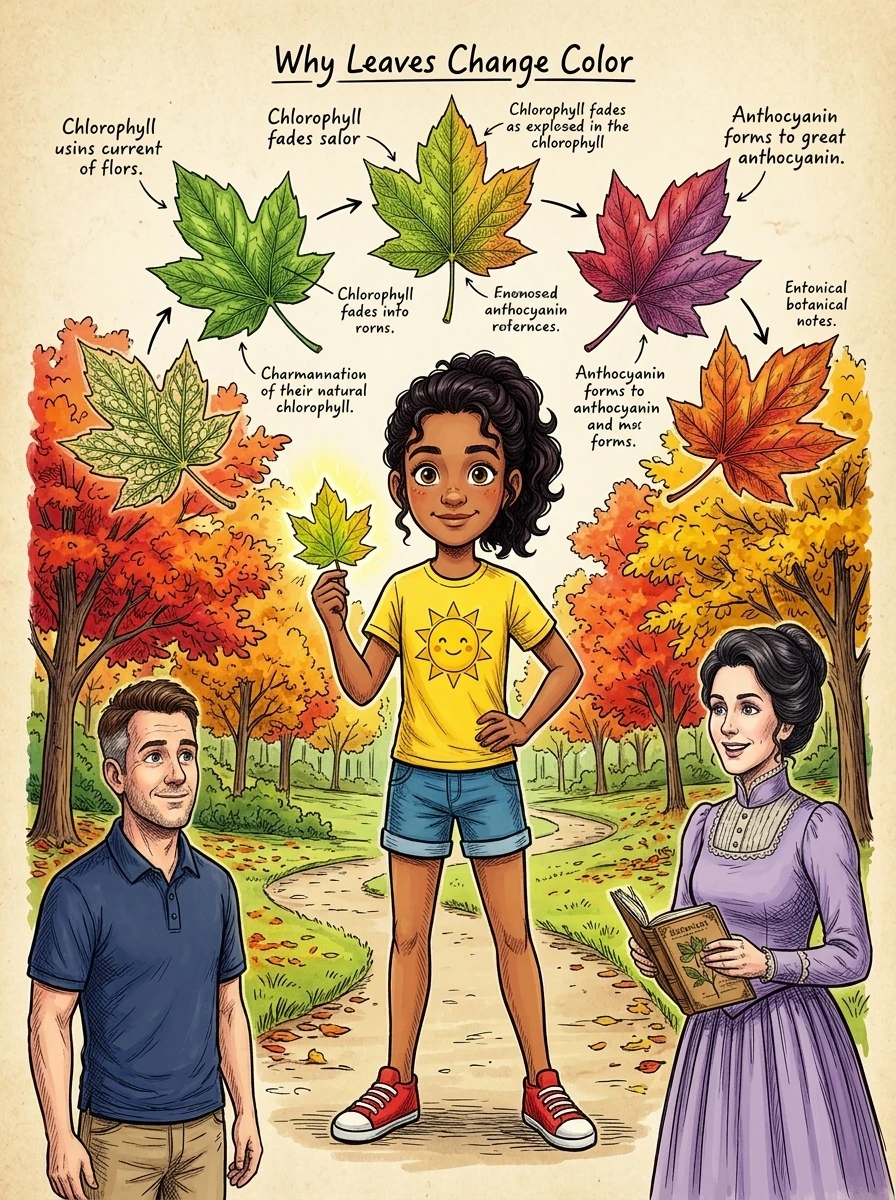
Maya and her dad were walking through Golden Gate Park when she noticed something strange. The leaves on one tree were bright red, while the tree right next to it was still green. "Dad, why are some leaves changing color while others aren't?" she asked, pointing at the two trees. "That's a great question, Maya! It's a bit of a puzzle, isn't it?"
Page 2

Later that day, Maya was video-chatting with her friend Sophie. "I was wondering about the leaves changing color. It's so pretty, but why does it even happen?" Maya asked. Sophie, looking puzzled, responded, "Yeah, and why don't all the leaves change at the same time? It's like some trees are running late to the party!" Maya's mom entered and said, "It has to do with something called chlorophyll—that's what makes the leaves green. But that's all I know!".
Page 3

Suddenly, the room shimmered and transformed. Maya found herself standing in a misty garden, filled with strange, mirrored structures. A voice echoed, "England, mid-1800s. A time of great scientific curiosity, but many mysteries remained unsolved." The air smelled damp and earthy, and strange, colorful flowers grew in abundance. What secrets does this strange garden hold?
Page 4

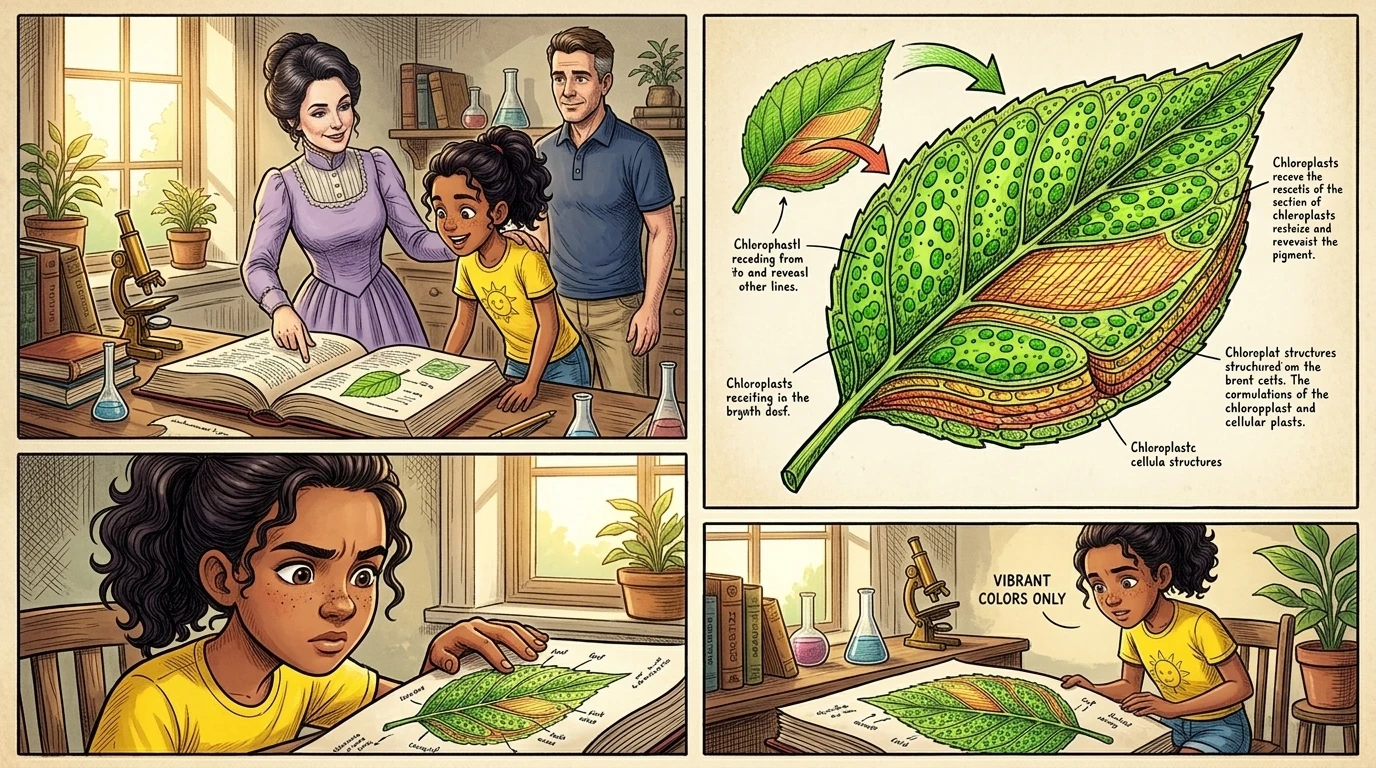
A woman with kind eyes and a determined expression approached Maya. "Welcome," she said, "I am Jane Haldimand Marcet. I was curious about why things are as they are! Like, why do plants make different colors!" She added, "My book, 'Conversations on Chemistry,' explains complex ideas in a simple way, as it helps others understand the world around them."
Page 5

Jane smiled, then began to explain, "As Leonardo da Vinci said, 'Study the science of art. Study the art of science. Develop your senses. Especially learn how to see.' I'm seeing the science of color!" Jane pointed to a prism splitting sunlight into a rainbow. "Like this prism breaking light into colors. Leaves are kind of like that – they have hidden colors all the time!"
Page 6
Page 7

\"This discovery of plant pigments helped us understand how plants work, and allowed us to use plant extracts in medicines, dyes, and even in art!\" Jane explained. \"Imagine how much less colorful the world would be without it!\" She showed Maya images of colorful dyes and paints made from plant extracts. \"Knowing this helped make those products even better. How amazing is that!\"
Page 8

Suddenly, the shimmering returned and Maya found herself back in Golden Gate Park, with her dad. "Dad! I know why the leaves change color! It's because the chlorophyll breaks down in the fall, and then you can see the other colors that were always there!" Maya exclaimed. "Wow, Maya!" her dad replied, impressed. "That's amazing, like the answer was hidden there all along."
Page 9

"It's like in art class, when you mix colors, sometimes you don't see all the colors you used until you add water!" Maya continued, excited. "Or when Rohan does that chemical reaction in his lab and the colors appear! Or when Camila shows her art which is all based on plant pigment!" Rohan said, "Yeah! It is science everywhere!"
Page 10
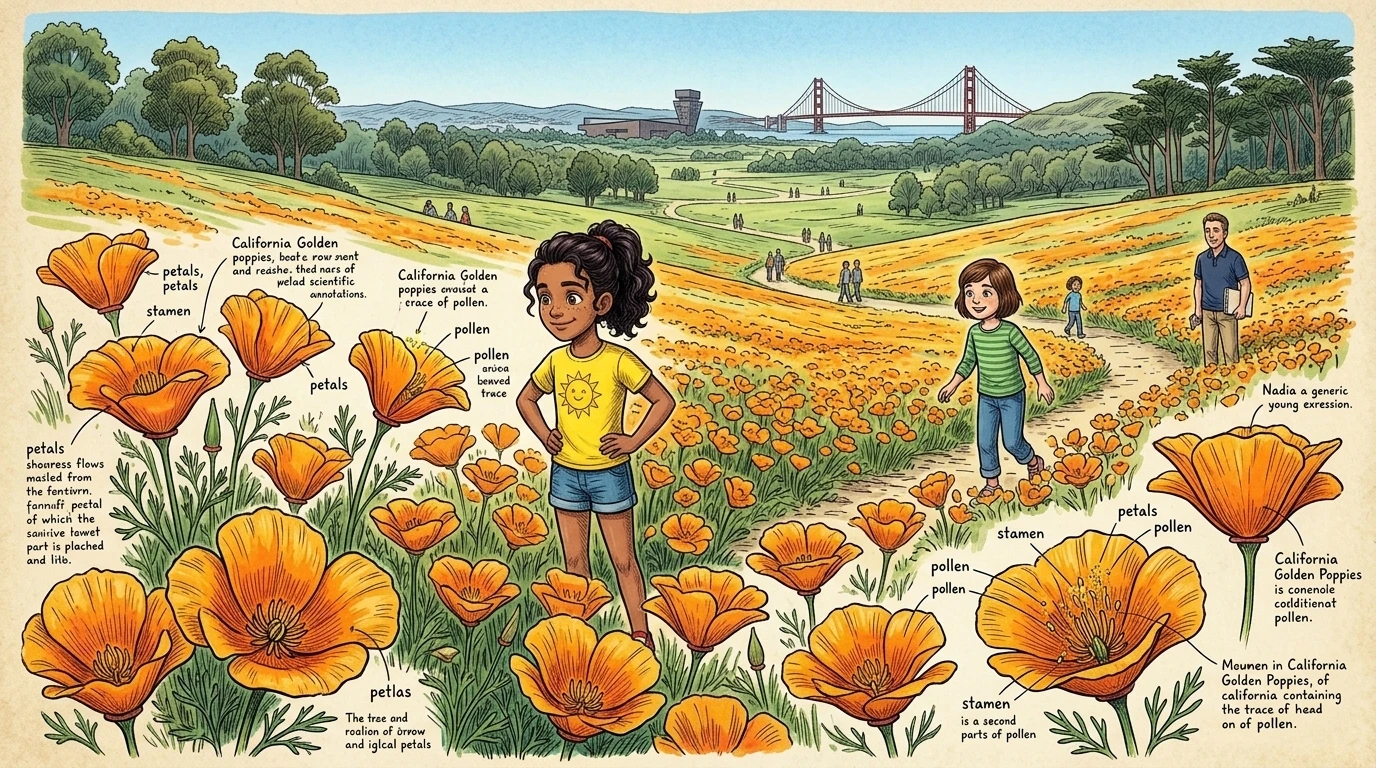
Maya summarized, "So, leaves change color because the green chlorophyll fades away, revealing the colors that were always there!" Nadia, walking up, asked, "If chlorophyll makes plants green, what makes flowers bloom with so many different colors, such as the Golden Poppies right here in California?" The friends looked at each other, curious to find out the answer.
About this story
- Location: England
- Audience: kids (ages 6–12)
Questions and answers
Read Wonder Science on your phone
Wonder Science is available on Android. Get Wonder Science on Google Play.