Illustrated fairy tales online: a guide from Grimm to Aesop
Where children can read and listen to illustrated fairy tales online, from the Brothers Grimm to Aesop, plus tips for choosing by age.
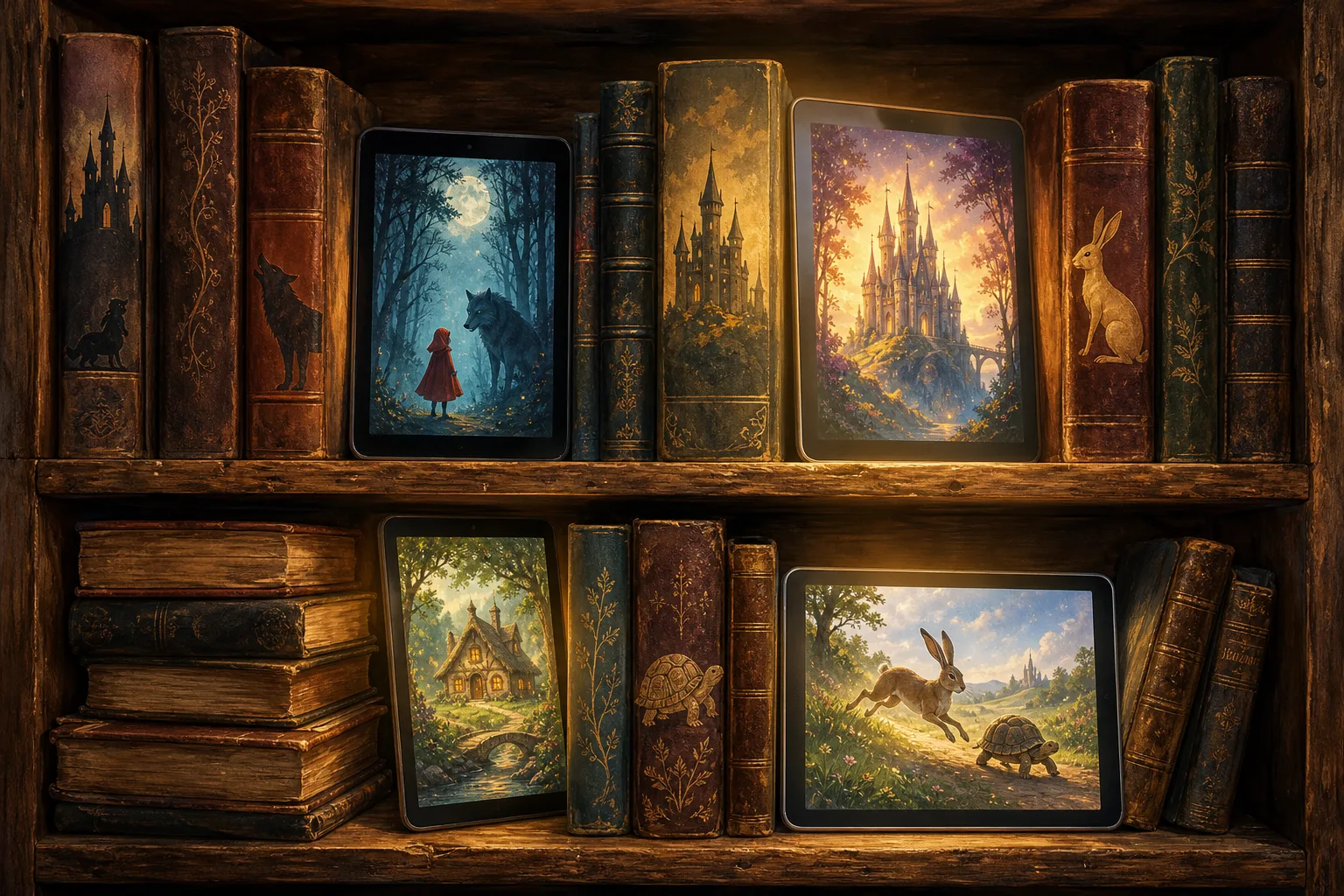
Fairy tales are the oldest shelf in children's reading. The best-known names on it are the Brothers Grimm, whose collection appeared in Germany from 1812. A newcomer who only knows the film versions misses most of the map: the French court tales, the animal fables, and the stories of Asia, Africa and the Middle East.
Online, the format works especially well. Pictures let a child follow the plot before they can read it. Narration carries the rhythm of the words. And a tale is short, so a session can last five minutes for a toddler or twenty for an older child. For more subject guides like this one, see the editorial articles.
- Aesop's fables (Greece, traditionally 6th century BCE): the shortest stories, one lesson each
- Charles Perrault, Histoires ou contes du temps passé (France, 1697): the polished court tales
- The Brothers Grimm, Kinder- und Hausmärchen (Germany, 1812 onward): the great folk collection
- Hans Christian Andersen (Denmark, from 1835): invented tales with a personal voice
- The Arabian Nights in Antoine Galland's version (France, 1704 onward): tales within tales
- Anansi stories from the Akan people of Ghana, and Japan's Momotaro: other traditions, other heroes
Perrault and Grimm: the European folk tale
Charles Perrault published eight tales in 1697, among them Cinderella, Sleeping Beauty, Puss in Boots and Little Red Riding Hood. They were written for readers at Louis XIV's court, with a neat moral at the end. Jacob and Wilhelm Grimm, working in Hesse, did something different. They gathered tales from many tellers and printed them plainly, then revised them for decades. Illustration suits both. Gustave Doré drew Perrault in 1862, and Arthur Rackham later drew Grimm. Dark forests and castles are half the pleasure, and a narrator's slow voice suits the repeated phrases.
Aesop and the Panchatantra: animal fables
Fables are not fairy tales in the strict sense. There is no magic wand, just a fox, a crow or a tortoise who behaves like a person. Aesop is the famous name, but scholars doubt he was a single real author, and the collection grew over centuries. The Indian Panchatantra, in Sanskrit, is dated roughly between 300 BCE and 300 CE, and that dating is disputed. It frames its animal stories inside one another. Fables are the best starting point for young children. A clear picture of each animal and one short narrated page are enough.
How Grimm grew: the numbers
In the infographic above you will see three bars comparing how many tales each landmark edition held: Perrault's 1697 book with 8, the first Grimm volume of 1812 with 86, and the Grimms' final 1857 edition with 200 numbered tales. Highlighted cards pick out the dates 1697, 1812 and 1857, and a note that Andersen's first tales for children followed in 1835. The figures show how a small set of court tales became a vast shelf. They also remind us that the Grimms kept editing, softening and adding for forty-five years.
Tales from other cultures, and where the standard story bends
Antoine Galland's French translation of the Arabian Nights began appearing in 1704 and introduced Europe to Aladdin and Ali Baba. Some of those stories were added by Galland himself from a storyteller named Hanna Diyab, which shows how tangled the sources are. That is the field's honest complication. The Grimm tales are often called pure peasant lore. In fact several informants were educated, and some stories had French roots. Beyond Europe, Anansi the spider trickster travelled from Ghana to the Caribbean. Andrew Lang's coloured Fairy Books, starting with The Blue Fairy Book in 1889, gathered many traditions for English readers. Illustration shows unfamiliar clothes, food and landscapes. Narration helps with names a child cannot yet pronounce.
Every man's life is a fairy tale, written by God's fingers.
Choosing by age, reading along, and using a multilingual library
For ages two to four, choose fables and very short tales with big pictures. For five to seven, try Perrault and gentler Grimm stories. From eight up, move to Andersen, the Arabian Nights and longer folk tales. Let the child follow the words with a finger while the narrator reads, then pause and ask what happens next. For bedtime, one tale is plenty, and the same one on repeat is normal. For language learning, listen first in a language the child knows, then in the new one, since the plot is already familiar. WonderBooks is one place to do this: a library of illustrated books, many of them narrated and available in several languages, with one founder directing the writing, the pictures and the narration. The fairy-tale shelf is Wonder Tales.
Frequently Asked Questions
Are the original Grimm fairy tales too scary for young children?
Some are, especially the earliest editions, which include violence the Grimms later toned down. Read a tale yourself first, or begin with gentler ones. Children vary, so watch their reaction rather than relying on an age label.
Does listening to narration help children learn to read?
Hearing a story while following the text helps children link spoken words to printed ones. It also builds vocabulary beyond what they can read alone. It works best alongside reading together with an adult, not as a replacement.
Can fairy tales help with learning a second language?
Yes, because the plots are familiar and repetitive. Children can guess meaning from the pictures and from stories they already know. Hearing the same tale in two languages is a simple, low-pressure way to start.
Are old fairy tales in the public domain?
Most original texts by Aesop, Perrault, the Grimms and Andersen are very old and free to reuse. Particular translations and illustrations can still be protected, so check each edition.