The Real Meaning Behind Jack and the Beanstalk
A boy trades a cow for magic beans, climbs into the sky, and robs a giant. Folklorists trace the story much further back than its first printing — and read it very differently.
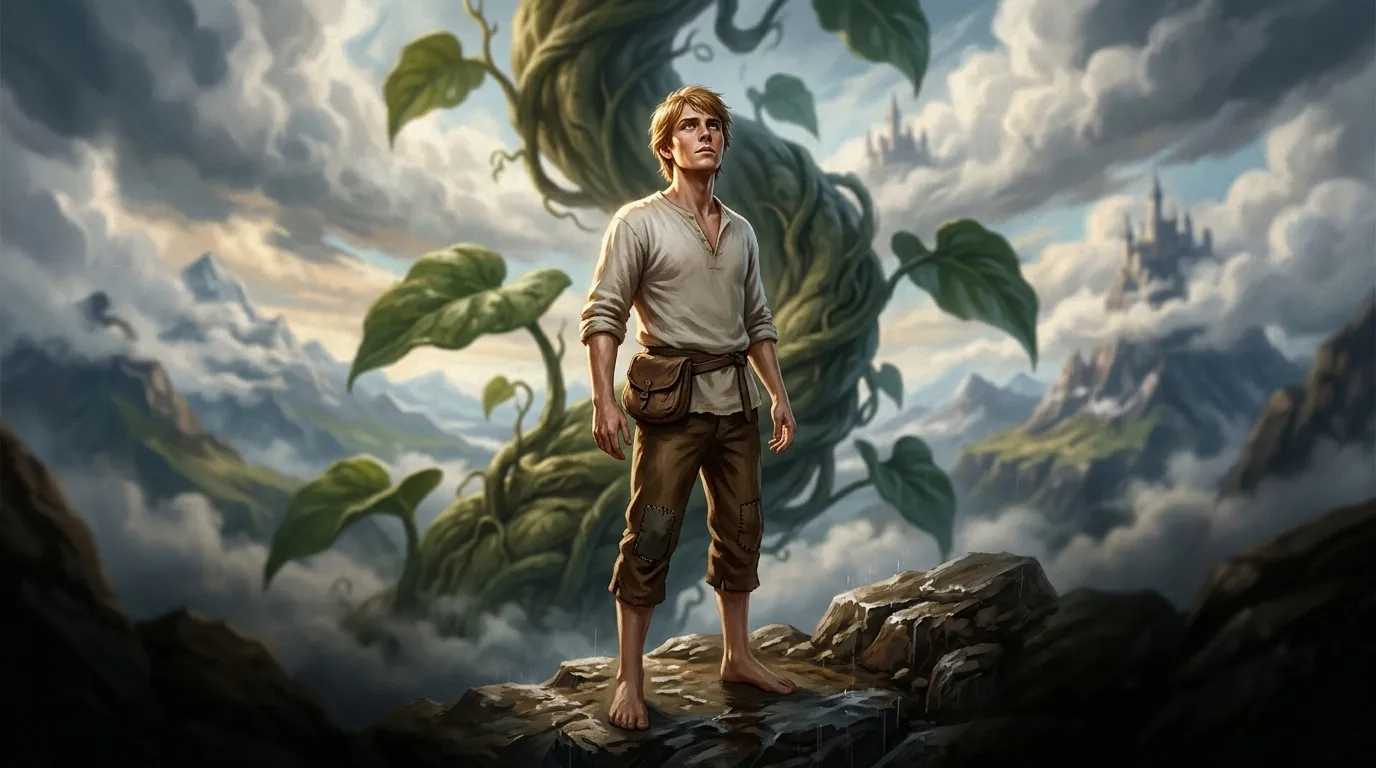
A boy trades his family's only cow for a handful of beans. The beans turn out to be magic, growing overnight into a stalk that climbs past the clouds. At the top is a giant's house, and inside it, a giant's gold, a giant's hen, and a giant's harp. On the surface it reads like a straightforward adventure — climb, take, escape, get rich. Read a little more closely, and the story people actually told for generations turns out to be a good deal stranger and less tidy than that.
The version now printed in most picture books tends to smooth over an uncomfortable detail: Jack is, by any plain reading, a thief. He climbs into a stranger's home three times, eats his food, and steals his property — and in some versions kills him. The story people have kept retelling for centuries isn't really a lesson about honesty. It sits somewhere closer to a fantasy about a poor family's luck finally turning, told without much interest in whether turning it was fair.
A story about theft, not thrift
Folklorists classify "Jack and the Beanstalk" as Aarne–Thompson tale type 328, "The Boy Steals the Ogre's Treasure" — a category that groups it with tales like "Hop-o'-My-Thumb" and "Molly Whuppie," where a child ends up in a man-eating giant's home, escapes, and returns to take what belongs to the giant. The earliest known print version, "The Story of Jack Spriggins and the Enchanted Bean" from 1734, doesn't soften Jack's role much. It was Benjamin Tabart's 1807 retelling that added a moral fix: a fairy explains that the giant had murdered Jack's father and stolen the family's fortune, turning theft into justified reclaiming. That justification is a later addition, not the original shape of the tale — folklorist Joseph Jacobs' 1890 version, generally considered closer to how the story was actually told before it was written down and moralized, is the one most commonly reprinted today, and it leaves Jack's motives a lot less clean.
Older than its first printing by thousands of years
The written record only goes back to 1734, but the story itself appears to be far older. Researchers at Durham University and the Universidade Nova de Lisboa — Sara Graça da Silva and Jamshid Tehrani — used techniques borrowed from evolutionary biology to trace tale types like AT 328 back through the language families that carried them, the same way a linguist traces a word's ancestry. Their analysis suggested this particular tale type could plausibly reach back to a common ancestor of the Indo-European languages, putting its origin somewhere between roughly 4500 and 2500 BC — long before anyone thought to write a fairy tale down at all. That doesn't mean the story was always about a beanstalk specifically; what survives across that much time is usually the underlying shape — a resourceful child, an enormous and dangerous figure, a theft that goes unpunished — dressed in whatever details a given culture and century found familiar.
One telling, illustrated
Frequently Asked Questions
Is Jack and the Beanstalk based on a true story?
No — it is a folk tale, classified by scholars as Aarne–Thompson type 328, and linguistic research suggests the underlying tale type may be thousands of years old, well before its first known printing in 1734.
Was Jack always shown as a hero for stealing from the giant?
Not without help. The earliest tellings leave his theft largely unjustified. The moral explanation now common in children's versions — that the giant had wronged Jack's family first — was added by editor Benjamin Tabart in 1807, more than seventy years after the tale first appeared in print.
Which version of the story is closest to how it was originally told?
Folklorist Joseph Jacobs' 1890 retelling in English Fairy Tales is generally considered closer to the older oral tradition than Tabart's earlier, more heavily moralized 1807 text, and it's the version most commonly reprinted today.