Cleopatra: The Ruler Behind the Myth
Cleopatra is remembered mostly for two Roman relationships. She was also a working head of state who spoke several languages fluently and held her kingdom together for two decades.
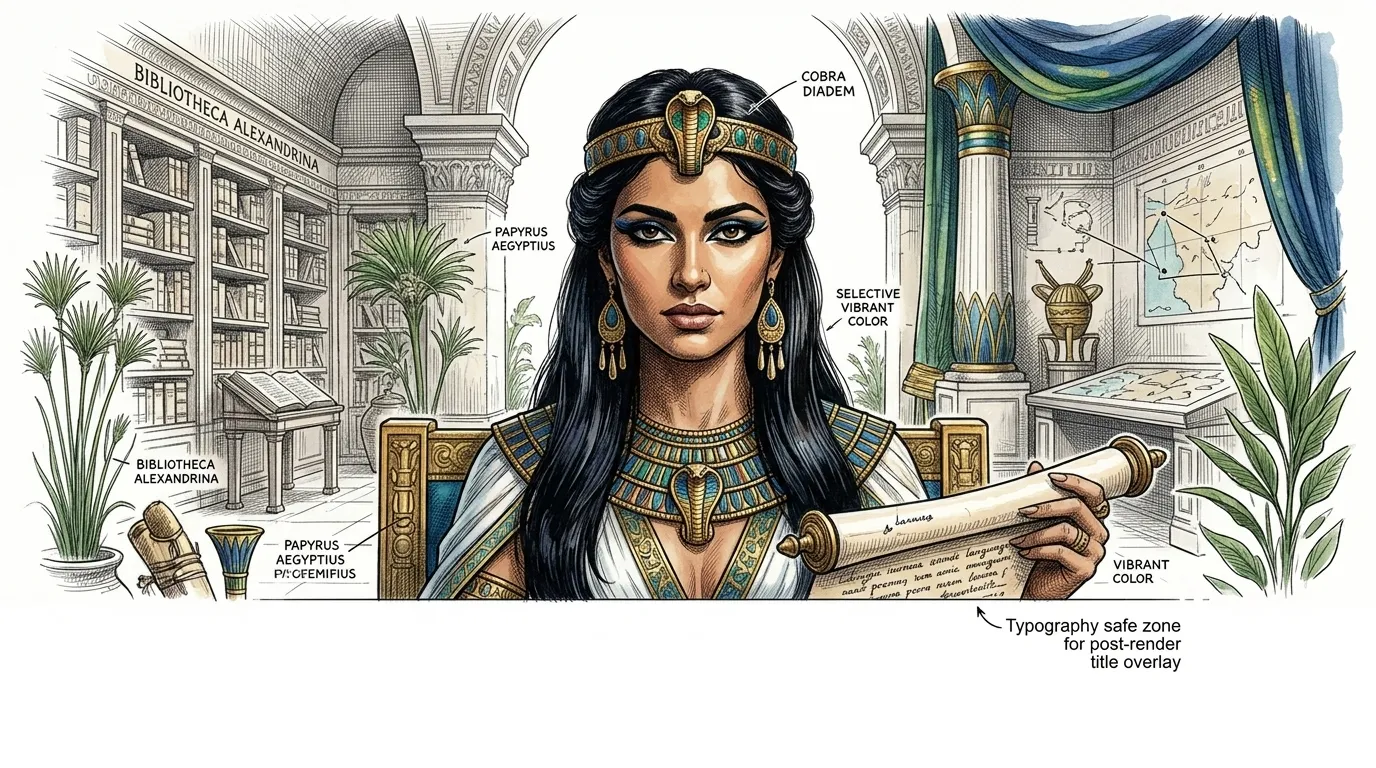
Cleopatra VII took the Egyptian throne in 51 BC at around eighteen years old, co-ruling first with her father's will and then, after a civil war with her younger brother, alone. She would be the last active pharaoh of Egypt — after her death in 30 BC, Egypt became a Roman province, ending nearly three thousand years of pharaonic rule. Almost everything most people know about her involves two Roman generals, Julius Caesar and Mark Antony, and that framing has quietly erased most of what she actually did as a ruler.
She wasn't Egyptian by ancestry — and that mattered to her rule
Cleopatra descended from Ptolemy I, one of Alexander the Great's generals who took control of Egypt after Alexander's death in 323 BC and founded a Macedonian Greek dynasty. For roughly 275 years before Cleopatra, the Ptolemaic rulers had governed Egypt largely in Greek, from the Greek-built city of Alexandria, without bothering to learn the Egyptian language. Cleopatra broke that pattern — ancient sources credit her as the first Ptolemaic ruler to learn Egyptian, alongside a reported command of numerous other languages for diplomacy. That choice was itself a political strategy: presenting herself to Egyptians as a genuine pharaoh, not merely a foreign administrator collecting taxes.
A head of state, not just a consort
Before Caesar ever arrived in Egypt, Cleopatra was already fighting to hold her throne against her brother's court faction. Her alliance with Caesar in 48 BC restored her to power militarily, and after his assassination in 44 BC she governed Egypt independently for years, managing its economy, its grain trade with Rome, and its currency. Egypt under her rule remained one of the wealthiest and most stable kingdoms in the eastern Mediterranean at a time when Rome's own republic was collapsing into civil war around her. Her later alliance with Mark Antony was, from her side, at least as much a calculated attempt to keep Egypt independent of direct Roman annexation as it was personal.
How the story got told after she lost
Cleopatra and Antony's combined forces were defeated by Octavian (the future Emperor Augustus) at the Battle of Actium in 31 BC. Octavian's propaganda machine, needing to justify a war against a fellow Roman general, recast the conflict as Rome defending itself against a foreign queen who had seduced two of its greatest men — a framing later Roman writers like Horace and Virgil repeated and that shaped nearly every account of her for the next two thousand years. Most of what survives about Cleopatra was written by the winners, decades after her death, which is a large part of why the myth outlasted the ruler.
Told as an illustrated story
Frequently Asked Questions
Was Cleopatra Egyptian?
By ancestry, no — she descended from Ptolemy I, a Macedonian Greek general of Alexander the Great, and her family had ruled Egypt as a Greek-speaking dynasty for over two and a half centuries before her. She is generally credited as the first of that dynasty to actually learn the Egyptian language.
How did Cleopatra die?
According to ancient sources, she died by suicide in 30 BC after her and Mark Antony's forces were defeated by Octavian, rather than be captured and paraded in a Roman triumph. The most famous account says she used an asp, though historians note the sources are not fully reliable on the exact method.
Why is Cleopatra remembered mainly for her relationships with Roman men?
Most surviving written accounts of her were produced by Roman writers after her defeat, working from propaganda that justified Octavian's war as Rome defending itself from a foreign seductress rather than a war between Roman rivals — a framing that shaped her reputation for centuries.