Mother Holle and What Fairy-Tale Reward Stories Were Really Teaching
A kind stepdaughter is rewarded with gold. A lazy one is punished with pitch. Mother Holle belongs to a tale shape told across dozens of cultures — and its central figure predates the fairy tale by centuries.
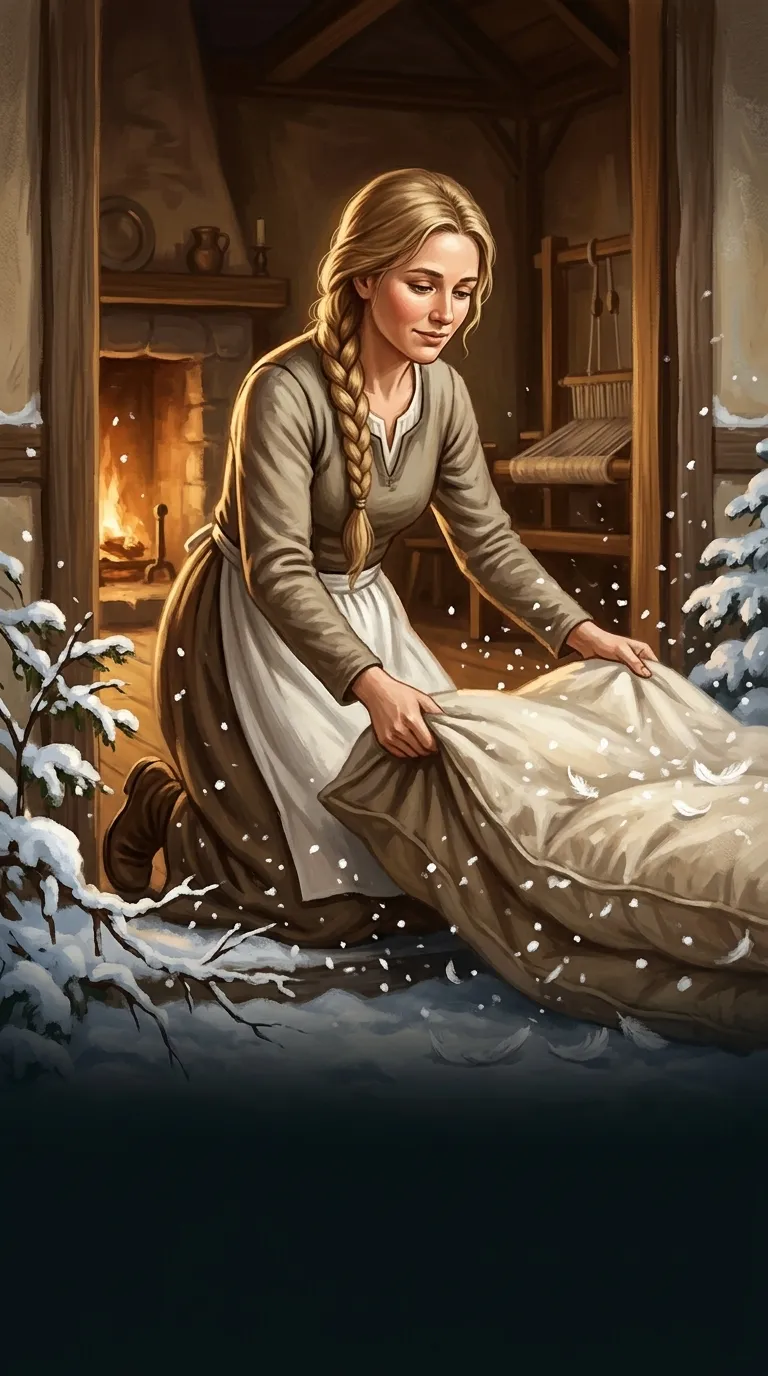
A girl falls down a well and finds herself in a strange, otherworldly place, working for a woman named Mother Holle — shaking her feather bed to make it snow in the world above. She works hard, is kind, and is sent home covered in gold. Her lazy, unkind stepsister tries the same thing, does the work poorly, and comes home covered in pitch instead. It's a simple shape, almost mechanical in its fairness: effort in, exact reward out. That simplicity is exactly why the tale has been told, in one form or another, across a striking number of cultures.
Unlike many fairy tales, Mother Holle doesn't really deal in moral ambiguity, family betrayal, or a villain to defeat. It's closer to a controlled experiment: two girls, one task, two outcomes that map directly onto how each of them behaved. That directness is part of what folklorists find useful about it — it's an unusually clean example of a tale type that shows up worldwide.
The "Kind and Unkind Girls" tale type
The story published by the Brothers Grimm in 1812 as "Mother Holle" is catalogued as Aarne–Thompson–Uther type 480, generally labeled "The Kind and Unkind Girls" — a tale type built around exactly this structure of rewarded diligence and punished laziness, and one folklorists have documented in variants across a wide span of European and wider oral tradition. The Grimms didn't invent the story; they recorded it from an oral telling by Henriette Dorothea "Dortchen" Wild in October 1811 in Kassel, Germany — a storyteller who, in one of the more pointed details of the tale's own history, went on to marry Wilhelm Grimm several years after he wrote her version down. The collection itself was revised more than once after that first printing, with a significantly expanded final edition — 200 tales in all — appearing in 1857.
Frau Holle is older than the fairy tale
The Mother Holle of the Grimms' story is a domesticated version of a much older figure in Germanic folk belief. Under names like Holda, Perchta, and Berchta depending on the region, she appears in sources going back to at least the 11th or 12th century, including early church documents such as Burchard of Worms' Decretum, which treated belief in her as exactly the kind of lingering folk practice the church was trying to stamp out. In the older tradition she was tied to winter, spinning, and household order generally, and regional variants of her carried real local texture — in Silesia she was sometimes called Spillahulle and described as a gaunt old woman used to frighten children into behaving, while in parts of Bohemia she was said to carry stinging nettles to punish laziness. The fairy tale's gold-and-pitch ending is a much simpler, later distillation of a figure who had been part of regional folk belief for the better part of a thousand years before the Grimms wrote her down.
One telling, illustrated
Frequently Asked Questions
Is Mother Holle the same story as Frau Holle?
Yes — "Mother Holle" is the standard English title for the Brothers Grimm's 1812 tale, recorded in German as "Frau Holle." The character herself, under regional names including Holda and Perchta, appears in German folk belief centuries before the Grimms wrote the fairy tale down.
What tale type does Mother Holle belong to?
Folklorists classify it as Aarne–Thompson–Uther type 480, "The Kind and Unkind Girls" — a story shape built around one character rewarded for good behavior and another punished for the opposite, documented in variants across many cultures, not unique to the Grimm version.
Did the Brothers Grimm invent the story of Mother Holle?
No. They recorded it from an oral storyteller, Henriette Dorothea 'Dortchen' Wild, in 1811 — part of the wider Grimm project of writing down existing oral tales rather than inventing new ones. Dortchen Wild later married Wilhelm Grimm.