Marcus Aurelius and the Journal He Never Meant to Publish
Meditations is now one of the most-read philosophy books in the world. Marcus Aurelius wrote it as a private notebook to himself, while ruling an empire at war, with no intention anyone else would read it.
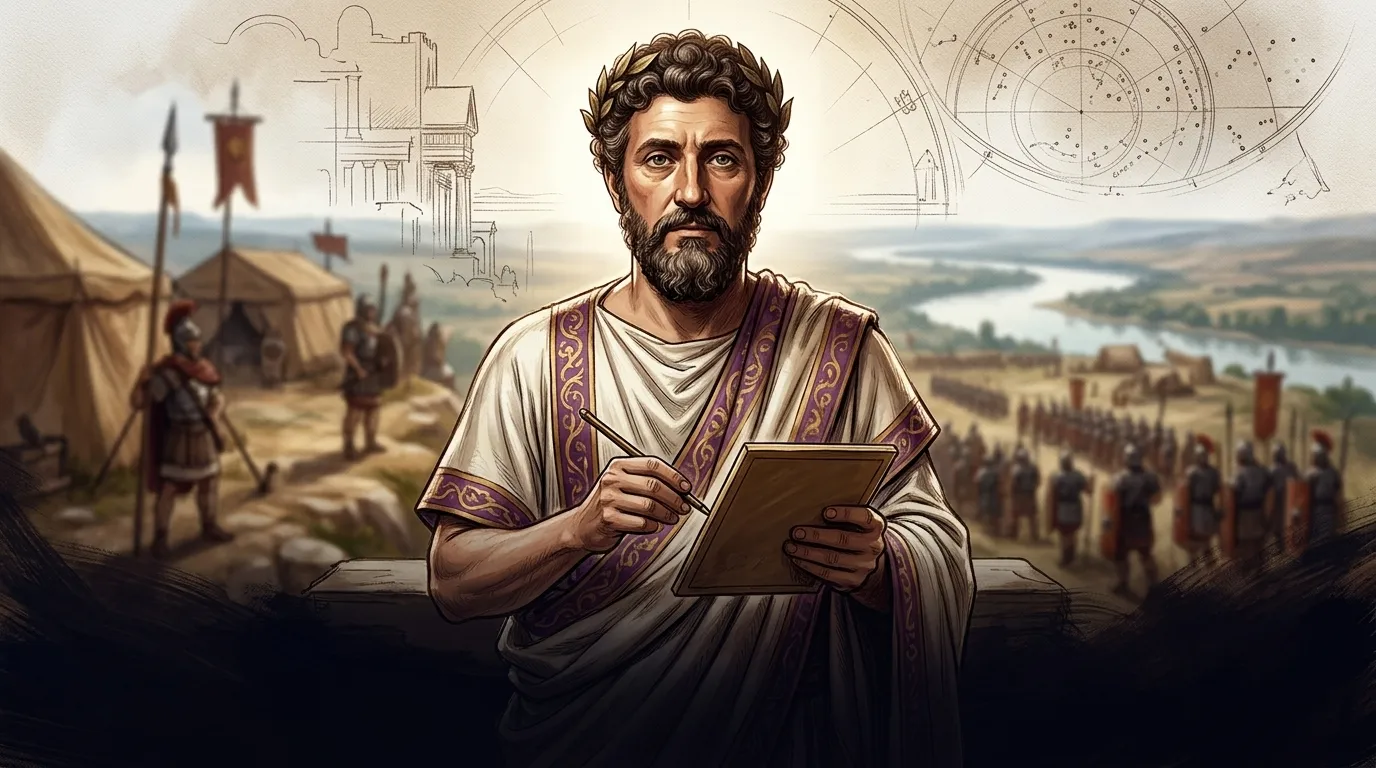
Marcus Aurelius ruled the Roman Empire from 161 to 180 AD, the last of the five consecutive emperors later historians would call the 'Five Good Emperors.' His reign was dominated by crisis rather than calm — years of war along the empire's northern frontier against Germanic tribes, and the Antonine Plague, a pandemic that historians estimate killed millions across the empire, possibly including Marcus himself at the end. Meditations, the book he's remembered for today, was written during these campaigns, in Greek, as a private philosophical notebook addressed to himself.
A Stoic emperor, not a Stoic teacher
Marcus was a practicing student of Stoic philosophy, a school of thought going back to Zeno of Citium in the 3rd century BC that held virtue as the only true good and taught that a person's own judgments, not external events, are what actually disturb them. Unlike earlier Stoic writers such as Epictetus or Seneca, Marcus wasn't a professional philosopher or teacher — he was applying Stoic discipline to the specific, exhausting problem of governing an empire and commanding armies, which is part of why Meditations reads less like a systematic philosophical treatise and more like a series of reminders one person is giving himself to stay steady.
The book almost didn't survive to be read at all
Marcus never gave the work a title — 'Meditations' was assigned by later editors, and the original Greek title translates closer to 'things addressed to himself.' It wasn't written for an audience and was never formally published in his lifetime. The text survived through a small number of manuscript copies across the following centuries, and the first printed edition wasn't produced until 1558, roughly 1,400 years after Marcus wrote it. Its now-widespread popularity as a standalone work of practical philosophy is a comparatively recent phenomenon — for most of its history, it was a specialist text known mainly to scholars of Stoicism, not the wide general readership it has today.
Told as an illustrated story
Frequently Asked Questions
Did Marcus Aurelius intend Meditations to be published?
No — he wrote it as a private notebook addressed to himself, in Greek, while on military campaign. It was never formally published in his lifetime and the title 'Meditations' was assigned later by editors.
Is Marcus Aurelius considered a Stoic philosopher or a Stoic emperor?
Both descriptions are used, but he wasn't a professional philosopher or teacher like Epictetus or Seneca — he was a practicing student of Stoicism applying its discipline to the demands of ruling an empire, which shapes the practical, self-directed tone of his writing.
When did Meditations become widely read?
Its first printed edition appeared in 1558, roughly 1,400 years after it was written, and for most of the centuries since it remained a specialist text for students of Stoicism rather than the broadly popular book it has become in recent decades.