The Defeat of the Spanish Armada, 1588: A Field Guide
Why Philip II sent the Armada in 1588, how English guns and bad weather beat it, and how to follow Elizabethan sea power in illustrated form.
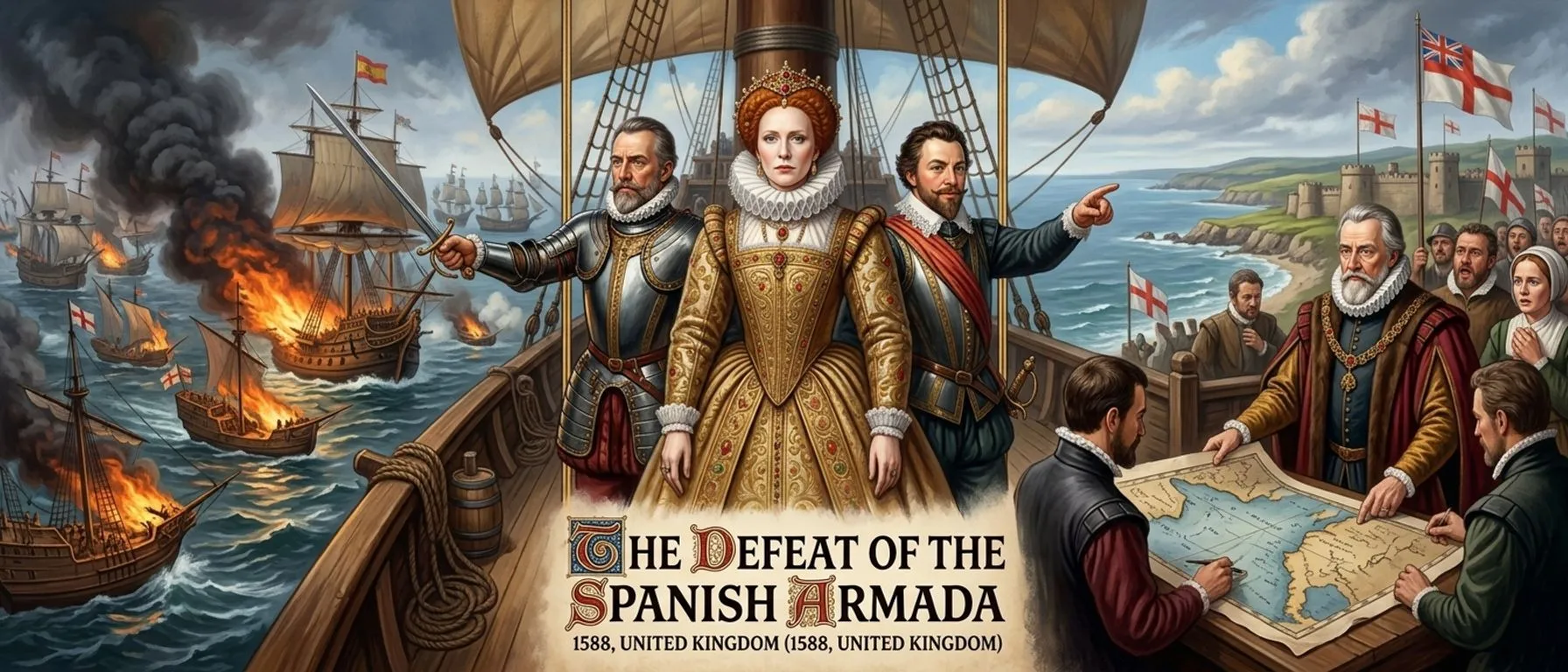
The Spanish Armada is the best-known naval campaign in English history. In 1588 Philip II of Spain sent a great fleet north to help invade England and remove Queen Elizabeth I. It failed. Without the wider story, a newcomer sees only a famous date. This guide gives the map: the people, the ships, the weather and the long quarrel behind it.
The 1588 Campaign: Why Philip II Sent the Fleet
Philip was king of Spain and a champion of Catholicism. Elizabeth was Protestant. She had helped the Dutch rebels fighting Spain, signing the Treaty of Nonsuch in 1585. English privateers such as Francis Drake also raided Spanish ships and ports. The last push came in 1587, when Elizabeth had her Catholic cousin Mary, Queen of Scots, executed. Philip's plan was for the fleet, under the Duke of Medina Sidonia, to sail up the Channel and meet the Duke of Parma's army in the Spanish Netherlands. That army would then cross to England on barges. The fleet left Lisbon in May 1588 and was sighted off Cornwall in late July.
Lord Howard, Drake and the English Fleet
The English fleet was led by Charles Howard, Lord Howard of Effingham, with Drake, John Hawkins and Martin Frobisher as commanders. English ships were often handier and carried long-range guns. Fighting began off Plymouth on 31 July. The Spanish kept a tight crescent formation, and the English could not break it. At Gravelines on 8 August the English closed in. Fireships sent into the anchored fleet off Calais on the night of 7–8 August had already scattered the Spanish. Sources differ on how much damage the guns did, but the formation was broken and the Spanish could not reach Parma.
He blew with his winds, and they were scattered.
The Weather and the Long Voyage Home
Strong winds pushed the Spanish into the North Sea. Medina Sidonia chose to sail home around Scotland and Ireland. Storms in September and October wrecked many ships on the Irish and Scottish coasts. Historians estimate that about 130 ships set out and that roughly 100 returned, and that thousands of men died, mostly from drowning, hunger and disease. These numbers are estimates. The English lost few ships but suffered terrible sickness afterwards.
What It Changed, and What the Legend Gets Wrong
The victory made Elizabeth a symbol of national survival, and it fed the later story of English sea power. But the standard story is an oversimplification. Spain was not finished: it rebuilt its navy, sent further armadas in 1596 and 1597 that failed mostly because of storms, and the war lasted until the Treaty of London in 1604. England's own 1589 expedition under Drake and Sir John Norreys, the so-called English Armada, failed badly. Many historians also stress that the Armada was no certain victory for England. Parma's army, the shallow Flemish coast and bad luck all mattered. The Dutch revolt went on, and France and the Netherlands were shaped as much by this struggle as England was.
Reading Sea Battles in Pictures and Sound
Sea battles are hard on the page. Ships move in lines, winds shift and names pile up. Illustrated, narrated history helps: a picture shows the crescent formation and the fireships, and a voice keeps the order of events clear. In the infographic above you will see two sets of figures. One bar pair compares the roughly 130 ships that sailed from Lisbon in 1588 with the roughly 100 that came home, both estimates. Highlighted cards give the dates: 1585 for the Treaty of Nonsuch, 1588 for the campaign and 1604 for the Treaty of London. WonderBooks is a library of illustrated books, many of them narrated and available in several languages, with one founder directing the writing, the pictures and the narration. That suits a subject like this, where seeing a map or hearing a story told slowly can make a confusing week at sea easy to follow. The Wonder History shelves on wars, battles and the Tudor age are a good place to start, and more subject guides are in our articles section.
Frequently Asked Questions
Was the Spanish Armada defeated only by the weather?
No. English guns, fireships and the failure to link up with Parma's army all mattered. The storms did the worst damage on the voyage home, after the fleet had already been scattered.
Did Elizabeth I really give a speech at Tilbury?
Yes, she visited troops at Tilbury in August 1588. The famous words about having 'the heart and stomach of a king' come from a version recorded later, so the exact wording is uncertain.
Why is it called the Invincible Armada?
The Spanish called it the Grande y Felicísima Armada, the great and most fortunate fleet. 'Invincible' was mostly added later, often with irony, by English writers.