Why Renoir Painted Ordinary Sunday Afternoons
No kings, no myths, no battles — just working-class Parisians dancing in Montmartre on a Sunday. Renoir spent a whole summer painting it on the spot.
In 1876, Pierre-Auguste Renoir painted a large canvas of an ordinary Sunday afternoon at the Moulin de la Galette, an open-air dance garden built around one of the last working windmills left on the hill of Montmartre in Paris. The scene shows working-class Parisians dressed in their best clothes, dancing, drinking, and eating the flat cakes — galettes — that gave the place its name. There is no single hero, no clear narrative moment, no historical event being commemorated. It is simply a crowd, enjoying itself, on a day off.
That choice of subject was itself a statement. For centuries, large-scale paintings had generally been reserved for mythology, religion, royalty, or history — grand subjects for a grand canvas. Renoir instead gave that same ambitious scale, roughly 1.3 by 1.75 metres, to a crowd of ordinary people at leisure. According to the Musée d'Orsay, which now holds the painting, Renoir's aim was less to record individual faces — though some of his friends do appear in the crowd — than to capture the atmosphere of the place itself: noisy, bright, and alive.
Painted Where It Happened, Not From Memory
Renoir did not sketch the scene once and finish it in a studio. He rented a small atelier nearby on Rue Cortot and, through the summer of 1876, physically moved his easel to the Moulin de la Galette itself to paint the dancers as they actually moved and the light as it actually fell. That same summer he was also working on a second major canvas, The Swing, painted in a garden near the same neighborhood — both works studies in how real outdoor light behaves on skin, fabric, and shifting crowds, a central preoccupation of the Impressionist painters. The brushwork in Bal du moulin de la Galette is loose and flickering rather than smoothly blended, deliberately built to suggest sunlight breaking through leaves and falling unevenly across the dance floor.
A Painting Critics Didn't Understand Yet
Renoir showed the painting at the third Impressionist group exhibition in 1877, and the reaction from contemporary critics was mixed at best — the same loose, blurred quality now considered the painting's great strength struck many reviewers at the time as simply unfinished or careless. Its later history was more fortunate: French painter Gustave Caillebotte, a friend and fellow artist, owned it from 1879 until his death in 1894, after which it passed to the French state. It hung in the Musée du Luxembourg and later the Louvre before moving to its current home at the Musée d'Orsay in 1986. Renoir also painted a smaller version of the same scene, which later became one of the most expensive paintings ever sold at the time of its sale — a very different fate from the puzzled reviews it received at its debut.
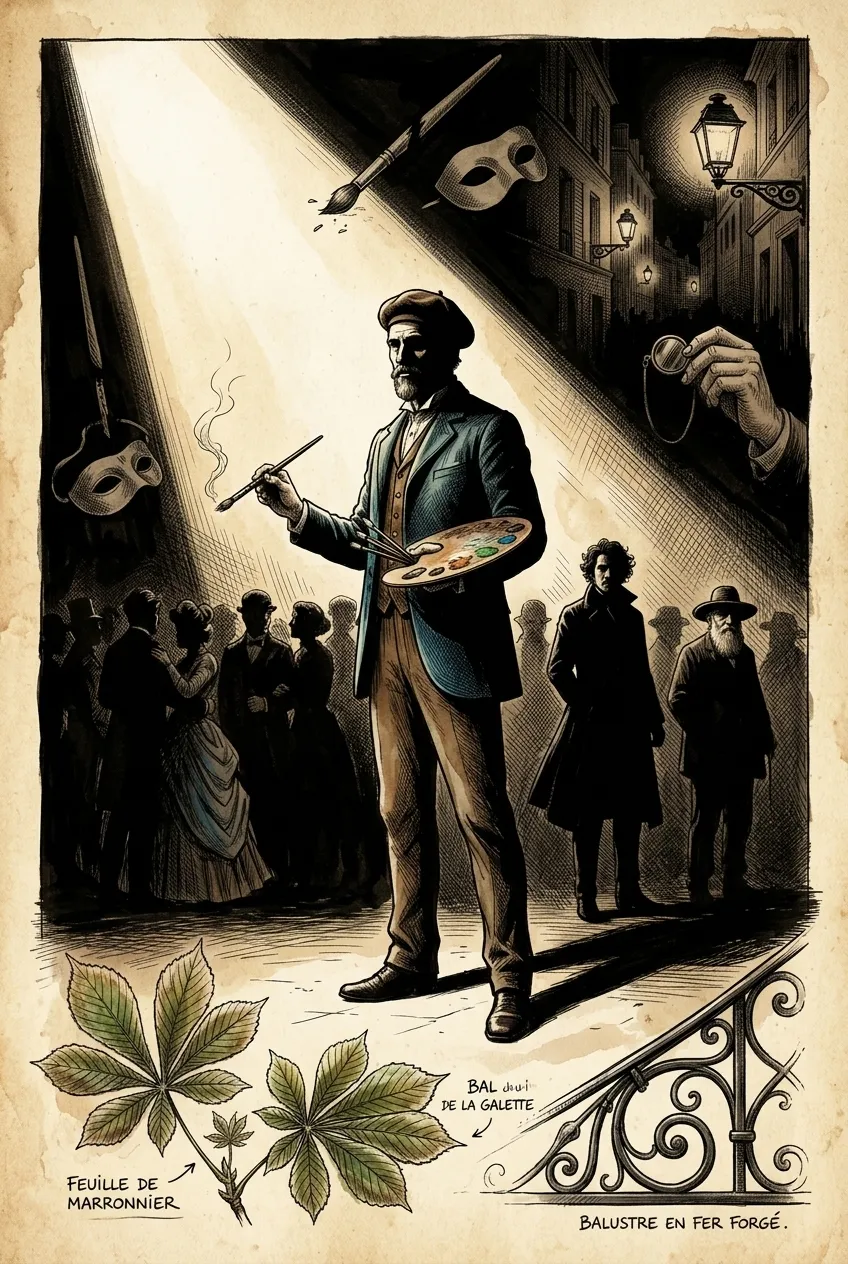
Told as an illustrated story
Frequently Asked Questions
What is actually happening in Bal du moulin de la Galette?
It depicts a real, ordinary Sunday afternoon at the Moulin de la Galette, an open-air dance garden in the Montmartre neighborhood of Paris, where working-class Parisians would dress up and spend the day dancing, drinking, and eating galettes. There is no historical event or myth being depicted — the subject is simply the atmosphere of the place itself.
Did Renoir paint it from life, on location?
Yes. Renoir rented a studio near Montmartre and spent the summer of 1876 setting up his easel at the Moulin de la Galette itself, painting the dancers and the light as they actually appeared rather than composing the scene later from memory or sketches.
Was the painting well received when it was first shown?
Not universally. It was exhibited at the third Impressionist group show in 1877, and its loose, blurred brushwork — now considered central to its appeal — drew negative reactions from a number of contemporary critics, who saw it as unfinished rather than deliberate. Its reputation grew substantially over the following century.