Fathers and Sons — Ivan Turgenev
Fathers and Sons — Ivan Turgenev — an illustrated literature story. 10 illustrated pages, free to read on Wonder Novels.
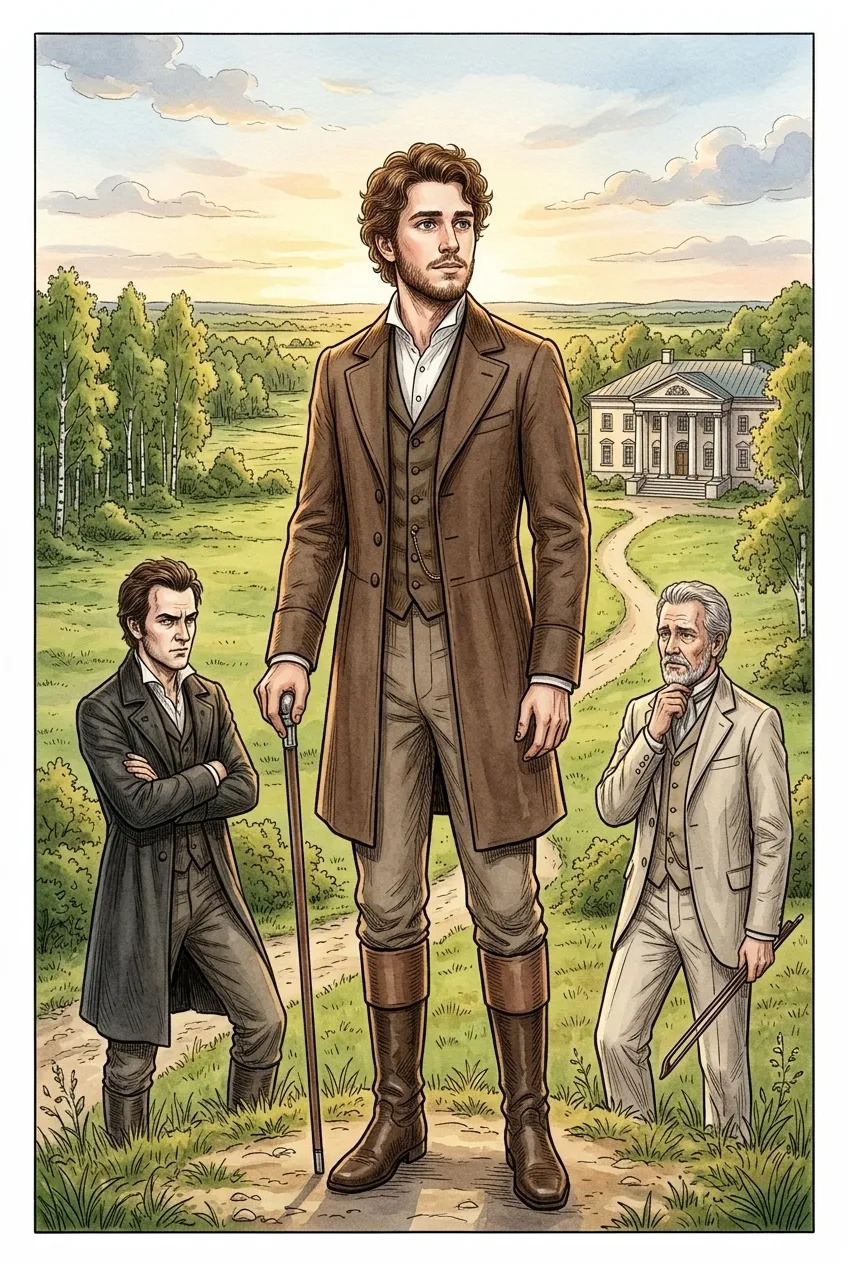
Page 1
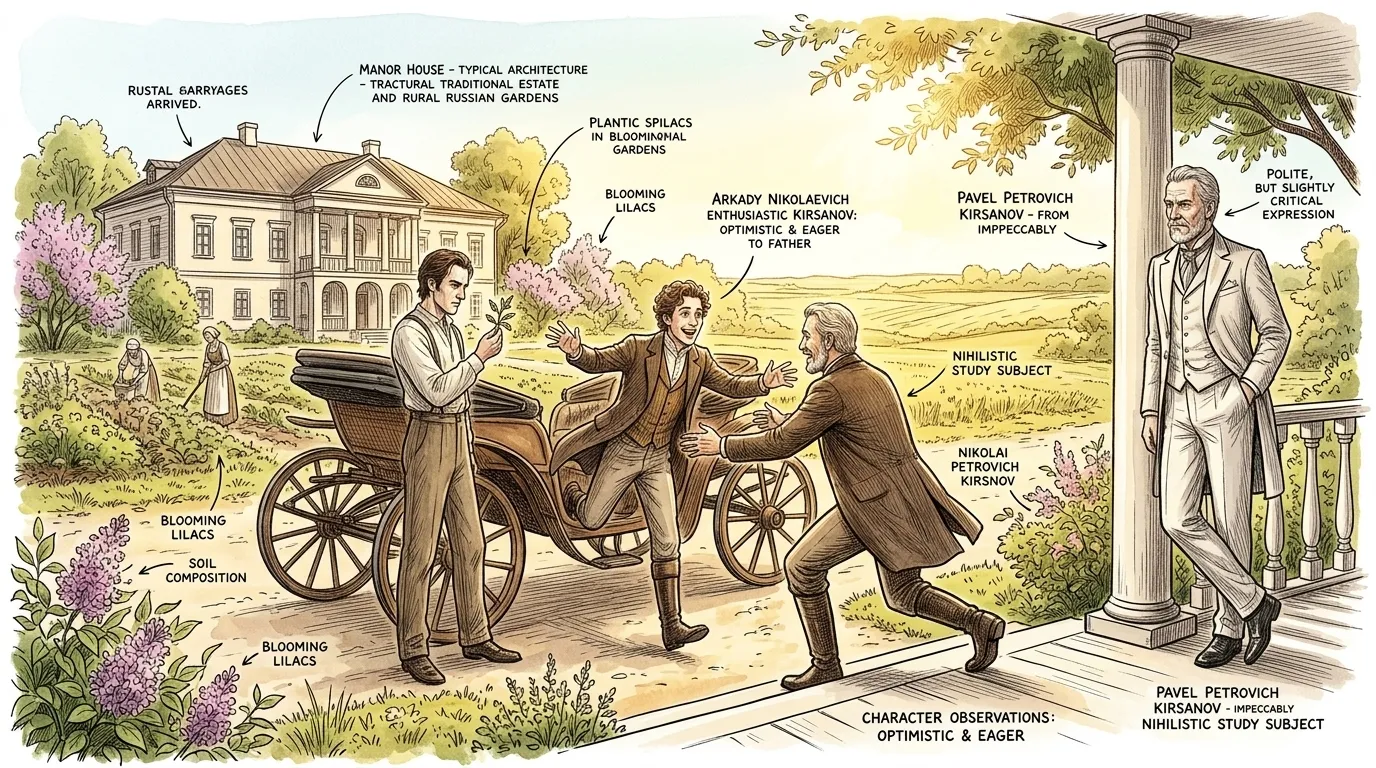
The year was 1859, and Arkady Nikolaevich Kirsanov, a young student, returned to his ancestral estate, Maryino, after his studies in Petersburg. "Father, I have brought a friend with me, Evgeny Vasilevich Bazarov!" Arkady exclaimed, stepping down from the carriage with a wide smile. Nikolai Petrovich, a gentle landowner, rushed forward, embracing his son with a tender sigh, his gaze then falling with curiosity upon the tall, unconventional companion. Pavel Petrovich, Nikolai's elegantly stern brother, watched from the porch, a flicker of polite disapproval crossing his distinguished features.
️ Literary Fact: This opening scene introduces the primary characters and establishes the rural Russian setting. The tension between generations and ideologies is immediately hinted at through the characters' contrasting appearances and initial interactions. Maryino symbolizes the traditional way of life.
Page 2
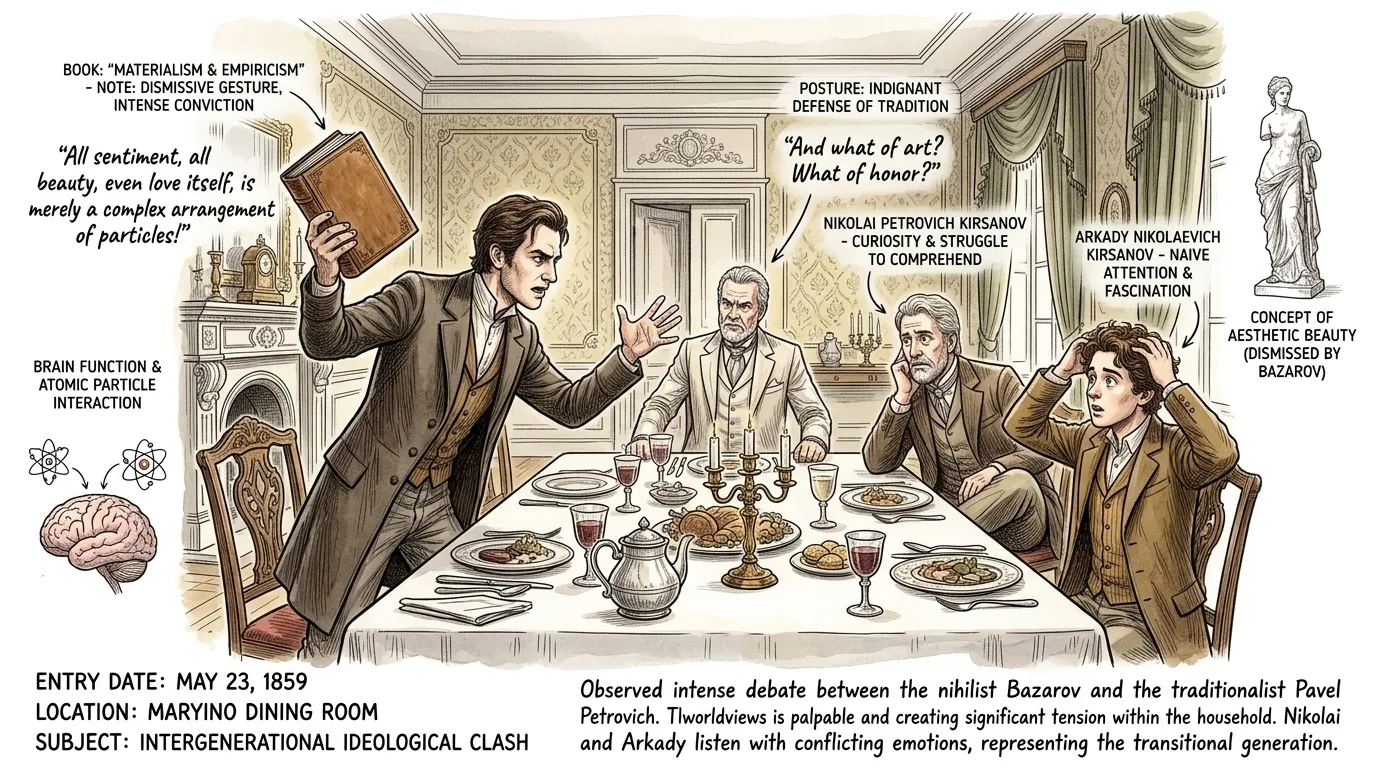
At dinner, the conversation swiftly escalated into a fervent debate, with Bazarov's blunt, nihilistic views challenging Pavel Petrovich's aristocratic principles. "All sentiment, all beauty, even love itself, is merely a complex arrangement of particles, a series of chemical reactions within the organism!" Bazarov declared, gesturing emphatically with a thick, worn leather-bound book. He then added, "As the physiologist Ludwig Büchner famously wrote, 'The brain secretes thought just as the liver secretes bile.' To cling to outdated ideals is simply absurd!" Pavel Petrovich, drawing himself up stiffly, countered, "And what of art? What of honor? Are these mere secretions as well, young man? Is there no value beyond the tangible?"
️ Literary Fact: This page depicts the pivotal 'clash of ideologies' between Bazarov's nihilism and Pavel's conservatism. The reference to Büchner's materialist philosophy serves as the 'Chekhov's Gun'—a specific piece of knowledge that will later resurface to highlight Bazarov's character or provide a narrative twist.
Page 3
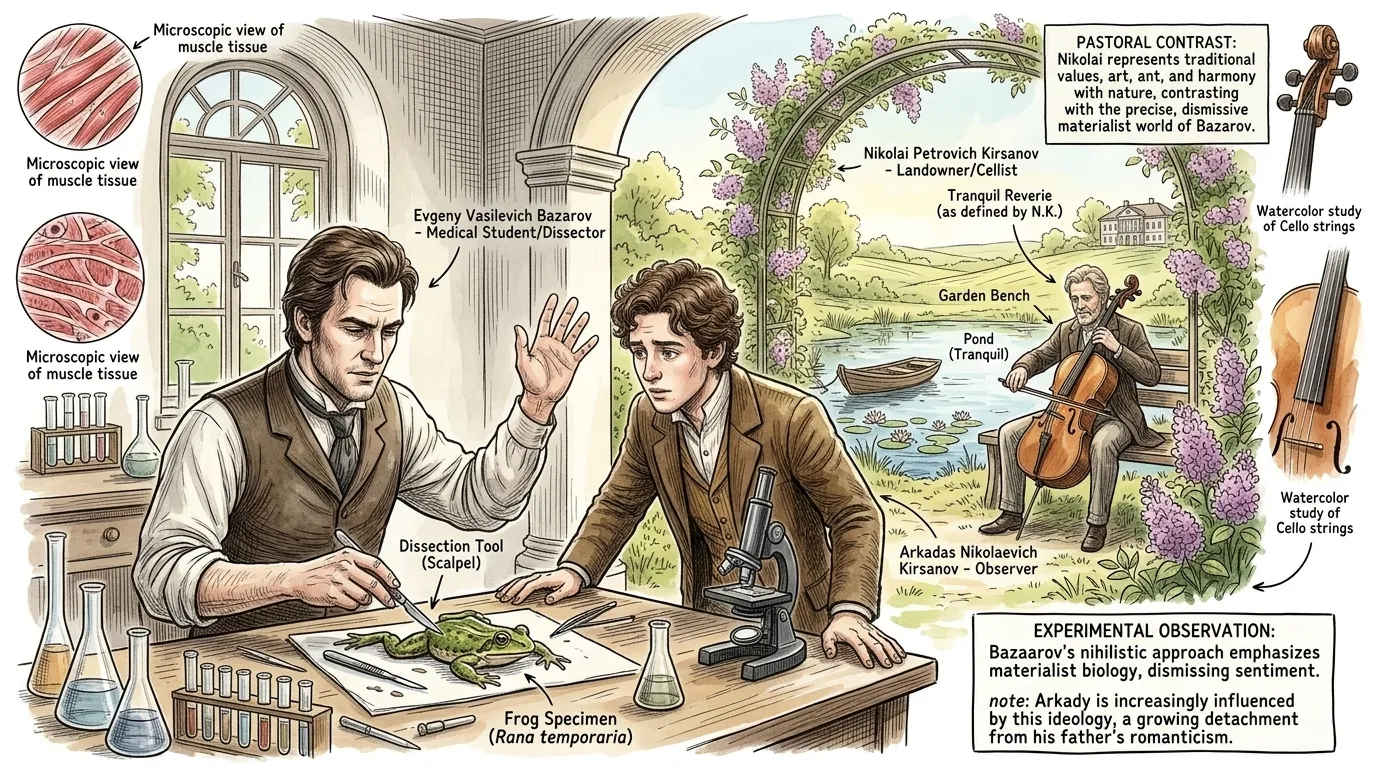
The following days saw Bazarov immersing himself in his scientific work, often with Arkady by his side, while observing Nikolai Petrovich's gentle, pastoral routines. "Look at him, still lost in his romantic verses," Bazarov remarked with a dismissive wave of his hand towards Nikolai, who was sitting on a bench by the pond, strumming his cello softly. "Such sentimental indulgences are futile, Arkady! The only true pursuit is the dissection of what truly exists, what can be tested and measured." Arkady, though respectful of his father, found himself increasingly swayed by Bazarov's compelling conviction, his expression a mix of affection and dawning skepticism.
️ Literary Fact: This scene contrasts Bazarov's scientific, utilitarian worldview with Nikolai's romantic, traditional inclinations. Arkady's internal conflict begins to manifest as he mediates between his affection for his father and his admiration for Bazarov's radical ideas.
Page 4
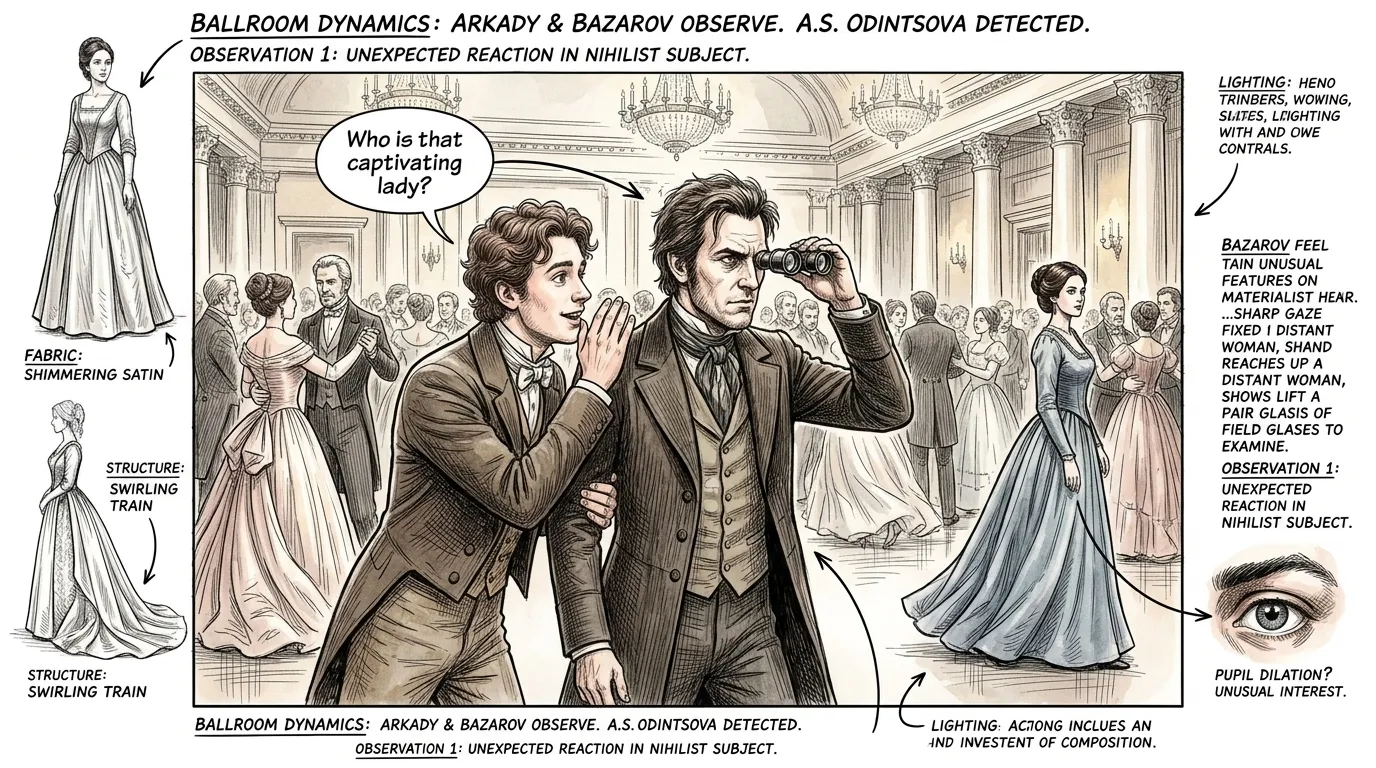
A few weeks later, Arkady and Bazarov attended a provincial ball, a rare social outing. Amidst the swirling gowns and formal dances, their eyes were drawn to a woman of remarkable poise. "Who is that captivating lady?" Arkady whispered, nudging Bazarov, who rarely showed interest in such matters. Anna Sergeevna Odintsova, a wealthy and independent widow, moved through the room with an almost regal grace. Bazarov, despite his outward indifference, felt an unusual stir of curiosity, his intense gaze following her every movement, an unexpected crack in his nihilistic armor.
️ Literary Fact: The introduction of Anna Sergeevna Odintsova marks a turning point. Her character challenges Bazarov's rigid philosophical stance by presenting an intellectual and emotional complexity he struggles to dismiss with his usual cynicism, hinting at his forthcoming internal conflict.
Page 5
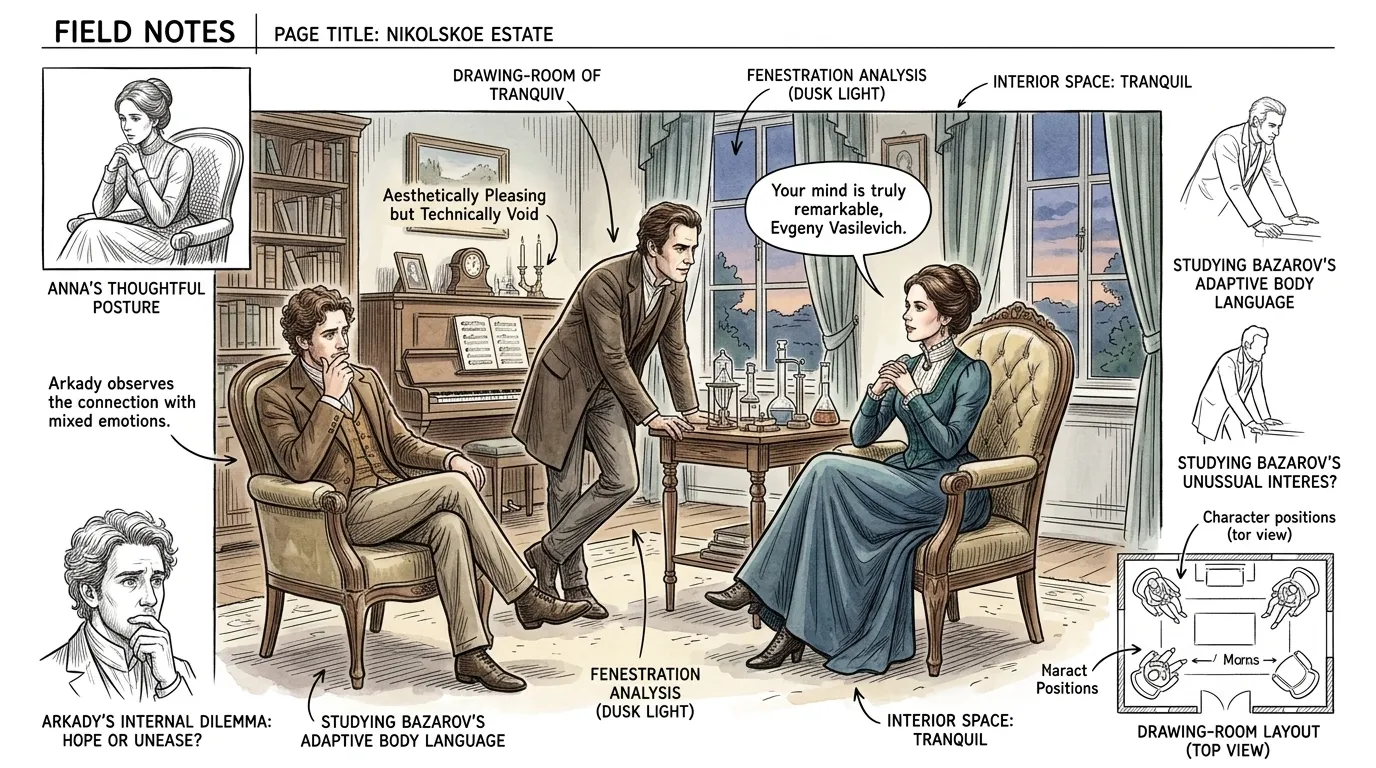
Intrigued by their unconventional visitors, Anna Sergeevna invited Arkady and Bazarov to stay at her tranquil estate, Nikolskoe. Days turned into weeks, filled with long discussions on science, philosophy, and society. "Your mind is truly remarkable, Evgeny Vasilevich," Odintsova remarked one evening, her emerald eyes thoughtful as she listened intently to his pronouncements. Bazarov, usually so dismissive of feminine intellect, found himself drawn to her calm intelligence and profound independence, his scientific detachment slowly yielding to an unfamiliar, powerful attraction. Arkady observed the deepening connection with a mixture of hope and unease.
️ Literary Fact: The extended stay at Nikolskoe is crucial for developing the relationship between Bazarov and Odintsova. Her intelligence and composure slowly erode Bazarov's cynical facade, forcing him to confront emotions he previously denied as mere 'chemical reactions.'
Page 6
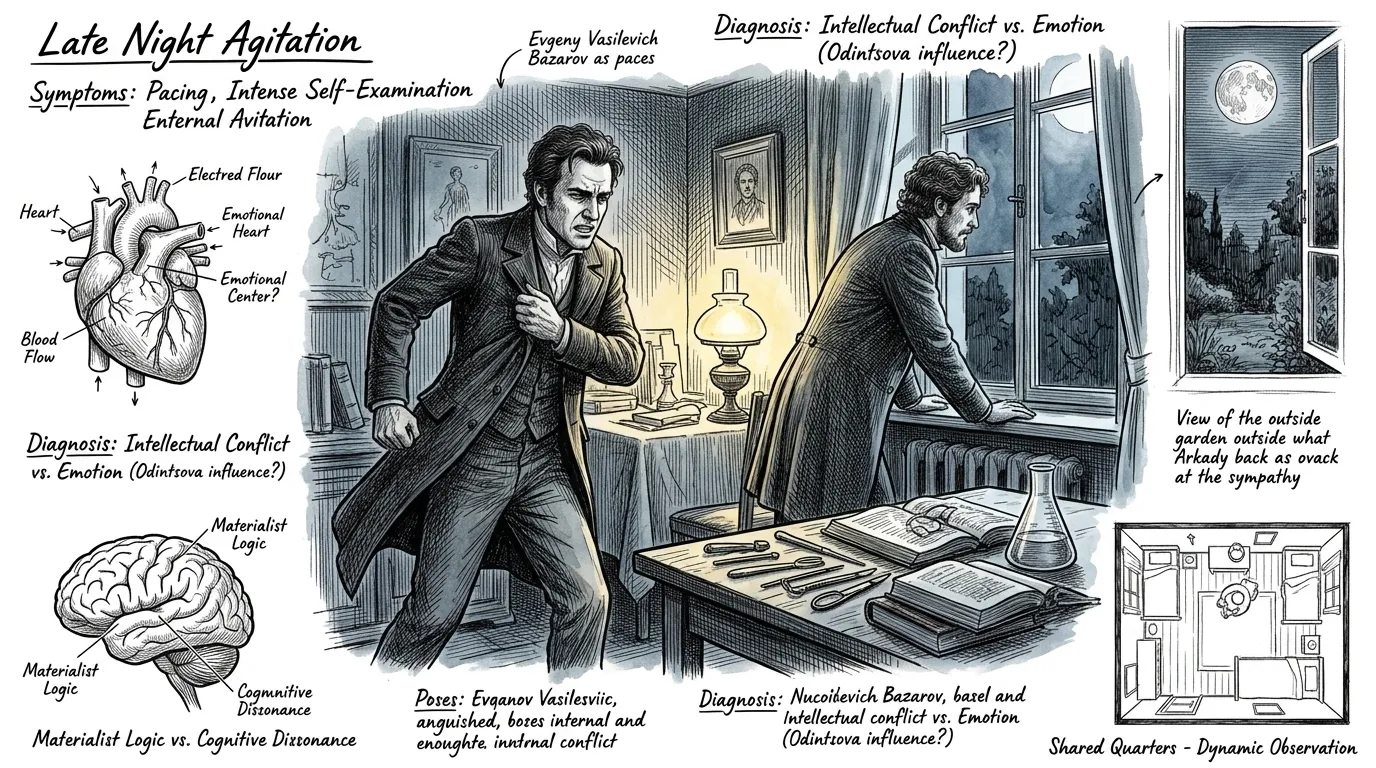
The unacknowledged tension between Bazarov and Odintsova grew, tormenting him in ways he never anticipated. "This... this feeling for Odintsova, Arkady," Bazarov confessed late one night, pacing restlessly in their shared room, his voice strained. "It's a sickness, an absurd weakness! I, who deny all romantic folly, find myself consumed by it! It mocks every principle I hold dear." Arkady, leaning against the window, watched his friend with profound sympathy, recognizing the depth of Bazarov's struggle as his intellectual convictions clashed violently with his burgeoning emotions.
️ Literary Fact: This scene vividly portrays Bazarov's profound internal conflict. His philosophical nihilism, which dismisses emotion as irrelevant, is now directly contradicted by his undeniable feelings for Odintsova, leading to immense psychological distress.
Page 7

Unable to contain his feelings, Bazarov confronted Anna Sergeevna, declaring his love in a raw, passionate outpouring. "I love you, Anna Sergeevna!" he stammered, his usual composure shattered. "More than anything, more than myself!" She listened calmly, her expression gentle but resolute. "You misunderstand me, Evgeny Vasilevich," Odintsova replied softly, stepping back from his intensity. "I value peace above all else. Such passion, such intensity... it would disturb my tranquility. I cannot return your feelings." Bazarov stood utterly crushed, his face paling, the weight of her refusal settling heavily upon him.
️ Literary Fact: The climax of Bazarov's emotional journey. His declaration and Odintsova's rejection highlight their fundamental differences: his passionate intensity versus her measured desire for tranquility. This event forces Bazarov to confront the limits of his nihilism when faced with genuine human connection.
Page 8
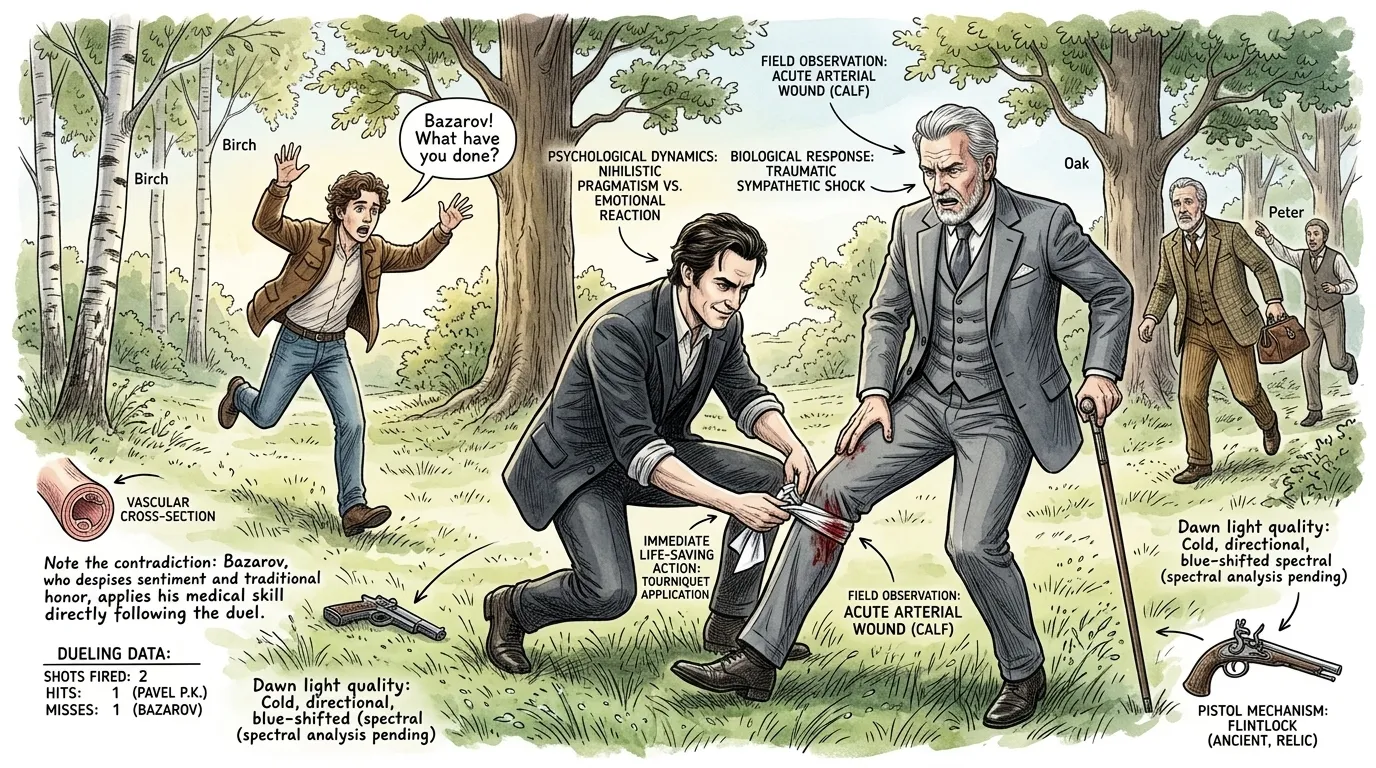
Humiliated, Bazarov and Arkady returned to Maryino, where the simmering animosity between Bazarov and Pavel Petrovich finally boiled over. A minor insult escalated into a challenge, and the two men met at dawn, pistols in hand, in a secluded grove. "'The brain secretes thought just as the liver secretes bile,' yet here we are, exchanging lead over something as 'irrational' as honor," Bazarov murmured, a wry, bitter smile playing on his lips as he aimed. A shot rang out, and Pavel Petrovich stumbled, clutching his leg. Bazarov, with his usual scientific pragmatism, instantly discarded his weapon and rushed to his opponent, quickly fashioning a tourniquet with a handkerchief.
️ Literary Fact: The duel serves as a dramatic physical manifestation of the ideological conflict that has been brewing between Bazarov and Pavel. Bazarov's quote here directly references the 'Chekhov's Gun' from page 2, illustrating his continued adherence to his materialist philosophy even in a moment of emotional and physical crisis, yet his practical action also reveals a complex humanity.
Page 9
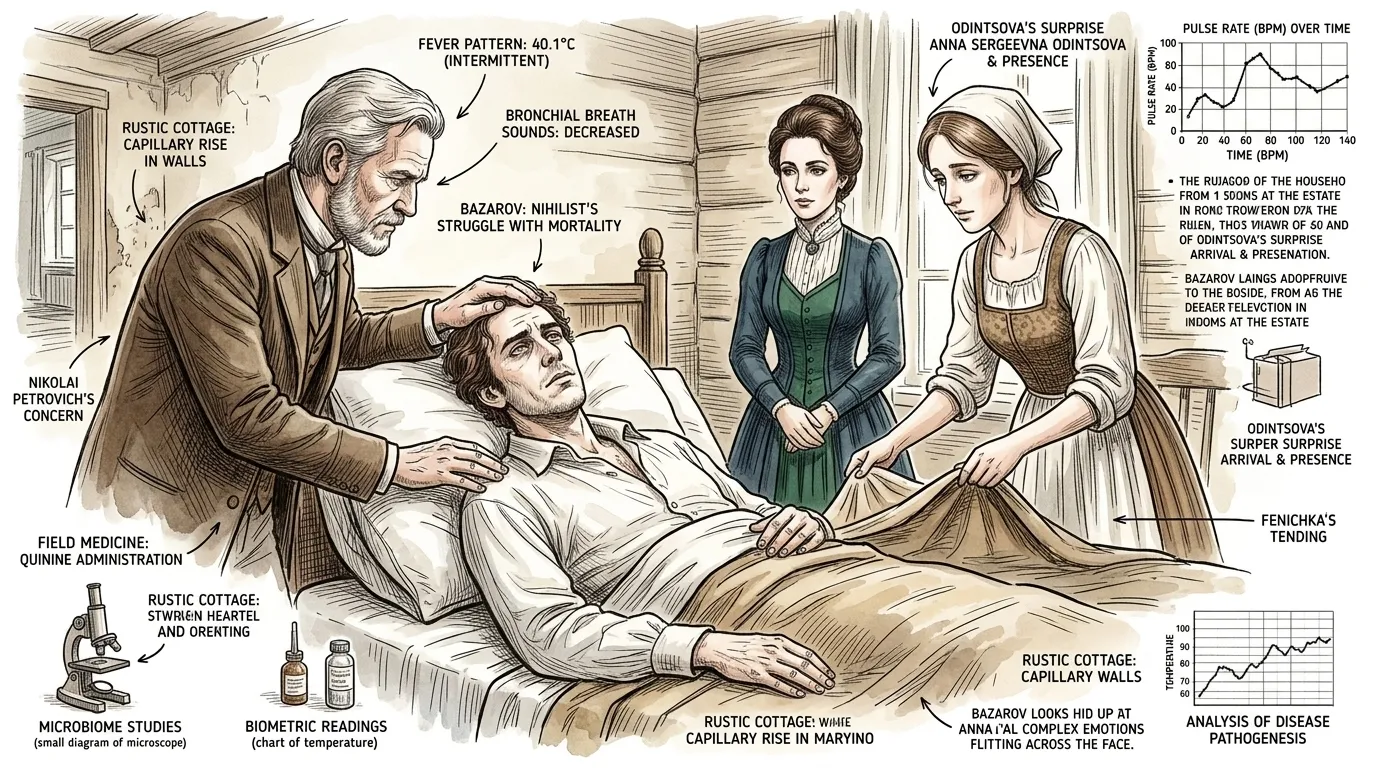
After performing an autopsy on a typhus victim, Bazarov himself contracted the deadly fever, his robust constitution failing rapidly. He lay in a feverish state, cared for by Nikolai and Fenichka. "I told you I was needed by Russia... but it turns out a fly on my nose would have been just as useful," he rasped, his voice weak but his cynical humor still present. To everyone's surprise, Anna Sergeevna Odintsova, upon hearing of his illness, arrived at Maryino, her serene face now etched with concern, taking her place at his bedside.
️ Literary Fact: Bazarov's illness and imminent death serve as the ultimate test of his nihilistic philosophy. The presence of both Nikolai (representing traditional love) and Odintsova (representing complex affection) at his bedside highlights the human connections he struggled to deny.
Page 10
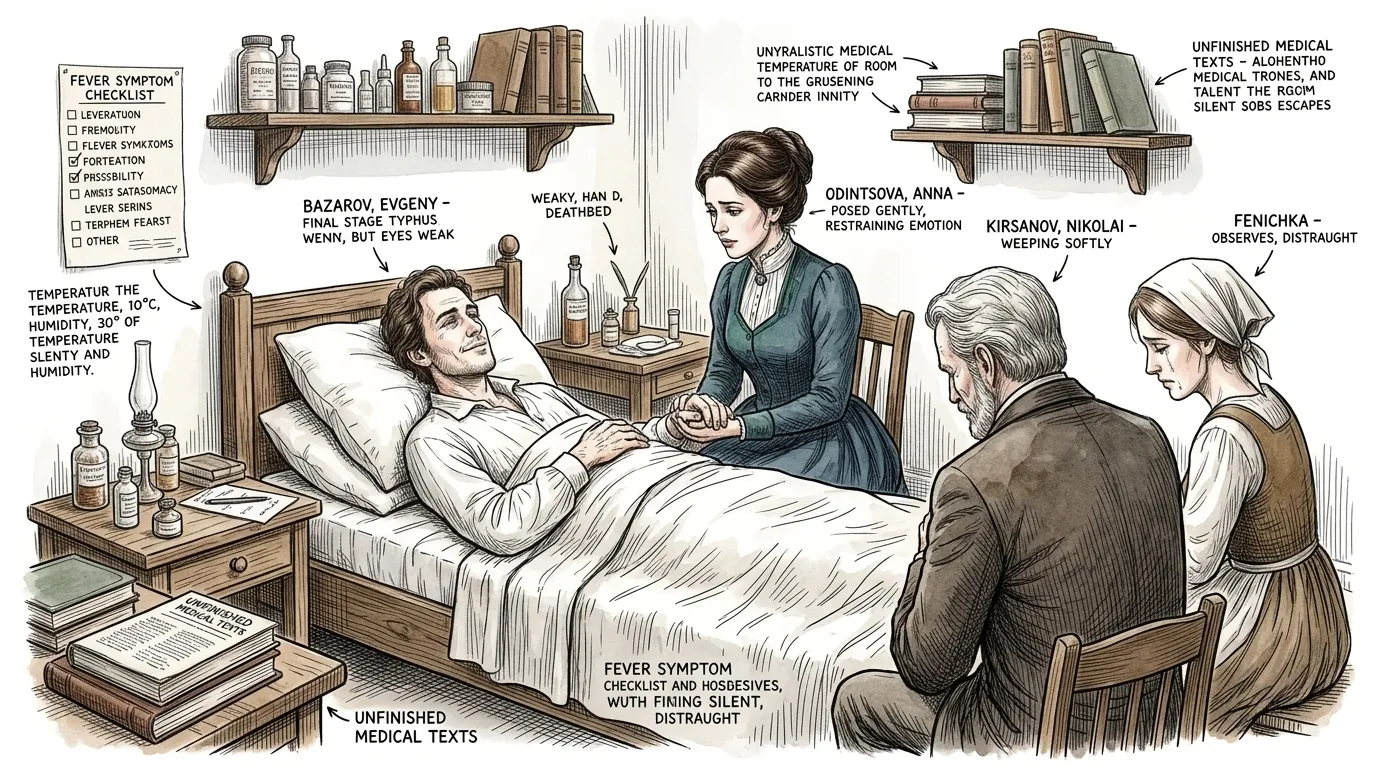
In his final moments, Bazarov gazed at Odintsova, his eyes softening. "Thank you," he whispered, a faint smile touching his lips. "It's the last time I'll see you." As he succumbed to the fever, the room fell silent, filled only with the quiet sobs of Nikolai and Fenichka. Though Bazarov's radical ideas had shaken their world, his death brought a poignant stillness, reminding them that beneath all philosophy, the enduring human need for love, compassion, and connection remained. Even in his defiance, Bazarov had touched their lives profoundly.
️ Literary Fact: Bazarov's death provides a resolution to the novel's central conflicts, demonstrating the ultimate triumph of enduring human values over rigid ideology. His final exchange with Odintsova and the mourning of his loved ones underscore the themes of love, loss, and the complex intertwining of 'fathers' and 'sons' in the human experience.
About this story
- Audience: general readers
Questions and answers
Questions and answers about Fathers and Sons — Ivan Turgenev
Read Wonder Novels on your phone
Wonder Novels is available on Android. Get Wonder Novels on Google Play.